Combinatorial and computational aspects of
multiple weighted voting games
Haris Aziz, Mike Paterson and Dennis Leech
No 823
WARWICK ECONOMIC RESEARCH PAPERS
Combinatorial and computational aspects of
multiple weighted voting games
Haris Aziz
Computer Science Department University of Warwick Coventry, UK, CV4 7AL Email: [email protected]
Mike Paterson
Computer Science Department University of Warwick Coventry, UK, CV4 7AL Email: [email protected]
Dennis Leech
Economics Department University of Warwick Coventry, UK, CV4 7AL Email: [email protected]
Abstract
Weighted voting games are ubiquitous mathematical models which are used in economics, political science, neuroscience, threshold logic, reliability theory and distributed systems. They model situations where agents with variable voting weight vote in favour of or against a decision. A coalition of agents is winning if and only if the sum of weights of the coalition exceeds or equals a specified quota. We provide a mathematical and computational
characterization ofmultiple weighted voting games which are an extension of weighted voting games1. We analyse
the structure of multiple weighted voting games and some of their combinatorial properties especially with respect to dictatorship, veto power, dummy players and Banzhaf indices. An illustrative Mathematica program to compute voting power properties of multiple weighted voting games is also provided.
Keywords: multi-agent systems, multiple weighted voting games, game theory, algorithms and complexity, voting power.
I. INTRODUCTION
A. Motivation
Weighted voting games are mathematical models which are used to analyze voting bodies in which the voters have different number of votes. In weighted voting games, each voter is assigned a non-negative weight and makes a vote in favour of or against a decision. The decision is made if and only if the total weight of those voting in favour of the decision is equal to or greater than the quota. Weighted voting games are also encountered in threshold logic, reliability theory, neuro-science and logical computing devices [1]. Nordmann et al. [2] deal with reliability and cost evaluation of weighted dynamic-threshold voting-systems. Systems of this type are used in various areas such as target and pattern recognition, safety monitoring and human organization systems.
Weighted voting games have also been applied in various political and economic organizations. Prominent applications include the United Nations Security Council, the Electoral College of the United States and the International Monetary Fund ([3], [4]). The weights of the players do not always indicate the power the player has in affecting decisions. This has led to a significant literature on voting power in WVG’s. The distribution of voting power in the European Union Council of Ministers has received special attention in [5], [6], [7], [8], [9] and [10]. Voting power is also used in joint stock companies where each shareholder gets votes in proportion to the ownership of a stock ([11], [12]).
B. Outline
Section II outlines preliminaries definitions related to voting games, voting power and complexity. Section III covers the background and structure of multiple weighted voting games. In section IV, we analyse combinatorial properties o multiple weighted voting games especially with respect to dictatorship,
veto power, dummy players. Section V outlines algorithmic considerations when computing voting power of players in multiple weighted voting games. We then conclude in section VI.
II. PRELIMINARIES
A. Voting Games
In this section we give definitions and notations of key terms. The set of voters is N ={1, ..., n}.
Definition II.1. A simple voting game is a pair (N, v)where the valuation function v : 2N → {0,1} has
the properties thatv(∅) = 0, v(N) = 1 andv(S)≤v(T) wheneverS ⊆T. A coalitionS ⊆N is winning
if v(S) = 1 and losing if v(S) = 0. A simple voting game can alternatively be defined as (N, W) where
W is the set of winning coalitions.
Definition II.2. The simple voting game (N, v) where
W ={X ⊆N,P
x∈Xwx ≥q} is called a WVG. A WVG is denoted by [q;w1, w2, ..., wn] where wi is the
voting weight of player i. Generally wi ≥wj if i < j.
Generally, q > 12P
1≤i≤nwi so that there are no two mutually exclusive winning coalitions at the same time. WVGs with this property are termed proper. Proper WVGs are also desirable because they satisfy the criterion of the majority getting preference.
B. Voting Power
Definition II.3. A player i is critical in a coalition S when S ∈W and S\i /∈W. For each i∈N, we
denote the number of coalitions in which i is critical in game v by ηi(v). The Banzhaf Index of player i
in weighted voting game v is βi = Pηi(v)
i∈Nηi(v).
Definition II.4. In a simple game, a player with a Banzhaf index of zero is called a dummy.
Definition II.5. A Dictator is a player who is present in every winning coalition and absent from every
losing coalition.
The definition implies that the dictator is player 1 with the biggest weight, β1 = 1 and ∀i6= 1, βi = 0. This is because any other player cannot prove critical in any coalition. Any winning coalition has to include the dictator and the opting out of any other player cannot make the coalition losing. For player
1 to be the dictator, w1 ≥q and P2≤i≤nwi < q. It is obvious that if a dictator exists, he is unique.
Definition II.6. A player has veto power if and only if the player is present in every winning coalition.
It is evident that a dictator has veto power but a player with veto power is not necessarily a dictator. Moreover there can be two or more players with veto power.
Example II.7. In the WVG, [5; 3,2,1], player 1 is not a dictator but it has veto power. Player 2 also has
veto power.
C. Complexity
Definition II.8. A problem is in complexity classP if it can be solved in time which is polynomial in the
size of the input. A problem is in the complexity class NP if it its solution can be verified in time which
is polynomial in the size of the input of the problem. A problem is in the complexity class NP-HARD if
any problem in NP is polynomial time reducible to that problem. NP-HARD problems are as hard as the
III. MULTIPLEWEIGHTED VOTINGGAMES
A. Introduction
Definition III.1. Let (N1, v1), . . . ,(Nm, vm) be simple games. Then a simple game (N, v) = (N1, v1)×
. . .×(Nm, vm) is the product of these games where N = Smt=1Ni and v(S) = 1 if and only if for all
1 ≤ t ≤ m, vt(S∩Nt) = 1. If all Nis of the games (N1, v1), . . . ,(Nm, vm) coincide then, the product
(N, v) of these games is called the meet of the games.(N, v) can simply be written as(N, v1∧. . .∧vm)
and v(S) = 1 if and only if for all 1 ≤ t ≤ m, vt(S) = 1. A meet-multiple weighted voting game
(meet-MWVG) is a meet of multiple weighted voting games.
Taylor and Zwicker [1] refer to the meet of multiple weighted voting games as vector weighted games.
Definition III.2. Let (N1, v1), . . . ,(Nm, vm) be simple games. Then a simple game (N, v) = (N1, v1) +
. . .+ (Nm, vm) is the sum of these games where N =
Sm
t=1Ni and v(S) = 1 if and only if there exists
a t, 1 ≤ i ≤ m such that vt(S ∩ Nt) = 1. If all Nis of the games (N1, v1), . . . ,(Nm, vm) coincide
then, the product (N, v) of these games is called the join of the games. (N, v) can simply be written
as (N, v1∨. . .∨vm) and v(S) = 1 if and only if there exists a t, 1 ≤ i ≤ m such that vt(S) = 1. A
join-multiple weighted voting game (join-MWVG) is a join of multiple weighted voting games.
Definition III.3. A coalition S is blockingif its complement S is losing. Then Gd = (N, Wd) is the dual
of the game G= (N, W) where Wd is the set of all blocking coalitions.
Taylor and Zwicker [1] prove the following proposition:
Proposition III.4. (Taylor & Zwicker) Let G1 = (N1, v1) and G2 = (N2, v2) be simple games. Then
(G1+G2)d=G1d×G2d and (G1×G2)d=G1d+G2d.
We can get the following corollary from this proposition:
Corollary III.5. For simple games Gi = (Ni, vi) for all i= 1, . . . , n, (PGi)d =QGid
From now on when we mention, MWVG, we will assume the meet of the respective games unless otherwise stated. MWVGs are utilized in various situations. The treaty of Nice made the overall voting games of the EU countries a triple majority weighed voting game with certain additional constraints. MWVGs are useful in multi-criteria multi-agent systems.
B. Structure
We define Si as the set of coalitions not including player i. Then Si can be partitioned into three mutually exclusive sets:
Si =Wi(v)∪Ci(v)∪Li(v)
where
• Wi(v) is the set of coalitions not including player i which are winning in the multiple gamev • Li(v) is the set of coalitions not including player i which are losing in the multiple game v even if
player i joins the coalitions.
• Ci(v) is the set of coalitions not including player i which are losing in the multiple game v but
winning in v if player i joins the coalitions.
The number of coalitions in which player i is critical in the multiple game v is ηi(v) = |Ci(v)|. In a 2-game MWVG,i is critical in a coalitioncif(c∈Ci(v1)∧c∈Ci(v2))∨(c∈Wi(v1)∧c∈Ci(v2))∨(c∈ Ci(v1)∧c∈Wi(v2)). In a MWVG, i is critical in a coalition c if
We define W(v) as the set of winning coalitions in v and W(vi) as the set of winning coalitions in vi. In that case
W(v) = W(v1)∧W(v2)...∧W(vm)
Similarly if we define L(v) as the set of losing coalitions in v and L(vi) as the set of losing coalitions in vi. In that case
L(v) = L(v1)∨L(v2)...∨L(vm)
C. Trade robustness, Dimension
Definition III.6. The dimension of (N, v) is the least k such that there exist WMGs (N, v1), . . . ,(N, vk)
such that v = (N, v1)∧. . .∧(N, vk)
Deineko and Woeginger [13] show that it is NP-hard to verify the dimension of multiple-weighted voting games. In [14], it is pointed out that the dimension of a game is at most the number of maximal losing coalitions. This kind of configuration is not very helpful though in estimating the actual dimension of a MWVG.
Taylor and Zwicker [1] defined the trade-robustness of simple games: a simple game (N, v) is k-trade
robust if no trading among j ≤k winning coalitions W1, . . . Wj that leads to losing coalitions L1, . . . , Lj
in such a way that |{p : i∈ Wp}| =|{p :i ∈ Lp}| for each i ∈N. A simple game is trade robust if it
is k-trade robust for all k. They proved that a simple game is trade robust if and only if it is a WVG.
However we observe that MWVGs are not even swap-robust which is robustness for a more restricted notion of trading in which a one to one player exchange between any two winning coalitions does not render both coalitions losing:
Example III.7. Let(N, v) = (N, v1∧v2)wherev1 = [20; 18,5,0,5,5,2,5]andv2 = [20; 0,5,18,5,5,2,5].
We see that coalitions {1,3,6} and {2,4,5,7} are winning in v. However if we have a trade so that the
resultant coalitions are {2,3,6} and {1,4,5,7}, then both coalitions are losing.
IV. PROPERTIES OFMWVGS
A. Unity and zero in MWVGs
We define u as the unanimity WVG in which a coalition is only winning if it is the grand coalition
N = {1,2, ..., n}. Every player has veto power in u. We know that in u, all players are critical only in
N and therefore have uniform Banzhaf Indices. Similarly we define s as the singleton weighted voting game in which every coalition is winning except the empty coalition.
Proposition IV.1. In the meet of WVGs, the unanimity WVG acts as a zero and the singleton WVG acts
as a unity.
Proof: For a WVG (N, v) and a unanimity WVG (N, u), we notice that for any coalition c to be
winning in (N, v∧u), it must be winning in both(N, v) and (N, u). This the grand coalition is the only winning coalition. So v∧u=u.
For a WVG (N, v) and a singleton WVG (N, s), we notice that for any coalition c to be winning in
(N, v∧u) it just has to non-empty. So v∧s=v.
So for v =v1 ∧...∧vm, if ∃j : vj =u, then v =u. This implies that even if player i is a dictator in one game of the MWVG, it does not mean it is a dictator in the MWVG. Moreover, even if a player is a dummy in all the games apart from the unanimity game vj, then that player will have Banzhaf power of 1/n.
Example IV.2. v =v1∧v2 where v1 = [3; 4,1,1] and v2 = [3; 1,1,1]. Player 1 is a dictator in v1 but it
B. Identifying players with dictator, veto or no powers
Assuming that we are given P
wi = W, we notice that a dictator in a single WVG is verifiable in
O(1) time. This is because we just need to check the two conditions of the player 1 being a dictator:
w1 ≥ q and P
2≤i≤nwi < q. Similarly, a dictator in a multiple m-WVG is verifiable in O(m) time. We
need to verify that {i} wins in the MWVG and that N \ {i} loses in the MWVG.
Moreover, it is evident from the definition that in a WVG, a player i has a veto power, if and only if
N\ {i}is a losing coalition. Thus, we can check whether a player has veto power in O(1) time. One can extend this idea to MWVs. We present an algorithm to compute players with veto power in a MWVG. The algorithm has time complexity O(mn).
Algorithm 1 VetoPlayersInMWVG
Input: m multiple weighted voting game (MWVG), (N, v1∧...∧vm) where the games (N, vt) are the
weighted voting games [qt;wt
1, ...wnt] for 1≤t≤m.
Output: vetoplayerset
1: vetoplayerset← {}
2: for i= 1 to n do
3: isvetoplayer←false
4: for j = 1 to m do
5: if wj(N)−wji < qj then
6: isvetoplayer←true
7: end if
8: end for
9: if isvetoplayer then
10: vetoplayerset←vetoplayerset∪ {i}
11: end if
12: end for
13: return vetoplayerset
Unlike, dictators and veto players, it is not easy to identify dummies in MWVGs. In fact, Matsui et al. [15] show that it is even NP-hard to identify players with zero powers or players with same powers in a single WVG.
C. Inherited properties of constituent games
Proposition IV.3. For MWVG, v =v1∧...∧vm:
1) ∀i: player 1 is a dictator in vi =⇒ player 1 is a dictator in v
2) ∀j : player i is a dummy in vj =⇒ player i is a dummy in v
3) ∃j : player i has veto power in vj =⇒ player i has veto power in v
4) ∀j :vj is proper =⇒ v is proper.
Proof:
1) Let player1be a dictator invi for alli= 1, . . . m. Thus∀i,1≤i≤m, w1i ≥qand
P
2≤j≤mwj < q.
This means that {1} is winning in v and {2, ..., n} are losing in v
2) We know that ∀j, Ci(vj) = {}. Then by definition, Ci(v) ={}. 3) If for some t= 1, . . . , m, N \ {i}∈/ W(vt), N \ {i}∈/W(v).
Counter-Examples IV.4. The converses for the previous proposition do not hold:
1) v =v1∧v2 where v1 = [4; 5,1,1] andv2 = [2; 5,1,1]. Although player 1 is a dictator inv, it is not
a dictator in v2.
Moreover, even if there is WVG vi in which player 1 does not have the biggest weight, it can still
be the dictator: v =v1∧v2 where v1 = [2; 5,1] and v2 = [2; 2,3]. Player1 is a dictator in v.
2) Let v = v1∧v2 where v1 = [5; 3,2,1] and v2 = [5; 3,2,2]. Player 3 is a dummy in v but not a
dummy in v2.
In fact a player can be a dummy inv even if he is not a dummy in any of the games: Letv =v1∧v2
wherev1 = [7; 4,3,3,1]andv2 = [8; 7,3,3,1]. Player 4is a not a dummy inv1 andv2 but a dummy
in v.
3) Let v =v1∧v2 where v1 = [5; 3,2,1] and v2 = [6; 5,2,1]. Player 2 has veto power in v but does
not have veto power in v2
4) Let v =v1∧uwhere v1 = [5; 4,3,2,2]and u= [4; 1,1,1,1]. We see that althoughv1 is not proper,
v is proper.
Proposition IV.5. For MWVG, v = v1 ∧...∧vm, if ∃i : player 1 is a dictator in vi, then player 1 has
veto power in v.
Proof:If player 1 is a dictator in vi, he is in every winning coalition ofvi. Therefore for any coalition
c which is winning in v, if the dictator opts out of c, c loses in vi and therefore loses in v.
V. COMPUTATION OF VOTING POWER
A. Complexity
Proposition V.1. The problem of computing the Banzhaf indices of players or even identifying dummies
in a multiple weighted voting game is NP-Hard.
Proof: Matsui and Matsui [15] show that it is NP-Hard to compute the Banzhaf indices of players or
identifying dummies in a single weighted voting game. show that it is NP-Hard to compute the Banzhaf indices of players or identifying dummies in a single weighted voting game. Their proof is by a polynomial time reduction of the Partition problem.
Let V be a set of WVGs, m, an integer and let fm be a function,fm :V 7→V such that fm(v) =Vmv. We notice that a playeri is critical in a coalitionS ⊂N for WVGv if and only if it is critical in coalition
S for fm(v). Therefore fm is a polynomial time function which reduces an instance of a single WVG to an instance of a MWVG.
Klinz and Woeginger [16] devised the fastest exact algorithm to compute Banzhaf indices in a WVG. In the algorithm, they applied a partitioning approach that dates back to Horowitz and Sahni [17]. The complexity of the algorithm is O(n22n2). This partitioning approach is not suitable for MWVGs though.
A useful website for voting power analysis is available at [18].
B. GF for MWVGs
The generating function method provides an efficient way of computing Banzhaf indices if the voting weights are integers [15]. Algaba et al. [19] outline a generating function method to find the Banzhaf indices of players in a multiple weighted majority game. Their algorithm m-BanzhafPower computes the Banzhaf index of the players in O(max(m, n2c)) time where c is the number of terms of B(x
1, ..., xm) =
Qn
j=1(1 +x
w1
j
1 ...x
wm j
m ) = Pw
t(N)
kt=0,1≤t≤mbk1...kmx1
k1...x
mkm. The coefficient,bk1...km of each termx1
k1...x mkm is the number of coalitions such that wt(S) =k
t for t ranging from 1 to m.
One can make generating functions, Bi(x1, ..., xm)for each playeriby excluding its influence from the considered coalitions just like in the single WVG case. Therefore Bi(x1, ..., xm) = B(x1, ..., xm)/((1 +
xw1i
1 ...x
wm i
clear picture and make the computation of coefficients easier. We present the algorithm due to Algaba et al. with some modifications to avoid extra computations and also to compute the total number of winning coalitions:
Algorithm 2 VotingPowersOfMWVGs
Input:MWVG: [qt;wt
1, ...wtn] for 1≤t ≤m.
Output: Number of winning coalitions w and Banzhaf indices: {w,(β1, . . . , βn)}.
1: B(x1, ..., xm)←Qnj=1(1 +xw
1
j
1 ...x
wm j
m ) 2: coeff =Coeff(B(x1, ..., xm))
3: For kt from qt to wt(N), 1≤t ≤m,
w←Sum(coef[k1, . . . ,km])
4: for i= 1 to n do
5: if i6= 1 and wit=wit−1 for t = 1, . . . , m then
6: ηi ←ηi−1
7: else
8: Bi(x1, ..., xm)← B(x1,...,xm)
(1+xw
1
i
1 ...x
wm i m )
9: coeffi =Coeff(Bi(x1, ..., xm))
10: For kt from qt−wti + 1 to wt(N \i) + 1, 1≤t ≤m,
si1 ←Sum(coefi[k1, . . . ,km])
11: For kt from qt+ 1 to wt(N \i) + 1, 1≤t≤m,
si
2 ←Sum(coefi[k1, . . . ,km])
12: ηi ←si1−si2
13: end if
14: end for
15: η←Pni=1ηi
16: for i= 1 to n do
17: βi ← ηηi
18: end for
19: return {w,(β1, . . . , βn)}
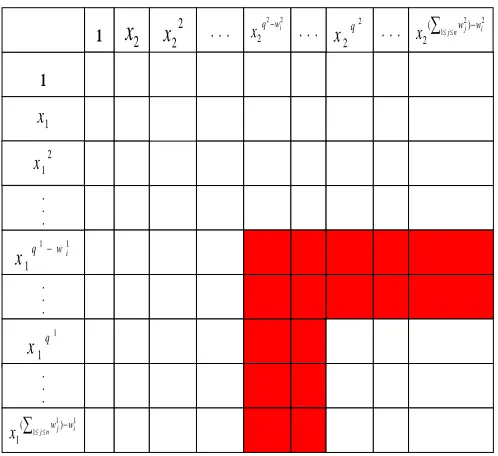
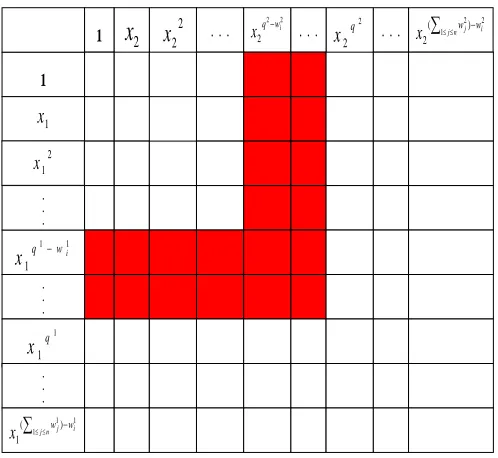
For a bi-weighted voting game which is a meet of its respective games, the critical region, Ci for a player i is shaded in Figure 1. The corresponding figure for the join of games is provided in Figure 2.
We give an example of how Algaba et al. have utilized the generating functions to compute Banzhaf indices in MWVGs.
Example V.2. Let v = v1 ∧v2 where v1 = [7; 5,2,1,1] and v2 = [5; 3,2,1,1]. The generating function
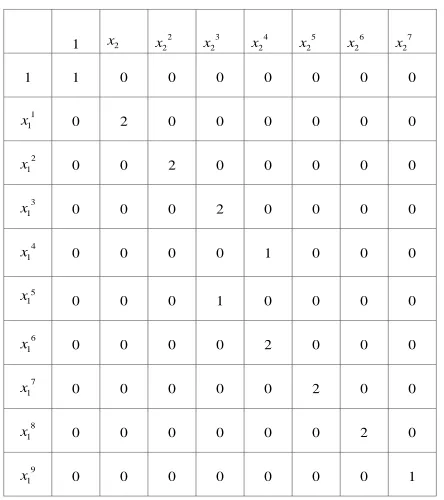
of the overall game is B(x1, x2) = (1 +x15x23)(1 +x12x22)(1 +x1x2)2. B(x1, x2) can be encapsulated
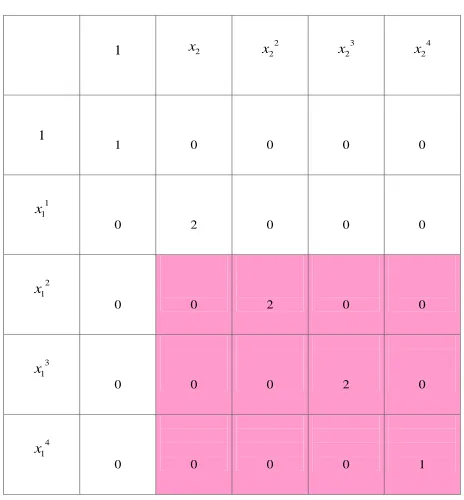
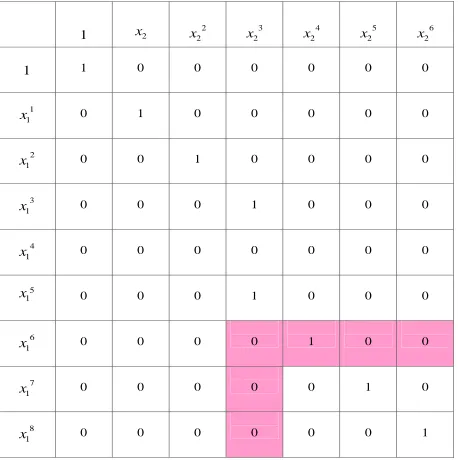
by a coefficient array (see Figure 3) which gives the coefficients of each term. Similarly the coefficient arrays of the generating function for each player can be computed (See Figures 4, 5 and 6). The shaded region signifies those coalitions in which the player is critical. The sum of the values in the shaded area then gives the Banzhaf value of each player.
Therefore, number of swings of players 1, 2, 3 and 4 are 5, 3, 1 and 1 respectively. Thus βi = 1/2,
βi = 3/10, βi = 1/10 and βi = 1/10.
C. Analysis and Improvements
2 1 2) ( 2 i n j wj w x ∑≤≤ −
. . . 2 2 q x . . . 2 2 2 i w q x − . . . 2 2 x 2
x
1 1 1 x 1 1 1 i w q x − . . . 1 1 q x . . . 2 1 x . . . 1 1 1) ( 1 i n j wj w [image:9.612.181.430.72.300.2]x ∑≤≤ −
Fig. 1. Analysis of the effect of excluding a playericoalitions in a bi-weighted voting game which is a meet of its respective games.
function method can be more time efficient but involves more storage of data. It requires the computation
of B(x1, ..., xm) and Bi(x1, ..., xm) for players, for 1 ≤ i ≤ n. The storage requirements increase even
more if B(x1, ..., xm) is encoded in a coefficient array. This makes the storage dependent on the sum of the weights in each component game.
Proposition V.3. The space complexity of the generating function method to compute Banzhaf indices of
players in a MWVG is c+P
1≤i≤nci+k where c is the number of terms of B(x1, ..., xm) and ci is the
number of terms in Bi(x1, ..., xm). Moreover
c+ X
1≤i≤n
ci ≤c+nc≤(n+ 1)(
Y
1≤t≤m
(1 +wt(N)))
Proof:The proposition follows from the fact that the generating function method requires computation
of B(x1, ..., xm), the generating function of the over all-game andBi(x1, ..., xm), the generating function
of each player i.
We can utilize the following observation to control the time and space required in computing Banzhaf indices via the generating function method where coefficient arrays are used:
Proposition V.4. The power indices of players in weighted voting game v = [q;w1, ..., wn] are the same
as the power indices in the weighted voting game λv= [λq;λw1, ..., λwn]
Proof: The proof is trivial. We notice that the set of coalitions for which player i is critical is the
2 1 2) ( 2 i n j wj w x ∑≤≤ −
. . . 2 2 q x . . . 2 2 2 i w q x − . . . 2 2 x 2
x
1 1 1 x 1 1 1 i w q x − . . . 1 1 q x . . . 2 1 x . . . 1 1 1) ( 1 i n j wj w [image:10.612.181.430.72.301.2]x ∑≤≤ −
Fig. 2. Analysis of the effect of excluding a playericoalitions in a bi-weighted voting game which is a join of its respective games.
This scaling of the WVGs into WVGs with smaller weights keeps the properties of the WVG invariant. Moreover, we have identified players with same voting weight to avoid re-computation of their generating functions and their underlying coefficient arrays. Whereas the Mathematica programs to compute Banzhaf indices of multiple weighted voting games with 2 or 3 games are available, the appendix gives the Mathematica code to compute Banzhaf indices of an arbitrary number of players. In case the space complexity of the generating function method is high, the generating function and the corresponding coefficient array for each player can be computed, and then cleared after extracting the number of swings of that player.
VI. CONCLUSION AND FUTURE WORK
In this paper, we have examined the computational and combinatorial aspects of multiple weighted voting games especially with respect to voting power. The computational complexity of computing cooperative game theoretic solutions of weighted voting games has been examined by Elkind [20]. It will be interesting to analyse the algorithms and complexity to compute other game theoretic solutions of multiple weighted voting games.
ACKNOWLEDGMENT
1 x2 x22 3 2
x 4
2
x 5
2
x 6
2
x 7
2
x
1 1 0 0 0 0 0 0 0
1 1
x 0 2 0 0 0 0 0 0
2 1
x 0 0 2 0 0 0 0 0
3 1
x 0 0 0 2 0 0 0 0
4 1
x 0 0 0 0 1 0 0 0
5 1
x 0 0 0 1 0 0 0 0
6 1
x 0 0 0 0 2 0 0 0
7 1
x 0 0 0 0 0 2 0 0
8 1
x 0 0 0 0 0 0 2 0
9 1
[image:11.612.196.418.77.327.2]x 0 0 0 0 0 0 0 1
Fig. 3. Coefficient array ofB(x1, x2).
REFERENCES
[1] A. Taylor and W. Zwicker,Simple Games: Desirability Relations, Trading, Pseudoweightings, first edition ed. New Jersey: Princeton University Press, 1999.
[2] L. Nordmann and H. Pham, “Weighted voting systems,”IEEE Transactions on Reliability, vol. 48, no. 1, pp. 42–49, Mar 1999. [3] D. Leech, “Voting power in the governance of the international monetary fund,”Annals of Operations Research, vol. 109, no. 1, pp.
375–397, 2002.
[4] J. Alonso-Meijide, “Generating functions for coalition power indices: An application to theIMF,”Annals of Operations Research, vol. 137, pp. 21–44, 2005.
[5] E. Algaba, J. M. Bilbao, and J. Fernandez, “The distribution of power in theEuropean Constitution,”European Journal of Operational Research, vol. 176, no. 3, pp. 1752–1755, 2007.
[6] J. Bilbao, J. Fernandez, N. Jimenez, and J. Lopez, “Voting power in theEuropean Union Enlargement,”European Journal of Operational Research, vol. 143, no. 1, pp. 181–196, 2002.
[7] A. Laruelle and M. Widgren, “Is the allocation of voting power amongEU states fair?”Public Choice, vol. 94, no. 3-4, pp. 317–39, March 1998, available at http://ideas.repec.org/a/kap/pubcho/v94y1998i3-4p317-39.html.
[8] J.-E. Lane and R. Maeland, “Constitutional analysis: The power index approach,”European Journal of Political Research, vol. 37, pp. 31–56, 2000.
[9] D. Leech, “Designing the voting system for the council of the european union volume,”Public Choice, vol. 113, no. 3, pp. 437–464, 1962.
[10] D. S. Felsenthal and M. Machover, “Analysis ofQMrules in the draft constitution forEuropeproposed by theEuropean Convention, 2003,”Social Choice and Welfare, vol. 23, no. 1, pp. 1–20, 08 2004.
[11] G. Arcaini and G. Gambarelli, “Algorithm for automatic computation of the power variations in share tradings,”Calcolo, vol. 23, no. 1, pp. 13–19, January 1986.
[12] G. Gambarelli, “Power indices for political and financial decision making: A review,” Annals of Operations Research, vol. 51, pp. 1572–9338, 1994.
[13] V. G. Deineko and G. J. Woeginger, “On the dimension of simple monotonic games.”European Journal of Operational Research, vol. 170, no. 1, pp. 315–318, 2006.
1 x2 x22
3 2
x 4
2
x
1
1 0 0 0 0
0 2 0 0
1 1
x
0
2 1
x
0 0 2 0 0
3 1
x
0 0 0 2 0
4 1
x
[image:12.612.190.422.74.324.2]0 0 0 0 1
Fig. 4. Coefficient array ofB1(x1, x2).
[15] T. Matsui and Y. Matsui, “A survey of algorithms for calculating power indices of weighted majority games,”Journal of the Operations Research Society of Japan, vol. 43, no. 7186, 2000, available at http://citeseer.ist.psu.edu/matsui00survey.html.
[16] B. Klinz and G. J. Woeginger, “Faster algorithms for computing power indices in weighted voting games,”Mathematical Social Sciences, vol. 49, no. 1, pp. 111–116, January 2005, available at http://ideas.repec.org/a/eee/matsoc/v49y2005i1p111-116.html.
[17] E. Horowitz and S. Sahni, “Computing partitions with applications to the knapsack problem,” J. ACM, vol. 21, no. 2, pp. 277–292, 1974.
[18] D. Leech, “Voting power algorithms website,”http://www.warwick.ac.uk/∼ecaae/, 2007.
[19] E. Algaba, J. M. Bilbao, J. R. Fernandez Garcia, and J. J. Lopez, “Computing power indices in weighted multiple majority games,”
Mathematical Social Sciences, vol. 46, no. 1, pp. 63–80, 2003.
1 x2 x22 3 2
x 4
2
x 5
2
x
1
1 0 0 0 0 0
1 1
x
0 2 0 0 0 0
2 1
x
0 0 1 0 0 0
3 1
x
0 0 1 0 0 0
4 1
x
0 0 0 0 0 0
5 1
x
0 0 0 1 0 0
6 1
x
0 0 0 0 2 0
7 1
x
[image:13.612.193.419.79.323.2]0 0 0 0 0 1
Fig. 5. Coefficient array ofB2(x1, x2).
1 x2
2 2
x 3
2
x 4
2
x 5
2
x 6
2
x
1 1 0 0 0 0 0 0
1 1
x 0 1 0 0 0 0 0
2 1
x 0 0 1 0 0 0 0
3 1
x 0 0 0 1 0 0 0
4 1
x 0 0 0 0 0 0 0
5 1
x 0 0 0 1 0 0 0
6 1
x 0 0 0 0 1 0 0
7 1
x 0 0 0 0 0 1 0
8 1
x 0 0 0 0 0 0 1
[image:13.612.193.422.426.656.2]APPENDIX
In[44]:= H∗:Mathematica Version:5.2, Package Version:1.10 ∗L
H∗:Name:Compute_Banzhaf_Indices_of_MWVG ∗L
H∗:Authors:Haris Aziz Hharis.aziz@warwick.ac.ukL ∗L
H∗:Summary: The program takes as input a multiple
weighted voting game with integer weights and quotas. It uses the
generating functions to compute the Banzhaf index of every player∗L
H∗:References: Computing power indices in weighted multiple majority games
by E.Algaba, Mathematical Social Sciences 46 H2003L pages 63−80.∗L
w=885, 2, 1, 1<,83, 2, 1, 1<<; q=887<,85<<;
Print@"weights: ", MatrixForm@wDD; Print@"quotas: ", MatrixForm@qDD;
m=Part@Dimensions@wD, 1D; Print@"There are ", m, " weighted voting games"D
n=Part@Dimensions@wD, 2D; Print@"There are ", n, " players"D;
Array@symmwithprevious, nD; symmwithprevious@1D=False;
For@i=2, i<n+1, i++, symmwithprevious@iD=True;D; For@i=2, i < n+1, i++,
For@j=1, j<m+1, j++, If@w@@j, iDD!=w@@j, i−1DD, symmwithprevious@iD=False;,DDD; For@i=1, i<n+1, i++, If@symmwithprevious@iD,
Print@"Player ", i, " has same weights as player ", i−1D,
Print@"Player ", i, " does not have same weights as player ", i−1D DD;
Bfunction=Product@1+Product@x@iD^ w@@i, jDD,8i, 1, m<D,8j, 1, n<D;
longBfunction=Expand@BfunctionD; Print@"Bfunction = ", BfunctionD;
Print@Array@x, mDD; maincoefmatrix=CoefficientList@longBfunction, Array@x, mDD;
Print@"CoefficientMatrix for the main GF is ", MatrixForm@maincoefmatrixDD;
For@j=1, j < n+1, j++, b@jD=Bfunctionê H1+Product@x@iD^ w@@i, jDD,8i, 1, m<DL; longb@jD=Expand@b@jDD; Print@"Generating Function of player ", j, "=", b@jDD D
kk=8<; For@j=1, j<m+1, j++, kk=Append@kk,8q@@j, 1DD+1, Total@w@@jDDD+1<DD;
winningmatrix=Take@maincoefmatrix, Part@kk, 1D, Part@kk, 2DD;
numofwinningcoalitons= Total@winningmatrix, mD;
Array@x, mD; Array@coefmatrix, mD;
coefmatrix@1D= CoefficientList@longb@1D, Array@x, mDD;
Print@"Coefficient Matrix of player", 1, " =", MatrixForm@coefmatrix@1DDD;
For@j=2, j < n+1, j++, If@symmwithprevious@jD, coefmatrix@jD=coefmatrix@j−1D,
coefmatrix@jD= CoefficientList@longb@jD, Array@x, mDD;D;
Print@"Coefficient Matrix of player", j, " =", MatrixForm@coefmatrix@jDDDD;
d=Table@0, 8m<, 8n<D;
For@t=1, t<m+1, t++, For@i=1, i<n+1, i++, d@@t, iDD=q@@t, 1DD−w@@t, iDDDD; e=Table@0, 8m<, 8n<D;
For@t=1, t<m+1, t++,
For@i=1, i<n+1, i++, e@@t, iDD=Total@w@@tDDD−w@@t, iDDDD;
For@i=1, i<n+1, i++, ll@iD=8<;D;
For@i=1, i<n+1, i++, For@t=1, t<m+1, t++,
ll@iD=Append@ll@iD,8d@@t, iDD+1, Part@Dimensions@coefmatrix@iDD, tD<D;DD
PrintH"Computing Small1 matrices"L;
small1@1D=Take@coefmatrix@1D, Part@ll@1D, 1D, Part@ll@1D, 2D D; Print@"small1@", 1, "D = ", MatrixForm@small1@1DDD
For@i=2, i<n+1, i++, If@symmwithprevious@iD, small1@iD=small1@i−1D, small1@iD=Take@coefmatrix@iD, Part@ll@iD, 1D, Part@ll@iD, 2D DD; Print@"small1@", i, "D = ", MatrixForm@small1@iDDDD;
For@i=1, i<n+1, i++,
sum1@iD=Total@small1@iD, InfinityD; Print@"sum1@", i, "D = ", sum1@iDDD; g=Table@0, 8m<, 8n<D;
For@t=1, t<m+1, t++,
For@i=1, i<n+1, i++, g@@t, iDD=Total@w@@tDDD−w@@t, iDD+1;DD;
mm@1D=8<; For@i=1, i<n+1, i++, mm@iD=8<;D;
Array@errorcheck, nD;
For@z=1, z<n+1, z++, errorcheck@zD=0;D; For@i=1, i<n+1, i++,
For@t=1, t<m+1, t++, mm@iD=Append@mm@iD,8q@@t, 1DD+1, g@@t, iDD<D; If@q@@t, 1DD+1> g@@t, iDD, errorcheck@iD=1;,D;D D;
For@i=1, i<n+1, i++, If@errorcheck@iD==1, small2@iD=8<, small2@iD=Take@coefmatrix@iD, Part@mm@iD, 1D, Part@mm@iD, 2D DD; Print@"small2@", i, "D = ", MatrixForm@small2@iDDDD;
For@i=1, i<n+1, i++, If@small2@iD==8<, sum2@iD=0,
sum2@iD=Total@small2@iD, InfinityDD; Print@"sum2@", i, "D = ", sum2@iDDD;
totalswings=0;
For@i=1, i<n+1, i++, swings@iD=sum1@iD−sum2@iD;
totalswings= totalswings+swings@iD; Print@"swings@", i, "D = ", swings@iDDD;
For@i=1, i<n+1, i++, banzhafindex@iD=swings@iD êtotalswings;
Print@"Banzhaf Index of player", i, " is ", banzhafindex@iDDD;
vetoplayerlist=8<;
For@i=1, i<n+1, i++, isvetoplayer=False; For@j=1, j<m+1,
j++, If@HTotal@w@@jDDD−w@@j, iDDL<q@@j, 1DD, isvetoplayer=True;,D D;
If@isvetoplayer, vetoplayerlist=Append@vetoplayerlist, iD;
Print@i, " has veto powers"D, Print@i, " does not have veto powers"DDD
Print@"Number of winning coalitions = ", numofwinningcoalitonsD;
weights: J5 2 1 1
3 2 1 1N
quotas: J7
5N
There are 2 weighted voting games
There are 4 players
Player 1 does not have same weights as player 0
Player 2 does not have same weights as player 1
Player 3 does not have same weights as player 2
Player 4 has same weights as player 3
Bfunction = H1+x@1Dx@2DL2H1+x@1D2x@2D2L H1+x@1D5x@2D3L
8x@1D, x@2D<
CoefficientMatrix for the main GF is
i k jjjjj jjjjj jjjjj jjjjj jjjjj jjjjj jjjjj jjjjj
1 0 0 0 0 0 0 0
0 2 0 0 0 0 0 0
0 0 2 0 0 0 0 0
0 0 0 2 0 0 0 0
0 0 0 0 1 0 0 0
0 0 0 1 0 0 0 0
0 0 0 0 2 0 0 0
0 0 0 0 0 2 0 0
0 0 0 0 0 0 2 0
0 0 0 0 0 0 0 1
y { zzzzz zzzzz zzzzz zzzzz zzzzz zzzzz zzzzz zzzzz
Generating Function of player 1=H1+x@1Dx@2DL2H1+x@1D2x@2D2L
Generating Function of player 2=H1+x@1Dx@2DL2H1+x@1D5x@2D3L
Generating Function of player 3=H1+x@1Dx@2DL H1+x@1D2x@2D2L H1+x@1D5x@2D3L
Generating Function of player 4=H1+x@1Dx@2DL H1+x@1D2x@2D2L H1+x@1D5x@2D3L
Coefficient Matrix of player1 =
i
k jjjjj jjjjj jjjjjj
1 0 0 0 0
0 2 0 0 0
0 0 2 0 0
0 0 0 2 0
0 0 0 0 1
y
{ zzzzz zzzzz zzzzzz
Coefficient Matrix of player2 =
i k jjjjj jjjjj jjjjj jjjjj jjjjj jjjjj
1 0 0 0 0 0
0 2 0 0 0 0
0 0 1 0 0 0
0 0 0 0 0 0
0 0 0 0 0 0
0 0 0 1 0 0
0 0 0 0 2 0
0 0 0 0 0 1
y { zzzzz zzzzz zzzzz zzzzz zzzzz zzzzz
Coefficient Matrix of player3 =
i k jjjjj jjjjj jjjjj jjjjj jjjjj jjjjj jjjjj
1 0 0 0 0 0 0
0 1 0 0 0 0 0
0 0 1 0 0 0 0
0 0 0 1 0 0 0
0 0 0 0 0 0 0
0 0 0 1 0 0 0
0 0 0 0 1 0 0
0 0 0 0 0 1 0
0 0 0 0 0 0 1
y { zzzzz zzzzz zzzzz zzzzz zzzzz zzzzz zzzzz
Coefficient Matrix of player4 =
i k jjjjj jjjjj jjjjj jjjjj jjjjj jjjjj jjjjj
1 0 0 0 0 0 0
0 1 0 0 0 0 0
0 0 1 0 0 0 0
0 0 0 1 0 0 0
0 0 0 0 0 0 0
0 0 0 1 0 0 0
0 0 0 0 1 0 0
0 0 0 0 0 1 0
0 0 0 0 0 0 1
small1@1D = i
k jjjjj j
2 0 0
0 2 0
0 0 1
y
{ zzzzz z
small1@2D = i
k jjjjj j
1 0 0
0 2 0
0 0 1
y
{ zzzzz z
small1@3D = i
k jjjjj j
1 0 0
0 1 0
0 0 1
y
{ zzzzz z
small1@4D = i
k jjjjj j
1 0 0
0 1 0
0 0 1
y
{ zzzzz z
sum1@1D = 5
sum1@2D = 4
sum1@3D = 3
sum1@4D = 3
small2@1D = 8<
small2@2D = H1L
small2@3D = J1 0
0 1N
small2@4D = J1 0
0 1N
sum2@1D = 0
sum2@2D = 1
sum2@3D = 2
sum2@4D = 2
swings@1D = 5
swings@2D = 3
swings@3D = 1
swings@4D = 1
Banzhaf Index of player1 is 1
2
Banzhaf Index of player2 is 103
Banzhaf Index of player3 is 1
10
Banzhaf Index of player4 is 1
10
1 has veto powers
2 does not have veto powers
3 does not have veto powers
4 does not have veto powers
Number of winning coalitions = 5