1
T
K.J.M. TÖNIS
MASTERTHESIS
EDUCATIONAL SCIENCE & TECHNOLOGY
ENSCHEDE, JULY 2018
FIRST SUPERVISOR: DR. H. H. LEEMKUIL
SECOND SUPERVISOR: DR. J. TER VRUGTE
“DE BESTE BUSINESS BAAS”
T
HE DEVELOPMENT AND EVALUATION OF A PROTOTYPE OF A
SERIOUS GAME TO TRAIN THE
21
STCENTURY SKILL SELF
-REGULATED LEARNING
,
AIMED FOR
D
UTCH SIXTH GRADE
2
Table of Contents
Foreword
... 3
Summary
... 4
Introduction
... 5
Problem Statement
... 5
Self-Regulation and Self-Regulated Learning (Training)
... 6
Instructional method (choice)
... 7
Design Approach
... 7
Study aim
... 8
Phase 1: Analysis
... 10
Self-Regulated Learning as Skills
... 10
The Trainability of SRL
... 13
Target Audience: 12 Year Olds
... 15
Serious Game Characteristics
... 17
Phase 2: Design
... 21
Design Requirement Overview
... 21
Learning Goals: SRL Strategies
... 21
Application of Design Requirements
... 22
Storyboard
... 29
Prototype
... 30
Phase 3: Development
... 31
Phase 4: Implementation
... 31
Phase 5: Evaluation
... 32
Pre-Formative Evaluation
... 32
Questionnaire Evaluation
... 32
Formative Evaluation
... 32
Discussion
... 35
References
... 37
Appendix A
... 44
Design Requirements
... 44
Appendix B
... 46
Questionnaire (in Dutch) for the Formative Evaluation
... 46
Appendix C
... 51
Prototype
... 51
Appendix D
... 52
Lesson Plan
... 52
Appendix E
... 54
Conceptualization of the SGDA Framework and ARCS Model
... 54
Appendix F
... 56
Results of the Formative Evaluation
... 56
Appendix G
... 61
3
Foreword
What’s a board game without rules or a video game without characters?
The same applies (to me) to a master thesis without a foreword.
Before I started the Bachelor Psychology at the University of Twente I had a
“student for a day” with a Psychology student (April 2013). We spoke
about the bachelor and she asked me about my plans. This was the first
time I spoke about my plan to do two masters, since I was interested in both
(clinical) Psychology and Learning Sciences.
This dream became reality after completing my bachelor Psychology
(summer 2016), my first master Positive Psychology & Technology
(November 2017) and now, my second master Educational Science &
Technology. In terms of games, all three levels are completed!
The completion of my second master started in October 2017, with the start
of my Final project. The idea for this project comes from a guest lecture on
(the training of) metacognitive skills and an article in the newspaper.
But this level (including my Final Project) was not possible without the
help of some (in game terms) fellow players. Therefore I want to thank….
Mom & Dad, for your support, help and the opportunity to continue
studying
Eros (my four legged buddy) for the refreshing walks
Maaike & Brandon
,
for your patients and good suggestions
The pilot-test students & questionnaire evaluators (both student and
sixth grade teacher), for your feedback
Formative evaluation teachers and students, for your opinion & time
Henny Leemkuil & Judith ter Vrugte, for your feedback and support
4
Summary
The 21st century skill self-regulated learning is important for everybody to be able to deal with the societal developments of the 21st century and contributes to the transition from primary to secondary education. Self-regulated learning skills in this study involve behavioral activity, cognitive (learning), metacognitive and motivational strategies, performed before, during and after a learning activity. Not all Dutch students are good self-regulated learners, as suggested by the almost half million euro spend by Enschede on homework support for students of poor parents. Therefore this study aimed to develop a self-regulated learning skill(s) training for Dutch sixth grade students, to support the transition from primary to secondary education. The training of self-regulated learning skills costs time and effort, and must involve motivational tasks. Because serious games are intrinsically motivating, a serious game was chosen as instructional material. Due to a lack of resources, a prototype of the serious game was developed, instead of a finished serious game. During the design phase a formative evaluation was performed to increase the appeal with the design, learning (match of the level of assignments with the target group), and the motivation to play. For this formative evaluation a qualitative questionnaire was developed and used to get in-depth insight in the opinion of the target group about the three themes (appeal, motivation and learning). These opinions focused on the content of the serious game (the background story), the name of the serious game, the level of some of the assignments, and ideas for improvement. The answers were summarized and reformulated in concrete improvement statements to increase the appeal, motivation and learning of the target group (e.g. include bonus games). This study resulted in a prototype that is ready to be further developed. Therefore, it is recommended to continue the evaluation of the product of each step (e.g. development, implementation) with several teachers and the target group (11-13 year olds). Since this study resulted in a prototype, the effectiveness on the transfer of trained self-regulated learning skills was not tested. To test the effectiveness, it is recommended to use a cognitive consequence approach. These findings can contribute to (scientific) knowledge on the use of serious games to train self-regulated learning skills. If the serious game increase self-regulated learning skills, it can be used to prepare students for a changing society and secondary education.
5
Introduction
This study aims to develop and evaluate the prototype of a serious game to teach sixth grade Dutch primary education students the 21st century skill “self-regulation”. This introduction section describes the reason for developing (problem statement) the serious game, a definition of self-regulation, and ends with a description of the used design approach.
Problem Statement
The combination of societal developments as the individualization, internationalization, job market flexibilisation and technologisation/technological developments led to an increase of the dynamics of the society, an increase of the importance of skills as planning and self-reflection and therewith the education in order to prepare people for the future (Onderwijsraad, 2011, 2014). Individualization requires self-regulation, self-development and the ability to take responsibility (Onderwijsraad, 2014; Thijs, Fisser, & van der Hoeven, 2014). Internationalization and technologisation require the ability to learn and more flexibility of employees (Onderwijsraad, 2014). The job market flexibilisation requires learning to stay up to date (Onderwijsraad, 2011). These skills are part of regulation and self-regulated learning (SRL) skills, which in turn are part of the 21st century skills (SLO, 2017a; Thijs et al., 2014). These 21st century skills are an important theme in the current educational debate as they are thought to be fundamental skills to function in current and future society (Thijs et al., 2014). SRL in this study is defined as the use of behavioral activity, cognitive (learning), metacognitive, and motivational strategies by the student in the own learning process (SLO, 2017a), as will be further explained under “Self-regulation and self-regulated learning (training)”.
Besides being important for functioning in the society, are SRL skills also necessary on the short term. The transition from primary to secondary school can namely be more easy and smooth for students with high SRL skills (Hendriks, 2013; Meusen-Beekman, Joosten-ten Brinke, & Boshuizen, 2015). Secondary school learning requires more independent studying of students, which requires self-regulation skills such as monitoring, planning and selecting learning strategies (Meusen-Beekman et al., 2015). The development of “self-regulated skills in primary education, prior to the complex transition to secondary education, might empower students, and enable them to become successful learners” (Meusen-Beekman et al., 2015, "introduction", para. 5). There is thus a need to prepare students for secondary education by training SRL skills. But are SRL skills included in such a way in primary education that students are prepared well enough for independent learning in secondary education? The Dutch education inspectorate researched the transition from primary to secondary education in one city and one region of the Netherlands. They found that teachers in the last year of primary education prepare students for this transition by paying extra attention to planning, study and independent learning skills (Inspectie van het Onderwijs, 2006 as cited in Inspectie van het Onderwijs, 2007). However, this is training of SRL skills is not sufficient for every student as demonstrated by the high expenses of Enschede in homework support. Enschede, a city of almost 160.000 inhabitants in the eastern of the Netherlands, spend 450.000 euro for homework support for children of poor parents in their city ("Enschede geeft 4,5 ton voor huiswerkbegeleiding arme kinderen," 2016; Kennispunt Twente, n.d.). Homework support can support students by focusing on 1) cognitive (learning) skills such as summarizing or reading a text, 2) organizational skills, such as planning, progress monitoring or the use of an agenda, or 3) intrinsic motivation (Bureau Avant Huiswerkbegeleiding, n.d.; CSG Augustinus, n.d.; Virtuwijs, n.d.). These three „types‟ of skills are all part of SRL, so this spending indicates that there is still space to improve SRL skills in primary education to prepare students for independent learning in secondary education.
So students entering secondary education need SRL skills, which implies that these skills must be trained in primary education. Dignath, Buettner, and Langfeldt (2008) performed a meta-analysis on the effectiveness of self-regulation training programs aimed at primary school students. They found that these training programs have a positive effect on motivation, strategy use and academic performance. Thijs et al. (2014) analyzed available additional learning materials (aimed at a specific and interdisciplinary theme) aimed at Dutch primary education. They stated that there are only a few additional materials available that focus on self-regulation in primary education. This indicates that self-regulation skills can be trained, and that there is a need for additional materials to stimulate students‟ self-regulation skills in Dutch primary education.
6
Self-Regulation and Self-Regulated Learning (Training)
Self-regulation means that people are able to take responsibility for their actions in a specific environment or situation, act independently and take own capacities into account (SLO, 2017b). According to Thijs et al. (2014) self-regulation is the ability to perform behavior that is goal-directed. Dinsmore, Alexander, and Loughlin (2008) stated that the concepts self-regulation and self-regulation learning (SRL) are sometimes interchangeably used and have a conceptual core, namely “that individuals make efforts to monitor their thoughts and actions and to act accordingly to gain some control over them” (p. 404). Self-regulated learners are learners that “proactively seek out information when needed and take the necessary steps to master it” (Zimmerman, 1990, p. 4). As described in the problem statement, this study follows the definition of the SLO (2017a) in which SRL includes three components: metacognitive, strategical, and motivational. The metacognitive component focuses on overseeing, reflecting on and controlling the chosen approach (SLO, 2017a). The strategical component involves both a cognitive element namely the use of learning strategies and a behavioral element, namely environment structuring in order to optimize learning (Boekaerts, 1999; SLO, 2017a; Zimmerman, 1990). The motivational component involves perseverance, taking initiative and interest in the (to be performed) task (SLO, 2017a). These three SRL components can be found in the three phases of a learning effort: before (or forethought), during (or performance) and after (self-reflection) phase, see Figure 1 (Zimmerman, 2000 as cited in Zimmerman, 2002).The forethought phase consists of an orientation on the task (SLO, 2017a), analysis of the task (making a strategic planning and setting goals) and self-motivation (believing in the own learning capabilities, valuing the learning process and task for the own merits and expectations of outcomes) (Bandura, 1977 as cited in Zimmerman, 2002; Zimmerman 2002). The performance phase consists of self-observation (noticing personal events such as studying with someone else is more time consuming than studying alone, and experimenting in order to see whether these hypothesis are true), self-control (use of planned strategies or methods and adjusted based on (intermediate) results or situations, and time management), attention and the perseverance (SLO, 2017a; Zimmerman, 2002). The self-reflection phase consists of self-judgment (comparing the performance against a (absolute) standard or learning goals, own prior or others‟ performances and attribution of results, influence on activities that will follow) and self-reaction (the emotional reaction on the own performance, this can be positive, defensive, such a withdrawing, or adjusting ineffective strategies) (SLO, 2017a; Zimmerman, 2002). A self-regulation focused learning activity focuses on making a planning, setting a goal and reflecting on own actions and the process (SLO, 2017a). “Thereby the student will be invited to observe him-/herself „from a distance‟, to interpret the observations, to transform these in a concrete action plan and to act accordingly” (SLO, 2017a, "Zelfregulering ontwikkelen", para. 2).
Figure 1. Self-regulated learning in this study
Before the learning activity
* Self-motivation * Orientation on the task * Making a strategic planning
* Setting goals
During the learning activity
* Time management * Use of planned cognitive
(learning) strategies
* Monitoring and adjusting * Concentration
After the learning activity
* Self-judgement (self-evaluation and causal attribution)
7
Instructional method (choice)
SRL skills are thus needed and can be trained in primary school students, but which instructional method can be used to train SRL in primary school students? The technological developments, as described above, not only require new skills, but also provide new opportunities for learning. One of these opportunities is the use of serious games. Serious games are games used for educational goals instead of entertainment goals (Michael & Chen, 2006). An important reason for using games for instructional purposes is the idea that games are intrinsically motiving (Garris, Ahlers, & Driskell, 2002; Malone, 1981). This motivational aspect is the main reason for choosing a serious game as instructional method to train SRL in this study, since the training of (parts of) SRL skills requires effort, time and motivational tasks (SLO, 2017a; Veenman, Van Hout-Wolters, & Afflerbach, 2006). The SLO (2017a) refers therewith to the self-determination. According to the self-determination theory of Ryan and Deci (2000), self-motivation will be increased by the satisfaction of the three psychological needs autonomy, relatedness and competence (in learning activities).
Serious games can be used for the training of 21st century skills in general. Kickmeier-Rust and Albert (2012) namely stated that “the nature of modern computer games provides a perfect context for the acquisition of those 21st century skills” (p. 680). Which matches Romero, Usart, and Ott (2015), who concluded “our investigation (…) indicates that serious games could be productively adopted to support the development of (…) 21st century skills” (p. 169). This however does not say anything about the specific 21st century skill that is included in this study, namely SRL skills. Romero et al. (2015) performed a literature review to answer whether serious games can contribute to the development and sustaining of 21st century skills. They included three 21st century skills that match the definition of SRL as included in this study. Firstly, learning to learn skills, in order to give learners the ability to shape and construct the own learning process successfully (European Commission, 2002). Pivec (2011) states that these learning to learn skills can be trained in a digital game, since players can experiment in a safe environment (as cited in Romero et al., 2015). Secondly, self-regulation or self-direction, which focus on goal setting and making a plan to achieve such a goal. Massively multiplayer online roleplaying games (MMORG) can contribute to the development of self-regulation skills (Wagner, 2008 as cited in Romero et al., 2015). MMORGs are online videogames in which (avatars created by) players can interact with both software and the avatars of other players (Steinkuehler, 2004 as cited in Childress & Braswell, 2006). According to Childress and Braswell (2006) MMORPGs can be used as environments for cooperative learning. Although cooperation is not explicit included in the definition of serious games, MMORPGs are included, because MMORPGs are games that can be used for learning purposes. Thirdly, planning as in imagining future actions. ”Some of the [serious] games in the category of strategy involve the development of planning (…) and adaptability skills”(Romero et al., 2015, p. 160). Although these ideas do not include hard research findings, there is some space to assume that a serious games can be used to train SRL skills.
Design Approach
8
Figure 2. The ADDIE model, which is used to guide the development of the serious game for self-regulated learning skills. Adapted from AF Manual 36-2234 Instructional System Development (p. 12), by the Department of the Air Force, 1993, Washington DC: U.S. Air Force.
Study aim
The first study part aims to develop a prototype for a SG to train SRL skills for Dutch pre-secondary school students, resulting in the first research question (RQ):
RQ 1: What are the design requirements for the development of a SG to train SRL skills in Dutch sixth grade students?
The second study part aims to evaluate the prototype. Since a SG as instruction method is chosen because of serious games are intrinsically motivating, the second RQ is:
RQ 2: What can be improved in the prototype to make the SG more motivating?
According to Holden (2015) a formative evaluation aims to improve the instruction. Dick and Johnson (2002) state that this improvement focuses on both the opinion (like) of the learner on the instruction and whether the learner learns something from the instruction. This resulted in the following RQ: RQ 3: What can be improved to increase the appeal of the player of the serious game?
RQ 4: What can be improved to increase the learning of the serious game?
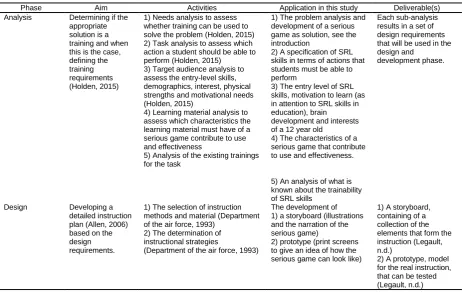
Table 1.
An overview of the ADDIE model applied to the development of the serious game to train
self-regulated learning (SRL) skills in Dutch sixth grade primary education students
Phase Aim Activities Application in this study Deliverable(s) Analysis Determining if the
appropriate solution is a training and when this is the case, defining the training requirements (Holden, 2015)
1) Needs analysis to assess whether training can be used to solve the problem (Holden, 2015) 2) Task analysis to assess which action a student should be able to perform (Holden, 2015)
3) Target audience analysis to assess the entry-level skills, demographics, interest, physical strengths and motivational needs (Holden, 2015)
4) Learning material analysis to assess which characteristics the learning material must have of a serious game contribute to use and effectiveness
5) Analysis of the existing trainings for the task
1) The problem analysis and development of a serious game as solution, see the introduction
2) A specification of SRL skills in terms of actions that students must be able to perform
3) The entry level of SRL skills, motivation to learn (as in attention to SRL skills in education), brain development and interests of a 12 year old
4) The characteristics of a serious game that contribute to use and effectiveness.
5) An analysis of what is known about the trainability of SRL skills
Each sub-analysis results in a set of design requirements that will be used in the design and
development phase.
Design Developing a detailed instruction plan (Allen, 2006) based on the design requirements.
1) The selection of instruction methods and material (Department of the air force, 1993)
2) The determination of instructional strategies
(Department of the air force, 1993)
The development of 1) a storyboard (illustrations and the narration of the serious game)
2) prototype (print screens to give an idea of how the serious game can look like)
1) A storyboard, containing of a collection of the elements that form the instruction (Legault, n.d.)
[image:8.595.67.530.480.773.2]9 Development The development
of the actual instructional material (Holden, 2015).
1) The development a plan of instruction (POI), which describes the aim, instruction time, supporting materials, instruction time and lesson plan(s) (Holden, 2015)
2) The development of the actual material (Holden, 2015)
A POI will be developed for the serious game to train SRL skills, whereas the development of the actual serious game will be skipped, due to a lack of resources
1) A plan of instruction
Implementation An efficient and sustained delivery of the instructional material to the target audience and the ongoing management and maintenance of reports and facilities (Holden, 2015).
The implementation of the instructional material
- -
Evaluation Besides the constant evaluation of the phases that forms the center of the model) three types of evaluation are distinguished (Department of the air force, 1993)
1) Formative evaluation which is a try out (in small groups) during the analysis and design phases (Department of the air force, 1993) 2) Summative evaluation, which is a tryout during the development (Department of the air force, 1993) 3) Operational evaluation, in which the operational system will be evaluated during the implementation phase
(Department of the air force, 1993)
10
Phase 1: Analysis
This phase of the developing process is a deepening of the problem statement and involves the sub-analysis as described in Table 1. These sub-sub-analysis involve a couple of aims. Firstly, to give an overview of what self-regulated learning (SRL) as skill actually is, in other words, what behavior is part of SRL? (task analysis). Secondly, to find out what is known about the trainability of SRL skills. Thirdly, to find out what 12 year olds already can in terms of SRL, their motivation to learn, their interests and probably the most important, what are they cognitively able to do? (target audience analysis) Fourthly, to find out which serious game characteristics contribute to a usable and effective game? (serious game characteristics). Each of these aims leads to a (series of) design requirements.
Self-Regulated Learning as Skills
The analysis of self-regulated learning as skills can be found in the introduction (see “Self-regulation and self-regulated learning (training)”). This (task-)analysis resulted in the conclusion that SRL contains of three components: a metacognitive component, a strategical component (cognitive learning strategies and behavioral activity), and a motivational component. Each component consists of activities or strategies that can be found in the three phases of a learning effort: before, during and after (see Figure 1). An extended description of each type of strategy can be found below.
Cognitive (learning) strategies
Cognitive (learning) strategies are tactic used to facilitate skills and knowledge acquisition (Smith & Ragan, 2005d). According to them, “direct instruction on cognitive strategies may be beneficial” (Smith & Ragan, 2005d, p. 244). As described earlier involve cognitive (learning) strategies, rehearsal or repeating strategies, elaboration strategies, organizational strategies, comprehension monitoring strategies, and affective strategies (Weinstein & Mayer, 1983). These strategies can be used during the learning activity.
The first strategy involve rehearsal or repeating strategies, which means that students are able to underline or copy the main content of a text. Copying as in literally taking over text from the blackboard is mentioned as a „Dutch language‟ competence in primary education (Greven & Letschert, 2006). Repeating in this case it is viewed as writing skill, but not as learning strategy. Therefore must be explained that copying also can be used as learning strategy. Besides copying, are verbally repeating the material, underlying and selective verbatim notes taking also part of this learning strategy. The core of this strategy is the active action in terms of writing, saying and pointing the key elements, this in order to select the core of the text and acquisition into the working memory (Weinstein & Mayer, 1983).
The second strategy involve elaboration strategies, which means that students are able to summarizing, paraphrasing or relating new information to existing knowledge. These strategies can contribute to learning, because new knowledge will be integrated with existing knowledge (Weinstein & Mayer, 1983). Paraphrasing as in writing things in own words is also a competence that primary education students must be able to do as part of the „Dutch language‟ class (Greven & Letschert, 2006). But paraphrasing is seen as writing skill instead of learning strategy, therefore players receive an instruction on the use of these strategies as learning strategies.
The third strategy involves organizational strategies, which means that students are able to create a hierarchy or outline. According to the Dutch core goals for primary school students, students must be able to structure a text, as in ordering it (Greven & Letschert, 2006). Again this is viewed from a writing skill perspective instead of a learning strategy perspective. Therefore must be explained that organizing can be used as learning strategy, because these strategies lead to the transference of selected information into the working memory and relating ideas in the working memory (Weinstein & Mayer, 1983). This requires extra training, that focuses on the structural relation types that exist between ideas, such as a symbolic outline in which phrases, concepts and words are related (Weinstein & Mayer, 1983).
The fourth strategy involves comprehension monitoring strategies, which means that comprehension failure will be checked. This can be done by self-questioning in order to check whether the material is understood and to guide the reading process before one starts with reading a section (Weinstein & Mayer, 1983). Fourth to sixth grade students must learn to be able to think about their own text comprehension and to come up with a solution when the text is not fully comprehended (Wijzer over de basisschool, n.d.).
11
Mayer, 1983). Smith and Ragan (2005d) described based on several publications that this also involves self-motivational skills, which involves stress reduction techniques, positive self-talk and time management.
Metacognitive strategies
Metacognitive strategies focus on the ability to keep an overview on the performed activities (SLO, 2017a). This involves activities before, during and after a learning effort, as explained in the introduction, see Figure 1.
Before the learning activity (the „forethought phase‟). According to the SLO (2017a) the learner starts with an orientation on the activity. The first activity, the orientation involves an estimation of the level of a task or chance of success, realizing the importance of the assignment for goals and the learner, and relating previous experiences to this assignment (SLO, 2017a). This process of prior knowledge (or experience) activation is at some level unconscious and automatic, outside explicit control. Therefore this part is not seen as self-regulatory. However, prompts that stimulate learners to think about knowledge on a problem, topic or domain, can stimulate a more conscious process of prior knowledge (Pintrich, 2000). The second activity or metacognitive strategy is (realistic) goal setting (based on previous experiences) before a learning activity starts (SLO, 2017a). According to Bandura (1988) and Locke, Shaw, Saari, and Lathman (1981) three properties of goals contribute to the effectiveness of these goals (as cited in Schunk, 1990). Firstly, to increase efficacy, activate self-evaluations and enhance learning, goals must be specific on performance. Secondly, to increase motivation and self-efficacy by observing progress (especially with young children), goals must be proximal. Thirdly, to increase self-efficacy and effort a goal must be difficult. These elements come back in SMART formulated goals, which means that a goal is specific, measurable, attainable, realistic and time bounded. The Collorado Education Initiative (2014) described that grade 6-8 students need help with the formulation of a SMART goal. SMART stands for 1) specific focuses on what the student is going to do, 2) measurable focuses on how the change can be seen, 3) attainable skills, attitudes and abilities that must be learned, 4) realistic focuses on the doable aspect of a goal, in the sense of not too hard and not too simple, and 5) time in which the goal must be completed (The Collorado Education Initiative, 2014). This must be explained in such a way that students are able to formulate these goals. The third strategy is planning (SLO, 2017a). Planning means that students think about when, why and how to act, in order to achieve a learning purpose. This involves an analysis of the context, retrieving the relevant skills and knowledge (also in terms of learning strategies), sequencing the steps needed to solve the problem and structuring the (learning)environment in such a way that the (learning)task performance will be optimized (Desoete, 2008; SLO, 2017a). However this environment structure optimization is part of the behavioral strategy and not of metacognitive strategies. Although planning skills continue to develop up to adulthood, 12 year are able to use planning skills (Balans Digitaal, n.d.).
12
Wouda (2017) described several tools that contribute to concentration, but states that concentration as skill is helpful in the entire level. This implicates that concentration can be trained.
After the learning activity. The sixth strategy is self-evaluation or reflection on the task executing and acting, which will be used after the learning activity is finished. This involves the performance evaluation against the (formulated) goals and own expectations, explain the chosen approach and relate to the performance, attribute the performance to others or the self, and lastly, explain the influence of the own performance on a follow-up task (Pintrich, 2000; SLO, 2017a). Although not described in the overview of activities after the learning activity of the SLO (2017a) is the monitoring of the competence or capacity development also an activity that can be added to the metacognitive strategies after the learning activity. This can be done because self-knowledge is seen as a metacognitive strategy and capacity (or competence) (development) insight is seen as self-regulation strategy (SLO, 2017a). SLO (n.d. ) gave an overview of students in grade five and six (10-12 year olds) and describes that students have knowledge of the options they have while they decide and to take that decision. This means that the self-evaluation strategy is manageable for the average 12 year old.
Motivational strategies
Motivational strategies are also used throughout the entire learning activity (before, during and after). Before the learning activity. According to Zimmerman (2002) the first phase of the learning activity contains self-motivation (beliefs). These beliefs are based on self-efficacy, expectations on outcomes, the perceived value of the lesson and learning goal orientation. Self-efficacy is a positive belief about the own competence to successfully perform a task or produce a favorable outcome (Akhtar, 2008). The (perceived) self-efficacy influences the effort one mobilizes, the goal level one set to challenge oneself and the persistence one has when a difficulty faces (Zimmerman, Bandura, & Martinez-Pons, 1992). Self-efficacy will be caused by four sources: 1) performance accomplishments which is based on mastery expectations caused by success and repeated failure experiences, 2) vicarious experiences which is the effort persistence and intensification by observing others performing an activity that is seen as threatening without adverse consequences, 3) verbal persuasion on the belief that someone can succeed, and 4) emotional (and physiological) arousal (such as stress) influences the competence belief (Bandura, 1977). Self-efficacy develops as a consequence of the development of effective self-regulation skills (Berk, 2013a), therefore self-efficacy is not trained in this serious game. To support the four sources of self-efficacy feedback will be included that focuses on the chance that the player will succeed, self-formulated feedback on the own learning process, and assignments that require persistence. According to Bandura (1994) self-efficacy partly determines expectations on outcomes. Outcome expectations are the expectations concerning the outcome of their learning effort (e.g. a low mark on a test). Because outcome expectations are partly influenced by self-efficacy, outcome expectations are not included in this serious game. Intrinsic interest focuses on valuing a learning task (Zimmerman, 2002). Since this is different for each task, this is element is not included in this serious game as skill or belief to train. Learning goal orientation focuses is valuing the learning process (Zimmerman, 2002). A learning goal orientation focuses on the increase of competence (Dweck & Leggett, 1988). This orientation towards understanding is also called achievement-motivation, which is related to making mastery-oriented attributions. This involves attributing success to the own ability, which can be improved by hard trying. In addition, failure will be attributed to controllable or changeable factors (e.g. putting not enough effort in the task or assignment) (Heyman and Dweck, 1998 as cited in Berk, 2013b). In this way it builds on self-attribution and will be stimulated by evaluative feedback.
During the learning activity. Perseverance is the drive to continue, dealing with setbacks and frustration and being confident that something can be learned (De Vos - van der Hoeven, 2012). This type of motivation can be trained by achievable assignments, dividing the assignment in smaller steps, learning to deal with frustration, and success experiences in children (De Vos - van der Hoeven, 2012; SLO, 2017a). SLO (2017a) states that taking initiative is also viewed as motivation. Initiative taking means that someone acts without external motivation (Bentvelsen & Pijlman, n.d.). Taking initiative can be trained to children (De Praktijk 4 Kids, n.d.).
13
performance in school-age children is the result of evaluative feedback and improvement of reasoning skills (Dweck, 2002 as cited in Berk, 2013b). Therefore feedback will be included in combination with the explicit focus on the causes of performance by making students think about it by explicit questions. In addition self-satisfaction and (defensive or adaptive) reactions are also part of the „after learning activity‟. Because (feelings of) self-satisfaction is a affective component and the reaction are personal and in that way not trainable, these are not included in the serious game.
Behavioral activity
Behavioral activity involves selecting, structuring and creating a learning optimizing environments (Zimmerman, 1986). Zimmerman (1989) defined environmental structuring as the effort students make into arranging and selecting a physical setting that simplify the learning (e.g. isolation in order to prevent from distraction or sitting in silence in order to concentrate). According to De Vos - van der Hoeven (2010) a (young) child can be stimulated at home to take care for an ordered place (which can contribute to concentration). This indicates that the target group of this serious game (12 year olds) can be trained in behavioral activity strategies.
Design requirements
Since the to be developed serious game aims to train SRL (existing of behavioral activity, cognitive, metacognitive and motivational strategies) the following design requirements are formulated based on both the description of SRL and its components:
I. The serious game trains the use behavioral activity strategies, which involves that students learn how to create, select and structure the environment
II. The serious game trains the use of the cognitive (learning) strategies, which involve creating awareness of the use of the five learning strategies of Weinstein and Mayer (1983) as learning strategy
III. The serious game trains the use of metacognitive strategies that can be used before, during and after a learning activity takes place.
IV. The serious game trains motivational strategies which involves motivational strategies before, during and after the learning activity takes place.
The Trainability of SRL
Existing SRL training programs
“Self-regulated learning programs proved to be effective [on learning outcomes, motivation and strategy use], even at primary school level” (Dignath et al., 2008, p. 101). These words are the conclusion of a meta-analysis on the effectiveness of SRL enhancing programs aimed at primary school students. The meta-analysis aimed to find the effect of SRL programs on several outcome variables at primary schools and what the most effective intervention types are. Based on the 48 studies they included, they found an overall effect of d=.62 for academic performance (overall), d=.73 for (meta)cognitive strategy use and d=.76 for motivational outcomes. In addition, Dignath et al. (2008) compared several training (content and context) characteristics and found that the following characteristics increase the effectiveness of SRL training programs on the use of cognitive and metacognitive strategies (shortly strategy use):
Firstly, interventions that are based on a social-cognitive theory led to a higher effect size for strategy use. Since this serious game aims to train (the use of) SRL skills the choice has been made for a social-cognitive theory basis. But what does this theory means for the training of SRL skills? Zimmerman (1989) viewed self-regulated (academic) learning from a social cognitive perspective. According to this view, SRL will be determined by behavioral, environmental and personal processes. Behavioral processes involve self-observation (own performance monitoring), self-judgment (comparison of own performance with the goal) and self-reaction (processes such as metacognitive planning, goal setting and behavioral outcomes). Environmental processes involve social experience and the physical context. And lastly, personal processes involve students‟ (self-regulative) knowledge of strategies, metacognitive processes (such as planning and behavioral control), affect and long-term goals (Zimmerman, 1989).
14
training of SRL in the full width (as explained in the previous chapter under „Self-Regulated Learning as Skills‟) and the study did not result on a combination of all three components of SRL, is decided to train all components of SRL in the serious game. Dignath et al. (2008) further analyzed the effectiveness of strategies for each component. These results are not taken into account in the development of this serious game because the meta-analysis did not include all strategies as included in this study.
Thirdly, significant differences in effect sizes were found for the comparison of interventions that included group work as training mean and interventions that did not include group work, in favor of interventions with group work. But for group work to be effective, students must know the behavioral rules in a group.
SRL training strategies
Several authors described strategies to train (elements of) SRL strategies. Santrock (2011) focused on SRL as whole (among others metacognitive strategies, which is included in design requirement III). Smith and Ragan (2005d) focused on the cognitive learning strategies (as mentioned in design requirement II). Simons (1994) described strategies to train the motivational element of SRL (as mentioned in design requirement IV). In this way strategies (or approaches) for the training of almost all elements of SRL except for behavioral strategies (design requirement I), will be explained.
Santrock (2011) mentioned six strategies for teachers to support SRL in students: (1) combine learning strategies with self-regulation skills, (2) verbalize and model SRL, (3) give assignments that include self-evaluation, goal setting, planning, performing of the plan and monitoring of progress and outcome, (4) give tips about how the SRL skills can help, (5) create an interesting and challenging classroom learning experience, and (6) make the guiding gradually, because it is time consuming, and requires monitoring and encouraging. In addition, the Nederlands Jeugdinstituut (n.d. a) states that students between nine and twelve year, still have some problems with the independent activation and application of knowledge, therefore cues and triggers can support these students.
In addition to the strategies of Santrock (2011), described Smith and Ragan (2005d) seven approaches to instruct cognitive (learning) strategies in their chapter on teaching cognitive strategies. The first six approaches to instruct strategies are the result of the literature review of Pressley, Snyder, and Cargilla-Bull (1987) (as cited in Smith & Ragan, 2005d). Smith and Ragan (2005d) added the seventh. The first approach was (guided) discovery, which involved discovering a strategy (by questions of an instructor). The second approach is observing among others a fictional character (textually or visually presented). The third approach is guided participation, which means guiding by the strategic procedure use. The fourth approach is the use of prepackaged strategy instructions. The fifth approach involves direct explanations of teachers on the applicability of where and when a strategy should be used. The sixth approach involves a dyadic instruction, a one-to-one instruction which involves a think-aloud procedure. The seventh approach involves self-instructional training. “Self-instruction training has been used to assist learners in regulating a wide variety of personal processes such as attention, problem solving, response guidance, and motivation” (Zimmerman, 1990, p.10 ).
15
actions, 4) assess understanding and remembering of information, 5) give students the assignment to explain to each other, and 6) demonstrate mechanisms on how things can be fixed. Fourthly, scaffolding, which means that guidance will be gradually decreased, by: 1) give students the opportunity to take gradually the responsibility for their learning (choices), 2) decrease external monitoring, 3) make sure that students get the opportunity to use their internal motivation for learning and automatize learning strategies. And fifthly, stimulate positive self-evaluation, by adapting goals, content and feedback to the students in order to stimulate self-confidence.
Design requirements
To develop a serious game that is effective in the training of SRL skills, based on the analysis of existing SRL materials and ideas on training strategies for the SRL components the following design requirements were formulated:
V. The serious game is based on the social-cognitive theory of SRL training (existing of behavioral, environmental and personal processes)
VI. The serious game must involves cognitive, metacognitive and motivational strategies VII. The serious game involves carefully supported group work assignments
VIII. To train SRL (and metacognitive strategies), the six strategies of Santrock (2011) are followed, which means that the serious game must
a. combine learning strategies with SRL skills b. verbalize SRL
c. include assignments that involve self-evaluation, goal setting, planning, performing of the plan and monitoring of progress and outcome
d. include hints about how SRL skills can help
e. include an learning experience that is interesting and challenging f. involve gradually guiding
IX. To train cognitive (learning) strategies, the teaching approach of Smith and Ragan (2005d) is followed in the serious game, involving:
a. (guided) discovery of a cognitive (learning) strategy b. Observing others using cognitive (learning) strategies
c. Guided participation (guided during the use of (learning) strategy) d. Prepackaged strategy instruction use
e. Direct explanations of teachers f. Dyad instruction
g. Self-instruction training
X. To train motivational strategies, the strategies of Simons (1994) are included: a. Be an example or expert-model for the students
b. Focus on metacognitive skills in order to stimulate active learning steering c. Be an external monitor of the chosen learning activities
d. Scaffolding (gradually decreased guiding) e. Stimulation of positive self-evaluations
Target Audience: 12 Year Olds
The following paragraphs describe the development of the brain and SRL skills to 12 year olds, followed by the average motivation to learn, the use of media and games in the target group, which lead to design requirements that are needed for the design of the serious game to train SRL skills.
Brain and SRL development to 12 year olds
16
Despite their brains‟ development, students are already able to regulate their own behavior and perform independent (learning) tasks with or without others at a young age (SLO, 2017a). Although several researchers stated and found that the metacognitive ability (operationalized as the relationship between confidence in decision making and task performance), cognitive self-regulation (progress control and monitoring towards a goal) and metacognitive knowledge are still improving (Berk, 2013a; Weil et al., 2013). This matches the ideas of Keating (2004) and Goswami and Bryant (2007), which are stated above. However the use of SRL skills is trainable (in the target group) as suggested by the findings of the meta-analysis of Dignath et al. (2008) (see „SRL training programs‟). In this way the serious game can contribute to the development of SRL skills to 12 years, since they not fully master these skills. This implies that players must be supported in the application of knowledge on the actual use of SRL skills.
Motivation to learn
Another important relevant topic for the target group, besides the development of the brain and SRL skills in the target group is the motivation to learn. The Dutch inspectorate of education namely, stated based on the PISA results of 2012 (published by the OECD, 2013) that both Dutch primary and secondary education students are not so motivated to learn, when compared to other countries (Inspectie van het Onderwijs, 2017).
Hornstra, van der Veen, Peetsma, and Volman (2013) performed a longitudinal study on the development of motivation among 722 Dutch primary school students. Motivation was measured with student self-reports that consisted of academic self-efficacy and task-orientation. As described under „Self-Regulated Learning as Skills‟, motivation in this study involves among others self-efficacy and task-orientation. For self-efficacy a (small) u-shaped curve was found, meaning that the self-efficacy firstly decreases a bit (during third and fourth grade) and then increases (during fifth and sixth grade). Self-efficacy is defined as the judgment of the own capabilities to perform those actions that are necessary for a successful academic task completion (Bandura, 1977 as cited in Hornstra et al., 2013). For task-orientation a linear decrease was found during the growth from halfway grade three to halfway grade six. Task orientation is defined as the orientation to increase understanding and competence (Covington, 2000 as cited in Hornstra et al., 2013). This last finding indicates that students decrease in the extent to which they are oriented to improve their own knowledge and skills, which matches the conclusion of the Dutch inspectorate of education.
Gaming and media use of 12 year olds
Since (serious) gaming is used as means to train SRL skills, it is important to include the use of games in the target group. Therefore an overview of gaming and media use in the target group is provided. The Dutch Youth Institute is a non-profit institute that aims to come up with reliable and actual information about the Dutch youth (Nederlands Jeugdinstituut, n.d. b). They published the factsheet media-use for several age groups, including one for nine up to twelve year olds. They state that this age group becomes more critical about computer games and TV-programs that do not contain enough action and look for the story behind something. On average, they spend every day almost three hours on gaming, watching TV and working on a computer (Nederlands Jeugdinstituut, n.d. a). According to Nederlands Jeugdinstituut (n.d. a) this age groups wants to be challenged in a game, however the game does not have to include violence. Nikken (2016) stated that Dutch 10 to 12 year olds become less interested in cartoons, however this is not true for ironic or sarcastic cartoons. They watch (together with family) talent- and family (television) shows and prefer adventurous games and games in which they can build a virtual world (Nikken, 2016).
Design requirements
This description of Dutch 12 year olds, the target group, resulted in the following design requirements: XI. The serious game must take into account that the target group is still developing SRL skills
and therefore should be supported in the application of knowledge about SRL on the use of these SRL skills.
XII. The serious game must take into account that the motivation to learn is low, which means that the serious game must be 1) motivational and 2) motivate learners to become motivated to learn (in general, also outside the serious game)
17
Serious Game Characteristics
The following paragraphs describe what a serious game actually is (definition and elements), how it affects learning and motivation (motivational elements, effective serious game elements, additional support, and effective realism level) and describes relevant guidelines of the manual of Poort (2017).
Definition
In „Serious Games: games that educate, train and inform‟, an edited book about serious games, an entire chapter was dedicated to the definition of serious games (Michael & Chen, 2006). According to them “A serious game is a game in which education (in its various forms) is the primary goal, rather than entertainment” (Michael & Chen, 2006, p. 17). Zyda (2005) also stated that a serious game is a computer played game, which has specific rules and is a mental contest. Wouters, Van der Spek, and Van Oostendorp (2009) stated that there are several definitions of games, but that these all can be traced back to the definition of Lindley (2004), which consists of three parts. Firstly, that it is goal-directed. Secondly, that it is a competitive activity, where the competitor can be the player self (or the player‟s own limitations), others playing the same game or the game developer. Thirdly, that players (implicit or explicit) agree with the rules that form the framework of the game. A serious game is thus a computer game that is a mental contest, a competitive activity, goal-directed and has specific rules in which education instead of entertainment is the primary goal.
Game elements
Game (design) elements can be seen as features or building blocks that are shared by games (Deterding, Dixon, Khaled, & Nacke, 2011). Schell (2008) states that there exist several ways to classify game elements. It is beyond the scope of this analysis to give an overview of all models or classifications, therefore three models are included. Schell (2008) differentiated between four basic elements: mechanics, story, aesthetics and technology. Mechanics involves the game rules and procedures, story involves the events that happen during the game, aesthetics involves the experience (in terms of how the game feels, smells, tastes, sounds and looks) and technology involves the medium that is used. These elements are equally important (Schell, 2008).
The „Serious Game Design Assessment Framework‟ (SGDA Framework) was developed as “an attempt to offer a basis to study how the design elements are configured formally and conceptually in relation to the game‟s aim and purpose” (Mitgutsch & Alvarado, 2012, "The development of the evaluation criteria", para. 6). This framework consists of six elements. The first element, purpose (or aim) is the main element, that must reflected in the other game elements. Serious games differ from „normal‟ (entertainment-oriented) games in the way that a serious game has a specific purpose that lies beyond the game (Mitgutsch & Alvarado, 2012). The second element is „content and information‟, which involves all the data, facts and information that is used in and offered by the game (Bateson, 1972 as cited in Mitgutsch & Alvarado, 2012), which involves all, for players, approachable and visible words and data. The third element is framing, this involves the framing of the other five elements in terms of the (broader) game topic, target group and play literacy of the target group. The fourth element is (game) mechanics, which are the actions players can perform in the game, such as trick-taking, betting and shuffling for card games (Hunicke, LeBlanc, & Zubek, 2004).The fifth element is graphics and aesthetics, which is the audiovisual language of the game (e.g. used imagery, artistic media or aesthetic characteristics). The sixth, and last element is fiction and narrative, which involves the fictional context (scenario, narrative, setting, story, characters, problem and back story) (Charsky, 2010 as cited in Mitgutsch & Alvarado, 2012).
Prensky (2001) came up with six „structural elements of games‟: 1) rules, 2) feedback and outcomes, 3) interaction, 4) story or representation, 5) objectives or goals, and 6) challenge or competition or conflict or opposition. Games are rule-based, in the sense of forcing the player to take specific paths in order to reach a goal. Feedback is an immediate reaction on what the player did, which makes games interactive and it is an form of measuring progress against goals. Interaction involves two aspects, firstly the interaction between computer and player (feedback) and secondly, with others. Representation means that a game includes a story or narrative. Objectives or goals differentiate toys (non-goal-oriented games) from games, because goals prevents from playing in the way the player wants. Challenges or the conflict are the problems that must be solved by the player.
18
of the game; 5) interaction with other players; 6) a challenge (a problem that must be solved); and 7) information provided by the game.
Motivational elements
The previous chapters described what a serious game is and what elements it consisted of, but these elements do not say anything about the motivational aspect of a serious game. This is important for the development of the serious game to train SRL skills since motivation is an important reason to choose for a serious game as means. Mayer (2008, 2011) defined motivation as an initiating internal state that keeps up behavior directed at the goal (as cited in Mayer, 2014a). Dondlinger (2007) reviewed literature on the design of educational video games and examined the effect on motivation. Despite the absence of fully agreement about the source of motivation in video games among researchers was motivation examined in several publications. Dondlinger (2007) gave an overview of these motivation sources: the narrative context (e.g. one that promotes fantasy, curiosity and challenge), rewards and goals, objectives that require higher-order thinking skills (decision making or creative problem solving) as found in strategy and adventure games and by providing feedback. So these sources or elements can contribute to an increased motivation to play the game, which is important to train SRL skills, because of the time it cost to train these skills and the motivational assignments that are needed, as described in the problem stamen (see „Introduction‟). These elements match the motivational theories as mentioned by Mayer (2014a): interests, beliefs, goals and needs. Interests involves interests in the material, and valuing the learning. Beliefs, involving the feeling of being competent to perform the task, the attribution of success and failure to effort, and seeing intelligence as changeable. Goals, involving a goal orientation. Needs, which involves of the experience of being in charge, experiencing internal rewards, being rewarded earlier, the experience of characters in the serious game that are supportive, and the use of the entire body (to control for example movement in the serious game).
Effective serious game elements
However, a motivational serious game is not enough to learn from. Mayer (2014a) mentioned that understanding of how learning and instruction work is useful for the development of an effective serious game (or game for learning as he calls it).
Learning. Understanding how learning works requires knowledge of the way humans process information. Mayer (2014a) describes three principles that resulted of several studies of several authors on how humans process information. Firstly, the dual channel principle, which means that people process auditory and verbal material via one channel and pictorial and visual material via a second. Secondly, the limited capacity principle, which means that the amount of material or information that can be processed by a channel at a moment is limited as the consequence of a limited working memory capacity. Thirdly, the active processing principle, involving that appropriate cognitive processing leads to meaningful learning. Appropriate cognitive processing means that relevant (auditory and visual) material will be selected, organized into a coherent (verbal and pictorial) representation and integrated (i.e. both representations will be combined with each other and then with prior knowledge). For game development, this implies that distraction by game mechanics must be avoided. To do so, additional instructional features can be added to guide the process of selection, organization and integration (Mayer, 2014a), those are described in the next paragraph.
19
explanations and advice from an expert during the serious game, 3) the segmenting principle (segment the game), and 4) the modality principle (decrease visual processing by the inclusion of spoken words instead of written words). Generative processing can be fostered by 1) the prompting of self-explanation or reflection 2) the personalization principle (application of a conversational style), and 3) the opportunity for players to choose parts of the interface appearance.
Mayer (2014b) reviewed serious game features that contribute to learning and found five features that were seen as promising for the improvement of learning by the use of computer games (and simulation games): personalization, modality, self-explanation, pre-training, and coaching. In addition, two features were seen as unpromising: redundancy and immersion. Lastly, six features were defined as „not yet promising‟: the inclusion of a narrative, format choice, segmentation, images of an agent, order control by the learner and competition. So an effective serious game must include at least coaching, modality, personalization, pre-training and self-explanation features.
Adding additional support
But applying CLT principles is not enough to make a good learnable serious game. Leemkuil and De Jong (2012) stated based on the conclusion of several authors that support must be added to games in order to lead to effective learning. Wouters and Van Oostendorp (2013) performed a meta-analytic review on instructional support in educational games (including among others serious game and simulation games). They stated that instructional support is needed for learners to engage in cognitive processes, such as the selection, organization and integration of new information. This was supported by the finding that games with instructional support lead to significantly more learning when compared to games without support, with a weighted effect of d=.34 (Wouters & Van Oostendorp, 2013).
Instructional support types. Wouters and Van Oostendorp (2013) distinguished between 24 different types of instructional support types and grouped these 24 types into ten different groups (advice, collaboration, feedback, interactivity, modality, modeling, narrative elements, personalization, reflection and others). However, only collaboration (playing and discussing with at least one other person), feedback (and guidance), modality, modeling (scaffolding, worked examples and modeling), personalization (of characters, topics, ideas and messages) and reflection (and assignments, elaboration, self-explanation) support improved learning.
Effective realism level
Besides a serious game that motivates, takes cognitive load into account and deals with additional support, the design of the serious game in terms of realism level is also important. Wouters and Van Oostendorp (2013) included the effect of (the level of) realism as moderator in their meta-analysis on the effect of instructional support in serious games (or game-based learning). They adapted the taxonomy of Vogel et al. (2006), resulting in the following levels: basic or schematic (involving schematic and low-quality pictures), cartoon(like), (photo)realistic and unknown (when the realism level was not determinable). They found instructional support led to an improvement of learning in serious games with a schematic (d=.45) and cartoonlike (d=.18) design, whereas the effect size of instructional support in realistic designed serious games was not significant. However, “instructional support in basic/schematic designs seems to improve learning more than in cartoonlike and (photo)realistic designs” (Wouters & Van Oostendorp, 2013, p. 421).
Guideline manual
Poort (2017) developed a guideline manual for collaborative serious games. Although collaboration is not included (as described below, under „information and communication system‟), the guidelines described for both feedback and goals are highly relevant for the serious games to train SRL skills, since goals and feedback contribute to motivation and feedback is a form of additional support. In addition, two guidelines for game content are added because the game content must fit the preferences of the target group.
For feedback three guidelines were formulated: (1) the guidance towards correct performance, instead of only focusing on mistakes, by providing hints, (2) providing the first step in the direction of the solution instead of giving the entire answer, and (3) show the score composition and possible score range during the game instead of only a score (Poort, 2017). A fourth guideline was actually written for the category „data‟, but is highly relevant for feedback. This guideline involves the use of data as progress monitoring (for player and teacher) and input for feedback (Poort, 2017).
20
can be performed, by triggering players to choose for a replay, and (5) adapt the task complexity in order to improve and/or acquire skills (Poort, 2017).
And lastly, for game content the following two guidelines were formulated: (1) the match of actions and theme in and of the environment to the goals and (2) personalize the game by giving players the opportunity to choose and adapt characters.
Design requirements
The analysis of effective and motivational game elements resulted in the following design requirements:
XIV. The serious game is a mental contest, goal-directed, competitive and involves specific rules. XV. The serious game includes the following game elements
a. goals, especially a purpose besides winning the game b. rules and mechanics (performable actions)
c. an underlying story that involves characters, a scenario and narrative d. feedback as reaction on what the player did
e. aesthetics, which is an idea behind the audiovisual part of the game f. interaction with other players
g. a challenge, which is a problem that must be solved h. information provided by the game.
XVI. The serious game is motivating trough the inclusion of a narrative context that promotes fantasy, curiosity and challenge, rewards and goals, objectives that require high-order thinking skills (decision making or creative problem solving), providing feedback, material that is seen as interesting, the attribution theory, an orientation on the goal, choices, internal rewards, support and movement.
XVII. Learning will be supported by the inclusion of coaching, modality, personalization, pre-training and self-explanation features.
XVIII. The serious game will be added with at least one of the following additional support forms: 1) collaboration, or 2) feedback and guidance, 3) modality, 4) modeling, scaffolding and worked examples, 5) personalization of characters, topics, ideas and messages, and 6) reflection, assignments (prompts to investigate variable relations), elaboration and self-explanation XIX. The serious game has a schematic design, because this has a positive effect on learning in
combination with instructional support.
XX. The serious game involves feedback that provides hints in the right direction of the solution and towards correct performance and shows the score composition and possible score range during the game instead of only a score. In addition, data out of the game will be used for both monitoring and as feedback.
XXI. The serious game involves multiple (clear) goals that can be achieved by the execution of particular actions, sub-goals (steps towards the goals). This also involves the opportunity to repeat a task when a better solution (in direction of the goal) can be performed by triggering players to choose for a replay. And lastly, the task complexity is adaptable in order to improve and/or acquire skills.