Bachelor Thesis
Measuring Resilience with the Brief Resilience Scale: Factor
Structure, Reliability and Validity of the Dutch Version of the
BRS (BRSnl)
Christin Consten
Research paper June 2016
University of Twente, Enschede, The Netherlands
Department:
Positive Psychology and Technology (PPT)
Examination committee: Prof. dr. K. Schreurs,
Dr. H. R. Trompetter
Extern:
Saxion University of Applied Sciences Academie Health Care
Acknowledgements
It would not have been possible to write this paper without the support and assistance of some people, so I will use this opportunity to offer my sincerest gratitude.
First and foremost, I want to give thanks to my first supervisor Prof. dr. Karlein Schreurs, who guided me throughout my thesis with inexhaustible calmness and composure. Much new insight and knowledge do I owe her. Beside her, I want to express my gratitude to my second supervisor, Dr. Hester Trompetter, for inspiring suggestions, especially regarding resilience. I am very thankful for the detailed and helpful feedback and the stimulating discussions, which made me look at things in a different way. They motivated me over the whole period of time.
I also want to give thanks to my external supervisor Dr. Remko Soer and to Dr. Marianne Six Dijkstra, from the Saxion University of Applied Sciences, who provided me support whenever I needed and the data on which my paper is based. Thank you for this opportunity.
I appreciate the University of Twente for an outstanding education in the domain of knowledge. The bachelor program and all contributing persons supported and challenged me. My study at the UT made me aware of my own limits and enabled me to reach beyond that.
In addition, I have to thank some of my fellow students for calming and helping me whenever I did not know how to go on or to solve a problem. Especially, I want to express my gratitude to Sarah Zimmermann, who had a similar thesis subject as mine. She discussed with me many topics and had ideas to deal with every problem.
Index
Acknowledgements ... 2
Index ... 3
Abstract ... 5
Abstract (Nederlandse versie) ... 6
Positive Psychology ... 7
Resilience... 7
Measuring Resilience and Its Relation to Other Constructs ... 9
Current Study ... 12
Method ... 12
Design ... 12
Participants ... 12
Procedure ... 13
Measurements ... 14
Resilience ... 14
Work Engagement and Vigor ... 14
Need for Recovery ... 15
Lifestyle-factors ... 15
Health ... 16
Physical Complaints and Mental Distress ... 16
Data Analysis ... 17
Data Adaption ... 17
Factor Analysis ... 17
Reliability ... 17
Construct Validity ... 18
Multiple Regression Analysis ... 18
Results ... 18
Psychometric Qualities ... 19
Relations to Other Constructs ... 20
Discussion ... 23
BRSnl... 23
Concept Resilience ... 25
Strengths and Limitations ... 26
Strengths ... 26
Limitations ... 27
Recommendations ... 27
Conclusion ... 28
References ... 29
Appendix A ... 34
Korte Veerkracht Vragenlijst ... 34
Appendix B ... 35
BRAVO-factoren ... 35
Physical Activity ... 35
Smoking ... 35
Alcohol ... 35
Diet ... 35
Recreation ... 35
Appendix C ... 36
Health... 36
Appendix D ... 37
Physical Complaints ... 37
Impact of Work on Physical Complaints ... 37
Abstract
Introduction. Because of the evolving use of the positive psychology construct resilience in different professional fields, a questionnaire had to be validated that measures resilience. By now only questionnaires with too many items are available. In daily practice a short
questionnaire is indispensable. The aim of the current study was to develop a questionnaire that measures the capacity of humans to bounce back from adversity in a reliable and valid way.
Method. Data of 104 participants from an annual health check from a concern was used. The questionnaires ‘Brief Resilience Scale’ (BRSnl), the ‘Utrechtse Bevlogenheidsschaal’
(UBES), the ‘Vragenlijst Beleving en Beoordeling van de Arbeid’ (vbba 2.0) and some other question sets were taken into the study. The participants completed a digital questionnaire. The data were analyzed with factor analysis, Cronbach’s alpha, Pearson’s correlation and multiple regression analysis.
Results. Factor analysis showed the most evidence for a one-factor solution for the BRSnl. Cronbach’s alpha was .73. All items were taken into further analyses. Eight correlations were found to be significant. Vigor, recreation, impact of work on physical complaints and mental distress were moderately correlated with resilience. Work engagement, need for recovery, health and physical complaints were found to be weakly correlated with resilience. Most hypotheses could be confirmed. Multiple regression analysis showed that the used model explained about 26% of the variance in resilience.
Discussion and conclusion. Results suggest that the BRSnl is a valid and reliable
Abstract (Nederlandse versie)
Introductie. Veerkracht wordt steeds vaker als construct uit de positieve psychologie gebruikt, daarom werd in deze studie een nieuwe vragenlijst gevalideerd. Tot nu zijn er alleen lange vragenlijsten gevalideerd in het Nederlands. Voor de dagelijkste praktijk is een korte
vragenlijst onontbeerlijk. Het doel van deze studie was daarom een vragenlijst te onderzoeken die op een valide een betrouwbare wijze de vaardigheid van personen meet om van stressvolle gebeurtenissen terug te veren.
Methode. Data van 104 deelnemers uit het jaarlijks gezondheidsonderzoek uit een bedrijf werden gebruikt. De gebruikte vragenlijsten waren de Brief Resilience Scale (BRSnl), de Utrechtse Bevlogenheidsschaal (UBES), de Vragenlijst Beleving en Beoordeling van de Arbeid (vbba 2.0) en enige andere vragen samenstellingen. De vragenlijsten werden online afgenomen. Geanalyseerd werd de data aan de hand van een factor analyse, Cronbach’s alpha, Pearson’s correlatie en een multiple regressieanalyse.
Resultaten. Factor analyse toonde één-dimensionaliteit. De BRSnl had een Cronbach’s alpha van .73. Alle items konden meegenomen worden in de volgende analyses. Significant bleken acht correlaties. Voor vitaliteit, ontspanning, invloed van werk op fysieke klachten en
psychische klachten werd een middelmatig verband met veerkracht gevonden. Voor bevlogenheid, herstelbehoefte, gezondheid en fysieke klachten werd een laag verband gevonden. De multiple regressieanalyse toonde een model dat 26% van de variantie van veerkracht kon verklaren.
The current study is concerned with resilience and how to measure this construct in an adequate way. By defining resilience, making a measurement instrument and relating it to constructs that were found to be important in determining resilience the validity was tested. The aim of the current study was to test whether the new instrument could be used in practice.
Positive Psychology
In 1998 a shift took place in modern psychology. Martin Seligman and Mihály
Csíkszentmihályi were significant figures in the initiation of positive psychology (Hücker & Jung, 2014). Positive psychology tries to help people to achieve satisfaction of the past, hope for the future and happiness in the present on a scientific manner (Hergenhahn, 2008). To accomplish this goal new ways of supporting human beings had to be found. For this reason the focus had to shift from correcting deficiencies, to empowering people with the help of positive psychology constructs (Seligman & Csikszentmihalyi, 2000).
There are many important resources in positive psychology that help to accomplish the goal to protect humans from severe problems and make them happy. Hope, satisfaction with life (Marques, Pais-Ribeiro, & Lopez, 2011), hardiness, general self-efficacy, emotional intelligence, happiness (Khodarahimi, 2014) and resilience (Martz & Livneh, 2015) are examples of those resources. Resilience is one construct that is linked with many of the others. Among others, this construct is equated with constructs such as hardiness,
self-efficacy, thriving, sense of coherence and inner strength and is associated with psychological attributes such as hope, self-esteem, optimism, acceptance of disability and more (Martz & Livneh, 2015). Resilience has become popular in positive psychology as research showed its effect on helping people to govern their lives with a wide range of disabling conditions (Martz & Livneh, 2015). Resilience is also an important factor for life-long health and well-being (Windle, Bennett, & Noyes, 2011). Based on empirical support for the valuable impact of resilience (Martz & Livneh, 2015) this study concentrates on the measurement of resilience.
Resilience
Resilience is defined as the competence to deal with stress or trauma and to ‘bounce-back’ from adversity with a varying degree of severity over life-time. Resources for resilience can be found in the individual or its environment (Windle et al., 2011). One key factor in
promoting resilience is temperance, which is a character strength that includes forgiveness and mercy. Resilience is associated with less severe reactions to negative events, less
experience a lower level of generalized emotional distress, depression and anxiety and on the other side higher levels of positive affectivity, perceived well-being and acceptance of disability were reported. More resilient people were found to experience less pain and resilience has been linked to posttraumatic growth (Martz & Livneh, 2015). Altogether
resilience is associated with more effective coping-strategies, better effects in therapy and less suicide attempts (Portzky, Wagnild, De Bacquer, & Audenaert, 2010).
While defining resilience some problems can be detected. By now it is not clear whether resilience is a fixed personality trait or a dynamic process (Portzky et al., 2010). In this study resilience is seen as a dynamic process, otherwise it would not make much sense to measure it with the aim to strengthen it and to help people afterwards. A fixed personality trait is more difficult to be trained or improved.
Another difficulty with the lack of a clear definition of resilience is that it appears in different studies with different operationalizations. Resilience yields distinct ecological, economic, systemic, sociological and psychological views, definitions and clinical uses (Martz & Livneh, 2015). So it is problematic to use this construct in practice and research.
Several reasons can be found showing the importance of using resilience. For example more than half of human beings experience at least one traumatic event during their lifetime, but most of them recover without developing mental illness (Leontjevas, De Beek, Lataster, & Jacobs, 2014). To the contrary 30-90% of people experiencing such events report an increased quality of life (Aspinwall & MacNamara, 2005). For achieving positive results after stressful events, resilience seems to be an important factor (Martz & Livneh, 2015). It has also got a positive effect on the rehabilitation of different illnesses, both physical and mental, as breast cancer (Markovitz, Schrooten, Arntz, & Peters, 2015). Resilience protects and prevents from clinical psychopathology (Portzky et al., 2010). Highly resilient people do show reactions to traumatic events, for example being upset, but those reactions are rather short-termed. Additionally, highly resilient people return faster to their initial level of functioning. Less resilient people can also recover from traumatic events, but usually this recovery is characterized by a lack in functioning in everyday life (Portzky et al., 2010).
Because of those reasons resilience is getting increasingly important in different professional fields, such as clinical psychology and medical sciences (Portzky et al., 2010). Finding an adequate measurement instrument for resilience can further improve work in different professional fields. Knowing whether a patient is highly or low resilient, can help to adapt appropriate treatment plans for the manifestation of resilience. The low level of
recover better and faster from diseases, traumata and adversities. For that reason, resilience and related factors have to be studied.
Measuring Resilience and Its Relation to Other Constructs
Several ways to measure resilience exist. One measurement instrument is the ‘Resilience Scale’ (RS), validated in Dutch by Portzky et al. (2010). A short version is the ‘Brief Resilience Scale’ (BRS) originally generated by Smith et al. (2008). The BRS is a short version of the RS because of only measuring the general ability of resilience and not the additional protective factors. One Dutch version of the BRS already exists. It was validated by Leontjevas et al. (2014). But both instruments, the RSnl and BRSnl, did not totally meet the requirements. The RS contains twenty-five items and is thus too long for daily use. The trial to get a validated version, done by Leontjevas et al. (2014), of the BRS in Dutch was not confirmed by the original developers of the BRS Smith et al (2008). Thus a new translation of the BRS was necessary. For the new version of the BRSnl a forward-backward translation was done to get the most appropriate translation. The new version was confirmed by the developers of the original BRS.
Accordingly, the present study was aimed to measure resilience. Because of missing an adequate questionnaire measuring resilience in Dutch, the aim of the current study is to answer the research question ‘To what extent is the ‘Dutch Brief Resilience Scale’ (BRSnl) a reliable and valid research instrument?’ To test this research question, the psychometric quality of the BRSnl has to be ascertained. This is done by checking the dimensionality, the internal consistency and validity by using construct validity.
The current study was implemented on the basis of an existing data set with certain questionnaires. The questionnaires were filled in by employees in the frame of the annual health check. Those questionnaires caught constructs that were possibly related to resilience. The aim was to use as many constructs as achievable. The correlations provided more information about the validity of the BRSnl. To make hypotheses about those correlations, a clear description of associated factors and constructs had to be given. Some of those
connections with resilience were found in studies and some were deduced from theory. In the following section, positively associated constructs are taken into account first, followed by negatively associated ones.
through having much energy, a positive attitude and a good feeling during work (Schaufeli & Bakker, 2003). Some studies were carried out that addressed the relation of resilience and work engagement. For example in the cross-sectional survey of Mache et al. (2014) resilience was amongst the most important factors in determining and improving work engagement. A moderate positive relation between resilience and work engagement was found (Mache et al., 2014). Vigor is one part of work engagement and was also used individually in the current study. This was done because of vigor being defined to be characterized by “high levels of energy and mental resilience while working, the willingness to invest effort in one’s work, and persistence even in the face of difficulties” (p. 702), as written in the cross-national study of Schaufeli, Bakker and Salanova (2006). Resilience seems to be one part of vigor and a moderate connection between resilience and vigor should be observed in the current study.
Physical activity is another construct used in the present study. In a cross-sectional study of Ho, Louie, Chow, Wong and Ip (2015) physical activity was found to have a weak relation with resilience. In this study resilience was the only significant mediating variable between physical activity and mental health. Over sixty percent of this relationship was accounted by resilience. Moljord, Moksnes, Espnes, Hjemdal and Eriksen (2014) found the same positive influence of resilience and physical activity on depressive symptoms. Both were negatively related with a high degree in depression.
The relationship of diet and resilience is not well examined, but it is known that resilience and diet are both associated with physical health. In a cross-sectional study of Schure, Odden and Goins (2013) a clear relation between high resilience and physical health were found. In a cross-sectional study of Zahra, Ford and Jodrell (2014) connection between eating unregularly and much junk food and low physical health was found. So physical health benefits from resilience and from eating healthy. This means that probably a high resilience goes hand in hand with a healthy diet.
Recreation is also a construct that is typically positively associated with resilience. In the study of Buchecker and Degenhardt (2015) the relation between resilience and outdoor recreation is analyzed. A moderate positive relation between both was found. Additionally, the study of Kim and Windsor (2015) describes a positive effect of a healthy work-life balance on resilience.
health. In the cross-sectional study resilience was found to be an important factor for mental health. As mentioned above a high value on resilience is clearly associated with physical health (King & Richardson, 2016). It can be said that resilience should be positively related to health, because of studies finding relations of resilience with global health and with mental and physical health.
The following sections will address the probably negatively associated constructs. These were need for recovery after work, smoking, alcohol, physical complaints and mental distress. Need for recovery is when someone must get well again after work (Qi et al., 2015). A direct link between need for recovery and resilience could not be found in the current literature. But the need for recovery and resilience could both be related to burnout. When a worker experiences incomplete recovery from work, the risk to develop different diseases, such as burnout or musculoskeletal disorder, increases (de Croon, Sluiter, & Frings-Dresen, 2006). On the other side in a cross-sectional survey of Hylton Rushton, Batcheller, Schroeder and Donohue (2015) a negative relation of resilience and burnout was found. In relation to burnout, resilience has a protective or preventive role (Hylton Rushton et al., 2015). Thus it can be expected that resilience is negatively related to a high need for recovery after work.
The next constructs that were suggested to be negatively associated with resilience were tobacco smoking and alcohol use. In the cross-sectional study of Goldstein, Faulkner and Wekerle (2013) it was found that past year smoking and smoking dependence were moderately negatively related with resilience. Resilience is thought to have a positive effect on smoking less. Also drinking alcohol was found to be associated with resilience. In the longitudinal study of Green, Beckham, Youssef and Elbogen (2014) resilience predicted the amount of alcohol consumption. In this study a low level of resilience was found to be weakly associated with alcohol misuse, which means that a higher level of resilience is probably negatively associated with a high level of alcohol use.
With regard to physical complaints Hopkins, Shepherd, Taylor and Zubrick (2015) said that “resilient youth were significantly less likely to have lifetime health problems and asthma symptoms than less resilient youth” (P. 10). This means that a high value of resilience may be negatively related to a high value at physical complaints.
engage in daily life activity. Thus resilience may be negatively associated with mental distress.
Current Study
For this research paper it was examined whether the new version of the BRSnl has the same excellent psychometric qualities as the original English version. This means that the BRSnl is expected to show a one-factor structure and a coefficient alpha above .7. A multiple
regression analysis is conducted to show which constructs explain unique variance in resilience. For the construct validity seven measurement instruments were used to grasp all constructs necessary to analyze it. The height of the correlations found in previous studies were used as orientation for the hypotheses of this research paper. Hereafter the hypotheses for this research paper are given.
H1: There is a weak positive correlation between resilience and work engagement. H2: There is a moderate positive correlation between resilience and vigor.
H3: There is a weak negative correlation between resilience and the need for recovery. H4: There is a weak positive correlation between resilience and physical activity. H5: There is a moderate negative correlation between resilience and smoking. H6: There is a weak negative correlation between resilience and alcohol. H7: There is a positive correlation between resilience and diet.
H8: There is a moderate positive correlation between resilience and recreation. H9: There is a moderate positive correlation between resilience and health.
H10: There is a moderate negative correlation between resilience and physical complaints. H11: There is a moderate negative correlation between resilience and mental distress.
Method Design
In this survey a correlational survey design was employed.
Participants
Detailed information about the demographic characteristics of the participants, which were taken into further analyses, can be seen in Table 1. The age ranged between 22 and 65 with a mean of 50.0 years. The unbalanced distribution of gender should be noted, with most of the participants being masculine. The data were collected over a period of two months in November and December 2015.
Table 1
Information about the participants
Proportion
Characteristics N %
Gender
Male 95 90.5
Female 10 9.50
Highest achieved education
WO 9 8.60
VWO/HAVO 2 1.90
HBO 35 33.3
MBO 43 41.0
VMBO 16 15.2
Work periods
Steady 85 81.0
Irregular 20 19.0
Procedure
The Medical Ethical Committee of the University Medical Center Groningen and the Institutional Review Board of the Saxion University of Applied Sciences gave their
permission to start this study. The questionnaires were given in an online environment and in the frame of the ‘Preventief Medisch Onderzoek’ (PMO), the annual health check. To every participant an individual login-key was sent via mail. For each respondent the same procedure was applied and the questionnaires could be completed at home. The collection of biometric data (e.g. blood pressure, cholesterol, glucose) and some tests were done in the location of the company by a physician.
BRSnl, UBES-9, WAI (short version), physical complaints and impact of work on physical complaints, mental distress and vbba 2.0.
Participants had the right to get a summary and an evaluation of the collected data. Information were anonymized and could not be attributed to answers of single persons. Employers had no access to the individual data of employees.
Measurements
Of all completed questionnaires, seven questionnaires were used in this study, namely the BRSnl, the UBES-9, the vbba 2.0, a lifestyle-questionnaire, a health-questionnaire and a questionnaire about physical complaints, impact of work on physical complaints and mental distress.
Resilience
To measure resilience a new Dutch forward-backward translation of the Brief Resilience Scale was used. The original Brief Resilience Scale was developed by Smith et al. (2008), who also verified the Dutch version. The translation was done by M. Six Dijkstra of the Saxion University of Applied Sciences in Enschede, the Netherlands.
The BRSnl contains six items, for example: ‘Het kost me niet veel tijd om te herstellen van een stressvolle gebeurtenis’ (‘It does not take me long to recover from a stressful event). The answers were scored on a 5-point Likert-scale from 1=’helemaal oneens’ (strongly disagree) to 5=’helemaal eens’ (strongly agree). Three items were formulated negatively, for example ‘Het kost me meestal veel tijd om over tegenslagen in mijn leven heen te komen’ (I tend to take a long time to get over set-backs in my life). Total scores were mean scores of all answers and thus ranged from one to five. Higher scores indicate a better developed ability of resilience. The whole questionnaire can be found in Appendix A.
The original BRS was tested in different samples on its psychometric quality by Smith et al. (2008). A factor analysis showed that the BRS is unidimensional and 55-67% of the variance could be explained by this factor. The loadings on the factor were between .68 and .91. Cronbach’s alpha was between .80 and .91 and test-retest reliability was .69 for one month, .62 for three months. Validity was tested in different ways and approved.
Work Engagement and Vigor
The UBES is the ‘Utrechtse Bevlogenheidsschaal’ developed by Schaufeli and Bakker
scale vigor is ‘Op mijn werk bruis ik van energie.’ (In my job I am overflowing with energy), for dedication it is ‘Ik ben enthousiast over mijn baan.’ (I am enthusiastic about my job) and for absorption it is ‘Wanneer ik heel intensief aan het werk ben, voel ik mij gelukkig.’ (I am happy when I am working really intensively). For this study the UBES-9 was used. Each scale contained three items, thus in total of nine questions. The questions were scored from 0= ‘nooit’ (never) to 6= ‘altijd’ (always). For the UBES-9 a one-factor solution is found.
A mean per scale was calculated and the average of the means is the total score, thus displays work engagement. The higher the score, the more the characteristic is marked. The Cronbach’s alpha in the current study were .85 vigor and .90 for work engagement.
Need for Recovery
The ‘Vragenlijst Beleving en Beoordeling van de Arbeid’, short vbba, is composed by Veldhoven, Meijman and Fortuin (2002). It measures psychosocial work strain and stress. The questionnaire aims to find causal factors of stress. The vbba 2.0 contains altogether 201 questions and 27 scales spread over seven dimensions. For this study only the need for recovery’ subscale is used. The scale contains 11 items. An example of a questions is ‘Mijn baan maakt dat ik me aan het eind van een werkdag nogal uitgeput voel’ (My job makes me feel exhausted after a working day). Veldhoven et al. (2002) found that the scale need for recovery was one-dimensional.
The scale was scored by following the instructions of the manual. This included scoring the questions with points, where the higher points were assigned to the unfavorable answer. One question had to be reversed. In the current study, Cronbach’s alpha for the scale need for recovery was .84.
Lifestyle-factors
(How many days of the week do you use alcohol?), 15 questions about diet, e.g. ‘Eet u gevarieerd?’ (Do you follow a balanced diet?) and 10 questions about recreation, e.g. ‘Hoe vaak per week lukt het u te ontspannen?’ (How often do you succeed to recreate?).
To correlate the constructs with resilience new scales were made. These procedures are described in Appendix B. Factor analyses showed one-dimensionality for physical activity, alcohol, diet and recreation. For physical activity about 77%, for alcohol 87%, for diet 45% and for recreation 48% of the variance could be explained by the factor. Cronbach’s alpha was .69 for physical activity, .76 for alcohol, .55 for diet and .69 for recreation. For smoking no factor analysis could be done, because of the questions only asking whether the participant smokes or not.
Health
The questions about health were not part of a validated questionnaire. Twenty questions were asked about the health of the participants. Questions were about the family background, different diseases and medication. An example of a question is ‘Heeft u medicijnen gehad om de bloeddruk te verlagen?’ (Did you take medicines against high blood pressure?). Those questions were used next to the medical tests to get a broader picture of the health of the respondent.
For correlating health to resilience a new scale was made. The procedure is explained in Appendix C. Factor analysis showed one-dimensionality. About 42% of the variance could be explained by the factor. Cronbach’s alpha was .74 for health.
Physical Complaints and Mental Distress
The questions about physical complaints and mental distress were also not part of a validated questionnaire. With regard to physical disorders four questions were asked. Those contained one question about whether the participants had pain in different parts of the body and the impact of the job on the physical well-being and vice versa. The first question about physical complaints is standardly asked without the questions about the impact of work on physical complaints status. An example is ‘Verergert een of meerdere klachten door uw werk?’ (Do one or more complaints worsen by work?).
More information about the procedures of making the new scales can be found in Appendix D. The coefficient alpha for physical complaints could not be computed because it only contained one question. Two questions were taken into account for the impact of work and work-related stress on physical health. Factor analysis showed one-dimensionality and about 71% of the variance could be explained by the factor. Cronbach’s alpha was .59. For mental distress one-dimensionality was shown, about 44% of the variance could be explained by the factor. Coefficient alpha was .84.
Data Analysis
Data Adaption
The data was given in Excel, transferred to Statistical Package for Social Sciences (SPSS), version 21, and analyzed there. The provided dataset only contained the questionnaires that were necessary for this research paper. Questionnaires that contained only missing values or missing values referring to the BRSnl were deleted. Normal distribution was tested and outliers were searched. It was decided per case whether the outliers were deleted or taken into account in further analyses. Negative items were reversed and one scale for each construct was made. Missing cases were excluded.
Factor Analysis
Factor analysis was used to construct a questionnaire for measuring resilience and
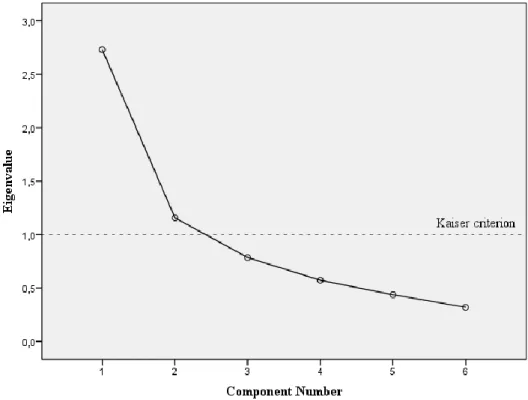
understanding its structure. The BRS is thought to be explained by only one latent variable. Therefore, first a scree plot was made and the point of inflection was discovered. This point gives information about how many factors there are. Another possibility is to use ‘Kaiser criterion’. This means that every factor with an eigenvalue greater than 1 can be retained. For a population of one hundred people the loading on the factor should be greater than .512 to be significant (Field, 2013). If the scree plot and Kaiser criterion show the one-dimensionality of the BRSnl and all questions score significantly on one factor, it can be said that the
questionnaire measures only one latent variable.
Reliability
inadequate, but can be labelled as questionable between .6 and .7 and as poor between .5 and .6. Every alpha lower than .5 is unacceptable (George & Mallery, 2002). So it is advisable to have a coefficient alpha above .7, but in some cases somewhat lower values might be
accepted. For variables with only two answer categories the KR-20, a modification of
Cronbach’s alpha, had to be used (Dooley, 2009). The outcome-categories are the same as for Cronbach’s alpha.
Construct Validity
If the questionnaires are normally-distributed, the Pearson’s product-moment-correlation can be used. Whether the results are normally-distributed could be seen with the aid of a
histogram. Twelve correlation-coefficients were calculated. Each construct was correlated to resilience measured with the BRSnl. A weak correlation is lower than .32, between .32 and .50 is a moderate correlation and a strong correlation is above .50 (Luteijn & Barelds, 2013). If the hypothesis is formulated directionally the statistical tests can be done one-tailed (Steinberg, 2011). Thus because of the hypotheses being directional, the test was done one-tailed. The significance level was <.05.
Multiple Regression Analysis
The multiple regression analysis was done for checking which constructs explained unique variance in the dependent variable, namely resilience. The model had as independent variables all constructs that correlated significantly with resilience. Multicollinearity should be tested. This could be done by correlating the independent variables among themselves and confirming these results by testing the variance-inflation factor (VIF). According to Urban and Mayerl (2008) the VIF should not be greater than five or lower than .25. The significance level was <.05.
Results Missing Values
108 persons volunteered their time to participate in the study. Three participants were taken out of the analyses. The first participant had not answered anything and the other two
from the average participants in this study. Most likely these cases had no special influence on the statistical analyses.
Psychometric Qualities
The factor analysis signalized ambiguous results regarding the dimensionality of the BRSnl. The scree plot can be seen in Figure 1. It displayed a one-factor solution. Taking Kaiser criterion into account the results point in the direction of two latent variables. The eigenvalue of the first factor was 2.731 and of the second was 1.156. About 46% of the variance could be explained by the first factor, 65% by both factors. The first item loaded significantly on the second factor and loaded also, but not significantly, on the first factor. The items 2 to 6 loaded significantly on the first factor and did not load significantly on the second factor. Values can be seen in Table 2.
The reliability analysis with Cronbach’s alpha showed an acceptable value the internal consistency of the BRSnl is .73. The coefficient alpha could only be increased by removing the first item from the analysis. After deleting that item, alpha would be .76.
It was chosen to retain the first item in the further statistical analyses. This was done because of the first item scoring also on the first factor and Cronbach’s alpha not increasing substantially when deleting this item (.03).
Table 2
Factor loadings
Component
Question 1 2
Na een moeilijke periode veer ik meestal gemakkelijk weer terug.
.330 .761*
Ik vind het moeilijk om me door
stressvolle gebeurtenissen heen te slaan.
.695* .262
Het kost me niet veel tijd om te herstellen van een stressvolle gebeurtenis.
.551* .454
Ik vind het moeilijk om het snel van me
af te schudden als er iets ergs is gebeurd. .701* -.420 Ik sla me meestal redelijk probleemloos
door moeilijke periodes heen.
.817* -.155
Het kost me meestal veel tijd om over
tegenslagen in mijn leven heen te komen. .823* -.320
Note: Items which load significant on the factor (>.512) appear with *.
Relations to Other Constructs
Linearity was checked and could be confirmed. Also it was searched for outliers, but no significant outliers could be detected. Table 3 displays the results of the correlation analyses. Altogether eight correlations between resilience and constructs were found to be significant. Besides recreation, the BRAVO-factoren showed no significant correlation with resilience. Four constructs, namely vigor, recreation, impact of work on physical complaints and mental distress, were found to be moderately correlated with resilience. The other significant
correlations were weak, namely work engagement, need for recovery, health and physical complaints.
Table 3
Pearson’s Correlations with the BRSnl (N=105, df=103; Diet, Smoking, Recreation and Health: N=104, df=102)
Pearson’s correlation
Construct R p
Work engagement .29 .001
Vigor .33 <.001
Need for recovery -.29 .001
Physical activity .10 .167
Smoking -.15 .071
Alcohol .09 .172
Diet .06 .261
Recreation .37 <.001
Health .25 .005
Physical complaints -.20 .018
Impact of work on physical complaints -.35 <.001
Table 4
Table 5
Results of the multiple regression analysis
Coefficients
Construct B P VIF
(Constant) 2.319 .000
Vigor .080 .223 1.403
Need for recovery -.001 .746 1.715
Recreation .053 .099 1.709
Health .036 .105 1.150
Physical complaints .007 .823 1.269
Impact of work on physical complaints
-.165 .079 1.295
Mental distress -.018 .298 1.595
Discussion
The current study tested whether the Dutch Brief Resilience Scale is a valid and reliable instrument to measure resilience. The current version of the BRSnl is found to be a reliable and valid resilience measurement instrument. The factor analysis showed ambiguous results that indicate both a one- and a two-factor structure. Despite this, a one-factor-solution was chosen, because of having enough evidence for that. The reliability was high enough to make the statement that the BRSnl shows internal consistency for the used sample. The results of the correlations point in the direction of a good validity. The highest correlated constructs were vigor, recreation, impact of work on physical complaints and mental distress with a significant moderate correlation with resilience. Four additional constructs showed a weak but significant relation with resilience. Altogether, this means that five hypotheses could be confirmed, two hypotheses could partly be confirmed and four hypotheses had to be rejected. The multiple regression analysis showed the model being significant in explaining variance in resilience. However, none of the constructs was uniquely related to resilience.
BRSnl
the most evidence is found for a one-factor structure. The loadings on the first factor were somewhat lower than those of the original BRS. The variance explained by the first factor would likely have a comparable height to the original version, if the item going to be reworded. For Cronbach’s alpha applied deleting the first item would heighten the alpha. Even in this case the coefficients would not reach exactly the height of the alpha of the original BRS. Analyses for the construct validity of the BRSnl point in the direction that the BRSnl measures resilience.
Regarding resilience itself some limitations should be mentioned. As seen in the introduction resilience is not clearly defined yet. It is not obvious whether resilience is really composed of one or more facets and which circumstances influence it. It was consequently difficult to find an adequate definition for this study. Nevertheless, in this study resilience was chosen to be defined as the capacity to bounce back from adversity, following the definition used by the developers of the original BRS. This definition seemed to be only one part of resilience and results suggested that this might only tell half the story of resilience. Resilience appears to be not only the capacity to bounce back from adversity, but for example also to recreate after daily stressful events.
Because of the BRSnl not measuring all parts of resilience, but only the general ability to bounce back, an alternative measurement instrument should be mentioned. Some
questionnaires are available that could grasp resilience itself and factors, which influence this ability. For example the RS validated in Dutch by Portzky et al. (2010). The RS measures additional to the ability of resilience protective factors, e.g. parts of the personality that promote better adaption of the person to different life situations (Leontjevas et al., 2014). The RS seems to be a good alternative if a broader operationalization is requested. The RS could have been an additional measurement instrument in the current study. This would have been useful to capture concurrent validity and to confirm the validity of the BRSnl definitely.
Regarding the validity, for some of the used constructs not many studies were
Concept Resilience
Some results led to the assumption that the current definition of resilience by Windle et al. (2011) is not complete. The current study brought new empirical findings based on the findings of the relation of resilience to the tested constructs. The question-sets had partly questionable psychometric quality. Whether those new assumptions are due to the question-sets or whether it is actually a modification the current definition of resilience, has to be checked in further research.
The results of the study suggest that resilience is a mental construct. The lifestyle and physical health of a person do not seem to be very important for having the capability to bounce back. More influential are a positive attitude and having good emotional resources, such as recreation from stress and the ability to differentiate between life spheres. This is amplified in the following sections.
In the current study the mental condition seemed to be more related to resilience than the physical part, as can be seen in the difference in the level of correlation of physical
complaints and mental distress with resilience. Health appeared to be less related to resilience than mental distress. Analyses suggested that health, as measured in this study, measures more physical health than mental health. This means that the physical state of the participants was steadily less related to the ability to bounce back. Resilience seems to be a mental state which is less affected by the physical condition of a person. This might suggest that resilience can rather be strengthened by improving the mental constitution of the person than by
advancing the person’s bodily state.
Other outcomes which point in the direction, that resilience is not really influenced by how a person behaves in her daily life, were the analyses about the relation to the lifestyle factors. All factors, except recreation, were found not to be related to resilience. The assumed relationships between resilience and physical activity (Ho et al., 2015; Moljord et al., 2014), the indirect relation between resilience and diet over health (Schure et al., 2013; Zahra et al., 2014), the relation of smoking and resilience (Goldstein et al., 2013) and alcohol and
resilience (Green et al., 2014) could not be replicated.
The current study found a relation of recreation and resilience. This relation was also suggested by studies of authors such as Buchecker and Degenhardt (2015) and Kim and Windsor (2015). In the current study recreation was found to be the most important construct in relation to resilience. This might mean that recreation has a more important role for
that resources can be found in the individual or its environment (Windle et al., 2011). One of those resources seems to be the capability to recreate. The negative relation of need for
recovery and resilience seems to point in the same direction. Those participants who had more problems in recreating after work seemed to have a less developed resilience. Learning how to recreate effectively from all daily life situations which stress the person, can help to develop a good working resource system.
Referring to the work constructs a moderate relation of the impact of work on physical complaints and resilience was discovered. When looking at the content of the used questions, it could be seen that the questions were about in how far work and physical complaints influence each other. That might mean that this question set measured the ability to differentiate between these life spheres. Results showed that a highly resilient person can differentiate between those two different life situations. This ability might be part of better coping-strategies that were found in highly resilient people (Portzky et al., 2010), but it might also mean that highly resilient people do not tend to let different spheres of life impact each other. This kind of handling might be a resource for a resilient person, because unaffected life spheres can be a good basis for more energy and a good sense of life.
Altogether the current results suppose resilience to be more facetted than the definition used in this and other studies suggested. Resilience seems to be a mental factor. This means that lifestyle-factors and physical circumstances have not much influence on it, but the inner attitude of the person has. This would suggest that the mindset of the person has to be changed to help a person to be more resilient. A more positive attitude to life and more self-care is essential for developing resilience. Part of that self-self-care is recreation after work or other stressful events. Another capacity that seems to be important is the capability to
differentiate between the life areas. Discriminating between the life spheres, where a negative event happened and where not, and not letting them influence each other is part of that. This could become apparent to be an important resource or part of resilience, which ensures the capacity to bounce back when the person is confronted with adversity. Altogether, the current study showed how important adequate resources for a highly resilient person are and that these resources are mostly mental.
Strengths and Limitations
Strengths
make it an even better measurement instrument than the current version is. New empirical findings regarding the concept resilience could be found which may improve the way current research displays resilience. Altogether, there were only a few missing values in this study. The new scales made for this study seemed to have acceptable psychometric quality, which could be seen by means of factor analysis and internal consistency.
Limitations
First it has to be mentioned that if participants take part in a research study they change their behavior, mostly unconsciously. Due to the fact that the participants feel observed, controlled or evaluated by both the researchers and their employers, they might not have given straight answers. This effect is known as the Hawthorne effect and it offers problems in many studies (Parsons, 1974). Unfortunately, this effect is inevitable in a correlational survey design, because of the necessity to use questionnaires.
Some problems could be detected in regard to the method in this study. Due to the convenience sample no balanced sample could be reached. Over 90 percent men took part in the study. Bonanno, Galea, Bucciarelli and Vlahov (2007) and Masood, Masud and Mazahir (2016) found a difference in gender respective resilience. Women were found to have a reduced likelihood of resilience. This could have been influential on the results. It should be noted that the mean age of the participants was relatively high. It reached nearly fifty years. These values might be not representable for the whole population. Cronbach’s alpha for diet and impact of work on physical complaints was poor and for alcohol and recreation
questionable. This has not been the best basis for the further statistical analyses.
Recommendations
To get a more proper measurement instrument for resilience, the BRSnl should be compared to other validated questionnaires that measures resilience itself. An important aspect is to use validated questionnaires for the constructs that belonged to the not validated questionnaires in the current study. Another advice is to reword the first item and make a new study that
investigates the BRSnl again. With regard to the participants used in the current study, it is necessary to repeat the study with an even distribution of age and gender in the sample. Also could be interesting to use a greater sample.
Conclusion
Altogether, the current study showed the BRSnl to be a good measurement instrument that might be useful in practice because of its brevity. However, to approve the BRSnl a new version with a new first item should be made and further analyses of the psychometric quality must be implemented.
References
Aspinwall, L. G., & MacNamara, A. (2005). Taking positive changes seriously: Toward a positive psychology of cancer survivorship and resilience. Cancer, 104(11 SUPPL.), 2549–2556. doi:10.1002/cncr.21244
Bonanno, G., Galea, S., Bucciarelli, A., & Vlahov, D. (2007). What predicts psychological resilience after disaster? The role of demographics, resources, and life stress. Journal of Consulting and Clinical Psychology, 75(5), 671–682. doi:10.1037/0022-006X.75.5.671
Buchecker, M., & Degenhardt, B. (2015). The effects of urban inhabitants’ nearby outdoor recreation on their well-being and their psychological resilience. Journal of Outdoor Recreation and Tourism, 10, 55–62. doi:10.1016/j.jort.2015.06.007
Cohrs, J. C., Christie, D. J., White, M. P., & Das, C. (2013). Contributions of positive psychology to peace: toward global well-being and resilience. The American Psychologist, 68(7), 590–600. doi:10.1037/a0032089
de Croon, E. M., Sluiter, J. K., & Frings-Dresen, M. H. W. (2006). Psychometric properties of the Need for Recovery after work scale: test-retest reliability and sensitivity to detect change. Occupational and Environmental Medicine, 63(3), 202–206.
doi:10.1136/oem.2004.018275
Dooley, D. (2009). Social Research Methods (4th ed.). Harlow: Pearson Education Limited.
Field, A. (2013). Exploratory Factor Analysis. In Discovering Statistics Using IBM SPSS Statistics (4th ed., pp. 665–719). London: SAGE.
Friborg, O., Hjemdal, O., Martinussen, M., & Rosenvinge, J. H. (2009). Empirical Support for Resilience as More than the Counterpart and Absence of Vulnerability and Symptoms of Mental Disorder. Journal of Individual Differences, 30(3), 138–151. doi:10.1027/1614-0001.30.3.138
George, D., & Mallery, P. (2002). SPSS for Windows Step by Step: A Simple Guide and Reference (4th ed.). Allyn & Bacon.
Green, K. T., Beckham, J. C., Youssef, N., & Elbogen, E. B. (2014). Alcohol misuse and psychological resilience among U.S. Iraq and Afghanistan era veterans. Addictive Behaviors, 39(2), 406–413. doi:10.1016/j.addbeh.2013.08.024
Hergenhahn, B. R. (2008). Humanistic (Third-Force) Psychology. In An Introduction to the History of Psychology (6th ed., pp. 570–605). Belmont: Michele Sordi.
Ho, F. K. W., Louie, L. H. T., Chow, C. B., Wong, W. H. S., & Ip, P. (2015). Physical activity improves mental health through resilience in Hong Kong Chinese adolescents.
BMC Pediatrics, 15(1), 48. doi:10.1186/s12887-015-0365-0
Hopkins, K. D., Shepherd, C. C. J., Taylor, C. L., & Zubrick, S. R. (2015). Relationships between psychosocial resilience and physical health status of Western Australian urban Aboriginal youth. PLoS ONE, 10(12), 1–16. doi:10.1371/journal.pone.0145382
Hücker, F.-J., & Jung, M. (2014). Update on Positive Psychology. Sozial Extra, 38(6), 6–9. doi:10.1007/s12054-014-0124-8
Hylton Rushton, C., Batcheller, J., Schroeder, K., & Donohue, P. (2015). Burnout and
Resilience Among Nurses Practicing in High-Intensity Settings. American Association of Critical-Care, 24(5), 412–421. doi:http://dx.doi.org/10.4037/ajcc2015291
Khodarahimi, S. (2014). The Role of Gender on Positive Psychology Constructs in a Sample of Iranian Adolescents and Young adults. Applied Research in Quality of Life, 9(1), 45– 61. doi:10.1007/s11482-013-9212-3
Kim, M., & Windsor, C. (2015). Resilience and work-life balance in first-line nurse manager.
Asian Nursing Research, 9(1), 21–27. doi:10.1016/j.anr.2014.09.003
Leontjevas, R., De Beek, W. O., Lataster, J., & Jacobs, N. (2014). Resilience to affective disorders: A comparative validation of two resilience scales. Journal of Affective Disorders, 168, 262–268. doi:10.1016/j.jad.2014.07.010
Luteijn, F., & Barelds, D. (2013). Psychologische diagnostiek in de gezondheidszorg (3rd ed.). Den Haag: Boom Lemma.
Manning, L. K., Carr, D. C., & Kail, B. L. (2014). Do Higher Levels of Resilience Buffer the Deleterious Impact of Chronic Illness on Disability in Later Life? The Gerontologist,
00(00), 1–12. doi:10.1093/geront/gnu068
Markovitz, S. E., Schrooten, W., Arntz, A., & Peters, M. L. (2015). Resilience as a predictor for emotional response to the diagnosis and surgery in breast cancer patients.
Psychooncology, 24(12), 1639–1645. doi:10.1002/pon.3834
Marques, S. C., Pais-Ribeiro, J. L., & Lopez, S. J. (2011). The Role of Positive Psychology Constructs in Predicting Mental Health and Academic Achievement in Children and Adolescents: A Two-Year Longitudinal Study. Journal of Happiness Studies, 12(6), 1049–1062. doi:10.1007/s10902-010-9244-4
Martz, E., & Livneh, H. (2015). Psychosocial Adaptation to Disability Within the Context of Positive Psychology: Findings from the Literature. Journal of Occupational
Rehabilitation, 26(1), 4–12. doi:10.1007/s10926-015-9598-x
Masood, A., Masud, Y., & Mazahir, S. (2016). Gender differences in resilience and psychological distress of patients with burns. Burns, 42(2), 300–306.
doi:10.1016/j.burns.2015.10.006
Moljord, I. E. O., Moksnes, U. K., Espnes, G. A., Hjemdal, O., & Eriksen, L. (2014). Physical activity, resilience, and depressive symptoms in adolescence. Mental Health and
Physical Activity, 7(2), 79–85. doi:10.1016/j.mhpa.2014.04.001
NISB. (n.d.). BRAVO-kompas. Retrieved April 8, 2016, from http://tools.nisb.nl/bravokompas
Parsons, H. M. (1974). What Happened at Hawthorne? Science, 183(4128), 922–932. doi:10.1126
Portzky, M., Wagnild, G., De Bacquer, D., & Audenaert, K. (2010). Psychometric evaluation of the Dutch Resilience Scale RS-nl on 3265 healthy participants: A confirmation of the association between age and resilience found with the Swedish version. Scandinavian Journal of Caring Sciences, 24(SUPPL. 1), 86–92.
doi:10.1111/j.1471-6712.2010.00841.x
kindergarten teachers. International Archives of Occupational and Environmental Health, 88(8), 1053–1059. doi:10.1007/s00420-015-1033-2
Schaufeli, W. B., Bakker, A. B., & Salanova, M. (2006). The measurement of work engagement with a short questionnaire: a cross-national study. Educational and Psychological Measurement, 66(4), 701–716. doi:10.1177/0013164405282471
Schaufeli, W., & Bakker, A. (2003). UBES - Utrechtse Bevlogenheidschaal. Universiteit Utrecht, Utrecht.
Schure, M. B., Odden, M., & Goins, R. T. (2013). The Association of Resilience With Mental and Physical Health Among Older American Indians: the Native Elder Care Study.
American Indian and Alaska Native Mental Health Research, 20(2), 27–41. Retrieved from
https://login.ezproxy.net.ucf.edu/login?auth=shibb&url=http://search.ebscohost.com/logi n.aspx?direct=true&db=edswss&AN=000322082700002&site=eds-live&scope=site
Seligman, M. E. P., & Csikszentmihalyi, M. (2000). Positive psychology: An introduction.
American Psychologist, 55(1), 5–14. doi:10.1037//0003-066X.55.1.5
Smith, B. W., Dalen, J., Wiggins, K., Tooley, E., Christopher, P., & Bernard, J. (2008). The Brief Resilience Scale : Assessing the Ability to Bounce Back, 194–200.
doi:10.1080/10705500802222972
Steinberg, W. J. (2011). Statistics Alive! (2nd ed.). SAGE.
Urban, D., & Mayerl, J. (2008). Regressionsanalyse: Theorie, Technik und Anwendung (3rd ed.). Wiesbaden: VS Verlag.
Vandereycken, W., Hoogduin, C. A. L., & Emmelkamp, P. M. G. (2008). Handboek Psychopathology (4th ed.). Houten: Bohn Stafleu van Loghum.
Veldhoven, M. Van, Meijman, T. F., & Fortuin, R. J. (2002). Handleiding vbba. In SKB Vragenlijst Services (2nd ed., pp. 1–32). Amsterdam: Suzanne de Haan (SKB Vragenlijst Services) en Annelies Vethman (Vethman Communicatie).
Windle, G., Bennett, K. M., & Noyes, J. (2011). A methodological review of resilience measurement scales. Health Qual Life Outcomes, 9(8). doi:10.1186/1477-7525-9-8
Appendix A Korte Veerkracht Vragenlijst
(Nederlandse vertaling, WMC Six Dijkstra, 2015)
1. Na een moeilijke periode veer ik meestal gemakkelijk weer terug.
1 2 3 4 5
2. Ik vind het moeilijk om me door stressvolle gebeurtenissen heen te slaan. (R)
1 2 3 4 5
3. Het kost me niet veel tijd om te herstellen van een stressvolle gebeurtenis.
1 2 3 4 5
4. Ik vind het moeilijk om het snel van me af te schudden als er iets ergs is gebeurd. (R)
1 2 3 4 5
5. Ik sla me meestal redelijk probleemloos door moeilijke periodes heen.
1 2 3 4 5
6. Het kost me meestal veel tijd om over tegenslagen in mijn leven heen te komen. (R)
Appendix B BRAVO-factoren
The BRAVO-factoren question sets could be get by the first author of this study.
Physical Activity
Points were assigned to two questions and a total score is made, the higher the value, the more often someone does sport. Questions were about how many days per week a medium or high exhausting sport is done.
Smoking
Assigning points to two questions arrived at the result that zero means being someone who never smoked, one is someone who smoked in the past and two being the ones that keep on smoking when a total score was made. The questions asked about whether the participant had ever smoked and whether he smokes currently.
Alcohol
Points were assigned to two questions and a total score was computed, where an eight means drinking a high amount of alcohol and zero means drinking nothing. The questions were about how many days a week and how many glasses were consumed.
Diet
Points were assigned to four questions and summed up. A high score means eating healthier. Questions were about self-perception, how often three meals per day were eaten, how much vegetable was eaten and whether the participants ate varied.
Recreation
Appendix C Health
Points were assigned to the answers. The higher the total score, the better is the health situation of the respondent.
1. Heeft u gezondheidsklachten?
o Nee, nauwelijks 3 o Soms 2
o Regelmatig 1
2. Is er bij uzelf ooit een hoge bloeddruk vastgesteld? o Ja 1
o Nee 3
3. Heeft u medicijnen gehad om de bloeddruk te verlagen?
o Ja, deze gebruik ik nog steeds. 1
o Ja, maar deze medicijnen gebruik ik niet meer. 2 o Nee 3
4. Heeft u bij uzelf al ooit te maken gehad met hart- en vaatziekten? o Ja 1
o Nee 3
5. Heeft u medicijnen gehad om suiker te beïnvloeden? o Ja, deze gebruik ik nog steeds. 1
o Ja, maar deze medicijnen gebruik ik niet meer. 2 o Nee 3
6. Heeft u medicijnen gehad om uw cholesterol te beïnvloeden?
o Ja, deze gebruik ik nog steeds. 1
Appendix D Physical Complaints
Points were assigned, where the unfavorable answer gets the higher points. A total score was made, the higher the worse is the physical health situation. The first question in divided in nine questions that it could be scored per problem zone. The last two questions were the work related variables. Here were also points assigned and a second total score made.
1. Heeft u de afgelopen 3 maanden last (pijn, ongemak) gehad van uw o Nek
o Schouder o Boven in de rug o Onder in de rug o Ellebogen
o Polsen of handen o Heupen
o Knieën
o Enkels of voeten
Impact of Work on Physical Complaints
1. Verergert een of meerdere van deze klachten door uw werk? Ja 1
Nee 0
2. Hindert een of meerdere van deze klachten uw werk? Ja 1
Nee 0
Mental Distress
The answers were scored and a high sum score means being in bad mental constitution and a low score being mentally fit and healthy.
1. Bent u de laatste tijd door zorgen veel slaap tekort gekomen?
o Helemaal niet 0
o Niet meer dan gewoonlijk 1 o Iets meer dan gewoonlijk 2 o Veel meer dan gewoonlijk 3
2. Heeft u de laatste tijd het gevoel dat u voortdurend onder druk stond?
o Helemaal niet 0
o Niet meer dan gewoonlijk 1 o Iets meer dan gewoonlijk 2 o Veel meer dan gewoonlijk 3
3. Heeft u zich de laatste tijd kunnen concentreren op uw bezigheden?
o Slechter dan gewoonlijk 2 o Veel slechter dan gewoonlijk 3
4. Bent u de laatste tijd in staat geweest uw problemen onder ogen te zien?
o Beter (in staat) dan gewoonlijk 0 o Net zo goed (in staat) als gewoonlijk 1 o Slechter (in staat) dan gewoonlijk 2 o Veel slechter (in staat) dan gewoonlijk 3
5. Voelde u zich de laatste tijd in staat om beslissingen (over dingen) te nemen?
o Beter in staat dan gewoonlijk 0 o Net zo goed in staat als gewoonlijk 1 o Slechter in staat dan gewoonlijk 2 o Veel slechter in staat dan gewoonlijk 3
6. Heeft u de laatste tijd het gevoel gehad dat u uw moeilijkheden niet de baas kon?
o Nee, ik had dat gevoel helemaal niet 0 o Niet minder de baas dan gewoonlijk 1 o Iets minder de baas dan gewoonlijk 2 o Veel minder de baas dan gewoonlijk 3
7. Heeft u zich de laatste tijd alles bij elkaar redelijk gelukkig gevoeld?
o Gelukkiger dan gewoonlijk 0 o Even gelukkig als gewoonlijk 1 o Minder gelukkig dan gewoonlijk 2 o Veel minder gelukkig dan gewoonlijk 3
8. Heeft u de laatste tijd plezier kunnen beleven aan uw gewone, dagelijkse bezigheden? o Meer dan gewoonlijk 0
o Evenveel als gewoonlijk 1 o Iets minder dan gewoonlijk 2 o Veel minder dan gewoonlijk 3
9. Heeft u zich de laatste tijd ongelukkig en neerslachtig gevoeld?
o Helemaal niet 0
o Niet meer dan gewoonlijk 1 o Iets meer dan gewoonlijk 2 o Veel meer dan gewoonlijk 3
10. Bent u de laatste tijd het vertrouwen in uzelf kwijtgeraakt? o Helemaal niet 0