Master Thesis – Public Version
29/09/2016
T.W. Duffhues
S1007181
Master: Industrial Engineering and Management Track: Financial Engineering and Management
Supervisor Ir. H.J. Hofstede RC
Supervisor Ir. H. Kroon
First Supervisor Dr. B. Roorda
Second Supervisor Dr. R.A.M.G. Joosten
A suitable alternative? How Product-Service
System can support Schiphol in the transition
Colophon
Master Thesis A suitable solution? How Product-Service Systems can support
Schiphol in the transition towards a Circular Economy
Version Public Version 1.0
Date 29/09/2016
Author T.W. Duffhues
S1007181
Master Industrial Engineering and Management Master Track Financial Engineering and Management Faculty of Behavioural Management and Social Sciences Dept. Industrial Engineering and Business Information Systems. University of Twente.
Supervisor Schiphol Ir. H.J. Hofstede RC
Senior Manager Control & Pricing Business Area Aviation
Schiphol Group
External Supervisor Ir. H. Kroon
First Supervisor Dr. B. Roorda
University of Twente Associate Professor of Financial Engineering
Faculty of Behavioural Management and Social Sciences, Dept. Industrial Engineering and Business Information Systems. University of Twente.
Second Supervisor Dr. R.A.M.G. Joosten
University of Twente Assistant Professor
Table of Content
Table of Content ... 3
1. Preface ... 5
2. Management Summary ... 6
3. Abbreviations ... 7
4. Introduction ... 8
4.1 Problem Introduction ... 8
4.2 Problem Statement ... 10
4.3 Research Goal ... 10
4.4 Research Questions ... 10
4.5 Research Approach ... 11
4.6 Scope ... 14
4.7 Deliverables ... 14
5. Theoretical Framework on Circular Economy and Product-Service Systems ... 15
5.1 Introduction ... 15
5.2 Circular Economy ... 15
5.3 Product-Service Systems ... 18
5.4 Decision making and valuation of Product-Service Systems. ... 20
5.5 Conclusion ... 29
6. Current Situation ... 31
6.1 Introduction ... 31
6.2 Asset Management at Schiphol ... 31
6.3 Sustainability at Schiphol ... 32
6.4 Project valuation ... 33
6.5 Sustainability at Schiphol ... 35
6.6 Light-as-a-Service ... 35
6.7 Conclusion ... 38
7. Product-Service Systems Framework ... 39
7.1 Introduction ... 39
7.2 Foundation ... 39
7.3 Framework elements ... 41
7.4 Product-Service System Decision Framework (PSS-DF) ... 43
7.5 PSS Pricing Tool ... 50
7.6 Outcome ... 53
7.8 Conclusion ... 55
8. Validation and Case Study ... 56
8.1 Introduction ... 56
8.2 Validation set-up ... 56
8.3 Validation of Decision Framework ... 57
8.4 Validation of PSS Pricing Tool ... 58
8.5 Validation Number of Simulations ... 67
8.6 Conclusion ... 67
9. Challenges for Product-Service Systems at Schiphol ... 68
9.1 Introduction ... 68
9.2 Challenges ... 68
10. Results, Conclusion and Recommendations ... 69
10.1 Introduction ... 69
10.2 Results ... 69
10.3 Conclusion ... 74
10.4 Recommendations ... 75
11. Further usability, Limitations, Discussion & Reflection and Future Research ... 76
11.1 Further usability ... 76
11.2 Limitations ... 76
11.3 Discussion & Reflection ... 76
11.4 Future Research ... 77
12. References ... 78
1. Appendix ... 83
1.1 Appendix A – Circular Economy ... 83
1.2 Appendix B – Product-Service Systems ... 90
1.3 Appendix C - Asset Management at Schiphol Aviation... 111
1.4 Appendix D - Circular Economy Project at Schiphol ... 116
1.5 Appendix E – PSS Pricing Tool example ... 117
1.6 Appendix F – Validation of the number of simulations ... 124
1.7 Appendix G - Manual Compact Product-Service Systems Decision Framework ... 125
1.8 Appendix H - Manual PSS Criteria Matrix ... 135
1.9 Appendix I – Manual PSS Pricing Tool ... 137
1.10 Appendix J –Extensive PSS Decision Framework ... 148
1.
Preface
Dear reader,
The last 9 months I have been working one my Master Thesis in order to graduate from the University of Twente. I performed my internship at Schiphol Group and I have enjoyed my time on the airport.
I want to thank a few people who have made this research possible, but also gave me the room, time and opportunity to find my way with graduating, which was not easy at times due to unforeseen events. The first person I want to thank is Huub Hofstede. Huub, you offered me the opportunity to perform my internship at Schiphol, not only allowing me to graduate at a firm which has inspired me for a long time, but also to get a taste of the complexity of operation an airport has to deal with on a daily basis during their 100th year existence. You granted me the space to make the research mine and take
Circular Economy to the next level for me personally. But most of all I really appreciate the openness, time and space you have given me to make sure that the most important parts of life were given enough attention.
The second person I want to thank is Henk Kroon. You have set me on a great start with sharp insight and asking the right questions, but also the space and time you provided when I needed it. I have enjoyed our corporation and enthusiasm you seem to spark with people. I also want to thank you for the great advice on my final presentation at Schiphol, which really enabled me to give a good presentation and spark a good discussion without losing the goal of the presentation.
The last persons I want to thank are Berend Roorda and Reinoud Joosten. You made it possible for me to graduate on short notice and with great support. I enjoyed the courses I have had over the last years from the both of you.
The most important persons whom I want to thank are my parents and my brother. You have shown what perseverance and unconditional love really are. I could not be more proud on what we have achieved the last year, despite all the troubles and challenges. I feel blessed.
Lastly, I would like to thank my family and friends for their support, friendship, (un)wanted advice and distraction which is always important.
I hope you all are proud of what I have done the last year, I certainly am.
Tom Duffhues
2.
Management Summary
Circular economy is a term which can be heard more and more in business and in the academic world. At Schiphol they are also working on incorporating Circular Economy into their business model. One of the ways Schiphol could introduce more, is via Product-Service Systems. But is it a suitable solution for the transition towards circular economy and how can success be guaranteed?
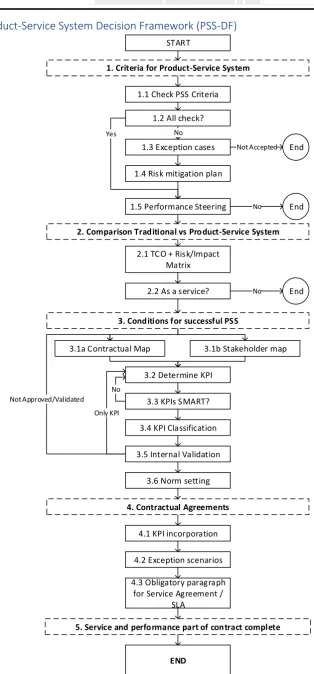
Product-Service Systems can contribute to more Circular Economy at Schiphol when the result-oriented approach is followed. This approach consists of that performance is the main aspect which Schiphol needs and the ownership remains at the supplier. Because Schiphol acquires a service instead of a product, it engages in a longer relationship with the supplier and it is important to capture the new relationship in proper KPIs. In order to make sure Schiphol has a clear decision process which enables PSS to be a suitable alternative, a decision framework is developed which captures the elements needed for decision making and is tailored towards Schiphol’s decision making process, as well as the lessons learned from the Light-as-a-Service pilot project.
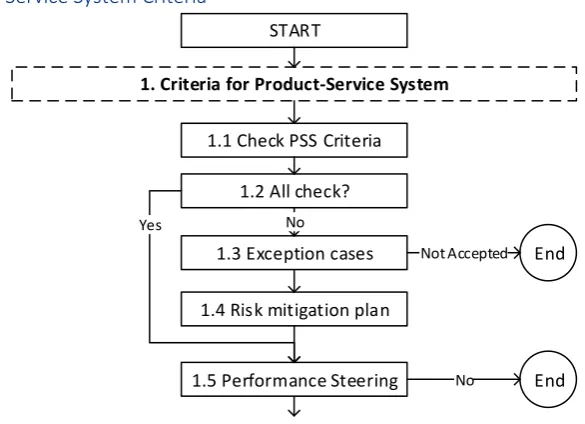
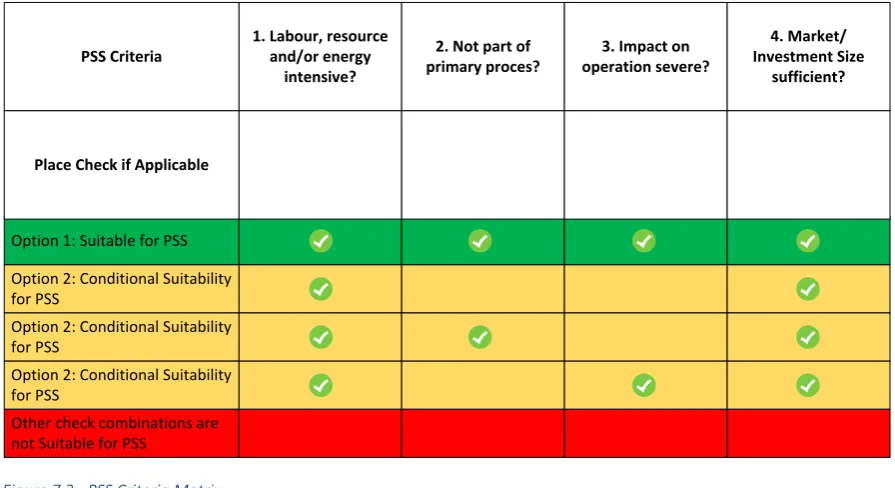
The first step is to check if an asset is suitable to be transformed to a Product-Service Systems. Four criteria need to be met, otherwise it is not advised to consider Product-Service Systems as an alternative. These criteria are; i) material/labour and/or energy intensive ii) not part of the primary process iii) consequence of malfunction is severe and iv) market/customer size has to be sufficient. The next step is to make sure that the decision making to check if a Product-Service System is a good alternative financially, is to make sure decision making is aligned with that of Schiphol. Schiphol uses a Total Cost of Ownership tool to calculate the costs it needs to carry across the lifetime of an asset. This financial data is used together with an uncertainty assessment of a supplier to get a price indication of what Schiphol should be willing to pay to get a service, instead of an asset. This pricing model is validated using the Light-as-a-Service pilot case, which Schiphol embarked on together with Cofely/Philips. From this validation case, the following results are obtained. The PSS price which Schiphol should be willing to pay is €441k and the offer Cofely/Philips made is €425k. The pricing tool shows that the offer of Philips was a good one and that the price difference could also be explained, thus validating the model.
PSS Price Offer Cofely Philips
€ 441.397,- €
3.
Abbreviations
CE Circular Economy
ACM Dutch Authority for Consumer and Markets ASM Aviation Asset Management
BA Business Area CAPEX Capital Expenditure CEC Cost Expertise Centre
CPS Consumers, Products and Services CR Corporate Responsibility
DCF Discounted Cashflow EAC Equivalent Annual Cost EoL End-of-Life
GDP Gross Domestic Product HU Heijmans Utilities
IAS International Accounting Standards
IFRS International Financial Reporting Standards KPI Key Performance Indicator
L.a.a.S. Light-as-a-Service LCC Life Cycle Costing NPV Net Present Value OPEX Operational Expenditure OPS Airport Operations PSS Product-Service Systems
PV Present Value
RAB Regulatory Asset Base RQ Research Question SLA Service Level Agreement
SMART Specific, Measurable, Accountable, Realistic and Timesensitive
SQ Sub Question
SSE Safety, Security & Environement TCO Total Cost of Ownership
TEC Technical Expertise Centre
4.
Introduction
4.1
Problem Introduction
The earth is faced with continuous, accelerated and unprecedented growth in both the number of people, as well as people who have obtained, or want to obtain a certain degree of wealth. To get an idea of what it actually implies, is that currently mankind asks around 1,5 earths in its annual need for consumption, this will grow to 3 or 4 earths in 2050 when the earth’s population is expected to hit 9 billion people (Bastein, Roelofs, Rietveld, & Hoogendoorn, 2013). The current linear approach of achieving this growth is incapable of sustaining this growth, because the earth simply cannot keep up with replenishing its natural resources. Circular Economy aims to be restorative and regenerative by design, and aims to keep products, components, and materials at their highest utility and value at all times in a fully sustainable matter. It aims to provide sustainable value creation, which is decoupled from the increased consumption of resources (Ellen MacArthur Foundation, 2013a).
Circular Economy (CE) is a sustainability term which has increased in usage over the last few years in the media and within businesses(Bastein et al., 2013) (Ellen MacArthur Foundation, 2013a) (Ellen MacArthur Foundation, 2013b) (Ellen MacArthur Foundation, 2013c) (NU.nl, 2016) (Rabobank, 2014) (Tegenlicht, 2015). It might also be a term which one would not expect to pop up at an organisation such as Schiphol, due to Schiphol’s role in the aviation value chain. But being part of this value chain does not mean Schiphol is not working on sustainability, on the contrary. In 2016, Schiphol joined the Ellen MacArthur Foundation, which strives to accelerate the transition towards a CE (Ellen MacArthur Foundation, 2016).
From a growing understanding that standing idle will not solve these problems, Schiphol incorporated sustainability into its strategic and corporate responsibility goals. Especially CE is mentioned explicitly (Schiphol Group, 2016). Schiphol has the desire to grow, maintain and improve its status as one of Europe’s biggest Europe and its strive to be Europe’s Preferred Airport, which it needs to pursue in order to stay a strong competitor in the fierce European and global aviation market. Furthermore, within the Netherlands Schiphol fulfils a main port function and has a major place in the Dutch economy, not just as an economic powerhouse, but also as a facilitator for businesses around the country (Schiphol Group, 2015). Uniting these goals, growth and sustainability, seems as a mission impossible, but CE promises to be the next big sustainability step mankind could take. By decoupling growth from resource usage. For Schiphol, CE offers the possibility to grow in a sustainable manner, while striving to become Europe’s Preferred Airport. A complex and daunting challenge, where Schiphol needs to invest in capacity, quality, while become more efficient with their resources such that airlines have an incentive, via low tariffs, to use Schiphol as their gateway.
Schiphol
Schiphol Group is the Dutch airport firm which is responsible for the exploitation of, mainly, Schiphol Amsterdam Airport since 1916. In 2015, Schiphol was responsible for the handling of 58,2 million passengers (Nijhuis, 2016) and in order to handle all these passengers in a good and sufficient manner, Schiphol has 4 Business Areas (BA), each responsible for the specific tasks required to operate Schiphol. These four BA’s are Aviation, Consumers Products and Services, Real Estate and Alliances & Participations (Schiphol Group, 2015). Consumers Products and Services (CPS) operates the parking, retail and advertise facilities. Real Estate manages the commercial property of the Schiphol excluding airside, such as; office locations, hotels and other types of real estate. Alliances & Participations is responsible for managing the interest of Schiphol in other (regional) airport, such as Lelystad and Eindhoven, and the exploitation of the Airport City concept outside Schiphol.
Business Area Aviation
The Business Area Aviation can be considered as the core business of Schiphol. It is the business area where all aviation related activities are performed. These activities can be split into three parts; Safety, Security & Environment (SSE), Airport Operations (OPS) and Asset Management (ASM).
SSE is responsible for the safety of the passengers, quality of the surface water, incident investigation and the lobby in Europe. SSE’s goal is to minimise the risk of endangering safety of everything which happens in and around Schiphol. OPS is responsible for the operational aspect of the aviation activities. Baggage handling, airside operations such as airplane handling, bird control, maintenance and terminal logistics and so on. ASM is the department which is the actual owner of all the aviation related assets, e.g. runways, taxiways, terminals and so on. Furthermore, ASM is responsible for the development and management of those assets. Finally, ASM is responsible for determining the tariffs for airlines for their usage of Schiphol’s facilities. Due to its economic relevance, the nature of its business and its market power over the airlines, Schiphol is regulated by the Dutch Authority of Consumers and Markets (ACM) which is granted the power by the Dutch Aviation Act to act as a regulator. This regulation has far reaching consequences on operations of ASM and is meant to ensure a non-discriminatory environment for aviation activities at Schiphol (Ministerie van Verkeer en Waterstaat, 2006), (Luchtvaartwet, 2016). To get sense of the magnitude of these consequences, 50% of the costs to airlines is directly related to regulated assets (Asset Wise! Team Schiphol, 2015).
Context
In order to have a clear picture of the context of this Master Thesis and where the research will be conducted, the following points have to be taken into account when reading this Master Thesis, to make sure that the reader is aware of the context.
1. This Master graduation assignment will primarily be executed within Schiphol Aviation Asset Management. This due to the initiator and supervisor of this research, Ir. Huub Hofstede RC, Sr. Manager Control and Pricing Business Area Aviation.
2. Due to the strict regulation by the ACM, normal applied business methods within real estate and asset management could be prohibited by the regulator and therefore, asset management is performed within tighter accounting principles than commercial asset management. 3. Schiphol is compliant with IFRS ruling for accountancy, however, where an issue arises
between the ‘Luchtvaartwet’ and the IFRS, the Dutch Aviation Law is leading. This mainly has to do with the activation of Asset on the Balance sheet.
5. Internal practices and guidelines of Schiphol will act as the basis for (possible) decision making, due to the clear Asset Management guidelines Schiphol has put forth. Furthermore, any decision processes need to be aligned with the current decision processes, in order to ensure transparency in decision making and consequences on airline tariffs.
4.2
Problem Statement
Within this Master Thesis, Schiphol is the problem owner for not being able to oversee on how a successful implementation of PSS could be performed, as well as, how it would contribute to CE for Schiphol. Therefore, the following problem statement has been formulated:
It is unclear whether Product-Service Systems are suitable to support the transition towards Circular Economy at Schiphol.
4.3
Research Goal
Given the problem statement, the research goal is primarily to shed light on how PSS can be implemented and therefore contribute to a CE at Schiphol. As can be imagined, it is therefore important to first know what CE is exactly, how it is currently applied within Schiphol, what PSS are, what a fair price is for a PSS and how the decision process of the acquisition of a PSSs should look like. Furthermore, it is always important to research what kind of barriers exist within Schiphol and with PSS themselves.
4.4
Research Questions
Research Question
Based on the problem statement, combined with the research goals, the main Research Question (RQ) can be formulated. This question reflects the problem statement and its answer should satisfy the stated research goals
RQ Are Product-Service Systems suitable to support the transition towards a Circular Economy at Schiphol?
Sub Questions
In order to fully answer the Research Question, a number of Sub Questions (SQ) have been formulated. By systematically answering the SQ, a fully substantiated answer to the RQ can be provided, as well as making sure that all relevant aspect of CE, PSS and it applications have been covered. This allows for clear conclusions and recommendations for Schiphol to use in the future and therefore maximise the usability of this Master Thesis, something which is of the utmost importance for an Industrial Engineering and Management student’s graduation internship, in the author’s opinion.
SQ1 What is Circular Economy?
The first sub question is posed in order to gain a better understanding of CE. What its fundamentals are and therefore provide a clear basis for the rest of this Master Thesis.
SQ2 What are Product-Service Systems?
The second sub question is regarding PSS. What are they, how can they be beneficial for Schiphol and its CE goals. By answering this question, it becomes clear on how PSS contribute, as well as how their implementation should be given shape in order to make it successful.
SQ3 What is the current status of Schiphol, especially regarding decision making?
Schiphol. Schiphol has clear processes which ensures that decision making is performed well, any solutions which are put forth in this thesis must fit in with this in mind.
SQ4 What is needed for good decision making with Product-Service Systems at Schiphol?
The fourth sub question deals with what is needed for good decision making PSS. The two previous sub questions are combined in order to facilitate clear decision making, which is suited for Schiphol. Furthermore, it needs to deal with how the conditions of PSS are translated in decision making tool(s).
SQ5 How can a price for a Product-Service System be determined?
The fifth sub question is focussed on how a price determination can be performed. Because a PSS is a service which is acquired and paid for by a yearly fee, Schiphol needs a tool which can determine what a fair price would be for supplier to ask, given the fact that the supplier remains owner of the Asset, for which they need to carry new uncertainties they previously did not need to bear. With the help of such a tool Schiphol can check what price they find reasonable and enable a good comparison between doing it the traditional way, as an asset owner, or acquiring such a PSS.
SQ6 What are possible barriers for the implementation of Product-Service Systems?
The sixth and last sub question will be dealing with what implementation barriers are discovered throughout the research. Implementation barriers can exist anywhere in the organisation and Schiphol needs to be aware that they exist and that they have the potential to slow down development. In order to fully enable the transition via PSS, the barriers, limitations and properties of PSS need to be compared to the current way of doing business of Schiphol, in order to point out where chances and challenges are present.
4.5
Research Approach
Data Collection
Data collection can roughly be divided into two categories, primary sources and secondary sources of information (Figure 4.1). The primary sources will be mainly used to capture Schiphol’s perspective in Sub Questions 3 and 6, whilst the secondary sources can provide excellent means for answering Sub Questions 1, 2. Sub questions 4 and 5 will draw form both primary and secondary sources.
Primary Sources
Primary sources of information consist of experts on different areas and case studies. The experts can provide relevant information on a wide spectrum related to this research. By consulting relevant experts for their opinion and perception of the matter, valuable information can be obtained. The current list of experts can be found in Table 4.1.
Table 4.1 - Primary sources; Experts
Secondary Sources
The secondary sources of information mainly consist of academic literature and other types of external sources which can be accessed. A literature study will provide a solid basis for the research. By systematically studying literature and other sources, a view of the current status of affairs can be formed which enables to see where current literature provides clues on how CE affects Schiphol, as well as identify knowledge gaps within either Schiphol or the literature itself. If a knowledge gap at Schiphol is found, the research allows Schiphol to obtain knowledge on CE. If a knowledge gap is found in the academic literature, the research might shed new light and enrich the academic literature on the impact of CE on service providers and regulated companies.
The literature search will be conducted on well-established academic research platforms such as, Sciencedirect, Web Of Science and Scopus. The structured search with search terms, number of hits and usable articles will be provided in the appendix of the thesis. Other sources of information will also be used, this could include websites, reports of CE organisations, reports about CE, government sources, news articles and other sources which might be found.
Research Methodology
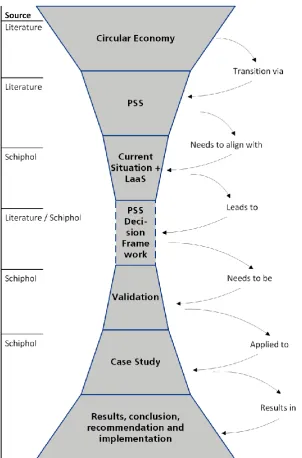
The research methodology and structure of this Master Thesis can be found in Figure 4.2. It clearly shows show one subject leads to the next and how the Thesis’ structure and scope are build. On the left the source of information is presented and on the right the flow of how the thesis is build up.
Expert Firm Area of Expertise
Sustainability Development Manager
Schiphol (internal) Sustainability goals & strategy
Sustainability Advisor
Schiphol (internal) Sustainability goals & strategy
Cost experts Schiphol (internal) Cost estimation and modelling
Asset management experts
Schiphol (internal) Asset data
Project Management L.a.a.S.
Schiphol (internal) Information on the Light-as-a-Service project at Schiphol
Control Aviation Asset Management
Schiphol (internal) Accounting and control principals of Schiphol, financial landscape, financial advice
Treasury Department
Schiphol (internal) Internal financing and risk assessment, financial landscape, financial advice and uncertainties
Circular economy experts
Various Sources on information of circular economy
This Master Thesis will commence by answering the question of what CE is, what benefits, challenges it has. This provides the basis for the Thesis. By using academic literature and other secondary sources of information, a clear view is constructed. In the second chapter, the current situation of Schiphol will be discussed. This will discuss current business practices, to make sure that the rest of the Thesis will align properly with Schiphol, as well as what CE initiatives are already starting at Schiphol. PSS is one option in the transition towards CE. Therefore, it is important to lay a solid foundation upon which to build using academic literature. Furthermore, the Cost Estimation Model is introduced which is going to be used for price indication for a PSS. This will all be combined in to a Product-Service System Decision Framework, which helps to structure the decision process for choosing a PSS. This framework together with the Cost Estimation model will be validated to check both their validity as well as the applicability. This is done via a case study within Schiphol, using the Light-as-a-Service project. Further applications will also be discussed and mentioned within the case study. Finally, this will lead to the results, conclusions, recommendations and implementation guidelines.
Reflection and future research
The final conclusion and recommendation will also contain a reflection of the author on his impression on the business of Schiphol. This will provide the possibility to provide an academic edge to the Master Thesis, as well as reflect on lessons learned, obstacles which had to be overcome, how CE and Schiphol are moving towards each other via PSS and other point worth of discussing.
Lastly, future research will put forth point which Schiphol or the academic community needs to address in order to be able to take the next step towards CE.
4.6
Scope
In order to make sure the research is doable and that the right expectations are introduced, the scope is provided. The scope makes sure that the intention is clear and that it is clear what is and what isn’t included within this thesis.
1. The content of this thesis will not provide a complete overview of how CE can be implemented at Schiphol, due to the width of CE. Therefore, the main focus is operationalising the proper implementation of Result-Oriented Product-Service Systems.
2. As stated before in 4.1.3, the main focus is at Schiphol’s Aviation Asset Management Business Area. Therefore, if the framework or the pricing model are used outside this business area, deviations from what is to be expected might occur.
3. Practical usage and ease of use are very important. In the author’s opinion, usability is very important for an Industrial Engineering and Management student’s graduation work, when executed at a company.
4. The study is initially intended as an exploratory research, therefore, the scoping starts wide (CE as a whole) and then narrows down (PSS). This allows Schiphol to gain more knowledge on what CE is about.
5. Decisions made, or opinions expressed are mostly the authors and do not necessarily reflect Schiphol’s point of view.
6. In the public version of this master thesis, monetary figures are made fictitious in order to protect Schiphol’s and its supplier’s interest and confidentiality of contractual agreements. However, this is done in such a manner that the figures can still be used and are in proportion to the real figures.
7. In the public version of this master thesis, some projects might be mentioned without any specificity on the nature of the project, what kind of asset it is, or any other information which might distort potential procurement. This is due to the sensitivity of the information, the status of the project which might or might not have been offered for tendering yet.
4.7
Deliverables
Based on the previously stated paragraphs, the following deliverables are to be expected of this Master Thesis’s graduation thesis:
1. Answer to the posed Research Question and related Sub Questions 2. Validated Product-Service System Decision Framework
3. Validated PSS Pricing Tool for determining a price indication for a Product-Service System 4. Case Study to validate and test both the framework and the PSS Pricing Tool.
5. Conclusion and recommendations on PSS at Schiphol to support the transition towards a Circular Economy at Schiphol
5.
Theoretical Framework on Circular Economy and Product-Service
Systems
5.1
Introduction
This chapter will provide the theoretical framework for answering the first two sub questions.
SQ1 What is Circular Economy?
SQ2 What are Product-Service Systems?
In order to structure the approach on how Product-Service Systems (PSS) can support in the transition towards CE, it is first important to get a brief overview of what CE is. The question will be answered in the context of the scope of the Master Thesis as presented in the previous chapter. The information presented in the next part is a summary of a more elaborate theoretical framework that can be found in 1.1 - Appendix A.
Secondly, PSS are explored to check how PSS can contribute to CE. Its characteristics, what types and what is needed to contribute. Only the most important point of PSS are given, for a more elaborate exploration of PSS, the reader is suggested to read Appendix B – Product-Service Systems. Once the main points are treated, the value proposition is explored which is needed for any project, how much will it cost.
Reading Guide
5.2
Circular Economy
Sustainability
In order to prevent confusion on how the transition of CE is going to influence sustainability, it is useful to clearly define how sustainability is defined by ISO26000 (Marcelino-Sádaba, González-Jaen, & Pérez-Ezcurdia, 2015):
“Development that meets the needs of the present without compromising t he ability of future generations to meet their own needs, integrating social, economic and
environmental goals to mutually reinforce each other”
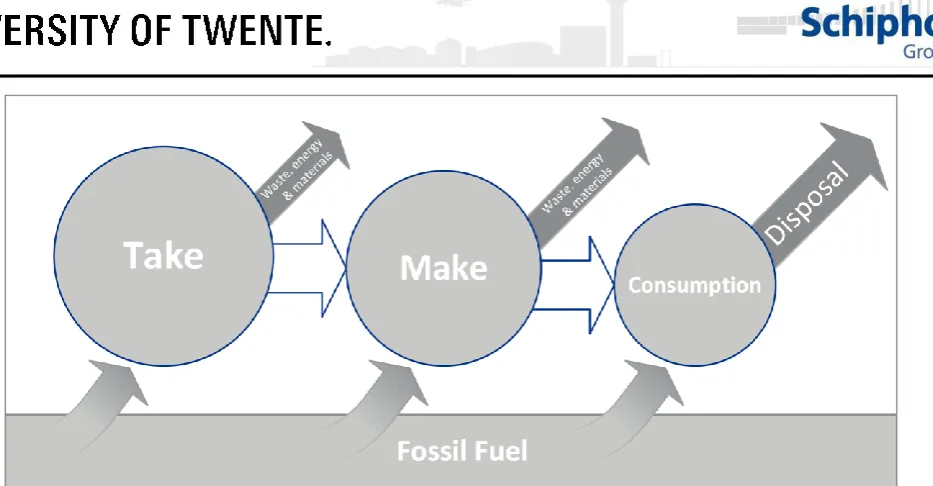
Linear economy
Figure 5.1 - Linear Economy model, adapted from the Ellen Macarthur Foundation (2014)
The major problem of the linear economy is that profit is a private gain, while pollution is a public problem and not bore by those who cause it (Sauvé, Bernard, & Sloan, 2015) (Anderson, 2007). Furthermore, the rise in GDP is no longer supported by a decline in resource prices (Schulte, 2013). A solution is needed in order to provide future generations with the equal opportunity to live and thrive on earth.
Circular Economy
Figure 5.2 - The Circular Economy, adapted from the Ellen Macarthur Foundation (2014)
CE can be summarised into 7 main points:
1. Design out waste
2. Build resilience through diversity 3. Rely on energy from renewable sources 4. System or value chain optimisation 5. Maximise energy efficiency
6. Customers want performance/functionality, not a product 7. Continued ownership is cost efficient.
But as with any transition, there are challenges to overcome. The main challenges are that system optimisation is needed across the whole value chain and that any organisation needs to be ready to cope with the different economical model of CE.
To conclude on Circular Economy, the following defintion is used:
“Circular Economy is a sustainable economic and industrial system, where environment and economy are regenerative by design, aimed at maximising value of a product while
Conclusion Circular Economy
As stated in the previous chapter, the current linear economy style is unsustainable in the long run. The perceived gains are mostly focussed on maximising production at minimum cost, using ever more non-renewable resources and where the producer is not responsible of the disposal at the End-of-Life, with all consequences attached. CE could be a solution, which allows mankind to tackle these problems. CE builds upon closing resource loops, optimising on systems level and using the fact that it is the function and not the product itself which is demanded. The last statement implies that ownership should no longer be attached to the user of a product. This could be a way of enabling the transformation towards a CE. The current problem is, that most literature uses a manufacturing point of view and therefore a knowledge gap in the literature can be identified on how this change in ownership is perceived from the customer point of view, instead of the manufacturer point of view.
For an extensive answer please consult Appendix A – Circular Economy.
5.3
Product-Service Systems
One of the tools in the transition towards CE are Product-Service Systems (PSS), as suggested by Adrodegari., et al. (2015), Bastein, T. et al. (2013), Beuren, Ferreire, & Miguel (2013) Lieder., et al. (2015), Tukker (2015), Van Ostaeyen (2014) and Witjes & Lozano (2016). It is important, with the focus on sustainable development, to understand the characteristics of PSS. Because using a PSS concept does not automatically produce sustainable development (Guidat, Barquet, Widera, Rozenfeld, & Seliger, 2014) (Kuijken, Gemser, & Wijnberg, 2016) (Pigosso & McAloone, 2015) (Sousa & Cauchick Miguel, 2015).
In order to create a clear picture of what is meant by a PSS, the definition of van Ostaeyen (2014) is used, which is in line with Beuren, Ferreire & Miguel (2013) and Sassenelli, Pezzotta, Rossi, Terzi, & Cavalieri (2015):
‘A Product-Service System (PSS) is an integrated offering of products and services with a revenue mechanism that is based on selling availability, usage or performance’
Criteria for Product-Service Systems
Drawing on the work of Scheepens et al. (2016), the nature of the product determines whether PSS is a suitable solution for lowering the environmental burden. In order to gain a better understanding on when PSS is suitable for a customer, the following criteria are identified (van Ostaeyen, 2014):
1. Material, labour and energy intensity
For customers that use products more intensively, a PSS would be interesting, because in theory a larger cost reduction could be achieved, which would result in a higher value of the product. 2. Primary process
PSS shift the responsibility towards the provider of the product/service. Therefore, PSS is interesting for customers who do not regard the operation or maintenance of the asset as essential part of their primary process.
3. Consequences of malfunction
A PSS is more interesting for a customer if the consequence of malfunction of an investment asset are more important and cause greater discomfort, because (theoretically) the provider will be able to offer a larger value improvement by investing in the quality and reliability of the product. Especially because the service provider/manufacturer is (financially) responsible for the performance issues of the service.
4. Market/customer size
The implementation of a PSS requires investment in service capabilities and infrastructure. Therefore, only large enough customers with large enough projects are interesting, because they should be able to bear the investment cost and be able to recuperate the investment over time.
Conditions for success for Product-Service Systems
There are a few conditions which must be taken into account in order to make Result-Oriented PSS a success. The first is that performance management is at the heart of Result-Oriented PSS. Key Performance Indicators (KPIs) are needed in order to track the performance of the PSS and these KPIs need to be SMART; Specific, Measurable, Accountable, Realistic and Time sensitive (Wilberg, Hollauer, & Omer, 2015). The next important condition that it is clear that all stakeholders are clear. It is essential, because the relationship supplier and customer are embarking upon is longer and more intertwined then before and therefore more important (Ghisellini, Cialani, & Ulgiati, 2015) (Tukker, 2015). Both KPIs and the stakeholder relationship should be covered by a good Service Level Agreement (SLA), which needs to cover the following aspects (Heidel, 1997):
1. Function of the service a. The functions offered b. Possible time of usage
c. Needed support from Schiphol 2. Performance of the required service
a. KPIs
b. Norm of the KPIs c. Bonus/Malus rules
3. Possible restrictions on the usage of the service 4. Administrative details of the SLA
a. Duration of the contract
b. Arrangements on the prolongation of the SLA c. Arrangements on proposed changes to the SLA
e. Arrangements for possible disputes and the roles of a potential third party as a mediator
f. Arrangements for End-of-Life disposal g. Possible financing arrangements h. Legal liabilities of both parties
i. Description of scenarios in which force majeure are at play j. Reporting and frequency of reporting
k. Clear definition on possible conflict of interpretation of certain words, passages, etc. l. Possible sections of contract which might be changed without renegotiating the whole
contract
m. Evaluation moments and possibilities of the SLA
n. If needed; paragraph on customer experience, measurements of customer experience and perception of quality of service
o. If needed; paragraph on innovation and continuous improvement of performance
One of the issues with PSS is that it is unclear what the value is of a PSS for an organisation (Kuijken, Gemser, & Wijnberg, 2016), together with the fact that the new, long relationship between supplier and customer introduces new challenges on stakeholder management, responsibility shift, dependencies increase, financial risks change and the need for information exchange increases (Beuren et al., 2013) (Schnürmacher, Haka, & Stark, 2015) (Lockett, Johnson, Evans, & Bastl, 2011) (Witjes & Lozano, 2016). The last issue is that it is of utmost important to be able to estimate the value of a PSS in order to support decision making with PSS involved.
5.4
Decision making and valuation of Product-Service Systems.
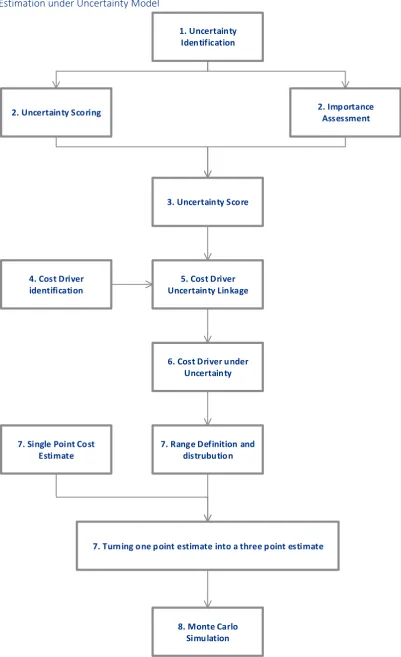
But how does one value a PSS. The adding of a service layer on top of a product adds a complication in valuation. Even though a PSS is different from a normal product, it is still compared to a normal product, or asset given Schiphol. In order to value the PSS and make a fair comparison, Cost Estimation under Uncertainty is used, as proposed by Erkoyuncu (2011). His model revolves around the question, how much should a supplier of a Product-Service System charge for the extra risks and uncertainty it needs to carry as owner of the product/asset. In order to align this model to the scope of this thesis, which is from the perspective of Schiphol as a customer for PSS, the model is reversed and proposed as how much should Schiphol accept as a fair price for a PSS.
The model of Erkoyuncu (2011) is based on the well-known Net Present Value technique. This will first be treated, before we will continue with the Cost Uncertainty part.
Net Present Value
One of the most well know valuation technique within project valuation is the Net Present Value (NPV) technique using Discounted Cash Flow (DCF). Using the NPV all future cash flows are taken into account and therefore a value can be determined. In order to capture all financial aspects of the life of an asset with regards for the influence of time on monetary value, discounting is used. The NPV is a wide spread method to value projects and can be calculated using the following formula (Brealey, Myers, & Allin, 2011) (Samis, Davis, Laughton, & Poulin, 2006):
𝑁𝑃𝑉(t, 𝑁) = ∑ 𝐶𝐹𝑡 (1 + 𝑟)𝑡 𝑁
𝑡=0
𝐶𝐹𝑡= 𝑁𝑒𝑡 𝐶𝑎𝑠ℎ 𝐹𝑙𝑜𝑤 𝑎𝑡 𝑡𝑖𝑚𝑒 𝑡
𝑡 = 𝑡𝑖𝑚𝑒 𝑜𝑓 𝑡ℎ𝑒 𝐶𝑎𝑠ℎ 𝐹𝑙𝑜𝑤
𝑟 = 𝑑𝑖𝑠𝑐𝑜𝑢𝑛𝑡 𝑟𝑎𝑡𝑒 𝑁 = 𝑛𝑢𝑚𝑏𝑒𝑟 𝑜𝑓 𝑝𝑒𝑟𝑖𝑜𝑑𝑠
The basic theory behind the NPV is that the project with the highest NPV should be accepted, because it adds the most value to a firm. If a project has a negative NPV is should be rejected, because it subtracts value from the firm. If the NPV would be zero, one should be indifferent between accepting or rejecting the project and decision making needs to be based on other criteria.
Expanding this to the perspective of the customer, e.g. Schiphol, the standard NPV valuation of a project at Schiphol is as follows (Rese, Karger, & Strotmann, 2009):
𝑁𝑃𝑉0= −𝐼0+ ∑ 𝐸𝑡 ∗
1 (1 + 𝑊𝐴𝐶𝐶)𝑡 𝑁
𝑡=1
𝑤ℎ𝑒𝑟𝑒,
𝐼0= 𝐼𝑛𝑣𝑒𝑠𝑡𝑚𝑒𝑛𝑡 𝑎𝑡 𝑡 = 0
𝐸𝑡 = 𝐸𝑥𝑝𝑒𝑛𝑠𝑒𝑠 𝑎𝑡 𝑡
𝑊𝐴𝐶𝐶 = 𝑊𝑒𝑖𝑔ℎ𝑡𝑒𝑑 𝐴𝑣𝑒𝑟𝑎𝑔𝑒 𝐶𝑜𝑠𝑡 𝑜𝑓 𝐶𝑎𝑝𝑖𝑡𝑎𝑙 𝑜𝑓 𝐶𝑢𝑠𝑡𝑜𝑚𝑒𝑟
Within Schiphol, the Net Present Value technique is used to determine the Total Cost of Ownership (TCO). The TCO is in principle nothing else than an extended NPV where all costs and benefits over the life time of an asset or project are taken into account. This allows to capture the full value and make an informed decision about an asset over its complete (useful) lifetime. As stated in the current situation, Schiphol uses the Equivalent Annual Cost to transform the NPV to an annuity, in order to see what the cost per year would be. This will be introduced in 6.4.
The deficiency of a straight forward NPV analysis, is that risk and uncertainties are not captured. This will be countered by the introduction of the uncertainty cost estimation.
Cost Estimation under Uncertainty
Risk and Uncertainty Management in Product-Service Systems
In order to better grasp how cost estimation under uncertainty can be performed, it is important to get a better understanding of what risk and uncertainties are. Everything is inherently connected with risks and uncertainties, PSS’s are no exception. Product-Service Systems introduce different types of risks and uncertainties compared to traditional asset ownership and usage. In order to better understand what kind of risk and uncertainties exist, the relationship between uncertainty and risk is defined as well as what an uncertainty is. For uncertainty, the following definition is used (Herzog, Meuris, Bender, & Sadek, 2014):
“Uncertainty is the stochastic behaviour of any physical phenomenon that causes the indefiniteness of outcomes meaning the expected and actual outcomes are never the
same.”
“Risk is a special outcome of uncertainty, where the outcome of a specific event or a number of events have a negative effect on the overall performance of a project.”
Thus risks follow from uncertainties and therefore the focus will be on uncertainty, because accounting for uncertainty will automatically cover the risks.
As stated earlier, it is important to account for risks and uncertainties, because when acquiring a PSS, risks and uncertainties become inherently connected to the price and therefore the value of a PSS. In order to make a comparison between traditional asset purchase and ownership and a PSS, the assessment of such uncertainties is needed to be made in order to know whether the price offered by a supplier is fair.
The Cost Uncertainty Estimation Model
Cost Estimation under Uncertainty Model
1. Uncertainty Identification
2. Uncertainty Scoring 2. Importance
Assessment
5. Cost Driver Uncertainty Linkage 4. Cost Driver
identification
3. Uncertainty Score
6. Cost Driver under Uncertainty
7. Single Point Cost Estimate
7. Range Definition and distrubution
7. Turning one point estimate into a three point estimate
[image:23.595.104.506.86.744.2]8. Monte Carlo Simulation
5.4.2.3.1 Uncertainty identification
Erkoyuncu (2011) distinguished 6 main categories of uncertainty. His research focusses on the uncertainties as experienced by manufacturers in the defence industry in their effort to determine a good price for offering a service. These main categories can be used as a guideline in assessing the main categories of uncertainty for suppliers of Schiphol.
Category
Description
1.
CommercialUncertainty
Factors that affect the contractual agreement, driven by requirements of the customer. However, the supplier is responsible for defining these requirements based on the capability.
2.
AffordabilityUncertainty
Factors that affect ability to predict customer’s and/or supplier’s funding capabilities.
3.
PerformanceUncertainty
Factors that affect the achievement in reaching the performance goals (KPI).
4.
TrainingUncertainty
Factors that affect achievement in reaching customer’s needs for the delivery of training.
5.
OperationUncertainty
Factors that affect achievement in reaching the required level of service and support delivery. Focusses on equipment level (e.g. maintenance etc.).
6.
EngineeringUncertainty
Factors that affect the achievement in managing strategic decisions with regards to the future service and support requirement (e.g. End-of-Life etc.).
These 6 main uncertainties categories consist of many uncertainties. A complete list of these uncertainties can be found in Appendix K – List of Uncertainties. Besides the uncertainties of Enkoyuncu, the following uncertainties are also identified by Reim et al., (2013):
1. Hard to communicate value
2. Inappropriate organisational structure 3. Cultural antipathy
4. Monitoring and information sharing 5. Too extensive or difficult contracts 6. Lack of resources and capabilities 7. Lack of financial resources 8. Complex supply chain 9. Adverse behaviour 10. Breakdown risk
Given the uncertainties provided, the actor has to assess which uncertainty is relevant for the project and should therefore be included in the uncertainty assessment.
5.4.2.3.2 Uncertainty assessment and relative significance
1. Basic Estimate 2. Rigour in Assessment 3. Level of Validation
Basic estimate regards on the basic estimate of uncertainty taken into account how experienced the firm and/or actor is in assessing the given uncertainty. The Rigour of Assessment regards the accuracy of the basic estimate and whether it can be based on internal knowledge on the uncertainty. The level of validation regards on how well the score can be validated outside the firm.
These three categories can be assessed using the following scoring using the guideline from Figure 5.4
7: No Experience in the area 5: Incomplete data, small sample, educated guesses, indirect approximate rule of thumb estimate
3: Small sample of historical data, parametric estimates, some experience in the area, internally verified data 1: Best possible data, large sample, use of historical field data, validated tools and independently verified data
7: No established assessment of processes
5: Limited experience of applied process with lack of consensus on results
3: Sufficiently experienced and benhmarked internal processes with consensus on results
1: Best practice in well established discipline
7: No validation
5: Limited internal validation, no independent validation
3: Internally validated with sufficient coverage of models, processes and verified data. Limited independent validation
1: Best available, independent validation within domain, full coverage of models and processes.
Basis of Estimate
Rigour of Assessment
Level of Validation
Figure 5.4 - Uncertainty Scoring Guidelines based on Erkoyuncu (2011)
The next step is to assess the relative importance of each uncertainty against the whole project. This is done within each category of uncertainty. A score from 1 to 9 is given to each uncertainty and using a partial Analytical Hierarchy Process (Saaty, 1990), the significance score is transformed into a pairwise comparison and normalised weights using a priority vector, which is the principal eigenvector of the score matrix, which is produced by scoring each uncertainty. Then the score is normalised to a scale relative to the most importance and significant uncertainty (given the weight of 1 and the others are compared to this score). The significance categories from 1 to 9 can be found in Figure 5.5.
Figure 5.5 - Significance Categories based on Erkoyuncu (2011)
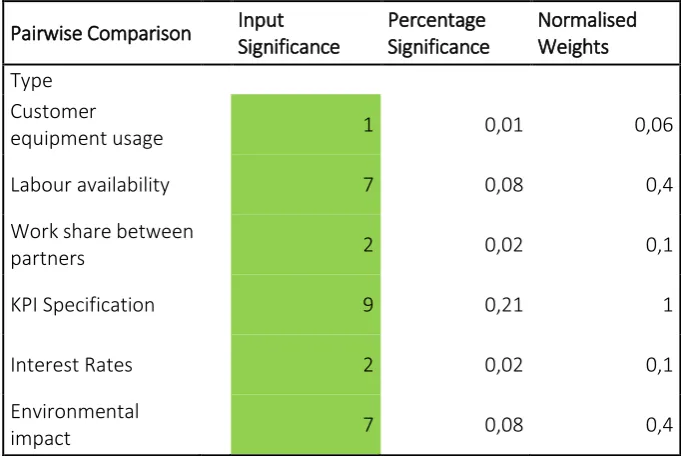
An example can be found in Table 5.1, the input significance score is provided in the green column for each uncertainty. Using the matrix from Table 5.2 the normalised weights are calculated and expressed again in Table 5.1. The normalised weights are the final scores for significance which are used for the calculation of the uncertainty score for each uncertainty in the next step.
Pairwise Comparison
The following significance/relevance can be assigned to each uncertainty. This will be automatically translated in a relative weighted importance of each uncertainty via the AHP process.
Table 5.1 – Example Input Significance input
Pairwise Comparison Input Significance
Percentage Significance
Normalised Weights
Type
Customer
equipment usage 1 0,01 0,06
Labour availability 7 0,08 0,4
Work share between
partners 2 0,02 0,1
KPI Specification 9 0,21 1
Interest Rates 2 0,02 0,1
Environmental
[image:26.595.80.421.103.331.2]impact 7 0,08 0,4
Table 5.2 - Example Matrix for Calculation Normalised Weights
Customer equipment usage
Labour availability
Work share between partners
KPI
Specification
Interest Rates
Environmental impact
Customer
equipment usage 1 0,14 0,33 0,11 0,33 0,14
Labour availability 7 1 5 0,33 5 1
Work share
between partners 3 0,2 1 0,14 1 0,2
KPI Specification 9 3 7 1 7 3
Interest Rates 3 0,2 1 0,14 1 0,2
Environmental
impact 7 1 5 0,33 5 1
5.4.2.3.3 Calculation of the Uncertainty score
These 2 separate assessments are now combined in order to produce the uncertainty score of each relevant uncertainty. The score is calculated in the following manner.
𝑈𝑛𝑐𝑒𝑟𝑡𝑎𝑖𝑛𝑡𝑦 𝑆𝑐𝑜𝑟𝑒 =
(1
3∗ (𝐵𝑎𝑠𝑖𝑐 𝐸𝑠𝑡𝑖𝑚𝑎𝑡𝑒 + 𝑅𝑖𝑔𝑜𝑢𝑟 𝑜𝑓 𝐴𝑠𝑠𝑒𝑠𝑠𝑚𝑒𝑛𝑡 + 𝐿𝑒𝑣𝑒𝑙 𝑜𝑓 𝑉𝑎𝑙𝑖𝑑𝑎𝑡𝑖𝑜𝑛)) ∗ 𝑁𝑜𝑟𝑚𝑎𝑙𝑖𝑠𝑒𝑑 𝐼𝑚𝑝𝑜𝑟𝑡𝑎𝑛𝑐𝑒 𝑆𝑐𝑜𝑟𝑒
Table 5.3 - Example of an Uncertainty Score list
Category Type Uncertainty
Score
1 Commercial Customer equipment usage 0,1
2 Commercial Labour availability 1,7
3 Commercial Work share between partners 0,5
4 Commercial KPI Specification 5,7
5 Commercial Interest Rates 0,1
6 Commercial Environmental impact 1,7
7 Commercial Warranty Scope 0,9
8 Commercial Relationship with customer 1,5
9 Commercial Stability of customer
requirements 4,9
5.4.2.3.4 Cost Driver identification
The next step is to identify all cost drivers. Purchase price, maintenance, repair, replacement, energy are all cost drivers which add cost to a project. These need to be identified in order to know what cost are going to be incurred over the life time of a project.
5.4.2.3.5 Cost Driver and Uncertainty Linkage
Now that all cost drivers have been identified, all relevant uncertainties have to be linked to these cost drivers. The actor must decide which uncertainty is relevant for each cost driver in a yes or no manner. A cost driver can be influenced by many uncertainties, but it is essential that each uncertainty has at least one cost driver link, otherwise the uncertainty can be deemed irrelevant or indicate a missing cost driver.
By linking the uncertainties to each cost driver, an uncertainty score for the cost driver can now be calculated by adding all uncertainty scores and averaging the result. For the sake of comparability, the score is then divided by 7 (the maximum uncertainty score possible) to gain a cost driver’s uncertainty score from a scale of 0 to 1.
5.4.2.3.6 Determination of cost range
Table 5.4 - Cost Range Classification based on Erkoyuncy (2011)
ESTIMATE CLASS
LEVEL OF PROJECT DEFINITION
METHODOLOGY LOWER
UNCERTAIN TY VALUE
UPPER UNCERTAIN TY VALUE
RANGE MIN
RANGE MAX
1 50% -100% Deterministic 0 0,3 -10 15
2 30% - 70% Primarily
Deterministic
0,3 0,5 -15 20
3 10% - 40% Mixed but
Primarily Deterministic
0,5 0,7 -20 30
4 1% - 15% Primarily
Stochastic
0,7 0,9 -30 50
5 0% - 2% Stochastic or
Judgement
0,9 1 -50 100
The next step is to check whether the actor agrees to the cost range or that it want to manually adjust the range of each cost driver. Together with the cost range a distribution is assigned to each cost driver. This distribution is initially a triangular distribution, because it is one of the easiest distributions to work with in cost estimation and provides a good base to start with (Erkoyuncu, 2011). If the distribution of a cost driver is known, this distribution can be used, but the assumptions for this distribution must be checked against the available data on the respective cost driver.
5.4.2.3.7 Single Cost estimation to Cost Range Estimation
The next step is to enter the single cost estimate for each cost driver. Using the cost driver and uncertainty linkage, this single cost estimation is transformed to cost estimation range
This is then transformed to a cost estimation range, consisting of three points (Lower limit, Most likely and Upper limit). Where the single cost estimate acts as the most likely, and the ranges assigned to the cost driver based on the uncertainty act as the lower and upper limit.
5.4.2.3.8 Simulation and determination of price.
90%
€
Probability
€ 1M
Cost Estimation under Uncertainty
Simulation (n = 5000)
Figure 5.6 - Stylised example outcome of a Simulated Cost Estimation under Uncertainty
Because the model compares the relationship between the traditional NPV and an uncertainty weighted NPV, the difference between them can be seen as an implied risk premium the supplier should ask for carrying the risks and uncertainties associated with remaining owner. This can be reversed for Schiphol as the max risk premium a supplier should be allowed to ask for carrying such risk and is for Schiphol the premium it pays to mitigate the risks of the asset ownership towards asset user.
Validation of Cost Estimation under Uncertainty
The usage of Cost Estimation under Uncertainty sounds very promising and useful. In order to make sure that the usage of such a model is valid, a validation must be performed. Luckily, the validation for such a model is quite straight forward. Because the goal of the model to provide an estimate on a fair price, given the uncertainties as experienced by a supplier. Therefore, the user should use the model and determine the outcome of the model against the offering of a supplier. So, in order to validate the outcome of the model needs to be checked against the offering of a supplier for a PSS. If the outcome of the model delivers a price which is higher
5.5
Conclusion
Using the summary of the main finding of the literature review, an extensive one can be found in Appendix B – Product-Service Systems, the second sub question can be answered. First, a definition will be presented:
‘A Product-Service System (PSS) is an integrated offering of products and services with a revenue mechanism that is based on selling availability, usage or performance’
PSS are a good way to facilitate the transition towards a CE within Schiphol. But, a PSS alone will not be sustainable all by itself. Of the three types of PSS, only the result-orientation is well suited to incorporate sustainability. PSS has clear benefits such as, higher quality of products, improved (sustainable) performance, lower cost for the whole value chain and therefore a win-win situation for both supplier and customer. Besides these benefits, there are barriers and uncertainties which affect the performance.
user towards supplier. Because a supplier becomes more important in the development of the service, the whole procurement strategy is different than traditional purchasing. Suppliers become stakeholders and therefore need to be involved earlier on in the project. This becomes more apparent when one thinks about the uncertainties which are attached to PSS. Commercial, performance, operational and engineering uncertainties are all of importance to have a clear understanding of roles and responsibilities between buyer and supplier early in the process. When these uncertainties turn into uncontrollable risks, the benefits associated with PSS will not be reached and the relationship between buyer and supplier will be put under pressure, something which is highly unwanted given the long interaction and dependency between the two parties.
Besides the relationship, it is important to take into account the criteria which need to be met in order to make sure that a product/asset is suitable for being converted into a PSS. These four criteria can be seen as a safety net. The four criteria are; material/energy/labour intensive, the product should not be a core competence of the buyer, the consequence of malfunction should be severe to make sure that the supplier delivers quality and the market/investment size should be substantial.
If a product/asset is suitable to be transformed into a service, a few condition apply which are to be taken into account to make sure that it is a success. The first is that there needs to be a synergy added value by combining the tangible product, with the intangible service component. The second is that the product should be technically advanced, this allows to steer on performance. The latter is the most important condition for success for a PSS.
Steering on performance requires performance measurement. Performance measurement requires information gathering and this information is also important for the relationship between buyer and supplier. Because the customer requires a certain performance, it is important that clear KPIs are established, which cover the flow of money, products, services and information within the relationship of the stakeholders. These KPIs should be SMART and reflect the responsibilities both parties have. To make sure that all flows are covered, it is important to map stakeholders and visualise the flow between them. This increases the effectiveness of stakeholders and allows a validation of the established KPIs for both the customer as well as the supplier.
All these criteria, conditions and performance steer measures should be covered by a Service Level Agreement (SLA) which provides clear and unambiguous rules on responsibilities for both parties.
What can be concluded from the academic literature is that it in order to make a PSS a success, risks and uncertainties should be clear and the process of purchasing a PSS must be in place. Otherwise, the uncertainties will lead to uncontrollable risks which endangers not only the benefits of a PSS, but also the relationship between buyer and supplier, as well as the possible failure of the required function.
6.
Current Situation
6.1
Introduction
SQ 3. What is the current situation at Schiphol, especially regarding decision making?
Schiphol is divided into 4 business areas (BA). Two of those BA’s are actively managing assets. Schiphol Real Estate (SRE) and Schiphol Aviation. As given in the scope, Schiphol Aviation is the business area in which this research takes place. Schiphol Aviation is responsible for all aviation related activities. This comes down to three main pillars, which are Airport Operations (OPS), Safety, Security & Environment (SSE) and Asset Management (ASM). The main focus will be on ASM. A more elaborate description of ASM can be found in Appendix C - Asset Management at Schiphol Aviation.
Within the description of the current situation, it is important to keep in mind that the scope of this thesis is towards CE and the transition towards it via Product-Service Systems. Therefore, the sub question’s answer will be more focussed towards PSS and not solely on the current situation at Schiphol.
Reading Guide
This chapter will provide an answer to the sub question on the current situation at Schiphol (SQ3). Paragraph 6.2 will provide information on Asset Management at Schiphol. Paragraph 6.3 will provide sustainability initiatives at Schiphol. Paragraph 6.4 provides information on how project valuation is performed at Schiphol. This provides a basis later on to sufficiently compare Product-Service Systems to traditional solutions. Paragraph 6.5 will treat sustainability at Schiphol, within the scope of CE. This results in paragraph 6.6, where the Light-as-a-Service case is further explained and evaluated. Finally, the conclusion and answer to SQ3 is given in 6.7.
6.2
Asset Management at Schiphol
The most important aspects of Aviation Asset Management (ASM) will be summarised, more information can be found in Appendix C - Asset Management at Schiphol Aviation.
1. There is a strict separation between Aviation and Non-Aviation assets. This separation is obliged by the Dutch Aviation Law (Luchtvaartwet, 2016).
2. Aviation asset are added to the Regulatory Asset Base (RAB). Schiphol can make a fictitious profit on this RAB, with a maximum of the regulated Weighted Average Cost of Capital (WACC) of Schiphol. This WACC is set every year in the ‘toerekeningssysteem’, or allocation system which has to be approved by the Authority for Consumers and Markets (ACM). The ‘Toerekeningssysteem’ describes how cost from Aviation are charged to the airlines via the airport tariffs.
3. 52% of all costs levied to airlines are directly asset related (Asset Wise! Team Schiphol, 2015). Therefore, reducing these costs would benefit airlines (lower tariffs) and Schiphol (more attractive due to lower tariffs).
4. Schiphol uses the principles of IFRS accounting, but where it is not aligned with the Aviation Law, the Aviation Law prevails. Main points are; the regulatory fixed depreciation scheme, controlled WACC, residual value is not allowed and assets are only added to the RAB once completely activated.
6.3
Sustainability at Schiphol
Corporate Responsibility Goals
Schiphol feels it has a strong responsibility on the corporate responsibility (CR) level. For quite some time now, Schiphol has incorporated CR into their strategic goals on many levels. Every BA is responsible for operationalising these CR goals which are set every year by the board. The last few years, CE has become a bigger part of the CR strategy and multiple objectives have been set. CE is mentioned in the annual report as one of the subjects which attributes directly to the CR goal of sustainable & safe performance (Schiphol Group, 2016).
CE Projects
Schiphol advocates CE through different projects. As stated before, the CR goals incorporate CE and design. A few projects have been initiated over the past years. Some of these initiatives will be elaborated upon, to see if the proposed transition with Product-Service Systems has a link with one of the already ongoing projects. One project, Light-as-a-Service will be further explained here, for the other CE projects, the reader can read
Zer0 Waste
One of the goals of Schiphol is to remove all waste streams and convert them into sustainable revenue streams. The so called Zer0 Waste plan aims at reaching zero waste from operations in 2030.
Blue Conveyor
Schiphol has developed a so called blue conveyor system which uses recycled and non-toxic materials for the baggage reclaim conveyer belts. Besides the recycled material, the belt is engineered as such that it uses considerable less energy than a conventional belt and that it can be completely recycled at its End-of-Life (Schiphol Group, 2016).
True Price
Within Schiphol, the need arose to have an insight in what the environmental impact of certain projects would be. In order to facilitate the decision making with a tool which contributes towards this, a True Price model has been developed. It monetises the effect a project has on the environment using shadow prices of the environmental impact. Furthermore, it helps to look further than just the internal financial gain, by showing what the societal effects are, if Schiphol would have to pay for the caused impact. Finally, this contributes to the awareness of Schiphol of their environmental impact and it is currently being implemented as an extension of the standard decision making procedure at Schiphol.
Light-as-a-Service
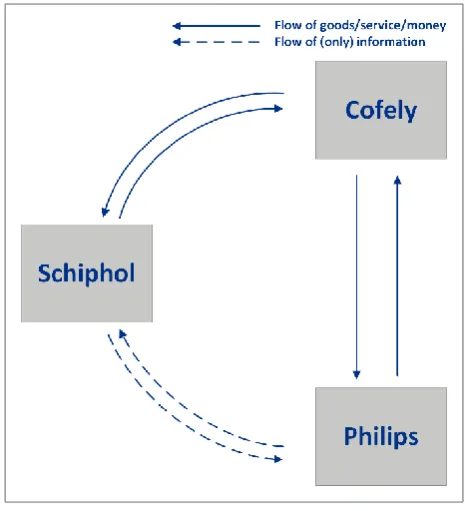
Schiphol is renewing its Lounge 2 area at the terminal. During the initial phase of this project, the idea was born to do a pilot project with the lighting. Together with Philips and Cofely, it was decided to try out the new Light-as-a-Service (L.a.a.S.) concept from Philips. The initial idea was that L.a.a.S. could offer an answer to the problem of increasing resource scarcity, provide Schiphol with a tool to grow towards a professional asset management organisation and support Schiphol goal of being Europe’s preferred airport. L.a.a.S. is characterised as a Product-Service System, due to the fact that it is a product which is normally purchased and managed internally, but is now outsources and used as a service.
Conclusion
this master thesis and the proposed way of enabling the transition from linear towards CE. The Light-as-a-Service (L.a.a.S.) can be classified as a Product-Service System, as it is a product/asset which normally would be purchased and separately maintained, disposed etc., but is now purchased as a service and not as a product. L.a.a.S. will be further examined in the next paragraph, as well as evaluated based on the knowledge obtained from literature, together with the information obtained from Schiphol. By analysing the project, more information can be obtained on how the project has been given shape, how such a project develops in real life and if the underlying processes are sufficient, efficient and effective.
6.4
Project valuation
In order to gain a better understanding of the financial implications of CE, it is important to know how Schiphol valuates its projects. This will provide a basis on which the comparison between current projects and a PSS can be performed. Furthermore, the current techniques used will be evaluated using academic literature, to see whether they are still good techniques to compare projects or alternatives, as well as take it into account in a recommendation if needed.
TCO
Schiphol uses a Total Cost of Ownership (TCO) approach in order to value the project as well as alternatives within a project. The definition which Schiphol uses for a TCO is that all costs over the lifetime of an asset are taken into account. The idea is that alternatives can be better compared if every aspect of its life cycle is accounted for and that not only CAPEX but also OPEX and End-of-Life (EoL) costs are used.
NPV
Schiphol uses the NPV technique to value projects and calculate the TCO of a project. The theory behind NPV is explained in 5.4.11.2.4.1.
EAC
In order to gain a better idea between different projects with possible different life times, it could be beneficial to transform the NPV to an annuity in the form of an Equivalent Annual Cost (EAC). It shows the cost per year of owning and operating an asset over its life time. However, it is important to state that project which are compared to one another should have similar risks. Therefore, EAC is not ideally suited for one time decisions, due to the fact that risks are different. (Emery, Finnerty, & Stowe, 2004), but it can be very insightful in determining the annual cost of a project. The EAC can be calculated using the following formula (Brealey, Myers, & Allin, 2011):
𝐸𝐴𝐶 = 𝑁𝑃𝑉 𝐴𝑡,𝑟
where,
𝐴𝑡,𝑟 =
1 − (1 + 𝑟)1 𝑡 𝑟
The main advantage of using EAC is that it can easily be compared over the years for different solutions what the annual cost would be and this can be used in the calculations for the airline tariffs.