This paper is made available online in accordance with
publisher policies. Please scroll down to view the document
itself. Please refer to the repository record for this item and our
policy information available from the repository home page for
further information.
To see the final version of this paper please visit the publisher’s website.
Access to the published version may require a subscription.
Author(s): Helen Spencer-Oatey
Article Title: Reconsidering power and distance
Year of publication: 1996
http://dx.doi.org/ 10.1016/0378-2166(95)00047-X
RECONSIDERING POWER AND DISTANCE
Helen Spencer-Oatey
RECONSIDERING POWER AND DISTANCE
Abstract
A wide range of studies indicate that power and distance affect the production and interpretation of language. However, this paper argues that greater consideration needs to be given to the conceptual nature of these dimensions, and to terminological usage. In the first half of the paper, the need for this consideration is explained. A number of pragmatic studies are examined, and this reveals that authors often use the same terms with different meanings, or different terms with the same meaning, and that the parameters are rarely explicitly defined. Then the paper reviews recent calls for an extra parameter of interlocutor relations to be added: for affect to be separated from distance. In the second half of the paper, relevant social psychological research is reported, and it is concluded that the number of `horizontal' dimensions of interlocutor relations needs to be reconsidered. Power, on the other hand, emerges as a robust and relatively unitary dimension, yet its label has connotations that may not be cross-culturally valid.
1. INTRODUCTION: POWER & DISTANCE AS VARIABLES IN LINGUISTICS
The notions of power and distance are used very widely in linguistics, and much research within sociolinguistics, pragmatics and discourse analysis has examined their effects on the production and interpretation of language.
Several classic studies have helped establish power and distance as key variables. For example, Brown & Gilman (1960/1972) in their study of the use of pronouns in French, German and Italian, argue that choice of pronoun is affected by two fundamental dimensions of participant relations: power and solidarity. And Brown & Levinson (1978/1987), in their influential model of politeness, maintain that interlocutors consider the power and distance of their relationship when choosing among different options for conveying a given speech act.
Moreover, a large number of subsequent empirical studies have provided additional evidence for an association between language and the variables power and distance. For example, many linguists have explored the wording of speech acts, such as requests (e.g. Blum-Kulka et al, 1985; Holtgraves & Yang, 1990; Lim & Bowers, 1991), apologies (e.g. Holmes, 1990; Olshtain, 1989), directives (e.g. Holtgraves et al, 1989), and disagreement (e.g. Beebe & Takahashi, 1989), and a very large number of them have found power and distance to be significant variables. (See Spencer-Oatey, 1992, for a detailed review of the empirical evidence for an association between language use and the variables power and distance.)
However, two conceptual issues have recently been raised by linguists: problems of terminology, and doubts over the unitary nature of the dimension of distance. The purpose of this paper is to examine these issues, and to report research within social psychology that is relevant to the debate.
2. PROBLEMS OF TERMINOLOGY & DEFINITION
Wierzbicka (1991) points out that a major problem with research in cross-cultural pragmatics is the imprecise use of terminology. Referring to terms such as solidarity and intimacy, she makes the following point:
... researchers in cross-cultural pragmatics try to explain differences in the ways of speaking in terms of values such as `directness' or `indirectness', `solidarity', `spontaneity' ... `intimacy', `self-expression', and so on, without explaining what they mean by these terms, and using them as if they were self-explanatory. But if one compares the ways in which different writers use these terms, it becomes obvious that they don't mean the same things for everyone.
Wierzbicka, 1991: 70
In the following two sub-sections, I examine a number of studies (not necessarily cross-cultural ones) that have explored the effects of power and distance on speech acts and terms of address, and I consider the extent to which the labels used for the dimensions are defined clearly and used consistently.
broad dimensions of power and distance. This is an attempt to denote a more general concept than specific terms such as power, status, authority, distance, closeness, solidarity and so on often convey.
2.1 Distance
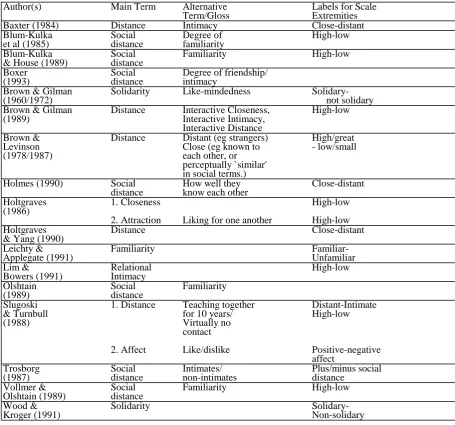
Table 1 below lists a number of studies that have investigated the effect of distance on people's use of language, and identifies the terms that the authors used for labelling and describing the parameter.
As can be seen from Table 1, Distance or Social Distance are used most often as the main labels for this dimension. However, a considerable number of other terms are also used: solidarity, closeness, familiarity, relational intimacy.
This variation in terminology raises the question as to whether the terms are all equivalent, or whether different researchers conceptualise the `horizontal' dimension of interlocutor relations in slightly different ways.
Unfortunately, not all the authors explicitly discuss their interpretation of the conceptual nature of distance. In fact, only two of them discuss it in comparative detail: the classic studies of Brown & Gilman (1960/1972) and Brown & Levinson (1978/1987). These two sets of authors use different terms for the dimension (solidarity and distance respectively), but both emphasise social similarity/difference as a key determinant of levels of distance, as can be seen from the following quotations:
Now we are concerned with a ... set of relations which are symmetrical ... If A has the same parents as B, B has the same parents as A.
Not every personal attribute counts in determining whether two people are solidary enough to use the mutual T. Eye color does not ordinarily matter nor does shoe size. The similarities that matter seem to be those that make for like-mindedness or similar behavior dispositions. These will ordinarily be such things as political membership, family, religion, profession, sex, and birthplace. However, extreme distinctive values on almost any dimension may become significant. Height ought to make for solidarity among giants and midgets. The T of solidarity can be produced by frequency of contact as well as by objective similarities. However, frequent contact does not necessarily lead to the mutual T. It depends on whether contact results in the discovery or creation of the like-mindedness that seems to be the core of the solidarity semantic.
Author(s) Main Term Alternative Labels for Scale
Term/Gloss Extremities
Baxter (1984) Distance Intimacy Close-distant
Blum-Kulka Social Degree of High-low
et al (1985) distance familiarity
Blum-Kulka Social Familiarity High-low
& House (1989) distance
Boxer Social Degree of friendship/
(1993) distance intimacy
Brown & Gilman Solidarity Like-mindedness Solidary-
(1960/1972) not solidary
Brown & Gilman Distance Interactive Closeness, High-low
(1989) Interactive Intimacy,
Interactive Distance
Brown & Distance Distant (eg strangers) High/great
Levinson Close (eg known to - low/small
(1978/1987) each other, or
perceptually `similar' in social terms.)
Holmes (1990) Social How well they Close-distant
distance know each other
Holtgraves 1. Closeness High-low
(1986)
2. Attraction Liking for one another High-low
Holtgraves Distance Close-distant
& Yang (1990)
Leichty & Familiarity Familiar-
Applegate (1991) Unfamiliar
Lim & Relational High-low
Bowers (1991) Intimacy
Olshtain Social Familiarity
(1989) distance
Slugoski 1. Distance Teaching together Distant-Intimate
& Turnbull for 10 years/ High-low
(1988) Virtually no
contact
2. Affect Like/dislike Positive-negative affect
Trosborg Social Intimates/ Plus/minus social
(1987) distance non-intimates distance
Vollmer & Social Familiarity High-low
Olshtain (1989) distance
Wood & Solidarity Solidary-
[image:5.595.69.525.64.489.2]Kroger (1991) Non-solidary
Table 1: Labels & Glosses used for the Parameter Distance
D is a symmetric social dimension of similarity/difference within which S & H stand for the purposes of this act. In many cases (but not all), it is based on an assessment of the frequency of interaction and the kinds of material or non-material goods (including face) exchanged between S & H (or parties representing S or H, or for whom S and H are representatives). An important part of the assessment of D will usually be measures of social distance based on stable social attributes. The reflex of social closeness is, generally, the reciprocal giving & receiving of positive face.
Brown & Levinson, 1987: 76-77
However, as Brown & Gilman (1960/1972) point out, the core of this dimension is more abstract than degree of social similarity per se, and seems to reflect a sense of like-mindedness between people.
Few of the other authors discuss the parameter explicitly. However, as can be seen from Table 1, many of them provide glosses or alternative wordings for their terms, and/or give labels for the two extremes of the dimension, from which their interpretations can be inferred to a certain extent.
Cody and his colleagues have identified an intimacy factor that translates directly to Brown & Levinson's relationship distance factor.
Baxter, 1984:429
... Brown & Levinson (1978:85) contend that their dimension of Social Distance subsumes the factor of relationship affect. Indeed, it is true that intimates tend generally to like one another ...
Slugoski & Turnbull, 1988:104
However, the scope of distance (and hence of intimacy) varies among the authors. Slugoski & Turnbull (1988) do not include affect as a component of distance/intimacy, whereas Baxter (1984) does. So in their hypothetical scenarios, distance/intimacy is manipulated differently. Baxter (1984) uses the following contrasting
descriptions:
"The person in question is someone you regard as a good friend." (high closeness) "The person in question is someone you don't know very well, except for project group meetings; you don't feel at all close to this person and have little desire to develop a friendship." (low closeness).
Baxter, 1984:442)
Slugoski & Turnbull (1988), on the other hand, manipulate distance/intimacy in terms of length of acquaintance and frequency/amount of contact, and treat like/dislike as a separate factor:
"Sue & Jill are both teachers at a college of art and design, where they have been teaching a painting course together for the past 10 years." (intimate)
"Sue & Jill are both teachers at a college of art and design. Sue teaches painting and Jill teaches fashion design, so there is virtually no contact between them." (distant)
"they like each other a great deal." (like) "they dislike one another a great deal" (dislike).
Slugoski & Turnbull, 1988:109
Yet both of these interpretations of intimacy are somewhat different from another everyday meaning of the term which Wierzbicka (1991) proposes:
Intimacy refers to a readiness to reveal to some particular persons some aspects of one's personality and of one's inner world that one conceals from other people; a readiness based on personal trust and on personal `good feelings'.
Wierzbicka, 1991:105
Similarly, Holtgraves (1986) and Slugoski & Turnbull (1988) both treat distance/closeness and
affect/attraction as separate parameters, yet Wierzbicka defines closeness as a combination of mutual knowledge and mutual good feelings: "two people are said to be `close' if they know one another very well, and have `good feelings' for one another." (Wierzbicka, 1991:109)
Moreover, the precise meaning of many of the terms that the authors use often remains unclear, even when glosses or alternative wordings are given. For example, distance/closeness and familiarity could potentially refer to one or more of the following: frequency of contact, length of acquaintance, amount of self-disclosure (how much people reveal to another person about themselves), and amount and type of affect. Yet very few of the authors discuss exactly how they interpret the terms. Even Slugoski & Turnbull (1988), who argue for affect to be treated as a separate factor (see Section 3 for further discussion of this), do not explicitly discuss the conceptual nature of the other `horizontal' parameter that they include, distance.
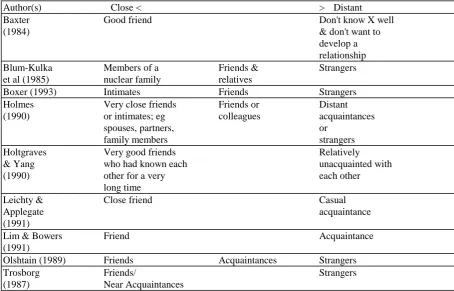
Many of the studies listed above use role relationships to illustrate or identify a given degree of distance. These are shown in Table 2 below.
In many respects, illustrative role relationships can be extremely helpful, because we all have prototypical conceptions of the nature of given types of role relationships. However, there are also dangers.
treats them as intermediate in terms of distance/closeness. Some of the authors (eg Holmes, 1990; Holtgraves & Yang, 1990; Leichty & Applegate, 1991) add words such as `close' and `casual' to the role relationships, presumably because they feel the terms friend and acquaintance are not clear enough on their own.
Secondly, in cross-cultural research, there is also the danger that people from different cultures may differ significantly in their prototypical conceptions of role relations. For example, Spencer-Oatey (1993) found that British and Chinese tutors and postgraduate students hold significantly different conceptions of the typical degrees of power and distance of the tutor-postgraduate student relationship. (See also Wood & Kroger, 1991.) So in cross-cultural research, it is probably unwise to define distance completely in terms of role relationships.
A further area of potential confusion regarding terminological usage lies in the use of the scale labels high and low. Some researchers, such as Brown & Levinson (1978/1987), use High D to refer to a distant relationship, whereas others, such as Blum-Kulka et al (1985), Brown & Gilman (1989), and Vollmer & Olshtain (1989) use High D to refer to a close relationship. This means that a very careful reading of the text is needed in order to identify how the term is being used. In fact, one wonders whether in some of the studies the
experimental subjects might have been confused. For example, Blum-Kulka & House (1989) give the following description of their research procedure:
Author(s) Close < > Distant
Baxter Good friend Don't know X well
(1984) & don't want to
develop a relationship
Blum-Kulka Members of a Friends & Strangers
et al (1985) nuclear family relatives
Boxer (1993) Intimates Friends Strangers
Holmes Very close friends Friends or Distant
(1990) or intimates; eg colleagues acquaintances
spouses, partners, or
family members strangers
Holtgraves Very good friends Relatively
& Yang who had known each unacquainted with
(1990) other for a very each other
long time
Leichty & Close friend Casual
Applegate acquaintance
(1991)
Lim & Bowers Friend Acquaintance
(1991)
Olshtain (1989) Friends Acquaintances Strangers
Trosborg Friends/ Strangers
[image:7.595.69.524.277.568.2](1987) Near Acquaintances
Table 2: Role Relationships used to illustrate Different Degrees of Distance/Closeness
The questionnaire contained descriptions of each of the five situations, followed by six questions representing six social dimensions considered relevant for choice of request form. The six dimensions were:
1. the relative dominance of the request relative to the hearer; 2. the relative social distance between the interlocutors; ...
Informants were asked to rate each dimension on a scale of 3, where 1 represents the lowest point and 3 the highest.
(Blum-Kulka & House, 1989:140)
the greater the familiarity. It is to be hoped that the experimental subjects were given clearer instructions than this account of the procedure implies.
In conclusion, then, this examination of a number of pragmatic studies broadens support for
Wierzbicka's (1991) claim that in cross-cultural pragmatic research, terms are often used without explanation, and may be used differently by different authors. Judging from the various terms, definitions, glosses and illustrative role relationships used in the studies listed above, the authors have variously interpreted distance as comprising one or more of the following (often overlapping) components:
1. Social similarity/difference (e.g Brown & Gilman, 1960/1972) 2. Frequency of contact (e.g Slugoski & Turnbull, 1988)
3. Length of acquaintance (e.g. Slugoski & Turnbull, 1988)
4. Familiarity, or how well people know each other (e.g. Holmes, 1990) 5. Sense of like-mindedness (e.g. Brown & Gilman, 1960/1972) 6. Positive/negative affect (e.g. Baxter, 1984)
Usually, however, these various components are not explicitly differentiated, perhaps because of an implicit assumption that any such components co-vary. Certainly, in some cases (for example, old friends) the components are likely to co-vary, but they do not always do so. For example, as Slugoski & Turnbull (1988) argue, frequency of contact and length of acquaintance are not always associated with positive affect (for instance, colleagues who have worked together for many years may be rivals and dislike each other).
2.2 Power
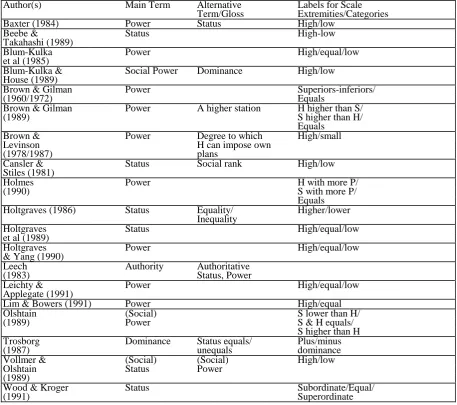
As with distance, a range of terms have been used in the literature for this dimension. Table 3 below lists those used in a number of studies.
As can be seen, power is the most popular name for this dimension, although social power and status are also used quite often. Dominance and authority are only used occasionally.
Once again, this raises the question as to whether the various terms are equivalent, or whether the different researchers conceptualise the `vertical' dimension of interlocutor relations in slightly different ways.
As with distance, only a few of the authors give explicit definitions of the terms they use. Brown & Gilman (1960/1972), Brown & Levinson (1978/1987) and Cansler & Stiles (1981) are the only authors to give lengthy definitions. Their explanations are quoted below:
One person may be said to have power over another in the degree that he is able to control the behavior of the other. Power is a relationship between at least two persons, and it is
nonreciprocal in the sense that both cannot have power in the same area of behavior. There are many bases of power - physical strength, wealth, age, sex, institutionalized role in the church, the state, the army or within the family.
Brown & Gilman, 1972: 255
P is an asymmetric social dimension of relative power, roughly in Weber's sense. That is, P(H,S) is the degree to which H can impose his own plans and his own self-evaluation (face) at the expense of S's plans and self-evaluation. In general there are two sources of P, either of which may be authorized or unauthorized - material control (over economic
distribution and physical force) and metaphysical control (over the actions of others, by virtue of metaphysical forces subscribed to by those others).
In most cases an individual's power is drawn from both these sources, or is thought to overlap them. The reflex of a great P differential is perhaps archetypally `deference', as discussed below.
Author(s) Main Term Alternative Labels for Scale Term/Gloss Extremities/Categories
Baxter (1984) Power Status High/low
Beebe & Status High-low
Takahashi (1989)
Blum-Kulka Power High/equal/low
et al (1985)
Blum-Kulka & Social Power Dominance High/low House (1989)
Brown & Gilman Power Superiors-inferiors/
(1960/1972) Equals
Brown & Gilman Power A higher station H higher than S/
(1989) S higher than H/
Equals
Brown & Power Degree to which High/small
Levinson H can impose own
(1978/1987) plans
Cansler & Status Social rank High/low
Stiles (1981)
Holmes Power H with more P/
(1990) S with more P/
Equals
Holtgraves (1986) Status Equality/ Higher/lower
Inequality
Holtgraves Status High/equal/low
et al (1989)
Holtgraves Power High/equal/low
& Yang (1990)
Leech Authority Authoritative
(1983) Status, Power
Leichty & Power High/equal/low
Applegate (1991)
Lim & Bowers (1991) Power High/equal
Olshtain (Social) S lower than H/
(1989) Power S & H equals/
S higher than H
Trosborg Dominance Status equals/ Plus/minus
(1987) unequals dominance
Vollmer & (Social) (Social) High/low
Olshtain Status Power
(1989)
Wood & Kroger Status Subordinate/Equal/
[image:9.595.69.527.54.459.2](1991) Superordinate
Table 3: Labels & Glosses used for the Parameter Power
A person's status, or social rank, may be construed both absolutely in a stable social hierarchy (eg an academic department, a business organisation, an army, a street gang, or a
neighborhood) and in relation to another member with whom he or she is currently interacting. Thus one's relative status is high in a conversation with a subordinate and low in a
conversation with a superior, but one's absolute status is the same in both conversations. We assume that people implicitly weigh many personal & social factors to estimate their own & others' status. Different hierarchies probably use different weights. For example, among the students and faculty of an academic department, we would expect age, academic rank (eg freshman, advanced graduate student, full professor), academic degrees, and knowledge & expertise in that field to be important determinants, whereas physical size and ancestry might be less important than in some other settings.
Cansler & Stiles, 1981:459-460
Clearly, Cansler and Stiles' (1981) interpretation is very different from the other two pairs of authors. Brown & Gilman (1960/1972) and Brown & Levinson (1978/1987) both emphasise control of another person's behaviour, whereas Cansler and Stiles (1981) focus on social rank.
High Speaker-Power Situation Remind friend to turn down stereo during quiet hours
Remind casual acquaintance why they can't smoke near or on elevator
Equal Speaker-Power Situation Request friend to attend educational program you have scheduled
Request friend to take over organizing large floor project for charity talent show
The authors themselves comment on this:
It should be noted that the speaker-power manipulations in this study involved a very specific type of power, namely, legitimate power. Consequently, the findings of the present study may not generalize to other types of power. Manipulations of other types of power are needed in the future.
Leichty & Applegate, 1991:481, note 5.
These different interpretations of power are partly reflected in the terminology used. For example, Brown & Gilman (1960/1972) and Brown & Levinson (1978/1987), who focus on the control of another person's behaviour, use the term power, whereas Cansler & Stiles (1981), who emphasise the notion of social rank, use the term status. However, Holtgraves (1986) also uses the term status, and he glosses it as equality-inequality. (See the end of this section for further discussion of these constructs.)
In terms of definitions, Blum-Kulka et al (1985) also attempt to explain their understanding of the term power. However, their comments seem more muddling than helpful:
By power we mean the power of the speaker over the hearer in a given role relationship. Thus, power would be considered high when a driver is speaking to a passenger, but equal if the exchange is taking place between two drivers.
Blum-Kulka et al, 1985: 118
This explanation is unhelpful for two reasons. Firstly, it does not elucidate what is really meant by power; for example, whether it involves control (dominance), status, or both. And secondly, the illustrative example is confusing, as the amount of power associated with the roles of driver and passenger are not immediately obvious.
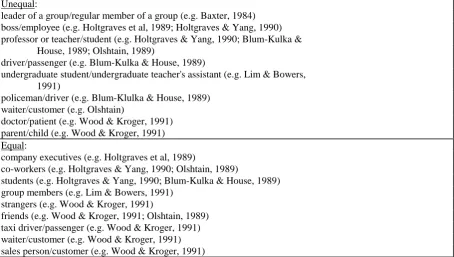
As with distance, many authors use role relations to illustrate or manipulate different levels of power. Some examples of role relations used in the studies listed are given in Table 4.
Unequal:
leader of a group/regular member of a group (e.g. Baxter, 1984) boss/employee (e.g. Holtgraves et al, 1989; Holtgraves & Yang, 1990) professor or teacher/student (e.g. Holtgraves & Yang, 1990; Blum-Kulka &
House, 1989; Olshtain, 1989)
driver/passenger (e.g. Blum-Kulka & House, 1989)
undergraduate student/undergraduate teacher's assistant (e.g. Lim & Bowers, 1991)
policeman/driver (e.g. Blum-Klulka & House, 1989) waiter/customer (e.g. Olshtain)
doctor/patient (e.g. Wood & Kroger, 1991) parent/child (e.g. Wood & Kroger, 1991) Equal:
company executives (e.g. Holtgraves et al, 1989)
co-workers (e.g. Holtgraves & Yang, 1990; Olshtain, 1989)
students (e.g. Holtgraves & Yang, 1990; Blum-Kulka & House, 1989) group members (e.g. Lim & Bowers, 1991)
strangers (e.g. Wood & Kroger, 1991)
[image:10.595.71.526.504.761.2]friends (e.g. Wood & Kroger, 1991; Olshtain, 1989) taxi driver/passenger (e.g. Wood & Kroger, 1991) waiter/customer (e.g. Wood & Kroger, 1991) sales person/customer (e.g. Wood & Kroger, 1991)
In most cases, these interpretations of the power associated with the role relations are uncontroversial. However, a few are less obvious. For example, Blum-Kulka et al (1985) refer to `driver and passenger' as an unequal relationship, whereas Wood & Kroger (1991) classify `taxi driver and passenger' as an equal relationship. Similarly, Olshtain (1989) treats `waiter/customer' as an unequal relationship, whereas Wood & Kroger (1991) classify it an an equal one.
In cases such as these, it seems that various interpretations are possible, depending on the rights and obligations associated with the role. For example, with respect to payment, drivers and waiters have the right to receive payment from passengers and customers, and in this sense have power over them if the
passenger/customer tries to avoid paying. On the other, drivers and waiters are obliged to provide good service, and if they fail to do so, passengers and customers have the right to complain, and so in these situations it is the passengers and customers who have greater power. So perhaps if these relative rights and obligations balance out, the relationship can be regarded as equal, as Wood & Kroger (1991) maintain.
A further area of potential confusion lies in the use of the terms high power and low power. Brown and Levinson (1978/1987) define a high power situation as one in which the hearer has power over the speaker, whereas Blum-Kulka et al (1985) define it as the reverse: one in which the speaker has power over the hearer. As can be seen from Table 3, many authors use the terms high and low power/status in their research. Some (e.g. Leichty & Applegate, 1991) make the issue clear by referring regularly to, for example, speaker power; others, however, explain it only once in the body of the text, and so careful reading is required in order to identify whether it is the speaker or the hearer who has `high power'.
Similarly, the use of the term low power is potentially confusing. Brown & Levinson (1978/1987), for example, use low or small power to mean `a small differential in power'; so when two people are equals, P is regarded as low. Holtgraves & Yang (1990), on the other hand, use the label equal-power for this kind of relationship, and they use low power for situations in which the hearer has less power than the speaker.
In conclusion, then, judging from the different terms used for power by the various authors, and considering the glosses, explanations and examples given, it seems that in their interpretations of the `vertical' dimension of interlocutor relations authors have emphasised one or more of the following aspects:
1. Power of control (e.g. Brown & Gilman, 1960/1972; Brown & Levinson, 1978/1987) 2. Social status or rank (e.g. Cansler & Stiles, 1981)
3. Authority, or the legitimate right to exert influence (e.g. Leichty & Applegate, 1991) 4. A general notion of equality-inequality (e.g. Holtgraves, 1986)
Clearly, these conceptions are often interrelated, but they are not necessarily identical. Power of control refers to the degree to which one person can control the behaviour of another, and as French & Raven (1959) point out in their classic paper, it can have several bases. One of these is social legitimacy: the socially-accepted authority or legitimate right to exert influence (French & Raven's legitimate power). Legitimate power can itself have several bases or sources, and one of these can be social status, or rank. Thus social status or rank can endow a person with power of control, but need not necessarily do so, as it might not be acknowledged as relevant or applicable.
There is a need for a greater amount of explicit discussion of these constructs, and their
interrelationships. As the review above indicates, they are frequently glossed over in the pragmatics literature, perhaps because the components of this `vertical' dimension of interlocutor relations are thought to co-vary. Certainly they are more likely to co-vary than the components of distance, but they do not inevitably do so. For example, the Residence Hall Advisors used by Leichty & Applegate (1991) have the legitimate right to exert influence on other residents of the hall, yet they do not really have higher social status or rank.
3. SPLITTING `DISTANCE' AND `AFFECT'
As can be seen from Table 1, Holtgraves (1986) used two `horizontal' variables, attraction and closeness, in his research. However, he does not discuss why he decided to treat these factors as separate variables, even though he refers to Brown & Levinson's (1978/1987) work.
Holtgraves (1986) investigated the effects of different types of replies on people's perceptions of three variables: status, attraction and closeness. Subjects were presented with brief scenarios, in which one of the interactants requested certain information from the other, such as what the other person thought of her new dress. After this, the subjects read a reply, which varied in type; for example, direct and true (e.g. "I don't think it looks very good on you."), direct and false (e.g. "I think it looks very good on you."), evasive (e.g. "It seems like clothes are getting terribly expensive."), and irrelevant (e.g. Did I tell you I'm going to take my vacation next month?).
After reading each scenario and reply, the subjects rated the following variables on 11-point scales:
(a) the relative status of the interactants (status);
(b) how much the questioner liked the replier (liking of replier); (c) how much the replier liked the questioner (replier's liking of other); (d) the closeness of the interactants' relationship (closeness).
Holtgraves found that people's inferences of all these variables were influenced by the type of reply given, and that inferences of liking and closeness were highest when a direct and true reply was used, next highest when an evasive reply was used, and lowest when an irrelevant reply was used. This order occurred for each of the `horizontal' dependent variables: liking of replier, replier's liking of other, and closeness.
However, Holtgraves does not report whether there was any significant difference in the degree to which ratings of liking and closeness were influenced by type of reply, and in subsequent studies (Holtgraves et al, 1989; Holtgraves & Yang, 1990), he uses a single measure of distance. This implies that he no longer felt it was worthwhile to distinguish between affect and closeness. Unfortunately, though, he does not discuss such matters explicitly.
Slugoski & Turnbull (1988), on the other hand, deliberately manipulated affect and distance in order to explore whether these variables have a differential effect on language use. Subjects were presented with 2-paragraph vignettes: in the first 2-paragraph, the variables affect and distance were manipulated, and in the second, one of the interactants made a comment that was either a counter-to-fact literal insult or a counter-to-fact literal compliment. For example, one of the Intimate-Dislike and Literal Insult scenarios was as follows:
Sue and Jill are both teachers at a college of art and design, where they have been teaching a painting course together for the past 10 years. Recently, each has been trying to have the other fired so that she could take complete control of the course. Not surprisingly, they now dislike each other a great deal.
Sue recently entered a national art competition. The painting she produced for the competition was clearly the best painting in an exhibition of all the entries, and it was placed right in the centre of the exhibition hall. Jill went to the exhibition, and when she saw Sue, she said, `Such a pity you haven't learned to paint yet, Sue.'
(Slugoski & Turnbull, 1988:109)
For each scenario, subjects were asked to state in their own words what they thought the speaker meant by his/her remark, and to rate on 7-point scales how insulting/complimentary the remark was, how well the interactants knew each other, and how much the interactants liked/disliked each other.
Slugoski & Turnbull (1988) found that affect had a much greater effect on people's interpretations of literal insults and compliments than distance did. So the authors argue that affect should be included as a separate variable within Brown & Levinson's (1978/1987) model of politeness.
Brown & Gilman (1989) also argue that affect and distance should be treated as separate parameters. These authors examined the use of politeness strategies in four Shakespeare plays, and although they did not initially distinguish between affect and distance, they found that variations in politeness strategies are highly associated in the plays with affect. They found that the more the interactants like each other, the more polite the speaker is, whereas when there is dislike or hostility, the speaker becomes less polite. As a result, they draw the following conclusion:
... in the tragedies we find nothing relevant to D except changes of feeling that occur suddenly rather than gradually and are not accompanied by changes of interactive closeness. The outcomes for the changes of feeling exactly reverse the outcomes predicted by the D of politeness theory, following instead the rule that increase of affection is associated with increase of politeness and decrease with decrease. We conclude, in agreement with Slugoski and Turnbull, that the Brown/Levinson model requires an additional parameter - "relationship affect." No one as yet has shown how such a new parameter ought to be fitted into the present model.
Brown & Gilman, 1989:196
Brown & Levinson (1987:16), in their introduction to the reissue of their model of politeness, concede that ``liking' might be an independent variable affecting choice of politeness strategy'. And they comment that `it would be interesting to investigate this by looking at cultures where `friendship' is less confounded with social distance.' (Brown & Levinson, 1987:16)
However, Wood & Kroger (1991) maintain that the key issue is not whether affect is an important, separate aspect of relationships, but the level at which factors such as affect need to be taken into account. These authors make the following suggestion:
... we would propose that we consider social relationships and politeness at three levels: abstract categories (or dimensions) of status and solidarity; types of relationships or role sets; and relationships between individuals. The last level is the most differentiated, concrete and contextualised, and would include factors such as liking, affect, familiarity, similarity, and `interactive closeness' (Brown & Gilman, 1989) as well as different forms of power (e.g. social, physical).
Wood & Kroger, 1991:165
Clearly, there is a lack of consensus at present concerning the status and relative importance of affect as a pragmatic variable.
4. SUMMARY
The review and discussion in sections 2 and 3 indicate that greater attention needs to be paid to two conceptual issues:
1. The number of fundamental dimensions of interpersonal relationships that have a crucial effect on language use;
2. The conceptual nature of these dimensions, and the terms used to label them.
In the next two sections of this paper, research within other disciplines, and especially social
psychology, is described and reviewed. This research is highly relevant to the debate and yet is often unfamiliar to linguists.
5. FUNDAMENTAL DIMENSIONS OF INTERPERSONAL BEHAVIOUR
5.1 Review of Social Psychological Research
One of the earliest models of interpersonal behaviour was proposed by Leary (1957). He suggested that social behaviour can be described in terms of two fundamental dimensions: love - hostility and dominance - submission. His model was intuitive in origin, although he cited correlational data in support of it. A rather similar model was also suggested by Schaefer (1965). Schaefer investigated the behaviour of parents towards their children, and on the basis of his findings proposed that two axes could account for the findings: love - hostility and control - autonomy.
Benjamin (1974) then extensively elaborated this work by Leary and Schaefer, and developed a complex model of social behaviour which was supported by data from a series of questionnaires. She agreed with Leary and Schaefer that one fundamental dimension relates to love - hostility, and she named this dimension affiliation. She then considered the nature of the other dimension, and felt that in some ways both were right in their specification of the extremes of the dimension: she felt that both submission and autonomy could justifiably be seen as the opposite of dominance. So she resolved the dilemma by proposing a complementary component to the model. She suggested that in unequal relations, such as parent - child, the range of the dimension differs for different role members. She proposed that the behaviour of the superordinate person ranges from dominate to allow autonomy, and that the behaviour of the subordinate person ranges from submit to be emancipated. So she suggested two complementary planes for the second dimension. In other words, her model has two main axes, with two complementary planes for the second axis:
1. Affiliation (love - hate)
2. Interdependence (dominate - allow autonomy) (submit - be emancipated)
In a somewhat more recent study of interpersonal behaviour, Stiles (1980) identified four fundamental dimensions. He presented subjects with dialogue excerpts, and then asked them to describe how each person acted toward the other person in the dialogue, by rating them on 12 adjectival scales. Multidimensional scaling of the ratings yielded four dimensions: dominance, friendliness, self-centredness, and task orientation.
Similar results were obtained by Wish, Deutsch and Kaplan (1976) in a study of both role and personal relations. They drew up a long list of dyads, such as husband and wife, business rivals, and nurse and invalid. Then, using a procedure similar to Kelly's (1955) repertory grid technique, they generated a set of 25 bipolar scales on which these dyads could be rated; for example, very cooperative - very competitive; exactly equal - extremely unequal power; intense - superficial interaction with each other. Next they asked 87 subjects to use these 25 bipolar scales to rate 20 of their own personal relations (for example, between you and your spouse) and 25 role relations (for example, between husband and wife). A multidimensional scaling analysis of the data revealed four dimensions, which they interpreted as follows:
1. Competitive & hostile - cooperative & friendly 2. Equal - unequal
3. Intense - superficial
4. Task oriented & formal - socioemotional & informal
Adamopoulos (1982) attempted a more ambitious study of the structure of interpersonal relations, in that he tried to link three concepts: social behaviour, social roles, and social situations. He asked subjects to consider various combinations of situation, role and behaviour, and to provide an estimate of the likelihood of the first person of the role relationship performing the particular behaviour toward (or with) the second person, in the situation specified. He then factor analyzed the results, and obtained the following sets of factors:
Behaviour factors: 1. Superordination 2. Association 3. Intimacy
Role factors: 1. Status & differential power 2. Formal & academic roles 3. Intimacy
Situation factors: 1. Informality 2. Constraint
Similar research into the structure of interpersonal behaviour has been carried out by other researchers (for a more comprehensive review, see Lonner, 1980).
research has been carried out in western contexts, usually in either Britain or America. However, in the 1960's, a classic cross-cultural study was carried out by Triandis, Vassiliou and Nassiakou (1968). These researchers undertook an extensive investigation of the behaviours associated with different roles. They used American and Greek subjects, and asked them to judge the appropriateness of certain behaviours for given role relationships. Factor analyses of the results showed that there were four factors common across the two cultures: affect, intimacy, dominance, and hostility. These are similar to those identified by other researchers, thus supporting the possibility that they may be universal.
5.2 Discussion
A number of authors (for example, Foa, 1961; Lonner, 1980; Stiles, 1980; Triandis, 1978; Wish et al, 1976) have commented on the convergence of these various social psychological findings.
Stiles (1980), for example, suggests that two dimensions are particularly robust: a dominance, control or status dimension, and a dimension relating to friendliness, affect or degree of association. And Triandis (1978) makes the following claim:
Interpersonal behavior can be measured on four universal dimensions: 1. Association - Dissociation
2. Superordination - Subordination 3. Intimacy - Formality
4. Overt - Covert Behavior1
... These are the dimensions that emerge again and again, in different cultures, when people make judgments about social interaction toward others or in role relationships.
Triandis, 1978:8
It certainly seems that the `vertical' dimension of interpersonal relations is extremely stable and robust. It emerges as a single factor in almost all of the studies, although it is labelled in various ways: dominance, equality/inequality, superordination/subordination, power, giving versus denying status, authority ranking.
However, there is less consensus over a second, single fundamental dimension. Many of the studies yielded two or more `horizontal' dimensions, and Triandis (1978, 1994) argues that two of them in particular are universal. He labels them associative/dissociative and intimacy/formality respectively.
These terms are not easy to interpret, but Triandis (1994) provides the following glosses to help indicate their conceptual nature:
Associative: helping, supportive, admiring, giving resources, sexual Dissociative: avoiding, aggressive, hostile
Intimacy: self-disclosure, touching, kissing Formality: doing what etiquette requires
Moreover, the behavioural items that had high loadings on each of the four main factors that emerged from Triandis et al's (1968) study give a further indication of the nature of the dimensions.2 They are shown in Table 5.
American Loadings Greek Loadings
Factor 1: Acceptance vs Prejudice Factor 1: Associative vs Dissociative
be prejudiced against (-ve) help
compliment reward
be afraid of (-ve) advise
stand up for hate (-ve)
be interested in feel antipathy (-ve)
exclude from neighbourhood (-ve) grow impatient with (-ve)
reward be indignant with (-ve)
not admire (-ve) be friend of
blame for failure (-ve) invite
argue with discuss
fear (-ve) argue with (-ve)
be eager to see infuriate (-ve)
laugh at jokes of be proud of success of
respect
be prejudiced against (-ve) swear at (-ve)
Factor 2: Contempt Factor 2: Hostility
lie to quarrel with
go to meeting with (-ve) exploit
enjoy meeting (-ve) cheat
laugh at be jealous toward
learn with help of (-ve) lie to
cheat annoy
sympathise with (-ve) accuse
enjoy company of (-ve) avoid
go shopping with (-ve)
Factor 3: Superordination Factor 3: Superordination-subordination
command thank for presents
advise apologize
treat as a subordinate ask for help
be annoyed by is dependent on (-ve)
look down upon accepts commands of (-ve)
inspect work of fear (-ve)
feel superior to order to do something counsel
punish
Factor 4: Intimacy Factor 5: Intimacy
kiss pet
cuddle cry for
love sex-love
marry love
punish
be captivated by charm
Key: (-ve) indicates a negative loading
Table 5: Equivalent Role Differential Factors, & their Highest Behavioural Loadings, found by Triandis et al (Based on Triandis et al, 1968)
It is interesting and significant to note that the `horizontal' dimensions that have emerged from this social psychological research do not correspond very closely to the division of Distance that Brown & Gilman (1989) and Slugoski & Turnbull (1988) propose. As explained in section 3, these authors argue that affect and distance (which they seem to interpret as degree or length of contact) have differential effects on language use and thus should be treated as separate factors. However, there seems to be an affectual component (and a sexual component) to both the dimensions association/dissociation and intimacy/formality suggested by Triandis (1994). Similarly, the dimensions that emerged from the studies by Wish et al (1975) (cooperative &
friendly/competitive & hostile; socioemotional & informal/task-oriented & formal) and those that Adamopoulos (1982) found (association and intimacy) also do not correspond closely to Slugoski & Turnbull's (1988) and Brown & Gilman's (1989) proposal.
So social psychological research indicates that there may be more than one fundamental `horizontal' dimension of interlocutor relations, but as yet there is no clear concensus as to their exact nature. It is clearly important for linguists to explore this issue more thoroughly, especially since the dimensions suggested by psychologists do not correspond very closely to those proposed by Slugoski & Turnbull (1988) and Brown & Gilman (1989).
6. DISTANCE
6.1 Social Psychological Research into Close Relationships
Social psychologists have carried out a lot of research into `close' relationships, and yet as Berscheid et al (1989) point out, little attention has been paid to ways of distinguishing close from distant relationships:
Agreement about the most useful manner of discriminating a close relationship from those that are less close does not now exist despite the great interest that investigators in a variety of disciplines have taken in close relationship phenomena in recent years. Not only is there as yet no agreement about the merits or demerits of different close relationship classification schemes, but the matter is seldom discussed.
Bersheid et al, 1989:64
Social psychologists traditionally assumed that certain types of relationship, such as husband-wife and parent-child, were automatically close. However, as Bersheid et al (1989) point out, in current Western society it is risky to make such an assumption: some husbands and wives, or parents and children, have close relationships, but by no means all of them.
Another way that psychologists have considered for identifying close relationships is to examine their emotional tone. In everyday life, people often characterise a close relationship in terms of strong and positive emotions which form a warm and intimate bond. However, many social psychologists (for example, Kelley et al, 1983; Bersheid, 1983; Blumstein and Kollock, 1988) warn against such a characterisation. Berscheid (1983), for example, argues that strong and positive affect is not always typical of close relationships. With regard to magnitude of affect, she points out that some relationships are emotionally quiescent for long periods of time, and yet if the participants are suddenly and irrevocably separated from each other (such as by sudden death), the result may be a long period of intense grief. And conversely, the break-up of a relationship in which there was intense affect may precipitate only a relatively mild and short-lived emotional reaction. With regard to the hedonic sign of affect, she points out that people in a close relationship nearly always experience negative emotions as well as positive ones; and that relationships characterized by predominantly negative feelings may often be surprisingly stable over time, and result in great sorrow and grief if they are severed for some reason.
Kelley et al (1983) propose that high interdependence is the key factor in a close relationship, and suggest the following definition:
... the close relationship is one of strong, frequent, and diverse interdependence that lasts over a considerable period of time.
Kelley et al, 1983:38
In other words, the individuals have frequent impact on each other; the degree of impact per each occurrence is strong (ie is psychologically highly significant in some way); the impact involves diverse kinds of activities for each person; and the interdependence occurs over a relatively long period of time.
Hays (1984, 1989) has applied this notion of interdependence to an investigation of close and casual friendships. He found that, compared with casual friends, close friends interact both more often and across a greater range of settings and times, and also perceive more benefits from the encounters.
Hays (1984) specifies four behavioural content areas that relate to friendship, and that can be used for differentiating close and distant relations:
Companionship: sharing an activity or experience together, doing something together, sharing each other's company.
Consideration (or utility): friend as `helper', providing goods, services or support; expressing concern for the other's well-being.
Communication (or self-disclosure): disclosing (verbally or non-verbally) or discussing information about oneself; exchanging ideas, facts, opinions or confidences about any topic. Affection: expressing any sentiment (positive or negative) felt towards the other, any expression of the emotional bond between partners.
Hays, 1984:78
Theory and research within social psychology confirms the complexity of the concept
distance/closeness. It acknowledges that both psychologists and lay people often conceive of relationships in terms of closeness or distance, but that the precise meaning of the parameter is less clear.
Psychologists seem to agree, however, that no single factor is responsible for the relative
distance/closeness of a relationship; it probably results from a number of factors. However, there is no concensus at present as to what these component factors are.
Several factors that linguists have used for measuring the parameter have also been included by some social psychologists; for instance, frequency of contact, length of acquaintance, and positive/negative affect. However, psychologists have also proposed some components that linguists have not yet explicitly utilised: for example, the diversity of people's interdependence (Kelley et al, 1983), companionship, consideration and communication (Hays, 1984). Moreover, some psychologists include affect as a key component factor and others do not.
7. POWER
This section does not review psychological conceptions of power, partly for reasons of space, and partly because there is less debate over the unitary nature of this dimension.3 Instead, it briefly draws attention to a cultural bias in western conceptions of power.
As Wetzel (1993) points out, in the West the term power is closely associated with domination and control, and so often has strong negative connotations. However, not all cultures view `vertical' relations in this `negative' way; they are often associated with a very different set of social values. In both China and Japan, for example, Confucian philosophy has influenced many people's conceptions of social relationships. Members of unequal dyads such as teacher-student, boss-employee, often feel extensive mutual ties and responsibilites towards each other. The `superior' member does not simply dominate or control the other; instead the pair are bound together in a role relationship which involves considerable mutual responsibilities, somewhat analagous to a parent-child relationship. In such contexts, inequality is not regarded as `bad', and therefore needing to be eliminated.
This raises again the problem of terminology. Although technically, the definitions of power given by Brown & Gilman (1960/1972) and Brown & Levinson (1978/1987) do not necessitate a negative interpretation, in reality people often associate this label unfavourably with control and domination.
As Wetzel (1993) argues, it is extremely difficult to find a term that is sufficiently neutral and unloaded to be applicable in a range of cultures. She suggests `vertical relationship' as an alternative. This is certainly a netural term, and useful from a cross-cultural perspective. However, it gives no indication as to the nature of the dimension, and if used with `horizontal', the meanings of the parameters become even less clear.
8. SUMMARY & CONCLUDING COMMENTS
The research reviewed in this paper indicates that further consideration needs to be given to the parameters power and distance.
With regard to distance, there is no consensus at present among either linguists or psychologists as to reliable ways of distinguishing close and distant relationships. Unfortunately, many linguistic studies do not seem to consider such issues: typically there is no explicit discussion as to how the parameter has been interpreted, and there is considerable inconsistency among studies in terminological usage.
Slugoski & Turnbull (1988) and Brown & Gilman (1989) argue that affect should not be conflated with distance. They maintain that affect and distance have a differential effect on language use, and that they should therefore be treated as separate parameters. Psychological research also indicates that distance is not a single, fundamental dimension of interpersonal relations. However, the two basic dimensions proposed by Triandis (1978, 1994), association/dissociation and intimacy/formality, do not correspond closely to those suggested by Slugoski & Turnbull and Brown & Gilman.
1994) conceptions, in order to establish which conceptualisation is more appropriate for linguists, or whether in fact a single dimension is more appropriate.
With regard to power, once again few linguists explicitly discuss the conceptual nature of this parameter. However, psychological research indicates that it is a universal dimension of interpersonal relations which is relatively unitary in nature. Although there may be different types or sources of power, a person who has one type of power very often (but not invariably) also has other types of power.
Footnotes
1 Triandis (1978:8) comments that the dimension overt vs. covert behaviour does not emerge in many studies because `a behaviourist often specializes in the overt and a cognitive psychologist in the covert, and there are few studies involving both kinds of behavior ...'
2 It is important to remember, though, that behavioural manifestations of dimensions are often culture specific. Behaviour that is seen as friendly in one culture, for instance, may be interpreted as distancing or rude in another.
References
Adamopoulos, John, 1982. The perception of interpersonal behavior. Dimensionality & importance of the social environment. Environment & Behavior, 14(1): 29-44.
Baxter, Leslie A. , 1984. An investigation of compliance-gaining as politeness. Human Communication Research, 10(3): 427-456.
Beebe, Leslie M. & Tomoko Takahashi, 1989. Do you have a bag?: social status and patterned variation in second language acquisition. In: S. Gass, C. Madden, D. Preston, & L. Selinker (Eds.), Variation in Second Language Acquisition (pp. 103-125). Clevedon, Philadelphia: Multilingual Matters. Benjamin, Lorna S., 1974. Structural analysis of social behavior. Psychological Review, 81(5): 392-425. Berscheid, Ellen, Mark Snyder & Allen M. Omoto, 1989. Issues in studying close relationships. Conceptualizing
and measuring closeness. In: C. Hendrick (Eds.), Close Relationships (pp. 63-91). London: Sage Publications.
Bersheid, Ellen, 1983. Emotion. In: H. H. Kelley, E. Berscheid, A. Christensen, J. H. Harvey, T. L. Huston, G. Levinger, E. McClintock, L. A. Peplau, & D. R. Peterson (Eds.), Close Relationships (pp. 110-168). New York: Freeman.
Blum-Kulka, Shoshana, Brenda Danet & Rimona Gherson, 1985. The language of requesting in Israeli society. In: J. Forgas (Eds.), Language and Social Situations (pp. 113-139). New York: Springer-Verlag. Blum-Kulka, Shoshana & Juliane House, 1989. Cross-cultural and situational variation in requesting behavior.
In: S. Blum-Kulka, J. House, & G. Kasper (Eds.), Cross-Cultural Pragmatics: Requests & Apologies (pp. 123-154). Norwood, N.J.: Ablex.
Blumstein, Philip & Peter Kollock, 1988. Personal relationships. Annual Review of Sociology, 14: 467-490. Boxer, Diana, 1993. Social distance and speech behavior: the case of indirect complaints. Journal of
Pragmatics, 19: 103-125.
Brown, Penelope & Stephen Levinson, 1978/1987. Politeness: Some Universals in Language Usage. First published in 1978 as part of Esther N. Goody (ed) Questions and Politeness. Reissued in 1987 with corrections, new introduction and new bibilography. Cambridge: Cambridge University Press. Brown, Roger, 1965. Social Psychology. First edition. London: Collier-Macmillan.
Brown, Roger & Albert Gilman, 1960. Pronouns of power and solidarity. In: T. A. Sebeok (Eds.), Style in Language (pp. 253-276). Cambridge, Mass.: MIT Press. Reprinted in Pier Gigliogli (Ed), 1972. Language and Social Context (pp.252-282). Harmondsworth: Penguin.
Brown, Roger & Albert Gilman, 1989. Politeness theory and Shakespeare's four major tragedies. Language in Society, 18: 159-212.
Cansler, David C. & William B. Stiles, 1981. Relative status and interpersonal presumptuousness. Journal of Experimental Social Psychology, 17: 459-471.
Fiske, Alan P., 1992. The four elementary forms of sociality: framework for a unified theory of social relations. Psychological Review, 99(4): 689-723.
Foa, Uriel G., 1961. Convergences in the analysis of interpersonal behavior. Psychological Review, 68: 341-353. French, John R.P & Bertram Raven, 1959. The bases of social power. In: D. Cartwright (Ed.) Studies in Social
Power. Ann Arbor: University of Michegan.
Hays, Robert B., 1984. The development and maintenance of friendship. Journal of Social & Personal Relationships, 1: 75-98.
Holmes, Janet, 1990. Apologies in New Zealand English. Language in Society, 19: 155-199.
Holtgraves, Thomas, 1986. Language structure in social interaction: perceptions of direct and indirect speech acts and interactants who use them. Journal of Personality & Social Psychology, 51(2), 305-313. Holtgraves, Thomas, Thomas K. Srull & Daniel Socall, 1989. Conversation memory: the effects of speaker
status on memory for the assertiveness of conversation remarks. Journal of Personality and Social Psychology, 56(2): 149-160.
Kelley, H.H., E. Berscheid, A. Christensen, J.H. Harvey, & T.L. et al., 1983, Analyzing close relationships. In: H. H. Kelley, E. Berscheid, A. Christensen, J. H. Harvey, T. L. Huston, G. Levinger, E. McClintock, L. A. Peplau, & D. R. Peterson (Eds.), Close Relationships (pp. 20-67). New York: Freeman.
Kelly, George, 1955. The Psychology of Personal Constructs. Vols. 1 & 2. New York: Norton. Leary, T. , 1957. Interpersonal Diagnosis of Personality. New York: Ronald Press.
Leech, Geoffrey, 1983. Principles of Pragmatics. London: Longman.
Leichty, Greg & James L. Applegate, 1991. Social-cognitive and situational influences on the use of face-saving persuasive strategies. Human Communication Research, 17(3): 451-484.
Lim, Tae-Seop & John W. Bowers, 1991. Facework, solidarity, approbation, and tact. Human Communication Research, 17(3): 415-450.
Longabaugh, Richard, 1966. The structure of interpersonal behavior. Sociometry, 29(4): 441-460.
Lonner, Walter , 1980. The search for psychological universals. In: H. C. Triandis & W. W. Lambert (Eds.), The Handbook of Cross-Cultural Psychology (pp. 143-204). Boston: Allyn & Bacon.
Olshtain, Elite, 1989. Apologies across languages. In: S. Blum-Kulka, J. House, & G. Kasper (Eds.), Cross-Cultural Pragmatics: Requests & Apologies (pp. 155-173). Norwood, N.J.: Ablex.
Schaefer, E.S., 1965. A configurational analysis of children's reports of parents' behavior. Journal of Consulting Psychology, 29: 552-557.
Slugoski, Ben & William Turnbull, 1988. Cruel to be kind and kind to be cruel: sarcasm, banter, and social relations. Journal of Language & Social Psychology, 7(2): 101-121.
Spencer-Oatey, Helen, 1992. Cross-cultural Politeness: British & Chinese conceptions of the tutor-student relationship. Unpublished Ph.D. thesis, Lancaster University.
Stiles, William B., 1980. Comparison of dimensions derived from rating versus coding of dialogue. Journal of Personality & Social Psychology, 38(3): 359-374.
Triandis, Harry C., 1972. The Analysis of Subjective Culture. New York: Wiley.
Triandis, Harry C., 1978. Some universals of social behavior. Personality & Social Psychology Bulletin, 4(1): 1-16.
Triandis, Harry C., 1994. Culture and Social Behaviour. New York: McGraw-Hill, Inc.
Triandis, Harry C., Vasso Vassiliou & Maria Nassiakou, 1968. Three cross-cultural studies of subjective culture. Journal of Personality & Social Psychology, Monograph Supplement, 8 (4): 1-42.
Trosborg, Anna, 1987. Apology strategies in natives/non-natives. Journal of Pragmatics, 11: 147-167.
Vollmer, Helmut J. & Elite Olshtain, 1989. The language of apologies in German. In: S. Blum-Kulka, J. House, & G. Kasper (Eds.), Cross-Cultural Pragmatics: Requests & Apologies (pp. 197-218). Norwood, N.J.: Ablex.
Wetzel, Patricia J., 1993. The language of vertical relationships and linguistic analysis. Multilingua, 12(4): 387-406.
Wierzbicka, Anna, 1991. Cross-Cultural Pragmatics. The Semantics of Human Interaction. Berlin & New York: Mouton de Gruyter.
Wish, Myron, Morton Deutsch & Susan J. Kaplan, 1976. Perceived dimensions of interpersonal relations. Journal of Personality & Social Psychology, 33(4): 409-420.