University of Warwick institutional repository: http://go.warwick.ac.uk/wrap
A Thesis Submitted for the Degree of PhD at the University of Warwick
http://go.warwick.ac.uk/wrap/66721
This thesis is made available online and is protected by original copyright. Please scroll down to view the document itself.
Symbolic dynamics for Kleinian groups
Andre Cavalcanti Rocha
Thesis submitted for the degree of Doctor of
Philosophy at the University of Warwick.
The Mathematics Institute,
University of Warwick,
Coventry.
Contents
List of Figures
Acknowledgements
Declaration
Summary
1 Markov partitions and zeta functions
1.1 Introduction...
1.2 Definitions and preliminary results 1.3 A subshift of finite type . . . . 1.4 An expanding map . . . . 1.5 Application: The Selberg Zeta Function
3
4
5
6
7
7
8 12 13 18
2 Markov partition and deformation spaces of Kleinian groups 23
2.1 Introduction.... 23
2.2 Markov partitions. 25
2.3 Deformation spaces and expanding maps 2.4 The Hausdorff dimension of the limit set 2.5 Even corners and Klein combination 2.6 Examples . . . .
3 Markov partitions and automatic structures 3.1 Introduction.
3.2 Preliminaries
3.3 Markov partitions and the word problem "3.4 Automatic structures and shifts of finite type
29
3136
39
41
41
42
46
Contents
Appendix
Bibliography
2
56
List of Figures
1.1 The typical situation
...
161.2 The triangle D. with vertices at xn,a~ and an . 17
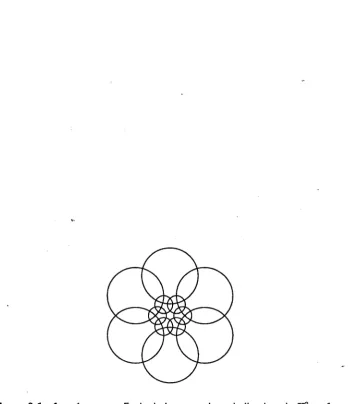
2.1 A web group
..
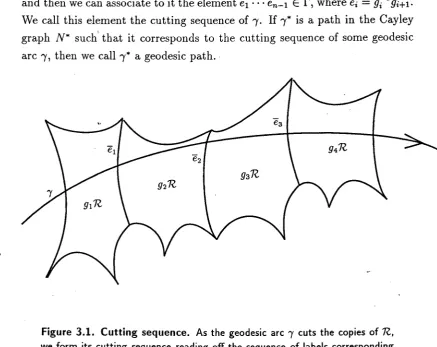
403.1 Cutting sequence 44
3.2 Surface af genus 2 . 45
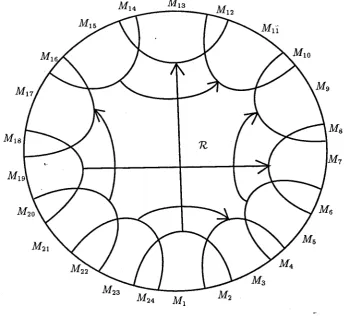
3.3 A Markov partition 47
Acknowledgements
I am very grateful to my supervisor Caroline Series for her support and guid-ance during these four years at Warwick. I thank her for always being available to answer my questions and for introducing me to Hyperbolic Geometry.
I thank Mark Pollicott for his help on the numerous occasio.ns he patiently explained to me zeta functions and Ruelle operators. Not only I was introduced by him to these topics, but also he guided me on how to use them in my research.
I thank John Parker for always being so happy to talk with me about my research problems and for always leaving his office door open to me whenever I wanted to come in and talk.
I thank Elaine, Peta, Fiona, Terry, Mavis, Hazel, Denise and Alice for their help regarding administrative matters and for quite a few happy moments.
I acknowledge the financial support of the Brazilian Government through a grant given by its research council CNPq.
During the years that I was in England together with my family, there was always the invaluable support of my parents and my sister. They are the solid lighthouse that I so often turn to in this sea called life. I am trying my best to serve just as well to my own family.
Declaration
The results in Chapter 1 constitute a paper which has been accepted for
pub-lication in the Mathematical Proceedings, Cambridge Philosophical Society. The results in Chapter 2 are a joint collaboration with Dr. James W.
Anderson from the Department of Mathematics Rice University, Houston USA.
Each author equally contributed to the material in this chapter. The resultG in the Appendix are due entirely to Dr. Anderson.
The work in this thesis is, to the best of my knowledge, original, except
Summary
This thesis is tomposed of three independent chapters and an appendix. In the first two chapters we deal with Kleinian groups and in the third one we concentrate on Fuchsian groups. In chapters 1 and 2, we study the action of a Kleinian group on points in hyperbolic space of three dimensions and on points on its boundary. All Kleinian groups we study have the property that their action on points in the hyperbolic 3-space has a fundamental polyhedron with the property that the union of the images of its faces under the group elements contains each geodesic plane that contains one of the faces. This is the so called even corners property. Using this property we prove in Chapter one the existence of an expanding Markov type mapping on the Riemann sphere. The main application is to give a shorter proof that the Selberg zeta function associated to the Kleinian group has a meromorphic extension to Co
In chapter two, we assume the existence of a Kleinian group with the even corner property and define its deformation space. We then prove that the
--Hausdorff dimension of the limit set of groups in the deformation space varies real analytically as we vary the points in the deformation space. We prove that Klein's combination Theorem quasi-preserves the even corners property in the sense that, if a group
r
is formed by other two via Klein's theorem and these last two are quasi-conformal deformations of groups with the even corners property, then r is a deformation of a Kleinian group with the even corners property. In particular, the result about the Hausdorff dimension is valid for all geometrically finite purely loxodromic function groups.Chapter
1
Markov partitions and zeta functions
l'We prove the existence of a piecewise analytic expanding map associated to cer-tain Kleinian groups without parabolics acting on points in the 3-dimensional hyperbolic space. These groups have a fundamental domain
n
with the the property that the geodesic planes containing each face are part of the tessela-tion. We use this map together with the methods of thermodynamic formal-ism to give another proof that the Selberg zeta function for such groups has a meromorphic extension to <C1.1. Introduction
The aim of this chapter is to show the existence of a piecewise analytic ex-panding map defined on the limit set of a Kleinian group having a fu~damental
1.2. Definitions and preliminary results 8
1.2.
Definitions and preliminary results
A Kleinian group is a discrete subgroup of the group of orientation preserving isometries of the three dimensional hyperbolic space
JHf3.
We use the Poincare ball model to realize hyperbolic space in three dimensions. Recall that this model consists of the unit ball in ]R3with the (hyperbolic) metric
2dr
ds = 1 _
Ir12·
Let f be a finitely generated non-elementary Kleinian group acting on
JHf3.
The limit set A of f is the set of limit points of the orbit under f of any point"
x E
JHf3.
Because f acts discontinuously, clearly we have that A C8
2 •The elements of f belong to the subgroup of all Mobius transformations that preserve B3
, which is in turn a subgroup of the full Mobius group Mob3 ,
see [AhI81]. The elements of Mob3 are real analytic bijective maps in a
suit-able open set in ]R3 which we will deal with later.
We assume that f has no parabolic elements.
Definition 1.2.1 (Even corners property). A fundamental domain
n
forr
is said to have the even corners property ifU
,(an)
')'Er
is a union of planes.
We assume that
n
is a fundamental polyhedron for f with the above property and such that 0 En.
Let fR be the set of face pairing transformations for
n.
Using Poincare's Theorem, we get a presentation<
r
RI
RR>
for the groupr, such that
f R isa symmetric system of generators and RR is the set of r~lations we get from
each vertex and face cycles, see [Mas88]. We use the elements in rR to label
the faces of
n
as follows. Use the label e on a face ofn
if the element e E f pairs it to some other face. Write e inside nande
on the outside, wheree
denotes e-1 E fR .Following Bourdon [Bou93], we have for each word eioei1 ... ein written
,"
1.2. Definitions and preliminary results 9
defined as : P( eio ) is the plane containing the face nneio
n
and for k = 1, ... ,nP( eio ei1 ••• eik) is the plane containing eio ... eik_1
n
n
eio ... eikn.
Proposition 1.2.2. The following statements are equivalent: (a) The word eio ... ein is shortest in
r
n(b)
For k =0, ...
,n the planes P( eio ... eik) are pairwise distinct.( c)
For every k E {O, ... , n}, and for every I satisfying k :::; 1 :::; n, the plane P( eio ... ei,,) separatesn
from eio ... ei!n.
Proof of 1.2.2.
This is in Bourdon [Bou93], §3.3. In fact he proved this result for any
dimension.
11.2.21
We introduce a few more definitions and prove a theorem that we will use later. Let H
(d)
be the half-space in 1ffi3 whose intersection withn
is the face whose exterior label is e. It is clear that{H( ei) :
ei E fn } and R have union 1ffi3. Since H (ei) contains a face ofn,
we could use the associated face pairing to define a mapf
that sends a point x in H( ei) to ei1x if i is the least element of{j :
X EH(ej)}
andf(x)
=
x
ifx
En.
We define:Theorem 1.2.3.
B(ei)
={x
EH(ei): f(x)
=e;lx},
I( ei)
=
S2n
B( ei),B( eo, ... ,
en)
=
n;=of-
rB( e
r ),I(eo, ... , en) = S2
n
B(eo , " " en)= n~=of-r I(er).
(a)
Int B(eo, .. ·,e
n )f.
0 {:}Int I(eo· .. e
n )f.
0.(b) Int B(eo· .. en) =1= 0
=*
eo· .. en is shortest.(c) If f(g·
n)
= h·n,
then Ihl = Igl- 1 (I· 1
denotes the word length norm with respect to the generating setr
n ).<0 (d) If Int B(eo,"', en)
=I-
0, then diamI(eo'" en) --+°
as n --+ 00.Proof of 1.2.3.
1.2. Definitions and preliminary results 10
of (a), (b), ( c) to the present case. We prove that (d) is also true in the present context. Observe that B( eoel) = B( eo)
n
eoB( el), and thenj
21
-1 -1 B(eoed = e1 eo .Use induction to get
and now it is easy to see that
( B( eo' .. en) = eo' .. en-lB( en)
n
B( eo· .. en-d·From this last equality we have B( eOel ... en) C eOel ... en-lH( en) and then
1.2.4.
If x, Y E Ja3, then denote their hyperbolic and Euclidean distance by dH(x,y) and dE(x,y), respectively. Recall two important estimates relating
the hyperbolic distance and the word metric:
(i) If
r
has no parabolics, then there exists a constant a>
0 such that if 9 Er -
{id} then dH(O,gO)>
algi.
(ii) If
r
has parabolics, then there exist constants k, no E N such that if9 E
r -
{id} then dH(O,gO)>
2 logIgl-
k if Igl>
no.Proofs of these inequalities can be found in [Fl080]. Let hEr - {id} be such that dH(O, hO)
>
L, for some L>
O. If BH(hO,r)
is a hyperbolic ball with centre hO and hyperbolic radius ~, L>
7', then it is well known that1.2.5.
where BE(hO,c) is an Euclidean ball of radius c with centre hO and Euclidean radius
c =
~7'cosh-2
((L -
r))
<
eoe-L
2 2 - ,
where
eo
is a constant which does not depend on L, but does depend on r. Let W = WI W2 ... W N and v=
VI V2 ... V M, M>
N with WI=
Vb ... ,Wn =Vn for some n :::; N, and such that B(VIV2'" VM) and. B(WIW2'" WN) are non-empty. Let r
=
max{ dH(O, eO) : e Ern}. If r has no parabolics, thenN-l .. 1.2.6.
1.2.7.
dE(wO, vO) :::;
L
dE(Wl'" Wn+i O, WI'" Wn+i+l0)i=O
M-l
+
L
dE( VI' .. Vn+i O, VI' .• Vn+i+1 0).1.2. Definitions and preliminary results 11
Using (i) above,
and therefore
We can obtain a similar relation for v, and then it follows that
dE( wO, vO) ::; I exp(
-an).
If
r
has pa,rabolics, then the same argument works with (b) instead of (a), it then follows that1.2.8.
00 1
dE(wO,vO)
::;2c~
(y'
~ n+t
1=0
These estimates were proved by C. Series in [Ser81]. Consider the sequence
{giO}~o where gi = eOel'" ei with B(eoe} ... ei) f= 0 for all i = 0,1, .... This sequence converges to a point in the limit set A of
r.
Now two observations to finish our argument. Clearly goO E H( eo) and for each i ~ 1 we have giO E eOe} ... ei-lH( ei), also the half-spaces H( eo), eoH( el), ... form a nested sequence of sets, that is to sayRecall that each of these half-spaces is a complete union of copies of the fun-damental domain
n
due to the fact thatn
is even cornered. Combining these conclusions together with estimates 1.2.6 and 1.2.8 we have that1.2.9.
1.3. A subshift of finite type 12
1.3. A subshift of finite type
Consider the set Sf) of all planes in r .
an
that intersect n in either a face, an edge or a vertex. The intersection of each plane in Sf) with S2 is a circle, and the closures of the components of the complement of the union of these circles cover S2. Although these regions can intersect their interiors are disjoint. This gives us either a finite or countable partition 91 = {Rd~l of S2 minus a set of Lebesgue measure zero.The map
j
was defined from Ja3 to itself using the half-spaces H ( ei) and it is not difficult to see that it extends to S2 in the same way it was defined. We would like to use the partition 91 to prove the Markov property forf,
that is to say, the image underf
of any element Ri E 91 is a union of ~lements in 91. To do so, we assume that 91 partitions the entire S2 and then we have thatProposition 1.3.1. The map f has the Markov property with respect to the
partition 91 = {Ri}~l' Proof of 1.3.1.
Let Ri E 91. The boundary of Ri is a union of arcs belonging to circles which are the intersection of planes in
s,p-
with S2. From the definition of the half-spaces H{ei), it follows that Ri is contained in H{ej)' some j such that fiR;=
ejl. Suppose that ejl pairs the face Fj to the face Fij' Observe that et sends the planes in Sf) intersecting Fj to similar ones inters~cting FirTherefore, the circles containing the arcs of the boundary of Ri are sent to circles which are the intersections of the images of the planes passing through Fj with S2. Therefore, the boundary of the image of Ri is a union of arcs in
distinct circles, this implies that the region ~ is mapped under ejl to a union
of regions in 91. 11.3.11
Following the standard procedures of symbolic dynamics we now introduce a subshift of finite type on the space
by u : L,j - t L,j, u{r'k)f:o
=
{rk+1)f:o' We refer the reader to [PP90] for the .. , general theory of subshifts of finite type.1.4. An expanding map 13
Clearly the sets L,f and n are related. Indeed, for each rk define 1jJ(rk)
=
e Ern
if flRk
=
e-l. The Markov property of f guarantees that the map
1jJ : L,f -+
n
defined by 1jJ((rk)k:o) = (1jJ(rk))k:O is well defined. This map allows us to define a mapping from the shift spa~e L, f to the limit set A' of
r.
Using the fact thatI( eOel ... en)
2
I( eOel ... en+dand diam I(eOel'" en) -+ 0 as n -+ 00 then, clearly if r.
=
(ro, rl,"') E L,j,00
7I"(r.)
=n
I(1jJ(ro)1jJ(rt)·· .1jJ(rk)) k=Ois a single poi:o.t in I(1jJ(ro))
n
A. Observe that points on the boundary of each Rk can have more than onef
-expansion, and therefore the map 71" : L, f -+ Apossibly fails to be a bijection precisely at these points. Therefore we have
Theorem 1.3.2. There is a continuous map 71" between the subshift of finite type L,f and the limit set A ofr which is bijective, except in a subset L,'
c
L,j,which is mapped under 71" in a set of zero Lebesgue measure.
Observe that
f7l"(r.)
=7I"(0"(r.)).
1.4. An expanding map
From this section onwards, the group
r
will be considered without parabolics. We review some basics facts about Mobius transformations in ]R3 as described in Ahlfors [Ahl81].Definition 1.4.1 (similarities and reflection in 32
). The group of
sim-ilarities are all mappings x 1-+ mx
+
b where b E ]R3, m = >"k, >..>
0 and k E 0(3), in words, m is a conformal matrix. Reflection, or inversion, with respect to the unit sphere is defined by x 1-+ x*=
~, where x=
(Xl, X2, X3)and
Ixl
= Jx~+
x~+
x5 .Definition 1.4.2 (Mobius group). The full Mobius group Mob3 is the
1.4. An expanding map 14
We are interested in those Mobius transformations in Moht which preserve Ja3, and since Mobius mappings are bijective the unit sphere
S2
and the exterior of Ja3 are also preserved. Needless to say that the elements ofr
are in this class. We call Isom(Ja3) the subgroup of Moht which keeps Ja3 invariant.In order to get a more explicit description of those transformations in Isom(Ja3), we quote some formulae .for , E Isom(Ja3) and 'its derivative as well. Once again, proofs for these formulae can be found in Ahlfors [AhI81]. Given a E Ja3 let
Ta
be the following Mobius transformationwhere [x, a]
=
Ixllx* - al
=
lallx - a*1
and [x, a]2=
1+
Ixl21al2 -:-
2x· a, wherex . a denotes the inner product of a and x.
The norm Of the derivative of a differentiable map
f
from lRn to lRm, whichwe denote by
IIDxfll,
is the supremum norm of the Jacobian matrix(f'(X)ij)
wheref'(x)··
I) = aXjaJ;.
Proposition 1.4.3. Let, E Isom(Ja3). Then it can be written uniquely as
1.4.4.
where k E 0(3) and a = ,-10. The norm of the derivative of, written as
above is
1.4.5.
We call 1.4.4 the canonical representation of, E Isom(Ja3)
Proof of 1.4.3.
Again, see Ahlfors [AhI81]
Remark 1.4.6. It is worthwhile to mention that the above transformation
Ta
is not defined at the point a* if we are not considering the one point compact-ification of lR 3. A more important fact for us is that from 'expression 1.4.5, we see that the derivative of , is always non-zero.1.4. An expanding map 15
Theorem 1.4.7. The map f is (eventually) expanding.
Proof of 1.4.7.
We use some of C. Series' ideas exposed in [SerS1]. For each n
2:
0 define the following subset of E fwhere A is the Lebesgue measure on S2. For (rOrl'" rn) E En define R(rOrl ... rn)
~
ni:of-i(RrJ. Let T: R(rOrl ... rn) -+ R(rn) be given by1.4.8.
Note that T is a bijection and also a Mobius transformation.' Use Proposi-tion 1.4.3 to ~rite T in its canonical form T
=
kTan , where an=
T-10 ='IjJ(ro) ... 'IjJ(rn-l)O. Still from Proposition 1.4.3 we obtain
1.4.9.
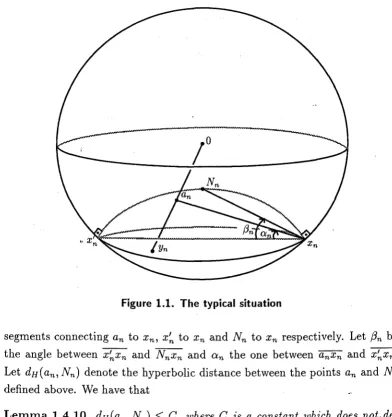
for x, y E R(ro ... rn). We want to show that 1.4.9 is bounded by a constant which does not depend on x, y and also is independent of the number of iter-ations taken in the definition of T, see 1.4.S. Recall that the boundary of the half-space 'IjJ(r'o)'" 'IjJ(r'n-t}H('IjJ(rn)) is the plane 'IjJ(ro)'" 'IjJ(rn-l)P('IjJ(rn)), and this last one is the intersection of a sphere perpendicular to S~_ with $3. Denote by S( 'IjJ(ro) ... 'IjJ(rn)) the intersection of 'IjJ( ro) ... 'IjJ( rn-l )P( 'IjJ( rn)) with S2 and let Nn be the point in this plane which is equidistant, with respect to
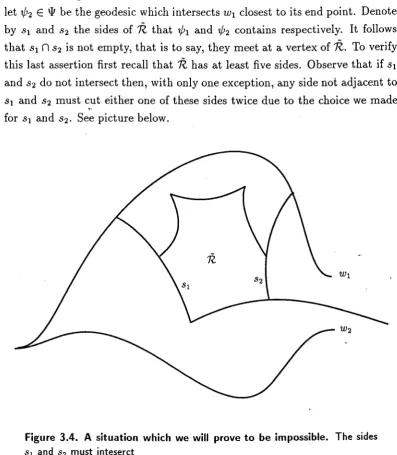
the Euclidean metric in ~3, to the points in S('IjJ(ro)'" 'IjJ(rn)), see figure 1. It
is clear that S('IjJ(ro) ... 'IjJ(rn)) is a circle which divides S2 in two regions, call C(ro' .. rn) the one containing R(ro ... rn). For n = 1,2, ... define
Cn
=
sup {::=
::1 :
x, Y E C(ro ... rn)} .Since C(ro ... rn) is compact Cn = IXn - anl/lYn - ani. for some Xn, Yn E C(ro ... rn), and moreover, using elementary Euclidean geometry it is not hard to see that Xn E S('IjJ(ro) ... 'IjJ(rn)) and that Yo is the intersection of the line -'. joining 0 to an with C(ro .. . rn), see figure 1 below.
1.4. An expanding map 16
Figure 1.1. The typical situation
segments connecting an to Xn, X~ to Xn and Nn to Xn respectively. Let f3n be the angle between x~xn and Nnxn and an the one between anxn and x~xn'
Let dH( an, Nn) denote the hyperbolic distance between the points an and Nn defined above. We have that
Lemma 1.4.10. dH(an,Nn ):::; C, where C is a constant which does not
de-pend on n.
Proof of 1.4.10.
The argument given here to prove the Lemma was suggested to me by Dr. Martin Bridson.
Since the group
r
is geometrically finite and has no parabolics, we have that the embedding of its Cayley graph in 1Hf3 is a quasi-isometry. A proof of this fact can be found in [Fl080] or in [Can84]. It then follows that there exists a constant C, which depends only on the generator setrn, such that a
geodesic in the Cayley graph is C-close with respect to the hyperbolic metric , to the geodesic in JH[3 with the same end points.1.4. An expanding map 17
C(ro ... 1'n) because this end point is coded in the shift '£j as (rOrl'" rn" .). Then we can say that the two geodesics are at most C hyperbolic distance apart using what was said in the last paragraph, The Lemma now follows.
11.4,101
U sing the above lemma we are able to say that as n goes to infinity we must have limn->oo Ian - f3n
I
= O. We have already proved that the diame-ter of S( 'ljJ(ro) .. ,'ljJ(rn)) goes to zero as n increases. This result and the fact that the planes 'ljJ(ro) .. , 'ljJ(rn-dP('ljJ(rn)) are perpendicular to S2 imply that liIDn-+oo lf3n - ~I
= O. Thus, for some no we have thatfor all n ~ no, Let
'Jr
a n
>-
6k 'I = mIn SIn 6'
,{,'Jr,
SIn a t " , , ) SIn ano-l ',
}
Consider the triangle ~ with vertices at Xn ) a~ and an, where a~
IS the orthogonal projection of the point an onto the plane containing S('ljJ(ro), .. 'ljJ(rn)), see Figure 2.
[image:19.499.47.447.255.671.2]1.50 Application: The Selberg Zeta Function 18
We have
l
a - aPI. n n
sIn an =
I
an - XnI'
Since Ian - a~1 < Ian - Ynl we get IYn - ani> k1lXn - ani for all n = 1,2, .... It is not difficult to see that
Finally, we obtain
1.4.11.
for all x, y E R(ro, . .. rn).
The change of variable formula gives us
A(R(rn)) = JR(rorlo.or n )
I
det DxTldx:s;
k2M(diamR(rOrl" .rn))2,where k2 is a constant and
Using 1.4.11 and this last inequality we get k3
IIDxTl1
~
(dO 'tam R ( T"Orl ••• rn))2'
with k3 another constant. Thus, choosing n such that diam R(rOrl-; .. rn))
<
~ proves the result.
1.5. Application: The Selberg Zeta Function
In line with the results of Pollicott [PoI91] for zeta function associated to com-pact Riemann surfaces, we apply here some of the methods in thermodynamic formalism to give a short proof that the Selberg zeta function for the groups we consider in this work has a meromorphic extension too the whole complex plane <C.
In
this section we realize hyperbolic space in three dimensions using the '-, upper- half space model which is defined as the set 1Hf3=
{(x, y, t) E ]R8 : t>
O}1.5. Application: The Selberg Zeta Function 19
This model will prove to be more convenient for the purposes of this section. Recall that the boundary at infinity of JHf3 is C, the one point compactification of the complex plane Co We get a conformal homeomorphism from S2 to C
using stereographic projection q : S2 -+ Co
The group of orientation preserving isometries of IHf3 is P S L(2, C). This group acts on points belonging to 8~ via fractional linear transformations. In this context, a Kleinian group is a discrete subgroup of PSL(2, C). Let
r
be a Kleinian group acting freely in JHf3. The quotient space M(r)
= JHf3Ir
is a hyperbolic 3-manifold and the natural projection 7r : JHf3 -+ M(r) is a coveringmap. Recall that an element of PSL(2, C) is called loxodromic if it has two fixed points on Co The axis of a loxodromic element is the geodesic in IHf3
whose end points are the two fixed points. Every closed geodesic "( E M(r) is the projection under 7r of the axis of a loxodromic element in
r.
The length"
l(-y)
of"( is the displacement distance of the loxodromic element whose image under 7r is "(. The set of all closed geodesics is countable.Any loxodromic element can be conjugated to one which fixes 0 and 00,
that is to say, to an element whose action on z E C is given by z 1-+ ).ei(J z,
). >
O. The magnification factor). and the angle () are conjugacy invariants associated to the geodesic "(.The Selberg zeta function of r is defined as, see [Fri86]
00
1.5.1. ZSelberg(S) =
II II
(1 -
e-i(Jke(s+k)I(-y))(1 -
ei(Jke(s+k)I(-y)) •'Y k=O
where,,( runs through all closed oriented geodesics of prime period, includ-ing their reverse. The product converges for ~(s)
>
2.We want to prove that ZSelberg( s) has a meromorphic extension to C using
the methods developed by Ruelle in [Rue76]. The first step in this direction was to construct the expanding map
f
defined in last section. We want to define a partition and a mapping with the same properties but this time we work on Co We get a Markov partition for C by mapping .each element in the partition we defined for S2 via the stereographic projection q. We denote this partition of C by 9t In order to get a Markov map on C we use the mapping", f
as defined in the last section. Conjugate it by q to get the map q 0f
0 q-l1.5. Application: The Selberg Zeta Function 20
If X is a fixed point of
f
n, n ~ 1, then x must be the end point of ageodesic in IHf3 which projects to a closed geodesic in IHf3
If.
Conversely, the f-expansion of an end point x of a closed geodesic in IHf3If
(we mean the end point of one of its lift) must be periodic, and therefore fn(x) = x, for some n . Thus, there is a one-to-one correspondence between closed geodesics in IHf3If
and fixed points of
f
n, n ~ 1. It is straightforward to verify that1.5.2. lh)
+
iB = log l(Jn),(x)1+
iarg((Jn),(x)).Indeed, suppose that we have fn(x) = x for some n ~ 1. From what we said in the last paragraph, fn is a fractional linear transformation 9 given by g(z) = ~:t~, a, b, c, dEC and ad - bc = 1. Observe that
g'(x)
=
1 2(trace(g)-(tr 2
ace2(g)-4)! )
and since trace(g)
=
e>./2+i9/2+
e->./2-i9/2, we get the the formula given in 1.5.2 We now follow the approach adopted in [Po194] and in [May91b]. Consider the partition 9t as defined above. Because f has no parabolics, the partition9t has only finitely many elements. In order to fix our notation, let 9t =
{RI, ... , Rm}
be the elements of the partition. For eachRi
E 9t we define an open convex neighbourhood Ui:2
Ri, such that fiR. extends to a real analytic function in Ui ( we can assume for intHi
~ int Rj we have f-lUj ~_.ui).Denote by D
=
U;:l
Ui the disjoint union of the Ui'S. FollowingRu-elle [Rue76], we define Bo(D) as the Banach space of those analytic function in D with a continuous extension to the closure
Vi
of eachVi,
whereVi
~ (;2 is an open neighbourhood of Ui . Denote the extension by f. Since flu, is afractional linear transformation, each of its local inverses fi belongs to Bo(D). Also, let Bl (D) and B2(D) be the spaces of real analytic exterior forms of order 1 and 2 respectively, whose coefficients have a continuous extension to the closure of each
Vi,
Motivated by formula 1.5.2, we define for each integer-k ~ 0 and for fixed'
8 E C the operator L~~J : Bo(D) - t Bo(D) by
(L~~Jh)(z)
=
exp( - 8 log Ifj(z)1+
ik arg(Jj(z)))h(Jj(z)),{j:ZEV; andf(Vj)2V,}
z E C2. Likewise, we define the operators
L~~l
:
Bl(D) - t B1(D) andL~~J
1.5. Application: The Selberg Zeta Function 21
We remind the reader of the definition of nuclear operator. Let B be a Banach space. An operator T : B ~ B is called nuclear, if for all x E B
we can write Tx = 2:~=o anb~(x)bn' where bn E B, b~ E B* are such that Ilbnll
=
IIb~11=
1 for all n ~ 0 and (an):=o E 11 . The reader should consultGrothendieck [Gr056] for full proofs of the results on nuclear operators that we use from now on.
Once we know the operators L
~~i,
L~~1
and L~~J
are nuclear of order zero, we can calculate their traces. These traces are related to the partition functionZn(J, As,k) =
L
expAs,k(Jn(X)),xEFixfn
where As,k (x) = -s log If' (x) I
+
ik arg(J' (x)) and s is a fixed complex number and k ~ 0 is an integer. The relation is given byTheorem 1.5.3. The partition function Zn(J, As,k) can be expressed as
2
Zn(J, As,k) =
L(
-l)jTr(L~~]t.
j=oProof of 1.5.3.
This follows from Lemma 2 of [Rue76] taking cP equal to Zn(J, As,k)'
11.5.31
Another important consequence of the fact that the operators L ~~J, i = 0, 1,2 are nuclear is that their Fredholm determinants det(l - zL~~J) are e~tire func-tions and satisfy
1.5.4. det(l -
zL~~J)
=
exp trace log(l -zL~~J).
For each k ~ 0, the function 1.5.5.
is well defined for
Izi
<
limn--++oo ~ log Zn(J, As,k), and it is not difficult to see that (k(Z,s)
is analytic for such values ofz.
Recall th·at each (k(Z,s)
is a' particular example of a Ruelle zeta function as introduced by Ruelle in [Rue76]. Using 1.5.4 we can write (dz, s) as2
(k(Z, s) =
II
(det(l - zL~~J))(-l)i+l.i=O
1.5. Application: The Selberg Zeta Function 22
Lemma 1.5.6. (k(Z, s) has a meromorphic extension to <C
x
<C.Now we are able to give a short proof that the Selberg zeta function has a meromorphic extension to <C, as we promised in the introduction.
Theorem 1.5.7. The Selberg zeta/unction defined in 1.5.1 has a meromorphic extension to <C.
Proo/0/1.5.7.
For
Re( s)
>
2 we have that00
ZSelberg(S) =
IT IT
(1 -
e-iOke(s+k}I(-y})IT
(1 -
eiOke(s+k}I(-y})'and
k=O ~ ~
=
~
exp ( -~
~ ~
e-m(-;,+(.+')l(,)))exp ( -
L
f
~ e-m'(iO+(S+k)I(~}})
~ m'=l
00 00 -1 00 1
=
II
expL - L -
L
e-s log I(JP)'(x)l-ikarg«(JP)'(x»mk=O m=l m p=l p { / }
00 1 00 1
exp '"' L..t
=- '"' -
m' L..t qm'=1 q=l {
Px
=
xp least
L
e-slog l(r}'(x)i+ikarg«(Jq)'(x»m'rx
= x } q least=
IT
expf
-1L
e-slogl(JP)'(x)l-ikarg«(JP)'(x»k=o p=1 p fP(x}=x
exp
f
-1L
e -s log I(r)'(x)i+ik arg«r)'(x»q=1 q fq(x}=x
00
=
IT
(k
1(1,s+
k)(k
1(1,s+
k).
k=O
where (k and (k are given by 1.5.5 with partition functions
As,k(X) = exp( -s log 1f'(x)1 + ik arg(J'(x )))
It,k(X) = exp( - 8 log 1f'(x)1 - ik arg(J'(x)))
Chapter
2
Markov partition and deformation
spaces of Kleinian groups
In this chapter we define the deformation of a Kleinian group and consider the question of regularity of the Hausdorff dimension of the limit set of ge-ometrically finite purely loxodromic Kleinian groups having the even corners property. For each point in the deformation space of these groups we prove that under real analytic pertubation, the Hausdorff dimension varies real an-alytic in a neighbourhood of the given point. Based on the work of Maskit, Marden and others we prove that this result is valid for a large class of Kleinian groups.
2.1. Introduction
The purpose of this chapter is to investigate the question of when the Hausdorff dimension of the limit set is an analytic function on the deformation space of a Kleinian group. We restrict ourselves to purely loxodromic, geometrically finite Kleinian groups.
The argument consists of three steps. The first involves showing that, if a (geometrically finite) Kleinian group (without parabolics) has an expanding Markov map, then Hausdorff dimension of the limit set is an analytic function on its deformation space. This is accomplished using the machinery of ther-modynamic formalism and ergodic theory following the ideas described in the' paper [KKPW89]. The aim is to build an appropriate set up in order to use Bowen's characterization of the Hausdorff dimension of the limit set.
2.1. Introduction 24
of any geodesic plane containing a side is an integral part of the tesselation. This is the so called even corners property.
Theorem 2.1.1. Let
r
be a purely loxodromic, geometrically finite Kleinian group. Suppose there exists a quasiconformal deformationrO
ofr
which hasthe even corners property. Then, the Hausdorff dimension of the limit set is
an analytic function on
T(r).
The third step. is to understand when this condition can be realized. We show that it is preserved under Klein combination, and hence needs only to be checked for groups with connected limit set, as it is obviously true for loxodromic cyclic groups. For quasifuchsian groups, one can get similar results from the work of Bowen. Hence, we need to demonstrate that it holds for web and extended quasifuchsian groups.
Theorem 2.1.2. Let
r
be a purely loxodromic, geometrically finite Kleinian group which is formed fromr
1 andr
2 by Klein combination. Suppose that eachr
j is quasiconformally conjugate to a grouprJ,
whererJ
has the even cornersproperty. Then,
r
is quasiconformally conjugate to a purely loxodromic,geo-metrically finite Kleinian group
ro
with the even corners property.In particular, we have that Hausdorff dimension is an analytic function of the deformation space of a geometrically finite, purely loxodromic function group.
History
Rufus Bowen in [Bow79] was the first one to ask whether the Hausdorff di-mension varies continuously over the deformation space of the group. Sullivan posed a harder question when in [SuI83] he asked if the Hausdorff dimension varies real analytically on the deformation space. Later, Ruelle in [Rue76] proved the result for the case of Fuchsian groups without elliptics or parabol-ics. His proof is based on zeta functions and how their coefficients vary under real analytic perturbation of a parameter.
One can see the problem from a dynamical systems point of view if one uses the work of Sullivan published in [SuI84]. In this paper, he proved that for
<0 geometrically finite Kleinian groups without cusps, the Hausdorff dimension of
2.2. Markov partitions 25
flows on closed Riemannian manifolds. They showed that the topological en-tropy varies as smoothly as the perturbations. Therefore, one could try to extend their results to the case of Axiom A flows and use Sullivan's charac-terization to prove that the Hausdorff dimension varies real a~alytically under
CW
perturbations. We based our methods on techniques which are rooted in the original work of Bowen. Our methods give a geometrical approach to the problem, and also we construct a "canonical" Markov map associated to the group. Moreover, using this geometrical approach we produced important results related to Kleinian group theory aspects of the problem.More recently, the result was proved to be false for infinitely generated Fuchsian groups, see [AZ94].
2.2. Markov partitions
In this section, we generalize a construction originally given by R. Bowen and C. Series [BS79] in their work on Markov partitions for Fuchsian groups. They show, among other results, the existence of an expanding Markov map associated to a finitely generated Fuchsian group acting on the Poincare disc
JH[2. They consider a finitely generated Fuchsian group cI> having a fundamental polygon D in JHI2 with the even corners property, that is, r(8D) is a union of lines. Note that the fundamental group of any compact surface of gehus g 2: 2 has a Fuchsian realization having a fundamental polygon with this property [BS79].
We wish to generalize this construction to Kleinian groups acting on
JHf3.
We begin with a few definitions. By a polyhedron in JHf3, we mean the intersec-tion of a locally finite collecintersec-tion of closed half spaces; in particular, polyhedra are convex. A fundamental polyhedron P for a Kleinian group f is a polyhe-dron inJHf3
so that every point ofIHrJ
is a translate of a point of P, the interiorint(P) of P is disjoint from all its translates, and the sides of P are paired. by elements of
r.
By this last condition, we mean that, for every side s of P,there is a side s' of P and an element IS E
r \
{id} with IS(S) = s'. We call's
., , a face pairing transformation. An example of a fundamental polyhedron for fis the Dirichlet polyhedron Do(r) centered at a point 0 E
JHf3,
given byDo(f) = {x E
1HPI
d(O,x)::; d(,(O),x) for all IE f \ {id}}.2.2. Markov partitions 26
r
acts properly discontinuously. The limit set A(r) is the smallest non-empty closed subset of C which is invariant under the action ofr, and is the home
of much of the interesting dynamical behavior of f.From now on we assume that !1(r)
"I-
0.A Kleinian group is geometrically finite if there exists a finite sided fun-damental polyhedron for its action on
JHf3.
It is a consequence of the Poincare Polyhedron Theorem [Mas71a] that a geometrically finite Kleinian group is generated by its face pairing transformations; in particular, geometrically fi-nite Kleinian groups are fifi-nitely generated.In the language of Sullivan, Kleinian groups which are pure.ly loxodromic and geometrically finite are expanding, in the sense that, for every x E A(r), there is some ,"E
r
so thatIt'
(x)I
~ 1.A Kleinian group
r
acting onJHf3
has the even corners property if there is a fundamental polyhedronP
forr
so thatr(oP) =
U
,(oP)-yEr
is a union of geodesic planes. We sometimes refer to a fundamental polyhedron
P satisfying this condition as an even cornered fundamental polyhedron for
r.
Let f be a purely loxodromic, geometrically finite Kleinian group which satisfies the even corners property. Recall that a Kleinian group 1 is purely loxodromic if every non-trivial element is loxodromic. We will show that. we can define an expanding Markov map f on A(f) for such r. This allows us to study the action of r on A(r), which can be quite complicated, via a single mapf
which is significantly easier to analyse.A Markov partition for the action of
r on C is a finite collection
P = {Vi} ~1of non-empty closed subsets of C and a map
f :
C -+ C such that(a)
U~lVi
=
C,
(b) for i
"I-
j, the interior ofVi
is disjoint from the interim ofVi,
and(c) the image under
f
of any element in the partition is a union of elements of the partition; that is,f(Vi)
=Vi!
U ... UVin'
We say that such an f has the Markov property with respect to the partition P.
2.2. Markov partitions 27
Let R be a fundamental polyhedron for f, and set
fn
= {,
E f \ {.id} : ,(R)n
R is a face of R}.This is a finite subset of f and is symmetric, in the sense that fn is closed under inverses. Since rn consists of the face pairing transformations for r, it is a generating set for f (though perhaps not minimal).
We use the elements in rn to label the faces of
R
as follows. Use the label e on a face ofR
if the element e E fn pairs it to some other face. Write e inside Rande
on the outside, wheree
denotes e-1 E f n . LetH(e)
be thehalf-space in ]R3 whose intersection with R is the face whose exterior label is e.
It is clear that .{ H ( ei) : ei E f n} and R have union ]R3. Since H ( ei) contains a face of R, we could use the associated face pairing to define a map f that sends a point x in H (ei) to eil x if i is the least element of
{j :
x E H (ej)}and f(x) = x if x E R.
Consider now the set of all planes in f(8R) that intersect
R
in either a face, an edge or a vertex. The intersection of each plane in this collection withC is a circle, and the closures of the components of the complement of the union of these circles covers C, giving us a measurable partition P = {Ri} of
C.
0"
Since the group r has no parabolics, this partition is finite. It is immediate to verify that the map f defined in the last paragraph can be extended to C
in the same way it was defined. This fact together with the hypothesis that R is even cornered allowed us to prove the following.
Proposition 2.2.1 ([Roc]). The map
f :
C --+ C has the Markov propertywith respect to the partition P.
We will usually restrict our attention to a Markov partition on A(f), which we obtain by intersecting each element of the partition P y,rith A(f) and then· restricting the action of f. Restricting f caused no difficulty; since f is defined in terms of elements of r, it preserves A(f).
One of the basic objects in thermodynamic formalism is the notion of a
.
shift of finite type, defined as follows. Given k>
1, let A be an aperiodic2.2. Markov partitions 28
Consider the space EA of all sequences in the alphabet {I, ... , k} such that the letter i is followed by the letter j if and only if Aij = 1. In other words,
EA =
{x
=(x
n )E
IT{1, ...
,k}:
AXnXn+l =I}.
n=O
Give {I, ... ,k} the discrete topology, so that EA with the product topology is a compact space. The (one sided) shift of finite type a = aA : EA ~ EA is defined by (ax)i = Xi+l. For each () in the interval (0,1), there exists a metric
p = P9 on EA defined by p(x,
y)
= ()N, where N = sup{n : Xi = Yi for 0 :::; i :::;n}.
Furthermore, the aperiodicity of A implies thata
is mixing, that is, given any two open sets U, V C EA , there is n ~ 0 such that an(U)n
V
=f.
0.Following t~e standard procedures of symbolic dynamics, we introduce a subshift of finite type
E
j having as alphabet the elements in the partitionP.
More explicitly, let
P
={Rdi=l
and setr:,f =
{r
=(c,)
EIT
{I, ... ,
n} : f(R,..)2
R,..+. } and define the shift mapa :
'f-f ~ 'f-f by(O"r)k
=
rk+!.
A finite sequence ro . .. rn is called admissible if f(Rrk ) ;2 Rrk+1 for 0 :::;
k :::; n - 1. If 7"0 ... rn is admissible, define
n
R(7"o ... rn) =
n
f-i(RrJ. i=OLemma 2.2.2 ([Roc]). diam(R(ro ... rn)) ~ O.
Notation: diam(R(7"o ... rn)) stands for the Euclidean diameter of the set R(ro ... rn).
The combination of Lemma 2.2.2 with the even corner condition on
n
allows us to prove thatf
is eventually expanding.Proposition 2.2.3 ([Roc)). There exists a jJ
>
0 and N .so that I(fN),(x)1 ~.f3
>
1 for all x E R(ro, ... , rN).We will later need to consider open neighbourhoods of each Ri E
P, which are
'defined as follows. Let Si be a small neighbourhood in C of Ri. We choose Sismall enough in order to guarantee that we still have
2.3. Deformation spaces and expanding maps 29
2.3. Deformation spaces and expanding maps
In this section, we give a brief description of the deformation space T(f) of a finitely generated Kleinian group f, and review some basic facts which we will make use of later. Much of the background material relating to this section can be found in Bers [Ber70] and Maskit [Mas71 b].
I
Let
M
be the complex Banach space of all complex valued measurable functions on C, with the norm 1If.L1I = ess sup(If.LI). Given a Kleinian group f, setM(f)
=
{f.L EM
1 f.L(-y(z)) ·,'(z)=
f.L(z) ·,'(z) for all, E f, a.e.z E n(f)},"
and note that M (r) is again a complex Banach space, as it is a closed subspace
ofM.
For each f.L E M(f) with 11f.L11
<
1, let w = wJl. be the unique solution of the Beltrami equation2.3.1. Wz = f.L' Wz
fixing 0, 1, and 00; the Theorem demonstrating the existence of such a solution is often referred to as the measurable Riemann mapping theorem, and a proof can be found in [AB60]. Note that the condition on the elements ofM(r) is exactly the condition needed to assert that w 0 , 0 w-1 is again an element of
PSL2(C),
Hence, the group fJl. = wJl.f(WJl.)-l is again a Kleinian group, which we call a deformation or quasi conformal deformation of f. The deformation space of f will be the set of equivalence classes of a certain equivalence relation on M(r).
Define an element (J" E M(f) to be trivial if wO' 0 , 0 (wO't 1 = , for all
, E f. Note that, if (J" is trivial, then wO' is the identity when restricted to.
A(r), as wO' fixes the fixed points of all elements of f and these fixed points are dense in A(r).
Say that two elements f.L and T of M (r) are equivalent if there is a trivial
(J" E
M
(f) so thatIn particular, if f.L and T are equivalent, thenwJl.IA(r) =w'TIA(r).
2.3. Deformation spaces and expanding maps 30
complex structure which comes from the canonical projection M(r) --+ T(r),
T(r) is a complex manifold (see, for example, [Ber70]).
It is also possible to see this complex structure by embedding T(r) as an open set in a complex manifold. Given
fl-
E M(r), consider the discrete, faithful representation pIJ- : r --+ PSL2(C) given by pIJ-( 1) = wIJ- 010 (WIJ-tl. Note that the representation depends only on the equivalence class offl-,
as trivial elements of M (r) induce the identity representation. With the choice of a generating set l b " " 1k for f, this gives a holomorphic embedding of T(r) as a complex submanifold of X = PSL2(C))\ given byWe now have the necessary material to construct Markov maps associated to groups in the deformation space T(r) of r. We use wIJ- to transport the Markov partition for r to a Markov partition for rIJ-. Recall that we determined a Markov partition for the whole of the sphere at infinity. We can get a partition of the limit set A(f) of
r
with the same properties by intersecting each element of P with A(r) and restricting the action off.
By a slight abuse of language, we denote this partition byP
and its elements byRI, . .. ,Rn.
Given
[fl-]
E T(r), define fIJ- = wIJ- 0 f 0 (WIJ-)-l and pIJ- = {Rf =.WIJ-(Ri) :Ri E
P};
this gives a Markov partition for the action of rIJ- on its limit set. Note that, if we choose T equivalent to j1, then w". and wIJ- are equal whenrestricted to A(r), and so fIJ- = f". and pIJ- = p".. Therefore, the shifts on '2:,f,..
and EfT are topologically the same, and so either one of them is an appropriate
shift to describe the dynamics occurring on A(rIJ-).
So, choose a representative fl- for
[fl-]
E T(r). Define Sf=
WIJ-(Si) of each Rf, where the Si are the neighborhoods for Ri chosen above.Proposition 2.3.2. The map fIJ- is (eventually) expanding.
Proof of 2.3.2. Define
and
SIJ-(ro ... rn) = wIJ-(S(ro ... rn)).
Let T : SIJ-(ro ... rn) --+ SIJ-(ro' .. rn) be given by
2.4. The Hausdorff dimension of the limit set 31
From this point on we follow the argument used to prove Lemma 3 of Bowen [Bow79]. We can assume, without loss of generality, that 00 E n(r).
Let in be a .closed curve bounding a region which contains R~ and interior to
S~. Given y E R~ we then have
for some constant C. Using 2.3.3 we have that T(S~) =
wJL(S(ro ... rn».
Sincewf.L is a homeomorphism and diam(S(ro ...
rn»
~ 0, then for someN
wehave
.' I
U:),(x)
I2::
(sup{IT'(y)1 : y ER
N }t
1>
1.2.4. The Hausdorff dimension of the limit set
The purpose of this section is to give a proof of Theorem 2.1.1. The proof is a re-interpretation of the results obtained by Katok, Knieper, Pollicott and Weiss on the analyticity of the topological entropy for Anosov flows, see [KKPW89], to the present case together with a characterization of the Hausdorff dimension of the limit set of groups in T(f) which is due to Bowen, see [Bow79].
We begin with some definitions, using the notation of the previous section. Let C(E A) be the space of complex valued continuous functions on EA. Given
f
E C(EA ), definevarn(f) = sup{lf(x) -
f(y)1 :
Xi = Yi,O:::;i:::;
n}and
If
I
o = supvarn(f)
() .n2:0 n
Set
Fo
={f
E C(EA ) :Iflo
<
oo}. Forf
EFo,
defineIIflle
=
Ilflloo
+
Ifle.
2.4. The Hausdorff dimension of the limit set 32 Definition 2.4.1 (Ruelle operator). For a given function
f
E C(~A)' define the Ruelle operator £j : C(~A) -+ C(~A) by(£j g)(x) =
L
ej(Y}g(y).'<1(Y)=X
Let
£j
denote the adjoint of £ j.\
Theorem 2.4.2 (Ruelle-Perron-Frobenius see [PP90D. For each real valued function f E F(), there is a simple maximal positive eigenvalue >'j of £j with a corresponding strictly positive eigenfunction h E
:F().
The remainder of the spectrum of I:-f : F(} -+ F(} (excluding >.f) is contained in a disc of radiussmaller than >"j centered at the origin. There is a unique Borel probability
measure J1 such'that LjJ1
=
AjJ1 (that is to say,J
LjvdJ1 = AIJ
vdJ1) for all v E C(L:A)' If the eigenvector h satisfiesJ
h d"" = 1, then;j£jV
-+ hJ
v dJ1uniformly for all v E C(L:A).
Given a real valued u E
:Fo,
defineP(
u)=
log >'1£ to be the pressure function. Theorem 2.4.3 (Variational principle see [Bow75D. For any real valued uEF(),2.4.4.
P(u) = sup{h(ft,O')
+
J
udft: ft is a O'-invariant probability measure},' where h(ft,(J)
is the measure theoretic entropy of(J
with respect to ft. There exists a unique probability measure"" such that P( u) = h(ft, 0')+
J
u dft. This measure is called the equilibrium state.We now analyse the dependence of s,.. with respect to parameters as [""] varies
in T(f). More specifically, we want to study the dependence of
s,..
when given[fl]
E T(f) we choose c >0 small enough so that we can define a real analytic'
perturbation [ft]t, t E (-6,6), of [ft] = [",,]0. Let 8 H(X) be the Hausdorff dimension of X C C.Proposition 2.4.5. (see [Rue82]) Define
<p,..(x) = -log If~(x)l.
Then,
8 mA(f"')) =
s,..,
2.4. The Hausdorff dimension of the limit set 33 Consider the function
S: T(f) - t IR
[Jl]
H SH(A(fll»).Theorem 2.4.6. Let f be a purely loxodromic, geometrically finite J(leinian group 'Which has the even corners property. Suppose there exists a
quasicon-formal deformation fO of f 'Which has the even corners property. Then, the
function SH is a real analytic function on T(r).
Proof of 2.4.6. Let
[Jl]
be a point in T(f). Recall that we get a Kleinian group flL if we conjugate all the elements in f by the solution of the Beltrami equation given in 2.3.1. In the context that follows, we consider these groups as being subgroups of PSL2(C)We can use the results described in the last section to define a decompo-sition pll = {Rn of
A(fIL)
and a Markov map fll' We use the partition pll andfll
to construct a symbolic coding for the points inA(fll),
that is to say we construct the shift of finite type .E f~' We remind the reader thatill
is an expanding mapping, as shown in Proposition 2.3.2. It is important to mention that the N for eventually expandig in Proposition 2.3.2 is independent of the point taken in the deformation space of the group f. This is due to the fact that the symbolic coding is the same for allfll
in (r).Let IS
>
0 be sufficiently small so that for t E(-c, c),
we have a realanalytic pertubation Jlt of Jl = Jlo. For each fill, with t fixed, consider the function dt(s)
=
l/(t(s), where2.4.7.
From the results proved by Pollicott in [Po186]' it follows that dt ( s) is analytic
for ~(s) > slI--{)' for some 0 < {) < SIl' where Sil is defined in Proposition 2.4.5.
There are no zeros for
~(s)>
S ILand there is only a single simple zero on
~( s)
=
S II- and this zero is located at s=
s wWe now pass to the proof that dt(s) is real analytic in t for ?R(s) sufficiently large. The objective is to show that the coefficients of
d
t (s),
which are functions2.4. The Hausdorff dimension of the limit set 34
Once the groups we are considering are purely loxodomic, we have that
f:t
is a loxodromic transformationII-'t'
Given a fixed point off:t
we can calculate the displacement distanceIbl-'t)'
We say thatII-'tis
primitive if it is not conjugate inrl-'t
to a power of any element inrl-'t
(including its own inverse). We have that2.4.8. dt(s) =
II
(1 -
e-s1h'1-'1)) , 'YI-'t i.p.where the product runs over all non-conjugate primitive elements. Given a loxodromic element I belonging to the unperturbed group
rl-',
we know that for each t E(:-6,6)
there is a unique loxodromic element It Erl-'t
which corresponds to I' This is a consequence of the way we construct the defor-mation space in section 2.3. Consider the function t 1--+ ltb), where ltb) isthe displacement distance of the loxodromic element It E
rl-'I.
The proof of the following crucial Lemma is an adaptation to our case of the proof given to Proposition 1.1 of [KKPW89].Lemma 2.4.9. Let I be a fixed element in
rl-',
then the function t 1--+ ltb) zsreal analytic in
(-6,6)
and it extends to a holomorphic function in V C CC, such that V does not depend on the choice of I'Proof of 2.4.9. Once /It depends real analytically on t, it follows from the measurable Riemann mapping theorem that the traces of all elements in each
rl-'I
depend real analytically on /It. Since ltb) can be expressed as a real analytic function of tracebt), the first part of the Lemma follows. Still by the measurable Riemann mapping theorem, we have that fl-" depends real analytically on /It because it is defined in terms of the generators ofrl-'t.
Due to the fact that bothIt
andfl-'t
are real analytic function on(-6,6), we can
extend them to a complex open neighbourhood of(-6,6).
We denote these extensions by It andfl-'t
respectively.Let P = {Ri\ ... , R~} be the Markov partition for the unperturbed group
<0
rl-',
andfl-'
the respective expanding Markov map. For eachRf
choose aneighbourhood
fir
such thatint(
fin
~Rr.
LetRf
Rj
be a pair of admissible symbols, see end of section 2.2. We have arrange thatint(jl-'fin
2
fij.
Choose- - - -
-2.4. The Hausdorff dimension of the limit set 35
is the end point of the axis of a loxodromic element in fJ.L. It is then easy to see that x has a periodic fJ.L-expansion with period, say, rOrl ... rn-l such that
f
J.L (R~.) • :::> - R~ .+l(mod n) . It is important to note that the coding of such a point .' is the same no matter which value of -J.L we are considering. Definev
=n
"'ij.
il-'(Ri)2 RJ
Given a periodic sequence rOrl ... rn-l as above we choose t E V in order to get a composition of contraction maps
.'
We now use the contraction mapping theorem to guarantee the existence of a unique fixed point Xt in R~o for the above composition. Therefore we can say that (fl-f.t)n has a fixed point in Ii~o. Once V :::>
(-6,6), we apply the implicit
function theorem to conclude that the function V ~ Ii~o given by t t--t Xt isholomorphic.
Recall that for t E
(-6, 6),
each (fJ.Lt)n is a fractional linear transformation gJ.Lt (x) = :~:t~t. Given a fixed point Xt of (fJ.Lt)n, the displacement distance distance It{gJ.L) = It {gJ.Lt ) of gl-f.t is given by2.4.10.
Since It{gl-f.) extends to a holomorphic function defined in V, we use (2.4.10)
to finish the claim.
12.4.91
We now return to the proof that
dt{s)
has a holomorphic extension toV
CC, where V is the neighbourhood obtained from Lemma 2.4.9. After some elementary manipulation we have that
Observe that from the above the analyticity of dt ( s) in t E V follows if we prove that the series" . L...J'YI-' t.p. le-slt(-rl-')nl converges uniformly t E