Internet of Things and New Product
Development process: A study on the impact on
success factors
Author: Max Mahmud
University of Twente
P.O. Box 217, 7500AE Enschede
The Netherlands
ABSTRACT
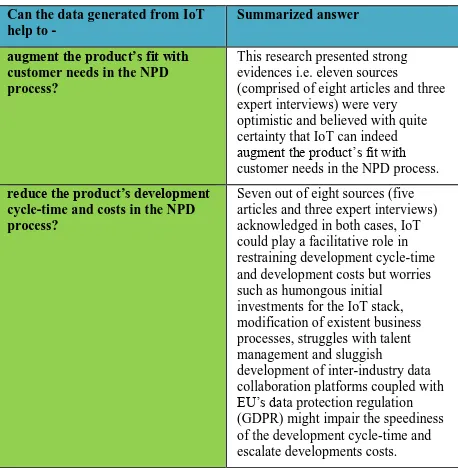
An increasing number of everyday products, appliances and physical gadgets are being embedded with sensors, actuators and connectivity mechanisms, connecting them to the internet and networks, thus forming the basis of the Internet of Things (IoT) anatomy. These “smart connected products” generate and exchange unprecedented levels of data which can be utilized as a part of discovering diversified insights from the products’ environment and use context, making it a huge source of competitive advantage for businesses dealing with the crucial task of developing new products. However, the majority of the businesses are quite reluctant towards implementing IoT as a product development tool since they are unaware of the impacts of IoT on the success factors of the New Product Development (NPD) process. This research investigates how the data generated from the IoT impacts and influences the three key success factors, i.e. augmenting the products’ fit with customer needs, reducing development cycle-time and lowering development costs, of the NPD process. With the help of a literature review and expert interviews, this research identifies the various determinants which can influence the success factors both positively and negatively. With regards to augmenting the products’ fit with customer needs, the research presented strong evidences which reinforces that IoT can indeed augment the product’s fit with customer requirement in the NPD process. Pertaining to the reduction of development cycle-time and costs, both experts and literature indicated that the data generated from the IoT could play a facilitative role in restraining the development time and costs. Although uncertainties concerning huge initial investments, modification of entire business processes, talent scouting, and lethargic development of inter-industry data collaboration platforms coupled with EU’s new data protection regulation might impair the speediness of the development cycle-time and escalate development costs. The study also presented and discussed plausible recommendations in great detail which could help companies to deal with some of these issues.
Graduation Committee members: Dr. Efthymios Constantinides and Dr.
Zalewska-Kurek
Keywords
New Product Development process, Internet of Things, Big Data, Stage Gate Model, BAH Model, Co-creation, Smart Connected Products, Heightened complexity
Permission to make digital or hard copies of all or part of this work for personal or classroom use is granted without fee provided that copies are not made or distributed for profit or commercial advantage and that copies bear this notice and the full citation on the first page. To copy otherwise, or republish, to post on servers or to redistribute to lists, requires prior specific permission and/or a fee.
11th IBA Bachelor Thesis Conference, July 10th, 2018, Enschede, The Netherlands.
1.
INTRODUCTION
The technological amelioration and the accelerated confluence of wireless communication, digital electronics and micro-electro-mechanical systems (MEMS) technologies have led to the evolution of the Internet of Things (Vasilakos et al., 2017). The Internet of Things can be defined as sensors and actuators connected by a system of IP-connected networks to computing systems (McKinsey Global Institute, 2015). According to a Cisco report (2017), the quantity of connected objects has surpassed the total population of human beings and is expected to exceed 50 billion by 2020. These IP-connected objects can take the form of anything, starting from mobile phones, wearables, thermostats, refrigerator etc. and forms the basis of the sensor enabled Internet of Things (IoT) anatomy. The sensor fitted products are also called “Smart Connected Products” and they can produce enormous quantity of data. Due to their sensing capabilities, the data generated from these smart products can be utilized as a part of discovering insights from the products’ environment and context of use. The brisk growth of smart connected products and their contributing data generation is having a disrupting effect on businesses. As the phenomenon of IoT grows rapidly (third big wave of the internet development), it appears to be essential for firms to comprehend the IoT and additionally the potential challenges and new opportunities these advancements may bring (Brown, 2017). The process of developing new products and services is a crucial task as well as of high importance for companies. Research has shown that businesses achieve high performance in terms of profit generation through the introduction of new products. As indicated by Cooper and Edgett (2013), new products are equivalent to 42% of the aggregate profit for the dominant 20% of businesses. Nonetheless, numerous firms fail in introducing new products to the market due to its traditional closed innovation policy or a slow development cycle. Firms who lack the capability in changing the offerings what it offers to the world (product and service innovation) and at the same time who are also deficient in terms of making and conveying these contributions, risks its survival and development prospects (Bessant et al., 2005).
The emergence of Internet of Things and the unprecedented levels of data generation coupled with the switch from in-house, proprietary innovation towards open innovation/co creation can be potentially utilized by companies to enhance the New Product Development (NPD) process and subsequently curtail the high failure rate of new product launchings to the market. Over the course of the previous years, considerable amount of NPD models or processes have been devised but little attention has been paid on the role of IoT and its impact on the success factors of the NPD process. Furthermore, IoT being a moderately recent phenomenon since the term was first coined in 1999 and is still considered in its initial stages (Ashton, 2009), a gap could also be identified in the academic and scientific literature where not many researchers have scrutinized and operationalized the effect of IoT on the accomplishment factors of the NPD process. Given the above-mentioned contexts, this thesis will lay emphasis on IoT and its impact on the success factors of the NPD process.
1.1
Research goal and research question
According to Schilling (2013), for new product development to be lucrative, it must concurrently achieve three goals: (1) augmenting the product’s fit with customer requirement, (2) reducing the development cycle time (the time elapsed from project initiation to product launch), and (3) reducing development costs. IoT and its influence on the above-mentioned success factors is broadly unknown and this thesis will serve to bridge that gap by assessing the possible effects of the data generated by Smart Connected Products or Internet of Things and its implication on the success factors of the NPD process. The research question which is proposed next encompasses the research goal and is constructed as follows:
“What is the possible impact of IoT on the success factors of the New Product Development process?”
At the first glance, the research question is wide-ranging and needs to be broken down into subparts in-order to address the central research issue. The sub-questions are as follows:
“Can the data generated from the Internet of Things help to augment the product’s fit with customer needs in the New Product Development process?”
“Can the data generated from the Internet of Things help to reduce the product’s development cycle-time in the New Product Development process?”
“Can the data generated from the Internet of Things help to reduce the product’s development costs in the New Product Development process?”
The main idea of the sub-questions is to disintegrate the research question into conceivable separate entity. These different entities when discussed together, will pave the way to answer the main research question.
1.2
Methodology
Due to the exploratory nature of the research question, this study considered two research methods i.e. a critical literature review and an expert interview, for the collection and evaluation of data. The literature review was conducted by categorically inspecting and evaluating literature from scholarly articles, journals, conference papers, company reports and management magazines in order to provide a dependable synapsis of the existing knowledge. The articles used for this thesis were scoured and sourced mainly through University of Twente’s Digital Library (literature databases) such as Web of Science and Scopus. They were then chosen based on the high relevancy and the number of times the paper was cited. IoT being a fairly recent phenomenon, scientific literature on this topic was very limited. As a result of this, it was not always possible to include peer-reviewed research papers. So, the inclusion of non-peer-reviewed articles i.e. various management magazines (Harvard Business Review, McKinsey Global Institute etc.) was taken into consideration. The primary focal point of the research was to discover the possible impact of IoT on the success factors of the NPD process, therefore, the literatures used for this study had strong affinity for either IoT or innovation management. By means of the literature review, it was possible to indicate, to what degree did the data retrieved from the IoT contributed to the success factors of the NPD process. In other words, the systematic review was able to demonstrate the resemblance and disparity between the standpoint of the literature sources on the sub-questions. The various findings of the literature review also served as the basis for devising the interview questions (refer to Appendix H). In light of the desire for an accurate comprehension of the topic, semi-structured interview method was chosen for the second research procedure. For the expert interview, this study considered individuals who worked for an organization that dealt with IoT solutions, researchers having vested interest in the field of IoT or entrepreneurs who helped to build an IoT related company. These experts were identified using a list of IoT experts provided by the thesis supervisor, browsing company websites (also LinkedIn profiles) and University websites. They were approached via email indicating a brief description of the research goal. Out of thirty-seven email invitations, three individuals responded. An interview guide was sent in advance and three separate face-to-face interviews were conducted. The interview guide entailed a short description of the research objective and a full list of the interview questions. The respondents were asked to provide their viewpoints in conjunction with the IoT and their likely effects on the success factors of the NPD process. Their responses were then analyzed in order to determine to what extent their answers relate to the previously found information and if not, what new insights did they provide. This enabled to draw concrete conclusion in relevance to the possible impact of IoT on the success factors of the NPD process based on the findings of the literature review and expert interviews.
2.
LITERATURE REVIEW
2.1
Characterization of Internet of Things
2.1.1
Smart, Connected Products
At the center of the Internet of Things lays the “smart connected product” According to Porter and Heppelmann (2014), smart connected products is an agglomeration of three core components: physical components, smart components and connectivity components. The smart segments enhance the abilities and value of the physical elements, while connectivity complements the capacities and value of the smart components and empowers a part of them to prevail outside the physical item itself, resulting in a righteous cycle of significant value enhancement (Porter and Heppelmann, 2014). The physical segments represent the product’s mechanical and electronic portion, whereas the smart components are comprised of an array of various sensors, data storage system, microprocessors, controllers, software unit and all embedded in an improved user interface (Porter and Heppelmann, 2014). The last core component, or in other words connectivity can be understood as the various ports, protocols and antennas who have the capability to enable diverse wireless or wired linkage with the products (Porter and Heppelmann, 2014). The connectivity component takes shape in three forms and they are: one-to-one, one-to-many and many-to-many. One-to-one connectivity is a linkage between an individual product and a user or another individual product. Analogously, one-to-many is a union between one product and many products simultaneously. Finally, many-to-many connects multiple number of products to many other variety of products and external data sources (Porter and Heppelmann, 2014). Connectivity in smart connected products serves two objectives. The first objective is the facilitation of information swap between the product and the environment they operate in. The information exchange could also take place with the products’ creators, users and other systems. The second objective is regarded as the enablement of certain capacities of the product to exist outside the physical space, which is popularly known as the cloud (Porter and Heppelmann, 2014).
2.1.2
Big Data
The fiery development in the quantity of smart connected products associated with the Internet of Things and the exponential increment in data utilization only reveal how the expansion of Big Data consummately overlaps with that of the Internet of Things (Vasilakos et al., 2017). The information created from Internet of Things associated smart products can be utilized as a part of discovering potential research trends (Vasilakos et al., 2017) and exploring the effect of specific occasions or choices. In-spite of the fact that IoT has generated remarkable opportunities which can boost revenue generation, downsize costs, and enhance efficiencies, collecting a colossal measure of data alone is insufficient (Riggins and Wamba., 2015). In-order to reap benefits from IoT, firms must establish platforms where they can compile, analyze and manage a colossal volume of sensor information in a scalable and economical manner and transform them into valuable insights (Riggins and Wamba., 2015). Given the background, utilizing a Big Data platform which can help with consuming and reading diversified data sources as well as in stimulating the data incorporation process becomes decisive (Vasilakos et al., 2017). The Internet of Things and Big Data are increasingly converging and need each other. The IoT needs Big Data to take all the information it gathers and turn it into something useful, actionable and in some cases automated. Big Data needs IoT because all that sensor data provides a world of valuable raw material beyond just things like social media sentiment analysis and public government data sources into two of the other big sources of the unstructured data that feed into Big Data.
2.2
Process of new product development
New Product Development can be regarded as the one of the most critical determinants of uninterrupted company performance and therefore can be considered as an instrument of innovation within firms (Oduola & Yukubu, 2017; Constantinides et al., 2018). The NPD’s commitment to the development of organizations, its impact on revenue generation, and its role as a decisive factor in business planning have well been recorded in various management literatures (Bhuiya, 2011; Urban & Hauser, 1993; Booz et al., 1982; Cooper, 2001). The New Product Development is basically a process of sequential steps in-order to bring a new product to the marketplace. Businesses often need to engage in such a process mainly due to the developments in customer desire, heightened competition and technological breakthroughs or to take advantage of new favorable circumstances. Creative organizations flourish by comprehending what the market needs are and by cultivating new products which can either meet or surpass the clients’ desires.
Various models have been created since the advent of the NPD process, but two models have become widely accepted across industries. Their basic understanding and functionality remain the same and the only difference can be observed in their unique nomenclature. The first model is widely known as the seven steps BAH model which has been created by the researchers Booz, Allen and Hamilton in 1982. The BAH model consists of 7 steps which is depicted in Appendix A. This is the best-known model because it dominates the NPD framework that have been introduced later. Another conceptual model which is highlighted significantly in the New Product Development literature is the Stage-Gate model developed by Robert G. Cooper. The Stage-Stage-Gate model consist of five stages (not including the Discovery stage), which is in its very basic essence comparable to the BAH model (see Appendix B). The Stage-Gate model can be particularly distinguished from the BAH model by its presence of gates. So, it has distinct stages which is separated by management decision gates (gatekeeping). Cross-functional teams must effectively complete a recommended set of interrelated cross-functional activities in each stage prior to acquiring management endorsement to proceed to the following stage of product development. The added value here is, each gate plays a part in reducing uncertainty and risk, which contributes significantly to the product development process.
Irrespective of the models mentioned previously, the first few stages or the early stages (for the BAH model prior to “Business Analytics” and for the Stage-Gate model prior to “Build Business Case”) of the NPD process is shaped by chaos and uncertainties. In a study conducted by Gupta and Wilemon in 1990, found out that the extent of uncertainties associated with the early stages of the NPD is becoming more intense since companies are under constant tremendous pressure to create more superior new products to keep up with competition (Gupta & Wilemon, 1990). This less formal, unstructured stages i.e. the conception of a new product idea up until its approval for development or cancellation of the NPD process is commonly known as the Fuzzy Front End (FFE) of Innovation. The front-end of the NPD process is specifically influential because it can bring about either total success or total ruins. Apart from reducing the degree of risks of the innovation process, it also comprises a considerable part of the entire cost of the NPD process (Sandmeier et al., 2006). In addition to that, it has the major influence on the design of the new product and one of the important stages to be considered by firms for the improvement of the overall NPD process (Verworn et al., 2001; Sandmeier et al.,2006). The Fuzzy Front End of the NPD process requires the addition of various inputs from multiple sources in-order to increase the commercial success of the new product. This can be achieved by either closed innovation or open innovation. Companies who are inclined towards closed innovation, generally fetch new ideas and commercialize them within the internal boundaries of the company, which causes them to run out of good ideas and create products which deviates from customer requirements. Sourcing innovation ideas outside the internal boundaries (open innovation) can tremendously facilitate the Front-End activities (Quinn, 2000; Muller et al., 2002). Open innovation-oriented companies are not solely reliant on their own R&D department but rather consider their R&D department as an open unit where the development of a new product takes place from their own ideas as well as external sources for achieving success in the Fuzzy Front-End (Hippel, 2005; Chesbrough, 2003). Because of the new open innovation model, better approaches to consolidate clients’ intelligence into the front-end must be investigated (Gassmann et al., 2006). One such approach is commonly known as co-creation, which will be described in a greater detail in the subsubsection 2.4.1. 5.. Note that this research will investigate the role of co-creation in association to Schilling’s first success factor (augmenting the product’s fit with customer requirements) only in the Fussy Front End of the NPD process since customer involvement impacts the front-end of the NPD mechanism the most.
2.3
Success factors of the new product
development process
In-order to understand the impact of Internet of Things on the success factors (augmenting customer needs and reducing development costs and time) of the NPD process, it is of utmost importance to first understand how these success factors are fundamentally constituted or defined.
2.3.1
Augmenting the product’s fit with customer
needs.
alluring financial value than contending products (Schilling, 2013). In spite of the apparent significance of this objective, many new product development ventures have been unsuccessful in achieving it. This may happen for various reasons. First and foremost, firms do not have a reasonable understanding of the features customers value the most, resulting in the firm’s overestimating in some features to the deprivation of features the customer desire more (Schilling, 2013). Secondly, firms may likewise miscalculate the client’s readiness to pay for certain features, encouraging them to include unnecessary features which is unaffordable for the greater extent of customers and thus failing to achieve significant market penetration (Schilling, 2013). Furthermore, businesses might similarly experience issues settling heterogeneity in client requests. Different customer groups might have different demands in terms of product features. Firms should be extra careful while fulfilling such demands since they might end up manufacturing a product that makes compromises between these conflicting demands, and the subsequent item may be unsuccessful in appealing to any of the client groups (Schilling, 2013).
2.3.2
Reducing the development cycle time
Products can fail due to a long time-to-market trajectory. A firm who has the capability to bring products faster in the market may enjoy certain benefits such as building up a long-term brand allegiance, capitalize upon rare resources and build client switching costs (Schilling, 2013). Another reason for reducing the development cycle time is directly attached to development cost and shorter product life cycles. As the development process becomes lengthy, companies must bear the costs of paying their employees who are involved in the product development and subsequently the cost of capital increases (Schilling, 2013). Furthermore, due to the phenomenon of shorter product lifecycles, firms who are slow to introduce a particular generation of technology, might not be able to fully recoup the costs of development since by the time the product is introduced, the product is close to obsolescence (Schilling, 2013). Finally, a short development cycle-time guarantees that a firm can rapidly overhaul or update its offering as design flaws are uncovered or technology propels (Schilling, 2013). But according to some researchers such as Dhebar (1996), caution should be observed while reducing the development cycle-time since it might cause adverse consumer reactions. It is directly related to a psychological fear, where a customer might regret a purchase in the past and become increasingly reluctant or cautious in terms of new purchases since they fear that the product might soon become obsolete. Other researchers pointed out additional repercussions associated with product quality and sloppy market introductions since the compression of development time can seriously put pressure on the development team, which in turn might propel them to overlook problems associated with product design (Crawford, 1992, Schilling, 2013). Nevertheless, in spite of the above-mentioned dangers, majority number of studies have discovered a solid positive connection amongst shortened development cycle time and the commercial success of new products (Nijssen et al., 1995, Schilling, 2013).
2.3.3
Reducing development costs
In some cases, a firm takes part in an intense effort to build up a product that surpasses client expectation and puts it up for sale to the public early, just to find that its development costs have sky-rocketed so much that it is beyond the bounds of possibility to recover the development costs even though the product is enthusiastically accepted by the market. So, the key here is that the development efforts should not only to focus on effectiveness, efficiency should also be taken into consideration (Schilling, 2013). Crawford and Benedetto (n.d.) indicated that in the new product management process, development cost is at the lowest in its primary stages. As the project moves forward to the next stages, development costs can increase to a larger extent. Furthermore, the goal of a new product’s process should be able to curb the amount of risk and uncertainty as one moves from idea generation to launch. It is of utmost importance to reduce the amount of uncertainty because each additional phase implies a greater financial investment.
2.4
IoT integration in the new product
development process
This section will try to elaborate in detail the impact of data generated from IoT on the three success factors (Schilling, 2013) of the New Product Development process.
2.4.1
Augmenting the product’s fit with customer
needs
The massive volume of data retrieved though the IoT implies that businesses can utilize these intelligences to better comprehend the requirements and needs of their clients, prompting a superior understanding of clients’ thought process and thus facilitating the product’s fit with customer requirement (Duckworth, 2017). Given the above-mentioned prospect of IoT in aligning the product’s fit with customer requirements, the succeeding subsections will try to elaborate this using five concepts: reiteration, continual improvement process (CIP), customer micro-segmentation, heightened complexity and co-creation (Constantinides et al., 2018). Both of the models, as mentioned previously in section 2.2, have three common stages in the New Product Development process. It can be classified as the front end of innovation, new product and process development and commercialization (Koen et al., 2014). For the purpose of this thesis, both the models will be confined to a simplified conceptual form. The simplified version is depicted in Appendix C. The simplified NPD process and its associated phases of the both BAH- and Stage-Gate model is depicted in Appendix D. The simplification is mainly done to be able to conveniently illustrate the implication of the Internet of Things on the concepts of reiteration circle, CIP and co-creation. These are explained in greater detail in the following subsubsections (refer to 2.4.1.1, 2.4.1.2 and 2.4.1.3).
2.4.1.1
Reiteration
which was deemed necessary and their willingness to pay from the customer’s standpoint. Thus, reinforcing the importance of the reiteration loop and simultaneously enhancing the product’s fit with customer requirements.
Cognizant (2015), an American multinational company which provides IT services, including digital, technology, consulting and operations services, conducted a recent study to investigate how connected products are shaping the industrial world. One of their findings indicated that the data retrieved from the smart products helped to capture useful customer insights across the entire product life-cycle and feeding it back to the innovation process substantially improved product design and performance in alignment with customer requirement. According to Cognizant (2015), if firms are able to understand customer usage patterns, it becomes easier for them to improve future product designs by including or abolishing distinguishing features and adjusting designs. Furthermore, according to Cognizant (2015), pharmaceutical organizations are investigating NPD frameworks that characterize the ideal production process for new products by coordinating data from various phases of the development mechanism such as R&D, maintenance, engineering etc. which is equipped with IoT to boost new product innovation. In other words, they are using historical data from their past processes to enhance the efficiency of the NPD process as well as the quality of their newly developed drug, which simultaneously increases the likelihood of a successful commercialization (Cognizant, 2015).
2.4.1.2
Continual improvement process (CIP)
A continual improvement process, abbreviated as CIP, is a continuous endeavor to boost the productivity or the value of an already existent products in the course of its product lifecycle, rather than enhancing future items. The CIP process is depicted in Appendix F (derived from Appendix C). In other words, it can be interpreted as extending the lifecycle of the product i.e. how will these products be supported and maintained over time. According to McKinsey Global Institute research organization (2011), data retrieved from embedded sensors in smart connected products can be leveraged to create proactive smart preventive maintenance packages to extend the life of the product. Even before the customer realizes that a component of a product is likely to fail, a repair technician can be dispatched to conduct necessary maintenance work. Additionally, assuming that it is a software glitch, the failure data generated by the product can be used to create software updates and thus extending the product’s value during its service. Furthermore, Watson IoT IBM (2017), supports the notion of remote updates as a part of the maintenance service, so that they can be fed back to the development process in-order to offer new services or capabilities in the already existent product, which was completely outside the scope of the originally released product. There have been situations where products have been launched with hardware features not supported by the release software, but consequently added via software updates. For example, Tesla Model S came equipped with the “Auto Pilot” hardware but was not released during its original roll-out. It was subsequently released in October 2014 as an additional software package. Since then Tesla Model S and Model X received several over-the-air software updates containing additional features such as adaptive cruise control, auto lane change etc. These improvements were only made possible due to seamless data generation of the embedded sensors present in the Tesla cars, which continually improves the product and the corresponding customer experience.
2.4.1.3
Customer micro-segmentation
Customer micro-segmentation is a special type of segmentation which accumulates customers into very specific groups of audiences within miscellaneous niche markets. This type of segmentation produces a personalized product fit to the customer’s needs. Tata consultancy services (2013) emphasizes the role of data retrieved from smart connected products, more specifically the automotive industry in this context. They explain how the automotive industry is leveraging upon sensor-fitted vehicles to augment the product’s fit with customer requirements. Such smart, sensor-fitted vehicles have the ability to track each and every moment of both the driver’s and the vehicle’s performance. Additionally, these automobiles have the capabilities to present the new product development managers real-time data which can be useful for future iteration of the product in terms of fulfilling specific customer requirements in different segments. For instance, understanding the anticipated and real performance of two identical automobiles
operating in Europe and Asia under various driving circumstances can help the manufacturers to customize the product to cater particular customer needs of two different continents. This notion could also be further extended by classifying among driver’s gender and age category. Harvard Business Review (2014), a general management magazine published by Harvard University, featured a study in one of their publications to investigate how smart connected products is transforming competition. According to them, the constant connectivity in smart connected products is facilitating the notion of granular customer-segmentation (as presented previously by Tata consultancy services) since it broadens the nature of insights and allows development teams to examine how consumers are utilizing a product, the frequency of their use and the features that are being neglected. They emphasized the usage of data analytics tools which helps organizations to granulize or dissect their customer segments in more-modern ways, offering more tailored product bundles to each customer-division and price those bundles accordingly to generate more value. Such approach works perfect when products can be rapidly and proficiently custom-fitted at low incremental cost at the hand of software customization contrary to hardware changes. For instance, John Deere (engine manufacturing company) used to produce numerous engines with varying degrees of engine horsepower to serve distinctive client sections. Data analytics from their sensor-fitted engines revealed that certain customers could benefit from varying levels of engine power. John Deere revamped those engines and customers are now able to adjust the engine strength according to their preferences utilizing the software alone and thus simultaneously enabling a personalized product fit and quenching the thirst of individual level customer demands (Harvard Business Review, 2014).
2.4.1.4
Heightened complexity
managers throughout the U.S. in-order to comprehend the phenomenon of smart connected products. According to the survey respondents, they found out that the prospects of the IoT can be in all respects exploited if the data from the developer’s end can be combined with data from external third-party suppliers. So, the complexity or the challenge in this particular case would be the degree of openness of the developers and the suppliers (instead of being reluctant) to conjointly work together in-order to better comprehend customer requirements and needs. This result can be reinforced by another Cognizant’s survey findings where it became evident that many managers or business leaders (32% out of 205 response base) are increasingly interested to share data with suppliers to strengthen product development. In addition to that, an increasing number of them are at the present working together with customers and suppliers with the help of co-creation, which is the topic of the next subsection.
2.4.1.5
Co-creation
According to Hippel (2005), the process of co-creation greatly facilitates the process of augmenting the product’s fit with client’s specification since the consumers can co-innovate exactly what they want (Hippel, 2005). Within the context of IoT and its promising potential for co-creation, customers can be regarded as inactive co-creators in the product development procedure and more particularly in the fussy front-end (Appendix C) since it lays the foundation of the successive phases and determines the commercial success of the new product (Sanders, 2005). Hence, it is feasible to expect that client-input requiring front-end endeavors will be improved by the IoT and more specifically by the data retrieved from the smart, IP-connected products. Voice of the customer research is a concept utilized as a part of business and information technology to interpret the comprehensive procedure of apprehending client’s desires, inclinations and dislikes. The process behind understanding clients’ needs well is usually a costly undertaking. In addition to that, traditional statistical surveying procedure or in other words consumer research only provide a one-dimensional superficial observation into clients’ requirements (noise between what people say in what they do) and the procedures are tedious and troublesome (Hippel & Katz, 2002). Customer needs can be differentiated between articulated needs and latent needs (Griffin & Hauser, 1993). On one hand, articulated needs are those needs that a customer can readily and easily verbalize, if asked appropriately. On the other hand, latent need is a problem that a user or consumer does not realize they have. These needs tend to go unexpressed, either in light of the fact that individuals believe that they are excessively insignificant to be a focal point for someone to solve or in light of the fact that they have not generally taken notice at the underlying driver of their pains and frustration to identify what is wrong (Further, 2016). Analyzing these articulated and inert clients’ needs provides colossal business opportunities and it energizes the fussy front-end of the development process, which in turn enables the organization to develop breakthrough products which truly excite the customers. Several methods such as focus groups, ethnographic research and lead user analysis have been used by companies, but these procedures require a considerable amount of time, the valuable time which firms may not have in-order to gain the first-mover advantage as well as given the recent developments in short product-lifecycle category. This is exactly where IoT intervenes and can significantly contribute to this process. The fundamental advantage of the IoT integrated voice of customer research is its ability to notify about how clients utilize products. This can be considered a noteworthy enhancement in contrast to past procedures since this data or in other words this intelligence was nonexistent before the emergence of IoT. Hence, it also signifies what the customer preferences are and what they do not really care for. It can identify enunciated needs and additionally latent needs of customers. Articulated needs can be recognized by equipping smart connected products with a graphical user interface on which clients can precisely communicate with firms. As a consequence, customers can verbalize their encounters, needs and issues associated with the product. Companies can utilize this possibility additionally to create a bilateral communication with customers. In addition to that, breaking down utilization patterns can be helpful in determining latent necessities. By evaluating the product usage course, a firm might be very successful in identifying needs where the clients were not even conscious about that such a need existed, subsequently acclimatizing the product development process to meet customer demands (Narver, Slater & Maclachlan, 2004).
2.4.2
Reducing development time and cost
This section will interchangeably talk about both product development time and cost since their effects are directly proportional to each other.
Each and every time the product development time increases, the associated development cost experiences proportionately similar expenditure upsurge. There is a very interesting saying that “hardware is hard”. To clarify this proverb in the context of IoT and its correlation to development time and cost, it is of sheer importance to first discuss the development mechanism of both hardware and software. Hardware involves as opposed to software longer development cycle and higher cost. So, unlike software, iteration processes in hardware take more time (Zubeldia, 2017). This means the company produces a prototype and there would be plenty of occasions where things would go wrong. In the hardware world that means companies would have to correct these issues and that would most likely trigger the development process all over again from scratch, which implies usually one iteration is not enough (Zubeldia, 2017). Contrary to hardware, companies can deploy, test and iterate software almost on daily basis with the help of IoT and these gives room for experimentation (Zubeldia, 2017). So, given the emergence of IoT, it can significantly reduce the need for multiple hardware iterations due to its real-time data analytics capabilities. In addition to that, the probability of making major development mistakes decreases too (Zubeldia, 2017).
Furthermore, another fascinating technique within the IoT ecosystem and more specifically in the IoT product development process is predictive analytics. As opposed to data analytics, predictive analytics can be characterized as a “specific” form of analytics, which is used by organizations to predict future based outcomes (EDUCBA, 2018). As the name suggests, predictive analytics with its “predictive” capabilities such as detecting failure patterns, modelling correlations, prescribing remedies, prioritizing recommendations against cost constraint etc., can boost the product development process by reducing time to market (shorter development cycle) and strengthening the product quality while at the same time reducing development cost (Joshi & Kansupada, 2018). Predictive analytics can be used across all stages of the New Product Development process. One case where it is being used is during the ideation and concept stage or more precisely at the front-end of the development process. It can be used to conduct analysis of intellectual property rights since it provides decisive information to develop a product which is legally sound (Joshi & Kansupada, 2018). This can be particularly helpful given the context of shorter development time and costs. If not done correctly in advance, businesses might get into unnecessary legal battles which results in prolonged periods of development time and costs (Joshi & Kansupada, 2018).
Two functions of predictive analytics which are further relevant for development time and costs are cost- and supplier management. Taking the function of cost management into account, predictive analytics can support development cost evaluation and cost rollups for various arrangements and BOMs (bill of materials). Capabilities such as simulation and product costs optimization during the development phase guarantees that correct choices are made at the right moment which improves the chances of successful commercialization and at the same time ensures product profitability (Joshi & Kansupada, 2019). For supplier management, “it improves the visibility into supplier data by combining silos of data from multiple sources” (Joshi & Kansupada, 2019, pg. 6). This can be to some extent related to the approach of complexity reduction (supplier data interoperability) in the IoT environment and hence develop speedier and cheaper products. Now from a somewhat detracting viewpoint, Harvard Business Review (2014) argues that “Building and supporting the new technology stack of IoT (see Appendix G) for the product development requires substantial investment and a range of new skills – such as software development, systems engineering, data analytics, and online security expertise” (pg. 8). This can be interpreted in twofold ways. On one hand, the organizations that uses smart connected product data during the development process is faced with a very high upfront cost since establishing the entire technology stack requires additional budget requirement, which might be detrimental in containing the development cost. Additionally, “Industries with high fixed cost structures are vulnerable to price pressure as firms seek to spread their fixed costs across a larger number of units sold” (Harvard Business Review, 2014, pg. 14). This indicates that due to the higher development costs, firms tend to compensate the cost by raising the price of the end-product. On the other hand, it ignores the possibility of cost reduction for future developments of products once the costly technology stack has been established. In other words, it ignores the long-term effects on development costs once the high upfront cost is recouped.
Furthermore, “The huge expansion of capabilities in smart connected products may also tempt companies to get into a feature and function arms race with rivals and give away too much of the improved product performance which is not necessarily desired by customers, a dynamic that escalates costs” (Harvard Business Review, 2014, pg. 14). This phenomenon is commonly known as the “innovation race” or in other words the tendency for firms to not miss the boat. This might be disadvantageous for firms because it produces the lock-in effect, which might limit sight of the developers on other efficient developmental solutions, subsequently increasing the development time and costs. As opposed to Harvard Business Review (2014), Cognizant and Economist Intelligence Unit (2015), anticipates a significant cutback on the development speed and costs. They argue that due to rise of the smart product economy, the traditional product economy is experiencing a shift towards an interconnected product economy approach. They claim that products are becoming increasingly intertwined with each other since firms have realized the added value of combining product data and co-investment (Cognizant & Economics Intelligence Unit, 2015). Furthermore, they predict that new corporate structures and partnership will evolve, which diminishes the financial risks of working cooperatively since firms have more access to external resources and can
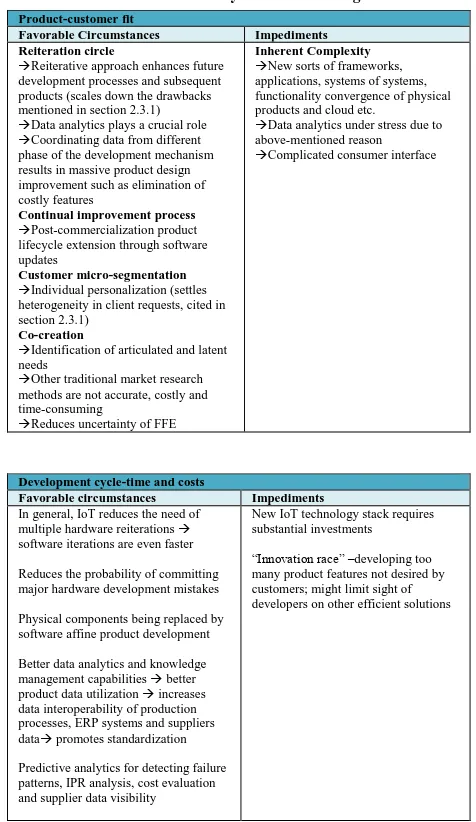
[image:7.595.306.544.121.532.2]share the risks. In view of all these factors, they indicate towards the reduction of development time and costs (Cognizant & Economics Intelligence Unit, 2015). A short summary entailing various findings of the impact of IoT on the success factors is depicted below in Table 1:
Table 1: Summary of critical findings
Product-customer fit
Favorable Circumstances Impediments Reiteration circle
→Reiterative approach enhances future development processes and subsequent products (scales down the drawbacks mentioned in section 2.3.1) →Data analytics plays a crucial role →Coordinating data from different phase of the development mechanism results in massive product design improvement such as elimination of costly features
Continual improvement process
→Post-commercialization product lifecycle extension through software updates
Customer micro-segmentation
→Individual personalization (settles heterogeneity in client requests, cited in section 2.3.1)
Co-creation
→Identification of articulated and latent needs
→Other traditional market research methods are not accurate, costly and time-consuming
→Reduces uncertainty of FFE
Inherent Complexity
→New sorts of frameworks, applications, systems of systems, functionality convergence of physical products and cloud etc.
→Data analytics under stress due to above-mentioned reason →Complicated consumer interface
Development cycle-time and costs
Favorable circumstances Impediments
In general, IoT reduces the need of multiple hardware reiterations → software iterations are even faster
Reduces the probability of committing major hardware development mistakes
Physical components being replaced by software affine product development
Better data analytics and knowledge management capabilities → better product data utilization → increases data interoperability of production processes, ERP systems and suppliers data→ promotes standardization
Predictive analytics for detecting failure patterns, IPR analysis, cost evaluation and supplier data visibility
New IoT technology stack requires substantial investments “Innovation race” –developing too many product features not desired by customers; might limit sight of developers on other efficient solutions
After having discussed the impact of data generated from IoT on the three success factors of the NPD process, the following interview questions were devised based on the above-depicted critical findings: 1. What is according to your opinion the impact of IoT on the capability to augment customer needs in the NPD process?2. What is according to your opinion the impact of IoT on the development cycle-time of the NPD process?3. What is according to your opinion the impact of IoT on the development costs of the NPD process? For the full length of the follow up questions, please refer to Appendix H.
3.
EMPIRICAL STUDY (EXPERT
INTERVIEWS)
This chapter discusses the main findings of the expert interviews. Various questions with regards to the three success factors were asked to three experts based on the summary of critical findings (Table 1) of the previous analysis. For the full list of interview questions and original transcripts, please refer to Appendix H. In the following sections, the results for each success factor is presented and assessed with the findings of the literature review, where applicable.
3.1
Augmenting the product’s fit with
customer requirement
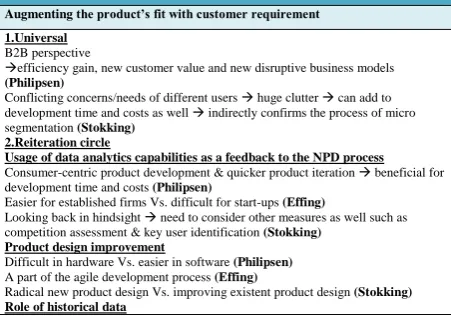
that their IoT solutions fulfils three main customer desires. With the help of KPN’s IoT architecture their customers are gaining efficiency in their business processes, creating new customer value and developing disruptive business models. This opens up a new viewpoint since the B2B perspective was not previously discussed. Furthermore, he states that IoT devices are able to generate concrete consumer-specific data and this is a huge competitive advantage for businesses since they can comprehend their customer behavior much better contrary to companies who are not equipped with IoT. Additionally, IoT devices also have the capability to provide live or real-time insights of the product usage, which facilitates businesses to be in more touch with their customer and develop products which are suited to their needs (comparable to Duckworth’s (2017) argumentation in section 2.4.1.). Dr. Robin Effing, an assistant professor at the University of Twente in the Business Information Systems department (IEBIS), explains the phenomenon of augmenting the product’s fit with customer requirement with the help of smart home devices. According to him, by using data sets and analyzing them with big data analysis and predictive analysis techniques, companies are able to predict whether people would require certain new products. He exemplifies the situation where a company is able to predict a new need for specific type of air conditioning based on patterns between temperature and geographical data sets. So, companies could maybe even learn from smart home devices, whether people would need a new car or not. He definitely believes that the data generated from the IoT can play a significant role on the capability to augment and predict customer needs in the NPD process. Mr. Johan Stokking, CTO and co-founder of the Things Industries, states that on one hand, it is very useful to measure some form of quantitative data and the corresponding insights available, but on the other hand, it can also create a lot of clutter for example, conflicting concerns of different users identified by the IoT, which the company needs to consider. This argument made by Mr. Stokking reaffirms the notion of IoT facilitating the micro segmentation phenomenon of customer groups which helps to recognize the market segments’ needs in detail (Tata consultation services, 2013). The concern regarding the clutter creation was previously ignored by the literature. All things considered, Mr. Stokking argues that with the help of IoT, companies are able to develop products which are more tailored to customer needs as opposed to companies who do not make use of IoT, but it can also be a big process of managing a lot of needs which adds a lot to the development time and costs in general. The concluding remark of Mr. Stokking is also applicable to sections 3.2. and 3.3.
3.1.1
Reiteration circle
3.1.1.1
Usage of data analytics capabilities as a
feedback to the NPD process
Mr. Philipsen believes that it is absolutely crucial for businesses to establish data analytics capabilities or become a data-driven company. According to him, a data-driven approach will help companies to be in much more contact with their customers, which subsequently can enable companies to steer their product development with the help of a consumer-centric and quicker product iterations. Dr. Effing states that in today’s modern era one cannot neglect anymore the fact that competitive advantage can be achieved from performing data analytics and it’s a very fast and well-developed method now to get really reliable client data. He states that in the past companies had to set up a market agency to do this for them and the results were inconsistent, unfocussed and unreliable but the evolution in data analytics capabilities is making such procedure redundant and much more cost effective (similar to the argument made by Hippel & Katz (2002) in section 2.4.1.5.). He also points out that such procedure could be very different for established and new emerging companies. The unexpected advantage of an established company is that they can combine their readily available data sets to find out innovation potential for new products and services whereas the startups have scarcity of consumer data. Mr. Stokking states that it is very important to establish data analytics capabilities which can be used as a feedback in the NPD process, but it is also good to be aware that this is a process which requires one to always look back, so always after in hindsight. Companies need to possess some sort of characteristics which enables them to look in the future as well, such as competitors’ assessment, key user identification etc. rather than just quantitatively analyzing data. So, it is useful, but firms need to consider other measures as well.
3.1.1.2
Product design improvement through the
reiteration loop
Mr. Philipsen mentions that product design improvements with the help of the reiteration loop is rather difficult in hardware development, but he foresees a positive business case particularly in software development. He reinforces his case by giving an example of the Philips Hue lighting system. He argues that by selling the LED lighting system Philips is able to gain insights of the product usage and they exactly know what their customers are doing through the company-specific app. Hence, companies are able to iterate and reiterate product designs which is more suited to customer desire by eliminating unnecessary and costly features which can be controlled through software (can serve as reducing the drawbacks of the success factor mentioned in section 2.3.1). On one hand, his example partially reflects the business case of the telecom hardware producer studied by Tata consultancy services (2013) in section 2.4.1.1. Partially because the telecom company was able to improve product design and through that enhanced the product’s fit with customer requirement, hardware-wise instead of software product design iteration. On the other hand, his statement fully approves the argument made by Harvard Business Review (2014) in section 2.4.1.3., where they state, “Such approach works best when products (..) at low incremental cost through software customization contrary to hardware changes”. Dr. Effing sees the reiteration circle and the corresponding product design improvements as a part of the agile development process. According to him, it is increasingly important for companies to have a quick post-commercialization user feedback mechanism in order to continually improve and come up with more versions of the same product because the competition asks for this (analogous to the idea of “Continual Improvement Process”). Mr. Stokking states that the reiteration circle is not a good mechanism to improve radical new product design because it only enables to optimize the same feature sets in future products. He argues that after a couple of iterations and since everything is in hindsight, companies optimize to a point where they think this is good for the time being, but it does not give them the insight on what new features the firm could focus on or how could things be done completely different since firms always have the reference of the first design. So, companies are fixated to an anchor and that’s their context.
3.1.1.3
Role of historical data
Dr. Effing states that when a company looks back at the data, it can determine or predict using predictive analysis the factors it should avoid for the next project and he is convinced that such procedures can be useful. But he also argues by indicating a recent research where blindly relying on computer generated algorithms or data is not enough and one needs to have some clear ideas about the specific industry and the R&D process. Furthermore, he specifies that by relying on data from past product development processes a company can signal waste, efficiency loss and key mistakes but that does not necessarily guarantee if the company does it otherwise it can do it better next time. Mr. Stokking believes that it can to certain extent help businesses to enhance their production processes with the help of data triangulation from diverse preceding processes (comparable to what Cognizant (2015) described in section 2.4.1.1) but at the same time he argues that these hindsight activities can hinder radical product innovation.
3.1.2
Continual improvement process
with a product on a large-scale, it is of utmost importance to have an update channel since it can help to patch security issues and to add functionality later on (the latter part is analogous to the description of Watson IoT IBM (2017) in section 2.4.1.2; Tesla example)
3.1.3
Customer micro segmentation
Mr. Philipsen states that smart connected product data can help determine demands of particular customers groups in the B2C market, but it is rather difficult in the B2B market. He argues that in the B2B market, the product development of IoT and also the business case development of IoT takes a lot of time. He presents the case of one of KPN’s business customer where they intend to equip ten thousand containers with sensors. Connecting them with such devices implies that the company has to change all their processes (the way people work, IT infrastructure, logistics etc.). So, the time setting up IoT until rolling out IoT equipped containers takes a lot of time. Dr. Effing suggests that today’s marketers need a shift in their thinking about segmentation and customer groups since they focus more on mass market groups. Given the technology and distribution options of today, marketers and firms can really think of very niche markets and granular consumer groups to create more product relevance and thus value (long-tail marketing). With the help of predictive capabilities and new sources of data firms are able to foresee specific product needs and these needs can be used to create new markets which do not exist yet (This reaffirms what has been mentioned by Tata consultancy services (2013) and Harvard Business Review (2014) in section 2.4.1.3). Furthermore, this also helps to create different kinds of services and products that people are really willing to pay for.
3.1.4
Co-creation
According to Mr. Philipsen, IoT can identify articulated as well as latent customer needs. He once again argues this by presenting a business case where KPN collaborated with a bicycle insurance company. So, their collaboration required them to do a lot of co-creation activities together and this initially helped them to find some articulated needs (for e.g. the bike needs to be tracked) of the insurance company. However, since the insurance company was not acquainted with the technology, there were also many latent needs that KPN had to discuss with the bicycle insurance company. This answer could be marginally misleading because KPN was able find out the articulated and latent customer needs by conducting co-creation activities with them and it says nothing about how KPN’s IoT solutions or in other words the data retrieved from the smart connected devices are helping them to investigate such needs. Mr. Stokking states that IoT can very much identify articulated as well as latent customer needs by analyzing how users use something. Firms are able to get more data on the ways that people are making use of existing products but in unexpected ways. So, it gives a lot of insights into how customers use the products that someone would not have thought of how they would use it before. He gives an example where a lot of smart features in cars have become successful where people thought that they would have never used it before or would have never come up with until the car maker introduced it because they were able to predict and identify certain customer needs with the help of IoT data.
3.2
Reducing the development cycle time
With regards to the impact of IoT on the cycle-time of the NPD process, some respondents indicated that the development time is likely to reduce but simultaneously some major concerns were raised as well. Mr. Philipsen acknowledges that IoT can have a huge impact on the speed of the development cycle-time in the NPD process. He states that, if a firm can use more and more data, the company will be much more effective with regards to development time and there will be much more chance that the product would turn out to be commercially successful. Dr. Effing agrees to a certain extent that the data retrieved from IoT can accelerate the NPD process since certain mechanisms could be efficient and faster (similar to Mr. Philipsen). During the development phase, what firms currently do is that they ask people and there is always a bit of noise between what people say and what they actually do (similar to the argument made by Hippel & Katz (2002) in section 2.4.1.5). This implies that the data obtained from such traditional market research could be deceptive and it consumes a lot of time. According to Dr. Effing, using data from smart devices can limit the time lag and firms can more speedily obtain the real insights pertaining to what is actually happening, use characteristic and use patterns etc. He also argues that only relying on IoT data is not sufficient and firms could make use of social media data, information from regular clients, questionnaires etc. To add up, firms require triangulation of data from multiples sources to further speed
up the product development time. Mr. Stokking describes the impact of IoT on development cycle time using two different perspective. The first perspective is irrelevant for the purpose of the research and is thus omitted. He states that if companies are using IoT data retrieved from for example, smart industry or industry 4.0. or smart products, the development cycle-time might decrease to some extent since firms are able to make certain decisions quicker due to the availability of more insights (similar to Mr. Philipsen and Dr. Effing) but at the same time he raises his concerns about the various conflicting customer needs which the products manager needs to scope and clarify beforehand, subsequently slowing down the development time.
3.2.1
Heightened complexity
Mr. Philipsen argues that given the heightened complexity of the IoT environment, it is necessary to have right human resources in order to have a quick product development cycle. He states that getting the right people for example technical consultants, software developers, data scientists etc., in this context is always a struggle and also the most important thing. If the company is able to overcome such hurdles, quick product development cycle can be achieved. Dr. Effing argues that even though there is a surge in different types of application and new products in the IoT environment (elevated complexity), there will always be people who can quite easily operate such complex systems. According to him, both knowledge and technology capabilities of companies should not be underestimated, and it should not pose a great difficulty for firms to handle such complex systems. Furthermore, he asserts that these technical barriers and complexity might propel companies to try out many new different things. (this argument is exactly similar to the argument made by Tata consultancy services (2013) in section 2.4.2. “Contrarily to the heightened complexity of the IoT environment, some researchers argue that the extraordinary levels of real-time data generation and concealed valuable insights would actually propel businesses to establish even more effective knowledge management approaches from data analytics”; Dr. Effing’s statement can also be regarded as a viable answer to section 3.2.2). Dr. Effing’s argumentation seems to counter balance Mr. Philipsen’s notion of finding skilled human resources. According to a report published by CEDEFOP (European Centre for the Development of Vocational Training; Centre Européen pour le Développement de la Formation Professionnelle) in 2015, between a half and two thirds of EU firms face difficulties in finding high-skilled workers. On one hand, given this evidence, Mr. Philipsen’s debate of finding the right human resources is more assertive. But on the other hand, the latter argument of Dr. Effing “these technical barriers and complexity might propel companies to try out many new different things” can be decisive as well.