Proceedings of the 12th International Workshop on Semantic Evaluation (SemEval-2018), pages 747–757
SemEval-2018 Task 11: Machine Comprehension Using Commonsense
Knowledge
Simon Ostermann Michael Roth Ashutosh Modi Stefan Thater Manfred Pinkal Saarland University
Saarbr¨ucken, Germany
{simono|mroth|ashutosh|stth|pinkal}@coli.uni-saarland.de
Abstract
This report summarizes the results of the Se-mEval 2018 task on machine comprehension using commonsense knowledge. For this ma-chine comprehension task, we created a new corpus, MCScript. It contains a high num-ber of questions that require commonsense knowledge for finding the correct answer. 11 teams from 4 different countries participated in this shared task, most of them used neu-ral approaches. The best performing system achieves an accuracy of 83.95%, outperform-ing the baselines by a large margin, but still far from the human upper bound, which was found to be at 98%.
1 Introduction
Developing algorithms for understanding natural language is not trivial. Natural language comes with its own complexity and inherent ambiguities. Ambiguities can occur, for example, at the level of word meaning, syntactic structure, or semantic interpretation. Traditionally, Natural Language Un-derstanding (NLU) systems have resolved ambigui-ties using information from the textual context (e.g. neighboring words and sentences), for example via distributional methods (Lenci, 2008). However, many times context may be absent or may lack sufficient information to resolve the ambiguity. In such cases, it would be beneficial to include com-monsense knowledge about the world in an NLU system. For example, consider example (1).
(1) The waitress brought Rachel’s order. She ate the food with great pleasure.
Looking at the example in isolation, the person eating the food could be either Rachel or the wait-ress. Using commonsense knowledge, or, more specifically, script knowledge about theRESTAU -RANTscenario, helps to resolve the referent of the pronoun: Rachel ordered the food. The person who
orders the food is the customer. So Rachel should eat the food,shethus refers to Rachel.
This shared task assesses how the inclusion of commonsense knowledge benefits natural language understanding systems. In particular, we focus on commonsense knowledge about everyday activi-ties, referred to asscripts. Scripts are sequences of events describing stereotypical human activities (also calledscenarios), for example baking a cake, taking a bus, etc. (Schank and Abelson,1975). The concept of scripts has its underpinnings in cognitive psychology and has been shown to be an important component of the human cognitive system (Bower et al.,1979;Schank,1982;Modi et al.,2017). From an application perspective, scripts have been shown to be useful for a variety of tasks, including story understanding (Schank,1990), information extrac-tion (Rau et al.,1989), and drawing inferences from texts (Miikkulainen,1993).
Factual knowledge is mentioned explicitly in texts from sources such as Wikipedia and news pa-pers. On the contrary, script knowledge is often im-plicit in the texts as it is assumed to be known to the comprehender. Because of this implicitness, learn-ing script knowledge from texts is very challenglearn-ing. There are few exceptions of corpora containing nar-rative texts that explicitly instantiate script knowl-edge. An example is the InScript (Modi et al., 2016), which contains short and simple narratives, that very explicitly mention script events and par-ticipants. TheDinners from Hellcorpus (Rudinger et al.,2015a) is a similar dataset centered around theEATING IN A RESTAURANTscenario.
In the past, script modeling systems have been evaluated using intrinsic tasks such as event order-ing (Modi and Titov,2014), paraphrasing (Regneri et al.,2010;Wanzare et al.,2017), event prediction (namely, the narrative cloze task) (Chambers and Jurafsky,2008,2009;Rudinger et al.,2015b;Modi, 2016) or story completion (e.g. the story cloze task
T It was a long day at work and I decided to stop at the gym before going home. I ran on the treadmill and lifted some weights. I decided I would also swim a few laps in the pool. Once I was done working out, I went in the locker room and stripped down and wrapped myself in a towel. I went into the sauna and turned on the heat. I let it get nice and steamy. I sat down and relaxed. I let my mind think about nothing but peaceful, happy thoughts. I stayed in there for only about ten minutes because it was so hot and steamy. When I got out, I turned the sauna off to save energy and took a cool shower. I got out of the shower and dried off. After that, I put on my extra set of clean clothes I brought with me, and got in my car and drove home.
Q1Where did they sit inside the sauna? a. on the floor b. on a bench
Q2How long did they stay in the sauna? a. about ten
min-utes b.minutesover thirty
Figure 1: An example for a text from MCScript with 2 reading comprehension questions.
(Mostafazadeh et al.,2016)). These tasks test a sys-tem’s ability to learn script knowledge from a text but they do not provide a mechanism to evaluate how useful script knowledge is in natural language understanding tasks.
Our shared task bridges this gap by directly re-lating commonsense knowledge and language com-prehension. The task has a machine comprehension setting: A machine is given a text document and asked questions based on the text. In addition to what is mentioned in the text, answering the ques-tions requires knowledge beyond the facts men-tioned in the text. In particular, a substantial subset of questions requires inference over commonsense knowledge via scripts. For example, consider the short narrative in (1). For the first question, the cor-rect choice for an answer requires commonsense knowledge about the activity of going to the sauna, which goes beyond what is mentioned in the text: Usually, people sit on benches inside a sauna, an
information that is not given in the text. The dataset also comprises questions that can just be answered from the text, as the second question: The informa-tion about the durainforma-tion of the stay is given literally in the text.
The paper is organized as follows: In Section2, we give an overview of other machine comprehen-sion datasets. In Section3, we describe the dataset used for our shared task. Section4.2gives details about the setup of our task. In Section5, informa-tion about participating systems is given. Results are presented and discussed in Sections6and 8, respectively.
2 Related Work
Recently, a number of datasets have been pro-posed for machine comprehension. One example is
MCTest(Richardson et al.,2013), a small curated dataset of 660 stories, with 4 multiple choice ques-tions per story. The stories are crowdsourced and not limited to a domain. Answering questions in
MCTestrequires drawing inferences from multiple sentences from the text passage. In our dataset, in contrast, answering requires drawing inferences using knowledge not explicit in the text. Another recently published multiple choice dataset is RACE (Lai et al.,2017), which contains 100,000 questions on reading examination data.
Rajpurkar et al.(2016) have proposed the Stan-ford Question Answering Dataset (SQuAD), a data set of 100,000 questions on Wikipedia articles col-lected via crowdsourcing. In that dataset, the an-swer to a question corresponds to a segment/span from the reading passage. Since Wikipedia articles mostly contain factual knowledge,SQuADdoes not assess how in practice, language comprehension relies on implicit and underrepresented knowledge about everyday activities i.e. script knowledge.
Weston et al. (2015) have created the BAbI
dataset. BAbI is a synthetic reading comprehen-sion data set testing different types of reasoning to solve different tasks. In contrast to our dataset, the artificial texts in BAbI are not reflective of a typically occurring narrative text.
Two recently published datasets that also have a larger focus on commonsense reasoning are
method ensures that literal repetitions of the text are avoided and the generation of non-trivial questions requiring background knowledge is supported. The NewsQA text collection differs from MCScript in domain and genre (newswire texts vs. narrative sto-ries about everyday events). Knowledge required to answer the questions is mostly factual knowledge and script knowledge is only marginally relevant.
TriviaQA (Joshi et al.,2017) contains automat-ically collected question-answer pairs from 14 trivia and quiz-league websites, together with web-crawled evidence documents fromWikipediaand
Bing. While a majority of questions require world knowledge for finding the correct answer, it is mostly factual knowledge.
3 Data
In3.1, we now briefly describe the machine com-prehension dataset used for the shared task, MC-Script. Parts of the following Section are taken fromOstermann et al.(2018). For a more detailed description of the resource collection and a more thorough discussion of the dataset, we refer to the original paper. Section3.2gives details about script data collections that were made available to the par-ticipants.
3.1 Machine Comprehension Data -MCScript
For our shared task, we use the MCScript data set (Ostermann et al.,2018). It is a collection of narrative texts, questions of various types referring to these texts, and pairs of answer candidates for each question. It comprises 2,119 such texts and a total of 13,939 questions. The texts in the data set talk about everyday activities and cover 110 script scenarios of differing complexity. For the text collection, we followedModi et al.(2016): All texts are simple and explicit in the description of script events and script participants.
The data set was crowdsourced via Amazon Me-chanical turk1. In the crowdsourcing experiments,
participants were asked to write questions inde-pendent of a concrete narrative, but only based on short descriptions of a scenario. By doing so, the collected questions were related to the scenario only and could be answered from different texts, independent of story details.
The scenario-based questions were paired ran-domly with texts from the same scenario. The
1www.mturk.com
how many/much 4 % how long/often
5 % when
6 % how 7 % where
9 % why
12 %
who/whose 12 %
what/which 14 %
Rest 2 %
[image:3.595.314.521.86.266.2]y/n 29 %
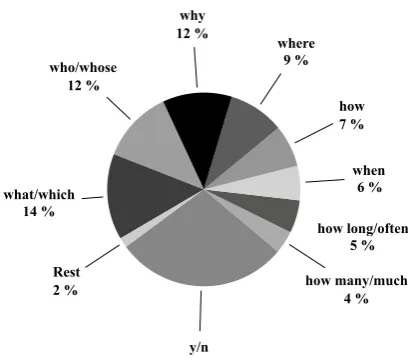
Figure 2: Distribution of question types in MCScript, fromOstermann et al.(2018).
subsequent answer collection was divided up into two steps: First, crowdsourcing workers had to an-notate whether a question could be answered based on the given text. If it could be answered, they had to explicitly mark whether it could be answered from the text directly or based on commonsense knowledge. Second, they had to write a plausi-ble correct and incorrect answer, if the question was answerable. Afterwards, all texts, questions and answers were manually validated by trained annotators, and corrected, if necessary.
Due to the design of the data acquisition process, a substantial subset of questions (27.4%) require commonsense inference about everyday activities. Figure2 gives an overview of the distribution of question types on the data.Yes/Noquestions form the largest group, with 29%, followed by ques-tions asking for details of a narration or scenario (what/whichandwho).
3.2 Script and Commonsense Knowledge Data
We also encouraged participants to make use of existing script data collections. Thus, we provided several existing collections of script data together with the machine comprehension corpus: DeScript (Wanzare et al.,2016), RKP (Regneri et al.,2010) and the OMCS stories (Singh et al., 2002). The three datasets contain sequences of short, telegraph-styled descriptions of all events that need to be con-ducted in a scenario (event sequence descriptions, ESDs). The data sets contain ESDs for different numbers of scenarios, with a total coverage of over 200 scenarios. The complexity of scenarios varies from simple activities, such asopening a window, to more complex ones, such as attending a wed-ding.
For 90 of the 110 scenarios in MCScript, there exist multiple ESDs per scenario in at least one of the 3 script data collections.
We also advised participants to make use of other representations for script knowledge, such as nar-rative chains (Chambers and Jurafsky, 2008), or event embeddings (Modi and Titov,2014).
Some participants also made use ofConceptNet
(Speer et al.,2017) as a resource for commonsense knowledge. ConceptNet is a large-scale knowledge graph that is built from several handcrafted and crowdsourced sources, and that encodes various types of commonsense knowledge.
4 Shared Task Setup 4.1 Evaluation Method
In our evaluation, we measured how well a system was capable of correctly answering questions that may involve commonsense knowledge. As evalu-ation metric, we used accuracy, calculated as the ratio between correctly answered questions and all questions in our evaluation data. We also evaluated systems with regard to specific question types and based on whether a question is directly answerable, or only inferable from the text.
4.2 Baselines
We provide results of two baseline systems as lower bounds for comparison: a rule-based baseline ( Slid-ing Window) and a neural end-to-end system ( At-tentive Reader). Both baselines are described in
2IUCM cluster MCScript texts and try to find answers
also in other texts, that are topically similar. In that sense, MCScript itself is used to represent commonsense knowledge.
more detail below. For details about the tuning of hyperparameters, we refer toOstermann et al. (2018).
Sliding Window
The sliding window baseline is a simple rule-based method that answers a question on a text by predict-ing the answer option with the highest similarity to the text. The intuition underlying this method is that answers similar to a text should be more plau-sible than answer options that are different from the text (independent of the question). In our base-line implementation, we compute similarity using a sliding window that compares each answer op-tion to any possible “window” ofwtokens of the
text. For comparison, each window and each an-swer is represented by an average vector, computed over the components of word embeddings corre-sponding to the words in the window and answer, respectively. For each possible window, we com-pute similarity as the cosine similarity between the window and the answer representation. The answer with the higher maximum similarity (over possible windows) is predicted to be the correct answer.
Attentive Reader
The attentive reader is an established machine com-prehension model that reaches good performance e.g. on theCNN/Daily Mailcorpus (Hermann et al., 2015;Chen et al., 2016). It is a neural network-based approach, which scores answers to a question on a text by finding (“paying attention to”) and scor-ing relevant passages in the text. The scorscor-ing and attention mechanisms are learned directly (“end-to-end”) from text–question–answer triples, without the need for manual rule writing or feature engi-neering. As a baseline for the shared task, we use the model formulation byChen et al.(2016) and Lai et al.(2017), who employ bilinear weight func-tions to compute both attention and answer-text fit. Bi-directional gated recurrent units (GRUs) are used to encode questions, texts and answers into hidden representations. For a question q and an
answera, the last state of the GRU,qanda, are
used as representations, while the text is encoded as a sequence of hidden statest1...tn. We compute an attention scoresj for each hidden statetj us-ing the question representationq, a weight matrix
Rank Team name Main model Commonsense Other resources Acc. 1 Yuanfudao LSTM ConceptNet GloVe, Wikipedia,
POS and NE tagging 0.84
2 MITRE LSTM − word2vec, Twitter, stemming 0.82
3 Jiangnan LSTM − GloVe, CoVe,
POS and NE tagging 0.81
4 ELiRF-UPV LSTM ConceptNet − 0.75
5 YNU Deep LSTM − GloVe 0.75
6 ZMU LSTM − word2vec, GloVe 0.74
7 ECNU LSTM − GloVe 0.73
8 YNU AI1799 LSTM/CNN − word2vec, GloVe 0.72
9 YNU-HPCC LSTM/CNN − word2vec 0.71
10 CSReader LSTM − lemmatization, GloVe 0.63
[image:5.595.76.524.63.266.2]11 IUCM k-means DeScript, MCScript2 NLTK 0.61
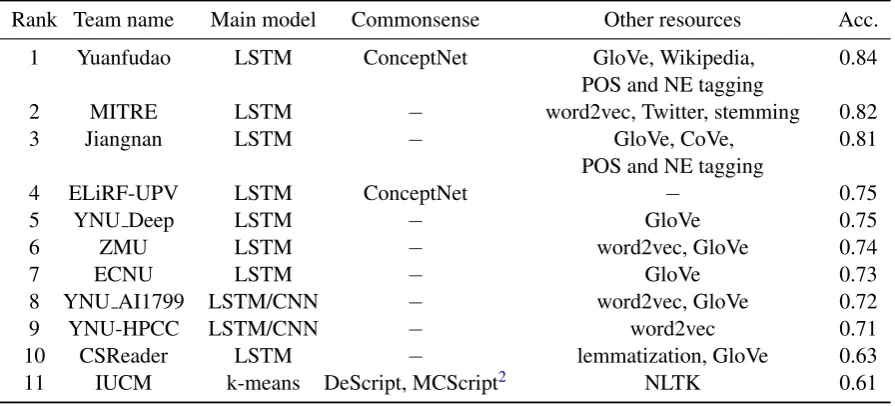
Table 1: Overview of techniques and resourced used by the participating systems.
representations:
sj =sof tmaxj(t>j Waq+b)
t=X
j
sjtj (1)
The probabilitypof answerabeing correct is
pre-dicted using another bilinear weight matrix Ws, followed by an application of the softmax function over both answer options for the question:
p(a|t, q) =sof tmax(t>Wsa) (2)
5 Participants
We ran our shared task through the CodaLab plat-form3. 24 teams submitted results during the
evalu-ation period, out of which 11 teams provided sys-tem descriptions: 8 teams from China, and one team each from Spain, Russia and the US. The full leader board containing all 24 submissions can be found on the shared task website.
Except for one team, all participating models rely on recurrent neural network techniques to en-code texts, questions and/or answers. The one team that did not apply neural methods proposed an alternative approach based on clustering tech-niques and scoring word overlap. Only 3 of the 11 teams made explicit use of commonsense knowl-edge: Two approaches used ConceptNet, either in the form of features extracted from ConceptNet relations or in the form of pretrainedNumberbatch
3https://competitions.codalab.org/
competitions/17184
embeddings (Speer et al.,2017). One participating system made use of script knowledge in the form of event sequence descriptions. Resources commonly used by participants include pretrained word em-beddings such as GloVe (Pennington et al.,2014) or word2vec (Mikolov et al., 2013), and prepro-cessing pipelines such as NLTK4. In the following,
we provide short summaries of the participants’ systems and we give an overview of models and resources used by them (Table1).
Non-neural methods IUCM (Reznikova and Derczynski, 2018) applied an unsupervised ap-proach that assigns the correct answer to a question based on text overlap. Text overlap is computed based on the given passage and text sources of the same topic. Different clustering and topic modeling techniques are used to identify such text sources in MCScript and DeScript.
Neural-network based models Apart from
IUCM, all participating systems are neural end-to-end models that employ recurrent and/or con-volutional neural network architectures. Systems mainly differ with respect to details of the architec-ture and the form of how words are represented.
Yuanfudao(Liang Wang,2018) applies a three-way attention mechanism to model interactions be-tween the text, question and answers, on top of BiL-STMs. Each word in a text, question, and answer is represented by a vector of GloVe embeddings and additional information from part-of-speech tagging, name entity recognition, and relation extraction
Rank Team name Total Commonsense Text Out of Domain
1 Yuanfudao 0.84* 0.82 0.85 0.79
2 MITRE 0.82 0.79 0.83* 0.78
3 Jiangnan 0.81* 0.80 0.81* 0.75*
4 ELiRF-UVP 0.75 0.82 0.73 0.70
5 YNU Deep 0.75 0.79 0.73 0.66
6 ZMU 0.74 0.80 0.72 0.66
7 ECNU 0.73 0.77 0.72 0.69
8 YNU AI1799 0.72 0.76 0.71 0.67
9 YNU HPCC 0.71* 0.78* 0.69* 0.64*
10 CSReader 0.63 0.64* 0.63 0.59
11 IUCM 0.61 0.54 0.64 0.58
– Attentive Reader 0.72 0.75 0.71 0.69
– Sliding Window 0.55 0.53 0.56 0.52
– Human Performance 0.98
Table 2: The accuracy of participating systems and the two baselines in total, on commonsense-based questions (CS), text-based questions (TXT) and on out-of-domain questions (from the 5 held-out testing scenarios). The best performance for each column is marked inbold print. Significant differences in results between two adjacent lines are marked by an asterisk (* p<0.05) in the upper line. The last line shows the human upper bound (Ostermann
et al.,2018) as comparison.
(based on ConceptNet). The model is pretrained on another large machine comprehension dataset, namely the RACE corpus.
MITRE (Merkhofer et al., 2018) use a combi-nation of 3 systems - two LSTMs with attention mechanisms, and one logistic regression model us-ing patterns based on the vocabulary of the trainus-ing set. The two neural models use different word em-beddings - one trained on GoogleNews, another one trained on Twitter, which were enriched with word overlap features. Interestingly, the simple logistic regression model achieves competitive per-formance and would have ranked 4th as an individ-ual system.
Jiangnan (Xia,2018) applies a BiLSTM over GloVe and CoVe embeddings (McCann et al.,2017) with an additional attention mechanism. The at-tention mechanism computes soft word alignment between words in the question and the text or an-swer. Manual features, including part-of-speech tags, named entitity types, and term frequencies, are employed to enrich word token representations.
ELiRF-UPV (Jos´e - ´Angel Gonz´alez et al.,2018) employs a BiLSTM with attention to find similar-ities between texts, questions, and answers. Each word is represented based on Numberbatch embed-dings, which encode information from ConceptNet.
YNU Deep(Ding and Zhou,2018) test different LSTMs and BiLSTMs variants to encode questions, answers and texts. A simple attention mechanism is applied between question–answer and text–answer pairs. The final submission is an ensemble of five model instances.
ZMU(Li and Zhou,2018) consider a wide vari-ety of neural models, ranging from CNNs, LSTMs and BiLSTMs with attention, together with pre-trained Word2Vec and GloVe embeddings. They also employ data augmentation methods typically used in image processing. Their best performing model is a BiLSTM with attention mechanism and combined GloVe and Word2Vec embeddings.
ECNU (Sheng et al., 2018) use BiGRUs and BiLSTMs to encode questions, answers and texts. They implement a multi-hop attention mechanism from question to text (a Gated Attention Reader (Dhingra et al.,2017)).
Rank Team name y/n what why who where when 1 Yuanfudao 0.76 0.87 0.85 0.93 0.88 0.81
2 MITRE 0.76 0.83 0.82 0.91 0.85 0.77
3 Jiangnan 0.75* 0.80* 0.80 0.88 0.84* 0.82* 4 ELiRF-UVP 0.72 0.68 0.79 0.86 0.69 0.74 5 YNU Deep 0.73 0.66 0.75 0.86 0.71 0.72
6 ZMU 0.73 0.65 0.77 0.81 0.72 0.75
7 ECNU 0.71 0.66 0.75 0.82 0.73 0.68
8 YNU AI1799 0.70 0.68 0.78* 0.80 0.67 0.72 9 YNU HPCC 0.72* 0.66* 0.71 0.83* 0.65 0.66 10 CSReader 0.54 0.59* 0.68 0.76* 0.62* 0.63
11 IUCM 0.54 0.75 0.66 0.45 0.77 0.61
[image:7.595.133.465.61.269.2]– Attentive Reader 0.67 0.66 0.75 0.84 0.73 0.71 – Sliding Window 0.47 0.69 0.56 0.48 0.61 0.51
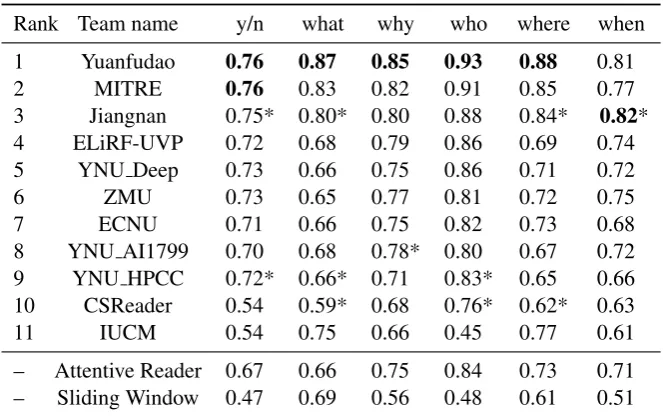
Table 3: Accuracy of participating systems and the baselines on the six most frequent question types. The best performance for each column is marked inbold print. Significant differences in results between two adjacent lines are marked by an asterisk (* p<0.05) in the upper line.
YNU-HPCC(Yuan et al.,2018) use an ensemble of neural networks with stacked CNN and LSTM layers and attention.
CSReader(Jiang and Sun,2018) use GRUs to encode questions and texts. Answer and text are combined by using an attention mechanism that models soft word alignments, inspired by work on Natural Language Inference (Bowman et al.,2015). Two answer classifiers based on these representa-tions are ensembled for prediction.
6 Results
Tables2and3give detailed results for all participat-ing systems. We performed pairwise significance tests using an approximate randomization test (Yeh, 2000) over texts. At an accuracy of 84%, the best participating team Yuanfudao performed signifi-cantly better (p<0.05) than the second best system,
MITRE (82%).
Except for when questions, Yuanfudao also achieved the best performance at each question type. However, individual differences in results over the 2nd place system were not found to be sig-nificant. The top three participating teams, Yuan-fudao, MITRE and Jiangnan, all significantly out-perform the remaining teams on text-based ques-tions (>80% vs.<74%) as well as onyes/no,what,
whereandwhenquestions.
In comparison to our baselines, all teams but Innopolis significantly outperform Sliding Win-dow. Results of the Attentive Reader are in line
with those of the participating systems ranked 7– 9: ECNU, YNU AI1799 and YNU HPCC. The six top-ranked systems all significantly outperform both of our baselines. On out-of-domain questions, only the top 3 performing models significantly out-perform the Attentive Reader baseline, while all models significantly outperform the Sliding Win-dow approach.
For commonsense-based questions as well as for questions onwhyandwho, results are considerably less consistent: while the top ranked system signifi-cantly outperforms teams ranked 7th or lower, most pairwise differences between the top teams are not statistically significant. This implies that the set of correctly answered questions considerably varies between systems, either due to randomness or be-cause they excel at different inference problems.
We found that 19.3 % of the questions in the test set were answered correctly by each participating system. These questions mainly contain text-based questions with an answer that is literally given in the text. Also, there are many commonsense-based questions with a standardized correct answer, as shown in Example2. Only few of the stories in MCScript cover a long timespan, so the answer to such questions is always similar.
(2) Q:How long did it take to pump up the tires?
Answer-ing these questions mainly requires complicated inference steps, such as counting or plausibility judgements.
7 Discussion
We briefly highlight some of the findings by the shared task participants.
External knowledge sources. One of the main goals of this shared task was to provide an extrin-sic evaluation framework for models of common-sense knowledge. However, only three participants actually made use of resources of commonsense knowledge.
Most prominent is the use of ConceptNet, a large-scale knowledge graph that is built from sev-eral handcrafted and crowdsourced sources. It was employed by two of the top 5 scoring models: Yuanfudao use it to learn their own ConceptNet-based relation embeddings. ELiRF-UPV make use of Numberbatch word embeddings, which are learned based on ConceptNet data. Ablation anal-yses conducted by Yuanfudao indicate that the ad-dition of ConceptNet increases overall accuracy by almost 1% absolute. In contrast, only one par-ticipant used crowdsourced script data from the DeScript corpus in their final submission, IUCM. They found that the use of script data, instead of or in addition to texts, improved performance by up to 0.3% absolute.
CSReader tried to extend their neural model with script data from OMCS, but report that it did not result in an improvement.
No participant made use of narrative chains or other forms of structured/learned representations of scripts or events (such as event embeddings).
Pretraining. Most participants made use of pre-training in the form of word embeddings such as word2vec or GloVe, that were build on large data collections. Yuanfudao used the RACE dataset, which is the largest available multiple-choice ma-chine comprehension corpus, for pretraining the complete model for several epochs. In their abla-tion analysis, they found pretraining to have the largest effect on model performance, with improve-ments in accuracy of up to 1.4% absolute. This result underlines that the comparably small size of MCScript naturally restricts how much neural approaches can learn from the data without overfit-ting.
Word representations. For representing tokens, most participants used word2vec embeddings, GloVe embeddings, or combinations thereof. The participating teams used different dimensionality sizes, and some of them refitted the vectors while others did not, leading to differing outcomes for both embedding types. In summary, none of both representations seems to clearly outperform the other.
In contrast, participants consistently found that extending word representations with additional fea-tures improves results: For example, Yuanfudao and Jiangnan use predicted part-of-speech tags and named entity information, as well as term fre-quency, and report improvements of up to 1% ab-solute in accuracy. Also, some participants report the use of word overlap features. Most notably, MITRE found that a logistic regression classifier based on overlap features can achieve performance competitive with neural approaches.
In general, additional features seem to be benefi-cial, since they provide more explicit or additional information that can be leveraged by neural net-works and other classifiers.
Preprocessing. Several participants reported that lemmatizing and stop word removal further im-proved their results. A prominent example is the submission by MITRE, who use a stemmer to de-rive root forms for all words, in order to compute overlap and co-occurrence statistics between an-swers and text/questions.
8 Conclusions
This shared task provides an evaluation framework for commonsense knowledge in a machine compre-hension setting. We create the MCScript corpus, which provides 2,119 stories and 13,939 answers for 110 everyday activities of different complex-ity. In contrast to previous datasets, MCScript was created in a way that results in a relatively large amount ofcommon sense questions,i.e. questions which can not be answered directly from the text but require some form of common-sense knowl-edge about the scenario under consideration to be answered correctly.
large margin; yet, there gap to the human upper bound (98%) is still relative large.
Although participants were explicitly encour-aged to use additional common-sense knowledge resources like DeScript of OMCS, only 3 systems (including the best-performing system) actually used such additional resources. The evaluation re-sults suggest that additional common-sense knowl-edge is in fact beneficial for overall accuracy. How-ever, the positive effect is relatively small, which might be due to the fact that our dataset has been created in a way that leads to relatively “easy” sto-ries, and that the systems are able to learn a certain amount of common sense knowledge directly from the stories. In future work, it would be interesting to see if the results of our shared task carry over to other, presumably more complex stories like for instance personal blog stories from the Spinn3r corpus (Burton et al.,2011).
Acknowledgments
We thank the reviewers for their helpful comments. Also, we thank all teams for their participation and the effort they put into their submissions and the discussions, making this shared task a success.
This research was funded by the German Re-search Foundation (DFG) as part of SFB 1102 In-formation Density and Linguistic Encoding and EXC 284 Multimodal Computing and Interaction.
References
Gordon H Bower, John B Black, and Terrence J Turner. 1979. Scripts in memory for text.Cognitive psychol-ogy, 11(2):177–220.
Samuel R Bowman, Gabor Angeli, Christopher Potts, and Christopher D Manning. 2015. A large anno-tated corpus for learning natural language inference. In Proceedings of the 2015 Conference on Empiri-cal Methods in Natural Language Processing, pages 632–642.
Kevin Burton, Niels Kasch, and Ian Soboroff. 2011. The icwsm 2011 spinn3r dataset. InProceedings of the Annual Conference on Weblogs and Social Me-dia (ICWSM 2011).
Nathanael Chambers and Dan Jurafsky. 2008. Unsu-pervised Learning of Narrative Event Chains. In
Proceedings of the 46th Annual Meeting of the As-sociation for Computational Linguistics: Human Language Technologies, pages 789–797, Columbus, Ohio. Association for Computational Linguistics.
Nathanael Chambers and Dan Jurafsky. 2009. Unsuper-vised Learning of Narrative Schemas and their Par-ticipants. InProceedings of the Joint Conference of the 47th Annual Meeting of the ACL and the 4th In-ternational Joint Conference on Natural Language Processing of the AFNLP, pages 602–610, Singa-pore. Association for Computational Linguistics.
Danqi Chen, Jason Bolton, and Christopher D Man-ning. 2016. A Thorough Examination of the CNN/Daily Mail Reading Comprehension Task. In
Proceedings of the 54th Annual Meeting of the As-sociation for Computational Linguistics (Volume 1: Long Papers), volume 1, pages 2358–2367.
Bhuwan Dhingra, Hanxiao Liu, Zhilin Yang, William Cohen, and Ruslan Salakhutdinov. 2017. Gated-attention readers for text comprehension. In Pro-ceedings of the 55th Annual Meeting of the Associa-tion for ComputaAssocia-tional Linguistics (Volume 1: Long Papers), volume 1, pages 1832–1846.
Peng Ding and Xiaobing Zhou. 2018. YNU Deep at SemEval-2018 Task 11: An Ensemble of Attention-based BiLSTM Model for Machine Comprehension. In Proceedings of the 12th International Workshop on Semantic Evaluations (SemEval-2018).
Karl Moritz Hermann, Tomas Kocisky, Edward Grefen-stette, Lasse Espeholt, Will Kay, Mustafa Suleyman, and Phil Blunsom. 2015. Teaching machines to read and comprehend. In Advances in Neural Informa-tion Processing Systems, pages 1693–1701.
Zhengping Jiang and Qi Sun. 2018. CSReader at SemEval-2018 Task 11: Multiple Choice Question Answering as Textual Entailment. InProceedings of the 12th International Workshop on Semantic Evalu-ations (SemEval-2018).
Jos´e - ´Angel Gonz´alez, Llu´ıs-F. Hurtado, Encarna Segarra, and Ferran Pla. 2018. ELiRF-UPV at SemEval-2018 Task 11: Machine Comprehension using Commonsense Knowledge. InProceedings of the 12th International Workshop on Semantic Evalu-ations (SemEval-2018).
Mandar Joshi, Eunsol Choi, Daniel S. Weld, and Luke Zettlemoyer. 2017. TriviaQA: A Large Scale Dis-tantly Supervised Challenge Dataset for Reading Comprehension. InProceedings of the 55th Annual Meeting of the Association for Computational Lin-guistics, Vancouver, Canada. Association for Com-putational Linguistics.
Guokun Lai, Qizhe Xie, Hanxiao Liu, Yiming Yang, and Eduard Hovy. 2017. Race: Large-scale reading comprehension dataset from examinations. arXiv preprint arXiv:1704.04683.
Yongbin Li and Xiaobing Zhou. 2018. ZMU at SemEval-2018 Task 11: Machine Comprehension Task using Deep Learning Models. In Proceed-ings of the 12th International Workshop on Semantic Evaluations (SemEval-2018).
Liang Wang. 2018. Yuanfudao at SemEval-2018 Task 11: Three-way Attention and Relational Knowledge for Commonsense Machine Comprehension. In Pro-ceedings of the 12th International Workshop on Se-mantic Evaluations (SemEval-2018).
Qingxun Liu, HongDou Yao, and Xiaobing Zhou. 2018. YNU AI1799 at SemEval-2018 Task 11: Machine Comprehension using Commonsense Knowledge of Different model ensemble. In Proceedings of the 12th International Workshop on Semantic Evalua-tions (SemEval-2018).
Bryan McCann, James Bradbury, Caiming Xiong, and Richard Socher. 2017. Learned in translation: Con-textualized word vectors. InAdvances in Neural In-formation Processing Systems, pages 6297–6308.
Elizabeth M. Merkhofer, John Henderson, David Bloom, Laura Strickhart, and Guido Zarrella. 2018. MITRE at SemEval-2018 Task 11: Commonsense Reasoning without Commonsense Knowledge. In
Proceedings of the 12th International Workshop on Semantic Evaluations (SemEval-2018).
Risto Miikkulainen. 1993. Subsymbolic natural lan-guage processing: An integrated model of scripts, lexicon, and memory. MIT press.
Tomas Mikolov, Ilya Sutskever, Kai Chen, Greg S Cor-rado, and Jeff Dean. 2013. Distributed representa-tions of words and phrases and their compositional-ity. InAdvances in neural information processing systems, pages 3111–3119.
Ashutosh Modi. 2016. Event Embeddings for Seman-tic Script Modeling. In Proceedings of The 20th SIGNLL Conference on Computational Natural Lan-guage Learning, pages 75–83, Berlin, Germany. As-sociation for Computational Linguistics.
Ashutosh Modi, Tatjana Anikina, Simon Ostermann, and Manfred Pinkal. 2016. InScript: Narrative texts annotated with script information. InProceedings of the Tenth International Conference on Language Resources and Evaluation (LREC 2016), Portoroˇz, Slovenia. European Language Resources Associa-tion (ELRA).
Ashutosh Modi and Ivan Titov. 2014. Inducing Neu-ral Models of Script Knowledge. In Proceedings of the Conference on Computational Natural Lan-guage Learning (CoNLL), Baltimore, MD, USA.
Ashutosh Modi, Ivan Titov, Vera Demberg, Asad Say-eed, and Manfred Pinkal. 2017. Modeling seman-tic expectations: Using script knowledge for refer-ent prediction. Transactions of the Association for Computational Linguistics, 5:31–44.
Nasrin Mostafazadeh, Nathanael Chambers, Xiaodong He, Devi Parikh, Dhruv Batra, Lucy Vanderwende, Pushmeet Kohli, and James Allen. 2016. A cor-pus and cloze evaluation for deeper understanding of commonsense stories. InProceedings of the 2016 Conference of the North American Chapter of the Association for Computational Linguistics: Human Language Technologies, pages 839–849, San Diego, California. Association for Computational Linguis-tics.
Simon Ostermann, Ashutosh Modi, Michael Roth, Ste-fan Thater, and Manfred Pinkal. 2018. MCScript: A Novel Dataset for Assessing Machine Compre-hension Using Script Knowledge. In Proceedings of the 11th International Conference on Language Resources and Evaluation (LREC 2018), Miyazaki, Japan.
Jeffrey Pennington, Richard Socher, and Christopher D. Manning. 2014. GloVe: Global Vectors for Word Representation. In Proceedings of the 2014 Con-ference on Empirical Methods in Natural Language Processing (EMNLP), pages 1532–1543.
Pranav Rajpurkar, Jian Zhang, Konstantin Lopyrev, and Percy Liang. 2016. SQuAD: 100,000+ Questions for Machine Comprehension of Text. In Proceed-ings of the 2016 Conference on Empirical Methods in Natural Language Processing, pages 2383–2392.
Lisa F Rau, Paul S Jacobs, and Uri Zernik. 1989. In-formation extraction and text summarization using linguistic knowledge acquisition. Information Pro-cessing & Management, 25(4):419–428.
Michaela Regneri, Alexander Koller, and Manfred Pinkal. 2010. Learning Script Knowledge with Web Experiments. In Proceedings of the 48th Annual Meeting of the Association for Computational Lin-guistics, pages 979–988, Uppsala, Sweden. Associa-tion for ComputaAssocia-tional Linguistics.
Sofia Reznikova and Leon Derczynski. 2018. IUCM at SemEval-2018 Task 11: Similar-Topic Texts as a Knowledge Source. In Proceedings of the 12th International Workshop on Semantic Evaluations (SemEval-2018).
Matthew Richardson, Christopher J.C. Burges, and Erin Renshaw. 2013. MCTest: A Challenge Dataset for the Open-Domain Machine Comprehension of Text. In Proceedings of the 2013 Conference on Empirical Methods in Natural Language Processing, pages 193–203, Seattle, Washington, USA. Associa-tion for ComputaAssocia-tional Linguistics.
Rachel Rudinger, Vera Demberg, Ashutosh Modi, Ben-jamin Van Durme, and Manfred Pinkal. 2015a. Learning to predict script events from domain-specific text. Lexical and Computational Semantics (* SEM 2015), page 205.
as language modeling. Proceedings of the 2015 Con-ference on Empirical Methods in Natural Language Processing, pages 1681–1686.
Roger C Schank. 1982. Dynamic memory: A theory of learning in people and computers. Cambridge Uni-versity Press.
Roger C Schank. 1990. Tell me a story: A new look at real and artificial memory. Scribner New York. Roger C Schank and Robert P Abelson. 1975. Scripts,
Plans, and Knowledge. In Proceedings of the 4th international joint conference on Artificial intelligence-Volume 1, pages 151–157. Morgan Kaufmann Publishers Inc.
Yixuan Sheng, Man Lan, and Yuanbin Wu. 2018. ECNU at SemEval-2018 Task 11: Using Deep Learning Method to Address Machine Comprehen-sion Task. In Proceedings of the 12th Interna-tional Workshop on Semantic Evaluations (SemEval-2018).
Push Singh, Thomas Lin, Erik T Mueller, Grace Lim, Travell Perkins, and Wan Li Zhu. 2002. Open Mind Common Sense: Knowledge Acquisition from the General Public. InOn the move to Meaningful In-ternet Systems 2002: CoopIS, DOA, and ODBASE, pages 1223–1237. Springer.
Robert Speer, Joshua Chin, and Catherine Havasi. 2017. Conceptnet 5.5: An open multilingual graph of gen-eral knowledge. InProceedings of the Thirty-First AAAI Conference on Artificial Intelligence (AAAI-17), pages 4444–4451.
Adam Trischler, Tong Wang, Xingdi Yuan, Justin Har-ris, Alessandro Sordoni, Philip Bachman, and Ka-heer Suleman. 2017. NewsQA: A Machine Compre-hension Dataset. In Proceedings of the 2nd Work-shop on Representation Learning for NLP, pages 191–200.
Lilian Wanzare, Alessandra Zarcone, Stefan Thater, and Manfred Pinkal. 2016. DeScript: A Crowd-sourced Database for the Acquisition of High-quality Script Knowledge. In Proceedings of the Tenth International Conference on Language Re-sources and Evaluation (LREC 2016), Portoroˇz, Slovenia. European Language Resources Associa-tion (ELRA).
Lilian Wanzare, Alessandra Zarcone, Stefan Thater, and Manfred Pinkal. 2017. Inducing Script Struc-ture from Crowdsourced Event Descriptions via Semi-Supervised Clustering. InProceedings of the 2nd Workshop on Linking Models of Lexical, Sen-tential and Discourse-level Semantics, pages 1–11, Valencia, Spain. Association for Computational Lin-guistics.
Jason Weston, Antoine Bordes, Sumit Chopra, Alexan-der M Rush, Bart van Merri¨enboer, Armand Joulin, and Tomas Mikolov. 2015. Towards AI-complete question answering: A set of prerequisite toy tasks.
arXiv preprint arXiv:1502.05698.
Jiangnan Xia. 2018. Jiangnan at SemEval-2018 Task 11: Attention-Based Reading Comprehension Sys-tem. InProceedings of the 12th International Work-shop on Semantic Evaluations (SemEval-2018).
Alexander Yeh. 2000. More accurate tests for the statis-tical significance of result differences. In Proceed-ings of the 18th Conference on Computational Lin-guistics, volume 2, pages 947–953.