Proceedings of the 7th Joint Conference on Lexical and Computational Semantics (*SEM), pages 160–166
Integrating Multiplicative Features
into Supervised Distributional Methods for Lexical Entailment
Tu Vu
College of Information and Computer Sciences University of Massachusetts Amherst
Amherst, MA, USA
Vered Shwartz
Computer Science Department Bar-Ilan University
Ramat-Gan, Israel
Abstract
Supervised distributional methods are applied successfully in lexical entailment, but recent work questioned whether these methods ac-tually learn a relation between two words. Specifically, Levy et al. (2015) claimed that linear classifiers learn only separate properties of each word. We suggest a cheap and easy way to boost the performance of these meth-ods by integrating multiplicative features into commonly used representations. We provide an extensive evaluation with different classi-fiers and evaluation setups, and suggest a suit-able evaluation setup for the task, eliminating biases existing in previous ones.
1 Introduction
Lexical entailment is concerned with identifying the semantic relation, if any, holding between two words, as in(pigeon, hyponym, animal). The pop-ularity of the task stems from its potential rele-vance to various NLP applications, such as ques-tion answering and recognizing textual entailment (Dagan et al., 2013) that often rely on lexical se-mantic resources with limited coverage like Word-net (Miller,1995). Relation classifiers can be used either within applications or as an intermediate step in the construction of lexical resources which is often expensive and time-consuming.
Most methods for lexical entailment are distri-butional, i.e., the semantic relation holding be-tween x and y is recognized based on their distributional vector representations. While the first methods were unsupervised and used high-dimensional sparse vectors (Weeds and Weir,
2003;Kotlerman et al.,2010;Santus et al.,2014), in recent years, supervised methods became popu-lar (Baroni et al.,2012;Roller et al.,2014;Weeds et al., 2014). These methods are mostly based on word embeddings (Mikolov et al.,2013b; Pen-nington et al.,2014a) utilizing various vector
com-binations that are designed to capture relational in-formation between two words.
While most previous work reported success us-ing supervised methods, some questions remain unanswered: First, several works suggested that supervised distributional methods are incapable of inferring the relationship between two words, but rather rely on independent properties of each word (Levy et al.,2015;Roller and Erk,2016;Shwartz et al., 2016), making them sensitive to training data; Second, it remains unclear what is the most appropriate representation and classifier; previ-ous studies reported inconsistent results with Con-cathv~x⊕v~yi(Baroni et al.,2012) andDiffhv~y−v~xi
(Roller et al.,2014;Weeds et al.,2014;Fu et al.,
2014), using various classifiers.
In this paper, we investigate the effectiveness of multiplicative features, namely, the element-wise multiplicationMulthv~xv~yi, and the squared
dif-ference Sqdiffh(v~y − v~x) (v~y −v~x)i. These
features, similar to the cosine similarity and the Euclidean distance, might capture a different no-tion of interacno-tion informano-tion about the relano-tion- relation-ship holding between two words. We directly inte-grate them into some commonly used representa-tions. For instance, we consider the concatenation
Diff⊕Multh(v~y−v~x)⊕(v~xv~y)ithat might
cap-ture both the typicality of each word in the relation (e.g., ifyis a typical hypernym) and the similarity between the words.
We experiment with multiple supervised distri-butional methods and analyze which representa-tions perform well in various evaluation setups. Our analysis confirms that integrating multiplica-tive features into standard representations can sub-stantially boost the performance of linear classi-fiers. While the contribution over non-linear clas-sifiers is sometimes marginal, they are expensive to train, and linear classifiers can achieve the same effect “cheaply” by integrating multiplicative
tures. The contribution of multiplicative features is mostly prominent in strict evaluation settings, i.e., lexical split (Levy et al., 2015) and out-of-domain evaluation that disable the models’ abil-ity to achieve good performance by memorizing words seen during training. We find thatConcat
⊕Multperforms consistently well, and suggest it
as a strong baseline for future research.
2 Related Work
Available Representations In supervised distri-butional methods, a pair of words (x, y) is rep-resented as some combination of the word em-beddings of x and y, most commonly Concat
h~vx ⊕~vyi (Baroni et al., 2012) or Diffh~vy −~vxi
(Weeds et al.,2014;Fu et al.,2014).
Limitations Recent work questioned whether supervised distributional methods actually learn the relation betweenxandyor only separate prop-erties of each word. Levy et al. (2015) claimed that they tend to perform “lexical memorization”, i.e., memorizing that some words are prototypical to certain relations (e.g., thaty =animalis a hy-pernym, regardless of x). Roller and Erk (2016) found that under certain conditions, these methods actively learn to infer hypernyms based on sep-arate occurrences of x and y in Hearst patterns (Hearst, 1992). In either case, they only learn whether x and y independently match their cor-responding slots in the relation, a limitation which makes them sensitive to the training data (Shwartz et al.,2017;Sanchez and Riedel,2017).
Non-linearity Levy et al. (2015) claimed that the linear nature of most supervised methods lim-its their ability to capture the relation between words. They suggested that using support vector machine (SVM) with non-linear kernels slightly mitigates this issue, and proposedKSIM, a custom kernel with multiplicative integration.
Multiplicative Features The element-wise mul-tiplication has been studied byWeeds et al.(2014), but models that operate exclusively on it were not competitive to Concat and Diff on most tasks.
Roller et al.(2014) found that the squared differ-ence, in combination withDiff, is useful for hyper-nymy detection. Nevertheless, little to no work has focused on investigating combinations of repre-sentations obtained by concatenating various base representations for the more general task of lexical entailment.
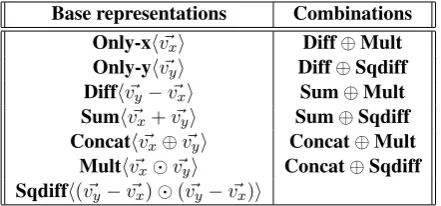
Base representations Combinations
Only-xhv~xi Diff⊕Mult
Only-yhvy~i Diff⊕Sqdiff
Diffhv~y−v~xi Sum⊕Mult
Sumhvx~ +vy~i Sum⊕Sqdiff
Concathvx~ ⊕vy~i Concat⊕Mult Multhvx~ vy~i Concat⊕Sqdiff
[image:2.595.307.528.62.165.2]Sqdiffh(vy~ −vx~ )(vy~ −vx~)i
Table 1: Word pair representations.
3 Methodology
We classify each word pair (x, y) to a specific semantic relation that holds for them, from a set of pre-defined relations (i.e., multiclass classifica-tion), based on their distributional representations.
3.1 Word Pair Representations
Given a word pair (x, y) and their embeddings ~
vx, ~vy, we consider various compositions as
fea-ture vectors for classifiers. Table1displays base representations and combination representations, achieved by concatenating two base representa-tions.
3.2 Word Vectors
We used 300-dimensional pre-trained word em-beddings, namely, GloVe (Pennington et al.,
2014b) containing 1.9M word vectors trained on a corpus of web data from Common Crawl (42B to-kens),1 andWord2vec(Mikolov et al.,2013a,c) containing 3M word vectors trained on a part of Google News dataset (100B tokens).2 Out-of-vocabulary words were initialized randomly.
3.3 Classifiers
Following previous work (Levy et al.,2015;Roller and Erk,2016), we trained different types of clas-sifiers for each word-pair representation outlined in Section 3.1, namely, logistic regression with L2 regularization (LR), SVM with a linear kernel
(LIN), and SVM with a Gaussian kernel (RBF). In addition, we trained multi-layer perceptrons with a single hidden layer (MLP). We compare our mod-els against theKSIMmodel found to be successful in previous work (Levy et al., 2015;Kruszewski et al., 2015). We do not include Roller and Erk
(2016)’s model since it focuses only on hyper-nymy. Hyper-parameters are tuned using grid search, and we report the test performance of the
Dataset Relations #Instances #Domains
BLESS attri (attribute), coord (co-hyponym), event, hyper (hypernymy), mero (meronymy), random 26,554 17 K&H+N hypo (hypernymy), mero (meronymy), sibl (co-hyponym), false (random) 63,718 3
ROOT09 hyper (hypernymy), coord (co-hyponym), random 12,762 –
[image:3.595.72.524.60.127.2]EVALution MadeOf (meronymy), IsA (hypernymy), antonym, PartOf (meronymy)HasProperty (attribute), synonym, HasA (possession), 7,378 –
Table 2: Metadata on the datasets. Relations are mapped to corresponding WordNet relations, if available.
hyper-parameters that performed best on the vali-dation set. Below are more details about the train-ing procedure:
• ForLR, the inverse of regularization strength
is selected from{2−1,21,23,25}.
• ForLIN, the penalty parameterCof the error term is selected from{2−5,2−3,2−1,21}.
• For RBF, C and γ values are selected from
{21,23,25,27}and{2−7,2−5,2−3,2−1}, re-spectively.
• ForMLP, the hidden layer size is either 50 or
100, and the learning rate is fixed at10−3. We use early stopping based on the performance on the validation set. The maximum number of training epochs is 100.
• For KSIM,C andαvalues are selected from
{2−7,2−5, . . . ,27} and {0.0,0.1, . . . ,1.0},
respectively.
3.4 Datasets
We evaluated the methods on four common se-mantic relation datasets:BLESS(Baroni and Lenci,
2011), K&H+N (Necsulescu et al., 2015), ROOT09 (Santus et al.,2016), andEVALution(Santus et al.,
2015). Table2provides metadata on the datasets. Most datasets contain word pairs instantiating dif-ferent, explicitly typed semantic relations, plus a number of unrelated word pairs (random). In-stances in BLESS and K&H+N are divided into a number of topical domains.3
3.5 Evaluation Setup
We consider the following evaluation setups:
Random (RAND) We randomly split each dataset into 70% train, 5% validation and 25% test.
Lexical Split (LEX) In line with recent work (Shwartz et al., 2016), we split each dataset into train, validation and test sets so that each con-tains a distinct vocabulary. This differs fromLevy et al. (2015) who dedicated a subset of the train 3We discarded two relations inEVALutionwith too few instances and did not include its domain information since each word pair can belong to multiple domains at once.
set for evaluation, allowing the model to memo-rize when tuning hyper-parameters. We tried to keep the same ratio70 : 5 : 25as in the random setup.
Out-of-domain (OOD) To test whether the methods capture a generic notion of each semantic relation, we test them on a domain that the clas-sifiers have not seen during training. This setup is more realistic than the random and lexical split setups, in which the classifiers can benefit from memorizing verbatim words (random) or regions in the vector space (lexical split) that fit a specific slot of each relation.
Specifically, onBLESSandK&H+N, one domain is held out for testing whilst the classifiers are trained and validated on the remaining domains. This pro-cess is repeated using each domain as the test set, and each time, a randomly selected domain among the remaining domains is left out for validation. The average results are reported.
4 Experiments
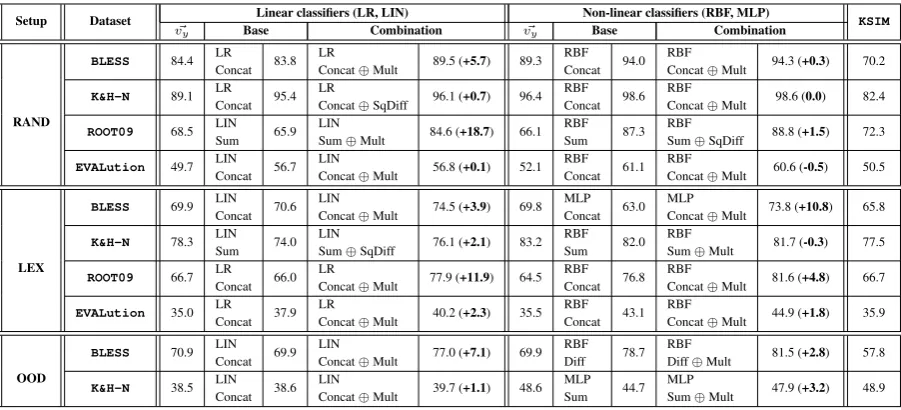
Table3summarizes the best performing base rep-resentations and combinations on the test sets across the various datasets and evaluation setups.4 The results across the datasets vary substantially in some cases due to the differences between the datasets’ relations, class balance, and the source from which they were created. For instance,K&H+N is imbalanced between the number of instances across relations and domains. ROOT09 was de-signed to mitigate the lexical memorization issue by adding negative switched hyponym-hypernym pairs to the dataset, making it an inherently more difficult dataset. EVALutioncontains a richer set of semantic relations. Overall, the addition of multiplicative features improves upon the perfor-mance of the base representations.
Setup Dataset Linear classifiers (LR, LIN) Non-linear classifiers (RBF, MLP) KSIM
~
vy Base Combination v~y Base Combination
RAND
BLESS 84.4 LR Concat 83.8
LR
Concat⊕Mult 89.5 (+5.7) 89.3 RBF Concat 94.0
RBF
Concat⊕Mult 94.3 (+0.3) 70.2
K&H-N 89.1 LR Concat 95.4
LR
Concat⊕SqDiff 96.1 (+0.7) 96.4 RBF Concat 98.6
RBF
Concat⊕Mult 98.6 (0.0) 82.4
ROOT09 68.5 LIN
Sum 65.9
LIN
Sum⊕Mult 84.6 (+18.7) 66.1 RBF
Sum 87.3
RBF
Sum⊕SqDiff 88.8 (+1.5) 72.3
EVALution 49.7 LIN Concat 56.7
LIN
Concat⊕Mult 56.8 (+0.1) 52.1 RBF Concat 61.1
RBF
Concat⊕Mult 60.6 (-0.5) 50.5
LEX
BLESS 69.9 LINConcat 70.6 LINConcat
⊕Mult 74.5 (+3.9) 69.8 MLP Concat 63.0
MLP
Concat⊕Mult 73.8 (+10.8) 65.8
K&H-N 78.3 LIN
Sum 74.0
LIN
Sum⊕SqDiff 76.1 (+2.1) 83.2 RBF
Sum 82.0
RBF
Sum⊕Mult 81.7 (-0.3) 77.5
ROOT09 66.7 LRConcat 66.0 LRConcat
⊕Mult 77.9 (+11.9) 64.5 RBF Concat 76.8
RBF
Concat⊕Mult 81.6 (+4.8) 66.7
EVALution 35.0 LR Concat 37.9
LR
Concat⊕Mult 40.2 (+2.3) 35.5 RBF Concat 43.1
RBF
Concat⊕Mult 44.9 (+1.8) 35.9
OOD
BLESS 70.9 LIN Concat 69.9
LIN
Concat⊕Mult 77.0 (+7.1) 69.9 RBF
Diff 78.7
RBF
Diff⊕Mult 81.5 (+2.8) 57.8
K&H-N 38.5 LIN Concat 38.6
LIN
Concat⊕Mult 39.7 (+1.1) 48.6 MLP
Sum 44.7
MLP
[image:4.595.73.524.61.266.2]Sum⊕Mult 47.9 (+3.2) 48.9
Table 3: Best test performance (F1) across different datasets and evaluation setups, usingGlove. The number in brackets indicates the performance gap between the best performing combination and base representation setups.
Vector/ RAND OOD
Classifier v~y Diff Diff⊕Mult Sum Sum⊕Mult Concat Concat⊕Mult v~y Diff Diff⊕Mult Sum Sum⊕Mult Concat Concat⊕Mult
GloV
e
LR 84.4 81.5 87.6(+6.1) 81.5 87.0 (+5.5) 83.8 89.5 (+5.7) 70.9 64.5 74.7 (+10.2) 59.2 68.9 (+9.7) 69.5 76.5 (+7.0) LIN 84.1 81.5 87.7(+6.2) 81.3 87.2 (+5.9) 83.8 89.2 (+5.4) 70.7 64.6 74.8 (+10.2) 59.3 69.4 (+10.1) 69.9 77.0 (+7.1) RBF 89.3 93.8 94.1(+0.3) 94.4 94.2 (-0.2) 94.0 94.3(+0.3) 67.8 78.7 81.5(+2.8) 65.3 66.4 (+1.1) 69.5 75.7 (+6.2) MLP 84.4 87.4 89.2(+1.8) 87.2 89.9 (+2.7) 90.5 90.5 (0.0) 69.9 67.4 77.7 (+10.3) 57.3 66.1 (+8.8) 71.5 77.3 (+5.8)
W
ord2v
ec LINLR 83.5 81.083.3 80.8 85.4 (84.6 (+4.4+3.8)) 80.080.4 84.6 (84.5 (+4.1+4.6)) 83.383.6 86.5 (87.1 (+3.2+3.5)) 71.5 62.871.2 62.4 69.1 (69.0 (+6.6+6.3)) 59.859.0 65.3 (65.2 (+5.4+6.3)) 72.171.8 76.0 (76.1(+3.9+4.3))
[image:4.595.74.528.305.420.2]RBF 89.1 93.7 93.7 (0.0) 93.7 93.8(+0.1) 93.6 93.8(+0.2) 69.2 75.6 76.0 (+0.4) 64.7 66.3 (+1.6) 71.4 75.3 (+3.9) MLP 81.6 81.0 84.6 (+3.6) 79.6 85.2 (+5.6) 81.3 84.7 (+3.4) 70.2 63.4 69.3 (+5.9) 56.2 60.0 (+3.8) 70.5 74.6 (+4.1)
Table 4: Test performance (F1) onBLESSin the RAND and OOD setups, usingGloveandWord2vec.
is smaller when non-linear classifiers are used, since they partially capture such notion of inter-action (Levy et al.,2015). Within the same repre-sentation, there is a clear preference to non-linear classifiers over linear classifiers.
Evaluation Setup The Only-y representation indicates how well a model can perform without considering the relation between x and y (Levy
et al.,2015). Indeed, in RAND, this method per-forms similarly to the others, except on ROOT09, which by design disables lexical memorization. As expected, a general decrease in performance is observed in LEX and OOD, stemming from the methods’ inability to benefit from lexical memo-rization. In these setups, there is a more signifi-cant gain from using multiplicative features when non-linear classifiers are used.
Word Pair Representations Among the base representations Concat often performed best, whileMultseemed to be the preferred multiplica-tive addition. Concat⊕Multperformed
consis-tently well, intuitively because Concat captures the typicality of each word in the relation (e.g., ifyis a typical hypernym) andMultcaptures the similarity between the words (whereConcatalone may suggest thatanimalis a hypernym ofapple). To take a closer look at the gain from addingMult, Table4shows the performance of the various base representations and combinations withMultusing different classifiers onBLESS.5
5 Analysis of Multiplicative Features
We focus the rest of the discussion on the OOD setup, as we believe it is the most challenging setup, forcing methods to consider the relation be-tween x andy. We found that in this setup, all methods performed poorly on K&H+N, likely due to its imbalanced domain and relation distribution. Examining the per-relationF1 scores, we see that
many methods classify all pairs to one relation. Even KSIM, the best performing method in this
5We also triedv~
xwith multiplicative features but they
x relation y similarity Concat Concat⊕Mult cloak-n random good-j 0.195 attribute random
cloak-n random hurl-v 0.161 event random
cloak-n random stop-v 0.186 event random
coat-n event wear-v 0.544 random event
cloak-n mero silk-n 0.381 random mero
dress-n attri feminine-j 0.479 random attri
Table 5: Example pairs which were incorrectly classified byConcatwhile being correctly classified byConcat⊕ MultinBLESS, along with their cosine similarity scores.
setup, classifies pairs as either hyper or random, effectively only determining if they are related or not. We therefore focus our analysis onBLESS.
To get a better intuition of the contribution of multiplicative features, Table5 exemplifies pairs that were incorrectly classified by Concat (RBF) while correctly classified by Concat ⊕ Mult
(RBF), along with their cosine similarity scores. It seems thatMultindeed captures the similarity be-tween x andy. While Concat sometimes relies on properties of a single word, e.g. classifying an adjectiveyto theattributerelation and a verbyto theevent relation, addingMultchanges the clas-sification of such pairs with low similarity scores torandom. Conversely, pairs with high similarity scores which were falsely classified asrandomby
Concatare assigned specific relations by
Concat⊕Mult.
Interestingly, we found that across domains, there is an almost consistent order of relations with respect to mean intra-pair cosine similarity:
coord meronym attribute event hypernym random 0.426 0.323 0.304 0.296 0.279 0.141 Table 6: Mean pairwise cosine similarity inBLESS.
Since the difference between random (0.141) and other relations (0.279-0.426) was the most significant, it seems that multiplicative features help distinguishing between related and unrelated pairs. This similarity is possibly also used to dis-tinguish between other relations.
6 Conclusion
We have suggested a cheap way to boost the performance of supervised distributional methods for lexical entailment by integrating multiplica-tive features into standard word-pair representa-tions. Our results confirm that the multiplicative features boost the performance of linear classi-fiers, and in strict evaluation setups, also of non-linear classifiers. We performed an extensive eval-uation with different classifiers and evaleval-uation
se-tups, and suggest the out-of-domain evaluation as the most suitable for the task. Directions for future work include investigating other composi-tions, and designing a neural model that can auto-matically learn such features.
7 Acknowledgements
We would like to thank Wei Lu for his involve-ment and advice in the early stage of this project, Stephen Roller and Omer Levy for valuable dis-cussions, and the anonymous reviewers for their insightful comments and suggestions.
Vered is supported in part by an Intel ICRI-CI grant, the Israel Science Foundation grant 1951/17, the German Research Foundation through the German-Israeli Project Cooperation (DIP, grant DA 1600/1-1), the Clore Scholars Pro-gramme (2017), and the AI2 Key Scientific Chal-lenges Program (2017).
References
Marco Baroni, Raffaella Bernardi, Ngoc-Quynh Do, and Chung-chieh Shan. 2012. Entailment above the word level in distributional semantics. In Proceed-ings of the 13th Conference of the European Chap-ter of the Association for Computational Linguis-tics, pages 23–32, Avignon, France. Association for Computational Linguistics.
Marco Baroni and Alessandro Lenci. 2011. How we blessed distributional semantic evaluation. In Pro-ceedings of the GEMS 2011 Workshop on GEomet-rical Models of Natural Language Semantics, pages 1–10. Association for Computational Linguistics. Ido Dagan, Dan Roth, Mark Sammons, and Fabio
Mas-simo Zanzotto. 2013. Recognizing textual entail-ment: Models and applications. Synthesis Lectures on Human Language Technologies, 6(4):1–220. Ruiji Fu, Jiang Guo, Bing Qin, Wanxiang Che, Haifeng
Marti A. Hearst. 1992. Automatic acquisition of hy-ponyms from large text corpora. InProceedings of the 14th Conference on Computational Linguistics -Volume 2, COLING ’92, pages 539–545.
Lili Kotlerman, Ido Dagan, Idan Szpektor, and Maayan Zhitomirsky-geffet. 2010. Directional distributional similarity for lexical inference. Natural Language Engineering, 16(4):359–389.
Germn Kruszewski, Denis Paperno, and Marco Baroni. 2015. Deriving boolean structures from distribu-tional vectors. Transactions of the Association for Computational Linguistics, 3:375–388.
Omer Levy, Steffen Remus, Chris Biemann, and Ido Dagan. 2015. Do supervised distributional meth-ods really learn lexical inference relations? In Pro-ceedings of the 2015 Conference of the North Amer-ican Chapter of the Association for Computational Linguistics: Human Language Technologies, pages 970–976, Denver, Colorado. Association for Com-putational Linguistics.
Tomas Mikolov, Kai Chen, Greg Corrado, and Jeffrey Dean. 2013a. Efficient estimation of word represen-tations in vector space. Proceedings of Workshop at ICLR, 2013.
Tomas Mikolov, Ilya Sutskever, Kai Chen, Greg S Cor-rado, and Jeff Dean. 2013b. Distributed representa-tions of words and phrases and their compositional-ity. InAdvances in neural information processing systems, pages 3111–3119.
Tomas Mikolov, Ilya Sutskever, Kai Chen, Greg S Cor-rado, and Jeff Dean. 2013c. Distributed represen-tations of words and phrases and their composition-ality. In C. J. C. Burges, L. Bottou, M. Welling, Z. Ghahramani, and K. Q. Weinberger, editors, Ad-vances in Neural Information Processing Systems 26, pages 3111–3119. Curran Associates, Inc.
George A. Miller. 1995. Wordnet: A lexical database for english. Communications of the ACM, 38(11):39–41.
Silvia Necsulescu, Sara Mendes, David Jurgens, N´uria Bel, and Roberto Navigli. 2015. Reading between the lines: Overcoming data sparsity for accurate classification of lexical relationships. In Proceed-ings of the Fourth Joint Conference on Lexical and Computational Semantics, pages 182–192, Denver, Colorado. Association for Computational Linguis-tics.
Jeffrey Pennington, Richard Socher, and Christopher Manning. 2014a. Glove: Global vectors for word representation. In Proceedings of the 2014 Con-ference on Empirical Methods in Natural Language Processing (EMNLP), pages 1532–1543. Associa-tion for ComputaAssocia-tional Linguistics.
Jeffrey Pennington, Richard Socher, and Christopher Manning. 2014b. Glove: Global vectors for word
representation. In Proceedings of the 2014 Con-ference on Empirical Methods in Natural Language Processing (EMNLP), pages 1532–1543, Doha, Qatar. Association for Computational Linguistics.
Stephen Roller and Katrin Erk. 2016. Relations such as hypernymy: Identifying and exploiting hearst pat-terns in distributional vectors for lexical entailment. In Proceedings of the 2016 Conference on Empiri-cal Methods in Natural Language Processing, pages 2163–2172, Austin, Texas. Association for Compu-tational Linguistics.
Stephen Roller, Katrin Erk, and Gemma Boleda. 2014. Inclusive yet selective: Supervised distributional hy-pernymy detection. In Proceedings of COLING 2014, the 25th International Conference on Compu-tational Linguistics: Technical Papers, pages 1025– 1036, Dublin, Ireland. Dublin City University and Association for Computational Linguistics.
Ivan Sanchez and Sebastian Riedel. 2017. How well can we predict hypernyms from word embeddings? a dataset-centric analysis. In Proceedings of the 15th Conference of the European Chapter of the As-sociation for Computational Linguistics: Volume 2, Short Papers, pages 401–407, Valencia, Spain. As-sociation for Computational Linguistics.
Enrico Santus, Alessandro Lenci, Tin-Shing Chiu, Qin Lu, and Chu-Ren Huang. 2016. Nine features in a random forest to learn taxonomical semantic re-lations. In Proceedings of the Tenth International Conference on Language Resources and Evaluation (LREC 2016), Paris, France.
Enrico Santus, Alessandro Lenci, Qin Lu, and Sabine Schulte im Walde. 2014. Chasing hypernyms in vec-tor spaces with entropy. InProceedings of the 14th Conference of the European Chapter of the Associa-tion for ComputaAssocia-tional Linguistics, volume 2: Short Papers, pages 38–42, Gothenburg, Sweden. Associ-ation for ComputAssoci-ational Linguistics.
Enrico Santus, Frances Yung, Alessandro Lenci, and Chu-Ren Huang. 2015. Evalution 1.0: an evolving semantic dataset for training and evaluation of dis-tributional semantic models. InProceedings of the 4th Workshop on Linked Data in Linguistics (LDL-2015), pages 64–69.
Vered Shwartz, Yoav Goldberg, and Ido Dagan. 2016. Improving hypernymy detection with an integrated path-based and distributional method. In Proceed-ings of the 54th Annual Meeting of the Association for Computational Linguistics (Volume 1: Long Pa-pers), pages 2389–2398, Berlin, Germany. Associa-tion for ComputaAssocia-tional Linguistics.
pages 65–75, Valencia, Spain. Association for Computational Linguistics.
Julie Weeds, Daoud Clarke, Jeremy Reffin, David Weir, and Bill Keller. 2014. Learning to distinguish hyper-nyms and co-hypohyper-nyms. In Proceedings of COL-ING 2014, the 25th International Conference on Computational Linguistics: Technical Papers, pages 2249–2259, Dublin, Ireland. Dublin City University and Association for Computational Linguistics.