TSA-INF at SemEval-2017 Task 4: An Ensemble of Deep Learning
Architectures Including Lexicon Features for Twitter Sentiment Analysis
Amit Ajit Deshmane Infosys Limited
Pune, Maharashtra 411057, India
Jasper Friedrichs Infosys Limited Newark, CA 94560, USA
jasper [email protected]
Abstract
This paper describes the submission of team TSA-INF to SemEval-2017 Task 4 Subtask A. The submitted system is an ensemble of three varying deep learning architectures for sentiment analysis. The core of the architecture is a convolutional neural network that performs well on text classification as is. The second subsystem is a gated recurrent neural network imple-mentation. Additionally, the third system integrates opinion lexicons directly into a convolution neural network architecture. The resulting ensemble of the three archi-tectures achieved a top ten ranking with a macro-averaged recall of 64.3%. Ad-ditional results comparing variations of the submitted system are not conclusive enough to determine a best architecture, but serve as a benchmark for further im-plementations.
1 Introduction
The SemEval competitions continually offer suit-able dataset and resulting benchmarks for a va-riety of natural language processing tasks. The SemEval-2017 Task 4 Subtask A addresses the po-larity classification task of informal texts ( Rosen-thal et al.,2017). Tweets serve as a very accessi-ble sample of the abundant social media content. Submitted systems must classify tweets into the categories of negative, positive and neutral opin-ion. Submitted results are compared over macro-averaged recall.
In recent benchmarks across this task, deep learning implementations achieved top re-sults (Nakov et al., 2016). We seek to combine three varying deep learning approaches in an ensemble. Conventional methods seem to become
obsolete since convolutional neural networks (CNN) have first shown state-of-the-art results in sentiment analysis (Kim, 2014). SemEval has since seen successful results by similar models (Severyn and Moschitti, 2015) as well as ensembles of CNNs (Deriu et al., 2016). Long term short term recurrent neural networks (LSTM) (Hochreiter and Schmidhuber, 1997) have also been applied successfully in ensemble with a CNN (Xu et al.,2016). As an alternative to LSTMs gated recurrent neural networks (GRNN) have been shown to be competitive in other domains (Chung et al.,2014). These models are well suited to model sequential data and were successfully applied for sentiment analysis of larger documents (Yang et al., 2016). The core contribution of a recent non deep learning system to win this task (Kiritchenko et al., 2014) back to back in 2013 and 2014, was the integration of opinion lexicons into a support vector machine system. Opinion lexicons have since then also been integrated into CNN architectures (Rouvier and Favre,2016;Shin et al.,2016). In this work we combine these diverse architectures.
We use a CNN, thoroughly optimized for text classification, as the foundation of our ensemble approach. We add a lexicon integrated CNN to take advantage of lexicon features. In order to di-versify the approach we also include a GRNN ar-chitecture as a sequential model. The idea is to get better and more robust results with a broader ar-chitecture. Results show that adding the latter two systems does not improve overall results, though the results for the core CNN approach were al-ready good. Furthermore, results for individual classes do improve, making this a viable option when prioritizing specific classes or evaluation metrics. With this work we seek to contribute to the growing body of literature that presents com-parable and reproducible solutions for this task.
Ensemble Layer CNN
GRNN
CNN-lex
v1
v2
v3
[image:2.595.76.287.61.181.2]o
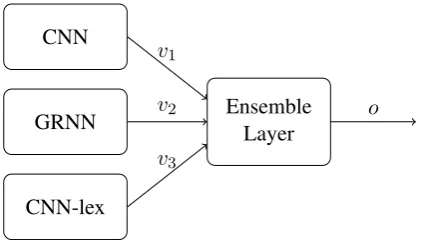
Figure 1: Ensemble component output vectorsvi are used as input to an ensemble, which deter-mines a classification output vectoro.
2 Approach
This section outlines the overall approach before detailing the subcomponents of the architecture. The purpose of the system is to classify an input tweet into an element of the opinion classes C, with |C| = 3. This is determined by the maxi-mal value of an system output vector o ∈ R|C|. As outlined in Fig. 1 we propose an ensemble of three deep learning architectures to solve this task. A CNN and a GRNN over word embeddings as well as a CNN over lexicon embeddings. The en-semble components output vector representations v1/2/3 can be considered an abstraction of the in-put tweet. These representations are the inin-put to an ensemble system which determines the final out-put. We will describe preprocessing steps to cre-ate the ensemble layer input before outlining the ensemble architecture.
2.1 Preprocessing
First of all the tweet data is tokenized with NLP4J1 as a preprocessing step for creating embeddings. In the following we refer to a tweet as a document, which is a sequence of tokens, constrained ton= 120. If the actual document is less in size, it is padded with zero vectors, otherwise it is truncated. The tokens are then converted into either word embeddings of dimension d or lexicon embed-dings of dimension l. We use pretrained word embeddings from Frederic Godin2 (Godin et al.,
2015), with d = 400. The embeddings were trained on 400 million tweets. The lexicon embed-dings are polarity scores from three different lexi-cons, thusl = 3. We use Bing Liu’s Opinion lex-icon (Hu and Liu, 2004), the Hashtag Sentiment
1https://github.com/emorynlp/nlp4j 2http://www.fredericgodin.com/software/
Lexicon and the Sentiment 140 Lexicon ( Moham-mad et al.,2013) to form the complete lexicon em-bedding.
Tensorflow3(Abadi et al., 2016) is used as the deep learning framework for implementing the system. The next subsections describe the com-ponents of this system, followed by an outline of how their outputs are combined into an ensemble.
2.2 Convolution Neural Network
This component is based on a standard CNN ar-chitecture used for text classification (Kim,2014). We make small changes for fine tuning to the task. The input to this component are the word embed-dings described in the preceding subsection. The embeddings of dimensiondare formed into a doc-ument matrixD∈Rn×dacross theninput tokens. The document matrixDis passed throughkfilters of filter size s. The convolution weights belong to Rs×d. The convolutions result in k convolu-tion output vectors of dimensionRn−s+1. A max pool layer converts these vectors to a vector of size
Rk. We then add a normalization layer (Ioffe and
Szegedy, 2015) so as to merge outputs from dif-ferent filter sizes. Withf filter sizes, we finally ar-rive at vectorv1 ∈Rk×f. This vector is passed to a dense layer of 256 ReLu units. The dense layer is followed by an output softmax layer. We apply dropout (Hinton et al., 2012) at the beginning of the dense layer as well as the output layer. The implementation uses following the configuration:
• Weights are initialized using Xavier weight initialization (Glorot and Bengio,2010).
• The Learning rate is set to 0.0001 with a batch size of 100.
• The architecture uses f = 5 filter sizes, [1,2,3,4,5], andk= 256filters per filter size overn= 120word embedding vectors of di-mensiond= 400.
• The input vector to the dense layer v1 thus has a dimension of 1280.
• At the dense layer and output layer, we use dropout with a keep probability of 0.7.
• We run 200 training iterations and select the model that performed best on development data.
2.3 Gated Recurrent Neural Network
The GRNN is based on the gated recurrent unit (GRU) (Cho et al., 2014), which uses a gating mechanism while tracking the input sequence with a latent variable. GRUs seemed to perform better compared to other RNN cells like LSTM in our experiments, which go beyond the scope of this paper. The input to the GRNN are the word em-beddings described in Section 2.1. The input is read sequentially by a GRU layer. The GRU cell is designed to learn how to represent a state, based on previous inputs and the current input. The GRU layer consists ofg hidden units. After the last to-ken of the sequence is processed, the output vector v2 ∈Rgof this layer is collected to be merged into other architectures. The implementation is config-ured by:
• g= 256hidden units with tanh activation, • resulting in the 256 dimensional output
vec-torv2.
2.4 Lexicon Integrated Convolution Neural Network
The lexicon integrated CNN (CNN-lex) is simi-lar to the previously described CNN architecture. The fundamental difference is that convolutions are done over lexicon embeddings, described in Section2.1. The input to this component is a doc-ument matrixL ∈ Rn×l across theldimensional lexicon embeddings ofninput tokens. The archi-tecture usesjfilters pereconvolution filter sizes. The convolution layer output is passed through a max pool and normalization layer. This results in an output vectorv3 ∈Rj×ethat is collected to be merged into other architectures. The implementa-tion uses following configuraimplementa-tion:
• The architecture uses e = 3 filter sizes, [3,4,5], andj = 64filters per filter size over n = 120 lexicon embeddings of dimension l= 3.
• The ensemble output vectorv3 thus has a di-mension of 192.
2.5 Ensembles
The previously described architectures can be combined into ensemble systems. The CNN-lex and GRNN architectures are already defined as en-semble subsystems through their output vectorsv2 andv3. While the CNN architecture was previous
Twitter Corpus Pos Neg Neut Total 2013-train 3640 1458 4586 9684
2013-dev 575 340 739 1654
2013-test 1475 559 1513 3547
2014-sarcasm 33 40 13 86
2014-test 982 202 669 1853
2015-test 1038 365 987 2390
2016-train 3094 863 2043 6000
2016-dev 843 391 765 1999
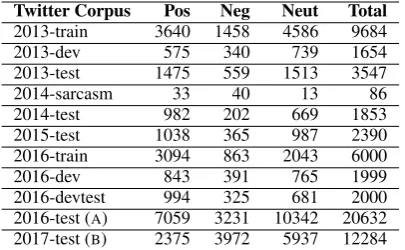
[image:3.595.316.519.62.187.2]2016-devtest 994 325 681 2000 2016-test (A) 7059 3231 10342 20632 2017-test (B) 2375 3972 5937 12284
Table 1: SemEval data subsets as available to au-thors. Aside from development test (A) and test
(B) split, all sets where combined for a train and
dev split.
introduced as a stand alone system it is naturally described as an ensemble component. The vector v1described in Section2.2is the output vector of the CNN as a subsystem. The three vectors are concatenated as inputs to the ensemble layer. The ensemble layer consists of a dense layer of 256 ReLu units followed by a softmax output layer, which results in the output vectoroof dimension |C|. The CNN is combined into three ensembles by concatenating its input vectorv1withv2(CNN, GRNN) and with v3 (CNN, CNN-lex) as well as with bothv2andv3(CNN, CNN-lex, GRNN). The latter is the submission architecture while the other two are evaluated for comparison. These ensem-bles are trained as a single system. Training is con-ducted as previously described for the CNN archi-tecture.
3 Data
The training data for this approach was con-strained to data published in the context of the Se-mEval workshops. Table1lists the data available to the authors. It is important to note that the data is heavily imbalanced. Before submission the sys-tem was tested with the 2016-test set as develop-ment test data. The results described in this pa-per focus on the 2017-test data, which was used to rank the submissions. All other data in Table1
was combined into one data set, shuffled and split four to one into training and development data.
4 Results
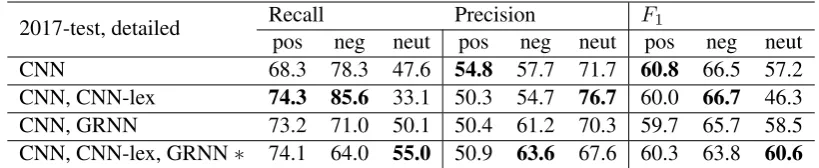
2017-test, detailed Recallpos neg neut posPrecisionneg neut posF1 neg neut CNN 68.3 78.3 47.6 54.8 57.7 71.7 60.8 66.5 57.2 CNN, CNN-lex 74.3 85.6 33.1 50.3 54.7 76.7 60.0 66.7 46.3 CNN, GRNN 73.2 71.0 50.1 50.4 61.2 70.3 59.7 65.7 58.5 CNN, CNN-lex, GRNN∗ 74.1 64.0 55.0 50.9 63.6 67.6 60.3 63.8 60.6
Table 2: Per class results of recall precision and F1 on test data (2017-test, Table 1) for CNN and ensemble architectures, where∗marks the submission system
2016-test ρ FP N
1 Acc.
CNN 66.1 62.6 62.8
CNN, CNN-lex 64.9 61.0 56.4 CNN, GRNN 64.2 61.9 61.3 CNN, CNN-lex, GRNN 64.0 62.4 64.1
Table 3: Macro-averaged recallρ, negative posi-tive macro-averaged F1 and accuracy on develop-ment test data (2016-test, Table 1) for CNN and ensemble architectures.
2017-test ρ FP N
1 Acc.
CNN 64.7 63.6 61.5
CNN, CNN-lex 64.3 63.4 58.0 CNN, GRNN 64.8 62.7 61.3 CNN, CNN-lex, GRNN 64.3∗ 62.0 61.6
Table 4: Macro-averaged recallρ, negative posi-tive macro-averaged F1 and accuracy on test data (2017-test, Table1) for CNN and ensemble archi-tectures, where∗marks the ranked submission.
For detailed rankings we refer to the task descrip-tion (Nakov et al.,2016), we only put this result in context with the described architectures. Three en-sembles are used for comparison, the basic CNN combined with either the GRNN or the lexicon in-tegrated CNN as well as both. The two result data sets are the 2016-test set as pre-submission test data and the final 2017-test data set used to bench-mark the submissions.
Overall the CNN performs en par or better than the ensembles on macro-averaged recall and macro-averaged positive negative F1. For both de-velopment test data in Table 3 and test data in Table 4 we observe that the CNN outperforms the ensembles across macro-averaged F1. Though there is a substantial difference between macro-averaged recall of the CNN versus the ensembles on the development test data, macro-averaged re-call on the test data is consistent across all sys-tems.
The strongest fluctuation in averaged results is the drop in accuracy for the CNN, CNN-lex en-semble across both data sets. Detailed results in Table2show that this is due to a steep drop in neu-tral class recall, a class the data is heavily biased towards (Table 1). We note that though macro-averaged recall stays consistent on the test data (Table 4), per class results do fluctuate substan-tially (Table 2). These class trends were gener-ally consistent across both 2017-test and 2016-test data, thus the later results are omitted for brevity.
5 Conclusions
In the previous sections we described experiments of adding various deep learning architecture ele-ments to a basic CNN. Results show that the de-rived ensembles of approaches did not improve performance over the more relevant metrics of macro-averaged recall and F1. To give further context it is important to mention that substan-tially more effort went into engineering and tuning of the CNN model than of the additional architec-tures. Just as the submission system, the CNN ar-chitecture itself would have ranked within the top ten of this sentiment analysis task. Room for im-provement was thus limited. We do note that per class results do fluctuate quite a bit across ensem-bles, which means these architecture can be used to prioritize class specific recall and precision.
It remains open whether the more complex ar-chitectures perform more robustly across diverse datasets. We will seek more clarity on this issue by experimenting with different data sets. Another architecture choice to pursue is to include an atten-tion mechanism so that the ensemble system can learn which subcomponents to prioritize.
Acknowledgments
References
Mart´ın Abadi, Ashish Agarwal, Paul Barham, Eugene Brevdo, Zhifeng Chen, Craig Citro, Greg S Corrado, Andy Davis, Jeffrey Dean, Matthieu Devin, et al. 2016. Tensorflow: Large-scale machine learning on heterogeneous distributed systems. arXiv preprint arXiv:1603.04467.
Kyunghyun Cho, Bart Van Merri¨enboer, Dzmitry Bah-danau, and Yoshua Bengio. 2014. On the properties of neural machine translation: Encoder- decoder ap-proaches. arXiv preprint arXiv:1409.1259.
Junyoung Chung, Caglar Gulcehre, KyungHyun Cho, and Yoshua Bengio. 2014. Empirical evaluation of gated recurrent neural networks on sequence model-ing. arXiv preprint arXiv:1412.3555.
Jan Deriu, Maurice Gonzenbach, Fatih Uzdilli, Au-relien Lucchi, Valeria De Luca, and Martin Jaggi. 2016. Swisscheese at semeval-2016 task 4: Sen-timent classification using an ensemble of convo-lutional neural networks with distant supervision.
Proceedings of SemEvalpages 1124–1128.
Xavier Glorot and Yoshua Bengio. 2010. Understand-ing the difficulty of trainUnderstand-ing deep feedforward neural networks. InAistats. volume 9, pages 249–256. Fr´ederic Godin, Baptist Vandersmissen, Wesley
De Neve, and Rik Van de Walle. 2015. Multime-dia lab @ acl w-nut ner shared task: Named entity recognition for twitter microposts using distributed word representations.ACL-IJCNLP2015:146–153.
Geoffrey E Hinton, Nitish Srivastava, Alex Krizhevsky, Ilya Sutskever, and Ruslan R Salakhutdinov. 2012. Improving neural networks by preventing co-adaptation of feature detectors. arXiv preprint arXiv:1207.0580.
Sepp Hochreiter and J¨urgen Schmidhuber. 1997. Long short-term memory. Neural computation
9(8):1735–1780.
Minqing Hu and Bing Liu. 2004. Mining and summa-rizing customer reviews. InProceedings of the tenth ACM SIGKDD international conference on Knowl-edge discovery and data mining. ACM, pages 168– 177.
Sergey Ioffe and Christian Szegedy. 2015. Batch nor-malization: Accelerating deep network training by reducing internal covariate shift. arXiv preprint arXiv:1502.03167.
Yoon Kim. 2014. Convolutional neural net-works for sentence classification. arXiv preprint arXiv:1408.5882.
Svetlana Kiritchenko, Xiaodan Zhu, and Saif M Mo-hammad. 2014. Sentiment analysis of short infor-mal texts. Journal of Artificial Intelligence Research
50:723–762.
Saif M. Mohammad, Svetlana Kiritchenko, and Xiao-dan Zhu. 2013. Nrc-canada: Building the state-of-the-art in sentiment analysis of tweets. In Pro-ceedings of the seventh international workshop on Semantic Evaluation Exercises (SemEval-2013). At-lanta, Georgia, USA.
Preslav Nakov, Alan Ritter, Sara Rosenthal, Veselin Stoyanov, and Fabrizio Sebastiani. 2016. SemEval-2016 task 4: Sentiment analysis in Twitter. In Pro-ceedings of the 10th International Workshop on Se-mantic Evaluation (SemEval 2016). Association for Computational Linguistics, San Diego, California. Sara Rosenthal, Noura Farra, and Preslav Nakov. 2017.
SemEval-2017 task 4: Sentiment analysis in Twit-ter. InProceedings of the 11th International Work-shop on Semantic Evaluation. Association for Com-putational Linguistics, Vancouver, Canada, SemEval ’17.
Mickael Rouvier and Benoit Favre. 2016. Sensei-lif at semeval-2016 task 4: Polarity embedding fusion for robust sentiment analysis. Proceedings of SemEval
pages 202–208.
Aliaksei Severyn and Alessandro Moschitti. 2015. Unitn: Training deep convolutional neural network for twitter sentiment classification. InProceedings of the 9th International Workshop on Semantic Eval-uation (SemEval 2015), Association for Computa-tional Linguistics, Denver, Colorado. pages 464– 469.
Bonggun Shin, Timothy Lee, and Jinho D Choi. 2016. Lexicon integrated cnn models with at-tention for sentiment analysis. arXiv preprint arXiv:1610.06272.
XingYi Xu, HuiZhi Liang, and Timothy Baldwin. 2016. Unimelb at semeval-2016 tasks 4a and 4b: An ensemble of neural networks and a word2vec based model for sentiment classification. Proceedings of SemEvalpages 183–189.
Zichao Yang, Diyi Yang, Chris Dyer, Xiaodong He, Alex Smola, and Eduard Hovy. 2016. Hierarchical attention networks for document classification. In