SentiSys at SemEval-2016 Task 4: Feature-Based System for Sentiment
Analysis in Twitter
Hussam Hamdan
Aix-Marseille University [email protected]
Abstract
This paper describes our sentiment analysis system which has been built for Sentiment Analysis in Twitter Task of SemEval-2016. We have used a Logistic Regression classifier with different groups of features. This tem is an improvement to our previous sys-tem Lsislif in Semeval-2015 after removing some features and adding new features ex-tracted from a new automatic constructed sen-timent lexicon.
1 Introduction
Sentiment analysis in Twitter is different from doc-ument level sentiment analysis. Normally, in docu-ment level, each docudocu-ment is classified as positive or negative, the document is long enough to obtain a good representation using only the existing words (bag-of-words). For example, in movie reviews we can get f-score of 85% using bag-of-words repre-sentation with SVM classifier while in Twitter it is about 60% according to our experiments in previ-ous SemEval workshops. This lower performance in Twitter domain is not surprising if we know the limitations of such task when applied to Twitter:
• The size of a tweet is limited to 140 characters
which leads to sparseness where the tweets do not provide enough word co-occurrence.
• The informal language and non-standard
ex-pressions.
• The numerous spelling errors.
For dealing with the previous limitations, we have decided to extend the bag-of-words representation. Therefore, many group of features have been ex-tracted. Uni-gram, bi-gram and 3-grams of words features to capture the text of tweet and the text. Negation features to handle the negated con-text. Sentiment lexicons features can help the clas-sification because it contains positive and negative words which can add a useful information about the polarity of a tweet, they also contain a lot of terms which may not appear in the training data which can be very useful. Semantic features as Brown clusters can also give a rich representation which can be use-ful for reducing the sparsity.
For evaluating our system, we have participated in SemEval-2016 competition for sentiment analysis in Twitter (message polarity subtask A)1 (Nakov et al.,
2016). Our system has been ranked six over 34, this system is derived from our previous system LsisLif which has been ranked third in SemEval-2015.
The rest of this chapter is organized as follows. Section 2 presents the problem formulation. Sec-tion 3 gives an overview of our proposed approach. The features we extracted for training the classifier are presented in Section 4. Our experiments are de-scribed in Section 5. The related work is presented in Section 6. The conclusion and future work are presented in Section 7.
2 Problem Formulation
Let T = t1, t2, .., tn be a collection of n tweets.
Each tweetti will be represented by a subset of all
1http://alt.qcri.org/semeval2016/task4/
possible featuresF = f1, f2, .., fm that can appear
inti. The features can be single words, bigrams,
n-grams, stemmed words or other syntactic or seman-tic features. If a feature fi exists in a tweettj, the
tweet can be represented as a vector of weighted fea-turestj = (w1, w2, .., wm) wherewi is the weight
of the featurefiin the tweettj.wican represent the
presence or absence of the feature or the frequency or any other function of the feature frequency in the tweet.
Let us have three classesC = c1, c2, c3wherec1 represents the negative class,c2the neutral class and
c3the positive class. Our task is to assign each tweet
tjto a classci.
3 Overview of the Proposed Approach Our proposed approach for sentiment polarity clas-sification consists of three steps:
1. We tokenize each tweet to get the feature space which contains the words, punctuations and emoticons that appear in the tweets.
2. We extend the feature space by extracting some features using different resources (Sentiment lexicons, Twitter dictionary) and some seman-tic features.
3. We train a supervised classifier to get a trained model in order to predict the sentiment of the new tweets.
The next section describes the features we have ex-tracted.
4 Feature Extraction
Before extracting the features, we should tokenize the tweet. Tokenization is a challenging problem for Twitter text. Happytokenizer2is the tokenizer which
we used. It can capture the words, emoticons and punctuations. For example, for this tweet:
”RT @ #happyfuncoding: this is a typical Twitter tweet :-)”
It returns the following terms:
{rt, @, #happyfuncoding, :, this, is, a, typical, twitter, tweet, :-)}
2http://sentiment.christopherpotts.net/tokenizing.html
We also replaced each web link by the wordurland each user name byuuser. Then, several groups of features have been extracted to improve the bag-of-words representation.
4.1 Word ngrams
Unigram, bigram and 3-gram are extracted for each term in the tweet without any stemming or stop-word removing, all terms with occurrence less than 3 are removed from the feature space. Therefore, for this tweet:
”i’am going to chapel hill on sat. :)” The feature vector produced by this group of feature will be:
{”i’m”, ’going’, ’to’, ’chapel’, ’hill’, ’on’, ’sat’,
’.’, ’:)’, ”i’m going”, ’going to’, ’to chapel’, ’chapel hill’, ’hill on’, ’on sat’, ’sat .’, ’. :)’, ”i’m going to”, ’going to chapel’, ’to chapel hill’, ’chapel hill on’, ’hill on sat’, ’on sat .’, ’sat . :)’}.
4.2 Negation Features
The rule-based algorithm presented in Christopher Potts’ Sentiment Symposium Tutorial3 is
imple-mented. This algorithm appends a negation suffix to all words that appear within a negation scope which is determined by a negation key and a punctuation or a connector belonging to [”,”, ”;”, ”.”, ”!”, ”?”, ”but”, ”—”, ”so”]. All the negated words are added to the feature space. For example, for this tweet:
”I’am not happy”
The feature vector generated by the words n-gram features with negation features is:
{”i’am”, ’not’, ’happy Neg’, ’happy’, ”i’am not”,
’not happy’, ”i’am not happy”}
happy NEG is added by the negation features while the others are the ngrams features. Obviously, we have chosen to add the negated feature to the vector without removing the original featurehappy.
4.3 Twitter Dictionary
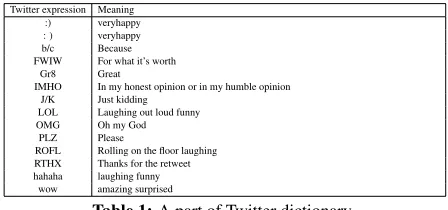
We constructed a dictionary for the abbreviations and the slang words used in Twitter in order to overcome the ambiguity of these terms which may increase the similarity between two similar tweets written in two different ways. This dictionary maps
certain Twitter expressions and emotion icons to their meaning or their corresponding sentiment. It contains about 125 terms collected from different pages on the Web. Table 1 shows a part of the dic-tionary.
Twitter expression Meaning :) veryhappy : ) veryhappy b/c Because FWIW For what it’s worth
Gr8 Great
IMHO In my honest opinion or in my humble opinion J/K Just kidding
LOL Laughing out loud funny OMG Oh my God
PLZ Please
ROFL Rolling on the floor laughing RTHX Thanks for the retweet hahaha laughing funny
[image:3.612.76.300.142.247.2]wow amazing surprised
Table 1:A part of Twitter dictionary.
All terms presented in a tweet and in the Twitter dictionary are mapped to their corresponding terms in the dictionary and added to the feature space. For this tweet: ”i’am going to chapel hill on sat. :)”, the termveryhappywill be added to the tweet vector be-cause the emoticon:)will be replaced byveryhappy
as indicated in the dictionary.
4.4 Semantic Features
The semantic representation of a text may bring some important hidden information, which may re-sult in a better document representation and a better classification system. Usually, the semantic features can help to overcome the problem of spareness in short text. Externally resources may be important to get such representation.
4.4.1 Brown Dictionary Features
From over 56 million English tweets (837 million tokens), 1000 hierarchical clusters have been con-structed over 217 thousand words (Owoputi et al., 2013). Table 2 shows an example of five clusters.
Cluster Top words (by frequency)
A1 lmao lmfao lmaoo lmaooo hahahahaha lool ctfu rofl loool lmfaoo lmfaooo lmaoooo lmbo lololol
A2 haha hahaha hehe hahahaha hahah aha hehehe ahaha hah hahahah kk hahaa ahah A3 yes yep yup nope yess yesss yessss ofcourse yeap likewise yepp yesh yw yuup yus A4 yeah yea nah naw yeahh nooo yeh noo noooo yeaa ikr nvm yeahhh nahh nooooo A5 smh jk #fail #random #fact smfh #smh #winning #realtalk smdh #dead #justsaying Table 2:Example Twitter word clusters: we list the most proba-ble words, starting with the most probaproba-ble, in descending order.
Note that in cluster A1, the term lololol (an exten-sion of lol for “laughing out loud”) is grouped with a large number of laughter acronyms.
Each word in the text is mapped to its cluster in Brown dictionary, 1000 features are added to feature space where each feature represents the number of words in the text belonging to each cluster.
4.5 Sentiment Lexicons
The system extracts four features from the manual constructed lexicons and six features from the auto-matic ones. For each sentence the number of posi-tive words, the number of negaposi-tive ones, the number of positive words divided by the number of negative ones and the polarity of the last word are extracted from manual constructed lexicons. In addition to the sum of the positive scores and the sum of the nega-tive scores from the automatic constructed lexicons. The manual lexicons are: MPQA Subjectivity Lexicon4 and Bing Liu Lexicon5. The automatic
ones are: NRC Hashtag Sentiment Lexicon and our lexicon based on natural entropy measure (Hamdan et al., 2015c).
Thus, this feature group adds 20 features to the tweet vector, some of this features are integer num-bers others are floats. The lexicons which we used are the following:
4.5.1 Manually Constructed Sentiment Lexicons
Two manual constructed lexicons have been ex-ploited:
1. MPQA Subjectivity Lexicon
Multi-Perspective Question Answering Subjec-tivity Lexicon is maintained by (Wilson et al., 2005), a lexicon of over 8,000 subjectivity single-word clues, each clue is classified as positive or negative. This is a fragment illus-trating this lexicon structure:
Strength Length Word Part-of-speech Stemmed priorpolarity weaksubj 1 abandoned adj n negative weaksubj 1 abandonment noun n negative weaksubj 1 abandon verb y negative
2. Bing Liu Lexicon
A list of positive and negative opinion words or sentiment words for English (around 6800
4http://mpqa.cs.pitt.edu/lexicons/subj lexicon/
words). This list was compiled over many years starting from this paper (Hu and Liu, 2004a). These are the first three words in each class of this lexicon:
Positive Negative
abound abnormal
abounds abolish
abundance abominable
4.5.2 Automatic Constructed Sentiment Lexicons
Three automatic constructed lexicon have been exploited:
1. NRC Hashtag Sentiment Lexicon
NRC Hashtag Sentiment Lexicon (Moham-mad, 2012) contains tweet terms with scores, positive score indicates association with pos-itive sentiment, whereas negative score indi-cates association with negative sentiment. It has entries for 54,129 unigrams and 316,531 bigrams; the scores were computed using PMI over corpus of tweets. Here are the first and the last three lines of the unigrams NRC lexicon file:
Term Score #positive #negative
#fabulous 7.526 2301 2
#excellent 7.247 2612 3
#superb 7.199 1660 2
ipad2 -6.615 1 1205
#dreadful -6.764 1 1398
#unacceptable -6.925 2 3284
Scoreis a real number indicates the sentiment score. #positive is the number of times the term co-occurred with a positive marker such as a positive emoticon or a positive hashtag.
#negativeis the number of times the term co-occurred with a negative marker such as a neg-ative emoticon or a negneg-ative hashtag.
4.6 Our Sentiment Lexicon
PMI metric has been widely used to compute the se-mantic orientation of words in order to construct the automatic lexicons. Sentiment140 lexicon is con-structed using semantic orientation on Sentiment140 corpus (Go et al., 2009), a collection of 1.6 million
tweets that contain positive and negative emoticons
6. But this corpus is a balanced corpus, it contains
the same number of positive and negative tweets. Therefore, semantic orientation can be rewritten as following:
SO(w) =P M I(w,+)−P M I(w,−) =log(p(w).p(+)p(w,+) )−log(p(w).p(p(w,−−)))
(1) Asp(+) =p(−) = 0.5in the balanced corpus:
So(w) = 1 +log(p(+|w))−1−log(p(−|w)) =log(a/c) (2) where + stands for the positive class, - stands for negative class, a is the number of documents con-taining the wordwin the positive class,cis the num-ber of documents containing the word w in the neg-ative class. Thus, the semantic orientation is posi-tive if a>c else it is negative. We should note that
the probability of the classes does not affect the fi-nal semantic orientation score, therefore we propose another metric which depends on the distribution of the word over the classes which seems more relevant in the balanced corpus.
We constructed a lexicon from sentiment140 cor-pus, we calculated Natural Entropy (ne) score for each term in this manner:
ne(w) = 1−(−(p(+|w).log(p(+|w))−p(−|w).log(p(−|w)))) (3) where
p(+|w): The probability of the positive class
given the wordw.
p(−|w): The probability of the negative class
given the wordw.
The more uneven the distribution of documents where a term occurs, the larger the Natural En-tropy of this term is. Thus, the enEn-tropy of the term can express the uncertainty of the classes given the term. One minus this degree of uncertainty boosts the terms that unevenly distributed between the two classes (Wu and Gu, 2014). ne score is always be-tween 0 and 1, and it assigns a high score for the words unevenly distributed over the classes, but it cannot discriminate the positive words from the neg-ative ones. Therefore, we have used theaandcfor discriminating the positive words from the negative ones; if a>c then the word is considered positive else it is considered negative.
Using this lexicon instead of sentiment140 can improve the performance of a state-of-the-art sen-timent classifier as shown in (Hamdan et al., 2015c).
5 Experiments and Results
5.1 Twitter Dataset
Twitter datasets have been provided by SemEval or-ganizers since 2013 for message polarity classifica-tion subtask of sentiment analysis in Twitter (Nakov et al., 2013). The participants have been provided with training tweets annotated positive, negative or neutral. In addition to a script for downloading the tweets. After executing the given script, we got the whole training dataset which consists of 9684 tweets. The organizers have also provided a devel-opment set containing 1654 tweets for tuning a ma-chine learner. Table 3 shows the distribution of each label in each dataset.
Data All Positive Negative Neutral
train 9684 3640 1458 4586
dev 1654 739 340 575
test-2016 - - -
-Table 3: Sentiment labels distribution in the training, testing and development datasets in Twitter.
5.2 Experiment Setup
We trained the L1-regularized logistic regression classifier implemented in LIBLINEAR (Fan et al., 2008), we had also tested L2 regularization tech-nique but it gives less performance than L1. The classifier is trained on the training dataset using the features in the previous section with the three po-larities (positive, negative, and neutral) as labels. A weighting schema is adapted for each class, we use the weighting option−wi which enables a use
of different cost parameterC for different classes.
Since the training data is unbalanced, this weighting schema adjusts the probability of each label. Thus, we tuned the classifier in adjusting the cost parame-ter C of logistic regression, weightwposof positive
class and weightwnegof negative class. We used the
development set for tuning the three parameters, all combinations ofC in range [0.1 .. 4] by step of 0.1, wposin range [1 .. 8] by step of 0.1,wneg in range
[1 .. 8] by step of 0.1 are tested. The combination
C=0.3,wpos=7.6,wneg=5.2 have given the best
F1-score for the development set and therefore it was selected for our experiments on test set 2016.
5.3 Results
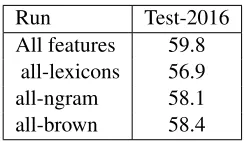
[image:5.612.363.485.268.339.2]The evaluation score used by the task organizers was the averaged F1-score of the positive and negative classes. In the SemEval-2016 competition, our sub-mission is ranked six (59.8%) over 34 subsub-missions while it was ranked third in SemEval-2015.
Table 4 shows the results of our experiments after removing a feature group at each run for the four test set 2016.
Run Test-2016
All features 59.8
all-lexicons 56.9
all-ngram 58.1
all-brown 58.4
Table 4: The F1 score for each run, All features run exploits all features while the others remove a feature group at each run lexicons, n-gram and brown cluster, respectively.
The results show that the sentiment lexicons features are the most important ones which conforms with the conclusion in different studies (Hamdan et al., 2015c; Mohammad et al., 2013) .
6 Related Work
There are two principally different approaches to opinion mining: lexicon-based and supervised. The lexicon-based approach goes from the word level in order to constitute the polarity of the text. This ap-proach depends on a sentiment lexicon to get the word polarity score. While the supervised approach goes from the text level and learn a model which as-signs a polarity score to the whole text, this approach needs a labeled corpus to learn the model.
6.1 Lexicon-Based Approach
Lexicon-based approaches decide the polarity of a document based on sentiment lexicons. The senti-ment of a text is a function of the common words between the text and the sentiment lexicons.
seman-tic orientation of text (Hatzivassiloglou and McKe-own, 1997; Hu and Liu, 2004b). (Taboada et al., 2011) proposed another function called SO-CAL (Semantic Orientation CALculator) which uses dic-tionaries of words annotated with their semantic ori-entation (polarity and strength), and incorporates in-tensification and negation.
Thus, the sentiment lexicon is the most important part of this approach. Three different ways can be used to construct such lexicons: Manual Approach, Dictionary-Based Approach and Corpus-Based Ap-proach.
6.2 Supervised Approach
The supervised approach is a machine learning ap-proach. Sentiment classification can be seen as a text classification problem (Pang et al., 2002; Liu, 2012). The research papers in sentiment classification have mainly focused on the two steps: document representation and classification methods.
While some papers have extended the bag-of-word representation by adding different types of fea-tures (Pang et al., 2002; Mohammad et al., 2013; Hamdan et al., 2013; Hamdan et al., 2015c), oth-ers have proposed different weighting schemas to weight the features such as PMI, Information Gain and chi-squareχ2 (Martineau and Finin, 2009;
Pal-toglou and Thelwall, 2010; Deng et al., 2014). Recently, after the success of deep learning tech-niques in many classification systems, several stud-ies have learned the features instead of extracting them (Socher et al., 2013; Severyn and Moschitti, 2015).
The work of (Pang et al., 2002) was the first to ap-ply this approach to classify the movie reviews into two classes positive or negative. They tested several classifiers (Naive Bayes, SVM, Maximum entropy) with several features.
Later on, many studies have proposed differ-ent features and some feature selection methods to choose the best feature set. Many features have been exploited :
• Terms and their weights: The features are the unigrams or n-grams with the associated fre-quency or weight given by a weighting schema like TF-IDF or PMI.
• Part of Speech (POS): The words can indicate
different sentiment according to their parts of speech (POS). Some papers treated the adjec-tives as special features.
• Sentiment Lexicons: The words and
expres-sions which express an opinion have been used to add additional features as the number of pos-itive and negative terms.
• Sentiment Shifters: The terms that are used to
change the sentiment orientation, from positive to negative or vice versa such asnotandnever. Taking into account these features can improve the sentiment classification.
• Semantic Features: The named entities, con-cepts and topics have been extracted to get the semantic of the text.
Many systems which have worked on feature extrac-tion have achieved a state-of-the-art performance in many competitions like SemEval7. For example,
(Mohammad et al., 2013) used SVM model with several types of features including terms, POS and sentiment lexicons in Twitter data set. (Hamdan et al., 2015a; Hamdan et al., 2015c; Hamdan et al., 2015b) have also proved the importance of feature extraction with logistic regression classifier in Twit-ter and reviews of restaurants and laptops. They ex-tracted terms, sentiment lexicon and some semantic features like topics. And (Hamdan et al., 2013) has proposed to extract the concepts from DBPedia.
Recently, some research papers have applied deep learning techniques to sentiment classification. (Socher et al., 2013) proposed to use recursive neu-ral network to capture the compositionality in the phrases, (Tang et al., 2014) combined the hand-crafted features with learned features. They used neural network for learning sentiment-specific word embedding, then they combined hand-crafted fea-tures with these word embedding to produce a state-of-the-art system in sentiment analysis in Twitter. (Kim, 2014) proposed a simple convolutional neu-ral network with one layer of convolution which per-forms remarkably well. Their results add to the well-established evidence that unsupervised pre-training of word vectors is an important ingredient in deep learning for Natural language processing.
7 Conclusion and Future Work
In this paper, we tested the impact of combining sev-eral groups of features on the sentiment classifica-tion of tweets. A logistic regression classifier with weighting schema was used, the sentiment lexicon-based features seem to get the most influential effect with the combination.
As the sentiment lexicons features seem to be so im-portant in sentiment classification, we think that it is important to orient our future work on this direction. Improving the automatic construction of sentiment lexicons may lead to an important improvement on sentiment classification. For example, taking the context in the consideration may help such process. Another important direction is using deep learning techniques which have recently proved their perfor-mance in several studies. Thus, we can learn the features instead of extracting them.
References
Zhi-Hong Deng, Kun-Hu Luo, and Hong-Liang Yu. 2014. A study of supervised term weighting scheme for sentiment analysis. Expert Systems with Applica-tions, 41(7):3506 – 3513.
Rong-En Fan, Kai-Wei Chang, Cho-Jui Hsieh, Xiang-Rui Wang, and Chih-Jen Lin. 2008. LIBLINEAR: A Li-brary for Large Linear Classification. Journal of Ma-chine Learning Research, 9:1871–1874.
Alec Go, Richa Bhayani, and Lei Huang. 2009. Twit-ter Sentiment Classification using Distant Supervision.
Processing, pages 1–6.
Hussam Hamdan, Fr ˜A cd ˜A cric Bechet, and Patrice Bellot. 2013. Experiments with DBpedia, WordNet and SentiWordNet as resources for sentiment analysis in micro-blogging. InInternational Workshop on Se-mantic Evaluation SemEval-2013 (NAACL Workshop), Atlanta, Georgia (USA), April.
Hussam Hamdan, Patrice Bellot, and Frederic Bechet. 2015a. Lsislif: CRF and Logistic Regression for Opin-ion Target ExtractOpin-ion and Sentiment Polarity Analy-sis. InProceedings of the 9th International Workshop on Semantic Evaluation (SemEval 2015), pages 753– 758, Denver, Colorado, June. Association for Compu-tational Linguistics.
Hussam Hamdan, Patrice Bellot, and Frederic Bechet. 2015b. Lsislif: Feature Extraction and Label Weight-ing for Sentiment Analysis in Twitter. InProceedings of the 9th International Workshop on Semantic Eval-uation (SemEval 2015), pages 568–573, Denver,
Col-orado, June. Association for Computational Linguis-tics.
Hussam Hamdan, Patrice Bellot, and Frederic Bechet. 2015c. Sentiment Lexicon-Based Features for Sen-timent Analysis in Short Text. InProceeding of the 16th International Conference on Intelligent Text Pro-cessing and Computational Linguistics, Cairo, Egypt. Vasileios Hatzivassiloglou and Kathleen R. McKeown.
1997. Predicting the Semantic Orientation of Adjec-tives. InProceedings of the Eighth Conference on Eu-ropean Chapter of the Association for Computational Linguistics, EACL ’97, pages 174–181, Stroudsburg, PA, USA. Association for Computational Linguistics. Minqing Hu and Bing Liu. 2004a. Mining and
Summa-rizing Customer Reviews. InProceedings of the Tenth ACM SIGKDD International Conference on Knowl-edge Discovery and Data Mining, KDD ’04, pages 168–177, New York, NY, USA. ACM.
Minqing Hu and Bing Liu. 2004b. Mining and Summa-rizing Customer Reviews. InProceedings of the Tenth ACM SIGKDD International Conference on Knowl-edge Discovery and Data Mining, KDD ’04, pages 168–177, New York, NY, USA. ACM.
Yoon Kim. 2014. Convolutional Neural Networks for Sentence Classification.CoRR, abs/1408.5882. Bing Liu. 2012. Sentiment Analysis and Opinion
Min-ing. Synthesis Lectures on Human Language Tech-nologies. Morgan & Claypool Publishers.
Justin Martineau and Tim Finin. 2009. Delta TFIDF: An Improved Feature Space for Sentiment Analysis. In
ICWSM.
Saif M. Mohammad, Svetlana Kiritchenko, and Xiaodan Zhu. 2013. NRCCanada: Building the State-of-the-Art in Sentiment Analysis of Tweets. InProceedings of the International Workshop on Semantic Evalua-tion, SemEval ’13.
Saif Mohammad. 2012. #Emotional Tweets. In*SEM 2012: The First Joint Conference on Lexical and Com-putational Semantics – Volume 1: Proceedings of the main conference and the shared task, and Volume 2: Proceedings of the Sixth International Workshop on Semantic Evaluation (SemEval 2012), pages 246–255, Montr´eal, Canada, June. Association for Computa-tional Linguistics.
Preslav Nakov, Alan Ritter, Sara Rosenthal, Fabrizio Se-bastiani, and Veselin Stoyanov. 2016. SemEval-2016 Task 4: Sentiment Analysis in Twitter. In Proceed-ings of the 10th International Workshop on Semantic Evaluation, SemEval ’2016. Association for Compu-tational Linguistics, June.
Olutobi Owoputi, Brendan O’Connor, Chris Dyer, Kevin Gimpel, Nathan Schneider, and Noah A Smith. 2013. Improved part-of-speech tagging for online conver-sational text with word clusters. In Proceedings of NAACL-HLT, pages 380–390.
Georgios Paltoglou and Mike Thelwall. 2010. A Study of Information Retrieval Weighting Schemes for Sen-timent Analysis. In Proceedings of the 48th Annual Meeting of the Association for Computational Linguis-tics, ACL ’10, pages 1386–1395, Stroudsburg, PA, USA. Association for Computational Linguistics. Bo Pang, Lillian Lee, and Shivakumar Vaithyanathan.
2002. Thumbs Up?: Sentiment Classification Using Machine Learning Techniques. InProceedings of the ACL-02 Conference on Empirical Methods in Natural Language Processing - Volume 10, EMNLP ’02, pages 79–86, Stroudsburg, PA, USA. Association for Com-putational Linguistics.
Aliaksei Severyn and Alessandro Moschitti. 2015. UNITN: Training Deep Convolutional Neural Net-work for Twitter Sentiment Classification. In Proceed-ings of the 9th International Workshop on Semantic Evaluation (SemEval 2015), pages 464–469, Denver, Colorado, June. Association for Computational Lin-guistics.
Richard Socher, Alex Perelygin, Jean Y Wu, Jason Chuang, Christopher D Manning, Andrew Y Ng, and Christopher Potts Potts. 2013. Recursive Deep Mod-els for Semantic Compositionality Over a Sentiment Treebank. InEMNLP.
Maite Taboada, Julian Brooke, Milan Tofiloski, Kim-berly Voll, and Manfred Stede. 2011. Lexicon-based Methods for Sentiment Analysis. Comput. Linguist., 37(2):267–307, June.
Duyu Tang, Furu Wei, Nan Yang, Ming Zhou, Ting Liu, and Bing Qin. 2014. Learning Sentiment-Specific Word Embedding for Twitter Sentiment Classification. InProceedings of the 52nd Annual Meeting of the As-sociation for Computational Linguistics (Volume 1: Long Papers), pages 1555–1565, Baltimore, Mary-land, June. Association for Computational Linguistics. Theresa Wilson, Paul Hoffmann, Swapna Somasun-daran, Jason Kessler, Janyce Wiebe, Yejin Choi, Claire Cardie, Ellen Riloff, and Siddharth Patwardhan. 2005. OpinionFinder: A System for Subjectivity Analysis. InProceedings of HLT/EMNLP on Interactive Demon-strations, HLT-Demo ’05, pages 34–35, Stroudsburg, PA, USA. Association for Computational Linguistics.