Taking the best from the Crowd:
Learning Question Passage Classification from Noisy Data
Azad Abad University of Trento [email protected]
Alessandro Moschitti Qatar Computing Research Institute
Abstract
In this paper, we propose methods to take into account the disagreement between crowd annotators as well as their skills for weighting instances in learning algo-rithms. The latter can thus better deal with noise in the annotation and produce higher accuracy. We created two passage rerank-ing datasets: one with crowdsource plat-form, and the second with an expert who completely revised the crowd annotation. Our experiments show that our weighting approach reduces noise improving passage reranking up to 1.47% and 1.85% on MRR and P@1, respectively.
1 Introduction
One of the most important steps for building accu-rate QA systems is the selection/reranking of an-swer passage (AP) candidates typically provided by a search engine. This task requires the auto-matic learning of a ranking function, which pushes the correct answer passages (i.e., containing the answer to the question) higher in the list.
The accuracy of such function, among other, also depends on the quality of the supervision pro-vided in the training data. Traditionally, the lat-ter is annotated by experts through a rather costly procedure. Thus, sometimes, only noisy annota-tions obtained via automatic labeling mechanisms are available. For example, the Text REtrieval Conference (TREC1) provides open-domain QA
datasets, e.g., for factoid QA. This data contains a set of questions, the answer keywords and a set of unannotated candidate APs. The labeling of the latter can be automatically carried out by check-ing if a given passage contains the correct answer keyword or not. However, this method is prone to
1http://trec.nist.gov
generate passage labels, i.e., containing the answer keyword but not supporting it. For instance, given the following question, Q, from TREC 2002-03 QA, associated with the answer keyDenmark:
Q:Where was Hans Christian Anderson born? the candidate passage:
AP:Fairy Tales written by Hans Christian Ander-sen was published in 1835-1873 inDenmark. would be wrongly labeled as a correct passage since it contains Denmark. Such passages can be both misleading for training and unreliable for evaluating the reranking model, thus requiring manual annotation.
Since the expert work is costly, we can rely on crowdsourcing platforms such as CrowdFlower2
for labeling data, faster and at lower cost (Snow et al., 2008). This method has shown promising results but it still produces noisy labels. Thus, a solution consists in (i) using redundant anno-tations from multiple annotators and (ii) resolv-ing their disagreements with a majority votresolv-ing ap-proach (Sheng et al., 2008; Zhang et al., 2015). However, the consensus mechanism can still pro-duce annotation noise, which (i) depends on crowd workers’ skill and the difficulty of the given task; and (ii) can degrade the classifier accuracy.
In this paper, we study methods to take into ac-count the disagreement among the crowd anno-tators as well as their skills in the learning algo-rithms. For this purpose, we design several in-stance weighting strategies, which help the learn-ing algorithm to deal with the noise of the trainlearn-ing examples, thus producing higher accuracy.
More in detail: firstly, we define some weight factors that characterize crowd annotators’ skill, namely: Prior Confidence, which indicates the previous performance of the crowd worker
re-2http://www.crowdflower.com
ported by the crowdsourcing platform;Task Con-fidence, which is determined by the total num-ber of annotations performed by the crowd worker in the target task; and Consistency Confidence, which quantify the agreements between the anno-tator and the majority voting labels. We used these parameters for building our weighting functions, which aim at reducing the impact of the noisy an-notations in learning algorithms.
Secondly, we build a passage reranking dataset based on TREC 2002/2003 QA. We used Crowd-flowers for carrying our an intial noisy annotation and we had an expert to manually verify and cor-rected incorrect labels. This is an important QA resource that we will release to the research com-munity. Additionally, the accuracy of our models, e.g., classifiers and search engines, tested on such gold standard data establish new baselines, useful for future research in the field.
Finally, we conducted comparative experiments on our QA dataset using our weighting strategies. The results show that (i) our rerankers improve on the IR baseline, i.e., BM25, by 17.47% and 19.22% in MRR and P@1, respectively; and (ii) our weighting strategy improves the best reranker (using no-weighting model) up to 1.47% and 1.85% on MRR and P@1, respectively.
2 Related Work
Crowdsourcing has been used in different domains to collect annotations. Kilgarriff (1998) proposed a model for generating golden standard datasets for word-sense disambiguation. The work in (Voorhees, 2000; Volkmer et al., 2007; Alonso and Mizzaro, 2012) considers relevance judgments for building IR systems. Works closer to this pa-per proposed by Donmez et al. (2009), Qing et al. (2014), Raykar et al. (2010), Whitehill et al. (2009) and Sheng et al. (2008), targeted the qual-ity of crowdsourced annotation and how to deal with noisy labels via probabilistic models. Our ap-proach is different as we do not improve the crowd annotation, but design new weighing methods that can help the learning algorithms to deal with noise. Plank et al. (2014) also propose methods for taking noise into account when training a classifier. How-ever, they modify the loss function of a percep-tron algorithms while we assign different weights to the training instances.
Regarding QA and in particular answer sen-tence/passage reranking there has been a large
body of work in the recent years, e.g., see (Radlin-ski and Joachims, 2006; Jeon et al., 2005; Shen and Lapata, 2007; Moschitti et al., 2007; Sur-deanu et al., 2008; Wang et al., 2007; Heilman and Smith, 2010; Wang and Manning, 2010; Yao et al., 2013), but none of them was devoted to ex-ploit annotation properties in their model.
3 Crowdsourced Dataset
Initially, we ran a crowdsourcing task on Crowd-Flower micro-tasking platform and asked the crowd workers to assign a relevant/not relevant an-notation label to the given Q/AP pairs. The crowd workers had to decide whether the given AP sup-ports the raised question or not. We consider the TREC corpora described in Section 5.1 and in par-ticular the first 20 APs retrieved by BM25 search engine for every question. We collect 5 judgments for each AP. Additionally, we removed the max-imum quota of annotations a crowd worker can perform. We demonstrated that this (i) does not affected the quality of the annotations in Section 5.1; and (ii) allows us to collect reliable statistics about the crowd annotators since they can partici-pate extensively to our annotation project. The in-tuition behind the idea is:a crowd worker is more reliable for a given task if (s)he annotates more passages. Finally, we used control questions dis-carding the annotation of crowd annotators provid-ing incorrect answers.
Overall, we crowdsourced 527 questions of the TREC 2002/2003 QA task and collected 52,700 judgments. The number of the participant workers was 108 and the minimum and maximum number of answer passages annotated by a single crowd annotator were 21 and 1,050, respectively.
To obtain an accurate gold standard, we asked an expert to revise the passages labeled by crowd annotators when at least one disagreement was present among the annotations. This super gold standard is always and only used for testing our models (not for training).
4 Weighting models for learning methods
We define weighing schema for each passage of the training questions. More in detail, each ques-tion q is associated with a sorted list of answer passages. In turn, each passage p is associated with a set of annotators {a1
p, a2p, ..., akp}, where ah
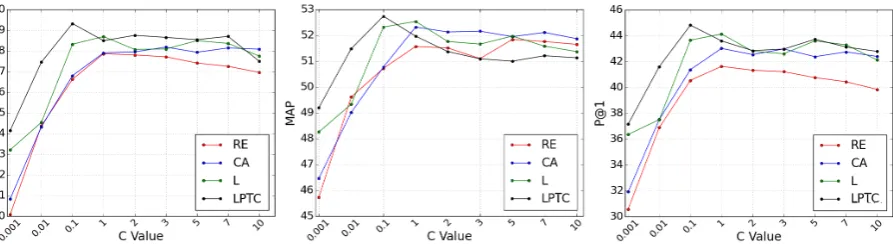
Figure 1:The impact of the C values on different models with (LPTC, L) and without (CA, RE) instance weighting.
passage. We defined a weighting function, f(·), for scoring the passagepas:
f(p) =|Xk
h=1
jh
pW(ah)|. (1)
The weighting function consists of a summa-tion of two factors: (i) jh
p, which indicates the judgment value the annotators, h, have provided for the passage p; and (ii) W(u), which aims at capturing the reliability of the crowd worker u, using the product of three factors:
W(u) =P(u)T(u)C(u), (2)
wherePrior Confidence,P(u), indicates the prior trust confidence score of the crowd worker,u, pro-vided by the crowdsourcing platform based on the quality of the annotations (s)he has done in the previous tasks. Task Confidence,T(u), indicates the total number of annotations performed by the crowd workeruin this task. The score is re-scaled and normalized between (0,1) by considering the maximum and minimum number of annotations the workers have done in this task. Consistency Confidence, C(u), indicates the total number of annotation agreements between the annotator u and the majority voting in this task. The score is normalized and re-scaled between (0,1) as well.
We use Eq. 1 in the optimization function of SVMs:
min ||~w||2 2 +c
X
i ξ2
if(pi), (3)
where ~w is the model, c is the trade-off param-eters,ξi is the slack variable associated with each training example~xi,piis the passage related to the examplexi(i.e., associated with a constraint), and f(pi)(Eq. 1) assigns a weight to such constraint.
5 Experiments
5.1 Experimental Setup
QA Corpora. In this paper, we used the ques-tions from TREC 2002 and 2003 from the large newswire corpus, AQUAINT. We created the Q/AP pairs training BM25 on AQUAINT and re-trieving candidate passages for each question.
Crowdsourcing Pilot Experiments. Before running the main crowdsourcing task, we eval-uated the effect of the initial configurations of the platform on the quality of the collected an-notation. We conducted two pilot crowdsourcing experiments, which show that without quota limitation, the collected sets of annotations have both high level of agreement (0.769) calculated with the Kappa statistic (Carletta, 1996).
Classifier Feature. We used the rich set of fea-tures described in the state-of-the-art QA system (Tymoshenko and Moschitti, 2015). Such fea-tures are based on the similarity between question and the passage text: N-gram overlap (e.g., word lemmas, bi-gram, part-of-speech tags and etc.), tree kernel similarity, relatedness between ques-tion category and the related named entity types extracted from the candidate answer, LDA simi-larity between the topic distributions of question and answer passage.
Reranking Model We used (i) a modified algo-rithm of SVM-rank3 using the Eq. 3 to train our
rerankers; (ii) the default cost-factor parameter; and (iii) some other specific values to verify if our results would be affected by differentCvalues.
Baselines. We compared our results with three different baselines, namely: BM25: we used Ter-rier search engine4, which provides BM25
Model MRR MAP P@1 Baselines
BM25 41.75±6.56 37.25±4.52 25.57±6.17 RE 57.41±7.31 51.75±6.27 41.38±11.12 CA 57.75±6.77 52.09±5.68 42.94±8.55
Our Weighting Results
[image:4.595.73.292.61.189.2]L 58.73±6.88 52.48±6.00 44.12±9.75 P 58.51±5.63 52.07±4.63 43.15±7.32 LP 58.76±6.52 52.60±6.03 44.22±8.72 TC 58.31±5.44 52.09±4.96 42.83±7.69 LTC 58.85±5.85 52.58±5.52 43.74±8.50 LPTC 59.22±6.30 52.63±5.96 44.79±8.82
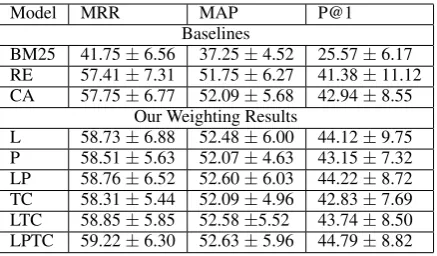
Table 1: Results over 5 fold cross validation. Our Weight-ing Results are all better than the Baselines with a statistical significant test of 95%.
ing model to index the answer passages (Robert-son and Walker, 1997). The APs are extracted from AQUAINT text corpus and treated as doc-uments. BM25 is used to retrieve 20 candidate answers for each question and rank them by their relevance scores. RE (regular expression): we trained a classifier with the noisy annotations pro-duced by labels automatically derived with RE ap-plied to answer keys (no weighting strategy). CA
(crowd annotations): we train a classier with the same configuration as RE but using majority vot-ing as a source of supervision.
Evaluation Metrics We evaluated the perfor-mance of the classifier with the mostly used met-rics for QA tasks: the Mean Reciprocal Rank (MRR), which computes the reciprocal of the rank at which the first relevant passage is retrieved, Pre-cision at rank 1 (P@1), which reports the percent-age of question with the correct answer at rank 1, and Mean Average Precision (MAP), which mea-sures the average of precision of the correct pas-sages appearing in the ranked AP list. All our re-sults are computed with 5-folds cross validations, thus the above metrics are averaged over 5 folds.
5.2 Weighting Experiments
In these experiments, we used the labels provided by crowd annotators using majority voting for training and testing our models. Most interest-ingly, we also assign weights to the examples in SVMs with the weighting schemes below:
- Labels Only (L), i.e., we setP(u) = T(u) = C(u) = 1in Eq. 2. This means that the instance weight (Eq. 1) is just the sum of the labelsjh
p.
- Prior Only (P):to study the impact of prior an-notation skills, we setC(u) =T(u) = 1in Eq. 2, and we only useP(u)(crowdflower trust), i.e., we
do not account for the sign of annotations,jh p.
- Labels & Prior (LP):the previous model but we also used the sign of the label,jh
p.
- Task & Consistency (TC): we set P(u) = 1 such that Eq. 2 takes into account both annota-tor skill parameters for the specific task, i.e., task and consistency confidence, but only in the current task and no sign ofjh
p.
- L & TC (LTC):same as before but we also take into account the sign of the annotator decision.
- LPTC:all parameters are used.
Table 1 shows the evaluation of the different baselines and weighting schemes proposed in this paper (using the default c parameter of SVMs). We note that: firstly, the accuracy of BM25 is lower than the one expressed by rerankers trained on noisy labels (-15.66% in MRR, -14.5% in MAP, -15.81 in P@1%).
Secondly, although there is some improvement using crowd annotations for training5compared to
the noisy training labels (RE), the improvement is not significant (+0.34% in MRR, +0.34% in MAP, +1.56% in P@1). This is due to three reasons: (i) the crowdsourcing annotation suffers from a certain level of noise as well (only 27,350 of the answer passages, i.e., 51.80%, are labeled with ”crowd fully in agreement”), (ii) although the RE labels may generate several false positives, these are always a small percentage of the total instances as the dataset is highly unbalanced (9,535 negative vs. 1,005 positive examples); and (iii) RE do not generate many false negatives as they are precise.
Thirdly, the table clearly shows the intuitive fact that it is always better to take into account the sign of the label given by the annotator, i.e., LP vs. L and LTC vs. TC.
Next, when we apply our different weighting schema, we observe that the noise introduced by the crowd annotation can be significantly reduced as the classifier improves by +1.47% in MRR, +0.54% in MAP and +1.85% in P@1, e.g., when using LTC & LPTC compared to CA, which does not provide any weight to the reranker.
better than the baseline, CA, (blue curve) in MRR and P@1.
6 Conclusions
Our study shows that we can effectively exploit the implicit information of crowd workers and apply it to improve the QA task. We demonstrated that (i) the best ranking performance is obtained when the combination of different weighting parameters are used; and (ii) the noise of annotations, present in crowdsourcing data, can be reduced by consider-ing weightconsider-ing scores extracted from crowd worker performance. In the future, we will explore bet-ter weighting cribet-teria to model the noise that is in-duced by annotations of crowd workers.
Acknowledgement
This work has been partially supported by the EC project CogNet, 671625 (H2020-ICT-2014-2, Re-searchand Innovation action).
References
Omar Alonso and Stefano Mizzaro. 2012. Using crowdsourcing for trec relevance assessment. 48(6).
Jean Carletta. 1996. Assessing agreement on classifi-cation tasks: The kappa statistic.Comput. Linguist.
Pinar Donmez, Jaime G. Carbonell, and Jeff Schnei-der. 2009. Efficiently learning the accuracy of label-ing sources for selective sampllabel-ing. KDD ’09, New York, NY, USA.
David A. Ferrucci. 2011. Ibm’s watson/deepqa. ISCA ’11, New York, NY, USA. ACM.
Michael Heilman and Noah A. Smith. 2010. Good question! statistical ranking for question generation. HLT ’10, Stroudsburg, PA, USA. Association for Computational Linguistics.
Jiwoon Jeon, W. Bruce Croft, and Joon Ho Lee. 2005. Finding similar questions in large question and an-swer archives. CIKM ’05, New York, NY, USA. ACM.
Adam Kilgarriff. 1998. Gold standard datasets for evaluating word sense disambiguation programs.
Alessandro Moschitti, Silvia Quarteroni, Roberto Basili, and Suresh Manandhar. 2007. Exploit-ing syntactic and shallow semantic kernels for ques-tion/answer classification. InIn Proceedings of the 45th Conference of the Association for Computa-tional Linguistics.
Barbara Plank, Dirk Hovy, and Anders Sogaard,
2014. Learning part-of-speech taggers with
inter-annotator agreement loss, pages 742–751. Associa-tion for ComputaAssocia-tional Linguistics.
Ciyang Qing, Ulle Endriss, Raquel Fern´andez, and Justin Kruger. 2014. Empirical analysis of aggrega-tion methods for collective annotaaggrega-tion. In Proceed-ings of the 25th International Conference on Com-putational Linguistics (COLING-2014).
Filip Radlinski and Thorsten Joachims. 2006. Query chains: Learning to rank from implicit feedback.
CoRR, abs/cs/0605035.
Vikas C. Raykar, Shipeng Yu, Linda H. Zhao, Ger-ardo Hermosillo Valadez, Charles Florin, Luca Bo-goni, and Linda Moy. 2010. Learning from crowds.
J. Mach. Learn. Res.
S. E. Robertson and S. Walker. 1997. On relevance weights with little relevance information. SIGIR ’97, pages 16–24, New York, NY, USA. ACM. Dan Shen and Mirella Lapata. 2007. Using semantic
roles to improve question answering. pages 12–21, Prague, Czech Republic, June. Association for Com-putational Linguistics.
Victor S. Sheng, Foster Provost, and Panagiotis G. Ipeirotis. 2008. Get another label? improving data quality and data mining using multiple, noisy label-ers. KDD ’08, New York, NY, USA. ACM.
Rion Snow, Brendan O’Connor, Daniel Jurafsky, and Andrew Y. Ng. 2008. Cheap and fast—but is it good?: Evaluating non-expert annotations for nat-ural language tasks. EMNLP ’08, Stroudsburg, PA, USA. Association for Computational Linguistics. Mihai Surdeanu, Massimiliano Ciaramita, and Hugo
Zaragoza. 2008. Learning to rank answers on large online qa collections. InIn Proceedings of the 46th Annual Meeting for the Association for Computa-tional Linguistics: Human Language Technologies (ACL-08: HLT, pages 719–727.
Kateryna Tymoshenko and Alessandro Moschitti. 2015. Assessing the impact of syntactic and seman-tic structures for answer passages reranking. CIKM ’15, pages 1451–1460, New York, NY, USA. Timo Volkmer, James A Thom, and Seyed MM
Tahaghoghi. 2007. Modeling human judgment of
digital imagery for multimedia retrieval.
Multime-dia, IEEE Transactions on, 9(5).
Ellen M. Voorhees. 2000. Variations in relevance judg-ments and the measurement of retrieval effective-ness. Inf. Process. Manage., pages 697–716. Mengqiu Wang and Christopher D. Manning. 2010.
Mengqiu Wang, Noah A Smith, and Teruko Mita-mura. 2007. What is the jeopardy model? a
quasi-synchronous grammar for qa. EMNLP-CoNLL, 7.
Jacob Whitehill, Ting fan Wu, Jacob Bergsma, Javier R. Movellan, and Paul L. Ruvolo. 2009. Whose vote should count more: Optimal integration of labels from labelers of unknown expertise. Cur-ran Associates, Inc.
Xuchen Yao, Benjamin Van Durme, Chris Callison-burch, and Peter Clark. 2013. Answer extraction as sequence tagging with tree edit distance. InIn North American Chapter of the Association for Computa-tional Linguistics (NAACL.