r
r
(l
~
r
r
I
~
j
J
L OOl
JJodaJ
Contents
Foreword
Mission statement and Organisational Structure
Artides
HIRLAM 5 Numerical Forecasting Model Met Elreann Web Site
Celebrating 25 Years Service
Programme News
Forecasting Programme
Observing and Technical Support Programme Climate Programme
Strategic Management
Other Activities
Appendices
I. Staff Training and Development II Forecast Accuracy
III. Publications
IV. Met Lireann Finances
Corporate Information
Glossary
3
4 7 8
9 12 14
17
11
24 26 29 30
Foreword
Accurate forecasting of weather conditions -whether for public safety, recreation, aViation, Industry, marine or agriculture purposes - IS a core task of any National Meteorological Service. It entails an on-going commitment to improve forecast services - by utiliSing the latest sCientific and technological advances, by monitonng forecast accuracy and by consulting the views of end-users. I am happy to record Ihat Met Eireann made noteworthy progress in all three areas dunng 2001.
In the science and technology area, Met Elfeann implemented an enhanced version of the numerical weather predictIOn model (HIRLAM 5) on a new high-speed computer system. The new model runs at higher resolution and avails of improved boundary values from the European Cenlre for Medium-Range Weather Forecasts (ECMWF). Initial results have been very pOSItiVe, and we are confident that HIRLAM 5 will lead 10 further improvement of Met Eireann's forecasts over the coming years.
Ultimately, the value of Met Eireann's forecasts depends on their usefulness to end-users. Following on the recommendations of the Value for Money study conduded by the Comptroller and Auditor-General In 2000, Met Elreann introduced more systematic procedures to measure the accuracy of forecasts issued to the public. In Ihls Annual Report we publish the first results from these accuracy measurements. We hope they help to demonstrate the usefulness and value of Met Eireann's services to all sectors of Irish society.
Declan Murphy Diredor
This Report also details the results of a survey of public attitudes towards Met Eireann conduded by Iflsh Marketing Surveys In November 2001. The survey revealed a keen public awareness of the value of Met Eireann's weather forecasts and warnings, and a high recognition of Met Eireann as the primary provider of weather information in Ireland.
Other important developments during 2001 Included the introdUdlon of Met tireann's web site, www.met.ie. and the deployment In the Irish Sea of the second weather buoy in the series planned as a joint initiative by Met Eireann, the Marine Institute, the Department of the Marine and Natural Resources and the UK Met Office. Met Eireann also successfully developed a prototype automatic weather station for use in climate and synoplic stations.
The issue of climate change continues to be a cause of public concern, and it has long been Met Eireann's ambition to devote more attention to thiS Important subjecL In particular, we wished to enhance our capability of providing
predictions of future climate trends in Ireland.
It gives me great satisfaction to report that during 2001, in collaboration with partners in the education
I
research sector, Met tireann secured support for the establishment of a Regional Climate Analysis, Modelling and Prediction Centre. This will function as the hub for a wider initiative in dimate studies to be known as the Community Climate Change Consortium for Ireland.The programme for modernisation in the Irish Civil Service continued with vigour during 2001. The implementation of the Performance Management and Development System (PMDS) in Met tireann was supported by the most ambitious training effort ever undertaken by the organisation. Because Met tireann's operations are widely dispersed throughout the country, training programmes were delivered at several locations. A happy side-effect of this process was the opportunity it afforded staff to meet colleagues from other offices. Training, of course, is only the first step and it will take some years before the benefits of PMDS to Met tireann become fully eVident
1 Met £ireann annual report 2001
Every year produces some unexpected events which engage the attention. In 2001 it came In the unwelcome form of the Foot and Mouth emergency. Met tireann played al) important role in coping with the crisis, supplying additional weather observations from its network of synoptic stations and developing systems to estimate the airbome spread of the disease. For their efforts in dealing With the Foot and Mouth episode, and their overall commitment to delivering high-quality customer service, I would like to express my gratitude to all Met tlreann's staff.
Declan Murphy
Director
August 2002
Mission Statement
Our Mission is to meet the national requirement for
high-quality weather forecasts and associated services,
with optimum efficiency and value for money.
Organisational Structure
(December 2001)
Assistant Director Operations and Administration
Seamus
0
Laogh6gAssistant Director Scientific and Technical Support
Peter l yn( h
Th
e
H
I
RLAM 5 Num
e
rical
Forecasting Model
In modem weather forecasting. the output from
computer-based Numerical Weather Prediction (NWP) models proVides invaluable guidance to
operational meteorologists. The meteorologists
interpret the NWP output and, USIng their skill and
experience, combine it with other data to produce
the best possible forecasts for end-users.
How does an NWP model work? Essentially, weather observations (reports of air pressure, temperature, wind etc.) over a Wide geographical area are collected at a speafic time and passed to
the model, which uses them to generate a 3-dimensional representation of the state of the atmosphere (the 'analysis'). This representation is then advanced forward in time by numerically
solving the dynamical and physical equations
describing the behaviour of the atmosphere, so
produang a new state (the 'forecast').
Since 1989, Met tireann has developed Its NWP
capability as part of an international collaborative
project called HIRlAM (High-Resolution limited Area ModeQ. The HIRlAM project aims to develop
and maintain a highly-accurate, short-range
forecasting system covering an area which each
member state can choose to suit its own
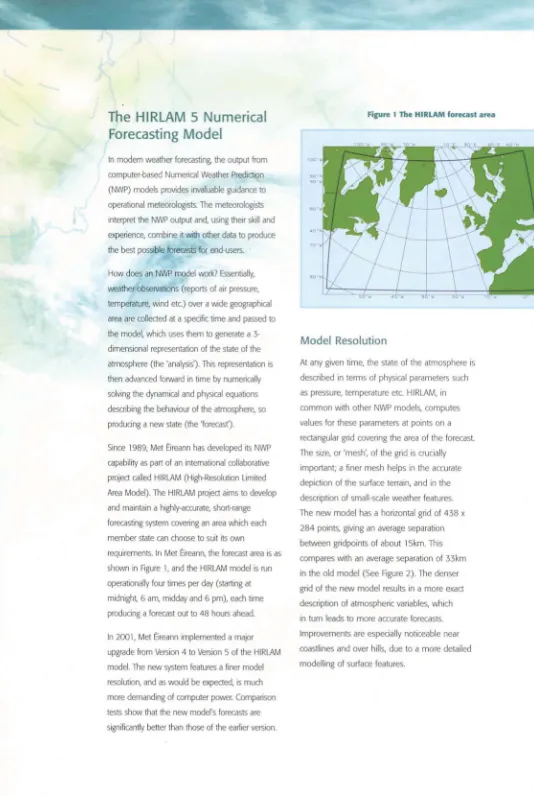
requirements. In Met tireann, the forecast area is as shown in Figure 1, and the HIRlAM model is run
operationally four times per day (starting at
midnlgh~ 6 am, midday and 6 pm), each time
producing a forecast out to 48 hours ahead.
In 2001, Met tireann implemented a major upgrade from Version 4 to Version 5 of the HIRlAM model. The new system features a finer model
resolullon, and as would be expected, IS much
more demanding of computer power. Companson
tests show that the new model's forecasts are significantly better than those of the earlier version.
[image:6.594.9.543.5.801.2]4 Met ~ireann annual report 2001
Figure 1 The HIRlAM forecast area
'0
J
Model
R
esolution
At any given time, the state of the atmosphere IS
described In terms of physical parameters such
as pressure, temperature etc HIRLAM, in
common With other NWP models, computes
values for these parameters at points on a
rectangular grid covering the area of the forecast.
The size, or 'mesh', of the grid is crucially
important; a finer mesh helps in the accurate depiction of the surface terrain, and in the
descnption of small-scale weather features.
The new model has a horizontal grid of 438 x
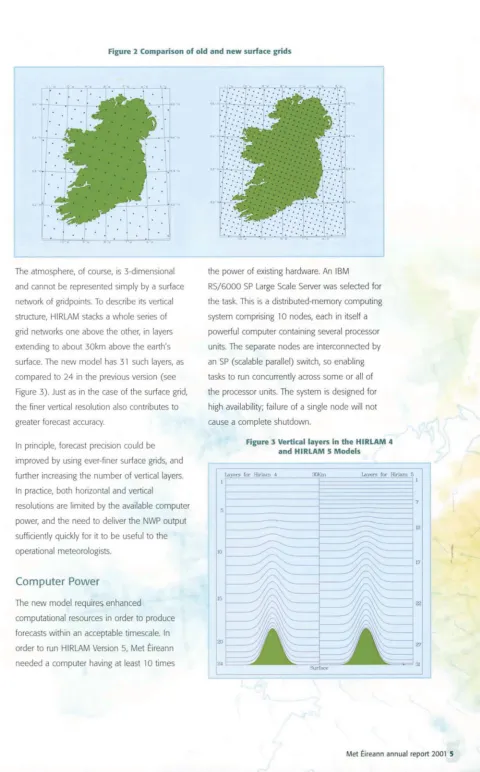
284 points, giving an average separation between grid points of about 15km. This compares with an average separation of 33km in the old model (See Figure 2). The denser grid of the new model results in a more exact
description of atmospheric variables, which
- - - -- - -
-Figure 2 Comparison of old and new surface grids
. .
'• >
-
'
The atmosphere, of course, IS 3-dimenslonal
and cannot be represented simply by a surface
network of grid points. To descnbe Its vertical structure, HIRLAM stacks a whole senes of
gnd networks one above the other, In layers
extending to about 30km above the earth's
surface. The new model has 31 such layers, as compared to 24 In the previous version (see
Figure 3). Just as in the case of the surface grid,
the finer vertical resolution also contnbutes to
greater forecast accuracy.
In principle, forecast preCision could be
improved by using ever-finer surface grids, and further Increasing the number of vertical layers.
In practice, both honzontal and vertlcal
resolutions are limited by the available computer
power, and the need to deliver the NWP output
sufficiently quickly for It to be useful to the
operational meteorologists.
Computer Power
The new model requires. enhanced
computallonal resources in order to produce
forecasts within an acceptable timescale. In order to run HIRLAM Version 5, Met tireann
needed a computer having at least 10 times
.
: ..
..
,
..
the power of existing hardware. An IBM
RS/6000 SP Large Scale Server was selected for
the task.. This is a distributed-memory computing
system compnsing 10 nodes, each in itself a
powerful computer containing several processor
units. The separate nodes are Interconnected by
an SP (scalable parallel) SWitch, so enabling
tasks to run concurrently across some or all of
the processor units. The system is designed for
high availability; failure of a single node will not
cause a complete shutdown.
Figure 3 VertJcallayers In the HIRLAM 4 and HIRLAM 5 Models
i
1..
t
i
,
< ~t
141"'" lor H,rIIom I) I I
[image:7.588.95.575.69.841.2]In addition to Improving the operational weather
forecasts, the RS/6000 SP will playa key role In
Met tireann's on-going research programme
aimed at further development of the HIRlAM model.
Performance of HIRLAM 4
and HIRLAM 5
The charts below show predictions of accumulated rainfall for 7th-8th December 2001, from the old and new forecasting systems. The HIRLAM 5 forecast clearly displays much greater detail, reflectmg the impact of the higher model resolution When the forecasts are
verified against obseNalions, the superiority of
the new model is immediately apparent'. For
example, up to 55mm of rainfall was recorded over the Wicklow MountainS, and a similar
amount fell at Rosslare, while at Valentia only
6mm was recorded - all In much better agreement With the new model than With the HIRlAM 4 predictions. The advantage of the higher-resolution system In forecasting rainfall
is also eVident from Similar compansons
conducted on other dates.
HIRLAM 4 Accumulated Rainfall
,(>
\
').(>
30 \0
Z
40 \/
20<0
c...
Jo - - - )~
20IBM RS/6000 SP Computer
HIRLAM 5 Accumulated Rainfall
,(> -f> /"-"1 (),
"to
c::
)0~
r )0V
L
)040
(
)0 .;0-f>
~~
)0McGrath, R. 200 I HIRLAM 5 on the IBM RS/6000 Sp, HIRLAM Progress Report No. 22
Surface Pressure Forecast Surface Temperature Forecast Goud Forecast
-"-'
.
The Met Eireann Web Site
-www.met.ie
The Site Launch
An exciting development occurred on 20th June when Met t:ireann's new web site was
successfully launched. The launch was the result of a rewardmg team effort by Met t:ireann staff in collaboration with external design consultants.
Home Page
-Sea Area Map
Focus on Content
The site is packed with high-quality content
delivering important weather information to the
general public and to specialised user groups. It
features national and regional forecasts for today
and tomorrow, along with a three-day outlook. Also mcluded are hourly weather reports, sea area forecasts, all active weather warnings,
satellite Images etc. There are sections dealing with the climate of Ireland and a wealth of information on the structure and history of Met
t:ireann. Complementing the site is an FrP
service that is used to channel data through the Intemet to Met tireann customers.
On-going Development
The web site has proven to be very popular, with
around 35,000 page views per week In the
months following its launch. For the future, Met
tireann plans to develop the site further through the inclusion of additional content, with the aim
of making www.melie the authoritative on-line source for all aspects of Irish weather and climate Information.
Celebrating 25
Years
Service in Limerick,
Cork and Cahirciveen
ContinUing the programme that began in
2000, celebrations to acknowledge the
contributions of staff who have completed 25
years service were held in Limerick, Cork and
Cahlrclveen.
The Limerick celebrations were held at the
Limerick Inn on 2nd March, and catered mainly
for slaff at Shannon Alrp and stations In the
Midwest region. Declan Jrphy (Director, Met
Eireann) "'!tended and IT de presentations to
over 20 slaff members.
In Cork, the 25-year celel:. atlons were held at
the Great Southern Hotel, Cork Airport, on 9th
November. The Director presented awards to a
lotal of 9 staff - 5 based In Cork, 2 In
Shannon AIrport and 2 In Kilkenny.
On 25th October the Daniel O'Connell Holel In
CahirCiveen was the venue for celebrations In
the Southwest. In the course of a very pleasant
evening the Director presented awards to
12 staff.
Stoff at the 25 Years celebrattons In CahlrclVeen.
8 Met ~ireann annual report 2001
Staff at the 25 Years celebrattans In Llmef/ck.
Forecasting Programme
While Met tireann's forecasting programme
draws on all the orgamsation's resources, the
two Divisions most directly Involved In delivenng
services to end-users are the General Forecasting
Division and the Aviation Services DIvIsion. These
Divisions rely on essential support from other
sectlons of Met tireann - for example, in the
areas of observing systems, Instrumentation and
Information Technology. EspeCially Important IS
the computer-based guidance prOVided to the
operational meteorologists by the Research and
Applications DIV1Slon.
General Forecasting
nle General Forecasting DiVIsion supplies a wide
range of forecast services through the Central
AnalYSIs and Forecast Office (CAFO) and the RTt
Weather OHlce.
DUring 2001, the DiVIsion continued Its routine
prOVIsion of general weather forecasts and
warnings. Specialised forecasts were prOVided to
the marine and agriculture sectors, the Defence
Forces and the emergency services. Forecasts of
pollen and sunburn Index were Issued dunng
the spring and summer months.
The Division supplied customised weather
services to national and local medla, energy
utilities, the building Industry, and several other
business and commercial Interests. In
collaboration With the National Roads Authority,
winter road maintenance forecasts were
prOVided for over 50 Sites nationwide. The
Telephone Consultancy Service (which proV1des
direct customer acces;; to the operational
weather forecasters) continued to prove popular
with many industrial and commercial clients.
The newly-renovated CAFO offices
The premium-rate Weatherdial service received
over 1.1 million calls, a slight decrease on the
2000 total.
As part of Met tireann/s on-going commitment
to quality customer serVIce, the DiVISion
Implemented a new forecast verification scheme
for 2001, based on the 07.55 a.m. RTt radio
forecast. Each morning. forecast values of
temperature, wind, rainfall and sunshine duration
are recorded for selected sites and stored In a
computer file. The forecast values are later
verified against observed conditions. The current
system focuses on forecasts out to 24 hours
ahead, but verification of the further outlook
will be Included later. Initial results from the new
verification scheme are presented elsewhere in
this Report.
CAFO/s office accommodation has been In
continuous use, 24 hours a day, for almost 25
years. To the great satisfaction of all concerned,
a major refurbishment programme was
completed during 2001.
- - - ~---~~
Shannon Airport
Aviation Forecasti
ng
The Aviation Services DivIsion provides a wide
range of services to CIVil, military and general
aviation, in accordance with International Civil
AViation Organisation (ICAO) standards and
national procedures. It compnses the Central
Aviation Office (CAO) at Shannon Airport, at
which the Head of the Division is normally
based, together With the Meteorological Offices
at Dublin, Cork and Knock Airports and at
Casement Aerodrome. The DIVISion IS also
responsible for services to a number of Regional
Airports around the country.
During 200 1 the DIVision Issued SIGMET warnings
for the Shannon Flight Information Region (FIR),
and Terminal Aerodrome Forecasts (TAFs) for
Shannon, Dublin, Cork and Knock AirportS, and for
Casement and Gormanstown Aerodromes. Local
Area Forecasts (LAFs) were provided for the
airports at Donegal, Sligo, Galway, Kerry and
Waterford. The DiVISion also provided support for
Search and Rescue operations and telephone
briefings for pnvate pilots.
In collaboration with staff of the Instrumentallon
and Environmental MonitOring Division, Aviallon
Services DiVISion helped ensure the smooth
Installation of a new enclosure for
meteorological Instrumentation at Cork Airport.
Aviation Services DIVISion IS the focal pOint for
liaison between Met ~Ireann and the vanous
International agencies Involved In the regulation
of aViation meteorology. Dunng 2001, staff
continued work on the development of a new
forecast display system as part of a major
ICAO prOject The DiviSion also partiCipated
In meetings of the Meteorology Group of
ICAO's European Air NaVigation Planning
Group (EANPG). and of the WMO's CommiSSion
on Aeronautical Meteorology (CAeM).
Summary of services provided by the Division in 1001
Number of SIGMET Warnings for Shannon FIR
Number of Flight Folders provided
Number of aerodrome and wind shear warnings
Number of telephone aviation briefings
Number of Terminal Aerodrome Forecasts issued
Number of Local Area Forecasts issued
Number of Search and Rescue forecasts issued
10 Met ~ireann annual report 2001
84
17,490
846
9,801
19,890
5,110
Research and Applications
Numerical Weather Prediction (NWP)
DUring 2001 the major achievement In the NWP
area was the operational implementation of the
HIRLAM Version 5 programme sUite. The new
HIRLAM model runs In a parallel computing
environment on IBM RS/6000 hardware. It
operates on a 15 km hOrizontal grid, as
compared to 33 km for HIRLAM Version 4,
and shows improved predictive skill especially
for wind and precipitation forecasts.
In response to the Foot and Mouth emergency,
a numerical model for the airborne spread of
the disease was adapted to use HIRLAM output
and proVided information to the veterinary
authonties for the duration of the crisis. HIRLAM
data was also supplied dally to the Radiological
Protection Institute of Ireland (RPII) as Input to
models for estimating levels of fallout In the
event of a nuclear accident.
Theoretical work continued on lateral boundary
conditions. Because HIRLAM IS a limited-area
model and cannot 'see' what IS happening
outside Its domain, there IS a particular problem
in computing pressure, temperature values etc.
along the area boundaries themselves. Proper
handling of these boundary-value calculations is
essential to ensure continUity and minimise
model forecast errors.
Agrometeorological Unit
The Agrometeorologlcal Unit prOVided
support to Govemment Departments and
Agencies throughout the Foot and Mouth
emergency. Mr. DeniS fitzgerald, Head of
the Research and Applications DiviSion, became
co-ordinator of AGMET, the JOint Working
Group on Applied Agricultural Meteorology.
Dunng 2001 AGMET published a new book
entitled 'AgroMeteorologlcal Modelling
-Prinaples, Data and Applications', which was
launched at a ceremony In University College
Dublin. The AGMET group also made significant
progress on a general review of weather services
for Irish agriculture.
AI the book launch - Or. Nicholas Holden (Edllor), Or. Art Cosgrove (PreSident UCO) and Oec1an Murphy (Olfec/Or, Mel tlfeann)
Marine Unit
Met tireann's operational wave model (WAM)
was upgraded to use the finer-resolution winds
from HIRLAM Version 5. Inll1al results indicated an
improvement In the accuracy of the wave
forecasts.
A new weather buoy was deployed In the Irish
Sea, the second to be installed as part of a Joint
Marine Institute / UK Met Office / Department
of the Marine and Natural Resources / Met
tlreann initiative. (The first was deployed off the
Aran Islands in 2000). Both buoys functioned
reliably and provided valuable data to Met
tlreann's meteorologists.
Reports of Visibility from five automatic
lighthouses operated by the Commissioners
of Irish Lights were evaluated (Dundalk, Fastnet,
Roche's Poin~ Baily and Kish), and are now
being used in the operational forecast offices.
The M2 Buoy ready for launch at Howth, Co. Dubltn.
Library & Information Services
Good progress was made In Implementing the
library's new cataloguing system. 111ree Issues
of Met ~ireann's staff magazine Sp(onc were
produced dunng the year. The librarian adopted
the role of content manager and contributed to
the mamtenance and development of Met
~Ireann's new web site. By the end of the year
a project to provide electronic access to
subscription Joumals was well on the way to
implementation.
12 Met £ireann annual report 2001
Observing and Technical
Support Programme
S
ynoptic Netwo
rk
Met Eireann's network of synoptic weather
stations, at which hourly observations of weather
conditions are made, comprises a mix of manned
and automatic sites. A full programme of 24-hour
observations was maintained throughout the year
at all stations.
The exlSllng AutomatiC Weather Stations (AWSs)
do not provide adequate information on some
weather parameters - e.g., visibility and cloud
conditions. A set of intelligent sensors capable of
monltonng these parameters was deployed at the
synoptic stations In Mulhngar and Kilkenny, for
real-time assessment by the meteorologists In
the Central AViation Office.
A new logger-based on-line AWS, with most
sensors duplicated, was designed and built
In-house for deployment In The Unified
Climatological and Synoptic Observational
Network (TUCSON). At the year's end, a
prototype was under test in the Instruments Unit
A sensor calibration and equipment maintenance
programme was carried out by the Instruments
Unit. This included site visits throughout the
synoptic network.
Airports
A fully duplicated sensor and telemetry system
was installed at the new meteorological
enclosure at Cork Airport, In a joint project with
Aer Rianta.
A new anemometer and wind display system for
airports was tested by the Instruments Unit This
was part of a major project to replace an older
system and to meet the requirements of the
Insh AViation Authonty over the next few years.
Meteorological Radar and Satellite
Receiving Systems
Met tireann operates two networked weather
sUNeiliance radars, located at Dublin and
Shannon Airports. The microwave link between
the Dublin Airport radar installation and Met ~ireann's Glasnevin offices was partly renewed
In 2001.
Images from meteorological satellites continue
to play an Importanl role in Met tireann's
forecasting activities. Preliminary investigations
confirmed that new antennas, designed to
receive Images from the next generation of
geostationary and polar-orbiting satellites, could
be sited on the roof of the Glasnevln offices.
Valentia Observatory
The solar radiation monitoring systems at the
ObseNatory were replaced and deployed in a
new location. This completed a two-year project
to upgrade the sensors, data collection and
quality assurance procedures of Met tireann's
national solar radiation network.
A national geomagnetic sUNey carried out in
2000 and 2001 was completed. Updated maps
of geomagnetic declination were prepared for
the Ordnance SUNey and the Irish Aviation
Authority.
f
Workmg on the anemometer mast at Valentia Observatory.
A fibre-optic data collection network was
installed at the ObseNatory.
Laboratory
The chemical composition of air and precipitation
samples at selected synoptic stations was
analysed as part of on-going national and
Intemational programmes. Some sampling
systems and analYSIS procedures were changed,
necessitattng intercomparison of dataselS.
Information Technology
The wide range of hardware and software
systems supported by the IT Division operated
throughout 2001 without any major problems.
Among the highlights of the Division's work were:
Numerical Weather Predtctlon: Met tireann's
new IBM RS/6000 SP computer, named SWIFT,
was Installed and successfully site accepted.
Development work to port the latest version of
the HIRLAM forecast model to the new system
was completed by the end of September, and
the new SWIFT system became operational from
2nd October.
rr DiviSion
.Telecommunications: New WAN
commUnications links were installed between IT
Operations at Glasnevln and Dublin and Cork
Airports. Work on the completion of the
Glasnevln tAN upgrade to Fast Ethemet
(lOOBasel) was completed. While the RMDCN
(Regional Meteorological Data Communication
Network) link to the UK Met Office and ECMwr continued to operate satisfactorily, the UK Met
Office began work on Installing a new electrOniC
traffic routing (aR) system via ECMWF as a
back-up for their data.
Desktop ServIces: 33 new desktop PCs and 6
laptops were purchased dUring the year. Firewall
and anti-virus systems were upgraded.
Web site: The IT Division played a central role in implementing Met Eireann's new web site which
was launched in June.
Foot and Mouth Emergency: To help cope with
the Foot and Mouth emergency, Met Eireann, In
collaboration with the Department of Agriculture,
Food and Rural Development, developed a new
Foot and Mouth Dispersion Model. This was
implemented on a high-speCification workstation,
with dual I GHz processors, 1 GB of memory and
40GB hard disk space.
14 Met ~ireann annual report 2001
Climate Programme
The main functions of the Climatology &
Observations DMSlon are (1) malntalnln~ the
National Climate Database, (2) management /
quality-control of the observational station
networks and (3) operating the Climate
Enquiries Office, which delivers c1l1natologlcal
data to customers and produces the Monthly
Weather Bulletin.
Monthly Weather
Bulletin
JAt«JARVo'OO'===-==-
=:.-:.":!:'::-...--.--
" " '-
.-_.-..-
----..-...-,,--
...
_
..-_
...
---.-...
=--==-..=.--
...
_----
-
...
--
...---.
..
-=.:..:::.:.-::-
----_
...January 2001 Monthly Weather Bulletm.
The new format of the Monthly Weather Bulletin,
Including colour images and charts, first
appeared in January and met with a very
positive response from readers.
During 2001 a total of 1 ,869 customer
enquiries were received by post, fax and
e-mail, representing an Increase of 31oto
on the previous year. The Increased demand
for services may have resulted in part from
the launch during the summer of Met
County
/
Station
CO. CLARE SHANNON AIRPORT
CO. CORK CORK AIRPORT
CO. DONEGAL MAUNHEAD
CO. DUBLIN OUBUN AIRPORT CASEMENT AERODROME
CO. KERRY
Routine inspection of rainfall and climate
observing stations was seriously delayed by the
Foot and Mouth emergency. On average,
good-quality data was received throughout the year
from some 550 stations, With 15 new stations
being opened and 4 closed.
The DiVision played a major role In planning a
jOint scientific project with the National Climate
Information Centre of the UK Met Office. USing
Geographic Information Systems (GIS)
techniques, the project aims to produce a
comprehensive gndded set of Climatological
Normal Indices for the Island of Ireland.
The Weather of 2001
During 2001 the weather was generally drier
and sunnier than normal. while temperatures
were a little above normal.
Rainfall totals for the year were below normal
everyvvhere. The winter and autumn months,
which are usually the wettest, were much drier
than normal. The heaViest daily falls of the year
at many locations were measured during the
summer months. Cork Airport's dally total of
65.5mm on 17th July was Its highest for July
since 1975, while a fall of 84.5mm measured
at Johnstown Castle, Co. Wexford, on 13th/14th
July Included a 2-hour fall of 65mm. Another
localised downpour at Dungarvan (Carriglea),
Co. Waterford, produced 124mm In the 2-day
penod between 19th and 20th October.
The Weather of 1001
RAINFALL (mml TEMPERATURE
te)
SUNSHINE (HOURS)No.
OF DAYS WITH:IT."
-'"
or:...
MaSlin a day dill Irom Extremes Dally-
0 " ,.,.
'" Maslin a nay..
~ ~ II> amounl dalel51 Mean average Highest Lowest r'leanJ!!:
date,s) ;: ~ "C""
., amoun! c: c
.
,.
0'"
8' .'!!'"
..,
n; c:<i n; .c a: (J) :I: I - .... c'.8
7935 85 199 50cl 109 ill 8 260 ·54 398 114 145 23 May 213 28 35 40
10m
91 655 17 Jul 10.3 ill 8 23.8 -40 466 123 15.0 1 Jul 217 17 5 5 109 678567 80 274 10Jul 97 ill 4 223 ·25 376 112 145 7/kj 247 18 10 31 3 11 168 6286 n/a 334 70d 95 n/a 26.9 ·79 421 108 147 23/kj 231 11 50 8 3 41 61 5811 81 262 70d 96 ill 3 26.6 ·90 407 112 145 23 May 201 9 52 6 8 25 57
VALENTIA OBSERVATORY 12534 87 35.0 6 Mar 10.8 ill 4 23.2 ·40 407 120 148 3 Jun 256 3 12 16 20 62 CO. KILKENNY
KILKENNY 783 5 95 24.9 14 Aug 98 ill 5 26.6 ·74 404 115 140 7 May 213 O/a 59 -O/a- 23
CO. MAYO
BELMULLET 9005 86 272 3 Dec 10.3
to
7 23.1 -48 395 113 148 23 May 259 12 16 41 2 17 107CONNAUGHT AIRPORT 10812 n/a 274 6 Oct 85 O/a 221 -38 352 n/a 150 23/kj 271 27 50 11
o
164 59CO. MONAGHAN
CLO ES 7310 79 208 8 Aug 93 +05 254 ·54 370 116 149 23/kj 242 O/a 55 -nJa- 36
CO.OFFALY
BIRR 6644 83 23.2 14Aug 98 illS 25.4 ·78 355 106 140 23 May 216 n/a 51 -nJa- 25 CO. WESTMEATH
MULlINGAR II 763.6 82 241 6Jun 94 +06 25.5 -8.0 404 115 144 23 May 228 n/a 56 -O/a- 20
CO. WEXFORD
ROSSlARE 8691 99 466 7 Oct 10.8 ill} 237 ·14 484 112 148 1 Jul 195 5 6 46 84
Mean annual air temperatures were around
half a degree above normal overall, but were
nevertheless the lowest for five years almost
everywhere. After a relatively cold January and
March, mean temperatures for May, October and
November were well above normal. Dunng a
summer when high daytime temperatures were
rare, the hottest day of the year at most stations
was 28th July, but both Valentia Observatory and
Belmullet had their highest temperatures on
12th/13th May. Unusually, the lowest air and ground temperatures were measured In early
spnng. during a short spell of very cold weather
In the penod I st-4th March.
Sunshine totals for the year were well above
normal almost everywhere; there was between
10% and 20% more sunshine than normal at
most stations but as much as 23% more than
normal at Cork Airport, where it was the sunniest
year since records began there In 1962. January,
February and December were sunniest relative
to normal, while the summer was sunny In the
west and south but relatively dull In the east and
midlands. Dally sunshine values of over 14
hours were measured at most stations on 23rd
May and 1 st July.
16 Met ~ireann annual report 2001
Mean annual wlndspeeds of between 7 and
11 knots (8 and 13 m.p.h.) over most of the
country were below normal everywhere and
were the lowest on record at Valentia
Observatory, Shannon Airport, Belmullet and
Mulhngar. Almost all stations had fewer than
half the normal number of gales dunng the
year, while none were recorded at most inland
stations. The highest gust of the year, 74 knots
(85 m.p.h.), was measured at Malin Head on
Strategic Management
High-Level Objectives
Met ~Ireann's High-Level Objectives, as identified in the Strategy Statement 1999-2001, are:
To provide a comprehensive range of hlgh -quality meteorological services to the Insh people and to all sedors of the Irish
economy.
To ensure the long-term sustainability of
meteorological services in Ireland through adequate Infrastrudurallnvestmenl
To help reduce public exchequer costs by engaging In profitable commercial aClivitles,
while maintaining a constrUdlve relationship with the private sedor and always
conforming fully with competition law. To obtain optimum benefit from
developments In meteorological science by
prudent ulllisation of modem technology, by a well-focused research programme and by
collaboration with relevant bodies.
To utilise fully the talents and potential of all
staff by pursuing a humane and effedlve human resource policy, and by according high pnority to training. communications and partlopatlon.
To examine the current clencal. technical
and professional grade strudures with a
view to matching individual skills to work requirements, and to promoting overall staffing nexibllity.
Significant progress wa!f made In achieVing these
obJedlves dunng 2001.
Meteorological Services
Met tireann continued to fulfil its primary role
as Ireland's National Meteorological Service,
delivering a Wide range of weather forecast products to public and commercial Interests. The full schedule of operational services to aViation
was maintained, and a significant increase in demand for climatological information was
addressed. All possible meteorological support
was provided to Govemment Departments and Agencies in their efforts to cope with the Foot
and Mouth emergency.
Forecast quality was enhanced through upgrades to Met Eireann's numerical weather prediction (HIRLAM 5) and wave predidlon 0NAM) models. More systematic procedures for the verification of public weather forecasts were implemented.
A new web site and FTP server facilitated the
delivery of weather forecasts and related
meteorological services to end-users.
Meteorological Infrastructure
Upgrading and maintenance of Ireland's meteorological infrastrudure is a key asped of Met Eireann's mandate.
During 200 I, good progress was made on
TUCSON (The Unrfied dimate/Synoptlc
Observing Network), a project to design, develop and deploy a network of logger-based Automatic Weather Stations. A prototype system was ready for installation and testing at the end of the year.
Annual Revenue 1986 - 2001
1,500
1,200
0 0 0
rfl 900
GI ::I C GI
> 600
GI II::
300
o 19116 1987 1988 1989 1990 1991 1992 1991 1994 1995 1996 1997 1998 1m 2000 2001
Meteorological equipment was installed at a new
weather enclosure at Cork Airport in a Joint
undertaking with Aer Rianta. In cooOperation with
the Irish Aviation Authority, further technical
investigations and planning took place on the
deployment of new anemometer and wind
displays at the airports.
Weather buoy M2 was positioned some 30
miles east of Dublin Bay, the second in a
network planned Jointly by the Marine Institute,
the UK Met Office, the Department of the
Manne and Natural Resources and Met ~ireann.
A new database system to assist in the
preparation and dissemination of weather
forecasts was installed in the General Forecasting
DiVision In November.
Installation work at the new weather enclosure at Cork AIrport
18 Met 8reann annual report 2001
Commercial Activities
As in prevIous years Met ~ireann's principal
commercial activities included services to TV and
media, the provision of premium-rate weather
forecasts (Weatherdial) and forecasts of severe
weather (including winter road Ice) to the
National Roads Authonty and Local Authorities.
Miscellaneous forecast services were also
prOVided to a wide range of commercial and
Industrial interests (construction, marine,
agnculture, energy utilities etc).
While overall revenues rose in 2001, there was
clear evidence of increased competitiveness in
the commercial meteorological market. Growing
demands for high-quality client-specific services
were accompanied by on-going downward
pressure on pnces.
Science and Technology
Met ~ireann continued its participation In
HIRLAM, an intemational project on co-operation
in Numerical Weather Prediction. Forecast quality
was enhanced through the Implementation of
Version 5 of the HI RLAM model on Met
The project teams established to prepare for
the acquisition and exploitation of data from
the Meteosat Second Generation (MSG)
weather satellite system continued their work
during the year. Launch of the first satellite
(MSG-1) IS expected In the second half of
2002.
Under the Research, Technological
Development and Innovation (RTDI)
programme administered by the Environmental
Protection Agency, and the Programme for
Research in Third-Level Institutions (PRTLI)
scheme run by the Higher Education Authority,
Met Eireann submitted a proposal to establish
a Community Climate Change Consortium for
Ireland. The Consortium, to be based around a
Regional Climate Analysis, Modelling and
Prediction Centre in Met tlreann, would seek
to embrace all university and other groups
adive In climate research. Funding for the
projed was approved, and over the next five
years Met tireann plans to playa leading role
in studying the Impact of climate change in
Ireland.
In discussions with the National Climate
Information Centre of the UK Met Office,
agreement was reached to undertake a jOint
projed, USing Geographic Information Systems
(GIS) techniques, aimed at producing Skm
gndded datasets of climatological elements for
the island of Ireland.
A new national geomagnetic sUNey was
completed by staff at Valentia ObseNatory,
produong updated measurements on
magnetic declination over Ireland. (Magnetic
declination denotes the angle between
magnetic North and true North, and lines
on a map joining points of equal magnetic
declination are referred to as IsogOnlcs).
[ -
lNCt~~
~~I
T _ _ __ -_ _ '_._.,."...,. _ _ • _ _ ~
IRELAND Magnetic Declination and Secular Variation Epoch 2001.0
Chan shOWIng magnelJc declmatlon over Irelond
Staff and Human Resource
Management
A long-standing shortfall In staff numbers was
significantly reduced during 2001, largely due
to Improved recruitment procedures.
Nonetheless, manning levels in many
operational and support areas were still under
pressure at the end of the year due to
on-going training of new recruits. Met Eireann
continued to engage some contract staff
to help maintain essential seNices.
From Moran, E. O'Sulltvan, 1. and Gavin, 1. 200 /. The Secular Vanallon of MagnetIC DeclmalJon In Ireland 200 I. Mel Eireann, Dubltn.
AI the Portnership CounCIl meetmg 01 Connaughl Airport
Met tireann's Partnership Council was very
active during the year -in all, seven meeting
were held, one at Connaught Airport, Co. Mayo.
At each meeting two 'open seats' were prOVided
to enable as many staff members as possible to
attend. A tri-partite gathering of the Partnership
bodies in Met tireann, the Geological Survey of
Ireland and the parent Department took place
in April.
2001 was also a busy year for the Partnership
Subgroups. The Human Resources Strategy
Group prepared reports on Direct Recruitment,
Devolution of HR Responsibilities and the
establishment within Met tireann of a separate
HR Division. Under the aegis of the HQ
Accommodation Panel, a consultant was
engaged to make proposals for the renovation
of the Glasnevin offices. The Staff Customer
Service Panel presented a review of the
Customer Service Plan, and arranged a
professional survey of public attitudes to Met
tireann and its services.
20 Met Eireann annual report 2001
Awards in recognition of exceptional
performance were made to nine staH members
by the Merit Awards Panel. The CommunicalJons
Group liaised with the new Communications
Committee within the parent Departmenl The
launch and initial training for the Performance
Management and Development System was
overseen by the PMDS Implementation Group.
North
-
South Co-operation
Continuing a series of bilateral meetings, staff
from the Northem Ireland branch of the UK Met
Office visited Met tireann in June and October,
with the aim of further developing existing
friendly relationships between the two
organisations and identifying possible areas for
collaboration. In partnership with the National
Roads Authority, agreement was reached on the
routine exchange of reports from roadside
weather stations throughout Ireland -such
information is especially useful to local authority
engineers in planning winter road maintenance
programmes. Some progress was also made on
co-operation in the deployment of
Other Activities
Administration
Total expenditure in 2001 was within the
approved allocation leaving an amount to be
brought forward to 2002. The underspend of
approximately €380K (f300K) was mainly In
the capital areas - plans to replace the existing
VAX computers were deferred, and payments in
respect of the new NWP server and AWS
sensors were less than budgeted. In addition, a
number of smaller projects were delayed or
deferred due to staff shortages.
The 3-year Administrative Budget cycle ended
on 31 st December 2001 and negotiations on a
new agreement lor 2002-2004 were expected
to commence In early 2002.
All preparations for converSion to the Euro
were completed well In advance of the
changeover dale.
Staff recruitment procedures improved
conSiderably to the extent that it was possible
to fill 22 Meteorological Officer and 4
Meteorologist vacancies during the year. New
arrangements for direct liaison between Met
tireann and the Civil Service Commission
proved very satisfactory and It IS hoped that
Similar arrangements can be agreed with the
Department of Finance.
Implementation of the recommendations of the
Value for Money Examination carried out by the
Comptroller and Auditor-General during 2000
focused on the development of an interim
Transparent Accounts system and improved
procedures for the verification of forecast
accuracy.
Met tireann is scheduled to produce a new
Statement of Strategy in 2002. In September,
members of the Partnership Council and the Management Committee attended a seminar
presented by Dr. Richard Boyle of the Institute
of Public Administration, to review the current
Strategy Statement and discuss procedures and
options for compiling its successor.
Customer Survey
The Staff Customer Service Panel recommended
to the Partnership Council that Mel tireann
should arrange a professional survey of public
perceptions and attitudes towards its products
and services. Following management approval, a
number of market research companies were
approached and the contract to conduct the
survey was awarded to Irish Marketing Surveys.
Field research was carried out in November and
preliminary results presented to Met tireann in
December.
Among the main questions addressed in the
survey were:
Is there a strong awareness of Met
tireann's role as Ireland's National
Meteorological Service?
By what means is weather information most
often accessed -
T\f.
radio etc.?Does the public value Met tireann's
forecasts above those available from other
sources?
How important is weather information?
How useful are Met tireann's forecasts
perceived to be?
Are times, formats and content of forecasts
appropnate / convenient?
Does Met tireann provide good value for
money?
The results showed that Met tireann was widely
recognised as the prindpal proVider of weather
seNlces In Ireland, and that TV / radiO were the
most-used means of accessing weather
Informatton. Overall, people approved of the
style and content of Met tlreann's forecasts, and
recognised their value in contnbutlng to safety
and the routine organlsal m of work and soda I
actWlties.
The analysIs of responses to some ISSUes raised
In the survey is shown bel )w.
Nellher
dgle.! nOl
"8ree dl$dgtee
The survey generated much valuable Information
which will be utilised by Met tlreann In planning
the future development of weather forecast
services.
International Affairs
Met tireann maintained its active involvement In
the work of several International organlsallons,
including the World Meteorological Organisation
(WMO), the International CiVil AViation
Organisation (ICAO), the European Centre for
Medium-Range Weather Forecasts (ECMWF), the
European Organisation for the ExplOitation of
Meteorological Satellites (EUMETSAT), the
European Co-operation in Meteorology grouping
(ECOMET) and the European Meteorological
Network (EUMETNET), Met tlreann also
continued Its participation In HIRLAM, a
co-operative project In Numerical Weather
Prediction between the Nordic countnes, Spain,
the Netherlands and Ireland
Dlsaglee
Don',
know
Weather warnIngs ISSued by
Met £Ireann dre of little Importance 9
II
78I
I never pay any heed to severe weather warnIngs from Mel tireann
I couldn't be bothered checkJng the wealher forecast because I(S never nght
I often get confused With the level of detail In Met ttreann's weather forecasts
The style of Met ttreann's weather forecasts is dull and bonng
I only half hsten to Ihe weather forecast
22 Met £ireann annual report 2001
11
.
75
I
12
I11III
n
18
I11III
66II
At the EGOS meetmg tn Dubltn. Will van Dljk (Vice Chairman), Evelyn Murphy (Met tlfeann). Volker Wagner (ChO/rman) and Peter Blouch (Technical Co-ordtnator).
A meeting of the European Group on Ocean
Stations (EGOS) was hosted In Dublin in June.
EGOS compnses nine member states, including
Ireland, and its main function is to maintain an
operational network of dnlting and moored
buoys in the North Atlanlic and surrounding
seas. The buoys are fitted With Instrumentation
to make weather measurements and transmit
them to Met Eireann and other National
Meteorological SeNlces. These data make an
Important contnbution to the accuracy of Irish
weather forecasts.
Mr. Rene Hoenson, chief executive of ECOMET,
Visited Met Eireann in June. Mr. Hoenson gave a
presentation describing the nature and purpose
of ECOMET and held detailed discussions with
management on current ECOMET procedures
and likely future developments.
Mr. Anders Persson of ECMWF visited Met
Eireann and gave a number of presentations on
the use and interpretation of ECMWF's forecast
products, focusing In particular on output from
the Centre's Ensemble Prediction System. He
also gave a public lecture entitled 'Is It possible
to understand Dynamic Meteorology?', which
was organised in University College Dublin under
the auspices of the Irish Meteorological Society.
Volvo Ocean Race
The Round-the-World Volvo Ocean Race started
from Southampton on September 23rd 2001.
On board the Nautor Challenge Arner Sports Too
yacht was Willemlen van Hoeve, a native of
Holland who has worked in Met Eireann since
September 2000. Willemien is an experienced
sailor and, with an M.5c. in Meteorology and
Physical Oceanography, was well placed to help
gUide Arner Sports Too through some of the
world's roughest oceans and most extreme
weather conditions.
The yachts leavtng Cape Town on 11th Novembec
Amer Sports Too is tn the foreground
Appendix I - Staff Training
and Development
General
During 200 I, Met ~ireann staff attended general
training courses totalling 348 training days. Three
newly appointed Meteorologists completed the
Initial Forecaster Programme at the UK Met
Office College. At Casement Aerodrome, seventeen Meteorological Officers completed
their initial training and ten Air Corps cadets
attended a twenty-lecture training course. A total
of eleven staff availed of the Refund of 3rd Level
Fees scheme, two of whom successfully
concluded their studies.
At the end of the year there were the eqUivalent
of 229.5 staff posts filled in Met ~ireann (taking
Into account work sharing etc).
Performance Management and
Development System
The major focus of Met tireann's training
activities was on preparations for the
Introduction of the Performance Management
and Development System (PMDS).
In May, the Taolseach announced the launch of
PMDS as the latest phase of the Strategic
Management Initiative (SMI). The PMDS's main
goal is to contribute to continuous Improvement
in performance across the Civil Service by
aligning individual and team performance with
organisational goals, and monltonng progress in
their achievement. It also provides a context In
which the development needs of lob holders
can be addressed.
As In other Civil Service Offices, Met tireann
established a PMDS Implementation Group as a
sub-group of the Partnership Council. In addition,
a full-lJme PMDS Officer was appOinted to oversee all stages of the PMDS process and In
particular to support the major training effort
required to familiarize staff With PMDS concepts
and procedures.
Trainers and trainees at a MeteorologICal Officer training course In Casement Aerodrome.
Staff at a PMOS trammg sessIon m Kilkenny.
Plans were made to deliver training on a
'Just-In-tllne' basIs, corresponding to the three phases of
PMDS Implementation - the completion of a
Role Profile Form by the manager and Jobholder
(Phase 1), on-golng assessment of progress
against the performance plan (Phase 2), and a
formal review of performance at the end of the
cycle (Phase 3). SIX staff members volunteered
to ad as Internal trainers, and undertook
Intensive training to acqUire the skills needed to
present PMDS to their colleagues.
Phase 1 training began In May, and by July
virtually all staff had attended a two-day course
at one of 5 locations (Dubhn, Sligo, Killamey,
Kilkenny and Tullamore). Role Profile Forms
were prepared and returned to the PMDS Untt.
As soon as Phase 1 was completed, the trainers
began preparations for Phase 2, and dehvery of
a second one-day course began in November at
three locallons (Dublin, Killamey and
Carnck-on-Shannon). By the end of the year about 50% of
staff had completed Phase 2 tralntng.
A total of 678 PMDS training days were
delivered dUring 2001. In terms of staff and
other resources, thiS represented a major
challenge for Met ~ireann and particularly for
the trainers who made an enormous personal
commitment of time and effort The fruits of all
these exertions Will be seen In future years as
PMDS becomes fully Integrated Into Met
~ireann's routine procedures.
Learning Resource Centre (LRC)
Operabng under the day-to-day management
of the IIbranan, the Learning Resource Centre
continued to prove popular With staff. The range
of learning / training materials was enhanced,
and the LRC contmued to be regIstered as a
Testcentre for the European Computer Driving
Licence (ECDL).
In 2001 Met ~Ireann joined EUMETCAL, a
EUMETNET proJect designed to promote the
JOint development of computer aSSisted leaming
(CAL) matenals for meteorology
Appendix
II
-Forecast Accuracy
Verification of Public Weather
Forecasts
Dunng 2001, Met tlreann began Implementation of the Comptroller and
Auditor-General's recommendations
regarding verification procedures for
public weather forecasts, contained in
the C&AG's Value for Money Report Number 35.
As an initial step, predicted daily values
of maximum temperature, minimum
temperature and rainfall, based on the
daily RTt: 1 radio forecasts at 07.55, were
verified at four sites (Dublin, Cork. Birr
and Belmullet). Figures 1 and 2 show
the monthly variation of the Root Mean
Square (RMS) error for the maximum
and minimum temperature forecasts (the
smaller the RMS error, the better the
forecast). Figure 3 shows the verification
of rainfall amount by means of Hanssen
and Kuipers' Score - this has a value of
1 for a perfect forecast, and zero for a
random forecast, i.e. one lacking any skill.
Averaged over the year, the results show
an RMS error of about 1.4°C in the
maximum temperature, and about 2.00( in the minimum temperature. For rainfall,
the average value of the Hanssen and
Kuipers' Score is 0.42.
26 Met Eireann annuat report 2001
u
'"
QI QI
..
1>0 QI 0u
'"
QI QI to QI 0
3.0
2.5
2.0
1.5
1.0
0.5
Figure 1 Max. Temperature Verification, 2001 Root Mean Square Error of Forecast
0.0 L--'---'-_,---'---'-_'---'---'-_"---'---I.---'
Jan Feb Mar ApI MdY Jun Jul Aug Sep Oct Nov Dt'C
2.5
15
1.0
[image:28.588.45.522.28.736.2] [image:28.588.16.522.34.776.2]0.5
Figure 2 Min. Temperature Verification, 2001 Root Mean Square Error of Forecast
0.0 l...--'---'-_'--'---'-_"---'----'-_"----'----'----'
1.10 Feb Mar Apr May JUri lui Aug Sep Oct Nov Dec
1.00
Figure 3 Rainfall Forecast Verification, 2001 Hanssen and Kuipers' Score
0.75
-0.50
0.25
0.00 L -- ' ----'-_"---'----'-_"----'----'-_-'--'---L----I
An indication of the quality of the forecasts can be got by comparing these scores with the values that
would be obtained for a 'standard' forecast. In this case, we use persistence as a standard - i.e., a
forecast that assumes that tomorrow's weather Will be the same as today's.
The comparative scores, averaged over the year, are shown In Table 1.
Table 1 Max. Temperature Min. Temperature RaInfall (Hanssen and (RMS Error) (RMS Error) Kuipers' Score)
Forecast 1.42°( 2.03°C 0.42
Persistence 2.06°( 3.16°C 0.16
As would be expected, In all cases the forecast scores are very substantially better than those for persistence.
Numerical Weather Prediction
Figure 4 HIRLAM VerifiutionRMS Error of 2-Metre Temperature
The evolution of the verification scores for the HIRLAM forecasts of 2 Metre Temperature
and 10-Metre Wind Speed from 1996 to
[image:29.593.122.478.202.264.2]2001 IS shown in rigures 4 and 5. Figure 4 gives the Root Mean Square error scores of forecast 2-Metre Temperature for
24 hrs and 48 hrs, verified against actual temperature reports from the network of Irish
obseNlng stallons. Both scores show a
marginal Increase In RMS error compared With
[image:29.593.99.582.225.808.2]corresponding values for 2000.
Figure 5 shows the Root Mean Square error scores of forecast 10-Metre Wind Speed for 24 hrs and 48 hrs. The score for the 24hr forecast is very similar to the value obtained
in 2000, while for the 48hr forecast a small
improvement is eVldenL
u
III QI
QI be QI
c
-.::J 2.5
2.0
1.5 1.0 0.5
0.0
3.0 2.5
g
2.0u
QI
~ 15
QI
::.
QI 1.0:E
0.5
• 24hr Fore<.l" • 48hr Foreca!ot
1996 1997 1998 1999 2000 2001
Figure 5 HIRLAM Verification
RMS Error of lO-Metre Wind Speed
• 24hr Foreca~, • 48hr Forecast
0.0 '--'='9U9-6 <--... ' ... 99-7----... 2000 200'
Road Surface Temperature
[image:30.592.16.531.21.805.2]Forecasts of road conditions are proVIded under contrad to the National Roads Authority. Verification of the Road Surface Temperature (RST) minimum forecasts was carned out dunng the winter 2000/2001 season for the so-called entical nights (nights on which RSTs less than Soc were observed) for all available sites. Table 2 shows the Hanssen and KUipers' Score and the RMS error for the 2000/2001 forecasts, along with the corresponding values for the winter seasons 1999/2000 and 1998/1999.
Table 1 Hanssen and Kuipers' Score RMS Error
2000-2001
1999-2000 1998-1999
0.70 0.58
0.55
l.rc
The Hanssen and KUipers' scores show a significant Improvement over the three-year period, while the RMS errors have remain largely unchanged.
A
ir
Temperature Forec
asts
Figure 6 Max. and Min. Temperature Verification. 1997-2001RMS Error of Forecasts for Dublin
Early morning forecasts of maximum and minimum temperatures for Dublin and Cork, for the current day and the subsequent two days, are Issued by the General Forecasting DiVISion.
These forecasts are subsequently venfied against observations at Dublin and Cork Airports. Figure 6 shows the annual RMS error scores for Dublin for the period 1997-2001 (Maxi = max.
temperature on current day, Max2 = max.
temperature on following day etc). Figure 7 shows the corresponding RMS error scores
for Cork.
The RMS errors for Dublin and Cork are broadly comparable with those of 2000. Small
Improvements are eVident tn, for example, the Maxi and Min2 scores for Cork, but there are also some disimprovements, as in the Max I,
Min I and Min3 scores for Dublin.
28 Met ~ireann annual report 200 I
u
'"
CII CII ~ CII Qu
'"
CII CII ~ CII Q
3.0
2.5
2.0 -i
::::J
19910
1998 • 1999 . 2000 . 2001Figure 7 Max. and Min. Temperature Verification, 1997-2001
RMS Error of Forecasts for Cork
3.0 2.5
2.0
1.5
r
I1.0 r
0.5
-
I0.0
Max I M,n I Max 2 Min] M.u3 Mln.3
Appendix III
-
Publications
Campbell, L 2001: Serving Two Masters - Public Sector and Private Enterprise. Organisational and
Human Resource Management Implications of pursUing Commercial ActIVIties in Met tireann. MBS
Thesis, DCU.
Finkele, K. and Lynch, P. 2001: Development and Simulation of Atlantic Storms dUring FASTEX. Pp.
143-146 In Advances in Mathematical Modelling of Atmosphere and Ocean Dynamics. Proceedings of
IUTAM Symposium, Limerick, 2-7 July, 2000. Ed. P.F. Hodnett, Kluwer Acad. Publ., 298pp.
Finkele, K. 2001: Simulat10n of a FASTEX Storm at Different Resolutions, HIRLAM Newsletter No. 37
Pp.47-50.
Lynch, P. 2001: Weather forecasting: from woolly art to solid sCience. Pp. 106-119 In Meteorology at
the Millennium. Ed. RP. Pearce. AcademiC Press.
Lynch, P. 2001: Max Margules and his Tendency Equation. HistOrical Note No.5, Met tireann.
Lynch, P. and McGrath, R 2001: Boundary Filter Initialization of the HIRLAM Model. Pp. 31-44 In
Advances in Mathematical Modelling of Atmosphere and Ocean Dynamics. Proceedings of IUTAM
SympOSium, limerick, 2-7 July, 2000. Ed P F. Hodnett, Kluwer Acad. Publ., 298pp.
McGrath, R. 2001: HIRlAM 5 on the IBM RS/6000 SP, HIRlAM Progress Report No. 22.
McGrath, Rand Finkele, K. 2001: Foot and Mouth Disease Dispersion Model, HIRLAM Progress
Report No. 2 1.
McGrath, R. and Finkele, K. 2001 : Verification of the Kain-Fritsch/Rasch-KristJAnsson Convection /
Condensation Scheme, HIRLAM Newsletter No. 38, Pp. 110-114.
Moran, E., O'Sullivan, J. and Gavin, J. 2001: The Secular Variation of Magnetic Dedinatlon In Ireland
2001. Met tireann, Dublin.
Sheridan, T. 2001 : Analysis of trends at some Insh rainfall stations, Technical Report 59 / 200 I, Met
tireann, Dublin, 44pp.
Shendan, T. 2001: Weather Forecasting by Numerical Weather Prediction. In Agro-Meteorological
Modelling - PrinCiples, Data and Applications, Ed. Holden, N. M., Dublin, Ireland, Pp. 221-244.