Proceedings of the 2nd Workshop on Stylistic Variation, pages 39–43
Cross-corpus Native Language Identification via Statistical Embedding
Francisco Rangel
Universitat Polit`ecnica de Val`encia Valencia - Spain
Paolo Rosso
Universitat Polit`ecnica de Val`encia Valencia - Spain
Alexandra L. Uitdenbogerd
RMIT University Melbourne - Australia
Julian Brooke
Thomson Reuters - Canada
Abstract
In this paper, we approach the task of na-tive language identification in a realistic cross-corpus scenario where a model is trained with available data and has to predict the native lan-guage from data of a different corpus. We have proposed a statistical embedding representa-tion reporting a significant improvement over common single-layer approaches of the state of the art, identifying Chinese, Arabic, and In-donesian in a cross-corpus scenario. The pro-posed approach was shown to be competitive even when the data is scarce and imbalanced.
1 Introduction
Native Language Identification (NLI) is the task of identifying the native language (L1) of a writer based solely on a textual sample of their writing in a second language (L2), for example, essays in English by students from China, Indonesia or Arabic-speaking countries. NLI is very important for education, since it can lead to the provision of more targeted feedback to language learners about their most common errors. It is also of interest for forensics, security and marketing. For exam-ple, knowing the possible native language of the user who wrote a potentially threatening message may help to better profile that user and the poten-tial scope of the threat.
The first Native Language Identification shared task was organised in 2013 (Tetreault et al.,2013). The twenty-nine teams had to classify essays writ-ten in English (L2) in one of the eleven possible native languages (L1). The most common features were word, character and POSn-grams, and the
reported accuracies rose to 83.6%. The Support Vector Machine (SVM) has been the most preva-lent classification approach. Furthermore, partici-pants were allowed to train their models with ex-ternal data, specifically i) any kind of external
data, excluding TOEFL1 (Blanchard et al.,2013); orii)any kind of external data, including TOEFL. Participants such as Brooke and Hirst (Brooke and Hirst,2013) combined data from sources such as Lang8,2 ICLE3 (Granger, 2003), FCE4 ( Yan-nakoudakis et al.,2011), and ICNALE5(Ishikawa, 2011). The reported accuracies show that, when training only with external data, the results fall to 56.5%. Recently, the 2017 Native Language Iden-tification Shared Task (Malmasi et al., 2017) has been organised with the aim of identifying the na-tive language of written texts, alongside a second task on spoken transcripts and low dimensional audio file representations as data (although orig-inal audio files were not shared). The organis-ers included the macro-averaged F1-score (Yang and Liu,1999) since it evaluates the performance across classes more consistently. Although deep learning approaches were widely used, the best re-sults (up to 88.18%) were achieved with classical methods such as SVM andn-grams. Despite par-ticipants being allowed to use external data, there were no such submissions, possibly also due to the poor results obtained in the previous edition (56.5% of accuracy).
We are interested in the following cross-corpus scenario: a model trained with data from ex-ternal sources (e.g. social media). The au-thors in (Malmasi and Dras, 2015) used the EF Cambridge Open Language Database (EFCam-Dat)6 (Geertzen et al., 2013) for training and
1https://www.ets.org/research/policy_
research_reports/publications/report/ 2013/jrkv
2http://www.lang8.com 3https://uclouvain.be/en/
research-institutes/ilc/cecl/icle.html
4https://ilexir.co.uk/datasets/index.
html
5http://language.sakura.ne.jp/icnale/ 6https://corpus.mml.cam.ac.uk/efcamdat1/
TOEFL for evaluation, and vice versa. They trained a linear-SVM with several features such as function word unigrams and bigrams, pro-duction rules and part-of-speech unigrams, bi-grams and tribi-grams, and the combination of all of them. The authors reported an accuracy of 33.45% when training with EFCamDat and evalu-ated on TOEFL, and an accuracy of 28.42% when training on TOEFL, and evaluated on EFCam-Dat, in contrast to the accuracy of 64.95% ob-tained when evaluating intra-corpus. The authors in (Ionescu et al.,2016) evaluated String Kernels in a cross-corpus scenario (TOEFL11 for train-ing and TOEFL11-Big (Tetreault et al.,2012) for evaluation). They reported significant improve-ments over the state of the art with accuracies up to 67.7%. The authors explain these results by argu-ing ”that strargu-ing kernels are language independent, and for the same reasons they can also be topic independent”.
In this work, we propose to follow the method-ology represented in Figure1. Given a set of cor-pora C, we learn a model with all the corpora
together except c, which is used to evaluate the
[image:2.595.342.490.61.134.2]model. To evaluate the task, we have proposed a statistical embedding representation that we have compared with common single-layer approaches based onn-grams, obtaining encouraging results.
Figure 1: Evaluation methodology.
2 Corpora
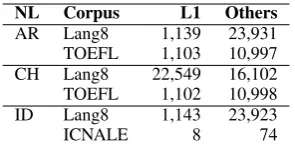
Due to the typical geographical origins of students registered in Australian universities, our interest is in Arabic (AR), Chinese (CH) and Indonesian (ID). Arabic is incorporated in TOEFL and Lang8, as well as Chinese. Indonesian is included in Lang8 and ICNALE. The number of documents per corpus and language is shown in Table1. As can be seen, classes are very imbalanced in most cases. Furthermore, in the case of Indonesian, fig-ures for the ICNALE corpus are very small7.
7We have used the merged text set from the ICNALE Written Essays 2.0
NL Corpus L1 Others AR Lang8 1,139 23,931 TOEFL 1,103 10,997 CH Lang8 22,549 16,102 TOEFL 1,102 10,998 ID Lang8 1,143 23,923
ICNALE 8 74
Table 1: Number of documents in each corpus.L1 cor-responds to the documents written by authors of the native language to be identified. Otherscomprise all the documents written by authors of the other native languages in the corpus.
3 Low Dimensionality Statistical Embedding
As shown in (Brooke and Hirst, 2012; Ionescu et al., 2014), single-layer representations such as
n-grams are able to obtain competitive results in a cross-corpus scenario. However, n-grams use
to be filtered in order to reduce dimensionality, and generally the most frequent ones are selected. Nevertheless, omitting some of the rarest terms is fairly common and necessary for top performance. We propose a Low Dimensionality Statistical Em-bedding (LDSE) to represent the documents on the basis of the probability distribution of the occur-rence of all their terms in the different languages, i.e. L1. Furthermore, LDSE represents texts with-out the need of using external resources or linguis-tic tools, nor preprocessing or feature engineering. The intuition is that the distribution of weights for a given document should be closer to the weights of its corresponding native language. The pro-posed representation relies on descriptive statistics to carry out the comparison among distributions. Formally, we represent the documents as follows.
We calculate thetf-idf weights for the terms in the training setD and build the matrix ∆. Each
row represents a documentdi, each column a
vo-cabulary termtj, and each cell represents the
tf-idf weight wij for each term in each document. Finally, δ(di) represents the assigned native lan-guagecto the documenti.
∆ =
w11 w12 ... w1m δ(d1)
w21 w22 ... w2m δ(d2)
... ... ... ...
wn1 wn2 ... wnm δ(dn) , (1)
Eq. 2 shows how we obtain the term weights
W(t, c) as the ratio between the weights of the
[image:2.595.77.290.465.534.2]and the total distribution of weights for that term.
W(t, c) =
P
d∈D/c=δ(d)wdt P
d∈Dwdt
,∀d∈D, c∈C
(2) As shown in Eq.3, these term weights are used to obtain the representation of the documents.
d={F(c1), F(c2), ..., F(cn)} ∼ ∀c∈C, (3)
EachF(ci)contains the set of features showed in Eq. 4, with the following meaning: i)average and median values of the document term weights;
ii)minimum and maximum values of the weights in the document;iii)first and third quartiles of the weights distribution;iv)Gini (Gini,1912) indexes (to measure the distribution skewness and kurto-sis); andvi)the nine first moments (Bowman and Shenton,1985) (the more moments two distribu-tions share, the more similar they are).
F(ci) ={avg, median, min, max,
Q1, Q3, G1, G2, M2, .., M10}
(4)
Finally, these weights are learned with a ma-chine learning algorithm. We have tested sev-eral machine learning algorithms and we report the ones with the best results: i) Naive Bayes in Lang8 for Arabic and Indonesian, as well as in ICNALE for Indonesian; ii) Simple Logistic in TOEFL for Arabic;ii)SVM in TOEFL and Lang8 for Chinese; andiii)Neural Networks in the Stu-dent Writing Task (SWT) for the three languages. As can be seen, this representation reduces the dimensionality to only 17 features per class by sta-tistically embedding the distribution of weights of the document terms, but unlike methods such as PCA or LSA, it takes into account all the terms in the corpus instead of removing those ones that contribute less. We have evaluated several ma-chine learning algorithms and reported the best re-sults obtained.
We have used both character and wordn-grams
with SVM to compare our proposal since they are the most common features used in the state of the art. We have iteratednfrom 1 to 5 with the top
100, 500, 1,000 and 5,000 most frequent terms. 4 Experimental scenario
In this section we report and discuss the obtained results. Firstly, we focus on the described corpora
for the languages of interest. Then, we analyse as a case study the Australian academic scenario. Due to the imbalance of the data, we use a macro-averaged F1-score which gives the same impor-tance to the different classes no matter their size.
4.1 Results on NLI corpora
Although NLI has most commonly approached as multi-class, the difficulty lining up multiple lan-guages across multiple corpora means that we in-stead focus here on the one versus all (1va) for-mulation; we note that in practice multi-class NLI using SVMs is of realized using 1va SVM classi-fication (Brooke and Hirst, 2012), so our results here should extend directly to the multi-class case. Results are presented in Table2. The second and third columns show respectively the corpus used for training and test: Lang8 and TOEFL include Arabic and Chinese, whereas Indonesian is in-cluded in Lang8 and ICNALE. The fourth column shows the best result obtained by the baseline:8, whereas the fifth column shows the result obtained with LDSE.
NL Train Test Base LDSE %
AR Lang8 TOEFL 54.75 65.30 19.27 TOEFL Lang8 51.10 59.60 16.63 CH Lang8 TOEFL 53.25 56.95 6.95 TOEFL Lang8 50.10 52.30 4.39 ID Lang8 ICNALE 73.05 86.15 17.93 ICNALE Lang8 53.75 61.35 14.14
Table 2: Results in macro-averaged F1-score. The baseline corresponds to the best result obtained with character or wordn-grams. The last column shows the improvement percentage achieved by LDSE over the baseline.
As can be seen, LDSE significantly9 outper-forms the best results obtained withn-grams for all languages and setups, with improvements from 4.39% up to to 19.27%. The highest improvement has been obtained for Arabic, although the best results were achieved for Indonesian. It is worth mentioning that, as shown in Table1, the ICNALE corpus is very small: 8 documents for Indonesian and 74 documents for the other 9 native languages. Due to that, especially in the case of evaluating on ICNALE, a small variation in the identification can cause a high variability in the results.
8The best results have been obtained with the following setupsi)character5-grams;ii)word1-grams;iii)character4 -grams;iv)character4-grams;v)word1-grams;vi)character 2-grams. In all the cases the 1,000 most frequentn-grams were selected.
Despite Chinese being larger and less imbal-anced in Lang8 (as can be seen in Table 1), the overall results are lower and closer to the baseline. No matter the language, the best results have been obtained when training with Lang8. This may be due to the larger size of this dataset, and especially to the freedom of choice of their authors to write about different topics.
4.2 Case study
With the aim of investigating the performance of our approach in the Australian academic scenario, we have tested LDSE on the Student Writing Task (SWT) corpus for the three native languages and compared the results obtained for the previous cor-pora. SWT contains 32 essays of 200–300 words, written by Computer Science PhD students study-ing in Australia. The students had 16 different native languages, including: Arabic (4), Chinese (5), and Indonesian (4). The essays all discuss the same topic, being the relative merit of three algo-rithms.
[image:4.595.77.288.445.538.2]To train our model, we have used Lang8 to-gether with TOEFL in the case of Arabic and Chi-nese, and Lang8 with ICNALE in the case of In-donesian. No data from SWT was used for train-ing.
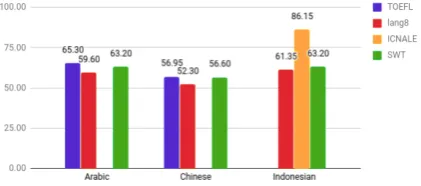
Figure 2: Comparative results of the LDSE model on the different corpora.
As shown in Figure2, results on SWT are sim-ilar to those obtained on Lang8 and TOEFL on the three languages. Specifically, results obtained on TOEFL are slightly better, whereas they are slightly worse in the case of Lang8, without sta-tistical significance in any case. However, results obtained on ICNALE are significantly higher.
5 Conclusions and future work
In this work, we have approached the task of iden-tifying the native language of authors based on their written text in English, focussing on the lan-guages of the main geographical origins of
stu-dents in the Australian academic environment: Arabic, Chinese, and Indonesian.
We have proposed the LDSE statistical embed-ding approach that considers descriptive statis-tics such as the distribution skewness and kurto-sis (Gini indexes) as well as the moment informa-tion to represent the documents of the three differ-ent classes (native languages). We have evaluated LDSE on the available corpora, showing a higher performance than SVM approaches based on n
-grams that obtained the bests results in the NLI previous shared tasks. Finally, we have evaluated LDSE also on the written essays of the SWT case study, showing its competitiveness from a cross-corpus perspective despite the small size and im-balance degree of the corpus.
Although it is typical to treat NLI as a multi-class problem instead of 1-vs-all, the main dif-ficulty would be to line up multiple languages across multiple corpora. Furthermore, our interest is in identifying whether the L1 is Arabic, Chinese or Indonesian. We aim to address NLI from multi-class perspective as a future work.
Acknowledgments
The research of the second author was partially funded by the SomEMBED TIN2015-71147-C2-1-P MINECO research project. The work on the data of authors whose native language is Arabic as well as this publication were made possible by NPRP grant #9-175-1-033 from the Qatar Na-tional Research Fund (a member of Qatar Founda-tion). The statements made herein are solely the responsibility of the first two authors.
References
Daniel Blanchard, Joel Tetreault, Derrick Higgins, Aoife Cahill, and Martin Chodorow. 2013. Toefl11: A corpus of non-native english. ETS Research Re-port Series2013(2).
Kamiko O Bowman and Leonard R Shenton. 1985. Method of moments.Encyclopedia of statistical sci-ences5:467–473.
Julian Brooke and Graeme Hirst. 2012. Robust, lexi-calized native language identification. Proceedings of COLING 2012pages 391–408.
Julian Brooke and Graeme Hirst. 2013. Using other learner corpora in the 2013 nli shared task. In
Jeroen Geertzen, Theodora Alexopoulou, and Anna Korhonen. 2013. Automatic linguistic annotation of large scale l2 databases: The ef-cambridge open lan-guage database (efcamdat). In Proceedings of the 31st Second Language Research Forum. Somerville, MA: Cascadilla Proceedings Project.
CW Gini. 1912. Variability and mutability, contribu-tion to the study of statistical distribucontribu-tion and re-laitons.Studi Economico-Giuricici della R.
Sylviane Granger. 2003. The international corpus of learner english: a new resource for foreign language learning and teaching and second language acquisi-tion research.Tesol Quarterly37(3):538–546.
Radu Tudor Ionescu, Marius Popescu, and Aoife Cahill. 2014. Can characters reveal your native lan-guage? a language-independent approach to native language identification. InProceedings of the 2014 Conference on Empirical Methods in Natural Lan-guage Processing (EMNLP). pages 1363–1373.
Radu Tudor Ionescu, Marius Popescu, and Aoife Cahill. 2016. String kernels for native language identification: Insights from behind the curtains.
Computational Linguistics42(3):491–525.
Shinichiro Ishikawa. 2011. A new horizon in learner corpus studies: The aim of the icnale project. Cor-pora and language technologies in teaching, learn-ing and researchpages 3–11.
Shervin Malmasi and Mark Dras. 2015. Large-scale native language identification with cross-corpus evaluation. InProceedings of the 2015 Conference of the North American Chapter of the Association for Computational Linguistics: Human Language Technologies. pages 1403–1409.
Shervin Malmasi, Keelan Evanini, Aoife Cahill, Joel Tetreault, Robert Pugh, Christopher Hamill, Diane Napolitano, and Yao Qian. 2017. A report on the 2017 native language identification shared task. In
Proceedings of the 12th Workshop on Innovative Use of NLP for Building Educational Applications. pages 62–75.
Joel Tetreault, Daniel Blanchard, and Aoife Cahill. 2013. A report on the first native language identi-fication shared task. In Proceedings of the eighth workshop on innovative use of NLP for building ed-ucational applications. pages 48–57.
Joel Tetreault, Daniel Blanchard, Aoife Cahill, and Martin Chodorow. 2012. Native tongues, lost and found: Resources and empirical evaluations in na-tive language identification. Proceedings of COL-ING 2012pages 2585–2602.
Yiming Yang and Xin Liu. 1999. A re-examination of text categorization methods. In Proceedings of the 22nd annual international ACM SIGIR confer-ence on Research and development in information retrieval. ACM, pages 42–49.