Proceedings of the Thirteenth Workshop on Innovative Use of NLP for Building Educational Applications, pages 365–369
TMU System for SLAM-2018
Masahiro Kaneko† Tomoyuki Kajiwara†‡
†Graduate School of Systems Design, Tokyo Metropolitan University, Tokyo, Japan ‡Institute for Datability Science, Osaka University, Osaka, Japan
[email protected] [email protected]
Mamoru Komachi†
Abstract
We introduce the TMU systems for the sec-ond language acquisition modeling shared task 2018 (Settles et al.,2018). To model learner error patterns, it is necessary to maintain a considerable amount of information regard-ing the type of exercises learners have been learning in the past and the manner in which they answered them. Tracking an enormous learner’s learning history and their correct and mistaken answers is essential to predict the learner’s future mistakes. Therefore, we pro-pose a model which tracks the learner’s learn-ing history efficiently. Our systems ranked fourth in the English and Spanish subtasks, and fifth in the French subtask.
1 Introduction
The second language acquisition modeling (SLAM) is an interesting research topic in the fields of psychology, linguistics, and pedagogy as well as engineering. Popular language learning applications such as Duolingo accumulate learn-ing data of language learners on a large-scale; thus, there has been an increasing interest for SLAM using machine learning using such data. In this study on SLAM, we aim to clarify both: (1) the inherent nature of second language learn-ing, and (2) effective machine learning/natural language processing (ML/NLP) engineering strategies to build personalized adaptive learning systems.
In order to predict the learner’s future mistakes, it is important to track a huge history of what and how exercises were solved by that learner and be able to model it. Therefore, we propose a model that can efficiently track a learner’s learning history. (Piech et al., 2015; Khajah et al., 2014, 2016)
Figure 1: An exercise example. Given exercise is a “correct” input. Outputs are “1” each time a learner makes a mistake
2 2018 Duolingo Shared Task on SLAM We used data from Duolingo in this shared task. Duolingo is the most popular language-learning online application. Learners solve the exercises and this shared task use only 3 type of exer-cises. Exercise (a) is a reverse translate item, where learners translate written prompt from the language they know into the language they are learning. Exercise (b) is areverse tapitem, where learners construct an answer given a set of words and distractors in the second language. Exercise (c) is alistenitem, where learners listen and tran-scribe an utterance in the second language. In this shared task, There are 3 exercise data of the fol-lowing groups of second language learners:
• English learners (who already speak Spanish)
• Spanish learners (who already speak English)
• French learners (who already speak English)
The Duolingo data set, which contains more than 2 million annotated words, is created from the answers submitted by more than 6,000 learn-ers during their first 30 days. In the related ex-ercises, learners answer questions related to the second language they are learning; thus, they in-evitably make various mistakes during the course. In this task, we predict mistakes on word level given an exercise. Figure 1 is an exercise exam-ple. Given a “correct” exercise as input a system has to predict labels as output.
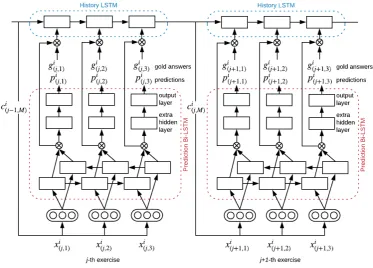
Figure 2: Architecture of the proposed TMU system.
In general, most tokens are perfect matches; however, the remainder of the tokens are either missing or spelled incorrectly (ignoring capitaliza-tion, punctuacapitaliza-tion, and accents). The former is signed the label “0” (OK), while the latter is as-signed the label “1” (Mistake).
3 TMU System
To track a lot of learner’s histories, our proposed TMU system has two components: (1) a base com-ponent that predicts whether a learner has made a mistake for the given word in an exercise (Fig. 2, Prediction Bi-LSTM) and (2) a component that tracks a specific learner’s information regarding the learned exercises and the words that he or she might have mistaken (Fig.2, History LSTM). It is expected to track huge history of the learned exer-cise by inputting the hidden state of the Prediction model to the History LSTM.
In prediction, we receive exercise as input and make predictions on word-level. Using Bi-LSTM for sequence labeling on exercise level, e.g., in-formation as POS tags or dependency edge labels, allows us to share information within each exer-cise for better prediction. We perform training by feeding input exercises arranged in a
chronologi-cal order for each learner.
3.1 Features
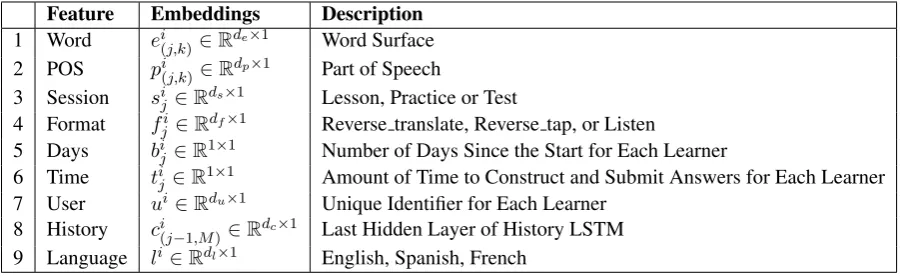
Table 1lists all the features used by our system. We use features (1-7) included in the dataset dis-tributed by the task organizers as well as the track-ing history (8) (Section 3.3) and labels for lan-guage identification (9). We trained a single model with three languages, including English, Spanish, and French; in addition, we used the language identification feature to distinguish them.
There are three types of inputs for the Bi-LSTM. The first input includes word-level features that indicate information changing for each word in an exercise. In particular, word surface and POS are used as word-level features. The second input consists of exercise-level features. In particular, days, session, format, time, and history are used as exercise-level features. The third input includes learner-level features. For this, learner and lan-guage features are extracted for each learner.
3.2 Prediction Bidirectional LSTM
Feature Embeddings Description
1 Word ei
(j,k)∈Rde×1 Word Surface
2 POS pi(j,k)∈Rdp×1 Part of Speech
3 Session si
j ∈Rds×1 Lesson, Practice or Test
4 Format fi
j∈Rdf×1 Reverse translate, Reverse tap, or Listen
5 Days bi
j∈R1×1 Number of Days Since the Start for Each Learner
6 Time ti
j∈R1×1 Amount of Time to Construct and Submit Answers for Each Learner
7 User ui∈Rdu×1 Unique Identifier for Each Learner
8 History ci
(j−1,M)∈Rdc×1 Last Hidden Layer of History LSTM
[image:3.595.74.525.62.201.2]9 Language li∈Rdl×1 English, Spanish, French
Table 1: Features used in our system.i: Learner’s ID;j: Exercise Number of thei-th Learner;k: Word’s and POS’s index of thej-th Exercise.de: Word Embedding Size;dp: POS Embedding Size;ds: Session
Embedding Size;df: Format Embedding Size;du: User Embedding Size;dc: History Embedding Size; M: Total Sentence Length of All Previous Exercises;dl: Language Embedding Size.
andpi(j,k)distributed representations, respectively.
Further, the session and format of the j-th
exer-cise of thei-th learner are converted into si j and fji distributed representations, respectively. Days
and time are represented asbijandtij, respectively.
User and language are converted into ui and li
distributed representations, respectively. History is the last hidden state ci(j−1,M) of the History
LSTM, which will be described later (Section3.3). The inputs of the Bi-LSTM are given as
xi(j,1), xi(j,2),· · ·, xi(j,N). where, xi(j,k) = [ei(j,k);pi(j,k);sij;fji;bji;tij;ci(j−1,M);ui;li] is the
concatenation of all features and N is the length
of the j-th exercise. xi
(j,k) is converted into the
forward hidden state −−−→hi
(j,k) ∈ Rdh×1 and
back-ward hidden state ←−−−hi
(j,k) ∈ Rdh×1 using LSTM,
where dh is the hidden size. The final hidden
state hi(j,k) ∈ R2dh×1 is acquired by
concatenat-ing−−−→hi(j,k) and←−−−hi(j,k). Further,hi(j,k)is fed into the
extra hidden layer:
ˆ
hi(j,k)= ReLU(Whhi(j,k)+bh) (1)
whereˆhi
(j,k)∈Rdˆh×1is an extra hidden layer
out-put, Wh ∈ Rdˆh×dh is a weighting matrix, and bh ∈ Rdˆh×1 is a bias. The extra hidden layer
outputˆhi
(j,k)is linearly transformed using the
out-put layer as follows and the probability distribu-tionpi
(j,k) ∈Rt×1 of the true/false tag is acquired
using the softmax function, wheretis the size of
the tag, which is set to 2 in our study.
pi(j,k)= softmax(Whˆhˆi(j,k)+bˆh) (2)
whereWˆh∈Rt×dhˆ is a weighting matrix andbˆ h∈ Rt×1is a bias.
3.3 History LSTM
As previously mentioned, to correctly predict each learner’s mistakes, it is important to consider not only the history of learned exercises, but also the learner’s answers to exercises. Thus, the History LSTM tracks all previous information regarding the learned exercises and how they were answered by each learner.
For each j-th exercise, oi(j,1), oi(j,2),· · ·, oi(j,N)
is given as an input to the j-th History LSTM,
whereoi(j,k) = [hi(j,k);g(j,k)i ]. hi(j,k) (Section3.2)
is considered as information about the j-th
exer-cise of the i-th learner and gi
(j,k) ∈ R1×1 is the
gold answer of thei-th learner to thej-th exercise. In addition, the first hidden state and cell mem-ory of the j-th History LSTM is initialized with
the last hidden state and cell memory of the previ-ousj-1-th History LSTM. The hidden state ci(j,1)
is created fromoi(j,1)using the LSTM for the next
step of the Prediction Bi-LSTM.
3.4 Training
The objective function is defined as follows:
Lθ = 1 |D|
∑
(x,y)∈D
logp(y|x;θ) (3)
where D is the training data and θ represents
model parameters. We use Backpropagation Through Time (BPTT) for training.
Language Train Dev Test
[image:4.595.324.509.60.284.2]English 936,782 3,000 114,586 Spanish 824,899 3,000 93,145 French 367,402 3,000 41,753
Table 2: Number of exercises for each language.
have low-frequency, but because they have not been learned yet. Hence, we use words that ap-pear for the first time in an exercise to be replaced by unkword to learn unkvector. In addition, we use words without unk replacement to track the
history for the History LSTM.
The final loss is calculated as follows:
Lθ =αLunkθ + (1−α)Lorigθ (4)
whereαLunkθ is calculated by replacing the word
appearing for the first time withunk, while(1−
α)Lorigθ is calculated using this word itself. In
par-ticular,αexpresses the degree of emphasis placed
onunkand a learned word. For example, when a word “Japanese” appears for the first time, then:
Original exercise:I am Japanese
Replaced byunk:I am<unk>
If theunkdoes not exist in any exercise,Lθhas the
same value asLorigθ .
3.5 Testing
During our test, predictions were made on exer-cises of the test data arranged in chronological or-der for each learner. We update History LSTM using output and hidden state of Prediction Bi-LSTM. Test data does not have gold answers un-like training data. Hence, each system used its own converted probability outputs of the Predic-tion Bi-LSTM component with arg max as gold answers.
In addition, we performed ensemble predic-tions. The parameters of ensemble models are ini-tialized with different values. As the final predic-tion result, we used the average of the probability outputs of each Prediction Bi-LSTM. Each system used its own converted probability outputs of the Prediction Bi-LSTM component as gold answers.
4 Experiments
4.1 Experiment settings
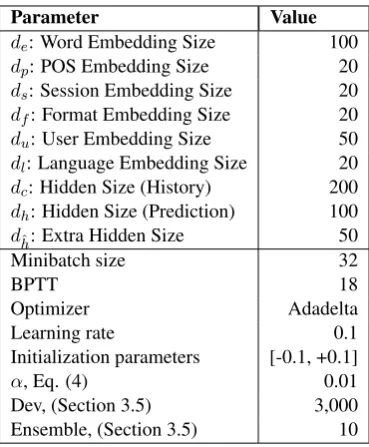
Table 2 shows the number of exercises for train, dev and test data for each language. The hyper pa-rameters of our model are listed in Table 3. All
Parameter Value
de: Word Embedding Size 100
dp: POS Embedding Size 20
ds: Session Embedding Size 20
df: Format Embedding Size 20
du: User Embedding Size 50
dl: Language Embedding Size 20
dc: Hidden Size (History) 200
dh: Hidden Size (Prediction) 100
dˆh: Extra Hidden Size 50
Minibatch size 32
BPTT 18
Optimizer Adadelta
Learning rate 0.1
Initialization parameters [-0.1, +0.1]
α, Eq. (4) 0.01
Dev, (Section 3.5) 3,000 Ensemble, (Section 3.5) 10
Table 3: Hyper parameter values.
words that appeared in the training data were in-cluded in the vocabulary. Preliminary experiments showed that the AUROC of the one model trained on data of three languages was higher than those models trained for each language. Therefore, we trained a single model with three language tracks, including English, Spanish and French. Espe-cially, AUROC increased for low-resource French language.
Each model of the ensemble uses different dev and training sets randomly sampled from the data. In particular, since we needed to evaluate the learning results of Future Days of each learner, we combined the provided official training and dev sets and arranged exercises in chronological or-der of Days for each learner. Next, we randomly sampled exercises from final learning exercises of learners to create a dev set and the remaining data were used as training data.
4.2 Results
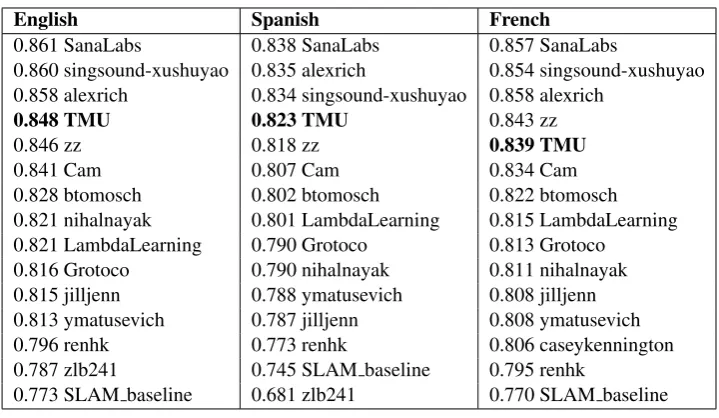
Table 4 lists the results of SLAM for English learners, Spanish learners, and French learners. The systems are ranked by their AUROC. The TMU system ranked fourth in English and Spanish subtasks, while it ranked fifth in the French sub-task.
4.3 Analysis of Tracking History
[image:4.595.90.271.62.113.2]English Spanish French
0.861 SanaLabs 0.838 SanaLabs 0.857 SanaLabs
0.860 singsound-xushuyao 0.835 alexrich 0.854 singsound-xushuyao 0.858 alexrich 0.834 singsound-xushuyao 0.858 alexrich
0.848 TMU 0.823 TMU 0.843 zz
0.846 zz 0.818 zz 0.839 TMU
0.841 Cam 0.807 Cam 0.834 Cam 0.828 btomosch 0.802 btomosch 0.822 btomosch 0.821 nihalnayak 0.801 LambdaLearning 0.815 LambdaLearning 0.821 LambdaLearning 0.790 Grotoco 0.813 Grotoco
0.816 Grotoco 0.790 nihalnayak 0.811 nihalnayak 0.815 jilljenn 0.788 ymatusevich 0.808 jilljenn 0.813 ymatusevich 0.787 jilljenn 0.808 ymatusevich 0.796 renhk 0.773 renhk 0.806 caseykennington 0.787 zlb241 0.745 SLAM baseline 0.795 renhk
[image:5.595.119.479.59.268.2]0.773 SLAM baseline 0.681 zlb241 0.770 SLAM baseline
Table 4: SLAM official evaluation results. Systems are ranked by AUROC.
Model AUROC
W/ History Model 0.834 W/O History Model 0.648
Table 5: The history model has an effect to improve AUROC on English subtask.
does not consider history (W/O History Model) on the dev set for English. The W/O History Model used only the Prediction Bi-LSTM component which does not use the history feature. For exper-iments using this model, we used a single model trained only on the English corpus. The default split of training set and dev set was 824,012 ex-ercises and 115,770 exex-ercises, respectively. Both aforementioned models used the same parameters as listed in Table3.
Table 5 lists our evaluation results1. It can be observed that the AUROC of prediction of the W/ History Model case is considerably higher than that of the W/O History Model. As we expected, it is important to consider what learner have learned in the past and how they responded to it in order to improve future predictions.
5 Conclusion
In this study, we described the TMU system for the 2018 SLAM Shared Task. Our system is based on RNN; It has two components: (1) Bi-LSTM for predicting learners’ error and (2) LSTM for track-ing learners’ learntrack-ing history.
1The performance is slightly different from the one
re-ported in Table 3 because of the difference in models and ensembling.
In this work, we have not used any language-specific information. As future work, we plan to exploit additional data for each language, such as pre-trained word representations, n-grams, and character-based features. Additionally, we hope to incorporate word difficulty features (Kajiwara and Komachi, 2018). In particular, the more complex a word is, the more difficult it likely is to be learned.
References
T. Kajiwara and M. Komachi. 2018. Complex Word Identification Based on Frequency in a Learner Cor-pus. InProceedings of The 13th Workshop on Inno-vative Use of NLP for Building Educational Appli-cations (BEA).
M. Khajah, R. V. Lindsey, and M. C. Mozer. 2016. How Deep Is Knowledge Tracing? CoRR.
M. Khajah, R. Wing, R. V. Lindsey, and M. C. Mozer. 2014. Integrating Latent-Factor and Knowledge-Tracing Models to Predict Individual Differences in Learning. InEducational Data Mining 2014. Cite-seer.
C. Piech, J. Bassen, J. Huang, S. Ganguli, M. Sa-hami, L. Guibas, and J. Sohl-Dickstein. 2015. Deep Knowledge Tracing. InAdvances in Neural Infor-mation Processing Systems 28, pages 505–513.