Bridge Correlational Neural Networks for Multilingual Multimodal
Representation Learning
Janarthanan Rajendran IIT Madras, India.
Mitesh M. Khapra IBM Research India.
Sarath Chandar University of Montreal.
Balaraman Ravindran IIT Madras, India.
Abstract
Recently there has been a lot of interest in learning common representations for multiple views of data. Typically, such common rep-resentations are learned using a parallel cor-pus between the two views (say, 1M images and their English captions). In this work, we address a real-world scenario where no direct parallel data is available between two views of interest (say,V1andV2) but parallel
data is available between each of these views and a pivot view (V3). We propose a model
for learning a common representation forV1,
V2 andV3 using only the parallel data
avail-able betweenV1V3 andV2V3. The proposed
model is generic and even works when there arenviews of interest and only one pivot view which acts as a bridge between them. There are two specific downstream applications that we focus on (i) transfer learning between lan-guages L1,L2,...,Ln using a pivot language L and (ii) cross modal access between im-ages and a language L1 using a pivot
lan-guageL2. Our model achieves state-of-the-art
performance in multilingual document classi-fication on the publicly available multilingual TED corpus and promising results in multilin-gual multimodal retrieval on a new dataset cre-ated and released as a part of this work.
1 Introduction
The proliferation of multilingual and multimodal content online has ensured that multiple views of the same data exist. For example, it is common to find the same article published in multiple lan-guages online in multilingual news articles, multilin-gual wikipedia articles,etc. Such multiple views can
even belong to different modalities. For example, images and their textual descriptions are two views of the same entity. Similarly, audio, video and subti-tles of a movie are multiple views of the same entity. Learning common representations for such mul-tiple views of data will help in several downstream applications. For example, learning a common rep-resentation for images and their textual descriptions could help in finding images which match a given textual description. Further, such common represen-tations can also facilitate transfer learning between views. For example, a document classifier trained on one language (view) can be used to classify doc-uments in another language by representing docu-ments of both languages in a common subspace.
Existing approaches to common representation learning (Ngiam et al., 2011; Klementiev et al., 2012; Chandar et al., 2013; Chandar et al., 2014; Andrew et al., 2013; Wang et al., 2015) except (Her-mann and Blunsom, 2014b) typically require paral-lel data between all views. However, in many real-world scenarios such parallel data may not be avail-able. For example, while there are many publicly available datasets containing images and their cor-responding English captions, it is very hard to find datasets containing images and their corresponding captions in Russian, Dutch, Hindi, Urdu,etc. In this work, we are interested in addressing such scenar-ios. More specifically, we consider scenarios where we haven different views but parallel data is only available between each of these views, and a pivot view. In particular, there is no parallel data available between the non-pivot views.
To this end, we propose Bridge Correlational
Neural Networks (Bridge CorrNets) which learn aligned representations across multiple views using a pivot view. We build on the work of (Chandar et al., 2016) but unlike their model, which only ad-dresses scenarios where direct parallel data is avail-able between two views, our model can work for
n(≥2) views even when no parallel data is avail-able between all of them. Our model only requires parallel data between each of these n views and a pivot view. During training, our model maximizes the correlation between the representations of the pivot view and each of thenviews. Intuitively, the pivot view ensures that similar entities across differ-ent views get mapped close to each other since the model would learn to map each of them close to the corresponding entity in the pivot view.
We evaluate our approach using two downstream applications. First, we employ our model to facil-itate transfer learning between multiple languages using English as the pivot language. For this, we do an extensive evaluation using 110 source-target language pairs and clearly show that we out-perform the current state-of-the art approach (Her-mann and Blunsom, 2014b). Second, we em-ploy our model to enable cross modal access be-tween images and French/German captions using English as the pivot view. For this, we created a test dataset consisting of images and their cap-tions in French and German in addition to the En-glish captions which were publicly available. To the best of our knowledge, this task of retrieving im-ages given French/German captions (and vice versa) without direct parallel training data between them has not been addressed in the past. Even on this task we report promising results. Code and data used in this paper can be downloaded fromhttp: //sarathchandar.in/bridge-corrnet.
2 Related Work
Canonical Correlation Analysis (CCA) and its vari-ants (Hotelling, 1936; Vinod, 1976; Nielsen et al., 1998; Cruz-Cano and Lee, 2014; Akaho, 2001) are the most commonly used methods for learning a common representation for two views. However, most of these models generally work with two views only. Even though there are multi-view generaliza-tions of CCA (Tenenhaus and Tenenhaus, 2011; Luo
et al., 2015), their computational complexity makes them unsuitable for larger data sizes.
Another class of algorithms for multiview learn-ing is based on Neural Networks. One of the ear-liest neural network based model for learning com-mon representations was proposed in (Hsieh, 2000). Recently, there has been a renewed interest in this field and several neural network based models have been proposed. For example, Multimodal Autoen-coder (Ngiam et al., 2011), Deep Canonically Cor-related Autoencoder (Wang et al., 2015), Deep CCA (Andrew et al., 2013) and Correlational Neural Net-works (CorrNet) (Chandar et al., 2016). CorrNet performs better than most of the above mentioned methods and we build on their work as discussed in the next section.
One of the tasks that we address in this work is multilingual representation learning where the aim is to learn aligned representations for words across languages. Some notable neural network based ap-proaches here include the works of (Klementiev et al., 2012; Zou et al., 2013; Mikolov et al., 2013; Hermann and Blunsom, 2014b; Hermann and Blun-som, 2014a; Chandar et al., 2014; Soyer et al., 2015; Gouws et al., 2015). However, except for (Her-mann and Blunsom, 2014a; Her(Her-mann and Blunsom, 2014b), none of these other works handle the case when parallel data is not available between all lan-guages. Our model addresses this issue and outper-forms the model of Hermann and Blunsom (2014b). The task of cross modal access between images and text addressed in this work comes under Mul-tiModal Representation Learning where each view belongs to a different modality. Ngiam et al. (2011) proposed an autoencoder based solution to learning common representation for audio and video. Srivas-tava and Salakhutdinov (2014) extended this idea to RBMs and learned common representations for im-age and text. Other solutions for imim-age/text rep-resentation learning include (Zheng et al., 2014a; Zheng et al., 2014b; Socher et al., 2014). All these approaches require parallel data between the two views and do not address multimodal, multilingual learning in situations where parallel data is available only between different views and a pivot view.
Nakov and Ng, 2009)), transitive CLIR (Ballesteros, 2000; Lehtokangas et al., 2008), transliteration and transliteration mining (Khapra et al., 2010a; Ku-maran et al., 2010; Khapra et al., 2010b; Zhang et al., 2011). None of these works use neural networks but it is important to mention them here because they use the concept of a pivot language (view) which is central to our work.
3 Bridge Correlational Neural Network
In this section, we describe Bridge CorrNet which is an extension of the CorrNet model proposed by (Chandar et al., 2016). They address the problem of learning common representations between two views when parallel data is available between them. We propose an extension to their model which si-multaneously learns a common representation forM
views when parallel data is available only between one pivot view and the remainingM −1views.
Let these views be denoted byV1, V2, ..., VM and
let d1, d2, ..., dM be their respective
dimensionali-ties. Let the training data be Z = {zi}N
i=1 where
each training instance contains only two views,i.e.,
zi = (vi
j, vMi )wherej ∈ {1,2, .., M−1}andM is
a pivot view. To be more clear, the training data con-tainsN1 instances for which(v1i, viM)are available, N2 instances for which (v2i, viM) are available and
so on tillNM−1instances for which(vMi −1, vMi )are
available (such thatN1+N2+...+NM−1 =N).
We denote each of these disjoint pairwise training sets byZ1,Z2 toZM−1 such thatZ is the union of
all these sets.
As an illustration consider the case when English, French and German texts are the three views of in-terest with English as the pivot view. As training data, we have N1 instances containing English and
their corresponding French texts and N2 instances
containing English and their corresponding German texts. We are then interested in learning a common representation for English, French and German even though we do not have any training instance contain-ing French and their correspondcontain-ing German texts.
Bridge CorrNet uses an encoder-decoder architec-ture with a correlation based regularizer to achieve this. It contains one encoder-decoder pair for each of theM views. For each viewVj, we have,
[image:3.612.334.518.53.177.2]hVj(vj) =f(Wjvj +b) (1)
Figure 1:Bridge Correlational Neural Network. The views are English, French and German with English being the pivot view.
wheref is any non-linear function such as sigmoid or tanh,Wj ∈Rk×dj is the encoder matrix for view Vj, b ∈ Rk is the common bias shared by all the
encoders. We also compute a hidden representation for the concatenated training instancez= (vj, vM)
using the following encoder function:
hZ(z) =f(Wjvj+WMvM +b) (2)
In the remainder of this paper, whenever we drop the subscript for the encoder, then the encoder is deter-mined by its argument. For example h(vj) means hVj(vj),h(z)meanshZ(z)and so on.
Our model also has a decoder corresponding to each view as follows:
gVj(h) =p(W0
jh+cj) (3)
wherepcan be any activation function,W0
j ∈Rdj×k
is the decoder matrix for viewVj,cj ∈ Rdj is the
decoder bias for view Vj. We also define g(h) as
simply the concatenation of[gVj(h), gVM(h)]. In effect, hVj(.) encodes the inputvj into a
hid-den representation h and then gVj(.) tries to de-code/reconstructvj from this hidden representation h. Note that h can be computed using h(vj) or h(vM). The decoder can then be trained to
de-code/reconstruct bothvjandvMgiven a hidden
rep-resentation computed using any one of them. More formally, we train Bridge CorrNet by minimizing the following objective function:
JZ(θ) =
N X
i=1
L(zi, g(h(zi))) +XN i=1
L(zi, g(h(vi l(i))))
+XN
i=1
L(zi, g(h(vi
M)))−λcorr(h(Vl(i)), h(VM))
wherel(i) = jifzi ∈ Z
j and the correlation term
corris defined as follows:
corr =
PN
i=1(h(xi)−h(X))(h(yi)−h(Y)) qPN
i=1(h(xi)−h(X))2 PN
i=1(h(yi)−h(Y))2
(5)
Note thatg(h(zi))is the reconstruction of the input zi after passing through the encoder and decoder.L
is a loss function which captures the error in this re-construction,λis the scaling parameter to scale the last term with respect to the remaining terms,h(X)
is the mean vector for the hidden representations of the first view and h(Y) is the mean vector for the hidden representations of the second view.
We now explain the intuition behind each term in the objective function. The first term captures the er-ror in reconstructing the concatenated inputzifrom
itself. The second term captures the error in recon-structing both views given the non-pivot view,vi
l(i).
The third term captures the error in reconstructing both views given the pivot view,vi
M. Minimizing the
second and third terms ensures that both the views can be predicted from any one view. Finally, the correlation term ensures that the network learns cor-related common representations for all views.
Our model can be viewed as a generalization of the two-view CorrNet model proposed in (Chandar et al., 2016). By learning joint representations for multiple views using disjoint training setsZ1,Z2 to
ZM−1it eliminates the need fornC2pair-wise
paral-lel datasets between all views of interest. The pivot view acts as a bridge and ensures that similar enti-ties across different views get mapped close to each other since all of them would be close to the corre-sponding entity in the pivot view.
Note that unlike the objective function of Cor-rNet (Chandar et al., 2016), the objective tion of Equation 4, is a dynamic objective func-tion which changes with each training instance. In other words,l(i) ∈ {1,2, .., M−1}varies for each
i ∈ {1,2, .., N}. For efficient implementation, we construct mini-batches where each mini-batch will come from only one of the sets Z1 to ZM−1. We randomly shuffle these mini-batches and use corre-sponding objective function for each mini-batch.
As a side note, we would like to mention that in addition toZ1,Z2 toZM−1 as defined earlier, if
ad-ditional parallel data is available between some of
the non-pivot views then the objective function can be suitably modified to use this parallel data to fur-ther improve the learning. However, this is not the focus of this work and we leave this as a possible future work.
4 Datasets
In this section, we describe the two datasets that we used for our experiments.
4.1 Multlingual TED corpus
Hermann and Blunsom (2014b) provide a multilin-gual corpus based on the TED corpus for IWSLT 2013 (Cettolo et al., 2012). It contains English tran-scriptions of several talks from the TED conference and their translations in multiple languages. We use the parallel data between English and other lan-guages for training Bridge Corrnet (English, thus, acts as the pivot langauge). Hermann and Blunsom (2014b) also propose a multlingual document classi-fication task using this corpus. The idea is to use the keywords associated with each talk (document) as class labels and then train a classifier to predict these classes. There are one or more such keywords asso-ciated with each talk but only the 15 most frequent keywords across all documents are considered as class labels. We used the same pre-processed splits1
as provided by (Hermann and Blunsom, 2014b). The training corpus consists of a total of 12,078 par-allel documents distributed across 12 language pairs.
4.2 Multilingual Image Caption dataset
The MSCOCO dataset2 contains images and their
English captions. On an average there are 5 cap-tions per image. The standard train/valid/test splits for this dataset are also available online. However, the reference captions for the images in the test split are not provided. Since we need such reference cap-tions for evaluacap-tions, we create a new train/valid/test of this dataset. Specifically, we take 80K images from the standard train split and 40K images from the standard valid split. We then randomly split the merged 120K images into train(118K), valida-tion (1K) and test set (1K).
We then create a multilingual version of the test data by collecting French and German translations for all the 5 captions for each image in the test set. We use crowdsourcing to do this. We used the CrowdFlower platform and solicited one French and one German translation for each of the 5000 cap-tions using native speakers. We got each transla-tion verified by 3 annotators. We restricted the ge-ographical location of annotators based on the tar-get language. We found that roughly 70% of the French translations and 60% of the German trans-lations were marked as correct by a majority of the verifiers. On further inspection with the help of in-house annotators, we found that the errors were mainly syntactic and the content words are trans-lated correctly in most of the cases. Since none of the approaches described in this work rely on syn-tax, we decided to use all the 5000 translations as test data. This multilingual image caption test data (MIC test data) will be made publicly available3and
will hopefully assist further research in this area.
5 Experiment 1: Transfer learning using a pivot language
From the TED corpus described earlier, we consider English transcriptions and their translations in 11 languages, viz., Arabic, German, Spanish, French, Italian, Dutch, Polish, Portuguese (Brazilian), Ro-man, Russian and Turkish. Following the setup of Hermann and Blunsom (2014b), we consider the task of cross language learning between each of the
11C
2non-English language pairs. The task is to
clas-sify documents in a language when no labeled train-ing data is available in this language but traintrain-ing data is available in another language. This involves the following steps:
1. Train classifier: Consider one language as the source language and the remaining 10 languages as target languages. Train a document classifier us-ing the labeled data of the source language, where each training document is represented using the hid-den representation computed using a trained Bridge Corrnet model. As in (Hermann and Blunsom, 2014b) we used an averaged perceptron trained for 10 epochs as the classifier for all our experiments. The train split provided by (Hermann and Blunsom,
3http://sarathchandar.in/bridge-corrnet
2014b) is used for training.
2. Cross language classification: For every target language, compute a hidden representation for ev-ery document in its test set using Bridge CorrNet. Now use the classifier trained in the previous step to classify this document. The test split provided by (Hermann and Blunsom, 2014b) is used for testing.
5.1 Training and tuning Bridge Corrnet
For the above process to work, we first need to train Bridge Corrnet so that it can then be used for com-puting a common hidden representation for docu-ments in different languages. For training Bridge CorrNet, we treat English as the pivot language (view) and construct parallel training setsZ1 toZ11.
Every instance inZ1 contains the English and Ara-bic view of the same talk (document). Similarly, ev-ery instance inZ2 contains the English and German
view of the same talk (document) and so on. For every language, we first construct a vocabulary con-taining all words appearing more than 5 times in the corpus (all talks) of that language. We then use this vocabulary to construct a bag-of-words representa-tion for each document. The size of the vocabulary (|V|) for different languages varied from 31213 to 60326 words. To be more clear, v1 = varabic ∈
R|V|arabic,v2 =vgerman∈R|V|german and so on.
We train our model for 10 epochs using the above training dataZ ={Z1,Z2, ...,Z11}. We use hidden
representations of size D = 128, as in (Hermann and Blunsom, 2014b). Further, we used stochastic gradient descent with mini-batches of size20. Each mini-batch contains data from only one of theZis.
We get a stochastic estimate for the correlation term in the objective function using this mini-batch. The hyperparameter λ was tuned to each task using a training/validation split for the source language and using the performance on the validation set of an av-eraged perceptron trained on the training set (notice that this corresponds to a monolingual classification experiment, since the general assumption is that no labeled data is available in the target language).
5.2 Results
F1-Training
Language Arabic German Spanish French ItalianTest LanguageDutch Polish Pt-Br Rom’n Russian Turkish
Arabic 0.662 0.654 0.645 0.663 0.654 0.626 0.628 0.630 0.607 0.644
German 0.920 0.544 0.505 0.654 0.672 0.631 0.507 0.583 0.537 0.597
Spanish 0.666 0.465 0.547 0.512 0.501 0.537 0.518 0.573 0.463 0.434
French 0.761 0.585 0.679 0.681 0.646 0.671 0.650 0.675 0.613 0.578
Italian 0.701 0.421 0.456 0.457 0.530 0.442 0.491 0.390 0.402 0.499
Dutch 0.847 0.370 0.511 0.472 0.600 0.536 0.489 0.458 0.470 0.516
Polish 0.533 0.387 0.556 0.535 0.536 0.454 0.446 0.521 0.473 0.413
Pt-Br 0.609 0.502 0.572 0.553 0.548 0.535 0.545 0.557 0.451 0.463
Rom’n 0.573 0.460 0.559 0.530 0.521 0.484 0.475 0.485 0.486 0.458
Russian 0.755 0.460 0.537 0.437 0.567 0.499 0.550 0.478 0.475 0.484
[image:6.612.94.515.54.178.2]Turkish 0.950 0.373 0.480 0.452 0.542 0.544 0.585 0.297 0.512 0.412
Table 1:F1-scores for TED corpus document classification results when training and testing on two languages that do not share any parallel data. We train a Bridge CorrNet model on all en-L2 language pairs together, and then use the resulting embeddings to train document classifiers in each language. These classifiers are subsequently used to classify data from all other languages.
Training
Language Arabic German Spanish French ItalianTest LanguageDutch Polish Pt-Br Rom’n Russian Turkish
Arabic 0.378 0.436 0.432 0.444 0.438 0.389 0.425 0.42 0.446 0.397
German 0.368 0.474 0.46 0.464 0.44 0.375 0.417 0.447 0.458 0.443
Spanish 0.353 0.355 0.42 0.439 0.435 0.415 0.39 0.424 0.427 0.382
French 0.383 0.366 0.487 0.474 0.429 0.403 0.418 0.458 0.415 0.398
Italian 0.398 0.405 0.461 0.466 0.393 0.339 0.347 0.376 0.382 0.352
Dutch 0.377 0.354 0.463 0.464 0.46 0.405 0.386 0.415 0.407 0.395
Polish 0.359 0.386 0.449 0.444 0.43 0.441 0.401 0.434 0.398 0.408
Pt-Br 0.391 0.392 0.476 0.447 0.486 0.458 0.403 0.457 0.431 0.431
Rom’n 0.416 0.32 0.473 0.476 0.46 0.434 0.416 0.433 0.444 0.402
Russian 0.372 0.352 0.492 0.427 0.438 0.452 0.43 0.419 0.441 0.447
[image:6.612.96.514.231.355.2]Turkish 0.376 0.352 0.479 0.433 0.427 0.423 0.439 0.367 0.434 0.411
Table 2:F1-scores for TED corpus document classification results when training and testing on two languages that do not share any parallel data. Same procedure as Table 1, but with DOC/ADD model in (Hermann and Blunsom, 2014b).
Setting Arabic German Spanish French ItalianLanguagesDutch Polish Pt-Br Rom’n Russian Turkish
Raw Data NB 0.469 0.471 0.526 0.532 0.524 0.522 0.415 0.465 0.509 0.465 0.513
DOC/ADD (Single) 0.422 0.429 0.394 0.481 0.458 0.252 0.385 0.363 0.431 0.471 0.435
DOC/BI (Single) 0.432 0.362 0.336 0.444 0.469 0.197 0.414 0.395 0.445 0.436 0.428
DOC/ADD (Joint) 0.371 0.386 0.472 0.451 0.398 0.439 0.304 0.394 0.453 0.402 0.441
DOC/BI (Joint) 0.329 0.358 0.472 0.454 0.399 0.409 0.340 0.431 0.379 0.395 0.435
Bridge CorrNet 0.266 0.456 0.535 0.529 0.551 0.565 0.478 0.535 0.490 0.447 0.477
Table 3:: F1-scores on the TED corpus document classification task when training and evaluating on the same language. Results other than Bridge CorrNet are taken from (Hermann and Blunsom, 2014b).
scores over all the 15 classes. We compare our re-sults with the best rere-sults reported in (Hermann and Blunsom, 2014b) (see Table 2). Out of the 110 experiments, our model outperforms the model of (Hermann and Blunsom, 2014b) in 107 experiments. This suggests that our model efficiently exploits the pivot language to facilitate cross language learning between other languages.
Finally, we present the results for a monolingual classification task in Table 3. The idea here is to see if learning common representations for multiple views can also help in improving the performance of a task involving only one view. Hermann and
[image:6.612.77.534.392.471.2]6 Experiment 2: Cross modal access using a pivot language
In this experiment, we are interested in retrieving images given their captions in French (or German) and vice versa. However, for training we do not have any parallel data containing images and their French (or German) captions. Instead, we have the following datasets: (i) a datasetZ1 containing
im-ages and their English captions and (ii) a datasetZ2
containing English and their parallel French (or Ger-man) documents. ForZ1, we use the training split
of MSCOCO dataset which contains 118K images and their English captions (see Section 4.2). For
Z2, we use the English-French (or German)
paral-lel documents from the train split of the TED corpus (see Section 4.1). We use English as the pivot lan-guage and train Bridge Corrnet usingZ ={Z1,Z2}
to learn common representations for images, En-glish text and French (or German) text. For text, we use bag-of-words representation and for image, we use the 4096 (fc6) representation got from a pre-trained ConvNet (BVLC Reference CaffeNet (Jia et al., 2014)). We learn hidden representations of size
D = 200by training Bridge Corrnet for 20 epochs using stochastic gradient descent with mini-batches of size20. Each mini-batch contains data from only one of theZis.
For the task of retrieving captions given an image, we consider the 1000 images in our test set (see sec-tion 4.2) as queries. The 5000 French (or German) captions corresponding to these images (5 per im-age) are considered as documents. The task is then to retrieve the relevant captions for each image. We represent all the captions and images in the com-mon space as computed using Bridge Corrnet. For a given query, we rank all the captions based on the Euclidean distance between the representation of the image and the caption. For the task of retrieving im-ages given a caption, we simply reverse the role of the captions and images. In other words, each of the 5000 captions is treated as a query and the 1000 im-ages are treated as documents. λwas tuned to each task using a training/validation split. For the task of retrieving French/German captions given an image,
λwas tuned using the performance on the validation set for retrieving French (or German) sentences for a given English sentence. For the other task,λwas
tuned using the performance on the validation set for retrieving images, given English captions. We do not use any image-French/German parallel data for tuning the hyperparameters.
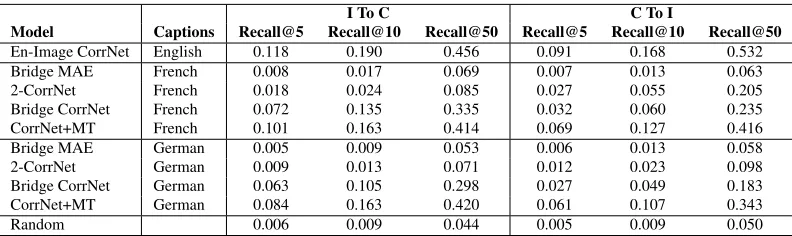
We use recall@k as the performance metric and compare the following methods in Table 4:
1. En-Image CorrNet: This is the CorrNet model trained using onlyZ1 as defined earlier in this
sec-tion. The task is to retrieve English captions for a given image (or vice versa). This gives us an idea about the performance we could expect if direct par-allel data is available between images and their cap-tions in some language. We used the publicly avail-able implementation of CorrNet provided by (Chan-dar et al., 2016).
2. Bridge CorrNet: This is the Bridge CorrNet model trained usingZ1 andZ2 as defined earlier in
this section. The task is to retrieve French (or Ger-man) captions for a given image (or vice versa).
3. Bridge MAE: The Multimodal Autoencoder (MAE) proposed by (Ngiam et al., 2011) was the only competing model which was easily extendable to the bridge case. We train their model usingZ1
and Z2 to minimize a suitably modified objective
function. We then use the representations learned to retrieve French (or German) captions for a given image (or vice versa).
4. 2-CorrNet: Here, we train two individual Corr-Nets usingZ1 andZ2 respectively. For the task of
retrieving images given a French (or German) cap-tion we first find its nearest English capcap-tion using the Fr-En (or De-En) CorrNet. We then use this En-glish caption to retrieve images using the En-Image CorrNet. Similarly, for retrieving captions given an image we use the En-Image CorrNet followed by the En-Fr (or En-De) CorrNet.
5. CorrNet + MT: Here, we train an En-Image Cor-rNet usingZ1 and an Fr/De-En MT system4 using
Z2. For the task of retrieving images given a French
(or German) caption we translate the caption to En-glish using the MT system. We then use this EnEn-glish caption to retrieve images using the En-Image Cor-rNet. For retrieving captions given images, we first translate all the 5000 French (or Germam) captions to English. We then embed these English transla-tions (documents) and images (queries) in the
I To C C To I
Model Captions Recall@5 Recall@10 Recall@50 Recall@5 Recall@10 Recall@50
En-Image CorrNet English 0.118 0.190 0.456 0.091 0.168 0.532
Bridge MAE French 0.008 0.017 0.069 0.007 0.013 0.063
2-CorrNet French 0.018 0.024 0.085 0.027 0.055 0.205
Bridge CorrNet French 0.072 0.135 0.335 0.032 0.060 0.235
CorrNet+MT French 0.101 0.163 0.414 0.069 0.127 0.416
Bridge MAE German 0.005 0.009 0.053 0.006 0.013 0.058
2-CorrNet German 0.009 0.013 0.071 0.012 0.023 0.098
Bridge CorrNet German 0.063 0.105 0.298 0.027 0.049 0.183
CorrNet+MT German 0.084 0.163 0.420 0.061 0.107 0.343
[image:8.612.108.504.53.171.2]Random 0.006 0.009 0.044 0.005 0.009 0.050
Table 4:Performance of different models for image to caption (I to C) and caption to image (C to I) retrieval
mon space computed using Image-En CorrNet and do a retrieval as explained earlier.
6. Random: A random image is returned for the given caption (and vice versa).
From Table 4, we observe thatCorrNet + MT
is a very strong competitor and gives the best re-sults. The main reason for this is that over the years MT has matured enough for language pairs such as Fr-En and De-En and it can generate almost per-fect translations for short sentences (such as cap-tions). In fact, the results for this method are almost comparable to what we could have hoped for if we had direct parallel data between Fr-Images and De-Images (as approximated by the first row in the table which reports cross-modal retrieval results between En-Images using direct parallel data between them for training). However, we would like to argue that learning a joint embedding for multiple views in-stead of having multiple pairwise systems is a more elegant solution and definitely merits further atten-tion. Further, a “translation system” may not be available when we are dealing with modalities other than text (for example, there are no audio-to-video translation systems). In such cases, BridgeCorrNet could still be employed. In this context, the perfor-mance of BridgeCorrNet is definitely promising and shows that a model which jointly learns represen-tations for multiple views can perform better than methods which learn pair-wise common representa-tions (2-CorrNet).
6.1 Qualitative Analysis
To get a qualitative feel for our model’s perfor-mance, we refer the reader to Table 5 and 6. The first row in Table 5 shows an image and its top-5 nearest German captions (based on Euclidean distance be-tween their common representations). As per our
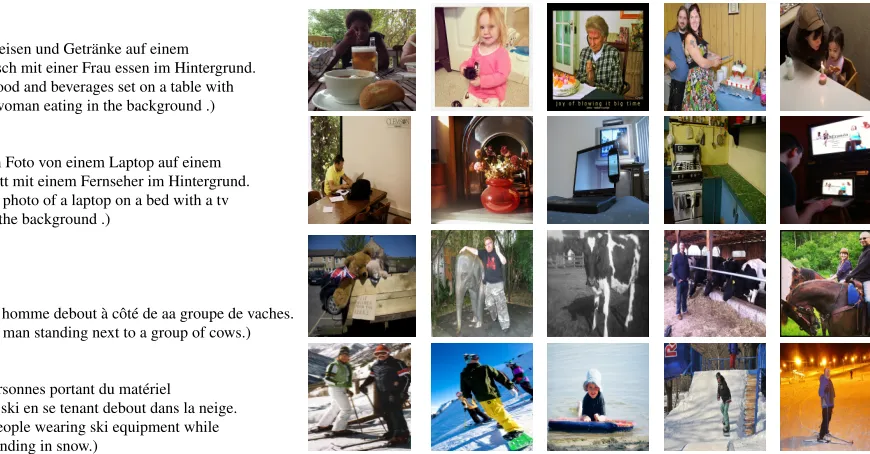
parallel image caption test set, only the second and fourth caption actually correspond to this image. However, we observe that the first and fifth cap-tion are also semantically very related to the image. Both these captions talk about horses, grass or wa-ter body (ocean),etc. Similarly the last row in Table 5 shows an image and its top-5 nearest French cap-tions. None of these captions actually correspond to the image as per our parallel image caption test set. However, clearly the first, third and fourth cap-tion are semantically very relevant to this image as all of them talk about baseball. Even the remaining two captions capture the concept of asportand ra-quet. We can make a similar observation from Table 6 where most of the top-5 retrieved images do not correspond to the French/German caption but they are semantically very similar. It is indeed impressive that the model is able to capture such cross modal semantics between images and French/German even without any direct parallel data between them.
7 Conclusion
In this paper, we propose Bridge Correlational Neu-ral Networks which can learn common representa-tions for multiple views even when parallel data is available only between these views and a pivot view. Our method performs better than the existing state of the art approaches on the cross language clas-sification task and gives very promising results on the cross modal access task. We also release a new multilingual image caption benchmark (MIC bench-mark) which will help in further research in this field5.
5Details about the MIC benchmark and performance of
1. Zwei Pferde stehen auf einem sandigen Strand nahe dem Ocean. (Two horses standing on a sandy beach near the ocean.) 2. grasende Pferde auf einer trockenen Weide bei einem Flughafen. (Horses grazing in a dry pasture by an airport.) 3. ein Elefant , Wasser aufseinen Rückend sprühend , in einem staubigen Bereich neben einem Baum.
(A elephant spraying water on its back in a dirt area next to tree .)
4. ein braunes pferd ißt hohes gras neben einem behälter mit wasser. (Brown horses eating tall grass beside a body of water .) 5. vier Pferde grasen auf ein Feld mit braunem gras. (Four horses are grazing through a field of brown grass.)
1. Ein Teller mit Essen wie Sandwich , Chips , Suppe und einer Gurke. (Plate of food including a sandwich , chips , soup and a pickle.)
2. Teller , gefüllt mit sortierten Früchten und Gemüse und einigem Fleisch. (Plates filled with assorted fruits and veggies and some meat.)
3. Ein Tisch mit einer Schüssel Salat und einem Teller Pizza. (a Table with a bowl of salad and plate with a cooked pizza .) 4. Ein Teller mit Essen besteht aus Brokkoli und Rindfleisch. (A plate of food consists of broccoli and beef.)
5. Eine Platte mit Fleisch und grünem Gemüse gemixt mit Sauce. (A plate with meat and green veggies mixed with sauce.)
1. un bus de la conduite en ville dans une rue entourée par de grands immeubles. (A city bus driving down a street surrounded by tall buildings.)
2. un bus de conduire dans une rue dans une ville avec des bâtiments de grande hauteur. (A bus driving down a street in a city with very tall buildings.)
3. bus de conduire dans une rue de ville surpeuplée. (Double - decker bus driving down a crowded city street.) 4. le bus conduit à travers la ville sur une rue animée. (The bus drives through the city on a busy street.) 5. un grand bus coloré est arrêté dans une rue de la ville. (A big , colorful bus is stopped on a city street.)
1. Un homme portant une batte de baseball à deux mains lors d’un jeu de balle professionnel. (A man holding a baseball bat with two hands at a professional ball game.)
2. un joueur de tennis balance une raquette à une balle. (A tennis player swinging a racket t a ball.)
[image:9.612.78.548.47.334.2]3. un garçon qui est de frapper une balle avec une batte de baseball. (A boy that is hitting a ball with a baseball bat.) 4. une équipe de joueurs de baseball jouant un jeu de base-ball. (A team of baseball players playing a game of baseball.) 5. un garçon se prépare à frapper une balle de tennis avec une raquette. (A boy prepares to hit a tennis ball with a racquet.)
Table 5:Images and their top-5 nearest captions based on representations learned using Bridge CorrNet. First two examples show German captions and the last two examples show French captions. English translations are given in parenthesis.
Speisen und Getränke auf einem
Tisch mit einer Frau essen im Hintergrund. (Food and beverages set on a table with a woman eating in the background .)
ein Foto von einem Laptop auf einem Bett mit einem Fernseher im Hintergrund. (A photo of a laptop on a bed with a tv in the background .)
un homme debout à côté de aa groupe de vaches. (A man standing next to a group of cows.)
personnes portant du matériel de ski en se tenant debout dans la neige. (People wearing ski equipment while standing in snow.)
Table 6:French and German queries and their top-5 nearest images based on representations learned using Bridge CorrNet. First two queries are in German and the last two queries are French. English translations are given in parenthesis.
Acknowledgments
We thank the reviewers for their useful feedback. We also thank the workers from CrowdFlower for
[image:9.612.87.522.374.601.2]References
S. Akaho. 2001. A kernel method for canonical correla-tion analysis. In Proc. Int’l Meeting on Psychometric Society.
Galen Andrew, Raman Arora, Jeff Bilmes, and Karen Livescu. 2013. Deep canonical correlation analysis.
ICML.
L.A. Ballesteros. 2000. Cross language retrieval via tran-sitive translation. InW.B. Croft (Ed.), Advances in in-formation retrieval: Recent research from the CIIR, pages 203–234, Boston: Kluwer Academic Publish-ers.
Mauro Cettolo, Christian Girardi, and Marcello Federico. 2012. Wit3: Web inventory of transcribed and
trans-lated talks. In Proceedings of the 16th Conference
of the European Association for Machine Translation (EAMT), pages 261–268, Trento, Italy, May.
Sarath Chandar, Mitesh M. Khapra, Balaraman Ravin-dran, Vikas C. Raykar, and Amrita Saha. 2013. Multi-lingual deep learning. NIPS Deep Learning Workshop. Sarath Chandar, Stanislas Lauly, Hugo Larochelle, Mitesh M. Khapra, Balaraman Ravindran, Vikas C. Raykar, and Amrita Saha. 2014. An autoencoder ap-proach to learning bilingual word representations. In
Advances in Neural Information Processing Systems 27: Annual Conference on Neural Information Pro-cessing Systems 2014, December 8-13 2014, Montreal, Quebec, Canada, pages 1853–1861.
Sarath Chandar, Mitesh M. Khapra, Hugo Larochelle, and Balaraman Ravindran. 2016. Correlational neu-ral networks. Neural Computation, 28(2):257 – 285. Trevor Cohn and Mirella Lapata. 2007. Machine
trans-lation by triangutrans-lation: Making effective use of multi-parallel corpora. In Proceedings of the 45th Annual Meeting of the Association of Computational Linguis-tics, pages 728–735, Prague, Czech Republic, June. Raul Cruz-Cano and Mei-Ling Ting Lee. 2014. Fast
regularized canonical correlation analysis. Computa-tional Statistics & Data Analysis, 70:88 – 100. Stephan Gouws, Yoshua Bengio, and Greg Corrado.
2015. Bilbowa: Fast bilingual distributed representa-tions without word alignments. InProceedings of the 32nd International Conference on Machine Learning, ICML 2015, Lille, France, 6-11 July 2015, pages 748– 756.
Karl Moritz Hermann and Phil Blunsom. 2014a. Mul-tilingual Distributed Representations without Word Alignment. In Proceedings of International Confer-ence on Learning Representations (ICLR).
Karl Moritz Hermann and Phil Blunsom. 2014b. Mul-tilingual models for compositional distributed seman-tics. In Proceedings of the 52nd Annual Meeting of the Association for Computational Linguistics, ACL
2014, June 22-27, 2014, Baltimore, MD, USA, Volume 1: Long Papers, pages 58–68.
H. Hotelling. 1936. Relations between two sets of vari-ates. Biometrika, 28:321 – 377.
W.W. Hsieh. 2000. Nonlinear canonical correla-tion analysis by neural networks. Neural Networks, 13(10):1095 – 1105.
Yangqing Jia, Evan Shelhamer, Jeff Donahue, Sergey Karayev, Jonathan Long, Ross Girshick, Sergio Guadarrama, and Trevor Darrell. 2014. Caffe: Convo-lutional architecture for fast feature embedding. arXiv preprint arXiv:1408.5093.
Mitesh M. Khapra, A. Kumaran, and Pushpak Bhat-tacharyya. 2010a. Everybody loves a rich cousin: An empirical study of transliteration through bridge lan-guages. InHuman Language Technologies: Confer-ence of the North American Chapter of the Association of Computational Linguistics, Proceedings, June 2-4, 2010, Los Angeles, California, USA, pages 420–428. Mitesh M. Khapra, Raghavendra Udupa, A. Kumaran,
and Pushpak Bhattacharyya. 2010b. PR + RQ AL-MOST EQUAL TO PQ: transliteration mining us-ing bridge language. In Proceedings of the Twenty-Fourth AAAI Conference on Artificial Intelligence, AAAI 2010, Atlanta, Georgia, USA, July 11-15, 2010. Alexandre Klementiev, Ivan Titov, and Binod Bhattarai.
2012. Inducing Crosslingual Distributed Representa-tions of Words. InProceedings of the International Conference on Computational Linguistics (COLING). A. Kumaran, Mitesh M. Khapra, and Pushpak Bhat-tacharyya. 2010. Compositional machine transliter-ation.ACM Trans. Asian Lang. Inf. Process., 9(4):13. Raija Lehtokangas, Heikki Keskustalo, and Kalervo
Järvelin. 2008. Experiments with transitive dictio-nary translation and pseudo-relevance feedback using graded relevance assessments. Journal of the Ameri-can Society for Information Science and Technology, 59(3):476–488.
Yong Luo, Dacheng Tao, Yonggang Wen, Kotagiri Ra-mamohanarao, and Chao Xu. 2015. Tensor canonical correlation analysis for multi-view dimension reduc-tion. In Arxiv.
Tomas Mikolov, Quoc Le, and Ilya Sutskever. 2013. Exploiting Similarities among Languages for Machine Translation. Technical report, arXiv.
Preslav Nakov and Hwee Tou Ng. 2009. Improved statis-tical machine translation for resource-poor languages using related resource-rich languages. InProceedings of the 2009 Conference on Empirical Methods in Nat-ural Language Processing, pages 1358–1367, Singa-pore, August.
F. Å. Nielsen, L. K. Hansen, and S. C. Strother. 1998. Canonical ridge analysis with ridge parameter opti-mization, may.
Richard Socher, Andrej Karpathy, Quoc V. Le, Christo-pher D. Manning, and Andrew Y. Ng. 2014. Grounded compositional semantics for finding and de-scribing images with sentences. TACL, 2:207–218. Hubert Soyer, Pontus Stenetorp, and Akiko Aizawa.
2015. Leveraging monolingual data for crosslingual compositional word representations. In Proceedings of the 3rd International Conference on Learning Rep-resentations, San Diego, California, USA, May. Nitish Srivastava and Ruslan Salakhutdinov. 2014.
Multimodal learning with deep boltzmann machines.
Journal of Machine Learning Research, 15:2949– 2980.
Arthur Tenenhaus and Michel Tenenhaus. 2011. Reg-ularized generalized canonical correlation analysis.
Psychometrika, 76(2):257–284.
Masao Utiyama and Hitoshi Isahara. 2007. A compar-ison of pivot methods for phrase-based statistical ma-chine translation. In Proceedings of the Conference of the North American Chapter of the Association for Computational Linguistics, pages 484–491, Rochester, New York, April.
H.D. Vinod. 1976. Canonical ridge and econometrics of joint production. Journal of Econometrics, 4(2):147 – 166.
Weiran Wang, Raman Arora, Karen Livescu, and Jeff Bilmes. 2015. On deep multi-view representation learning. InICML.
Hua Wu and Haifeng Wang. 2007. Pivot language approach for phrase-based statistical machine transla-tion. Machine Translation, 21(3):165–181.
Min Zhang, Xiangyu Duan, Ming Liu, Yunqing Xia, and Haizhou Li. 2011. Joint alignment and artifi-cial data generation: An empirical study of pivot-based machine transliteration. In Fifth International Joint Conference on Natural Language Processing, IJCNLP 2011, Chiang Mai, Thailand, November 8-13, 2011, pages 1207–1215.
Yin Zheng, Yu-Jin Zhang, and Hugo Larochelle. 2014a. A deep and autoregressive approach for topic model-ing of multimodal data. CoRR, abs/1409.3970. Yin Zheng, Yu-Jin Zhang, and Hugo Larochelle. 2014b.
Topic modeling of multimodal data: An autoregressive approach. In2014 IEEE Conference on Computer Vi-sion and Pattern Recognition, CVPR 2014, Columbus, OH, USA, June 23-28, 2014, pages 1370–1377. Will Y. Zou, Richard Socher, Daniel Cer, and