Proceedings of NAACL-HLT 2018, pages 1169–1180
A Structured Syntax-Semantics Interface for English-AMR Alignment
Ida Szubert Adam Lopez
School of Informatics University of Edinburgh Edinburgh, Scotland, UK
{k.i.szubert@sms,alopez@inf}.ed.ac.uk
Nathan Schneider
Linguistics and Computer Science Georgetown University
Washington, DC, USA [email protected]
Abstract
Abstract Meaning Representation (AMR) an-notations are often assumed to closely mir-ror dependency syntax, but AMR explicitly does not require this, and the assumption has never been tested. To test it, we devise an expressive framework to align AMR graphs to dependency graphs, which we use to anno-tate 200 AMRs. Our annotation explains how 97% of AMR edges are evoked by words or syntax. Previously existing AMR alignment frameworks did not allow for mapping AMR onto syntax, and as a consequence they ex-plained at most 23%. While we find that there are indeed many cases where AMR annota-tions closely mirror syntax, there are also per-vasive differences. We use our annotations to test a baseline AMR-to-syntax aligner, find-ing that this task is more difficult than AMR-to-string alignment; and to pinpoint errors in an AMR parser. We make our data and code freely available for further research on AMR parsing and generation, and the relationship of AMR to syntax.
1 Introduction
Abstract Meaning Representation (AMR; Ba-narescu et al.,2013) is a popular framework for an-notating whole sentence meaning. An AMR anno-tation is a directed, usually acyclic graph in which nodes represent entities and events, and edges rep-resent relations between them, as on the right in figure1.1
AMR annotations include no explicit mapping between elements of an AMR and the correspond-ing elements of the sentence that evoke them, and this presents a challenge to developers of machine learning systems that parse sentences to AMR or generate sentences from AMR, since they must
1For clarity of presentation, we have constructed the sen-tences and AMRs shown in figures—except for figure3, which is a simplified version of a sentence in the corpus.
lies llie
cat ccat
My ii
sun ssun
[image:1.595.308.525.219.353.2]the
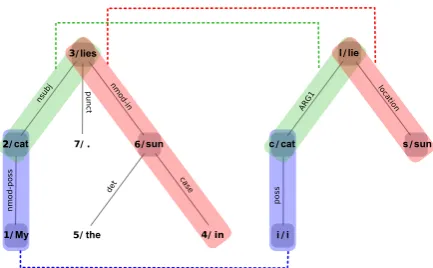
Figure 1: “My cat lies in the sun.” An alignment be-tween the dependency parse (left) and AMR (right). Nodes participating in lexical alignments are marked with boxes, but the links between them are not dis-played. Structural alignments are colour-coded and linked by dotted lines. Sense numbers for concepts that are PropBank frames are omitted for brevity.
first infer this mapping in the training data (e.g. Flanigan et al.,2014;Wang et al.,2015;Artzi et al., 2015;Flanigan et al.,2016;Pourdamghani et al., 2016;Misra and Artzi,2016;Damonte et al.,2017; Peng et al.,2017, inter alia).2
This AMR alignment problem was first for-malized by Flanigan et al. (2014), who mapped AMR nodes or connected subgraphs to words or sequences of words under the assumption of a one-to-one mapping—we call thisJAMR alignment. Pourdamghani et al.(2014) then re-formalized it so that any AMR node or edge can map to any word without a one-to-one assumption—we call thisISI alignment. In ISI alignments, edges often align to syntactic function words: for example,:location aligns to in in figure 1. So edge alignments al-low ISI to explain more of the AMR structure than JAMR, but in a limited way: only 23% of AMR edges are aligned in the ISI corpus. This may be
be-2Some recent neural AMR sytems require minimal or no explicit alignments (Konstas et al.,2017;van Noord and Bos,
cause edges are often evoked by syntactic structure rather than words: for instance, the:ARG1edge in figure1is evoked by the fact thatcatis the subject ofliesand not by any particular word.
Although it seems sensible to assume that all of the nodes and edges of an AMR are evoked by the words and syntax of a sentence, the existing alignment schemes do not allow for expressing that relationship. We therefore propose a framework expressive enough to align AMR to syntax (§2) and use it to align a corpus of 200 AMRs to dependency parses. We analyse our corpus and show that the addition of syntactic alignments allows us account for 97% of the AMR content.
Syntactic-semantic mappings are often assumed by AMR parsing models (e.g.Wang et al.,2015; Artzi et al., 2015;Damonte et al.,2017), which is understandable since these mappings are well-studied in linguistic theory. But AMR explic-itly avoids theoretical commitment to a syntax-semantics mapping:Banarescu et al.(2013) state that “AMR is agnostic about how we might want to derive meanings from strings.” If we are go-ing to build such an assumption into our models, we should test it empirically, which we can do by analysing our corpus. We observe some pervasive structural differences between AMR and depen-dency syntax (§3), despite the fact that a majority of AMR edges map easily onto dependency edges. Since syntactic alignment can largely explain AMRs, we also develop a baseline rule-based aligner for it, and show that this new task is much more difficult than lexical alignment (§4). We also show how our data can be used to analyze errors made by an AMR parser (§5). We make our anno-tated data and aligner freely available for further research.3
2 Aligning AMR to dependency syntax Our syntactic representation is dependency gram-mar, which represents the sentence as a rooted, directed graph where nodes are words and edges are grammatical relations between them (Kruijff, 2006). We use Universal Dependencies (UD), a cross-lingual dependency annotation scheme, as implemented in Stanford CoreNLP (Manning et al., 2014). Within the UD framework, we useenhanced
dependencies (Schuster and Manning, 2016), in which dependents can have more than one head,
3https://github.com/ida-szubert/amr_ud
resulting independency graphs(DGs).4
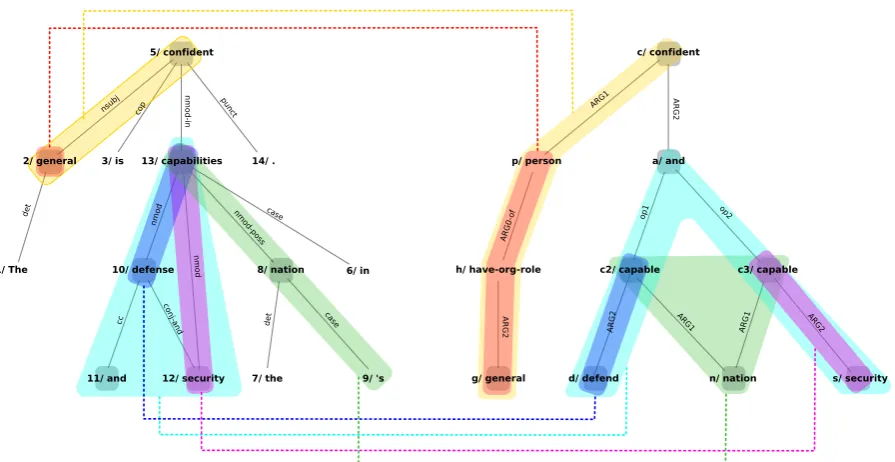
Our alignment guidelines generalize ideas present in the existing frameworks. We want to allow many-to-many alignments, which we mo-tivate by the observation that some phenomena cause an AMR graph to have one structure express-ing the same information as multiple DG struc-tures, and vice versa. For instance, in figure 2 the AMR subgraph representing Cruella de Vil aligns to two subgraphs in the dependency graph because of pronominal coreference. In the other direction, in figure3thecapabilitiesnode aligns to bothcapablenodes in the AMR, which is a result of the AMR treating conjoined adjectival modifiers as a case of ellipsis. The alignments we propose hold between subgraphs of any size. By align-ing subgraphs we gain expressiveness needed to point out correspondences between semantic and syntactic structure. If AMR and DG were very similar in how they represent information, such correspondences would probably hold between sub-graphs consisting of a single edge, as in figure1
catÐÐÐÐÐ→nmod:possmy∼catÐÐ→possI. However, AMR by de-sign abstracts away from syntax and it should not be assumed that all mappings will be so clean. For example, the same figure hasliesÐÐÐÐ→nmod-in sunÐÐ→case in ∼ liesÐÐÐÐ→locationsun. Moreover, AMR represents the meaning of particular words or phrases with elaborate structures, the result of which might be that the same information is expressed by a single word and a complex AMR subgraph, as in figure 3 where AMR represents general as personÐÐÐÐ→ARG0-ofhave-org-roleÐÐ→ARG2 general.
2.1 Overview
An alignment is a link between subgraphs in an AMR and a DG which represent equivalent infor-mation. Given a sentence’s DG and AMR we de-fine analignmentas a mapping between an AMR subgraph and a DG subgraph.Lexical alignments
(§2.2) hold between pairs of nodes, and nodes from either graph may participate in multiple lexical alignments. Structural alignments (§2.3) hold between pairs of connected subgraphs where at least one of the subgraphs contains an edge.
greed greed
" " " " " "
[image:3.595.81.525.60.313.2]-xsub j
Figure 2: “In the story, evildoer Cruella de Vil makes no attempt to conceal her glee and greed.” For legibility in this and following figures only a subset of the structural alignments are shown.
In the following two sections we discuss the types of alignments that our framework allows. More detailed guidelines regarding how to align particular linguistic constructions can be found in appendixA.
2.2 Lexical alignments
A lexical alignment should hold between a word and an AMR concept if the latter is judged to ex-press the lexical meaning of the former. Node labels usually reflect their lexically aligned word or its lemma, including derivational morphology (e.g.thirsty∼thirst-01). Thus,string similarity is a useful heuristic for lexical alignment.5
Most AMR nodes align lexically to a single word. Cases of one-to-many alignments include
coreference, when an entity is mentioned multiple times in the sentence, andmultiword expressions
such as a verb-particle constructions (pay off ∼
pay-off-02) and fixed grammatical expressions (instead of ∼ instead-of-91). Occasionally an AMR node does not lexically align to any DG node. This is true for constants indicating sentence mood such asimperative, implicit uses ofand to group list items, inferred concept nodes such as entity
5Exceptions include: pronouns with noun antecedents in the sentence; the-indicating negative polarity, which lexically
aligns tono,not, and negative prefixes; modal auxiliaries, e.g.,can∼possible; normalized dates and values such as
February∼2 in adate-entity; andamr-unknown, which
aligns to wh-words.
types,namein named entities, and-91frames like have-org-role-91.
Most words are lexically aligned to a single AMR node, if they are aligned at all. A word may align to multiple AMR nodes if it is duplicated
in the AMR due to ellipsis or distributive coordi-nation (capabilities aligns to c2 / capableand c3 / capablein figure3), or if it is
morpholog-ically decomposed in the AMR (evildoer aligns toevilanddo-02 in figure2). Many words are not lexically aligned to any AMR node, including
punctuationtokens,articles,copulas, nonmodal
auxiliaries, expletive subjects, infinitivalto, com-plementizerthat, and relative pronouns.
2.3 Structural alignments
Structural alignments primarily reflect composi-tional grammatical constructions, be they syn-tactic or morphological. Note that the structural alignments build upon the lexical ones. Structural alignments hold between two subgraphs, at least one of which is larger than a single node. If a sub-graph includes any edges, it automatically includes nodes adjacent to those edges. Structural align-ments need not be disjoint: an edge can appear in two or more distinct alignments. Nodes and edges in both AMR and DG may be unaligned.
2.3.1 Constraints on structural alignments
Figure 3: “The general is confident in the nation’s defense and security capabilities.” can be interpreted. We establish the following
prin-ciples to guide the specification of alignment:
Connectedness Principle. In an alignmentd∼a,
dmust be a connected subgraph of the DG, anda
must be a connected subgraph of the AMR.
Minimality Principle. If two alignments, d ∼a
andd′ ∼a′, have no dependency or AMR edges in common, then their union d∪d′ ∼a∪a′is re-dundant, even if it is valid. Individual alignments should be as small as possible; we believe compo-sitionality is best captured by keeping structures minimal. Therefore, in figure1there is no align-ment between subgraphs spanningMy,cat,liesand i,cat,lie. Such subgraphs do express equivalent information, but the alignment between them de-composes neatly into smaller alignments and we record only those.
Subsumption Principle. This principle ex-presses the fact that our alignments are hierarchical. Structural alignments need to be consistent with lexical alignments: for subgraphato be aligned to subgraphd, all nodes lexically aligned to nodes in
amust be included ind, and vice versa. Moreover, structural alignments need to be consistent with other structural alignments. A structural alignment
d ∼a is valid only if, for every connected AMR subgrapha<⊂awhich is aligned to a DG subgraph, d′ ∼ a<, we also have that d′ is a subgraph of d—and vice versa for everyd<⊂d.
Further, if a contains a node n which is not lexically aligned but which is part of a struc-turally aligned subgraph a′ such that d′ ∼ a′, it needs to be the case that a′ ⊂a∧d′ ⊂d or
a′ ⊃a∧d′⊃d. (And vice versa for nodes in
d.) For example, concealÐÐÐÐÐ→nsubj-xsubj Cruella ∼
concealÐÐ→ARG0personÐÐ→namenameÐ→op1 Cruellais not a valid alignment, because the AMR side contains nodes person and name, which are not lexically aligned but which are both parts of a structural alignment marked in blue.
Coordination Principle. If an alignment con-tains a dependency edge between two conjuncts, or between a conjunct and a coordinating conjunction, then it must also include all conjuncts and the con-junction. This preserves the integrity of coordinate structures in alignments. For example, in figure2 there is no alignmentgleeÐ→ccand ∼ andÐ→op1 glee; only the larger structure which includes thegreed nodes is aligned.
Named Entity Principle. Any structural alignment containing an AMR name node or any of the strings under it must contain the full subgraph rooted in the name plus the node above it specifying the entity type. This means that for example, in figure 2 there is no alignment concealÐÐÐÐÐ→nsubj-xsubjCruella ∼
2.3.2 Typology of structural alignments
The smallest structure which can participate in a structural alignment is a single node, provided that it is aligned to a subgraph containing at least one edge. A DG node may align to an AMR subgraph if the word is morphologically decomposed or oth-erwise analyzed in the AMR (e.g. in figure2, evil-doer ∼ personÐÐÐÐ→ARG0-ofdo-02ÐÐ→ARG1 thingÐ→mod evil). Examples of DG structures whose meaning is expressed in a single AMR node include light verb constructions, phrasal verbs, and various other multiword expressions (e.g. in figure 2,
makesÐÐ→dobj attempt∼attempt-01).
Conceptually the simplest case of structural alignment is one edge to one edge, as in the blue and green alignments in figure1. For such an align-ment to be possible, two requirealign-ments must be satisfied: nodes which are endpoints of those edges need to be aligned one-to-one; and the AMR rela-tion and the syntactic dependency must map cleanly in terms of the relationship they express.
A one edge to multiple edges alignment arises when either of those requirements is not met. To see what happens in absence of one-to-one end-point alignments let’s look at the relation between
confident and generalin figure 3. The DG gen-eralnode is aligned to an AMR subgraph:general ∼personÐÐÐÐ→ARG0-of have-org-roleÐÐ→ARG2general. All alignments which involve thegeneralnode on the DG side need to include its aligned subgraph on the AMR side. It necessarily follows that the AMR subgraphs in those alignments will contain more edges that the DG ones; in this case the yellow sub-graph in DG has 1 edge, and in AMR 3 edges. As for the second requirement, it is possible for one graph to use multiple edges to express a relation-ship when the other graph needs only one. This is the case forlieÐÐÐÐ→nmod-insunÐÐ→casein∼lieÐÐÐÐ→location sun in figure1. An example which combines both the node- and edge-related issues is marked in red in figure2.
Finally, we also allow for many edges to many edges alignments. This may seem counterintu-itive considering the assumption that we want to capture mappings between relations expressed in DG and AMR, and that we want to align mini-mal subgraphs. There are cases where an align-ment is actually capturing a single relation, but we need to treat a subgraph as an endpoint of the edge both in DG and AMR. For instance,
con-sider in figure2the relationship that holds between Cruella de Vil and concealing, expressed syntac-tically as an nsubj-xsubj edge and semantically as anARG0edge. One of the entities involved in that relationship, Cruella, is represented by a 2-edge DG subgraph and a 4-2-edge AMR subgraph. Consequently, the alignment covering the DG and AMR edges that relate Cruella to concealing must link subgraphs consisting respectively of 3 and 5 edges. A more difficult case of many edges to many edges alignment arises when relationships between nodes are expressed so differently in the DG and AMR that given an edge in one graph it is not possible to find in the other graph a subgraph that would convey the same information without also including some other information. Coordina-tion has this property: e.g. in figure2theconj-and
dependency betweengleeandgreedhas no counter-part in the AMR. There is no edge between AMR nodes aligned to those words, and the smallest AMR subgraph which contains them also contains and, which is itself lexically aligned. We cannot align gleeÐÐÐÐ→conj-andgreed ∼ glee←Ðop1andÐ→op2 greed because of the rule that all lexically aligned nodes in one subgraph must be aligned to nodes in the other subgraph. Therefore we need to extend the DG side toand←ÐccgleeÐÐÐÐ→conj-andgreed.
3 Manually aligned corpus
We annotated a corpus of 200 AMR-sentence pairs (3813 aligned structures) using the guidelines of §2 and appendixA.6
Data selection. To create the corpus we drew a total of 200 AMR-sentence pairs: 135 from the training split of the AMR Annotation Release 1.0 (Knight et al.,2014), 55 from the training split of
The Little PrinceCorpus v1.6,7and 10 sentences
from the Adam part of the CHILDES Brown corpus (Brown,1973), for which AMRs were produced by an experienced annotator. Seventy items were selected to illustrate particular linguistic phenom-ena.8 The remaining 130 were selected at random.
6We followed the precedent of previous AMR-to-sentence alignment corpora (see §4.2) in including 200 sentences in our gold standard, though ours was a different sample.
7https://amr.isi.edu/download/
amr-bank-struct-v1.6.txt
Preprocessing. Dependency parses were ob-tained using Stanford CoreNLP neural network parser9(Chen and Manning,2014) and manually
corrected. The final parses conform to the en-hanced UD guidelines,10except they lack
enhance-ments for ellipsis.
Inter-annotator agreement. The corpus was cre-ated by one annotator. To assess inter-annotator agreement, a second annotator deeply familiar with UD and AMR annotated a random sample of sen-tences accounting for 10% of alignments in the corpus. The overall inter-annotatorF1-score was
88%, with 96% agreement on lexical alignments and 80% on structural alignments. We take this as an indication that our richly structured align-ment framework as laid out in §2 is reasonably well-defined for annotators.
3.1 Coverage
To assess our attempt to explain as much of the AMR as possible, we computed the proportion of AMR nodes and edges that participate in at least one alignment. Overall, 99.3% of nodes and 97.2% of edges in AMRs are aligned. We found that 81.5% of AMR graphs have full coverage, 18.5% have at least one unaligned edge, and 7.5% have one unaligned node (none had more than one; all unaligned nodes express mood or discourse-related information: interrogative,and, andsay). We conclude that nearly all information in an AMR is evoked by lexical items or syntactic structure.
We expected coverage of DG to be lower be-cause punctuation and many function words are unaligned in our guidelines (§2.2). Indeed, only 71.4% of words and 65.2% of dependency edges are aligned.
3.2 Syntactic-semantic similarity
The similarity of AMR to syntax in examples like figure 1 invites the assumption of a close map-ping, which often seems to be made in AMR parsers (Wang et al.,2015;Artzi et al.,2015;Misra and Artzi,2016;Damonte et al.,2017) and align-ers (Chu and Kurohashi,2016;Chen and Palmer,
9The corpus is annotated with UD v1; a release of the dataset converted to UD v2 is planned for the future. We used the pretrained dependency parsing model provided in CoreNLP withdepparse.extradependenciesset toMAXIMAL, and used collapsed CCprocessed dependencies.
10http://universaldependencies.org/u/overview/
enhanced-syntax.html
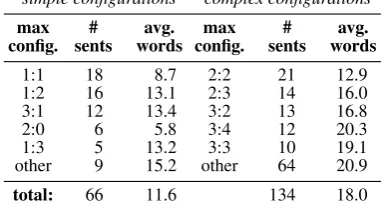
simple configurations complex configurations max # avg. max # avg. config. sents words config. sents words
1:1 18 8.7 2:2 21 12.9
1:2 16 13.1 2:3 14 16.0
3:1 12 13.4 3:2 13 16.8
2:0 6 5.8 3:4 12 20.3
1:3 5 13.2 3:3 10 19.1
[image:6.595.320.515.67.173.2]other 9 15.2 other 64 20.9 total: 66 11.6 134 18.0 Table 1: Number of sentences whose highest alignment configurations is max config.
2017).11 Such an attitude reflects decades of work
in the syntax-semantics interface (Partee,2014) and the utility of dependency syntax for other forms of semantics (e.g.,Oepen et al.,2014;Reddy et al., 2016;Stanovsky et al.,2016;White et al., 2016; Zhang et al.,2017;Hershcovich et al.,2017). How-ever, this assumption has not been empirically tested, and asBender et al. (2015) observe, it is an assumption not guaranteed by the AMR anno-tation style. Having aligned a corpus of AMR-DG pairs, we are in a position to provide empirical evidence.
Are AMRs and dependency graphs structurally similar? We approach the question by analyzing the sizes of subgraphs used to align the two repre-sentations of the sentence.
We define the size of a subgraph as the number of edges it contains. If a structure consists of a sin-gle node, we say its size is 0. Theconfigurationof an alignment is then the pair of sizes for its AMR and DG sides; for example, an alignment with 1 AMR edge and 2 DG edges has configuration 1:2. We call an alignment configurationsimpleif at least one of the subgraphs is a single edge, indicating that there is a single relation which the alignment captures. Complexconfigurations cover multiple relations. By principle of minimality we infer that some structural difference between the graphs pre-vented those relations from aligning individually.
One measure of similarity between AMR and DG graphs is the configuration of the most com-plex subgraph alignment between them. Configura-tion a:b is higher than c:d ifa+b>c+d. However, all configurations involving 0 are lower than those which do not. A maximum of 1:1 means the graphs have only node-to-node, node-to-edge, and edge-to-edge alignments, rendering the graphs isomorphic (ignoring edge directions and unaligned nodes). In
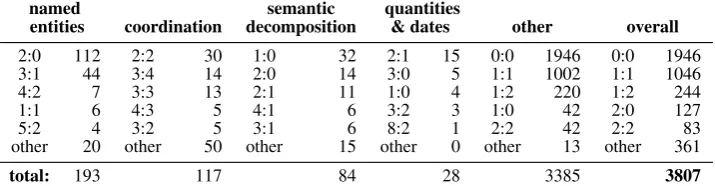
named semantic quantities
entities coordination decomposition & dates other overall
2:0 112 2:2 30 1:0 32 2:1 15 0:0 1946 0:0 1946
3:1 44 3:4 14 2:0 14 3:0 5 1:1 1002 1:1 1046
4:2 7 3:3 13 2:1 11 1:0 4 1:2 220 1:2 244
1:1 6 4:3 5 4:1 6 3:2 3 1:0 42 2:0 127
5:2 4 3:2 5 3:1 6 8:2 1 2:2 42 2:2 83
other 20 other 50 other 15 other 0 other 13 other 361
[image:7.595.121.479.62.155.2]total: 193 117 84 28 3385 3807
Table 2: Frequency of alignment configurations for named entities, coordination, semantically decomposed words, quantities and dates, and other phenomena.
general, if the maximum alignment configuration is a simple one, the graphs could be made isomorphic by collapsing the larger side of the alignment (e.g., in figure 2, the AMR side of the alignment evil-doer∼personÐÐÐÐ→ARG0-ofdoÐÐ→ARG1 thingÐ→modevilcould be collapsed into a node).
In contrast, complex configurations imply seri-ous structural dissimilarity, as in figure3, where the cyan alignment has configuration 4:4.
The numbers in table1show that≈33% of the sentences aresimple.
Table2provides a detailed breakdown of align-ment configurations in the corpus. Phenom-ena which often trigger complex configurations include coordination, named entities, semanti-cally decomposed words, attachment of negation, and preposition-based concepts encoding location, time, and quantity.12
We observe, comparing tables1and2, that while simple configurations are most frequent in the cor-pus, the majority of sentences have at least one alignment which is complex. It should not be as-sumed that AMR and DG representations of a sen-tence are, or could trivially be made to be, isomor-phic. It is worth noting that our analysis suggests that DG and AMR could be made more similar by applying simple transformations targeting prob-lematic constructions like coordination and named entities.
4 Evaluation of automatic aligners
We use our annotations to measure the accuracy of AMR aligners on specific phenomena that were inexpressible in previous annotation schemes. Our experiments evaluate the JAMR heuristic aligner (Flanigan et al.,2014), the ISI statistical aligner (Pourdamghani et al.,2014), and a heuristic rule-based aligner that we developed specifically for
12An AMR concept evoked by a preposition usually domi-nates the structure (afterÐÐ→op1date-entityÐÐÐ→decade nineties), which is at odds with UD’s prepositions-as-case-markers pol-icy (ninetiesÐÐ→caseafter).
structural alignment.
4.1 Rule-based aligner
Our aligner operates in two passes: one for lexical alignment and one for structural alignment.
Lexical alignment algorithm. AMR concepts are cognate with English words, so we align them by lexical similarity. This algorithm does not make use of the DG. Before alignment, we remove sense identifiers on AMR node labels, and lemmatize DG node labels. Then for every pair of nodesafrom the AMR anddfrom the DG we align them if any of the following conditions holds:
1. The Levenshtein distance ofaanddis 15% or less of the length of the longer word.13
2. The label ofais the morphological negation ofd(e.g.prudent∼imprudent).14
3. The label of a is – (AMR’s annotation of negation) and the parent ofaaligns tod via rule2.
4. The label ofais – anddis one ofno,none,
not, ornever.
5. The label ofaconsists of multiple words, and the label ofdmatches any one of them under rule1. (e.g.sit∼sit-down,war-torn∼war).15
6. Labels ofaandd likely have the same mor-phological root. We determine this by segmenting each word with Morfessor (Grönroos et al.,2014) trained on Wiki data and applying rule1to the first morpheme of each word.
Note that if a word type is repeated in a sentence, each repetition is aligned to the same AMR nodes under the above rules.
Structural alignment algorithm. We align sub-graphs using the procedure below, first from AMR to DG, then from DG to AMR. For clarity, the explanation refers to the first case.
13Threshold was determined empirically on a 10% sample from the dataset.
14We use a list of morphologically negated words provided by Ulf Hermjakob.
dataset
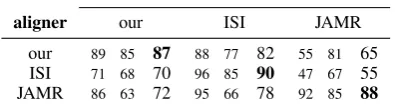
[image:8.595.311.523.70.129.2]aligner our ISI JAMR our 89 85 87 88 77 82 55 81 65 ISI 71 68 70 96 85 90 47 67 55 JAMR 86 63 72 95 66 78 92 85 88 Table 3: Lexical alignment (precision, recall,F1-score). Ourlexicalalignment algorithm does not use syntax.
Local phase. For every AMR edgeea whose
endpoints are lexically aligned nodesa1 (aligned
tod1) anda2(aligned tod2), we attempt to align
minimal and connected AMR and dependency sub-graphs,a′andd′:
1. If there is a DG edgeedwhose endpoints are
d1andd2, thena′←eaandd′←ed.
2. Otherwise, letπd be the shortest undirected
path between d1 and d2. If all lexically aligned
nodes inπd are aligned toa1 ora2, thena′←ea
andd′←πd.
3. Otherwise, leta′′ be the smallest subgraph covering all AMR nodes that are lexically aligned to nodes inπd. If all the nodes ina′′are aligned
only to nodes inπd, thena′←a′′andd′←πd.
4. Otherwise, the attempt is abandoned. 5. Finally, if the top node ofa′has a parent node labeled with an entity type concept, extend a′to include the parent. (This step is performed only in the AMR-to-DG step.)
Global phase. The local phase might produce alignments that violate the Subsumption Principle (§2.3.1), so we filter them out heuristically. For every pair of structural alignments, πd ∼ πa and
π′
d ∼ πa′ where πa overlaps with πa′, or πd with
π′
d, if the region of overlap is not itself an aligned
subgraph, we prune both alignments.16
4.2 Experiments
We evaluate JAMR, ISI, and our aligner on two distinct tasks.
Lexical alignment. Lexical alignment involves aligning AMR nodes to words, a task all three systems can perform. We evaluate against three datasets: our own, the JAMR dataset (Flanigan et al.,2014), and the ISI dataset (Pourdamghani et al.,2014).17 Results (table3) suggest that this
task is already well-addressed, but also that there exist marked differences between how lexical align-ment is defined in each dataset and that aligners are
16This could be order-dependent since the removal of one alignment could trigger the removal of others, but our aligner does not account for this.
17We remove span alignments in the JAMR dataset and edge alignments in the ISI dataset.
prec., rec.,F1 prec., rec.,F1
lexical alignments using gold DGs using automatic DGs
gold 79 73 76 70 63 66
our aligner 68 56 61 63 48 55
ISI 65 50 57 58 44 50
[image:8.595.83.281.71.123.2]JAMR 71 41 52 61 34 44
Table 4: Structural alignment (§4.1) scores, with dif-ferent sources of input lexical alignments. Scores are shown for gold standard and automatic UD trees. fine-tuned to their dataset.
For our aligner, errors are due to faulty morpho-logical analysis, duplicated words, and both acci-dental string similarity between AMR concepts and words and occasional lack of similarity between concepts and words that should be aligned.
Structural alignment. An important goal of our experiments is to establish baselines for the struc-tural alignment task. While we cannot evaluate the JAMR and ISI aligners directly on this task, we can use the lexical alignments they output in place of the first pass of our aligner. The only dataset for this task is our own. The results (table4) evaluate accuracy of structural alignments only and do not count lexical alignments.
The automatic alignments have lower coverage of AMRs than the gold alignments do: our best aligner leaves 13.3% of AMR nodes and 30.0% of AMR edges unaligned, compared to 0.07% and 2.8% in the gold standard. The aligner also leaves 39.2% of DG nodes and 47.7% of DG edges un-aligned, compared to 28.6% and 34.8% in the gold standard. The relatively low F-score for the gold standard lexical alignments and DGs condition sug-gests that substantial improvements to our struc-tural alignment algorithm are possible. The two most common reasons for low recall were miss-ing one of the conjuncts in a coordinate structure and aligning structures that violate the principle of minimality.
Our corpus gives alignments between AMRs and gold standard dependency parses. To see how much performance degrades when such parses are not available we also evaluate on automatic parses.18
Both precision and recall are substantially worse when the aligner relies on automatic syntax.
5 Improving error analysis for AMR parsers
Our corpus of manually aligned AMRs can be used to identify linguistic constructions which cause
UD structure missed mislabeled nsubj 103 (40%) 14 (6%) nmod + case 74 (44%) 26 (16%)
[image:9.595.99.266.61.158.2]compound 55 (41%) 7 (5%) amod 40 (26%) 9 (6%) dobj 40 (33%) 6 (5%) advmod 30 (39%) 7 (9%) cc + conj 29 (57%) 4 (8%) nmod 21 (60%) 1 (3%)
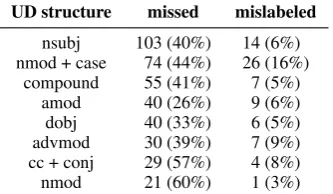
Table 5: Error analysis of the AMR parser of Da-monte et al.(2017). Frequency of dependency struc-tures aligned to AMR edges which the automatic AMR parser missed altogether or mislabeled; absolute count (% of all such aligned structures in the corpus). problems for an AMR parser. We parsed the sen-tences from our corpus with the parser ofDamonte et al.(2017).19 We map the nodes of the
result-ing automatic AMRs to the gold AMRs usresult-ing the smatch evaluation tool (Cai and Knight,2013), and on the basis of this mapping identify those nodes and edges of the gold AMRs which are missing or mislabeled in the automatic AMRs.
We then measured the number and rate of erro-neous AMR fragments associated with each UD relation or construction (table5). The largest pro-portion of recall errors were for fragments associ-ated with the subject relation, prepositional phrases, and nominal compounds. Focusing on the subject relation, we can further say that 69% of the miss-ing or mislabeled edges have the gold labelARG0, 19% ARG1, and the rest are distributed amongst domain, ARG2, purpose and mod. Inspecting the errors we see that phenomena underlying them in-clude pronominal coreference, sharing arguments between conjoined predicates, auxiliary verb con-structions, and control and raising.20
Our corpus facilitates fine-grained error analysis of AMR parsers with respect to individual syntactic constructions. We release the code for the above an-alysis in order to encourage syntactically-informed comparison and improvement of systems.
6 Conclusion
We have presented a new framework and corpus for aligning AMRs to dependency syntax. Our data and analysis show that the vast majority of the semantics in AMR graphs can be mapped to the lexical and syntactic structure of a sentence, though current alignment systems do not fully cap-ture this correspondence. The syntax–semantics
19The overall smatch score of the parser on this dataset was 0.65.
20The missing edge counts include gold edges for which the parser failed to produce one or both endpoints.
correspondences are often structurally divergent (non-isomorphic). Simple algorithms for lexical and structural alignment establish baselines for the new alignment task; we expect statistical models will be brought to bear on this task in future work. Our framework also facilitates syntactically-based analysis of AMR parsers. We release our data and code for the benefit of the research community.
Acknowledgments
This work was supported in part by EU ERC Ad-vanced Fellowship 249520 GRAMPLUS and EU ERC H2020 Advanced Fellowship GA 742137 SE-MANTAX.
We thank Sameer Bansal, Marco Damonte, Lu-cia Donatelli, Federico Fancellu, Sharon Goldwa-ter, Andreas Grivas, Yova Kementchedjhieva, Junyi Li, Joana Ribeiro, and the anonymous reviewers for helpful discussion of this work and comments on previous drafts of the paper.
References
Yoav Artzi, Kenton Lee, and Luke Zettlemoyer. 2015. Broad-coverage CCG semantic parsing with AMR. InProc. of EMNLP.
Laura Banarescu, Claire Bonial, Shu Cai, Madalina Georgescu, Kira Griffitt, Ulf Hermjakob, Kevin Knight, Philipp Koehn, Martha Palmer, and Nathan Schneider. 2013. Abstract Meaning Representation for sembanking. InProc. of the 7th Linguistic An-notation Workshop and Interoperability with Dis-course.
Emily M. Bender, Dan Flickinger, Stephan Oepen, Woodley Packard, and Ann A. Copestake. 2015. Layers of interpretation: On grammar and compo-sitionality. InProc. of IWCS.
Roger Brown. 1973.A first language: The early stages. Harvard University Press.
Shu Cai and Kevin Knight. 2013. Smatch: an evalua-tion metric for semantic feature structures. InProc. of ACL.
Danqi Chen and Christopher D. Manning. 2014. A fast and accurate dependency parser using neural net-works. InProc. of EMNLP.
Wei-Te Chen and Martha Palmer. 2017. Unsuper-vised AMR-dependency parse alignment. In Proc. of EACL.
Marco Damonte, Shay B. Cohen, and Giorgio Satta. 2017. An incremental parser for Abstract Meaning Representation. InProc. of EACL.
Jeffrey Flanigan, Chris Dyer, Noah A. Smith, and Jaime G. Carbonell. 2016. Generation from Ab-stract Meaning Representation using tree transduc-ers. InProc. of HLT-NAACL.
Jeffrey Flanigan, Sam Thomson, Jaime Carbonell, Chris Dyer, and Noah A. Smith. 2014. A discrim-inative graph-based parser for the Abstract Meaning Representation. InProc. of ACL.
Stig-Arne Grönroos, Sami Virpioja, Peter Smit, and Mikko Kurimo. 2014. Morfessor FlatCat: An HMM-based method for unsupervised and semi-supervised learning of morphology. In Proc. of COLING.
Daniel Hershcovich, Omri Abend, and Ari Rappoport. 2017. A transition-based directed acyclic graph parser for UCCA. InProc. of ACL.
Kevin Knight, Laura Baranescu, Claire Bonial, Madalina Georgescu, Kira Griffitt, Ulf Herm-jakob, Daniel Marcu, Martha Palmer, and Nathan Schneider. 2014. Abstract Meaning Represen-tation (AMR) AnnoRepresen-tation Release 1.0. Techni-cal Report LDC2014T12, Linguistic Data Consor-tium, Philadelphia, Pennsylvania, USA. https:// catalog.ldc.upenn.edu/LDC2014T12.
Ioannis Konstas, Srinivasan Iyer, Mark Yatskar, Yejin Choi, and Luke Zettlemoyer. 2017. Neural AMR: Sequence-to-sequence models for parsing and gen-eration. InProc. of ACL.
Geert-Jan M. Kruijff. 2006. Dependency grammar. In Keith Brown, editor, Encyclopedia of Language and Linguistics (Second Edition), Elsevier, Oxford, pages 444–450.
Christopher D. Manning, Mihai Surdeanu, John Bauer, Jenny Finkel, Steven J. Bethard, and David Mc-Closky. 2014. The Stanford CoreNLP natural lan-guage processing toolkit. In Proc. of ACL System Demonstrations.
David Mareˇcek, Martin Popel, Loganathan Ramasamy, Jan Štˇepánek, Daniel Zeman, Zdenˇek Žabokrtský, and Jan Hajiˇc. 2013. Cross-language study on in-fluence of coordination style on dependency parsing performance. Technical Report 49, ÚFAL MFF UK.
Dipendra Kumar Misra and Yoav Artzi. 2016. Neu-ral shift-reduce CCG semantic parsing. InProc. of EMNLP.
Joakim Nivre. 2005. Dependency grammar and depen-dency parsing. Technical Report MSI report 05133, Växjö University School of Mathematics and Sys-tems Engineering, Växjö, Sweden.
Stephan Oepen, Marco Kuhlmann, Yusuke Miyao, Daniel Zeman, Dan Flickinger, Jan Hajiˇc, Angelina Ivanova, and Yi Zhang. 2014. SemEval 2014 Task 8: Broad-Coverage Semantic Dependency Parsing. In
Proc. of SemEval.
Barbara H. Partee. 2014. A brief history of the syntax-semantics interface in Western formal linguistics.
Semantics-Syntax Interface1:1–20.
Xiaochang Peng, Chuan Wang, Daniel Gildea, and Ni-anwen Xue. 2017. Addressing the data sparsity is-sue in neural AMR parsing. InProc. of EACL. Nima Pourdamghani, Yang Gao, Ulf Hermjakob, and
Kevin Knight. 2014. Aligning English strings with Abstract Meaning Representation graphs. InProc. of EMNLP.
Nima Pourdamghani, Kevin Knight, and Ulf Herm-jakob. 2016. Generating English from Abstract Meaning Representations. InProc. of INLG. Siva Reddy, Oscar Täckström, Michael Collins, Tom
Kwiatkowski, Dipanjan Das, Mark Steedman, and Mirella Lapata. 2016. Transforming dependency structures to logical forms for semantic parsing.
Transactions of the Association for Computational Linguistics4:127–140.
Sebastian Schuster and Christopher D. Manning. 2016. Enhanced English Universal Dependencies: an im-proved representation for natural language under-standing tasks. InProc. of LREC.
Gabriel Stanovsky, Jessica Ficler, Ido Dagan, and Yoav Goldberg. 2016. Getting more out of syn-tax with PropS. arXiv preprinthttp://arxiv.org/ abs/1603.01648.
Rik van Noord and Johan Bos. 2017. Neural semantic parsing by character-based translation: experiments with Abstract Meaning Representations. arXiv preprinthttp://arxiv.org/abs/1705.09980. Chuan Wang, Nianwen Xue, Sameer Pradhan, and
Sameer Pradhan. 2015. A transition-based algo-rithm for AMR parsing. InProc. of NAACL-HLT. Aaron Steven White, Drew Reisinger, Keisuke
Sak-aguchi, Tim Vieira, Sheng Zhang, Rachel Rudinger, Kyle Rawlins, and Benjamin Van Durme. 2016. Uni-versal Decompositional Semantics on UniUni-versal De-pendencies. InProc. of EMNLP.
Sheng Zhang, Rachel Rudinger, and Benjamin Van Durme. 2017. An evaluation of PredPatt and Open IE via stage 1 semantic role labeling. InProc. of IWCS.
A Details of alignment guidelines
A.1 Lexical alignments
Entity types. If the entity type is based on a com-mon noun which occurs in the sentence, it is lex-ically aligned: e.g.,Jon, a clumsy man, has a cat
would involve the alignment man ∼ man. Most often, however, an entity type is not explicitly men-tioned in the sentence and is taken from AMR’s ontology of entity types (http://www.isi.edu/ ~ulf/amr/lib/ne-types.html), in which case it will not be lexically aligned.
Case marking and prepositions. The possessive marker ’s and many prepositions participate in structural but not lexical alignments because they are inherently relational. However, we align a preposition if it carries sufficient lexical content to be included as an AMR node (e.g., the AMR for The cat is under the table would include underÐ→op1table).
Wh-questions. The special conceptamr-unknown aligns lexically to the wh-word whose referent is questioned. For multiword wh-expressions like
how much, the expression is aligned structurally (not lexically) toamr-unknown.
Sentence mood. In AMR, non-wh questions are indicated byÐÐ→mode interrogative, imperatives by
mode
ÐÐ→imperative, and exclamations/interjections by ÐÐ→modeexpressive. UD parses do not encode sentence mood, which can be conveyed by non-canonical word order (subject-auxiliary inversion for questions) or argument omission (subject omis-sion for imperatives), rather than the presence of certain relations or words. Sometimes the sentence includes an appropriate alignment point, e.g. com-plementizers whether andif for interrogative, allowing for a lexical alignment. More often the parse has no obvious alignment point, and the con-stantinterrogative,imperative, orexpressive is left unaligned.21
A.2 Structural alignments
Copulas. In UD, copulas are treated as modifiers of a predicate nominal or adjective, which is linked directly to the subject of the sentence via annsubj
dependency. We do not align copulas or thecop
edge. Thus, in figure3, there is a structural align-ment betweengeneral←ÐÐnsubjconfidentand the AMR subgraph connecting the lexically aligned nodes.
21Among the UD community there has been discussion of possibly adding sentence-level marking of mood (https:// github.com/UniversalDependencies/docs/issues/458),
which could provide a convenient alignment point.
Control. The subject of the control verb and the controlled predicate are connected by the
nsubj-xsubjedge, which can be structurally aligned with
the corresponding AMR argument relation, as in e.g. figure2.
Relative clauses. In enhanced UD the noun gov-erning a relative clause and the embedded predicate are linked by edges in both directions: a “surface syntax”acl-relcledge headed by the noun, and a “deep syntax” edge such asnsubj, dobj, iobj, or
nmod headed by the embedded predicate. Each participates in a structural alignment with the cor-responding AMR subgraph. The relative pronoun is left unaligned.
Coordination. Coordination does not naturally lend itself to analysis with dependencies, and dif-ferent dependency grammar traditions offer differ-ent approaches (Nivre,2005;Mareˇcek et al.,2013). UD follows the Stanford style, where the first con-junct serves as the head of the remaining concon-juncts, and the conjunction is a dependent of one of the conjuncts.22 In AMR the conjunction heads all
the conjuncts (Prague style). In light of this mis-match, we use a subgraph alignment to group the conjunction with its conjuncts on each side. A simple example is illustrated in figure2. A quirk of UD’s approach to coordination is that it does not distinguish modifiers of the first conjunct from modifiers of the coordinate structure as a whole. The basic UD parse ofher glee and greedis there-fore ambiguous. We rely on an extra edge in the enhanced parse betweenherandgreedto establish an alignment for the AMR edgegreedÐÐ→ARG0person.
The coordination in figure 3is more complex: the coordinated modifierdefense and security dis-tributes overcapabilities(i.e., there are two kinds of capabilities). In the enhanced parse, defense
andsecurityare both attached as modifiers of ca-pabilities. This is expressed semantically via du-plicateAMR nodes labeledcapable, each receiv-ing different modifiers correspondreceiv-ing to different conjuncts. Independent of coordination, the two capable nodes also share a common argument, nation. The three syntactic modifiers give rise to three subgraph alignments, and the subgraph align-ment covering the coordinate structure (cyan in the figure) envelops two of these. Ellipsis
tions can also trigger node duplication in AMR, requiring similar structural alignments.
Named entities. AMR annotates each named en-tity with a node representing the name, linked to the strings of the name and headed by an entity type. This full structure is aligned to the full name in the dependency parse.
Coreferent mentions. Coreference often causes an AMR structure to align to multiple DG sub-graphs. For example, in figure2, both the pronoun
herand the name align to the AMR subgraph rep-resenting the entity. This mechanism suffices to represent coreference between mentions in the sen-tence.
Light verbs. Light verbs have no lexical align-ment, but a subgraph alignment covers the light verb construction as a unit (e.g.makesÐÐ→dobj attempt ∼ attempt-01 in figure 2). All subgraph align-ments which involve the light verb or its comple-ment have to involve to whole unit, as shown in the alignment highlighted in red in figure2.
Multiword expressions. In verb-particle con-structions and fixed grammatical expressions the AMR node lexically aligns to all words in the ex-pression, and additionally to the DG subgraph span-ning the whole expression. (e.g.pay∼pay-off-02, off ∼ pay-off-02, and payÐÐÐÐÐÐÐ→compound-prtoff ∼ pay-off-02).
Prepositional phrases. PP modifiers typically in-volve an extra dependency edge for the preposi-tion attachment, as with liesÐÐÐÐ→nmod-insunÐÐ→casein ∼ lie-07ÐÐÐÐ→locationsun.
Semantically decomposed words. When one word has multiple lexical alignments because of morphological decomposition, there also exists a structural alignment between that word and an AMR subgraph representing the decomposition: e.g., in figure 2, evildoer ∼ personÐÐÐÐ→ARG0-of do-02ÐÐ→ARG1thingÐ→mod evil,
and in figure 3, general ∼
personÐÐÐÐ→ARG0-ofhave-org-role-91ÐÐ→ARG2general. AMR decomposes certain words by convention which must always be structurally aligned, such as ago ∼ beforeÐ→op1now and government ∼ government-organizationÐÐÐÐ→ARG0-ofgovern-01.
Date, time, and value expressions. These ex-pressions are aligned similarly to named entities, even though the normalized constants may not ex-actly match the words in the sentence. For example,