Proceedings of NAACL-HLT 2018, pages 152–162
A Deep Ensemble Model with Slot Alignment for Sequence-to-Sequence
Natural Language Generation
Juraj Juraska, Panagiotis Karagiannis, Kevin K. Bowden and Marilyn A. Walker Natural Language and Dialogue Systems Lab
University of California, Santa Cruz
{jjuraska,pkaragia,kkbowden,mawalker}@ucsc.edu
Abstract
Natural language generation lies at the core of generative dialogue systems and conversa-tional agents. We describe an ensemble neural language generator, and present several novel methods for data representation and augmen-tation that yield improved results in our model. We test the model on three datasets in the restaurant, TV and laptop domains, and re-port both objective and subjective evaluations of our best model. Using a range of automatic metrics, as well as human evaluators, we show that our approach achieves better results than state-of-the-art models on the same datasets.
1 Introduction
There has recently been a substantial amount of research in natural language processing (NLP) in the context of personal assistants, such as Cortana or Alexa. The capabilities of these conversational agents are still fairly limited and lacking in vari-ous aspects, one of the most challenging of which is the ability to produce utterances with human-like coherence and naturalness for many different kinds of content. This is the responsibility of the natural language generation (NLG) component.
Our work focuses on language generators whose inputs are structured meaning representa-tions(MRs). An MR describes a single dialogue act with a list of key concepts which need to be conveyed to the human user during the dialogue. Each piece of information is represented by a slot-value pair, where theslotidentifies the type of in-formation and thevalueis the corresponding con-tent. Dialogue act(DA) types vary depending on the dialogue manager, ranging from simple ones, such as agoodbyeDA with no slots at all, to com-plex ones, such as aninformDA containing multi-ple slots with various types of values (see exammulti-ple in Table1).
MR inform[Japanese(name [], priceRange [The Golden Currymoderate], fami-], food lyFriendly [yes], near [The Bakers])
Utt. Located nearrant,The Golden CurryThe Bakers, offers,kid-friendlyJapaneserestau- cui-sine with amoderateprice range.
Table 1: An example of an MR and a corresponding reference utterance.
A natural language generator must produce a syntactically and semantically correct utterance from a given MR. The utterance should express all the information contained in the MR, in a natu-ral and conversational way. In traditional language generator architectures, the assembling of an utter-ance from an MR is performed in two stages: sen-tence planning, which enforces semantic correct-ness and determines the structure of the utterance, andsurface realization, which enforces syntactic correctness and produces the final utterance form. Earlier work on statistical NLG approaches were typically hybrids of a handcrafted compo-nent and a statistical training method (Langkilde and Knight, 1998; Stent et al., 2004; Rieser and Lemon, 2010). The handcrafted aspects, how-ever, lead to decreased portability and potentially limit the variability of the outputs. New corpus-based approaches emerged that used semantically aligned data to train language models that out-put utterances directly from their MRs (Mairesse et al., 2010; Mairesse and Young, 2014). The alignment provides valuable information during training, but the semantic annotation is costly.
The most recent methods do not require aligned data and use an end-to-end approach to training, performing sentence planning and surface realiza-tion simultaneously (Konstas and Lapata, 2013). The most successful systems trained on unaligned data use recurrent neural networks (RNNs) paired with an encoder-decoder system design (Mei et al.,
2016;Duˇsek and Jurˇc´ıˇcek, 2016), but also other concepts, such as imitation learning (Lampouras and Vlachos,2016). These NLG models, however, typically require greater amount of data for train-ing due to the lack of semantic alignment, and they still have problems producing syntactically and se-mantically correct output, as well as being limited in naturalness (Nayak et al.,2017).
Here we present a neural ensemble natural lan-guage generator, which we train and test on three large unaligned datasets in the restaurant, televi-sion, and laptop domains. We explore novel ways to represent the MR inputs, including novel meth-ods for delexicalizing slots and their values, auto-matic slot alignment, as well as the use of a seman-tic reranker. We use automaseman-tic evaluation metrics to show that these methods appreciably improve the performance of our model. On the largest of the datasets, the E2E dataset (Novikova et al., 2017b) with nearly 50K samples, we also demon-strate that our model significantly outperforms the baseline E2E NLG Challenge1 system in human
evaluation. Finally, after augmenting our model with stylistic data selection, subjective evaluations reveal that it can still produce overall better results despite a significantly reduced training set.
2 Related Work
NLG is closely related to machine translation and has similarly benefited from recent rapid develop-ment of deep learning methods. State-of-the-art NLG systems build thus on deep neural sequence-to-sequence models (Sutskever et al., 2014) with anencoder-decoderarchitecture (Cho et al.,2014) equipped with anattentionmechanism (Bahdanau et al., 2015). They typically also rely on slot
delexicalization (Mairesse et al., 2010; Hender-son et al., 2014), which allows the model to bet-ter generalize to unseen inputs, as exemplified by TGen (Duˇsek and Jurˇc´ıˇcek, 2016). However, Nayak et al. (2017) point out that there are fre-quent scenarios where delexicalization behaves inadequately (see Section 5.1 for more details), and Agarwal and Dymetman (2017) show that a
character-level approach to NLG may avoid the need for delexicalization, at the potential cost of making more semantic omission errors.
The end-to-end approach to NLG typically re-quires a mechanism for aligning slots on the out-put utterances: this allows the model to generate
1http://www.macs.hw.ac.uk/InteractionLab/E2E/
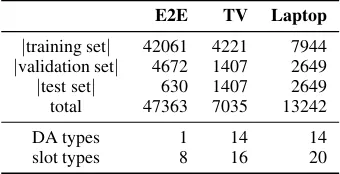
E2E TV Laptop
|training set| 42061 4221 7944 |validation set| 4672 1407 2649 |test set| 630 1407 2649 total 47363 7035 13242
DA types 1 14 14
[image:2.595.330.500.63.150.2]slot types 8 16 20
Table 2: Overview of the number of samples, as well as different DA and slot types, in each dataset .
utterances with fewer missing or redundant slots. Cuay´ahuitl et al.(2014) perform automatic slot beling using a Bayesian network trained on a la-beled dataset, and show that a method using spec-tral clustering can be extended to unlabeled data with high accuracy. In one of the first success-ful neural approaches to language generation,Wen et al.(2015a) augment the generator’s inputs with a control vector indicating which slots still need to be realized at each step. Wen et al.(2015b) take the idea further by embedding a new sigmoid gate into their LSTM cells, which directly conditions the generator on the DA. More recently,Duˇsek and Jurˇc´ıˇcek(2016) supplement their encoder-decoder model with a trainable classifier which they use to rerank the beam search candidates based on miss-ing and redundant slot mentions.
Our work builds upon the successful atten-tional encoder-decoder framework for sequence-to-sequence learning and expands it through en-sembling. We explore the feasibility of a domain-independent slot aligner that could be applied to any dataset, regardless of its size, and beyond the reranking task. We also tackle some challenges caused by delexicalization in order to improve the quality of surface realizations, while retaining the ability of the neural model to generalize.
3 Datasets
We evaluated the models on three datasets from different domains. The primary one is the recently released E2E restaurant dataset (Novikova et al., 2017b) with 48K samples. For benchmarking we use the TV dataset and the Laptop dataset (Wen et al., 2016) with 7K and 13K samples, respec-tively. Table2summarizes the proportions of the training, validation, and test sets for each dataset.
3.1 E2E Dataset
Figure 1: Proportion of unique MRs in the datasets. Note that the number of MRs in the E2E dataset was cut off at 10K for the sake of visibility of the small differences between other column pairs.
collected using pictures as the source of tion, which was shown to inspire more informa-tive and natural utterances (Novikova et al.,2016). With nearly 50K samples, it offers almost 10 times more data than the San Francisco restaurant dataset introduced in Wen et al. (2015b), which has frequently been used for benchmarks. The reference utterances in the E2E dataset exhibit su-perior lexical richness and syntactic variation, in-cluding more complex discourse phenomena. It aims to provide higher-quality training data for end-to-end NLG systems to learn to produce more naturally sounding utterances. The dataset was re-leased as a part of the E2E NLG Challenge.
Although the E2E dataset contains a large num-ber of samples, each MR is associated on aver-age with 8.65 different reference utterances,
ef-fectively offering less than 5K unique MRs in the training set (Fig.1). Explicitly providing the model with multiple ground truths, it offers multi-ple alternative utterance structures the model can learn to apply for the same type of MR. The delex-icalization, as detailed later in Section 5.1, im-proves the ability of the model to share the con-cepts across different MRs.
The dataset contains only 8 different slot types, which are fairly equally distributed. The number of slots in each MR ranges between 3 and 8, but the majority of MRs consist of 5 or 6 slots. Even though most of the MRs contain many slots, the majority of the corresponding human utterances, however, consist of one or two sentences only (Ta-ble3), suggesting a reasonably high level of sen-tence complexity in the references.
3.2 TV and Laptop Datasets
The reference utterances in the TV and the Laptop datasets were collected using Amazon
Mechani-slots 3 4 5 6 7 8
sent. 1.09 1.23 1.41 1.65 1.84 1.92
[image:3.595.313.518.64.105.2]prop. 5% 18% 32% 28% 14% 3%
Table 3: Average number of sentences in the reference utterance for a given number of slots in the correspond-ing MR, along with the proportion of MRs with specific slot counts.
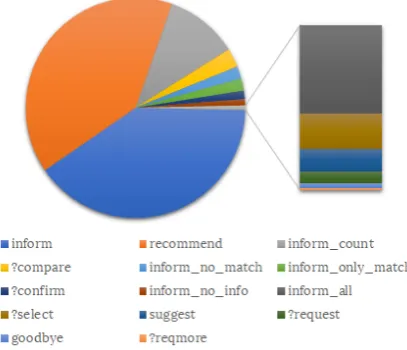
Figure 2: Proportion of DAs in the Laptop dataset.
cal Turk (AMT), one utterance per MR. These two datasets are similar in structure, both using the same 14 DA types.2 The Laptop dataset, however,
is almost twice as large and contains 25% more slot types.
Although both of these datasets contain more than a dozen different DA types, the vast majority (68% and 80% respectively) of the MRs describe a DA of either type inform or recommend (Fig. 2), which in most cases have very simi-larly structured realizations, comparable to those in the E2E dataset. DAs such as suggest, ?request, orgoodbyeare represented by less than a dozen samples, but are significantly easier to learn to generate an utterance from because the corresponding MRs contain three slots at the most.
4 Ensemble Neural Language Generator 4.1 Encoder-Decoder with Attention
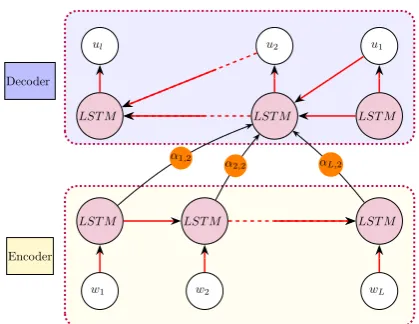
Our model uses the standard encoder-decoder ar-chitecture with attention, as defined inBahdanau et al.(2015). Encoding the input into a sequence of context vectors instead of a single vector en-ables the decoder to learn what specific parts of the
2We noticed the MRs with the?requestDA type in the
[image:3.595.314.518.179.354.2]Decoder
Encoder
LST M LST M LST M
w1 w2 wL
LST M LST M LST M
ul u2 u1
α1,2 α
2,2 αL,2
Figure 3: Standard architecture of a single-layer encoder-decoder LSTM model with attention. For each time steptin the output sequence, the attention scores αt,1, . . . , αt,L are calculated. This diagram shows the
attention scores only fort= 2.
input sequence to pay attention to, given the out-put generated so far. In this attentional encoder-decoder architecture, the probability of the output at each time step t of the decoder depends on a
distinct context vectorqtin the following way:
P(ut|u1, . . . , ut−1,w) =g(ut−1, st, qt),
where in the place of functiong we use the soft-max function over the size of the vocabulary, and
st is a hidden state of the decoder RNN at time
stept, calculated as:
st=f(st−1, ut−1, qt).
The context vector qt is obtained as a weighted
sum of all the hidden statesh1, . . . , hLof the
en-coder:
qt= L
X
i=1
αt,ihi,
where αt,i corresponds to the attention score the
t-th word in the target sentence assigns to thei-th
item in the input MR.
We compute the attention score αt,i using a
multi-layer perceptron (MLP) jointly trained with the entire system (Bahdanau et al.,2015). The en-coder’s and deen-coder’s hidden states at timeiandt,
respectively, are concatenated and used as the in-put to the MLP, namely:
αt,i=sof tmax wTtanh(W[hi;st]) ,
whereW andware the weight matrix and the
vec-tor of the first and the second layer of the MLP, re-spectively. The learned weights indicate the level
of influence of the individual words in the input se-quence on the prediction of the word at time stept
of the decoder. The model thus learns a soft align-ment between the source and the target sequence.
4.2 Ensembling
In order to enhance the quality of the predicted ut-terances, we create three neural models with dif-ferent encoders. Two of the models use a bidirec-tional LSTM (Hochreiter and Schmidhuber,1997) encoder, whereas the third model has a CNN (Le-Cun et al.,1998) encoder. We train these models individually for a different number of epochs and then combine their predictions.
Initially, we attempted to combine the pre-dictions of the models by averaging the log-probability at each time step and then selecting the word with the maximum log-probability. We no-ticed that the quality, as well as the BLEU score of our utterances, decreased significantly. We be-lieve that this is due to the fact that different mod-els learn different sentence structures and, hence, combining predictions at the probability level re-sults in incoherent utterances.
Therefore, instead of combining the models at the log-probability level, we accumulate the top 10 predicted utterances from each model type us-ing beam search and allow the reranker (see Sec-tion4.4) to rank all candidate utterances taking the proportion of slots they successfully realized into consideration. Finally, our system predicts the ut-terance that received the highest score.
4.3 Slot Alignment
Our training data is inherently unaligned, meaning our model is not certain which sentence in a multi-sentence utterance contains a given slot, which limits the model’s robustness. To accommodate this, we create a heuristic-based slot aligner which automatically preprocesses the data. Its primary goal is to align chunks of text from the reference utterances with an expected value from the MR. Applications of our slot aligner are described in subsequent sections and in Table4.
[image:4.595.76.286.64.226.2]sentence in an utterance, by associating all pos-sible slot realizations with their appropriate slot type. We additionally augment the gazetteer us-ing a small set of handcrafted rules which capture cases not easily encapsulated by the above pro-cess, for example, associating thepriceRange slot with a chunk of text using currency symbols or relevant lexemes, such as “cheap” or “high-end”. While handcrafted, these rules are transfer-able across domains, as they target the slots, not the domains, and mostly serve to counteract the noise in the E2E dataset. Finally, we use Word-Net (Fellbaum,1998) to further augment the size of our gazetteer by accounting for synonyms and other semantic relationships, such as associating “pasta” with thefood[Italian]slot.
4.4 Reranker
As discussed in Section4.2, our model uses beam search to produce a pool of the most likely utter-ances for a given MR. While these results have a probability score provided by the model, we found that relying entirely on this score often results in the system picking a candidate which is objec-tively worse than a lower scoring utterance (i.e. one missing more slots and/or realizing slots in-correctly). We therefore augment that score by multiplying it by the following score which takes the slot alignment into consideration:
salign= N
(Nu+ 1)·(No+ 1)
,
where N is the number of all slots in the given MR, and Nu and No represent the number of
unaligned slots (those not observed by our slot aligner) and over-generated slots (those which have been realized but were not present in the orig-inal MR), respectively.
5 Data Preprocessing 5.1 Delexicalization
We enhance the ability of our model to general-ize the learned concepts to unseen MRs by delex-icalizing the training data. Moreover, it reduces the amount of data required to train the model. We identify the categorical slots whose values al-ways propagate verbatim to the utterance, and re-place the corresponding values in the utterance with placeholder tokens. The placeholders are eventually replaced in the output utterance in post-processing by copying the values from the input
MR. Examples of such slots would be name or near in the E2E dataset, and screensize or processorin the TV and the Laptop dataset.
Previous work identifies categorical slots as good delexicalization candidates that improve the performance of the model (Wen et al., 2015b; Nayak et al., 2017). However, we chose not to delexicalize those categorical slots whose values can be expressed in alternative ways, such as “less than $20” and “cheap”, or “on the riverside” and “by the river”. Excluding these from delexical-ization may lead to an increased number of incor-rect realizations, but it encourages diversity of the model’s outputs by giving it a freedom to choose among alternative ways of expressing a slot-value in different contexts. This, however, assumes that the training set contains a sufficient number of samples displaying this type of alternation so that the model can learn that certain phrases are syn-onymous. With its multiple human references for each MR, the E2E dataset has this property.
As Nayak et al. (2017) point out, delex-icalization affects the sentence planning and the lexical choice around the delexicalized slot value. For example, the realization of the
slot food[Italian] in the phrase “serves
Italian food” is valid, while the realization of food[fast food] in “serves fast food food” is clearly undesired. Similarly, a naive delexical-ization can result in “a Italian restaurant”, whereas the article should be “an”. Another problem with articles is singular versus plural nouns in the slot value. For example, the slot accessories in the TV dataset, can take on values such as “remote control”, as well as “3D glasses”, where only the former requires an article before the value.
We tackle this issue by defining different placeholder tokens for values requiring differ-ent treatmdiffer-ent in the realization. For instance, the value “Italian” of the food slot is re-placed by slot vow cuisine food, indicat-ing that the value starts with a vowel and rep-resents a cuisine, while “fast food” is replaced by slot con food, indicating that the value starts with a consonant and cannot be used as a term for cuisine. The model thus learns to gen-erate “a” before slot con food and “an”
be-foreslot vow cuisine foodwhen
can automatically be applied across different slots and domains.
5.2 Data Expansion Slot Permutation
In our initial experiments, we tried expanding the training set by permuting the slot ordering in the MRs as suggested in Nayak et al. (2017). From different slot orderings of every MR we sampled five random permutations (in addition to the orig-inal MR), and created new pseudo-samples with the same reference utterance. The training set thus increased six times in size.
Using such an augmented training set might add to the model’s robustness, nevertheless it did not prove to be helpful with the E2E dataset. In this dataset, we observed the slot order to be fixed across all the MRs, both in the training and the test set. As a result, for the majority of the time, the model was training on MRs with slot orders it would never encounter in the test set, which ulti-mately led to a decreased performance in predic-tion on the test set.
Utterance/MR Splitting
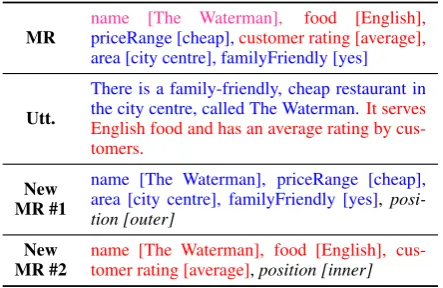
Taking a more utterance-oriented approach, we augment the training set with single-sentence ut-terances paired with their corresponding MRs. These new pseudo-samples are generated by split-ting the exissplit-ting reference utterances into single sentences and using the slot aligner introduced in Section4.3to identify the slots that correspond to each sentence. The MRs of the new samples are created as the corresponding subsets of slots and, whenever the sentence contains the name (of the restaurant/TV/etc.) or a pronoun referring to it (such as “it” or “its”), thename slot is included too. Finally, a new positionslot is appended to every new MR, indicating whether it represents the first sentence or a subsequent sentence in the original utterance. An example of this splitting technique can be seen in Table4. The training set almost doubled in size through this process.
Since the slot aligner works heuristically, not all utterances are successfully aligned with the MR. The vast majority of such cases, however, is caused by reference utterances in the datasets having incorrect or entirely missing slot mentions. There is a noticeable proportion of those, so we leave them in the training set with the unaligned slots removed from the MR so as to avoid confus-ing the model when learnconfus-ing from such samples.
MR name [The Waterman],priceRange [cheap],customer rating [average],food [English], area [city centre], familyFriendly [yes]
Utt.
There is a family-friendly, cheap restaurant in the city centre, called The Waterman.It serves English food and has an average rating by cus-tomers.
New MR #1
name [The Waterman], priceRange [cheap], area [city centre], familyFriendly [yes], posi-tion [outer]
New
MR #2 name [The Waterman], food [English], cus-tomer rating [average],position [inner] Table 4: An example of the utterance/MR splitting.
MR name [Wildwood], eatType [coffee shop],food [English], priceRange [moderate], cus-tomer rating [1 out of 5], near [Ranch]
Simple utt.
Wildwood provides English food for a mod-erate price. It has a low customer rating and is located near Ranch. It is a coffee shop.
Elegant utt.
[image:6.595.306.528.62.206.2]A low-rated English style coffee shop around Ranch, called Wildwood, has moderately priced food.
Table 5: Contrastive example of a simple and a more elegant reference utterance style for the same MR in the E2E dataset.
5.3 Sentence Planning via Data Selection The quality of the training data inherently im-poses an upper bound on the quality of the predic-tions of our model. Therefore, in order to bring our model to produce more sophisticated utter-ances, we experimented with filtering the train-ing data to contain only the most natural soundtrain-ing and structurally complex utterances for each MR. For instance, we prefer having an elegant, single-sentence utterance with an apposition as the refer-ence for an MR, rather than an utterance composed of three simple sentences, two of which begin with “it” (see the examples in Table5).
utter-ances, such as the “simple” example in the above table, in the filtered training set.
6 Evaluation
Researchers in NLG have generally used both au-tomatic and human evaluation. Our results report the standard automatic evaluation metrics: BLEU (Papineni et al., 2002), NIST (Przybocki et al., 2009), METEOR (Lavie and Agarwal,2007), and ROUGE-L (Lin, 2004). For the E2E dataset ex-periments, we additionally report the results of the human evaluation carried out on the CrowdFlower platform as a part of the E2E NLG Challenge.
6.1 Experimental Setup
We built our ensemble model using the seq2seq framework (Britz et al., 2017) for TensorFlow. Our individual LSTM models use a bidirectional LSTM encoder with 512 cells per layer, and the CNN models use a pooling encoder as inGehring et al. (2017). The decoder in all models was a 4-layer RNN decoder with 512 LSTM cells per layer and with attention. The hyperparameters were determined empirically. After experiment-ing with different beam search parameters, we set-tled on the beam width of 10. Moreover, we em-ployed the length normalization of the beams as defined in Wu et al. (2016), in order to encour-age the decoder to favor longer sequences. The length penalty providing the best results on the E2E dataset was 0.6, whereas for the TV and Lap-top datasets it was 0.9 and 1.0, respectively.
6.2 Experiments on the E2E Dataset
We start by evaluating our system on the E2E dataset. Since the reference utterances in the test set were kept secret for the E2E NLG Challenge, we carried out the metric evaluation using the vali-dation set. This was necessary to narrow down the models that perform well compared to the base-line. The final model selection was done based on a human evaluation of the models’ outputs on the test set.
6.2.1 Automatic Metric Evaluation
In the first experiment, we assess what effect the augmenting of the training set via utterance split-ting has on the performance of different models. The results in Table 6show that both the LSTM and the CNN models clearly benefit from addi-tional pseudo-samples in the training set. This can likely be attributed to the model having access to
BLEU NIST METEOR ROUGE
LSTM s 0.6664 8.0150 0.4420 0.7062
s 0.6930‡ 8.4198 0.4379 0.7099
CNN s 0.6599 7.8520 0.4333 0.7018
s 0.6760† 8.0440 0.4448 0.7055
Table 6: Automatic metric scores of different mod-els tested on the E2E dataset, both unmodified (s) and augmented (s) through the utterance splitting. The symbols † and ‡ indicate statistically significant im-provement over the scounterpart withp < 0.05and
p <0.01, respectively, based on the paired t-test.
more granular information about which parts of the utterance correspond to which slots in the MR. This may assist the model in sentence planning and building a stronger association between parts of the utterance and certain slots, such as that “it” is a substitute for the name.
Testing our ensembling approach reveals that reranking predictions pooled from different mod-els produces an ensemble model that is overall more robust than the individual submodels. The submodels fail to perform well in all four met-rics at once, whereas the ensembling creates a new model that is more consistent across the differ-ent metric types (Table7).3 While the ensemble
model decreases the proportion of incorrectly re-alized slots compared to its individual submodels on the validation set, on the test set it only out-performs two of the submodels in this aspect (Ta-ble 8). Analyzing the outputs, we also observed that the CNN model surpassed the two LSTM models in the ability to realize the “fast food” and “pub” values reliably, both of which were hardly present in the validation set but very frequent in the test set. On the official E2E test set, our en-semble model performs comparably to the base-line model, TGen (Duˇsek and Jurˇc´ıˇcek,2016), in terms of automatic metrics (Table9).
6.2.2 Human Evaluation
It is known that automatic metrics function only as a general and vague indication of the quality of an utterance in a dialogue (Liu et al.,2016;Novikova et al.,2017a). Systems which score similarly ac-cording to these metrics could produce utterances that are significantly different because automatic
3The scores here correspond to the model submitted to
BLEU NIST METEOR ROUGE
LSTM1 0.6661 8.1626 0.4644 0.7018
LSTM2 0.6493 7.9996 0.4649 0.6995
CNN 0.6636 7.9617 0.4700 0.7107
[image:8.595.95.269.222.306.2]Ensem. 0.6576 8.0761 0.4675 0.7029
Table 7: Automatic metric scores of three different models and their ensemble, tested on thevalidation set
of the E2E dataset. LSTM2 differs from LSTM1 in that it was trained longer.
Validation set Test set
LSTM1 0.116% 0.988%
LSTM2 0.145% 1.241%
CNN 0.232% 0.253%
Ensem. 0.087% 0.965%
Table 8: Error rate of the ensemble model compared to its individual submodels.
metrics fail to capture many of the characteris-tics of natural sounding utterances. Therefore, to better assess the structural complexity of the pre-dictions of our model, we present the results of a human evaluation of the models’ outputs in terms of both naturalness and quality, carried out by the E2E NLG Challenge organizers.
Quality examines the grammatical correctness and adequacy of an utterance given an MR, whereasnaturalnessassesses whether a predicted utterance could have been produced by a native speaker, irrespective of the MR. To obtain these scores, crowd workers ranked the outputs of 5 ran-domly selected systems from worst to best. The final scores were produced using the TrueSkill algorithm (Sakaguchi et al., 2014) through pair-wise comparisons of the human evaluation scores among the 20 competing systems.
Our system, trained on the E2E dataset without stylistic selection (Section5.3), achieved the high-est quality score in the E2E NLG Challenge, and was ranked second in naturalness.4 The system’s
performance in quality (the primary metric) was significantly better than the competition according to the TrueSkill evaluation, which used bootstrap resampling with ap-level ofp≤0.05. Comparing these results with the scores achieved by the base-line model in quality and naturalness (5th and 6th
4The system that surpassed ours in naturalness was ranked
the last according to the quality metric.
BLEU NIST METEOR ROUGE
TGen 0.6593 8.6094 0.4483 0.6850
Ensem. 0.6619 8.6130 0.4454 0.6772
Table 9: Automatic metric scores of our ensemble model compared against TGen (the baseline model), tested on thetest setof the E2E dataset.
Ex. #1
The Cricketers is a cheap Chinese restaurant near All Bar One in the riverside area,but it has an av-erage customer rating and is not family friendly.
Ex.
#2 If you are looking forBoat,tryGiraffe. a coffee shop near The Rice
Table 10: Examples of generated utterances that con-tain more advanced discourse phenomena.
place, respectively) reinforces our belief that mod-els that perform similarly on the automatic metrics (Table9) can exhibit vast differences in the struc-tural complexity of their generated utterances. 6.2.3 Experiments with Data Selection After filtering the E2E training set as described in Section5.3, the new training set consisted of ap-proximately 20K pairs of MRs and utterances. In-terestingly, despite this drastic reduction in train-ing samples, the model was able to learn more complex utterances that contained the natural vari-ations of the human language. The generated ut-terances exhibited discourse phenomena such as contrastive cues (see Example #1 in Table10), as well as a more conversational style (Example #2). Nevertheless, the model also failed to realize slots more frequently.
In order to observe the effect of stylistic data se-lection, we conducted a human evaluation where we assessed the utterances based onerror rateand
naturalness. The error rate is calculated as the per-centage of slots the model failed to realize divided by the total number of slots present among all sam-ples. The annotators ranked samples of utterance triples – corresponding to three different ensemble models – by naturalness from 1 to 3 (3 being the most natural, with possible ties). Theconservative
model combines three submodels all trained on the full training set, theprogressiveone combines sub-models solely trained on the filtered dataset, and finally, thehybridis an ensemble of three models only one of which is trained on the full training set, so as to serve as a fallback.
Ensemble model Error rate Naturalness
Conservative 0.40% 2.196
Progressive 1.60% 2.118
Hybrid 0.40% 2.435
Table 11: Average error rate and naturalness metrics obtained from six annotators for different ensemble models.
training samples becomes evident by looking at the score of the progressive model (Table 11), where this model trained solely on the reduced dataset had the highest error rate. We observe, however, that a hybrid ensemble model manages to perform the best in terms of the error rate, as well as the naturalness.
These results suggest that filtering the dataset through careful data selection can help to achieve better and more natural sounding utterances. It significantly improves the model’s ability to pro-duce more elegant utterances beyond the “[name] is... It is/has...” format, which is only too common in neural language generators in this domain.
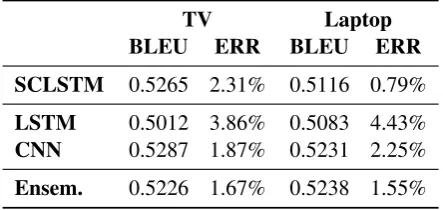
6.3 Experiments on TV and Laptop Datasets In order to provide a better frame of reference for the performance of our proposed model, we uti-lize the RNNLG benchmark toolkit5 to evaluate
our system on two additional, widely used datasets in NLG, and compare our results with those of a state-of-the-art model, SCLSTM (Wen et al., 2015b). As Table12shows, our ensemble model performs competitively with the baseline on the TV dataset, and it outperforms it on the Laptop dataset by a wide margin. We believe the higher error rate of our model can be explained by the sig-nificantly less aggressive slot delexicalization than the one used in SCLSTM. That, however, gives our model a greater lexical freedom and, with it, the ability to produce more natural utterances.
The model trained on the Laptop dataset is also a prime example of how an ensemble model is ca-pable of extracting the best learned concepts from each individual submodel. By combining their knowledge and compensating thus for each other’s weaknesses, the ensemble model can achieve a lower error rate, as well as a better overall qual-ity, than any of the submodels individually.
5https://github.com/shawnwun/RNNLG
TV Laptop
BLEU ERR BLEU ERR
SCLSTM 0.5265 2.31% 0.5116 0.79%
LSTM 0.5012 3.86% 0.5083 4.43%
CNN 0.5287 1.87% 0.5231 2.25%
[image:9.595.306.528.63.168.2]Ensem. 0.5226 1.67% 0.5238 1.55%
Table 12: Automatic metric scores of our ensemble model evaluated on the test sets of the TV and Lap-top datasets, and compared against SCLSTM. The ERR column indicates the slot error rate, as computed by the RNNLG toolkit (for our models calculated in post-processing).
7 Conclusion and Future Work
In this paper we presented our ensemble atten-tional encoder-decoder model for generating natu-ral utterances from MRs. Moreover, we presented novel methods of representing the MRs to improve performance. Our results indicate that the pro-posed utterance splitting applied to the training set greatly improves the neural model’s accuracy and ability to generalize. The ensembling method paired with the reranking based on slot alignment also contributed to the increase in quality of the generated utterances, while minimizing the num-ber of slots that are not realized during the genera-tion. This also enables the use of a less aggressive delexicalization, which in turn stimulates diversity in the produced utterances.
We showed that automatic slot alignment can be utilized for expanding the training data, as well as for utterance reranking. Our alignment currently relies in part on empirically observed heuristics, and a more robust aligner would allow for more flexible expansion into new domains. Since the stylistic data selection noticeably improved the di-versity of our system’s outputs, we believe this is a method with future potential, which we intend to further explore. Finally, it is clear that current au-tomatic evaluation metrics in NLG are only suffi-cient for providing a vague idea as to the system’s performance; we postulate that leveraging the ref-erence data to train a classifier will result in a more conclusive automatic evaluation metric.
Acknowledgements
References
Shubham Agarwal and Marc Dymetman. 2017. A sur-prisingly effective out-of-the-box char2char model on the e2e nlg challenge dataset. InSIGDIAL Con-ference.
Dzmitry Bahdanau, Kyunghyun Cho, and Yoshua Ben-gio. 2015. Neural machine translation by jointly learning to align and translate. ICLR.
Denny Britz, Anna Goldie, Minh-Thang Luong, and Quoc V. Le. 2017. Massive exploration of neural machine translation architectures. CoRR
abs/1703.03906.
Kyunghyun Cho, Bart van Merri¨enboer, C¸aglar G¨ulc¸ehre, Dzmitry Bahdanau, Fethi Bougares, Hol-ger Schwenk, and Yoshua Bengio. 2014. Learning phrase representations using rnn encoder-decoder for statistical machine translation. InEMNLP. Heriberto Cuay´ahuitl, Nina Dethlefs, Helen Hastie, and
Xingkun Liu. 2014. Training a statistical surface realiser from automatic slot labelling. In Spoken Language Technology Workshop (SLT), 2014 IEEE. IEEE, pages 112–117.
Ondˇrej Duˇsek and Filip Jurˇc´ıˇcek. 2016. Sequence-to-sequence generation for spoken dialogue via deep syntax trees and strings .
Christiane Fellbaum. 1998. WordNet. Wiley Online Library.
Jonas Gehring, Michael Auli, David Grangier, Denis Yarats, and Yann Dauphin. 2017. Convolutional se-quence to sese-quence learning. InICML.
Matthew Henderson, Blaise Thomson, and Steve Young. 2014. Robust dialog state tracking using delexicalised recurrent neural networks and unsu-pervised adaptation. InSpoken Language Technol-ogy Workshop (SLT), 2014 IEEE. IEEE, pages 360– 365.
Sepp Hochreiter and J¨urgen Schmidhuber. 1997. Long short-term memory. Neural computation
9(8):1735–1780.
Ioannis Konstas and Mirella Lapata. 2013. A global model for concept-to-text generation. J. Artif. Intell. Res.(JAIR)48:305–346.
Gerasimos Lampouras and Andreas Vlachos. 2016. Imitation learning for language generation from un-aligned data. InCOLING.
Irene Langkilde and Kevin Knight. 1998. Generation that exploits corpus-based statistical knowledge. In
COLING-ACL.
Alon Lavie and Abhaya Agarwal. 2007. Meteor: An automatic metric for mt evaluation with high lev-els of correlation with human judgments. In Pro-ceedings of the Second Workshop on Statistical Ma-chine Translation. Association for Computational Linguistics, pages 228–231.
Yann LeCun, L´eon Bottou, Yoshua Bengio, and Patrick Haffner. 1998. Gradient-based learning applied to document recognition. Proceedings of the IEEE
86(11):2278–2324.
Chin-Yew Lin. 2004. Rouge: A package for auto-matic evaluation of summaries. Text Summarization Branches Out.
Chia-Wei Liu, Ryan Joseph Lowe, Iulian Serban, Michael Noseworthy, Laurent Charlin, and Joelle Pineau. 2016. How not to evaluate your dialogue system: An empirical study of unsupervised evalu-ation metrics for dialogue response generevalu-ation. In
EMNLP.
Franc¸ois Mairesse, Milica Gaˇsi´c, Filip Jurˇc´ıˇcek, Simon Keizer, Blaise Thomson, Kai Yu, and Steve Young. 2010. Phrase-based statistical language generation using graphical models and active learning. InACL. Franc¸ois Mairesse and Steve Young. 2014. Stochastic language generation in dialogue using factored lan-guage models. Computational Linguistics40:763– 799.
Christopher Manning, Mihai Surdeanu, John Bauer, Jenny Finkel, Steven Bethard, and David McClosky. 2014. The stanford corenlp natural language pro-cessing toolkit. InACL.
Hongyuan Mei, Mohit Bansal, and Matthew R Walter. 2016. What to talk about and how? selective gen-eration using lstms with coarse-to-fine alignment.
NAACL.
Neha Nayak, Dilek Hakkani-Tur, Marilyn Walker, and Larry Heck. 2017. To plan or not to plan? dis-course planning in slot-value informed sequence to sequence models for language generation. In IN-TERSPEECH.
Jekaterina Novikova, Ondˇrej Duˇsek, Amanda Cercas Curry, and Verena Rieser. 2017a. Why we need new evaluation metrics for nlg. InEMNLP.
Jekaterina Novikova, Ondˇrej Duˇsek, and Verena Rieser. 2017b. The E2E NLG shared task .
Jekaterina Novikova, Oliver Lemon, and Verena Rieser. 2016. Crowd-sourcing nlg data: Pictures elicit better data. INLG.
Kishore Papineni, Salim Roukos, Todd Ward, and Wei-Jing Zhu. 2002. Bleu: a method for automatic eval-uation of machine translation. InACL.
Mark Przybocki, Kay Peterson, S´ebastien Bronsart, and Gregory Sanders. 2009. The nist 2008 met-rics for machine translation challenge – overview, methodology, metrics, and results. Machine Trans-lation23(2-3):71–103.
Keisuke Sakaguchi, Matt Post, and Benjamin Van Durme. 2014. Efficient elicitation of annota-tions for human evaluation of machine translation. In Proceedings of the Ninth Workshop on Sta-tistical Machine Translation. Association for Computational Linguistics, pages 1–11.
Amanda Stent, Rashmi Prasad, and Marilyn Walker. 2004. Trainable sentence planning for complex in-formation presentation in spoken dialog systems. In
Proceedings of the 42nd annual meeting on associ-ation for computassoci-ational linguistics. Association for Computational Linguistics, page 79.
Ilya Sutskever, Oriol Vinyals, and Quoc V. Le. 2014. Sequence to sequence learning with neural net-works. InNIPS.
Tsung-Hsien Wen, Milica Gaˇsi´c, Dongho Kim, Nikola Mrkˇsi´c, Pei hao Su, David Vandyke, and Steve Young. 2015a. Stochastic language generation in dialogue using recurrent neural networks with con-volutional sentence reranking. InSIGDIAL Confer-ence.
Tsung-Hsien Wen, Milica Gaˇsi´c, Nikola Mrkˇsi´c, Lina M. Rojas-Barahona, Pei-Hao Su, David Vandyke, and Steve Young. 2016. Multi-domain neural net-work language generation for spoken dialogue sys-tems. InNAACL.
Tsung-Hsien Wen, Milica Gaˇsi´c, Nikola Mrkˇsi´c, Pei-Hao Su, David Vandyke, and Steve Young. 2015b. Semantically conditioned lstm-based natural lan-guage generation for spoken dialogue systems. In
EMNLP.
Yonghui Wu, Mike Schuster, Zhifeng Chen, Quoc V. Le, Mohammad Norouzi, Wolfgang Macherey, Maxim Krikun, Yuan Cao, Qin Gao, Klaus Macherey, Jeff Klingner, Apurva Shah, Melvin Johnson, Xiaobing Liu, Lukasz Kaiser, Stephan Gouws, Yoshikiyo Kato, Taku Kudo, Hideto Kazawa, Keith Stevens, George Kurian, Nishant Patil, Wei Wang, Cliff Young, Jason Smith, Jason Riesa, Alex Rudnick, Oriol Vinyals, Gregory S. Corrado, Macduff Hughes, and Jeffrey Dean. 2016. Google’s neural machine translation system: Bridg-ing the gap between human and machine translation.