Proceedings of NAACL-HLT 2018, pages 1919–1929
Human Needs Categorization of Affective Events Using Labeled and
Unlabeled Data
Haibo Ding School of Computing
University of Utah Salt Lake City, UT 84112 [email protected]
Ellen Riloff School of Computing
University of Utah Salt Lake City, UT 84112 [email protected]
Abstract
We often talk about events that impact us posi-tively or negaposi-tively. For example“I got a job”
is good news, but“I lost my job”is bad news. When we discuss an event, we not only under-stand its affective polarity but also the reason
whythe event is beneficial or detrimental. For example, getting or losing a job has affective polarity primarily because it impacts us finan-cially. Our work aims to categorize affective events based uponhuman needcategories that often explain people’s motivations and desires: PHYSIOLOGICAL, HEALTH, LEISURE, SO -CIAL, FINANCIAL, COGNITION, and FREE -DOM. We create classification models based on event expressions as well as models that use contexts surrounding event mentions. We also design a co-training model that learns from unlabeled data by simultaneously train-ing event expression and event context classi-fiers in an iterative learning process. Our re-sults show that co-training performs well, pro-ducing substantially better results than the in-dividual classifiers.
1 Introduction
Recent research has focused on identifying affec-tive events in text, which are activities or states that positively or negatively affect the people who experience them. Recognizing affective events in text is challenging because they appear as factual expressions and their affective polarity is often im-plicit. For example,“I broke my arm”and“I got fired” are usually negative experiences, while “I broke a record” and “I went to a concert” are typically positive experiences. Several NLP tech-niques have been developed to recognize affec-tive events, including patient polarity verb boot-strapping (Goyal et al., 2010, 2013), implicature rules (Deng and Wiebe,2014), label propagation (Ding and Riloff, 2016), pattern-based learning
(Vu et al.,2014;Reed et al.,2017), and semantic consistency optimization (Ding and Riloff,2018). Our research aims to probe deeper and under-stand not just the polarity of affective events, but the reason forthe polarity. Events can impact peo-ple in many ways, and understandingwhyan event is beneficial or detrimental is a fundamental as-pect of language understanding and narrative text comprehension. Additionally, many applications could benefit from understanding the nature of af-fective events, including text summarization, con-versational dialogue processing, and mental health therapy or counseling systems. As an illustra-tion, a mental health therapy system can benefit from understanding why someone is in a negative state. If the triggering event for depression is “I broke my leg” then the reason is about the per-son’s Health, but if the triggering event is“I broke up with my girlfriend”then the reason is based on Social relationships.
We hypothesize that the polarity of affective events can often be attributed to a relatively small set ofhuman needcategories. Our work is moti-vated by theories in psychology that explain peo-ple’s motivations, desires, and overall well-being in terms of categories associated with basic hu-man needs, such as Maslow’s Hierarchy of Needs (Maslow et al., 1970) and Fundamental Human Needs (Max-Neef et al., 1991). Drawing upon these works, we propose that the polarity of af-fective events often arises from 7 types of human
needs: PHYSIOLOGICAL, HEALTH, LEISURE,
SOCIAL, FINANCIAL, COGNITION, and FREE
-DOM. For example, “I broke my arm” has
neg-ative polarity because it negneg-atively impacts one’s Health, “I got fired” is negative because it neg-atively impacts one’s Finances, and “I am con-fused”is negative because it reflects a problem re-lated to Cognition.
We explore this hypothesis and tackle the
lenge of categorizing affective events in text with respect to these 7 human need categories. As our evaluation data, we use events extracted from per-sonal blog posts and manually labeled with affec-tive polarity in previous work (Ding and Riloff,
2018). These affective events were then subse-quently annotated for the human need categories.
In this paper, we design several types of classifi-cation models that learn from both labeled and un-labeled data. First, we present supervised learning models that use lexical and embedding features for the words in event expressions, as well as models that learn from the sentence contexts surrounding mentions of event expressions. Next, we explore self-training and co-training models that exploit both labeled and unlabeled data for training. The most effective system is a co-training model that uses two classifiers with two different views in an iterative learning process: one classifier only uses the words in an event expression, and the other classifier only uses the contexts surrounding in-stances of an event expression. Our results show that this co-training model effectively uses unla-beled data to substantially improve results com-pared to classifiers trained only with labeled data, yielding gains in both precision and recall.
2 Related Work
Recently, there has been growing interest in rec-ognizing the affective polarity of events. For ex-ample, Goyal et al. (2013) developed a boot-strapped learning method to learn patient polar-ity verbs, which impart affective polarities to their patients. Li et al.(2015) designed methods to ex-tract verb expressions that imply negative opin-ions from reviews. Rashkin et al. (2016) re-cently proposed connotation frames to incorpo-rate the connotative polarities for a verb’s argu-ments from the writer’s and other event entities’ perspectives. Li et al. (2014) proposed a boot-strapping approach to extract major life events from tweets using congratulation and condolence speech acts. Most of these major life events are affective although their work did not identify po-larity. Another group of researchers have stud-ied +/- effect events (Deng et al.,2013;Choi and Wiebe,2014) which they previously called bene-factive/malefactive events. Their work mainly fo-cused on inferring implicit opinions through im-plicature rules (Deng and Wiebe,2014,2015).
Ding and Riloff (2016) designed an event
con-text graph model to identify affective events us-ing label propagation. Reed et al. (2017) demon-strated that automatically acquired patterns could benefit the recognition of first-person related af-fective sentences. Most recently, Ding and Riloff (2018) developed a semantic consistency model to induce a large set of affective events using three types of semantic relations in an optimiza-tion framework. (We use their annotated affective event data set in our work.) All of this previous work only identifies affective events and their po-larities. In contrast, our work aims to identify the reason for the affective polarity of an event.
The human need categories are inspired by two prior theories. The first one is Maslow’s Hierar-chy of Needs (Maslow et al.,1970) which was de-veloped to study people’s motivations and person-alities. The second one is Fundamental Human Needs (Max-Neef et al.,1991) which was devel-oped to help communities identify their strengths and weaknesses. The human need categories are also related to the concept of “goals”, which has been proposed by (Schank and Abelson, 1977) to understand narrative stories. Goals could be very specific to a character in a particular narra-tive story. However, but many types of goals orig-inate from universal needs and desires shared by most people (Max-Neef et al.,1991). In addition, our work is also related to research on wish de-tection (Goldberg et al.,2009), desire fulfillment (Chaturvedi et al., 2016), and modelling protago-nist goals and desires (Rahimtoroghi et al.,2017). Self-training is a semi-supervised learning method to improve performance by exploiting un-labeled data. Self-training has been successfully used in many NLP applications such as informa-tion extracinforma-tion (Ding and Riloff, 2015) and syn-tactic parsing (McClosky et al.,2006). Co-training (Blum and Mitchell,1998) uses both labeled and unlabeled data to train models that have two differ-ent views of the data. Co-training has been previ-ously used for many NLP tasks including spectral clustering (Kumar and Daum´e,2011), word sense disambiguation (Mihalcea,2004), coreference res-olution (Phillips and Riloff,2002), and sentiment analysis (Wan,2009;Xia et al.,2015).
3 Affective Event Data
Physiological Health Leisure Social Finance Cognition Freedom Emotion None 19 (4%) 52 (10%) 75 (14%) 108 (20%) 29 (5%) 26 (5%) 7 (1%) 128 (24%) 98 (18%)
Table 1: Distribution of Human Need Categories (each cell shows the frequency and percentage).
created for prior research (Ding and Riloff,2018) which aims to identify affective events. We will refer to this data as the AffectEvent dataset. We will briefly describe this data and the human need category annotations that we added on top of it.
The AffectEvent dataset contains events ex-tracted from a personal story corpus that was cre-ated by applying a personal story classifier ( Gor-don and Swanson,2009) to 177 million blog posts. The personal story corpus contains 1,383,425
per-sonal story blogs. StanfordCoreNLP (Manning
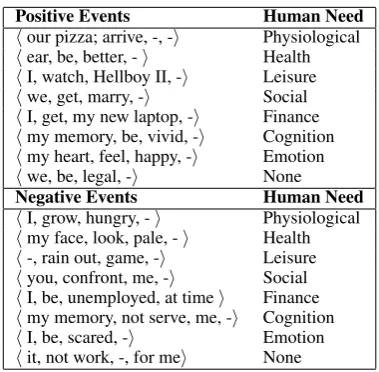
et al.,2014) was used for POS and NER tagging and SyntaxNet (Andor et al., 2016) for parsing. Each event is represented using a frame-like struc-ture to capstruc-ture the meanings of different types of events. Each event representation contains four components: hAgent, Predicate, Theme, PPi. The Predicate is a simple verb phrase correspond-ing to an action or state. The Agent is a named entity, nominal, or pronoun, and is extracted us-ing syntactic heuristics rather than semantic role labeling. We use “Theme” loosely to allow a NP or adjective to fill this role. The PP component is composed of a preposition and a NP. All words in the event are lemmatized, and active and passive voices are normalized to have the same representa-tion. See (Ding and Riloff,2018) for more details of the event representation. Table 2 shows some examples of extracted events.
Positive Events Human Need
hour pizza; arrive, -, -i Physiological hear, be, better, -i Health hI, watch, Hellboy II, -i Leisure hwe, get, marry, -i Social hI, get, my new laptop, -i Finance hmy memory, be, vivid, -i Cognition hmy heart, feel, happy, -i Emotion hwe, be, legal, -i None
Negative Events Human Need
[image:3.595.85.275.532.718.2]hI, grow, hungry, -i Physiological hmy face, look, pale, -i Health h-, rain out, game, -i Leisure hyou, confront, me, -i Social hI, be, unemployed, at timei Finance hmy memory, not serve, me, -i Cognition hI, be, scared, -i Emotion hit, not work, -, for mei None
Table 2: Examples of Affective Events with Human Need Category Labels
3.1 Human Need Category Annotations
Affective events impact people in a positive or negative way for a variety of reasons. We hypoth-esized that the polarity of most affective events arises from the satisfaction or violation of basic human needs. Psychologists have developed theo-ries that explain people’s motivations, desires, and overall well-being in terms of categories associ-ated with basic human needs, such as Maslow’s Hierarchy of Needs (Maslow et al.,1970) and Fun-damental Human Needs (Max-Neef et al.,1991). Based upon this work, we defined 7 human need categories, which are briefly described below.
Physiological Needsmaintain our body’s basic functions (e.g., air, food, water, sleep). Health Needs are to be physically healthy and safe. Leisure Needs are to have fun, to be relaxed, to have leisure time, to appreciate and enjoy beauty. Social Needs are to have good social relations (e.g., family, friendship), to have good self-worth and self-esteem, and to be respected by others. Fi-nancial Needsare to obtain and protect financial income, to acquire and maintain valuable posses-sions, to have a job and satisfying work. Cogni-tion Needs are to obtain skills, information, and knowledge, to receive education, to improve one’s intelligence, and to mentally process information correctly. Freedom Needsare the ability to move or change positions freely, and to access things or services in a timely manner. We also de-fined two categories for event expressions that represent explicit emotions and opinions ( Emo-tions/Sentiments/Opinions) and events that do not fall into any other categories (None of the Above). We added manual annotations for human need categories on top of the manually annotated pos-itive and negative affective events in the Af-fectEvent dataset. Three people were asked to assign a human need category label to each of the 559 affective events in the AffectEvent test set. Annotators achieved good pairwise inter-annotator agreement (κ ≥.65) on this task. The
Cohen’s kappa scores were κ=.69, κ=.66 and
κ=.65. We assigned a single category to each
for multiple categories. We discuss this issue fur-ther in Section5.4
The distribution of human need categories is shown in Table1. Since very few affective events were found to belong to theFreedomcategory, this category was merged into None. Additionally, 17 events received three different labels from the an-notators, so they were discarded. The majority label was then assigned to the remaining events, yielding a gold standard data set of 542 affective events with human need category labels. Some of the annotated examples are shown in Table2. A more detailed description of the human need cat-egory definitions, data set, and manual annotation effort is described in (Ding et al.,2018). This data set is freely available for other researchers to use.
In the next section, we present classification models designed to tackle this human needs cat-egorization task.
4 Categorizing Human Needs with Labeled and Unlabeled Data
Automatically categorizing affective events in text based on human needs is a new task, so we in-vestigated several types of approaches. First, we designed supervised classifiers to categorize af-fective events based upon the words in the event expressions, which we will refer to as Event Ex-pression Classifiers. We explored lexical fea-tures, word embedding feafea-tures, and semantic cat-egory features, along with several types of ma-chine learning algorithms.
Our task is to determine the human need cate-gory of an affective event based on the meaning of the event itself, independent of any specific con-text.1 But we hypothesized that collecting the con-texts around instances of the events could also pro-vide valuable information to infer human need cat-egories. So we also designedEvent Context Clas-sifiers to use the sentence contexts around event mentions as features.
Our gold standard data set is relatively small, so supervised learning that relies entirely on manu-ally labeled data may not have sufficient coverage to perform well across the human need categories. However, the AffectEvent dataset contains a very large set of events that were extracted from the same blog corpus, but not manually labeled with
1We view this as assuming the most common interpreta-tion of an event, which would be the default in the absence of context.
affective polarity. Consequently, we explored two weakly supervised learning methods to exploit this large set of unlabeled events. First, we tried self-training to iteratively improve the event expres-sion classifier. Second, we designed a co-training model that takes advantage of both an event ex-pression classifier and an event context classifier to learn from the unlabeled events. These two types of classifiers provide complementary views of an event, so new instances labeled by one classifier can be used as valuable new data to benefit the other classifier, in an iterative learning cycle.
4.1 Event Expression Classifiers
The most obvious approach is to use the words in event expressions as features for recognizing hu-man need categories (e.g., {ear, be, better} for the event <ear, be, better>). We experimented
with both lexical (string) features and pre-trained word embedding features. For the latter, we used GloVe (Pennington et al., 2014) vectors (200d) pretrained on 27B tweets. For each event expres-sion, we compute its embedding as the average of its words’ embeddings.
We also designed semantic features using the lexical categories in the LIWC lexicon ( Pen-nebaker et al., 2007) to capture a more general meaning for each word. LIWC is a dictionary of words associated with “psychologically meaning-ful” lexical categories, some of which are directly relevant to our task, such as AFFECTIVE, SO -CIAL, COGNITIVE, and BIOLOGICAL PROCESS.
We identify the LIWC category of the head word of each phrase in the event representation and use them asSemantic Categoryfeatures.
We experimented with three types of supervised classification models: logistic regression (LR), support vector machines (SVM), and recurrent neural network classifiers (RNN). One advantage of the RNN is that it considers the word order in the event expression, which can be important. In our experiments, we used the Scikit-learn imple-mentation (Pedregosa et al.,2011) for the LR clas-sifier, and LIBSVM (Chang and Lin,2011) with a linear kernel for the SVM classifier. For the RNN, we used the example LSTM implementation from Keras (Chollet et al.,2015) github, which was de-veloped to build a sentiment classifier. We used the default parameters in our experiments2.
4.2 Event Context Classifiers
The event dataset was originally extracted from a large collection of blog posts, which contain many instances of the events in different sen-tences. We hypothesized that the contexts sur-rounding instances of an event can also provide strong clues about the human need category asso-ciated with the event. Therefore, we also created Event Context Classifiers to exploit the sentence contexts around event mentions. We explored sev-eral designs for event context classifiers, which are explained below.
ContextSentBOW: For each event in the training
set, we first collect all sentences mentioning this event and assign the event’s human need category as the label for each sentence. Each sentence is then used as a training instance for the event con-text classifier. We use a bag-of-words representa-tion for each sentence.
ContextSentEmbed : This variation labels
sen-tences exactly the same way as the previous model. But each sentence is represented as a dense embedding vector, which is computed as the aver-age of the embeddings for each word in the sen-tence. We used GloVe (Pennington et al., 2014) vectors (200d) pretrained on 27B tweets.
ContextAllBOW : Instead of treating each
sen-tence as a training instance, for this model we ag-gregate all of the sentences that mention the same event to create one giant context for the event. Each event corresponds to one training instance in this model, which is represented using bag-of-word features.
ContextAllEmbed: This variation aggregates the
sentences that mention an event exactly like the previous model. But each sentence is represented as a dense embedding vector. First, we compute an embedding vector for each sentence as the average of the embeddings of its words. Then we compute a single context embedding by averaging all of the sentence embeddings.
In the data, some events appear in many sen-tences, while others appear in just a few sentences. To maintain balance, we randomly sample 10 sen-tences for each event to use as its contexts.
To predict the human need category of an event, we first apply the event context classifier to con-texts that mention the event, which produces a probability distribution over the human need cat-egories. For each category, we compute its mean probability. Finally, we assign the event with the
human need category that has the highest mean probability (i.e. argmax).
4.3 Self-Training the Event Expression Classifier
Our labeled data set is relatively small, but as men-tioned previously, the AffectEvent dataset con-tains a large set of unlabeled events as well. So we designed a self-training model to try to itera-tively improve the event expression classifier by exploiting the unlabeled event data.
The self-training process works as follows. Ini-tially, the event expression classifier is trained us-ing the manually labeled events. Then the classi-fier is applied to the unlabeled events and assigns a human need category to each event with a con-fidence value. For each human need category, we select the unlabeled event that has been assigned to that category with the highest confidence. There-fore, each category will have one additional la-beled event at each iteration. The newly lala-beled events are added to the labeled data set, and the classifier is re-trained for the next iteration.
4.4 Co-Training with Event Expression and Event Context Classifiers
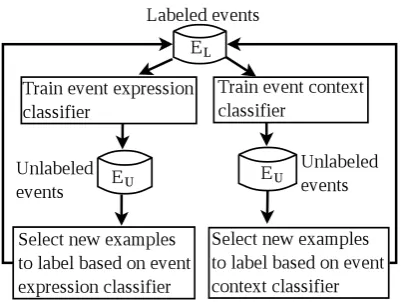
[image:5.595.315.517.496.647.2]The sentence contexts in which an event appears contain complementary information to the event expression itself. So we designed co-training models to exploit these complementary types of classifiers to iteratively learn from unlabeled data.
Figure 1: The Co-Training Model
Figure 1 shows the architecture of our
hu-man need category, we then select the event that has been assigned to the category with the highest confidence value as a new instance to label. Con-sequently, each category will receive two addi-tional labeled events at each iteration, one from the event expression classifier and another one from the event context classifier.3 Both sets of newly labeled events are then added to the labeled set
EL, and each of the classifiers is re-trained on the
expanded set of labeled data. Because the classi-fiers have different views of the events, the new instances labeled by one classifier serve as fresh training instances for the other, unlike self-training with a single classifier where it is learning entirely from its own predictions. The following section describes the co-training algorithm in more detail.
4.4.1 The Co-Training Algorithm
Our co-training algorithm is shown in Algorithm
1. The input to the algorithm are the sets of la-beled eventsEL and unlabeled events EU. Each event is associated with both an event expression and the set of sentences in which it occurs in the blogs corpus.
For each iteration, the event expression classi-fier is first trained using the labeled eventsELwith the event expression view. Then, we construct an event context viewXcon for each event in the la-beled setEL. The context sentences are used
dif-ferently depending on the type of context model (described in Section4.2). An event context clas-sifier is then trained using the context viewXcon.
Both classifiers are then independently applied to the unlabeled events EU. For each human need category, each classifier selects one event to label based on its most confident prediction. All of the newly labeled events are then added to the labeled training setEL, and the process repeats.
4.4.2 Prediction with Co-Trained Classifiers
The co-training process simultaneously trains two classifiers, so here we explain how we use the re-sulting classifiers after the co-training process has finished. For each eventein the test set, we apply
both the event expression classifier and the event context classifier, which each produce a probabil-ity distribution over the human need categories. Then we explore two different methods to com-bine the two probability distributions for each test
3The event expression classifier first selects from unla-beled events, then the event context classifier does the selec-tion. This ensures that there are 16 new events in total at each iteration.
Algorithm 1Co-Training Algorithm
1: Input:LabeledEL, unlabeledEUevents
2: while Not maximum iteration do
3: Train the event expression classifier onEL
4: Construct context view (Xcon) ofEL
5: Train the event context classifier onXcon
6: Apply the event expression classifier toEU and select new labeled events (Eexp) 7: Apply the event context classifier toEUand
select new labeled events (Econ)
8: Update labeled events:
EL=EL∪Eexp∪Econ
9: end while
event: (1)sum, we compute the final probability vectorp(e)by applying the element-wise summa-rization operation to the two predicted probability vectors; (2) product, we compute the final p(e) as the element-wise product of the two vectors. Then, the final probability vector is normalized to make sure the sum of probabilities over all classes is 1. Finally, we predict an event’s human need category as the one with the highest probability.
5 Evaluation
We conducted experiments to evaluate the meth-ods described in Section4. For all of our exper-iments, the results are reported based on 3-fold cross-validation on the 542 affective events manu-ally labeled with human need categories. We show the average results over 3-folds in the following sections. For development, we used a distinct set of events labeled during preliminary studies. We did not tune any of the models, using only their de-fault parameter settings. We present experimental results in terms of precision, recall, and F1 score, macro-averaged over the human need categories.
5.1 Performance of Event Expression Classifiers
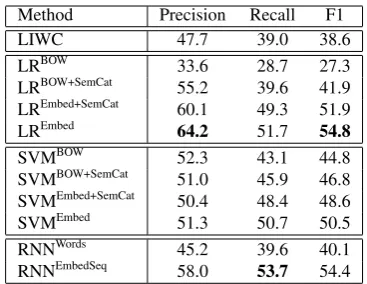
Table4shows the results4for the event expression classifiers. We also evaluated the ability of the LIWC lexicon (Pennebaker et al., 2007) to label the event expressions. We manually aligned the relevant LIWC categories with our human need categories, as shown in Table3. Then we labeled each event by identifying the human need cate-gory of each word in the event phrase and
ing the most frequent category to the event.5 If no words were assigned to our categories, we labeled the event as None. The top row of Table4shows that LIWC achieved 39% recall but only 47.7% precision. The reason is that some categories in LIWC are more generalized compared with the definitions of our corresponding categories. For example, the words “abandon” and “damage” be-long to the Affect category (corresponding to our Emotion category) in LIWC. However, based on our definition the event “my house was damaged” actually belongs to the Finance category. In this way, the Emotion category is overly generalized which leads to low precision for this class.
LIWC Category Human Need Category
Ingest → Physiological
Health, Body, Death → Health
Leisure → Leisure
Social → Social
Money, Work → Finance Inhib, Insight → Cognition
[image:7.595.323.507.60.202.2]Affect → Emotion
Table 3: LIWC Mapping to Human Need Categories.
The LR and SVM rows in Table 4 show the
performance of the logistic regression (LR) and support vector machine (SVM) classifiers, respec-tively. We evaluated classifiers with bag-of-words features (BOW) and classifiers with event embed-ding features (Embed), computed as the average of the embeddings for all words in the event ex-pression. We also tried adding semantic category features from LIWC to each feature set, denoted as +SemCat. The results show that the Embed features performed best for both the LR and SVM classifiers. Adding the SemCat features improved upon the bag-of-word representations, but not the embeddings.
The last two rows of Table 4 show the perfor-mance of two RNN classifiers, one using lexical words as input (RNNWords) and one using pre-trained word embeddings as input (RNNEmbedSeq).
The RNNEmbedSeq system takes the sequence of
word embeddings as input rather than the aver-age embeddings. As with the other classifiers, the word embedding feature representations per-formed best, achieving an F1 score 54.4%, which is comparable to the F1 score of the LREmbed sys-tem. However, the RNN’s precision was only 58%, compared to 64.2% for the logistic
regres-5For ties, we remove a component one by one in the order of Agent, PP, Theme until we obtain a majority label.
Method Precision Recall F1
LIWC 47.7 39.0 38.6
LRBOW 33.6 28.7 27.3
LRBOW+SemCat 55.2 39.6 41.9 LREmbed+SemCat 60.1 49.3 51.9
LREmbed 64.2 51.7 54.8
SVMBOW 52.3 43.1 44.8
SVMBOW+SemCat 51.0 45.9 46.8 SVMEmbed+SemCat 50.4 48.4 48.6 SVMEmbed 51.3 50.7 50.5 RNNWords 45.2 39.6 40.1 RNNEmbedSeq 58.0 53.7 54.4 Table 4: Performance of Event Expression Classifiers
sion model, with only 2% higher recall that does not fully compensate for the lower precision. Neu-ral net models often need large training sets, so the relatively small size of our training data may not be ideal for an RNN.
Overall, we concluded that the logistic re-gression classifier with event embedding features (LREmbed) achieved the best performance because of its F1 score (54.8%) and higher precision (64.2%).
5.2 Performance of Event Context Classifiers
Table5shows the performance4of the event con-text classifiers described in Section4.2. Since lo-gistic regression worked best in the previous ex-periments, we only evaluated logistic regression classifiers in our remaining experiments. The re-sults show that using each context sentence as an individual training instance (ContextSentBOW and ContextSentEmbed) substantially outperformed the classifiers that merged all the context sentences as a single training instance (ContextAllBOW and ContextAllEmbed). Overall, the best performing system ContextSentEmbed achieved an F1 score of 44.3% with 59.1% Precision.
Method Precision Recall F1 ContextAllBOW 20.6 18.0 17.8 ContextAllEmbed 38.2 29.9 29.1 ContextSentBOW 48.2 31.4 32.8 ContextSentEmbed 59.1 41.9 44.3 Table 5: Performance of Event Context Classifiers
[image:7.595.78.282.263.348.2] [image:7.595.324.507.592.652.2]framework seemed like a logical way to use them together to gain additional benefits from unlabeled event data.
We also created a classifier that combined event expression features and event context features to-gether. But combining them did not improve per-formance.
5.3 Performance of Self-Training and Co-Training Models
In this section, we evaluate the weakly supervised self-training and co-training methods that addi-tionally use unlabeled data. To keep the num-ber of unlabeled events manageable, we only used events in the AffectEvent dataset that had fre-quency≥100, which produced an unlabeled data
set of 23,866 events.
We used the best performing event expression classifier (LREmbed) in these models, and the co-training framework includes the best performing event context classifier (ContextSentEmbed) as well.
We also experimented with the sum and
prod-uct variants for co-training (described in Sec-tion 4.4.2), which are denoted as CoTrainsum and CoTrainprod. We ran both the self-training and co-training methods for 20 iterations.
0
5
10
15
20
Number of Iterations
48
50
52
54
56
58
60
62
64
F1
[image:8.595.323.506.398.531.2]LREmbed SelfTrain CoTrainsum CoTrainprod
Figure 2: Learning Curves
Figure 2 tracks the performance of the self-training and co-self-training models after each itera-tion, in terms of F1 score. The flat line shows the F1 score for the best classifier that uses only labeled data (LREmbed). Both types of models yield performance gains from iteratively learning with the unlabeled data, but the co-training models perform substantially better than the self-training model. Even after just 5 iterations, co-training
achieves an F1 score over 58%, and by 20 itera-tions performance improves to>60%.
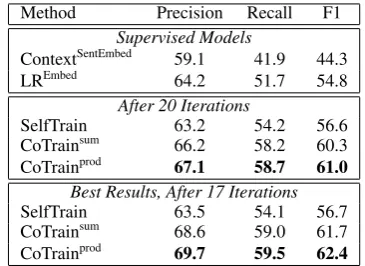
Table 6 shows the results for these models af-ter 20 iaf-terations, which was an arbitrary stopping criterion, and after 17 iterations, which happened to produce the best results for all three systems. The first two rows show the results of the best per-forming event context classifier (ContextSentEmbed) and best performing event expression classifier (LREmbed) from the previous experiments, for the sake of comparison.
Table 6 shows that after 20 iterations, the CoTrainprodmodel performed best, yielding an F1 score of 61% compared to 54.8% for the LREmbed model. Furthermore, we see gains in both recall and precision.
All three systems performed best after 17 itera-tions, so we show those results as well to give an idea of additional gains that would be possible if we could find an optimal stopping criterion. Our data set was small so we did not feel that we had enough data to fine-tune parameters, but we see the potential to further improve performance given additional tuning data.
Method Precision Recall F1 Supervised Models
ContextSentEmbed 59.1 41.9 44.3 LREmbed 64.2 51.7 54.8
After 20 Iterations
SelfTrain 63.2 54.2 56.6
CoTrainsum 66.2 58.2 60.3 CoTrainprod 67.1 58.7 61.0
Best Results, After 17 Iterations
SelfTrain 63.5 54.1 56.7
CoTrainsum 68.6 59.0 61.7 CoTrainprod 69.7 59.5 62.4 Table 6: Performance of Self-Training and Co-Training
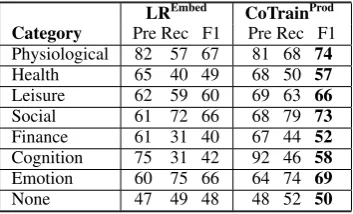
Table7shows a breakdown of the performance across the individual human need categories for two models: the best event expression classifier and the best co-training model (CoTrainprod after 17 iterations). We see that the co-training model outperformed the LREmbed model on every cate-gory. Co-training improved performance the most for the Finance and Cognition categories, yielding F1 score gains of +12% and +16%, respectively, and notably improving both recall and precision.
5.4 Analysis
We manually examined our system’s predictions
to better understand its behavior. We found
[image:8.595.78.285.438.605.2]LREmbed CoTrainProd
Category Pre Rec F1 Pre Rec F1 Physiological 82 57 67 81 68 74
Health 65 40 49 68 50 57
Leisure 62 59 60 69 63 66
Social 61 72 66 68 79 73
Finance 61 31 40 67 44 52 Cognition 75 31 42 92 46 58 Emotion 60 75 66 64 74 69
[image:9.595.92.269.62.169.2]None 47 49 48 48 52 50
Table 7: Breakdown of results across Human Need cat-egories. Each cell shows Precision, Recall, and F1.
events were related to food, while the correctly classified Cognition events were primarily about learning and understanding. Our method missed many events for the Health, Finance, and Cog-nition classes. For Health, many medical symp-toms were not recognized, such as“my face looks pale” and “I puked”. For Finance, the system missed events related to possessions (e.g.,“engine stopped running” and“my clock is wrong”) and jobs (e.g.,“I went to resign”).
We also took a closer took at which categories were confused with other categories. Figure 3
shows the confusion matrix between CoTrainProd and the gold annotations. Each cell shows the total number of confusions across the 3-folds of cross-validation. The category names are abbreviated as Physiological (Phy), Health (Hlth), Leisure (Leis), Social (Socl), Finance (Fnc), Cognition (Cog), and Emotion (Emo). #Tot denotes the total number of events in each row or column.
Pred. \ Gold Phy Hlth Leis Socl Fnc Cog Emo None #Tot
Phy 13 1 0 0 1 0 0 2 17
Hlth 1 26 1 0 1 1 4 8 42
Leis 1 1 48 4 0 1 4 10 69
Socl 0 6 4 84 2 3 10 11 120
Fnc 1 0 2 0 13 0 1 5 22
Cog 0 0 0 0 0 12 1 2 15
[image:9.595.80.287.499.578.2]Emo 1 5 12 12 3 1 91 16 141 None 2 13 8 8 9 8 17 51 116 #Tot 19 52 75 108 29 26 128 105 542
Figure 3: Confusion between Predictions and Gold.
The co-training model had difficulty distin-guishing the None category from other classes, presumably because None does not have its own semantics but is used for affective events that do not belong to any of the other categories. We also see that the system often confuses Emotion with Leisure and Social. This happens because many event expressions contain words that refer to emo-tions. Our guidelines instructed annotators to fo-cus on the event and assign the Emotion label only
when no event is described beyond an emotion (e.g., “I was thrilled”). Consequently, the gold label of“I love journey”is Leisure and“I’m wor-ried about my mom”is Social, but both were clas-sified by the system as Emotion. In future work, it may be advantageous to allow event expressions to be labeled as both an explicit Emotion and a Human Need category based on the target of the emotion.
6 Conclusions
In this work, we introduced a new challenge to recognize the reason for the affective polarity of events in terms of basic human needs. We de-signed four types of classification methods to cat-egorize affective events according to human need categories, exploiting both labeled and unlabeled data. We first evaluated event expression and event context classifiers, trained using only labeled data. Then we designed self-training and co-training methods to additionally exploit unlabeled data. A co-training model that simultaneously trains event expression and event context classifiers produced substantial performance gains over the individual models. However, performance on the human need categories still has substantial room for im-provement. In future work, obtaining more human annotations will be useful to build a better human needs categorization system. In addition, applying and analyzing the human needs of affective events in narrative stories and conversations is a fruitful and interesting direction for future research.
7 Acknowledgements
This material is based in part upon work supported by the National Science Foundation under Grant Number IIS-1619394. Any opinions, findings, and conclusions or recommendations expressed in this material are those of the authors and do not nec-essarily reflect the views of the National Science Foundation. We are very grateful to Tianyu Jiang and Yuanyuan Gao for participating in the manual annotation effort.
References
Avrim Blum and Tom Mitchell. 1998. Combining Labeled and Unlabeled Data with Co-training. In
Proceedings of the Eleventh Annual Conference on Computational Learning Theory. ACM.
Chih-Chung Chang and Chih-Jen Lin. 2011. LIB-SVM: A Library for Support Sector Machines. ACM Transactions on Intelligent Systems and Technology (TIST)2(3):27.
Snigdha Chaturvedi, Dan Goldwasser, and Hal Daum´e III. 2016. Ask, and Shall You Receive? Un-derstanding Desire Fulfillment in Natural Language Text. InProcessings of the 30th AAAI Conference on Artificial Intelligence.
Yoonjung Choi and Janyce Wiebe. 2014. +/-EffectWordNet: Sense-level Lexicon Acquisition for Opinion Inference. InProceedings of the 2014 Conference on Empirical Methods on Natural Lan-guage Processing.
Franc¸ois Chollet et al. 2015. Keras. https://
keras.io.
Lingjia Deng, Yoonjung Choi, and Janyce Wiebe. 2013. Benefactive/Malefactive Event and Writer Attitude Annotation. InProceedings of the 51st An-nual Meeting of the Association for Computational Linguistics.
Lingjia Deng and Janyce Wiebe. 2014. Sentiment Propagation via Implicature Constraints. In Pro-ceedings of the 14th Conference of the European Chapter of the Association for Computational Lin-guistics.
Lingjia Deng and Janyce Wiebe. 2015. Joint Predic-tion for Entity/Event-Level Sentiment Analysis us-ing Probabilistic Soft Logic Models. In Proceed-ings of the 2015 Conference on Empirical Methods in Natural Language Processing.
Haibo Ding, Tianyu Jiang, and Ellen Riloff. 2018. Why is an Event Affective? Classifying Affective Events based on Human Needs. InAAAI-18 Work-shop on Affective Content Analysis.
Haibo Ding and Ellen Riloff. 2015. Extracting Infor-mation about Medication Use from Veterinary Dis-cussions. InProceedings of the 2015 Conference of the North American Chapter of the Association for Computational Linguistics: Human Language Tech-nologies.
Haibo Ding and Ellen Riloff. 2016. Acquiring Knowl-edge of Affective Events from Blogs Using Label Propagation. InProceedings of the 30th AAAI Con-ference on Artificial Intelligence.
Haibo Ding and Ellen Riloff. 2018. Weakly Super-vised Induction of Affective Events by Optimizing Semantic Consistency. InProceedings of the Thirty-Second AAAI Conference on Artificial Intelligence.
Andrew B Goldberg, Nathanael Fillmore, David An-drzejewski, Zhiting Xu, Bryan Gibson, and Xiao-jin Zhu. 2009. May All Your Wishes Come True: A Study of Wishes and How to Recognize Them. In Proceedings of Human Language Technologies: The 2009 Annual Conference of the North American Chapter of the Association for Computational Lin-guistics.
Andrew Gordon and Reid Swanson. 2009. Identifying Personal Stories in Millions of Weblog Entries. In
Third International Conference on Weblogs and So-cial Media, Data Challenge Workshop.
A. Goyal, E. Riloff, and H. Daum´e III. 2010. Auto-matically Producing Plot Unit Representations for Narrative Text. In Proceedings of the 2010 Con-ference on Empirical Methods in Natural Language Processing.
A. Goyal, E. Riloff, and H. Daum´e III. 2013. A Com-putational Model for Plot Units. Computational In-telligence29(3):466–488.
Abhishek Kumar and Hal Daum´e. 2011. A Co-training Approach for Multi-view Spectral Clustering. In
Proceedings of the 28th International Conference on Machine Learning (ICML-11).
Huayi Li, Arjun Mukherjee, Jianfeng Si, and Bing Liu. 2015. Extracting Verb Expressions Implying Nega-tive Opinions. InProceedings of the Twenty-Ninth AAAI Conference on Artificial Intelligence.
Jiwei Li, Alan Ritter, Claire Cardie, and Eduard Hovy. 2014. Major Life Event Extraction from Twit-ter based on Congratulations/Condolences Speech Acts. InProceedings of the 2014 Conference on Em-pirical Methods in Natural Language Processing. Christopher D. Manning, Mihai Surdeanu, John Bauer,
Jenny Finkel, Steven J. Bethard, and David Mc-Closky. 2014. The Stanford CoreNLP Natural Lan-guage Processing Toolkit. InProceedings of 52nd Annual Meeting of the Association for Computa-tional Linguistics.
Abraham Harold Maslow, Robert Frager, James Fadi-man, Cynthia McReynolds, and Ruth Cox. 1970.
Motivation and Personality, volume 2. Harper & Row New York.
Manfred Max-Neef, Antonio Elizalde, and Martin Hopenhayn. 1991. Human Scale Development: Conception, Application and Further Reflections. The Apex Press.
David McClosky, Eugene Charniak, and Mark John-son. 2006. Effective Self-training for Parsing. In
Proceedings of the Conference on Human Language Technology and North American Chapter of the As-sociation for Computational Linguistics.
F. Pedregosa, G. Varoquaux, A. Gramfort, V. Michel, B. Thirion, O. Grisel, M. Blondel, P. Pretten-hofer, R. Weiss, V. Dubourg, J. Vanderplas, A. Pas-sos, D. Cournapeau, M. Brucher, M. Perrot, and E. Duchesnay. 2011. Scikit-learn: Machine Learn-ing in Python. Journal of Machine Learning Re-search12:2825–2830.
James W Pennebaker, Roger J Booth, and Martha E Francis. 2007. Linguistic Inquiry and Word Count: LIWC2007. Austin, TX: liwc.net.
Jeffrey Pennington, Richard Socher, and Christopher D Manning. 2014. GloVe: Global Vectors for Word Representation. In Proceedings of the 2014 Con-ference on Empirical Methods in Natural Language Processing.
William Phillips and Ellen Riloff. 2002. Exploit-ing Strong Syntactic Heuristics and Co-TrainExploit-ing to Learn Semantic Lexicons. In Proceedings of the 2002 Conference on Empirical Methods in Natural Language Processing.
Elahe Rahimtoroghi, Jiaqi Wu, Ruimin Wang, Pranav Anand, and Marilyn A Walker. 2017. Modelling Protagonist Goals and Desires in First-Person Nar-rative. InProceedings of the 18th Annual SIGdial Meeting on Discourse and Dialogue.
Hannah Rashkin, Sameer Singh, and Yejin Choi. 2016. Connotation Frames: A Data-Driven Investigation. In Proceedings of the 54th Annual Meeting of the Association for Computational Linguistics.
Lena Reed, Jiaqi Wu, Shereen Oraby, Pranav Anand, and Marilyn A. Walker. 2017. Learning Lexico-Functional Patterns for First-Person Affect. In Pro-ceedings of the 55th Annual Meeting of the Associa-tion for ComputaAssocia-tional Linguistics.
Roger C. Schank and Robert P. Abelson. 1977.Scripts, Plans, Goals and Understanding: An Inquiry into Human Knowledge Structures. L. Erlbaum, Hills-dale, NJ.
Hoa Trong Vu, Graham Neubig, Sakriani Sakti, Tomoki Toda, and Satoshi Nakamura. 2014. Ac-quiring a Dictionary of Emotion-Provoking Events. InProceedings of the 14th Conference of the Euro-pean Chapter of the Association for Computational Linguistics.
Xiaojun Wan. 2009. Co-training for Cross-lingual Sen-timent Classification. In Proceedings of the Joint Conference of the 47th Annual Meeting of the ACL and the 4th International Joint Conference on Natu-ral Language Processing of the AFNLP.