Proceedings of NAACL-HLT 2018, pages 885–895
Supervised Open Information Extraction
Gabriel Stanovsky∗2,3, Julian Michael2, Luke Zettlemoyer2, and Ido Dagan1
1Bar-Ilan University Computer Science Department, Ramat Gan, Israel
2Paul G. Allen School of Computer Science&Engineering, University of Washington, Seattle, WA 3Allen Institute for Artificial Intelligence, Seattle, WA
{gabis,julianjm,lsz}@cs.washington.edu [email protected]
Abstract
We present data and methods that enable a supervised learning approach to Open Infor-mation Extraction (Open IE). Central to the approach is a novel formulation of Open IE as a sequence tagging problem, addressing challenges such as encoding multiple extrac-tions for a predicate. We also develop a bi-LSTM transducer, extending recent deep Se-mantic Role Labeling models to extract Open IE tuples and provide confidence scores for tuning their precision-recall tradeoff. Fur-thermore, we show that the recently re-leased Question-Answer Meaning Represen-tation dataset can be automatically converted into an Open IE corpus which significantly in-creases the amount of available training data. Our supervised model, made publicly avail-able,1outperforms the state-of-the-art in Open
IE on benchmark datasets.
1 Introduction
Open Information Extraction (Open IE) systems extract tuples of natural language expressions that represent the basic propositions asserted by a sen-tence (see Figure 1). They have been used for a wide variety of tasks, such as textual entail-ment (Berant et al., 2011), question answering (Fader et al., 2014), and knowledge base popu-lation (Angeli et al., 2015). However, perhaps due to limited data, existing methods use semi-supervised approaches (Banko et al., 2007; Wu and Weld, 2010), or rule-based algorithms (Fader et al., 2011; Mausam et al., 2012; Del Corro and Gemulla, 2013). In this paper, we present new data and methods for Open IE, showing that supervised learning can greatly improve performance.
∗Work performed while at Bar-Ilan University.
1Our code and models are made publicly available
at https://github.com/gabrielStanovsky/ supervised-oie
Mercury filling, particularly prevalent in the USA, was banned in the EU, partly because it causes antibiotic resistance.
(mercury filling;particularly prevalent; in the USA) (mercury filling;causes; antibiotic resistance)
(mercury filling;was banned; in the EU; partly because it causes antibiotic resistance)
Figure 1: Open IE extractions from an example sentence. Each proposition is composed of a tu-ple with a single predicate position (in bold), and an ordered list of arguments, separated by semi-colons.
We build on recent work that studies other natural-language driven representations of predi-cate argument structure, which can be annotated by non-experts. Recently, Stanovsky and Dagan (2016) created the first labeled corpus for eval-uation of Open IE by an automatic translation from question-answer driven semantic role label-ing (QA-SRL) annotations (He et al., 2015). We extend these techniques and apply them to the QAMR corpus (Michael et al., 2018), an open variant of QA-SRL that covers a wider range of predicate-argument structures (Section 5). The combined dataset is the first corpus that is large and diverse enough to train an accurate extractor.
To train on this data, we formulate Open IE as a sequence labeling problem. We introduce a novel approach that can extract multiple, overlap-ping tuples for each sentence (Section 3), extend-ing recent deep BIO taggers used for semantic role labeling (Zhou and Xu, 2015; He et al., 2017). We also introduce a method to calculate extrac-tion confidence, allowing us to effectively trade off precision and recall (Section 4).
performs state-of-the-art Open IE systems on sev-eral benchmarks (Section 6), including three that were collected independently of our work (Xu et al., 2013; de S´a Mesquita et al., 2013; Schneider et al., 2017). This shows that for Open IE, careful data curation and model design can push the state of the art using supervised learning.
2 Background
In this section we survey existing Open IE sys-tems, against which we compare our system, and available data for the task, that we will use for training and testing our model.
2.1 Different Open IE Systems and Flavors
Open IE’s original goal (Banko et al., 2007) was to extend traditional (closed) information extrac-tion, such thatall of the propositions asserted by a given input sentence are extracted (see Figure 1 for examples). The broadness of this defini-tion, along with the lack of a standard benchmark dataset for the task, prompted the development of various Open IE systems tackling different facets of the task.
While most Open IE systems aim to extract the common case of verbal binary propositions (i.e, subject-verb-object tuples), some systems spe-cialize in other syntactic constructions, includ-ing noun-mediated relations (Yahya et al., 2014; Pal and Mausam, 2016), n-ary relations (Akbik and L¨oser, 2012), or nested propositions (Bhutani et al., 2016).
Many different modeling approaches have also been developed for Open IE. Some of the early systems made use of distant supervision (Banko et al., 2007; Wu and Weld, 2010), while the current best systems use rule-based techniques to extract predicate-argument structures as a post-processing step over an intermediate representation. ReVerb (Fader et al., 2011) extracts Open IE proposi-tions from part of speech tags, OLLIE (Mausam et al., 2012), ClausIE (Del Corro and Gemulla, 2013) and PropS (Stanovsky et al., 2016) post-process dependency trees, and Open IE42extracts tuples from Semantic Role Labeling (SRL) struc-tures. These systems typically associate a confi-dence metric with each extraction, which allows end applications to trade off precision and recall.
2https://github.com/dair-iitd/
OpenIE-standalone
2.2 Open IE Corpora
Recent work addressed the lack of labeled ref-erence Open IE datasets for comparatively eval-uating extractors. Stanovsky and Dagan (2016) created a large Open IE corpus (OIE2016) for verbal predicates by automatic conversion from QA-SRL (He et al., 2015), a variant of traditional SRL that labels arguments of verbs with sim-ple, template-based natural language questions. Schneider et al. (2017) aggregated datasets anno-tated independently in previous Open IE efforts (WEB and NYT (de S´a Mesquita et al., 2013), PENN (Xu et al., 2013), and OIE2016) into a common benchmarking suite.
In addition to these, we create and make avail-able a new Open IE training corpus, All Words Open IE (AW-OIE), derived from Question-Answer Meaning Representation (QAMR) (Michael et al., 2018), a recent extension of the QA-SRL paradigm to free-form questions over a wide range of predicate types (see Section 5). Table 1 presents more details on these datasets.
3 Task Formulation
In this work, we choose to model an Open IE proposition as a tuple consisting of a single predi-cate operating over a non-empty set of arguments, where the predicate and the arguments are con-tiguous spans from the sentence. As with tradi-tional (binary) Open IE, every tuple should be as-serted by the sentence and the order of the tuple elements should be such that it would be naturally interpretable when reading from left to right (for example, see the third tuple in Figure 1). As we show in following sections, this formulation intu-itively lends itself to BIO tagging, while being ex-pressive enough to capture a wide range of propo-sitions.
Formally, given an input sentence S =
Dataset Domain #Sent. Train #TuplesDev Test AW-OIE∗ Wikinews,Wiki 3300 12952 4213 -OIE2016 News,Wiki 3200 5077 1671 1729 WEB-500 News,Web 500 - - 461 NYT-222 News,Wiki 222 - - 222
PENN-100 Mixed 100 - - 51
Open IE Encoding Examples
(a)The president claimed that he won the majority vote.
(The president;claimed that he won; the majority vote)
TheA0−BpresidentA0−IclaimedP−BthatP−IheP−IwonP−ItheA1−BmajorityA1−IvoteA1−I (b)Barack Obama, a former U.S president, was born in Hawaii.
(Barack Obama;was born in; Hawaii)
(a former U.S. president;was born in; Hawaii)
BarackA0−BObamaA0−I,OaA0−BformerA0−IU.S.A0−IpresidentA0−I,OwasP−BbornP−IinP−IHawaiiA1−B (c)Theresa May plans for Brexit, on which the UK has voted last June.
(the UK;has voted on; Brexit; last June)
TheresaOMayOplansOforOBrexitA1−B,OonOwhichOtheA0−BUKA0−IhasP−BvotedP−IonP−IlastA2−BJuneA2−I Table 2: Example sentences and respective Open IE extractions. The first line in each example presents the input pairs (S, p), where S is the input sentence, and the predicate head, p, is denoted with an underline. Below the inputs we present the corresponding Open IE extractions. The corresponding encodings are presented below the dashed lines, where subscripts indicate the associated BIO label. Demonstrating: (a) the encoding of a multi-word predicate, (b) several arguments collapsed into the sameA0argument position, (c) argument position deviating from the sentence ordering.
(w1, . . . , wn), a tuple consists of (x1, . . . ,xm),
where eachxiis a contiguous subspan ofS. One
of thexiis distinguished as thepredicate(marked
in bold in Figure 1), while the other spans are con-sidered its arguments. Following this definition, we reformulate Open IE as a sequence labeling task, using a custom BIO3(Ramshaw and Marcus, 1995; Sang and Veenstra, 1999) scheme adapted from recent deep SRL models (He et al., 2017).
In our formulation, the set of Open IE tuples for a sentenceS are grouped by predicate head-word p, as shown in Table 2. For instance, example (b) lists two tuples for the predicate head “born”, which is underlined in the sentence. Grouping tu-ples this way allows us to run the model once for each predicate head, and accumulate the predic-tions across predicates to produce the final set of extractions.
Open IE tuples deviate from SRL predicate-argument structures in two major respects. First, while SRL generally deals with single-word pred-icates, Open IE uses multi-word predicates that of-ten incorporate modals and embedded predicates. For example, the first tuple in the table includes the embedded predicate claimed that he won. Sec-ond, Open IE generates multiple extractions from a single predicate in certain syntactic construc-tions (e.g., apposition, co-ordination or corefer-ence). For instance, example (b) repeats the
predi-cate was born in for the two components of the
3Beginning, Inside, Outside
apposition Barack Obama, a former U.S. presi-dent.
To model these unique challenges, we introduce a custom BIO tagging scheme, shown in Table 2 below the dashed lines. Predicates are encoded using theP label type, while arguments are rep-resented using Ai labels, where i represents the argument’s position within the extracted Open IE tuple. While softer than SRL’s predicate-specific argument roles (e.g., ARG0), these argument po-sitions also capture semantic information because they are arranged such that the tuple can be nat-urally read as a standalone statement, regardless of the complications of the source text’s syntax (such as reorderings and long-distance dependen-cies). For instance, in the last example in Table 2, the order of the arguments in the Open IE tuple deviates from the ordering in the original sentence due to a relative clause construction (headed by the wordBrexit).
Obama P(A0-B)
was P(P-B)
born P(P-I)
in P(A1-B)
America P(A1-I)
[image:4.595.78.285.62.201.2]Embeddings bi-LSTM Softmax
Figure 2: RNN model architecture. Orange cir-cles represent current word features: embedding for word and part of speech. Yellow circles rep-resent predicate features, duplicated and concate-nated to all other word features.
O
58%
A1-I
15%
A0-I
9%
A2-I
5%
P-B
3%3% A0-BA1-B 3% Other
4%
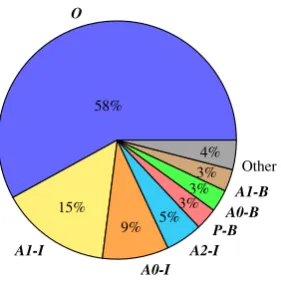
Figure 3: Word label distribution in the training set.
4 Supervised Open IE Model
Our model, named RnnOIE, is a bi-LSTM trans-ducer, inspired by the state of the art deep learn-ing approach for SRL suggested by Zhou and Xu (2015) and He et al. (2017). The architecture is shown in Figure 2.
Given an input instance of the form (S, p), whereS is the input sentence, andp is the word index of the predicate’s syntactic head, we extract a feature vectorf eatfor every wordwi∈S:
f eat(wi, p) =emb(wi)⊕emb(pos(wi))⊕
⊕emb(wp)⊕emb(pos(wp))
Here, emb(w) is a d-dimensional word embed-ding,emb(pos(w))is a 5-dimensional embedding ofw’s part of speech, and ⊕ denotes concatena-tion. We duplicate the predicate head’s features on all words to allow the model to more directly ac-cess this information as it makes predicate-specific word label predictions.
The features are fed into a bi-directional deep LSTM transducer (Graves, 2012) which computes contextualized output embeddings. The outputs are used in softmaxes for each word, producing in-dependent probability distributions over possible BIO tags.
The model is trained with gold predicate heads, using a per-word maximum likelihood objective. Figure 3 depicts the overall word label distribu-tion within the training set. The large percentage of O labels demonstrates Open IE’s tendency to shorten arguments, compared to SRL which con-siders full syntactic constitutes as arguments.
Inference At inference time, we first identify
all verbs and nominal predicates in the sen-tence as candidate predicate heads. We use a Part Of Speech (POS) tagger to identify verbs, and Catvar’s subcategorization frames (Habash and Dorr, 2003) for nominalizations, identifying nouns which share the same frame with a verbal equivalent (e.g., acquisition with acquire). We then generate an input instance for each candi-date predicate head. For each instance, we tag each word with its most likely BIO label under the model, and reconstruct Open IE tuples from the resulting sequence according to the method de-scribed in Section 3, with the exception that we ig-nore malformed spans (i.e., if anA0-Ilabel is not preceded byA0-IorA0-B, we treat it asO).
Assigning extraction confidence It is beneficial for an Open IE system to associate a confidence value with each predicted extraction to allow for tuning its precision-recall tradeoff. Our model does not directly produce confidence values for ex-tractions, but it does assign probabilities to each BIO label that it predicts. We experimented with several heuristics to combine these predictions to an extraction-level confidence metric. The best performance on the development set was achieved by multiplying the probabilities of the B and I la-bels participating in the extraction.4 This metric prefers shorter extractions, which correlates well with the requirements of Open IE (Bhutani et al., 2016).
Implementation details We implemented the
model using the Keras framework (Chollet, 2015) with TensorFlow backend (Abadi et al., 2015). All
4We also tried taking the maximum or minimum observed
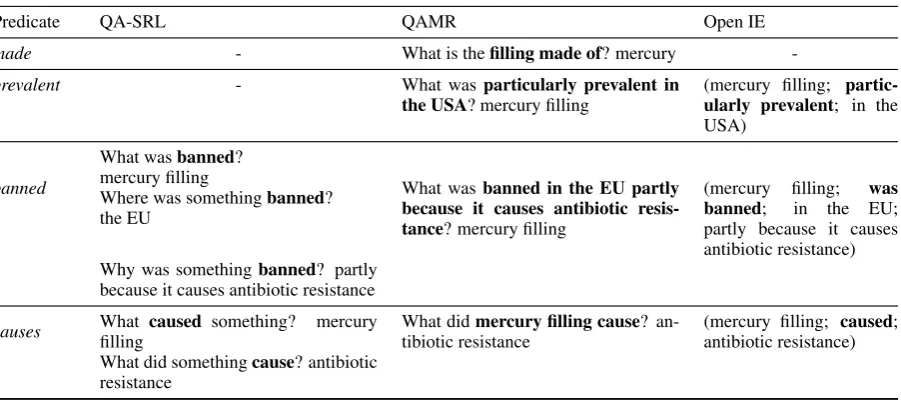
[image:4.595.110.251.290.432.2]Mercury filling, particularly prevalent in the USA, was banned in the EU, partly because it causes antibiotic resistance.
Predicate QA-SRL QAMR Open IE
made - What is thefilling made of? mercury
-prevalent - What wasparticularly prevalent in
the USA? mercury filling (mercury filling;ularly prevalent; in the partic-USA)
banned
What wasbanned? mercury filling
Where was somethingbanned? the EU
What wasbanned in the EU partly because it causes antibiotic resis-tance? mercury filling
(mercury filling; was banned; in the EU; partly because it causes antibiotic resistance) Why was somethingbanned? partly
because it causes antibiotic resistance
causes Whatfillingcaused something? mercury What didtibiotic resistancemercury filling cause? an- (mercury filling;antibiotic resistance)caused; What did somethingcause? antibiotic
[image:5.595.76.527.76.278.2]resistance
Table 3: Comparison of QA-SRL, QAMR, and desired Open IE annotations for an example sentence, adapted from the QAMR corpus.
hyperparameters were tuned on theOIE2016 de-velopment set. The bi-LSTM transducer has 3 lay-ers and each LSTM cell uses 128 hidden units and a linear rectifier (ReLU) (Nair and Hinton, 2010) activation function. The model was trained for 100 epochs in mini batches of 50 samples, with 10% word-level dropout. The word-embeddings were initialized using the GloVe 300-dimensions pre-trained embeddings (Pennington et al., 2014) and were kept fixed during training. The part of speech embeddings were randomly initialized and updated during training. Finally, we use the av-erage perceptron part-of-speech tagger (as imple-mented in spaCy5) to predict parts of speech for input features and verb predicate identification. 5 Open IE from QAMR
This section describes our approach for automat-ically extracting Open IE tuples from QAMR (Michael et al., 2018), a recent extension of QA-SRL. While QA-SRL uses question templates cen-tered on verbs, QAMR annotates free-form ques-tions over arbitrary predicate types. The QAMR corpus consists of annotations over 5,000 sen-tences. By extending the OIE2016 training set with extractions from QAMR, we more than triple the available amount of training data.
The extraction algorithm, as well as the resulting corpus, are made publicly available at https://github.com/gabrielStanovsky/
5https://spacy.io
supervised-oie.
5.1 The QAMR Corpus
Question-Answer Meaning Representation, or QAMR (Michael et al., 2018), was recently pro-posed as an extension of SRL. Like QA-SRL, QAMR represents predicate-argument struc-ture with a set of question-answer pairs about a sentence, where each answer is a span from the sentence. However, while QA-SRL restricts ques-tions to fit into a particular verb-centric template, QAMR is more general, allowing any natural lan-guage question that begins with a wh-word and contains at least one word from the sentence. This allows QAMR to express richer, more complex re-lations. Consider, for example, the first two entries for QAMR in Table 3. The first explicates the im-plicit relation made offrom the noun compound
mercury filling, and the second identifies the ad-jectival predicateprevalent. Neither of these can be represented in QA-SRL.
5.2 Extraction Algorithm
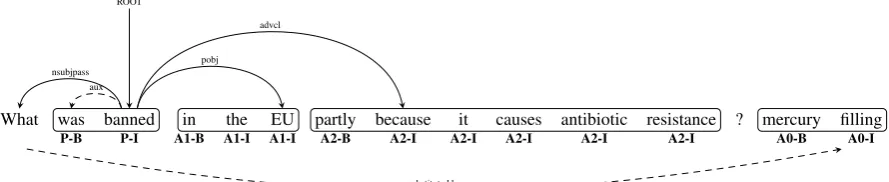
What was banned in the EU partly because it causes antibiotic resistance ? mercury filling
P-B P-I A1-B A1-I A1-I A2-B A2-I A2-I A2-I A2-I A2-I A0-B A0-I
ROOT
aux nsubjpass
pobj advcl
substituted by
[image:6.595.79.524.66.157.2](mercury filling;was banned; in the EU; partly because it causes antibiotic resistance)
Figure 4: A QAMR (top) to Open IE (bottom) conversion example. The BIO labels for our encoding of the Open IE tuple appear below the text. The root of the question’s dependency tree is the predicate, while its syntactic constituents are the arguments. The answer appears as the first argument of the Open IE tuple due to the passive construction.
Over-expressiveness The QAMR formalism
al-lows many constructions that diverge from Open IE extractions, which generally are drawn verba-tim from the source text. For example, the predi-catemadeis introduced in the QAMR for the tence in Table 3, despite not appearing in the sen-tence. To circumvent this issue, we filter out ques-tions which: (1) introduce new content words,6(2) have more than onewh-word, (3) do not start with
who, what, whenorwhere, or (4) askwhat did X do?, delegating the predicate to the answer.
Detecting predicates and arguments While a
QA-SRL question has a designated predicate and a single argument as the answer, in QAMR, the predicate can appear anywhere in the question and its arguments are spread between the question and answer. For example, extracting an Open IE tuple for the predicatebanned in Table 3 requires de-coupling the predicate and its argumentsin the EU
andpartly because it causes antibiotic resistance. Our solution to this problem is illustrated in Figure 4. We first run each question through a syntactic dependency parser. We then identify the predicate as the head of the question’s dependency tree ex-tended to include all dependents with an auxiliary relation (e.g.,aux,neg, orprt). The predicted ar-guments are the predicate’s constituent argument subtrees, while the answer to the question replaces the subtree headed by the wh-word. Finally, we employ similar heuristics to those used convert-ing verbal QA-SRL to Open IE to find the correct argument position for the answer (Stanovsky and Dagan, 2016). For example, the passive
construc-6We do not count inflected forms of verbs from the
sen-tence, such ascaused in the last entry of the table, as new words.
QAMR Open IE Tuples
(The treaty of Brussels;was signed; on 17 March 1948; by Belgium, the Netherlands, Luxembourg, France, and the UK)
(The treaty of Brussels; is the precursor to; the NATO agreement)
(The scope of publishing; has expanded to in-clude; websites, blogs, and the like.)
Table 4: Tuples from the All Words Open IE Cor-pus, exemplifying n-ary extractions (top example), non-verbal predicates (middle), and multi-word predicates (bottom).
tion in Figure 4 implies that the answer should be placed in the first argument position, while the ex-istence of a prepositional object in, e.g.,What did he puton the table?signals that the answer should be placed in the second argument position.
5.3 The All Words Open IE Corpus
As described by Michael et al. (2018), QAMR an-notations were gathered via crowdsourcing in a two-stage pipeline over Wikipedia and Wikinews text. We use the training partition of the QAMR dataset, which consists of 51,063 QA pairs over 3,938 sentences. Our filtering and conversion from the QAMR corpus yields 12,952 Open IE tuples (2.5 times the size ofOIE2016’s training corpus), composed of 7,470 (58%) verbal pred-icates, 4,952 (38%) nominal predpred-icates, and 530 (4%) adjectival predicates. See Table 4 for exam-ple tuexam-ples, taken from the converted corpus.
cor-pus, partly because some relations were missed by the annotators of QAMR and partly because of noise introduced in the automatic extraction pro-cess. Instead, we use this corpus to extend the train partition ofOIE2016. In the following section, we show its usefulness in significantly improving the precision and recall of our Open IE model. 6 Evaluation
We evaluate the performance of our model on the four test sets discussed in Section 2.
6.1 Experimental Setup
Metrics We evaluate each system according to
three metrics. First, as is typical for Open IE, we compute a precision-recall (PR) curve by evalu-ating the systems’ performance at different extrac-tion confidence thresholds. This curve is useful for downstream applications which can set the thresh-old according to their specific needs (i.e., recall oriented versus precision oriented). Second, we compute the area under the PR curve (AUC) as a scalar measurement of the overall system per-formance. Finally, for each system, we report a single F1 score using a confidence threshold opti-mized on the development set. This can serve as a preset threshold for out-of-the-box use.
Matching function Similar to other cases in
NLP, we would like to allow some variability in the predicted tuples. For example, for the sen-tenceThe sheriff standing against the wall spoke in a very soft voice we would want to treat both (The Sheriff;spoke; in a soft voice) and (The sher-iff standing against the wall;spoke; in a very soft voice) as acceptable extractions. To that end, we follow He et al. (2015) which judge an argument as correct if and only if it includes the syntac-tic head of the gold argument (and similarly for predicates). ForOIE2016, we use the available Penn Treebank gold syntactic trees (Marcus et al., 1993), while for the other test sets, we use pre-dicted trees instead. While this metric may some-times be too lenient, it does allow a more balanced and fair comparison between systems which can make different, but equally valid, span boundary decisions.
Baselines We compare our model (RnnOIE)
against the top-performing systems of those eval-uated most recently in Stanovsky and Dagan (2016) and in Schneider et al. (2017): Open
IE4,7ClausIE (Del Corro and Gemulla, 2013), and PropS (Stanovsky et al., 2016).
6.2 Results
Table 5 reports the AUC and F1 scores of all of the systems on the 4 test sets. In addition, the PR curves for the two largest test sets (OIE2016and WEB) are depicted in Figures 5a and 5b. We re-port results for two versions of our model: one trained on the OIE2016 training set containing only verbal predicates (RnnOIE-verb), and an-other on the extended training set that includes the automatic conversion of QAMR outlined in Sec-tion 5 (RnnOIE-aw).
Overall, RnnOIE-aw outperforms the other sys-tems across the datasets. On the larger test sets (OIE2016 andWEB) it provides the best perfor-mance in terms of AUC and F1, with a superior precision-recall curve. On each of the smaller test sets, it performs best on one metric and competi-tively on the other.
Furthermore, on all of the test sets, extending the training set significantly improves our model’s performance, showing that it benefits from the ad-ditional data and types of predicates available in the QAMR dataset. While this is most notable in the test sets which include nominalizations (WEB, NYT, andPENN), it also improves the performance on OIE2016, which is composed solely of verb predicates.
6.3 Performance Analysis
In our analysis, we find that RnnOIE generalizes to unseen predicates, produces more and shorter arguments on average than are in the gold extrac-tions, and, like all of the systems we tested, strug-gles with nominal predicates.
Unseen predicates We split the propositions in
the gold and predicted OIE2016 test set into two partitions,seenandunseen, based on whether the predicate head’s lemma appears in the training set. The unseen part contains 145 unique predi-cate lemmas in 148 extractions, making up 24% out of the 590 unique predicate lemmas and 7% out of the 1993 total extractions in the test set. We then evaluated RnnOIE-aw on each part sep-arately. The resulting PR curves (Figure 5c) de-pict overall good performance also on the unseen part, competitive with previous Open IE systems.
7https://github.com/dair-iitd/
OIE2016
WEB
NYT
PENN
AUC F1(P, R) AUC F1(P, R) AUC F1(P, R) AUC F1(P, R)
ClausIE
.38 .59
(.49, .74).40
.45
(.39,.53).23 .30
(.24, .39).28
.34
(.24, .61)PropS
.34 .56
(.64, .49).45
.59
(.44, .89).22 .37
(.25, .77).28
.39
(.26, .81)Open IE4
.42 .60
(.64, .56).45
.56
(.63, .50).24
.38
(.26, .74).28
.43
(.37, .50)RnnOIE-verb
.45 .59
(.57, .62).23
.46
(.38, .58).09
.25
(.20,.33).21 .38
(.35, .40) [image:8.595.77.524.61.171.2]RnnOIE-aw
.48 .62
(.61, .64).47
.67
(.83, .56).25
.35
(.24,.67).26
.44
(.31,.75)Table 5: Performance of the OIE extractors on our test sets. Each system is tested in terms of Area Under the PR Curve (AUC), and F1 (precision and recall in parenthesis).
[image:8.595.76.522.232.376.2](a)OIE2016 (b)WEB (c) Seen vs. unseen
Figure 5: Precision-recall curves of the different OIE systems onOIE2016(5a),WEB(5b) and seen vs. unseen predicates in RnnOIE-aw onOIE2016(5c). See details in Section 6.
System # Tuples Args/Prop Words/Arg
Gold 1730 2.45 5.38
ClausIE 2768 2.00 5.78
PropS 1551 2.68 5.8
Open IE4 1793 3.07 4.55 RnnOIE-aw 1993 3.19 4.68
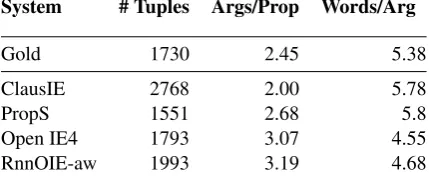
Table 6: Output statistics of the different systems onOIE2016, versus the gold data.
This indicates that our model generalizes beyond memorization of specific predicate templates.
Argument length and number In Table 6 we
compare statistics on the the outputs of the Open IE systems onOIE2016 and the gold data. The best performing systems, RnnOIE and OpenIE4, tend to produce more arguments, and each argu-ment tends to be shorter on average, in comparison to other systems and gold.
Runtime analysis Since Open IE is intended to
be usable at web scale, we timed the different
Open IE systems on a batch of 3200 sentences fromOIE2016, running on a Xeon 2.3GHz CPU. The results are presented in Table 8.8 We find that our system fares well, processing only 12% fewer sentences per second than the fastest sys-tem, Open IE 4.0. Further, while these numbers are reported on CPU for the sake of fair compari-son, running our neural model on a GPU (NVIDIA GeForce GTX 1080 Ti) boosts speed by a factor of more than 10 (149.25 sentences per second, on av-erage).
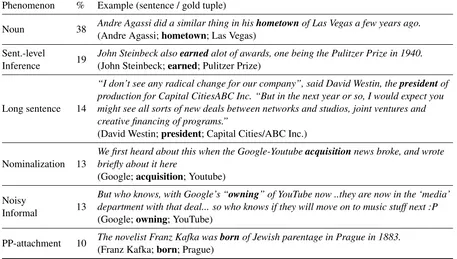
Error analysis All of the systems still lack in recall across all tested corpora. We examined a random sample of 100 recall errors shared by all of the extractors across the tested datasets and found several common error types, shown in Table 7. Notably, noun and nominalized predicates still pose a challenge, appearing in 51% of the recall errors (whereas they make up 24% of all extrac-tions). 19% of the examined errors required some
8PropS and ClausIE’s relatively slow performance is in
[image:8.595.74.289.444.534.2]Phenomenon % Example (sentence / gold tuple)
Noun 38 Andre Agassi did a similar thing in his(Andre Agassi; hometownof Las Vegas a few years ago.
hometown; Las Vegas) Sent.-level
Inference 19
John Steinbeck alsoearnedalot of awards, one being the Pulitzer Prize in 1940. (John Steinbeck;earned; Pulitzer Prize)
Long sentence 14
“I don’t see any radical change for our company”, said David Westin, thepresidentof production for Capital CitiesABC Inc. “But in the next year or so, I would expect you might see all sorts of new deals between networks and studios, joint ventures and creative financing of programs.”
(David Westin;president; Capital Cities/ABC Inc.)
Nominalization 13
We first heard about this when the Google-Youtubeacquisitionnews broke, and wrote briefly about it here
(Google;acquisition; Youtube)
Noisy
Informal 13
But who knows, with Google’s “owning” of YouTube now ..they are now in the ‘media’ department with that deal... so who knows if they will move on to music stuff next :P (Google;owning; YouTube)
PP-attachment 10 The novelist Franz Kafka was(Franz Kafka; bornof Jewish parentage in Prague in 1883.
[image:9.595.70.527.67.326.2]born; Prague)
Table 7: Analysis of frequently-occuring recall errors for all tested systems on a random sample of 100 sentences. For each phenomenon we list the percentage of sentences in which it occurs (possibly overlapping with other phenomena), and a protoypical example, taken from the WEB corpus.
ClausIE PropS Open IE4 RnnOIE
CPU
4.07
4.59
15.38
13.51
GPU
—
—
—
149.25
Table 8: Runtime analysis, measured in sentences per second, of the different systems on 3200 sentences from the OIE2016 corpus on Xeon 2.3GHz CPU (top) and on an NVIDIA GeForce GTX 1080 Ti (bottom). Baselines were only run on CPU as they are currently not optimized for GPU.
form of sentence level inference, such as determin-ing event factuality or pronoun resolution. 14% of the errors involved long sentences with over 40 words (where the average word count per sentence is 29.4).
7 Conclusions and Future Work
We present a supervised model for Open IE, for-mulating it as a sequence tagging problem and ap-plying a bi-LSTM transducer to produce a state-of-the-art Open IE system. Along the way, we address several task-specific challenges, includ-ing the BIO encodinclud-ing of predicates with multiple
extractions and confidence estimation in our se-quence tagging model. To train the system, we leverage a recently published large scale corpus for Open IE (Stanovsky and Dagan, 2016), and further extend it using a novel conversion of the QAMR corpus (Michael et al., 2018), which cov-ers a wider range of predicates.
In addition to these contributions, this work shows that Open IE can greatly benefit from future research into the QA-SRL paradigm. For example, Open IE would directly benefit from an automatic QA-SRL extractor, while a more exhaustive or ex-tensive annotation of QAMR would improve Open IE’s performance on a wider range of predicates.
Acknowledgments
References
Mart´ın Abadi, Ashish Agarwal, Paul Barham, Eugene Brevdo, Zhifeng Chen, Craig Citro, Greg S. Cor-rado, Andy Davis, Jeffrey Dean, Matthieu Devin, Sanjay Ghemawat, Ian Goodfellow, Andrew Harp, Geoffrey Irving, Michael Isard, Yangqing Jia, Rafal Jozefowicz, Lukasz Kaiser, Manjunath Kudlur, Josh Levenberg, Dan Man´e, Rajat Monga, Sherry Moore, Derek Murray, Chris Olah, Mike Schuster, Jonathon Shlens, Benoit Steiner, Ilya Sutskever, Kunal Tal-war, Paul Tucker, Vincent Vanhoucke, Vijay Va-sudevan, Fernanda Vi´egas, Oriol Vinyals, Pete War-den, Martin Wattenberg, Martin Wicke, Yuan Yu, and Xiaoqiang Zheng. 2015. TensorFlow: Large-scale machine learning on heterogeneous systems. Software available from tensorflow.org. http:// tensorflow.org/.
Alan Akbik and Alexander L¨oser. 2012. Kraken: N-ary facts in open information extraction. In NAACL-HLT 2012: Proceedings of the The Knowledge Ex-traction Workshop.
Gabor Angeli, Melvin Johnson Premkumar, and Christopher D. Manning. 2015. Leveraging linguis-tic structure for open domain information extrac-tion. InProceedings of the 53rd Annual Meeting of the Association for Computational Linguistics (ACL 2015).
Michele Banko, Michael J. Cafarella, Stephen Soder-land, Matthew Broadhead, and Oren Etzioni. 2007. Open information extraction from the web. In IJ-CAI 2007, Proceedings of the 20th International Joint Conference on Artificial Intelligence, Hyder-abad, India, January 6-12, 2007. pages 2670–2676.
Jonathan Berant, Ido Dagan, and Jacob Goldberger. 2011. Global learning of typed entailment rules. In
Proceedings of ACL. Portland, OR.
Nikita Bhutani, HV Jagadish, and Dragomir Radev. 2016. Nested propositions in open information ex-traction. InProceedings of the 2016 Conference on Empirical Methods in Natural Language Processing (EMNLP). Association for Computational Linguis-tics, Austin, Texas, pages 55–64.
Franois Chollet. 2015. Keras. https://github. com/fchollet/keras.
Filipe de S´a Mesquita, Jordan Schmidek, and Denil-son Barbosa. 2013. Effectiveness and efficiency of open relation extraction. InProceedings of the 2013 Conference on Empirical Methods in Natural Language Processing, EMNLP 2013, 18-21 Octo-ber 2013, Grand Hyatt Seattle, Seattle, Washington, USA, A meeting of SIGDAT, a Special Interest Group of the ACL. pages 447–457.
Luciano Del Corro and Rainer Gemulla. 2013. Clausie: clause-based open information extraction. In Pro-ceedings of the 22nd international conference on World Wide Web. International World Wide Web Conferences Steering Committee, pages 355–366.
Anthony Fader, Stephen Soderland, and Oren Etzioni. 2011. Identifying relations for open information ex-traction. InProceedings of the Conference on Em-pirical Methods in Natural Language Processing. Association for Computational Linguistics, pages 1535–1545.
Anthony Fader, Luke Zettlemoyer, and Oren Etzioni. 2014. Open question answering over curated and extracted knowledge bases. In The 20th ACM SIGKDD International Conference on Knowledge Discovery and Data Mining, KDD ’14, New York, NY, USA - August 24 - 27, 2014. pages 1156–1165.
Alex Graves. 2012. Sequence transduction with recurrent neural networks. arXiv preprint arXiv:1211.3711.
Nizar Habash and Bonnie J. Dorr. 2003. A categorial variation database for english. InHLT-NAACL.
Luheng He, Kenton Lee, Mike Lewis, and Luke Zettle-moyer. 2017. Deep semantic role labeling: What works and whats next. In Proceedings of the An-nual Meeting of the Association for Computational Linguistics.
Luheng He, Mike Lewis, and Luke Zettlemoyer. 2015. Question-answer driven semantic role labeling: Us-ing natural language to annotate natural language. Inthe Conference on Empirical Methods in Natural Language Processing (EMNLP).
Mitchell P Marcus, Mary Ann Marcinkiewicz, and Beatrice Santorini. 1993. Building a large annotated corpus of english: The penn treebank. Computa-tional linguistics19(2):313–330.
Mausam, Michael Schmitz, Stephen Soderland, Robert Bart, and Oren Etzioni. 2012. Open language learning for information extraction. InProceedings of the 2012 Joint Conference on Empirical Meth-ods in Natural Language Processing and Compu-tational Natural Language Learning. Association for Computational Linguistics, Jeju Island, Korea, pages 523–534. http://www.aclweb.org/ anthology/D12-1048.
Julian Michael, Gabriel Stanovsky, Luheng He, Ido Da-gan, and Luke Zettlemoyer. 2018. Crowdsourcing question-answer meaning representations. In Pro-ceedings of the 2018 Conference of the North Amer-ican Chapter of the Association for Computational Linguistics: Human Language Technologies. Asso-ciation for Computational Linguistics.
Vinod Nair and Geoffrey E Hinton. 2010. Rectified linear units improve restricted boltzmann machines. InProceedings of the 27th international conference on machine learning (ICML-10). pages 807–814.
Harinder Pal and Mausam. 2016. Demonyms and compound relational nouns in nominal open ie. In
Jeffrey Pennington, Richard Socher, and Christopher D Manning. 2014. Glove: Global vectors for word representation. InEMNLP. volume 14, pages 1532– 1543.
Lance A Ramshaw and Mitchell P Marcus. 1995. Text chunking using transformation-based learning.
arXiv preprint cmp-lg/9505040.
Erik F Sang and Jorn Veenstra. 1999. Representing text chunks. InProceedings of the ninth conference on European chapter of the Association for Compu-tational Linguistics. Association for Computational Linguistics, pages 173–179.
Rudolf Schneider, Tom Oberhauser, Tobias Klatt, Fe-lix A. Gers, and Alexander Loser. 2017. Analysing errors of open information extraction systems.
CoRRabs/1707.07499.
Gabriel Stanovsky and Ido Dagan. 2016. Creating a large benchmark for open information extraction. In Proceedings of the 2016 Conference on Em-pirical Methods in Natural Language Processing (EMNLP). Association for Computational Linguis-tics, Austin, Texas.
Gabriel Stanovsky, Jessica Ficler, Ido Dagan, and Yoav Goldberg. 2016. Getting more out of syntax with props. arXiv preprint.
Fei Wu and Daniel S. Weld. 2010. Open infor-mation extraction using wikipedia. In Proceed-ings of the 48th Annual Meeting of the Associ-ation for ComputAssoci-ational Linguistics. Association for Computational Linguistics, Uppsala, Sweden, pages 118–127. http://www.aclweb.org/ anthology/P10-1013.
Ying Xu, Mi-Young Kim, Kevin Quinn, Randy Goebel, and Denilson Barbosa. 2013. Open information extraction with tree kernels. In Proceedings of the 2013 Conference of the North American Chap-ter of the Association for Computational Linguis-tics: Human Language Technologies. Association for Computational Linguistics, Atlanta, Georgia, pages 868–877. http://www.aclweb.org/ anthology/N13-1107.
Mohamed Yahya, Steven Euijong Whang, Rahul Gupta, and Alon Y. Halevy. 2014. Renoun: Fact extraction for nominal attributes. InEMNLP.