Proceedings of NAACL-HLT 2018, pages 284–290
Near Human-Level Performance in Grammatical Error Correction
with Hybrid Machine Translation
Roman Grundkiewicz University of Edinburgh
10 Crichton St, Edinburgh EH8 9AB, Scotland
Marcin Junczys-Dowmunt Microsoft
Redmond, WA 98052, USA
Abstract
We combine two of the most popular ap-proaches to automated Grammatical Er-ror Correction (GEC): GEC based on Sta-tistical Machine Translation (SMT) and GEC based on Neural Machine Translation (NMT). The hybrid system achieves new state-of-the-art results on the CoNLL-2014 and JFLEG benchmarks. This GEC system preserves the accuracy of SMT output and, at the same time, generates more fluent sen-tences as it typical for NMT. Our analysis shows that the created systems are closer to reaching human-level performance than any other GEC system reported so far.
1 Introduction
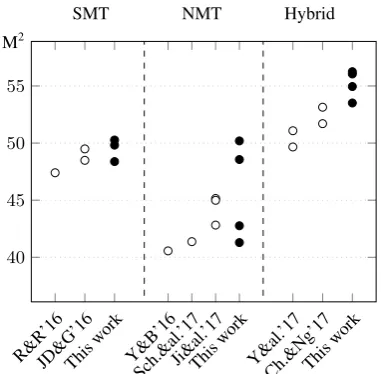
Currently, the most effective GEC systems are based on phrase-based statistical machine trans-lation (Rozovskaya and Roth, 2016; Junczys-Dowmunt and Grundkiewicz,2016;Chollampatt and Ng, 2017). Systems that rely on neural ma-chine translation (Yuan and Briscoe, 2016; Xie et al.,2016;Schmaltz et al.,2017;Ji et al.,2017) are not yet able to achieve as high performance as SMT systems according to automatic evalua-tion metrics (see Table 1 for comparison on the CoNLL-2014 test set). However, it has been shown that the neural approach can produce more fluent output, which might be desirable by human eval-uators (Napoles et al., 2017). In this work, we combine both MT flavors within a hybrid GEC sys-tem. Such a GEC system preserves the accuracy of SMT output and at the same time generates more fluent sentences achieving new state-of-the-art re-sults on two different benchmarks: the annotation-based CoNLL-2014 and the fluency-annotation-based JFLEG benchmark. Moreover, comparison with human gold standards shows that the created systems are
R&R’16JD&G’16Thiswork Y&B’16 Sch.&al.
’17 Ji&al.
’17 This
work Y&al.
’17 Ch.&Ng’17This
work 40
45 50 55 M2
[image:1.595.323.514.222.409.2]SMT NMT Hybrid
Figure 1: Comparison of SMT, NMT and hybrid GEC systems on the CoNLL-2014 test set (M2).
closer to reaching human-level performance than any other GEC system described in the literature so far.
Using consistent training data and preprocess-ing (§ 2), we first create strong SMT (§ 3) and NMT (§ 4) baseline systems. Then, we experiment with system combinations through pipelining and reranking (§ 5). Finally, we compare the perfor-mance with human annotations and identify issues with current state-of-the-art systems (§ 6).
2 Data and preprocessing
Our main training data is NUCLE (Dahlmeier et al., 2013). English sentences from the publicly avail-able Lang-8 Corpora (Mizumoto et al.,2012) serve as additional training data.
We use official test sets from two CoNLL shared tasks from 2013 and 2014 (Ng et al.,2013,2014) as development and test data, and evaluate using M2 (Dahlmeier and Ng, 2012). We also report
results on JFLEG (Napoles et al.,2017) with the
Corpus Sentences Tokens
NUCLE 57,151 1,162K
Lang-8 NAIST 1,943,901 25,026K CoNLL-2013 (dev) 1,381 29K CoNLL-2014 (test) 1,312 30K
JFLEG Dev 754 14K
[image:2.595.322.512.63.124.2]JFLEG Test 747 13K
Table 1: Statistics for training and testing data sets.
GLEU metric (Napoles et al.,2015). The data set is provided with a development and test set split. All data sets are listed in Table1.
We preprocess Lang-8 with the NLTK tokenizer (Bird and Loper,2004) and preserve the original tokenization in NUCLE and JFLEG. Sentences are truecased with scripts from Moses (Koehn et al., 2007). For dealing with out-of-vocabulary words, we split tokens into 50k subword units using Byte Pair Encoding (BPE) bySennrich et al.(2016b). BPE codes are extracted only from correct sen-tences from Lang-8 and NUCLE.
3 SMT systems
For our SMT-based systems, we follow recipes proposed byJunczys-Dowmunt and Grundkiewicz (2016), and use a phrase-based SMT system with a log-linear combination of task-specific features. We use word-level Levenshtein distance and edit operation counts as dense features (Dense), and cor-rection patterns on words with one word left/right context on Word Classes (WC) as sparse features (Sparse). We also experiment with additional character-level dense features (Char. ops). All systems use a 5-gram Language Model (LM) and OSM (Durrani et al., 2011) both estimated from the target side of the training data, and a 5-gram LM and 9-gram WCLM trained on Common Crawl data (Buck et al.,2014).
Experiment settings Translation models are trained with Moses (Koehn et al., 2007), word-alignment models are produced with MGIZA++ (Gao and Vogel,2008), and no reordering models are used. Language models are built using KenLM (Heafield,2011), while word classes are trained with word2vec1.
We tune the systems separately for M2 and
GLEU metrics. MERT (Och, 2003) is used for tuning dense features and Batch Mira (Cherry and Foster,2012) for sparse features. For M2 tunning
1https://github.com/dav/word2vec
CoNLL JFLEG
System P R M2 GLEU
[image:2.595.94.269.63.144.2]SMT Dense 56.91 30.25 48.38 54.68 + Sparse 60.28 29.40 49.82 55.25 + Char. ops 60.27 30.21 50.27 55.79
Table 2: Results for SMT baseline systems on the CoNLL-2014 (M2) and JFLEG Test (GLEU) sets.
we follow the 4-fold cross-validation on NUCLE with adapted error rate recommended by Junczys-Dowmunt and Grundkiewicz(2016). Models evalu-ated on GLEU are optimized on JFLEG Dev using the GLEU scorer, which we added to Moses. We report results for models using feature weights av-eraged over 4 tuning runs.
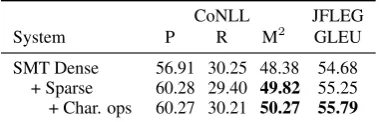
Results Other things being equal, using the orig-inal tokenization, applying subword units, and extending edit-based features result in a similar system to Junczys-Dowmunt and Grundkiewicz (2016): 49.82 vs 49.49 M2(Table2).
The phrase-based SMT systems do not deal well with orthographic errors (Napoles et al.,2017) — if a source word has not been seen in the train-ing corpus, it is likely copied as a target word. Subword units can help to solve this problem par-tially. Adding features based on character-level edit counts increases the results on both test sets.
A result of 55.79 GLEU on JFLEG Test is al-ready 2 points better than the GLEU-tuned NMT system ofSakaguchi et al.(2017) and only 1 point worse than the best reported result byChollampatt and Ng(2017) with their M2-tuned SMT system,
even though no additional spelling correction has been used at this point. We experiment with spe-cialized spell-checking methods in later sections.
4 NMT systems
The model architecture we choose for our NMT-based systems is an attentional encoder-decoder model with a bidirectional single-layer encoder and decoder, both using GRUs as their RNN variants (Sennrich et al.,2017). A similar architecture has been already tested for the GEC task bySakaguchi et al.(2017), but we use different hyperparameters.
To improve the performance of our NMT models, similarly toXie et al.(2016) andJi et al.(2017), we combine them with an additional large-scale lan-guage model. In contrast to previous studies, which use ann-gram probabilistic LM, we build a 2-layer
CoNLL JFLEG
System P R M2 GLEU
NMT 66.61 17.58 42.76 50.08
NMT + RNN-LM 61.05 26.71 48.56 56.04 NMT×4 71.10 15.42 41.29 50.30 NMT×4 + RNN-LM 60.27 30.08 50.19 56.74
Table 3: Results for NMT systems on the CoNLL-2014 (M2) and JFLEG Test (GLEU) sets.
LM) with GRU cells which we train again on En-glish Common Crawl data (Buck et al.,2014). Experimental settings We train with the Marian toolkit (Junczys-Dowmunt et al.,2018) on the same data we used for the SMT baselines, i.e. NUCLE and Lang-8. The RNN hidden state size is set to 1024, embedding size to 512. Source and target vocabularies as well as subword units are the same.
Optimization is performed with Adam (Kingma and Ba,2014) and the mini-batch size fitted into 4GB of GPU memory. We regularize the model with scaling dropout (Gal and Ghahramani,2016) with a dropout probability of 0.2 on all RNN in-puts and states. Apart from that we dropout entire source and target words with probabilities of 0.2 and 0.1 respectively. We use early stopping with a patience of 10 based on the cross-entropy cost on the CoNLL-2013 test set. Models are validated and saved every 10,000 mini-batches. As final mod-els we choose the one with the best performance on the development set among the last ten model check-points based on the M2or GLEU metrics.
Size of RNN hidden state and embeddings, target vocabulary, and optimization options for the RNN LM are identical to those used for our NMT models. Decoding is done by beam search with a beam size of 12. We normalize scores for each hypothesis by sentence length.
Results A single NMT model achieves lower per-formance than the SMT baselines (Table3). How-ever, the M2 score of 42.76 for CoNLL-2014 is
already higher than the best published result of 41.53 M2 for a strictly neural GEC system ofJi
et al.(2017) that has not been enhanced by an addi-tional language model.
Our RNN LM is integrated with NMT models through ensemble decoding (Sennrich et al.,2016a). Similarly toJi et al.(2017), we choose the weight of the language model using grid search on the development set2. This strongly improves recall,
2Used weights are 0.2 and 0.25 for M2and GLEU
evalua-SMT NMT SMT
+LM NMT
+LM 40
45 50
38.3 41.3
50.3 50.2 CoNLLM2
SMT NMT SMT
+LM NMT
+LM 50 52 54 56 58
52.5
49.5 55.8
56.7 JFLEGGLEU
[image:3.595.310.523.63.284.2]Avg ×4
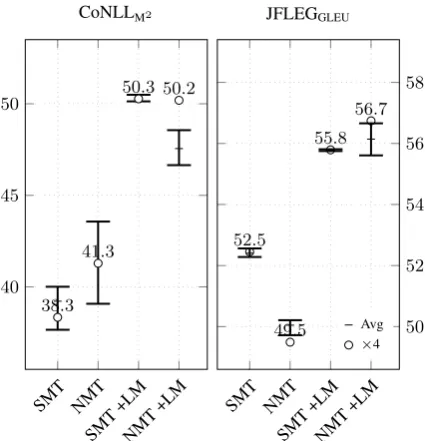
Figure 2: Contribution of a language model (LM) for SMT and NMT GEC systems.
and thus boosts the results significantly on both test sets (+5.8 M2 and +5.96 GLEU).
An ensemble of four independently trained mod-els3(NMT×4), on the other hand, increases preci-sion at the expense of recall, which may even lead to a performance drop. Adding the RNN LM to that ensemble balances this negative effect, resulting in 50.19 M2. These are by far the highest results
re-ported on both benchmarks for pure neural GEC systems.
Comparison to SMT systems With model en-sembling, the neural systems achieve performance similar to SMT baselines (Figure2). A stripped-down SMT system without CCLM, quite surpris-ingly gives better results on JFLEG than the NMT system, and the opposite is true for CoNLL-2014. The reason for the lower performance on JFLEG might be a large amount of spelling errors, which are more efficiently corrected by the SMT system using subword units.
If both systems are enhanced by a large-scale language model, the neural system outperforms the SMT system on JFLEG and it is competitive with SMT systems on CoNLL-2014. However, it is not known if the results would preserve if the NMT model is combined with a probabilistic n
-gram LM instead as it has been proposed in the previous works (Xie et al.,2016;Ji et al.,2017).
tion, respectively.
CoNLL JFLEG
System P R M2 GLEU
Best SMT 60.27 30.21 50.27 55.79 →Pip. NMT 60.25 34.80 52.56 57.21 →Pip. NMT+LM 58.87 39.23 53.51 58.83
+ Res. RNN-LM 70.97 24.86 51.77 56.97 + Res. NMT 70.40 26.69 53.03 57.21 + Res. NMT+LM 71.40 28.60 54.95 57.53 →Pip. NMT+LM 65.73 33.36 55.05 58.83
[image:4.595.323.513.63.327.2]+ Spell SMT 70.80 30.57 56.05 60.09 →Pip. NMT+LM 66.77 34.49 56.25 61.50
Table 4: Results for hybrid SMT-NMT systems on the CoNLL-2014 (M2) and JFLEG Test (GLEU) sets.
5 Hybrid SMT-NMT systems
We experiment with pipelining and rescoring meth-ods in order to combine our best SMT and NMT GEC systems4.
SMT-NMT pipelines The output corrected by an SMT system is passed as an input to the NMT en-semble with or without RNN LM5. In this case the NMT system serves as an automatic post-editing system. Pipelining improves the results on both test sets by increasing recall (Table4). As the per-formance of the NMT system without a RNN LM is much lower than the performance of the SMT system alone, this implies that both approaches produce complementary corrections.
Rescoring with NMT Rescoring of an n-best list obtained from one system by another is a com-monly used technique in GEC, which allows to combine multiple different systems or even differ-ent approaches (Hoang et al.,2016;Yannakoudakis et al., 2017;Chollampatt and Ng,2017;Ji et al., 2017). In our experiments, we generate a 1000 n-best list with the SMT system and add separate scores from each neural component. Scores of NMT models and the RNN LM are added in the form of probabilities in negative log space. The re-scored weights are obtained from a single run of the Batch Mira algorithm (Cherry and Foster, 2012) on the development set.
As opposed to pipelining, rescoring improves precision at the expense of recall and is more ef-fective for the CoNLL data resulting in up to 54.95 M2. On JFLEG, rescoring only with the RNN LM 4The best system combinations are chosen again based on the development sets, i.e. CoNLL-2013 and JFLEG Dev. We omit these results as they are highly overestimated.
5We did not observed any improvements if the order of the systems is reversed.
CoNLL-10 JFLEG
System P R M2 GLEU
Human Avg. 73.17 68.75 72.15 62.38 Ch&Ng’17 79.46 43.73 68.29 56.78 Ratio (%) 1.08 0.64 94.66 91.02 This work 83.15 46.97 72.04 61.50 Ratio (%) 1.14 0.68 99.85 98.59
Ch&Ng’17This work
Human 65
70 75
CoNLL-10
Ch&Ng’17This work
Human 55 60 65 JFLEG
[image:4.595.75.287.63.195.2]Avg
Figure 3: Comparison with human annotators. The fig-ure presents average M2 and GLEU scores with
stan-dard deviations.
produces similar results as rescoring with the NMT ensemble. However, the best result for rescoring is lower than for pipelining on that test set. It seems the SMT system is not able to produce as diversi-fied corrections in an n-best list as those generated by the NMT ensemble.
Spelling correction and final results Pipelining the NMT-rescored SMT system and the NMT sys-tem leads to further improvement. We believe this can be explained by different contributions to pre-cision and recall trade-offs for the two methods, similar to effects observed for the combination of the NMT ensemble and our RNN LM.
On top of our final hybrid system we add a spell-checking component, which is run before pipelin-ing. We use a character-level SMT system follow-ingChollampatt and Ng(2017) which they deploy for unknown words in their word-based SMT sys-tem. As our BPE-based SMT does not really suffer from unknown words, we run the spell-checking component on words that would have been seg-mented by the BPE algorithm. This last system achieves the best results reported in this paper: 56.25 M2 on CoNLL-2014 and 61.50 GLEU on
System Example
Source but now every thing is change , the life becom more dificullty . Best SMT But noweverything is changed, the life becom more dificullty . Best NMT But noweverything is changing, the lifebecomesmoredifficult. Pipeline But noweverything is changed, the lifebecomesmoredifficult. Rescoring But noweverything has changed, the life becom more dificullty .
[image:5.595.142.455.62.190.2]+ Pipeline But noweverything has changed, the lifebecomesmoredifficult. Reference 1 Now everything has changed , and life becomes more difficult . Reference 2 Everything has changed now and life has become more difficult . Reference 3 But now that everything changes , life becomes more difficult . Reference 4 But now that everything is changing , life becomes more difficult .
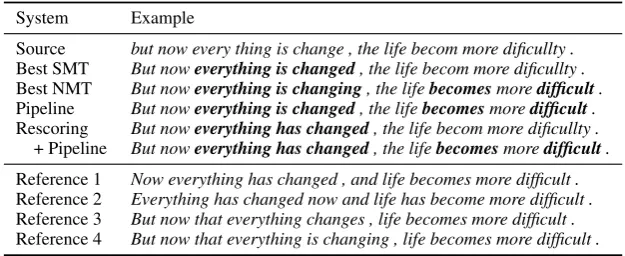
Table 5: System outputs for the example source sentence from the JFLEG Test set.
6 Analysis and future work
For both benchmarks our systems are close to au-tomatic evaluation results that have been claimed to correspond to human-level performance on the CoNLL-2014 test set and on JFLEG Test.
Example outputs Table5shows system outputs for an example source sentence from the JFLEG Test corpus that illustrate the complementarity of the statistical and neural approaches. The SMT and NMT systems produce different corrections. Rescoring is able to generate a unique correction (is change→has changed), but it fails in generating
some corrections from the neural system, e.g. mis-spellings (becomanddificullty). Pipelining, on the other hand, may not improve a local correction made by the SMT system (is changed). The combi-nation of the two methods produces output, which is most similar to the references.
Comparison with human annotations Bryant and Ng(2015) created an extension of the CoNLL-2014 test set with 10 annotators in total, JFLEG already incorporates corrections from 4 annotators. Human-level results for M2 and GLEU were
cal-culated by averaging the scores for each annotator with regard to the remaining 9 (CoNLL) or 3 (JF-LEG) annotators, respectively.
Figure3contains human level scores, our results, and previously best reported results byChollampatt and Ng (2017). Our best system reaches nearly 100% of the average human score according to M2
and nearly 99% for GLEU being much closer to that bound than previous works6.
6During the camera-ready preparation,Chollampatt and
Ng(2018) have published a GEC system based on a multi-layer convolutional encoder-decoder neural network with a character-based spell-checking module improving the previ-ous best result to 54.79 M2on CoNLL-2014 and 57.47 GLEU on JFLEG Test.
Further inspection reveals, however, that the pre-cision/recall trade-off for the automatic system in-dicates lower coverage compared to human cor-rections — lower recall is compensated with high precision7. Automatic systems might, for example, miss some obvious error corrections and therefore easily be distinguishable from human references. Future work would require a human evaluation ef-fort to draw more conclusions.
Acknowledgments
This work was partially funded by Facebook. The views and conclusions contained herein are those of the authors and should not be interpreted as neces-sarily representing the official policies or endorse-ments, either expressed or implied, of Facebook.
References
Steven Bird and Edward Loper. 2004. NLTK: the nat-ural language toolkit. In Proceedings of the ACL 2004 on Interactive poster and demonstration ses-sions. Association for Computational Linguistics, page 31.
Christopher Bryant and Hwee Tou Ng. 2015. How far are we from fully automatic high quality gram-matical error correction? In Proceedings of the 53rd Annual Meeting of the Association for Compu-tational Linguistics and the 7th International Joint Conference on Natural Language Processing (Vol-ume 1: Long Papers). Association for Computa-tional Linguistics, Beijing, China, pages 697–707.
http://www.aclweb.org/anthology/P15-1068.
Christian Buck, Kenneth Heafield, and Bas van Ooyen. 2014. N-gram counts and language models from the Common Crawl. In Proceedings of the Language Resources and Evaluation Conference. Reykjavík, Iceland, pages 3579–3584.
Colin Cherry and George Foster. 2012. Batch tuning strategies for statistical machine translation. In Pro-ceedings of the 2012 Conference of the North Amer-ican Chapter of the Association for Computational Linguistics: Human Language Technologies. Asso-ciation for Computational Linguistics, Stroudsburg, USA, pages 427–436.
Shamil Chollampatt and Hwee Tou Ng. 2017. Con-necting the dots: towards human-level grammatical error correction. In Proceedings of the 12th Work-shop on Innovative Use of NLP for Building Educa-tional Applications. Association for Computational Linguistics, Copenhagen, Denmark, pages 327–333.
http://www.aclweb.org/anthology/W17-5037. Shamil Chollampatt and Hwee Tou Ng. 2018. A
multi-layer convolutional encoder-decoder neural network for grammatical error correction. InProceedings of the Thirty-Second AAAI Conference on Artificial In-telligence.
Daniel Dahlmeier and Hwee Tou Ng. 2012. Better eval-uation for grammatical error correction. In Proceed-ings of the 2012 Conference of the North American Chapter of the Association for Computational Lin-guistics: Human Language Technologies. Associa-tion for ComputaAssocia-tional Linguistics, pages 568–572. Daniel Dahlmeier, Hwee Tou Ng, and Siew Mei Wu.
2013. Building a large annotated corpus of learner english: The NUS corpus of learner english. In
Proceedings of the Eighth Workshop on Innovative Use of NLP for Building Educational Applications. pages 22–31.
Nadir Durrani, Helmut Schmid, and Alexander Fraser. 2011. A joint sequence translation model with integrated reordering. In Proceedings of the 49th Annual Meeting of the Association for Com-putational Linguistics: Human Language Tech-nologies. Association for Computational Linguis-tics, Portland, Oregon, USA, pages 1045–1054.
http://www.aclweb.org/anthology/P11-1105. Yarin Gal and Zoubin Ghahramani. 2016. A
theoret-ically grounded application of dropout in recurrent neural networks. InAdvances in neural information processing systems. pages 1019–1027.
Qin Gao and Stephan Vogel. 2008. Parallel implemen-tations of word alignment tool. In Software Engi-neering, Testing, and Quality Assurance for Natural Language Processing. ACL, pages 49–57.
Kenneth Heafield. 2011. KenLM: Faster and smaller language model queries. InProceedings of the Sixth Workshop on Statistical Machine Translation. Asso-ciation for Computational Linguistics, Stroudsburg, USA, WMT ’11, pages 187–197.
Duc Tam Hoang, Shamil Chollampatt, and Hwee Tou Ng. 2016. Exploiting n-best hypotheses to im-prove an SMT approach to grammatical error cor-rection. InProceedings of the Twenty-Fifth Interna-tional Joint Conference on Artificial Intelligence. IJ-CAI/AAAI Press, pages 2803–2809.
Jianshu Ji, Qinlong Wang, Kristina Toutanova, Yongen Gong, Steven Truong, and Jianfeng Gao. 2017. A nested attention neural hybrid model for grammati-cal error correction. InProceedings of the 55th An-nual Meeting of the Association for Computational Linguistics. Association for Computational Linguis-tics, pages 753–762.
Marcin Junczys-Dowmunt and Roman Grundkiewicz. 2016. Phrase-based machine translation is state-of-the-art for automatic grammatical error cor-rection. In Proceedings of the 2016 Con-ference on Empirical Methods in Natural Lan-guage Processing. Association for Computational Linguistics, Austin, Texas, pages 1546–1556.
https://aclweb.org/anthology/D16-1161.
Marcin Junczys-Dowmunt, Roman Grundkiewicz, Tomasz Dwojak, Hieu Hoang, Kenneth Heafield, Tom Neckermann, Frank Seide, Ulrich Germann, Alham Fikri Aji, Nikolay Bogoychev, André F. T. Martins, and Alexandra Birch. 2018. Marian: Fast neural machine translation in C++. arXiv preprint arXiv:1804.00344https://arxiv.org/abs/1804.00344. Diederik Kingma and Jimmy Ba. 2014. Adam: A method for stochastic optimization. Proceedings of the 3rd International Conference on Learning Rep-resentations (ICLR).
Philipp Koehn, Hieu Hoang, Alexandra Birch, Chris Callison-Burch, Marcello Federico, Nicola Bertoldi, Brooke Cowan, Wade Shen, Christine Moran, Richard Zens, Chris Dyer, Ondrej Bojar, Alexandra Constantin, and Evan Herbst. 2007. Moses: Open source toolkit for statistical machine translation. In
Annual Meeting of the Association for Computa-tional Linguistics. The Association for Computer Linguistics.
Tomoya Mizumoto, Yuta Hayashibe, Mamoru Ko-machi, Masaaki Nagata, and Yu Matsumoto. 2012. The effect of learner corpus size in grammatical er-ror correction of ESL writings. InProceedings of COLING 2012. pages 863–872.
Courtney Napoles, Keisuke Sakaguchi, Matt Post, and Joel Tetreault. 2015. Ground truth for grammati-cal error correction metrics. InProceedings of the 53rd Annual Meeting of the Association for Compu-tational Linguistics and the 7th International Joint Conference on Natural Language Processing (Vol-ume 2: Short Papers). Association for Computa-tional Linguistics, Beijing, China, pages 588–593.
http://www.aclweb.org/anthology/P15-2097. Courtney Napoles, Keisuke Sakaguchi, and Joel
Tetreault. 2017. JFLEG: A fluency corpus and benchmark for grammatical error correction. In Pro-ceedings of the 2017 Conference of the European Chapter of the Association for Computational Lin-guistics. Association for Computational Linguistics, Valencia, Spain.https://arxiv.org/abs/1702.04066. Hwee Tou Ng, Siew Mei Wu, Ted Briscoe,
Christopher Bryant. 2014. The CoNLL-2014 shared task on grammatical error correction. In Proceedings of the Eighteenth Conference on Computational Natural Language Learning: Shared Task. Association for Computational Linguistics, Baltimore, Maryland, pages 1–14.
http://www.aclweb.org/anthology/W14-1701.
Hwee Tou Ng, Siew Mei Wu, Yuanbin Wu, Chris-tian Hadiwinoto, and Joel Tetreault. 2013. The CoNLL-2013 shared task on grammatical error correction. In Proceedings of the Seventeenth Conference on Computational Natural Language Learning: Shared Task. Association for Compu-tational Linguistics, Sofia, Bulgaria, pages 1–12.
http://www.aclweb.org/anthology/W13-3601.
Franz Josef Och. 2003. Minimum error rate training in statistical machine translation. InProceedings of the 41st Annual Meeting on Association for Computa-tional Linguistics - Volume 1. Association for Com-putational Linguistics, Stroudsburg, USA, ACL ’03, pages 160–167.
Alla Rozovskaya and Dan Roth. 2016. Grammati-cal error correction: Machine translation and clas-sifiers. In Proceedings of the 54th Annual Meet-ing of the Association for Computational LMeet-inguistics (Volume 1: Long Papers). Association for Compu-tational Linguistics, Berlin, Germany, pages 2205– 2215.http://www.aclweb.org/anthology/P16-1208.
Keisuke Sakaguchi, Matt Post, and Benjamin Van Durme. 2017. Grammatical error correction with neural reinforcement learning. InProceedings of the Eighth International Joint Conference on Natural Language Processing (Volume 2: Short Papers). Asian Federation of Natural Language Processing, Taipei, Taiwan, pages 366–372.
http://www.aclweb.org/anthology/I17-2062.
Allen Schmaltz, Yoon Kim, Alexander Rush, and Stuart Shieber. 2017. Adapting sequence models for sentence correction. InProceedings of the 2017 Conference on Empirical Methods in Natural Lan-guage Processing. Association for Computational Linguistics, Copenhagen, Denmark, pages 2807– 2813. https://www.aclweb.org/anthology/D17-1298.
Rico Sennrich, Orhan Firat, Kyunghyun Cho, Alexan-dra Birch, Barry Haddow, Julian Hitschler, Marcin Junczys-Dowmunt, Samuel Läubli, Antonio Vale-rio Miceli Barone, Jozef Mokry, and Maria Nade-jde. 2017. Nematus: a toolkit for neural ma-chine translation. In Proceedings of the Soft-ware Demonstrations of the 15th Conference of the European Chapter of the Association for Com-putational Linguistics. Association for Computa-tional Linguistics, Valencia, Spain, pages 65–68.
http://aclweb.org/anthology/E17-3017.
Rico Sennrich, Barry Haddow, and Alexandra Birch. 2016a. Edinburgh neural machine
translation systems for WMT 16. In Pro-ceedings of the First Conference on Machine Translation. Association for Computational Linguistics, Berlin, Germany, pages 371–376.
http://www.aclweb.org/anthology/W/W16/W16-2323.
Rico Sennrich, Barry Haddow, and Alexandra Birch. 2016b. Neural machine translation of rare words with subword units. In Proceed-ings of the 54th Annual Meeting of the As-sociation for Computational Linguistics (Volume 1: Long Papers). Association for Computational Linguistics, Berlin, Germany, pages 1715–1725.
http://www.aclweb.org/anthology/P16-1162.
Ziang Xie, Anand Avati, Naveen Arivazhagan, Dan Ju-rafsky, and Andrew Y Ng. 2016. Neural language correction with character-based attention. arXiv preprint arXiv:1603.09727.
Helen Yannakoudakis, Marek Rei, Øistein E. Ander-sen, and Zheng Yuan. 2017. Neural sequence-labelling models for grammatical error correc-tion. In Proceedings of the 2017 Conference on Empirical Methods in Natural Language Pro-cessing. Association for Computational Linguis-tics, Copenhagen, Denmark, pages 2785–2796.
https://www.aclweb.org/anthology/D17-1296.