Proceedings of NAACL-HLT 2018, pages 1503–1515
Identifying Semantic Divergences in Parallel Text without Annotations
Yogarshi Vyas and Xing Niu and Marine Carpuat Department of Computer Science
University of Maryland College Park, MD 20742, USA
[email protected], [email protected], [email protected]
Abstract
Recognizing that even correct translations are not always semantically equivalent, we auto-matically detect meaning divergences in par-allel sentence pairs with a deep neural model of bilingual semantic similarity which can be trained for any parallel corpus without any manual annotation. We show that our seman-tic model detects divergences more accurately than models based on surface features derived from word alignments, and that these diver-gences matter for neural machine translation. 1 Introduction
Parallel sentence pairs are sentences that are trans-lations of each other, and are therefore often assumed to convey the same meaning in the source and target language. Occasional mis-matches between source and target have been pri-marily viewed as alignment noise (Goutte et al.,
2012) due to imperfect sentence alignment tools in parallel corpora drawn from translated texts (Tiedemann, 2011; Xu and Yvon, 2016), or the noisy process of extracting parallel segments from non-parallel corpora (Fung and Cheung, 2004;
Munteanu and Marcu,2005).
In contrast, we view translation as a process that inherently introduces meaning mismatches, so that even correctly aligned sentence pairs are not nec-essarily semantically equivalent. This can hap-pen for many reasons: translation lexical choice often involves selecting between near synonyms that introduce language-specific nuances (Hirst,
1995), typological divergences lead to structural mismatches (Dorr,1994), differences in discourse organization can make it impossible to find one-to-one sentence alignments (Li et al., 2014). Cross-linguistic variations in other discourse phe-nomena such as coreference, discourse relation and modality (Lapshinova-Koltunski,2015) com-pounded with translation effects that distinguish
“translationese” from original text (Koppel and Ordan, 2011) might also lead to meaning mis-matches between source and target.
In this paper, we aim to provide empirical ev-idence that semantic divergences exist in paral-lel corpora and matter for downstream applica-tions. This requires an automatic method to distin-guish semantically equivalent sentence pairs from semantically divergent pairs, so that parallel cor-pora can be used more judiciously in downstream cross-lingual NLP applications. We propose a semantic model to automatically detect whether a sentence pair is semantically divergent (Sec-tion 3). While prior work relied on surface cues to detect mis-aligments, our approach focuses on comparing the meaning of words and overlapping text spans using bilingual word embeddings ( Lu-ong et al., 2015) and a deep convolutional neural network (He and Lin, 2016). Crucially, training this model requires no manual annotation. Noisy supervision is obtained automatically borrowing techniques developed for parallel sentence extrac-tion (Munteanu and Marcu, 2005). Our model can thus easily be trained to detect semantic di-vergences in any parallel corpus.
We extensively evaluate our semantically-motivated models on intrinsic and extrinsic tasks: detection of divergent examples in two paral-lel English-French data sets (Section 5), and data selection for English-French and Vietnamese-English machine translation (MT) (Section6).The semantic models significantly outperform other methods on the intrinsic task, and help select data to train neural machine translation faster with no loss in translation quality. Taken together, these results provide empirical evidence that sentence-alignment does not necessarily imply semantic equivalence, and that this distinction matters in practice for a downstream NLP application.
2 Background
Translation Divergences We use the term se-mantic divergences to refer to bilingual sentence pairs, including translations, that do not have the same meaning. These differ from typological divergences, which have been defined as struc-tural differences between sentences that convey the same meaning (Dorr,1994;Habash and Dorr,
2002), and reflect the fact that languages do not encode the same information in the same way.
Non-Parallel Corpora Mismatches in bilingual sentence pairs have previously been studied to ex-tract parallel segments from non-parallel corpora, and augment MT training data (Fung and Cheung,
2004;Munteanu and Marcu,2005, 2006; AbduI-Rauf and Schwenk,2009;Smith et al.,2010;Riesa and Marcu,2012,inter alia). Methods for parallel sentence extraction rely primarily on surface fea-tures based on translation lexicons and word align-ment patterns (Munteanu and Marcu,2005,2006). Similar features have proved to be useful for the related task of translation quality estimation ( Spe-cia et al.,2010,2016), which aims to detect diver-gences introduced by MT errors, rather than hu-man translation. Recently, sentence embeddings have also been used to detect parallelism ( Espa˜na-Bonet et al., 2017; Schwenk and Douze, 2017). Although embeddings capture semantic general-izations, these models are trained with neural MT objectives, which do not distinguish semantically equivalent segments from divergent parallel seg-ments.
Cross-Lingual Sentence Semantics Cross-lingual semantic textual similarity (Agirre et al.,
2016) and cross-lingual textual entailment (Negri and Mehdad, 2010; Negri et al., 2012, 2013) seek to characterize semantic relations between sentences in two different languages beyond translation equivalence, and are therefore directly relevant to our goal. While the human judgments obtained for each task differ, they all take inputs of the same form (two segments in different languages) and output a prediction that can be in-terpreted as indicating whether they are equivalent in meaning or not. Models share core intuitions, relying either on MT to transfer the cross-lingual task into its monolingual equivalent (Jimenez et al., 2012; Zhao et al., 2013), or on features derived from MT components such as translation dictionaries and word alignments (Turchi and
Negri, 2013; Lo et al., 2016). Training requires manually annotated examples, either bilingual, or monolingual when using MT for language transfer.
Impact of mismatched sentence pairs on MT
Prior MT work has focused on noise in sentence alignment rather than semantic divergence.Goutte et al. (2012) show that phrase-based systems are remarkably robust to noise in parallel segments. When introducing noise by permuting the target side of parallel pairs, as many as 30% of training examples had to be permuted to degrade BLEU significantly. While such artificial noise does not necessarily capture naturally occurring diver-gences, there is evidence that data cleaning to re-move real noise can benefit MT in low-resource settings (Matthews et al.,2014).
Neural MT quality appears to be more sensi-tive to the nature of training examples than phrase-based systems. Chen et al. (2016) suggest that neural MT systems are sensitive to sentence pair permutations in domain adaptation settings. Be-linkov and Bisk (2018) demonstrate the brittle-ness of character-level neural MT when exposed to synthetic noise (random permutations of words and characters) as well as natural human errors. Concurrently with our work,Hassan et al.(2018) claim that even small amounts of noise can have adverse effects on neural MT models, as they tend to assign high probabilities to rare events. They filter out noise and select relevant in-domain ex-amples jointly, using similarities between sentence embeddings obtained from the encoder of a bidi-rectional neural MT system trained on clean in-domain data. In contrast, we detect semantic di-vergence with dedicated models that require only 5000 parallel examples (see Section5).
3 Approach
We introduce our approach to detecting divergence in parallel sentences, with the goal of (1) detecting differences ranging from large mismatches to sub-tle nuances, (2) without manual annotation.
Cross-Lingual Semantic Similarity Model We address the first requirement using a neural model that compares the meaning of sentences using a range of granularities. We repurpose the Very Deep Pairwise Interaction (VDPWI) model, which has been previously been used to detect semantic textual similarity (STS) between English sentence pairs (He and Lin,2016). It achieved competitive performance on data from the STS 2014 shared task (Agirre et al., 2014), and outperformed pre-vious approaches on sentence classification tasks (He et al.,2015;Tai et al.,2015), with fewer pa-rameters, faster training, and without requiring ex-pensive external resources such as WordNet.
The VDPWI model was designed for compar-ing the meancompar-ing of sentences in the same lan-guage, based not only on word-to-word similar-ity comparisons, but also on comparisons between overlapping spans of the two sentences, as learned by a deep convolutional neural network. We adapt the model to our cross-lingual task by initializing it with bilingual embeddings. To the best of our knowledge, this is the first time this model has been used for cross-lingual tasks in such a way. We give a brief overview of the resulting model here and refer the reader to the original paper for details. Given sentenceseandf , VDPWI mod-els the semantic similarity between them using a pipeline consisting of five components:
1. Bilingual word embeddings: Each word in eandf is represented as a vector using pre-trained, bilingual embeddings.
2. BiLSTM for contextualizing words: Con-textualized representations for words ineand fare obtained by choosing the output vectors at each time step obtained by running a bidi-rectional LSTM (Schuster and Paliwal,1997) on each sentence.
3. Word similarity cube: The contextualized representations are used to calculate various similarity scores between each word inewith each word inf. Each score thus forms a ma-trix and all such matrices are stacked to form asimilarity cubetensor.
4. Similarity focus layer: The similarity cube is fed to a similarity focus layer that re-weights the similarities in the cube to focus on highly similar word pairs, by decreasing the weights of pairs which are less similar. This output is called thefocus cube.
5. Deep convolutional network: The focus cube is treated as an “image” and passed to a deep neural network, the likes of which have been used to detect patterns in images. The network consists of repeating convolu-tion and pooling layers. Each repeticonvolu-tion con-sists of a spatial convolutional layer, a Rec-tified Linear Unit (Nair and Hinton, 2010), and a max pooling layer, followed by fully connected layers, and a softmax to obtain the final output.
The entire architecture is trained end-to-end to minimize the Kullback-Leibler divergence ( Kull-back, 1959) between the output similarity score and gold similarity score.
Noisy Synthetic Supervision How can we ob-tain gold similarity scores as supervision for our task? We automatically construct examples of se-mantically divergent and equivalent sentences as follows. Since a large number of parallel sentence pairs are semantically equivalent, we use parallel sentences as positive examples. Synthetic negative examples are generated following the protocol in-troduced byMunteanu and Marcu(2005) to distin-guish parallel from non-parallel segments. Specif-ically, candidate negative examples are generated starting from the positive examples {(ei, fi) ∀i}
and taking the Cartesian product of the two sides of the positive examples{(ei, fj)∀i, j s.t.i 6= j}.
This candidate set is filtered to ensure that nega-tive examples are not too easy to identify: we only retain pairs that are close to each other in length (a length ratio of at most 1:2), and have enough words (at least half) which have a translation in the other sentence according to a bilingual dictionary derived from automatic word alignments.
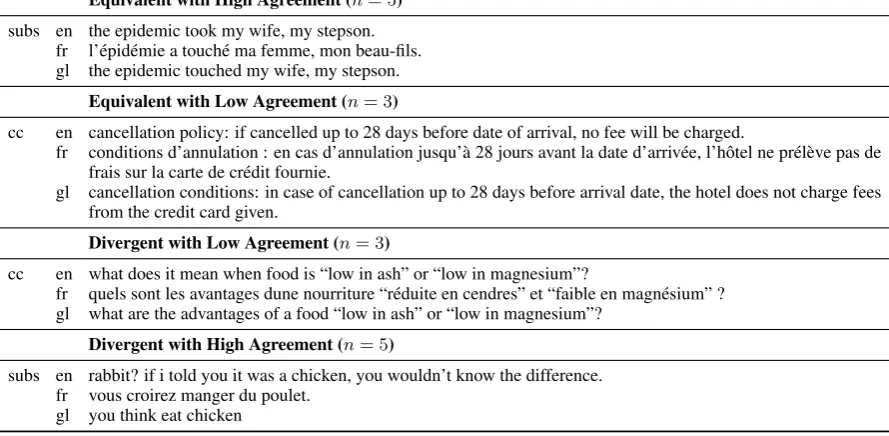
Equivalent with High Agreement (n= 5)
subs en the epidemic took my wife, my stepson. fr l’´epid´emie a touch´e ma femme, mon beau-fils. gl the epidemic touched my wife, my stepson.
Equivalent with Low Agreement (n= 3)
cc en cancellation policy: if cancelled up to 28 days before date of arrival, no fee will be charged.
fr conditions d’annulation : en cas d’annulation jusqu’`a 28 jours avant la date d’arriv´ee, l’hˆotel ne pr´el`eve pas de frais sur la carte de cr´edit fournie.
gl cancellation conditions: in case of cancellation up to 28 days before arrival date, the hotel does not charge fees from the credit card given.
Divergent with Low Agreement (n= 3)
cc en what does it mean when food is “low in ash” or “low in magnesium”?
fr quels sont les avantages dune nourriture “r´eduite en cendres” et “faible en magn´esium” ? gl what are the advantages of a food “low in ash” or “low in magnesium”?
Divergent with High Agreement (n= 5)
subs en rabbit? if i told you it was a chicken, you wouldn’t know the difference. fr vous croirez manger du poulet.
[image:4.595.72.517.71.289.2]gl you think eat chicken
Table 1: Randomly selected sentence pairs (English (en), French (fr) and gloss of French (gl)) annotated as diver-gent or equivalent, with high and low degrees of agreement between the 5 annotators. Examples are taken either from the OpenSubtitles (subs) or Common Crawl (cc) corpus.
4 Crowdsourcing Divergence Judgments
We crowdsource annotations of English-French sentence pairs to construct test beds for evaluat-ing our models, and also to assess how frequent semantic divergences are in parallel corpora.
Data Selection We draw examples for annota-tion randomly from two English-French corpora, using a resource-rich and well-studied language pair, and for which bilingual annotators can eas-ily be found. The OpenSubtitles corpus con-tains 33M sentence pairs based on translations of movie subtitles. The sentence pairs are expected to not be completely parallel given the many con-straints imposed on translations that should fit on a screen and be synchronized with a movie ( Tiede-mann, 2007; Lison and Tiedemann, 2016), and the use of more informal registers which might require frequent non-literal translations of figu-rative language. The Common Crawl corpus
contains sentence-aligned parallel documents au-tomatically mined from the Internet. Parallel doc-uments are discovered using e.g., URL contain-ing language code patterns, and sentences are automatically aligned after structural cleaning of HTML. The resulting corpus of 3M sentence pairs is noisy, yet extremely useful to improve transla-tion quality for multiple language pairs and do-mains (Smith et al.,2013).
Annotation Protocol Divergence annotations are obtained via Crowdflower.1 Since this task requires good command of both French and En-glish, we rely on a combination of strategies to obtain good quality annotations, including Crowd-flower’s internal worker proficiency ratings, geo-restriction, reference annotations by a bilingual speaker in our lab, and instructions that alternate between the two languages (Agirre et al.,2016).
Annotators are shown an English-French sen-tence pair, and asked whether they agree or dis-agree with the statement “the French and English text convey the same information.” We do not use the term “divergent”, and let the annotators’ intu-itions about what constitutes the same take prece-dence. We set up two distinct annotation tasks, one for each corpus, so that workers only see examples sampled from a given corpus in a given job. Each example is shown to five distinct annotators.
Annotation Analysis Forcing an assignment of divergent or equivalent labels by majority vote yields 43.6% divergent examples in OpenSubti-tles, and 38.4% in Common Crawl. Fleiss’ Kappa indicates moderate agreement between annotators (0.41 for OpenSubtitles and 0.49 for Common Crawl). This suggests that the annotation pro-tocol can be improved, perhaps by using graded judgments as in Semantic Textual Similarity tasks (Agirre et al., 2016), or for sentence alignment
confidence evaluation (Xu and Yvon,2016). Cur-rent annotations are nevertheless useful, and dif-ferent degrees of agreement reveal nuances in the nature of divergences (Table1). Examples labeled as divergent with high confidence (lowest block of the table) are either unrelated or one language misses significant information that is present in the other. Examples labeled divergent with lower confidence contain more subtle differences (e.g., “what does it mean” in English vs. “what are the advantages” in French).
5 Divergence Detection Evaluation
Using the two test sets obtained above, we can evaluate the accuracy of our cross-lingual seman-tic divergence detector, and compare it against a diverse set of baselines in controlled settings. We test our hypothesis that semantic divergences are more than alignment mismatches by comparing the semantic divergence detector with models that capture mis-alignment (Section5.2) or translation (Section 5.3). Then, we compare the deep con-volutional architecture of the semantic divergence model, with a much simpler model that directly compares bilingual sentence embeddings (Section
5.4). Finally, we compare our model trained on synthetic examples with a supervised classifier used in prior work to predict finer-grained textual entailment categories based on manually created training examples (Section5.5). Except for the en-tailment classifier which uses external resources, all models are trained on the exact same paral-lel corpora (OpenSubtitles or CommonCrawl for evaluating on the corresponding test bed.)
5.1 Neural Semantic Divergence Detection Model and Training Settings We use the pub-licly available implementation of the VDPWI model.2 We initialize with 200 dimensional BiVec French-English word embeddings (Luong et al.,
2015), trained on the parallel corpus from which our test set is drawn. We use the default setting for all other VDPWI parameters. The model is trained for 25 epochs and the model that achieves the best Pearson correlation coefficient on the val-idation set is chosen. At test time, VDPWI outputs a score∈[0,1], where a higher value indicates less divergence. We tune a threshold on development
2https://github.com/castorini/ VDPWI-NN-Torch
data to convert the real-valued score to binary pre-dictions.
Synthetic Data Generation The synthetic train-ing data is constructed ustrain-ing a random sample of 5000 sentences from the training parallel corpus as positive examples. We generate negative exam-ples automatically as described in Section 3, and sample a subset to maintain a 1:5 ratio of positive to negative examples.3
5.2 Parallel vs. Non-parallel Classifier
Are divergences observed in parallel corpora more than alignment errors? To answer this question, we reimplement the model proposed byMunteanu and Marcu(2005). It discriminates parallel pairs from non-parallel pairs in comparable corpora us-ing a supervised linear classifier with the follow-ing features for each sentence pair(e, f):
• Length features: |f|,|e|,|f| |e|, and |
e| |f|
• Alignment features (for each ofeandf):4
– Count and ratio of unaligned words
– Top three largest fertilities
– Longest contiguous unaligned and aligned sequence lengths
• Dictionary features:5 fraction of words in e that have a translation inf and vice-versa. Training uses the exact same synthetic exam-ples as the semantic divergence model (Section3).
5.3 Neural MT
If divergent examples are nothing more than bad translations, a neural MT system should assign lower scores to divergent segments pairs than to those that are equivalent in meaning. We test this empirically using neural MT systems trained for a single epoch, and use the system to score each of the sentence pairs in the test sets. We tune a threshold on the development set to convert scores to binary predictions. The system architecture and training settings are described in details in the later MT section (Section 6.2). Preliminary ex-periments showed that training for more than one epoch does not help divergence detection.
3We experimented with other ratios and found that the re-sults only slightly degraded while using a more balanced ratio (1:1, 1:2), but severely degraded with a skewed ratio (1:9).
4Alignments are obtained using IBM Model 2 trained in each direction, combined with union, intersection, andgrow-diag-final-andheuristics.
5.4 Bilingual Sentence Embeddings
Our semantic divergence model introduces a large number of parameters to combine the pairwise word comparisons into a single sentence-level pre-diction. This baseline tests whether a simpler model would suffice. We detect semantic diver-gence by computing the cosine similarity between sentence embeddings in a bilingual space. The sentence embeddings are bag-of-word representa-tions, build by taking the mean of bilingual word embeddings for each word in the sentence. This approach has been shown to be effective, despite ignoring fundamental linguistic information such as word order and syntax (Mitchell and Lapata,
2010). We use the same 200 dimensional BiVec word embeddings (Luong et al.,2015), trained on OpenSubtitles and CommonCrawl respectively.
5.5 Textual Entailment Classifier
Our final baseline replicates our previous system (Carpuat et al.,2017) where we repurposed anno-tations and models designed for the task of Cross-Lingual Textual Entailment (CLTE) to detect se-mantic divergences. This baseline also helps us understand how the synthetic training data com-pares to training examples generated manually, for a related cross-lingual task. Using CLTE datasets from SemEval (Negri et al.,2012,2013), we train a supervised linear classifier that can distinguish sentence pairs that entail each other, from pairs where entailment does not hold in at least one di-rection. The features of the classifier are based on word alignments and sentence lengths.6
5.6 Intrinsic Evaluation Results
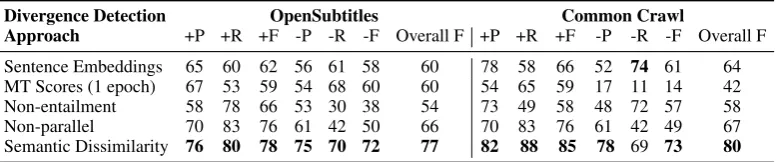
Table2shows that the semantic similarity model is most successful at distinguishing equivalent from divergent examples. The break down per class shows that both equivalent and divergent examples are better detected. The improvement is larger for divergent examples with gains of about 10 points for F-score for the divergent class, when compared to the next-best scores.
Among the baseline methods, the non-entailment model is the weakest. While it uses manually constructed training examples, these examples are drawn from distant domains, and the categories annotated do not exactly match the task 6As in the prior work, alignments are trained on 2M sen-tence pairs from Europarl (Koehn,2005) using the Berkeley aligner (Liang et al.,2006). The classifier is the linear SVM from Scikit-Learn.
at hand. In contrast, the other models benefit from training on examples drawn from the same corpus as each test set.
Next, the machine translation based model and the sentence embedding model, both of which are unsupervised, are significantly weaker than the two supervised models trained on synthetic data, highlighting the benefits of the automatically con-structed divergence examples. The strength of the semantic similarity model compared to the sen-tence embeddings model highlights the benefits of the fine-grained representation of bilingual sen-tence pairs as a similarity cube, as opposed to the bag-of-words sentence embedding representation. Finally, despite training on the same noisy syn-thetic data as the parallel v/s non-parallel system, the semantic similarity model is better able to de-tect meaning divergences. This highlights the ben-efits of (1) meaning comparison between words in a shared embedding space, over the discrete translation dictionary used by the baseline, and of (2) the deep convolutional neural network which enables the semantic comparison of overlapping spans in sentence pairs, as opposed to more local word alignment features.
5.7 Analysis
We manually examine the 13-15% of examples in each test set that are correctly detected as diver-gent by semantic similarity and mis-classified by the non-parallel detector.
On OpenSubtitles, most of these examples are true divergences rather than noisy alignments (i.e. sentences that are not translation of each other.) The non-parallel detector weighs length features highly, and is fooled by sentence pairs of sim-ilar length that share little content and therefore have very sparse word alignments. The remaining sentence pairs are plausible translations in some context that still contain inherent divergences, such as details missing or added in one language. The non-parallel detector views these pairs as non-divergent since most words can be aligned. The semantic similarity model can identify subtle meaning differences, and correctly classify them as divergent. As a result, the non-parallel detec-tor has a higher false positive rate (22%) than the semantic similarity classifier (14%), while having similar false negative rates (11% v/s 12%).
Divergence Detection OpenSubtitles Common Crawl
Approach +P +R +F -P -R -F Overall F +P +R +F -P -R -F Overall F Sentence Embeddings 65 60 62 56 61 58 60 78 58 66 52 74 61 64 MT Scores (1 epoch) 67 53 59 54 68 60 60 54 65 59 17 11 14 42 Non-entailment 58 78 66 53 30 38 54 73 49 58 48 72 57 58
Non-parallel 70 83 76 61 42 50 66 70 83 76 61 42 49 67
[image:7.595.106.495.63.144.2]Semantic Dissimilarity 76 80 78 75 70 72 77 82 88 85 78 69 73 80
Table 2: Intrinsic evaluation on crowdsourced semantic equivalence vs. divergence testsets. We report overall F-score, as well as precision (P), recall (R) and F-score (F) for the equivalent (+) and divergent (-) classes separately. Semantic similarity yields better results across the board, with larger improvements on the divergent class.
noisy segments that should not be aligned to sen-tences with subtle divergences.
6 Machine Translation Evaluation
Having established the effectiveness of the seman-tic divergence detector, we now measure the im-pact of divergences on a downstream task, ma-chine translation. As in our prior work (Carpuat et al., 2017), we take a data selection approach, selecting the least divergent examples in a paral-lel corpus based on a range of divergence detec-tors, and comparing the translation quality of the resulting neural MT systems.
6.1 Translation Tasks
English-French We evaluate on 4867 sentences from the Microsoft Spoken Language Translation dataset (Federmann and Lewis, 2016) as well as on 1300 sentences from TED talks (Cettolo et al.,
2012), as in past work (Carpuat et al., 2017). Training examples are drawn from OpenSubtitles, which contains ~28M examples after deduplica-tion. We discard 50% examples for data selecdeduplica-tion.
Vietnamese-English Since the SEMANTIC SIMILARITY model was designed to be easily portable to new language pairs, we also test its impact on the IWSLT Vietnamese-English TED task, which comes with ~120,000 and 1268 in-domain sentences for training and testing respectively (Farajian et al.,2016). This is a more challenging translation task as Vietnamese and English are more distant languages, there is little training data, and the sentence pairs are expected to be cleaner and more parallel than those from OpenSubtitles. In these lower resource settings, we discard 10% of examples for data selection.
6.2 Neural MT System
We use the attentional encoder-decoder model (Bahdanau et al.,2015) implemented in the Sock-Eye toolkit (Hieber et al., 2017). Encoders and
decoders are single-layer GRUs (Cho et al.,2014) with 1000 hidden units. Source and target word embeddings have size 512. Using byte-pair en-coding (Sennrich et al.,2016), the vocabulary size is 50000. Maximum sequence length is set to 50.
We optimize the standard cross-entropy loss us-ing Adam (Kingma and Ba,2014), until validation perplexity does not decrease for 8 checkpoints. The learning rate is set to 0.0003 and is halved when the validation perplexity does not decrease for 3 checkpoints. The batch size is set to 80. At decoding time, we construct a new model by av-eraging the parameters for the 8 checkpoints with best validation perplexity, and decode with a beam of 5. All experiments are run thrice with distinct random seeds.
Note that the baseline in this work is much stronger than in our prior work (>5 BLEU). This is due to multiple factors that have been recom-mended as best practices for neural MT and have been incorporated in the present baseline – dedu-plication of the training data, ensemble decoding using multiple random runs, use of Adam as the optimizer instead of AdaDelta (Bahar et al.,2017;
Denkowski and Neubig,2017), and checkpoint av-eraging (Bahar et al., 2017) – as well as a more recent neural modeling toolkit.
6.3 English-French Results
We train English-French neural MT systems by se-lecting the least divergent half of the training cor-pus with the following criteria:
• SEMANTICSIMILARITY(Section3)
• PARALLEL: the non-parallel sentence detec-tor (Section5.2)
• ENTAILMENT: the entailment classifier (Sec-tion5.5), as inCarpuat et al.(2017)
• RANDOM: Randomly downsampling the training corpus
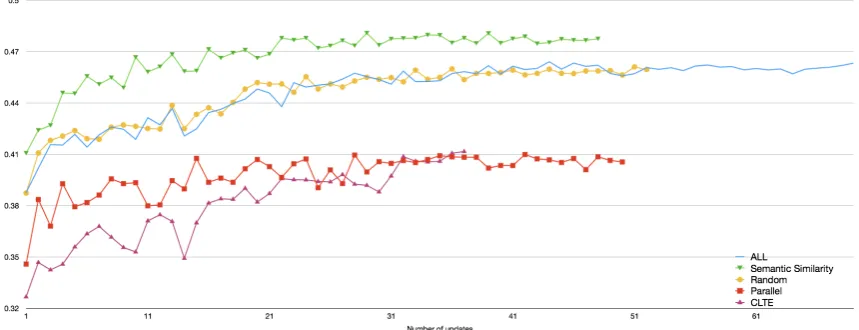
Figure 1: Learning curves on the validation set for English-French models (mean of 3 runs/model). The SEMANTIC SIMILARITYmodel outperforms other models throughout training, including the one trained on all data.
Model MSLT BLEU TED BLEU
Avg. Ensemble Avg. Ensemble
RANDOM 43.49 45.64 36.05 38.20
PARALLEL 40.65 42.12 35.99 37.86
ENTAILMENT 39.64 41.86 33.30 35.40
SEMANTICSIM. 45.53 47.23* 36.98 38.87
ALL 44.64 46.26 36.98 38.59
Table 3: English-French decoding results. BLEU scores are either averaged across 3 runs (“Avg.”) or ob-tained via ensemble decoding (“Ensemble”). SEMAN -TIC SIMILARITY reaches BLEU scores on par with ALL with only half of the training data. SEMANTIC SIMILARITYscores marked with * are significanly bet-ter (p<0.05) than the corresponding ALLscores.
validation BLEU throughout training compared to all other models. SEMANTIC SIMILARITY se-lects more useful examples for MT than PAR -ALLEL, even though both selection models are trained on the same synthetic examples. This high-lights the benefits of semantic modeling over sur-face mis-alignment features. Furthermore, SE -MANTICSIMILARITYachieves the final validation BLEU of the model that uses ALLdata with only 30% of the updates. This suggests that semanti-cally divergent examples are pervasive in the train-ing corpus, confirmtrain-ing the findtrain-ings from manual annotation (Section 4), and that the presence of such examples slows down neural MT training.
Decoding results on the blind test sets (Table3) show that SEMANTIC SIMILARITY outperforms all other data selection criteria (with differences being statistically significant (p < 0.05) (Koehn,
2004)), and performs as well or better than the ALL model which has access to twice as many training examples.
Model Avg. Test Set BLEU
RANDOM(90%) 22.71
SEMANTICSIM. (90%) 23.38
[image:8.595.321.508.280.338.2]ALL 23.30
Table 4: Vietnamese-English decoding results: drop-ping 10% of the data based on SEMANTICSIMILAR -ITYdoes not hurt BLEU, and performs significantly (p <0.05) better than RANDOMselection.
The SEMANTIC SIMILARITY model also achieves significantly better translation quality than the ENTAILMENT model used in our prior work. Surprisingly, the ENTAILMENTmodel per-forms worse than the ALLbaseline, unlike in our prior work. We attribute this different behavior to several factors: the strength of the new base-line (Section 6.2), the use of Adam instead of AdaDelta, which results in stronger BLEU scores at the beginning of the learning curves for all mod-els, and finally the deduplication of the training data. In our prior systems, the training corpus was not deduplicated. Data selection had a side-effect of reducing the ratio of duplicated examples. When the ENTAILMENT model was used, longer sentence pairs with more balanced length were se-lected, yielding longer translations with a better BLEU brevity penalty than the baseline. With the new systems, these advantages vanish. We further analyze output lengths in Section6.5.
6.4 Vietnamese-English Results
-TIC SIMILARITY also yields better BLEU than RANDOM with the differences being statistically significant. While differences in score here are smaller, these result are encouraging since they demonstrate that our semantic divergence models port to more distant low-resource language pairs.
6.5 Analysis
We break down the results seen in Figure 1 and Table3, with a focus on the behavior of the EN -TAILMENT and ALLmodels. We start by analyz-ing the BLEU brevity penalty trends observed on the validation set during training (Figure2).
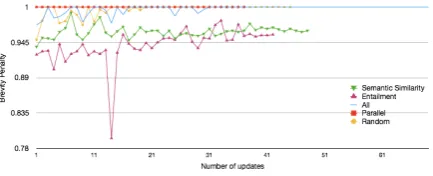
Figure 2: Brevity penalties on the validation set for English-French models (single run).
We observe that both the ENTAILMENTand SE -MANTIC SIMILARITY based models have simi-lar brevity penalties despite having performances that are at opposite ends of the spectrum in terms of BLEU. This implies that translations gener-ated by the SEMANTIC SIMILARITY model have better n-gram overlap with the reference, but are much shorter. Manual examination of the transla-tions suggests that the ENTAILMENTmodel often fails by under-translating sentences, either drop-ping segments from the beginning or the end of source sentences (Table5).
The PARALLEL model consistently produces translations that are longer than the reference. 7 This is partially due to the model’s propensity to generate a sequence of garbage tokens in the be-ginning of a sentence, especially while translating shorter sentences. In our test set, almost 12% of the translated sentences were found to begin with the garbage text shown in Table 5. Only a small fraction (<0.02%) of the French sentences in our training data begin with these tokens, but the ten-dency of PARALLEL to promote divergent exam-ples above non-divergent ones, seems to exagger-ate the generation of this sequence.
7The brevity penalty does not penalize translations that are longer than the reference.
ENTAILMENTis inadequate due to under-translation
Source he’s a very impressive manand still goes out to do digs.
Reference c’est un homme tr`es impressionnant et il fait encore des fouilles.
ENTAILMENT c’est un homme tr`es impressionnant.
Source when the Heatfirstwon.
Reference lorsque les Heat ont gagn´e pour la premi`ere fois.
ENTAILMENT quand le Heat a gagn´e.
PARALLELproduces garbage tokens
Source alright. Reference d’accord.
[image:9.595.307.531.79.231.2]ENTAILMENT { \pos (192,210)}d’accord.
Table 5: Selected translation examples from the ensem-ble systems of the various models.
7 Conclusion
We conducted an extensive empirical study of semantic divergences in parallel corpora. Our crowdsourced annotations confirms that correctly aligned sentences are not necessarily meaning equivalent. We introduced an approach based on neural semantic similarity that detects such di-vergences much more accurately than shallower translation or alignment based models. Impor-tantly, our model does not require manual an-notation, and can be trained for any language pair and domain with a parallel corpus. Finally, we show that filtering out divergent examples helps speed up the convergence of neural ma-chine translation training without loss in transla-tion quality, for two language pairs and data condi-tions. New datasets and models introduced in this work are available at http://github.com/
yogarshi/SemDiverge.
These findings open several avenues for future work: How can we improve divergence detec-tion further? Can we characterize the nature of the divergences beyond binary predictions? How do divergent examples impact other applications, including cross-lingual NLP applications and se-mantic models induced from parallel corpora, as well as tools for human translators and second lan-guage learners?
Acknowledgments
[image:9.595.74.291.261.349.2]References
Sadaf AbduI-Rauf and Holger Schwenk. 2009. On the Use of Comparable Corpora to Improve SMT Per-formance. InProceedings of the 12th Conference of the European Chapter of the Association for Compu-tational Linguistics. Association for Computational Linguistics, Athens, Greece, EACL ’09, pages 16– 23.
Eneko Agirre, Carmen Banea, Claire Cardie, Daniel Cer, Mona Diab, Aitor Gonzalez-Agirre, Weiwei Guo, Rada Mihalcea, German Rigau, and Janyce Wiebe. 2014. Semeval-2014 task 10: Multilingual semantic textual similarity. In Proceedings of the 8th International Workshop on Semantic Evalua-tion (SemEval 2014). Association for Computational Linguistics Dublin, Ireland, pages 81–91.
Eneko Agirre, Carmen Banea, Daniel Cer, Mona Diab, Aitor Gonzalez-Agirre, Rada Mihalcea, Ger-man Rigau, and Janyce Wiebe. 2016. SemEval-2016 Task 1: Semantic Textual Similarity, Mono-lingual and Cross-Lingual Evaluation. In Proceed-ings of the 10th International Workshop on Semantic Evaluation (SemEval-2016). Association for Com-putational Linguistics, San Diego, California, pages 497–511.
Parnia Bahar, Tamer Alkhouli, Jan-Thorsten Peter, Christopher Jan-Steffen Brix, and Hermann Ney. 2017. Empirical investigation of optimization algo-rithms in neural machine translation. The Prague Bulletin of Mathematical Linguistics108(1):13–25.
Dzmitry Bahdanau, Kyunghyun Cho, and Yoshua Ben-gio. 2015. Neural Machine Translation by Jointly Learning to Align and Translate. In International Conference on Learning Representations (ICLR). Yonatan Belinkov and Yonatan Bisk. 2018. Synthetic
and natural noise both break neural machine transla-tion. InProceedings of the 6th International Con-ference on Learning Representations. Vancouver, Canada.
Marine Carpuat, Yogarshi Vyas, and Xing Niu. 2017. Detecting cross-lingual semantic divergence for neural machine translation. InProceedings of the First Workshop on Neural Machine Translation. Association for Computational Linguistics, pages 69–79. http://aclweb.org/anthology/ W17-3209.
Mauro Cettolo, Christian Girardi, and Marcello Fed-erico. 2012. Wit3: Web inventory of transcribed and translated talks. In Proceedings of the 16th Con-ference of the European Association for Machine Translation (EAMT). volume 261, page 268. Boxing Chen, Roland Kuhn, George Foster, Colin
Cherry, and Fei Huang. 2016. Bilingual Methods for Adaptive Training Data Selection for Machine Translation. Proceedings of the 12th Conference of the Association for Machine Translation in the Americas (AMTA)page 93.
Kyunghyun Cho, Bart van Merrienboer, Caglar Gul-cehre, Dzmitry Bahdanau, Fethi Bougares, Hol-ger Schwenk, and Yoshua Bengio. 2014. Learn-ing Phrase Representations usLearn-ing RNN Encoder-Decoder for Statistical Machine Translation. In
Proceedings of EMNLP 2014. ArXiv: 1406.1078. http://arxiv.org/abs/1406.1078.
Michael Denkowski and Graham Neubig. 2017. Stronger baselines for trustable results in neu-ral machine translation. In Proceedings of the First Workshop on Neural Machine Translation. Association for Computational Linguistics, pages 18–27. http://aclweb.org/anthology/ W17-3203.
Bonnie J. Dorr. 1994. Machine Translation Diver-gences: A Formal Description and Proposed Solu-tion. Computional Linguistics20(4):597–633.
Cristina Espa˜na-Bonet, ´Ad´am Csaba Varga, Alberto Barr´on-Cede˜no, and Josef van Genabith. 2017. An Empirical Analysis of NMT-Derived Interlingual Embeddings and their Use in Parallel Sentence Iden-tification. arXiv:1704.05415 [cs].
M. Amin Farajian, Rajen Chatterjee, Costanza Con-forti, Shahab Jalalvand, Vevake Balaraman, tia A. Di Gangi, Duygu Ataman, Marco Turchi, Mat-teo Negri, and Marcello Federico. 2016. FBK’s Neural Machine Translation Systems for IWSLT 2016. In Proceedings of the Ninth Interna-tional Workshop on Spoken Language Translation (IWSLT), Seattle, WA.
Christian Federmann and William D. Lewis. 2016. Mi-crosoft speech language translation (MSLT) corpus: The IWSLT 2016 release for English, French and German. InInternational Workshop on Spoken Lan-guage Translation (IWSLT). Seattle, USA.
Pascale Fung and Percy Cheung. 2004. Multi-level Bootstrapping for Extracting Parallel Sentences from a Quasi-comparable Corpus. InProceedings of the 20th International Conference on Computational Linguistics. Association for Computational Linguis-tics, Geneva, Switzerland, COLING ’04. https: //doi.org/10.3115/1220355.1220506.
Cyril Goutte, Marine Carpuat, and George Foster. 2012. The Impact of Sentence Alignment Errors on Phrase-Based Machine Translation Performance. InProceedings of AMTA-2012: The Tenth Biennial Conference of the Association for Machine Transla-tion in the Americas.
Nizar Habash and Bonnie Dorr. 2002. Handling trans-lation divergences: Combining statistical and sym-bolic techniques in generation-heavy machine trans-lation. InConference of the Association for Machine Translation in the Americas. Springer, pages 84–93.
William Lewis, Mu Li, Shujie Liu, Tie-Yan Liu, Renqian Luo, Arul Menezes, Tao Qin, Frank Seide, Xu Tan, Fei Tian, Lijun Wu, Shuangzhi Wu, Yingce Xia, Dongdong Zhang, Zhirui Zhang, and Ming Zhou. 2018. Achieving Human Parity on Automatic Chinese to English News Translation.
arXiv:1803.05567 [cs] https://arxiv.org/ pdf/1803.05567.pdf.
Hua He, Kevin Gimpel, and Jimmy Lin. 2015. Multi-Perspective Sentence Similarity Modeling with Con-volutional Neural Networks. InProceedings of the 2015 Conference on Empirical Methods in Natu-ral Language Processing. Association for Compu-tational Linguistics, Lisbon, Portugal, pages 1576– 1586.
Hua He and Jimmy Lin. 2016. Pairwise word inter-action modeling with deep neural networks for se-mantic similarity measurement. InProceedings of NAACL-HLT. pages 937–948.
Felix Hieber, Tobias Domhan, Michael Denkowski, David Vilar, Artem Sokolov, Ann Clifton, and Matt Post. 2017. Sockeye: A Toolkit for Neural Machine Translation. ArXiv e-prints https://arxiv. org/abs/1712.05690.
Graeme Hirst. 1995. Near-synonymy and the structure of lexical knowledge. InAAAI Symposium on Rep-resentation and Acquisition of Lexical Knowledge: Polysemy, Ambiguity, and Generativity. pages 51– 56.
Sergio Jimenez, Claudia Becerra, and Alexander Gel-bukh. 2012. Soft Cardinality + ML: Learning Adap-tive Similarity Functions for Cross-lingual Textual Entailment. In Proceedings of the Sixth Interna-tional Workshop on Semantic Evaluation (SemEval). Association for Computational Linguistics, Mon-treal, Canada, SemEval ’12, pages 684–688.
Diederik P. Kingma and Jimmy Ba. 2014. Adam: A Method for Stochastic Optimization. ArXiv: 1412.6980. http://arxiv.org/abs/1412. 6980.
Philipp Koehn. 2004. Statistical significance tests for machine translation evaluation. InProceedings of EMNLP 2004. http://www.aclweb.org/ anthology/W04-3250.
Philipp Koehn. 2005. Europarl: A Parallel Corpus for Statistical Machine Translation. InMachine Trans-lation Summit X. Phuket, Thailand.
Moshe Koppel and Noam Ordan. 2011. Transla-tionese and its dialects. In Proceedings of the 49th Annual Meeting of the Association for Com-putational Linguistics: Human Language Tech-nologies - Volume 1. Association for Computa-tional Linguistics, Stroudsburg, PA, USA, HLT ’11, pages 1318–1326. http://dl.acm.org/ citation.cfm?id=2002472.2002636.
Solomon Kullback. 1959. Information theory and statistics. Courier Corporation.
Ekaterina Lapshinova-Koltunski. 2015. Exploration of inter-and intralingual variation of discourse phe-nomena. InProceedings of the Second Workshop on Discourse in Machine Translation. pages 158–167.
Junyi Jessy Li, Marine Carpuat, and Ani Nenkova. 2014. Assessing the Discourse Factors that Influ-ence the Quality of Machine Translation. In Pro-ceedings of the 52nd Annual Meeting of the Associa-tion for ComputaAssocia-tional Linguistics (Volume 2: Short Papers). Association for Computational Linguistics, Baltimore, Maryland, pages 283–288.
Percy Liang, Ben Taskar, and Dan Klein. 2006. Align-ment by AgreeAlign-ment. In Proceedings of the Main Conference on Human Language Technology Con-ference of the North American Chapter of the As-sociation of Computational Linguistics. Association for Computational Linguistics, Stroudsburg, PA, USA, HLT-NAACL ’06, pages 104–111. https: //doi.org/10.3115/1220835.1220849.
Pierre Lison and J¨org Tiedemann. 2016. Opensub-titles2016: Extracting large parallel corpora from movie and tv subtitles. InProceedings of the 10th International Conference on Language Resources and Evaluation.
Chi-kiu Lo, Cyril Goutte, and Michel Simard. 2016. CNRC at SemEval-2016 Task 1: Experiments in Crosslingual Semantic Textual Similarity. In Pro-ceedings of the 10th International Workshop on Se-mantic Evaluation (SemEval-2016). Association for Computational Linguistics, San Diego, California, pages 668–673.
Thang Luong, Hieu Pham, and Christopher D. Man-ning. 2015. Bilingual word representations with monolingual quality in mind. InProceedings of the 1st Workshop on Vector Space Modeling for Natural Language Processing. pages 151–159.
Austin Matthews, Waleed Ammar, Archna Bhatia, We-ston Feely, Greg Hanneman, Eva Schlinger, Swabha Swayamdipta, Yulia Tsvetkov, Alon Lavie, and Chris Dyer. 2014. The CMU Machine Translation Systems at WMT 2014. InProceedings of the Ninth Workshop on Statistical Machine Translation. As-sociation for Computational Linguistics, Baltimore, Maryland, USA, pages 142–149.
Jeff Mitchell and Mirella Lapata. 2010. Composition in distributional models of semantics.Cognitive sci-ence34(8):1388–1429.
Dragos Stefan Munteanu and Daniel Marcu. 2005. Im-proving machine translation performance by exploit-ing non-parallel corpora. Computational Linguistics
31(4):477–504.
Non-parallel Corpora. InProceedings of the 21st In-ternational Conference on Computational Linguis-tics and the 44th Annual Meeting of the Associ-ation for ComputAssoci-ational Linguistics. Association for Computational Linguistics, Sydney, Australia, ACL-44, pages 81–88. https://doi.org/10. 3115/1220175.1220186.
Vinod Nair and Geoffrey E. Hinton. 2010. Rectified Linear Units Improve Restricted Boltzmann Ma-chines. In Proceedings of the 27th International Conference on International Conference on Ma-chine Learning. Omnipress, USA, ICML’10, pages 807–814.
Matteo Negri, Alessandro Marchetti, Yashar Mehdad, Luisa Bentivogli, and Danilo Giampiccolo. 2012. Semeval-2012 Task 8: Cross-lingual Textual Entail-ment for Content Synchronization. InProceedings of the First Joint Conference on Lexical and Com-putational Semantics - Volume 1: Proceedings of the Main Conference and the Shared Task, and Volume 2: Proceedings of the Sixth International Workshop on Semantic Evaluation. Association for Computa-tional Linguistics, Montr\?al, Canada, SemEval ’12, pages 399–407.
Matteo Negri, Alessandro Marchetti, Yashar Mehdad, Luisa Bentivogli, and Danilo Giampiccolo. 2013. Semeval-2013 Task 8: Cross-lingual Textual Entail-ment for Content Synchronization. InSecond Joint Conference on Lexical and Computational Seman-tics (*SEM), Volume 2: Proceedings of the Sev-enth International Workshop on Semantic Evalua-tion (SemEval 2013). Association for Computational Linguistics, Atlanta, Georgia, USA, pages 25–33.
Matteo Negri and Yashar Mehdad. 2010. Creating a Bilingual Entailment Corpus Through Translations with Mechanical Turk: $100 for a 10-day Rush. In
Proceedings of the NAACL HLT 2010 Workshop on Creating Speech and Language Data with Amazon’s Mechanical Turk. Association for Computational Linguistics, Los Angeles, California, CSLDAMT ’10, pages 212–216.
Jason Riesa and Daniel Marcu. 2012. Automatic Par-allel Fragment Extraction from Noisy Data. In Pro-ceedings of the 2012 Conference of the North Amer-ican Chapter of the Association for Computational Linguistics: Human Language Technologies. As-sociation for Computational Linguistics, Montr´eal, Canada, pages 538–542.
Mike Schuster and Kuldip K Paliwal. 1997. Bidirec-tional recurrent neural networks. IEEE Transactions on Signal Processing45(11):2673–2681.
Holger Schwenk and Matthijs Douze. 2017. Learn-ing joint multilLearn-ingual sentence representations with neural machine translation. In Proceedings of the 2nd Workshop on Representation Learning for NLP. Association for Computational Linguis-tics, pages 157–167. http://aclweb.org/ anthology/W17-2619.
Rico Sennrich, Barry Haddow, and Alexandra Birch. 2016. Neural Machine Translation of Rare Words with Subword Units. Proceedings of the Meet-ing of the Association for Computational LMeet-inguistics (ACL).
Jason R. Smith, Chris Quirk, and Kristina Toutanova. 2010. Extracting Parallel Sentences from Compara-ble Corpora Using Document Level Alignment. In
Human Language Technologies: The 2010 Annual Conference of the North American Chapter of the Association for Computational Linguistics. Associ-ation for ComputAssoci-ational Linguistics, Los Angeles, California, HLT ’10, pages 403–411.
Jason R. Smith, Herve Saint-Amand, Magdalena Pla-mada, Philipp Koehn, Chris Callison-Burch, and Adam Lopez. 2013. Dirt Cheap Web-Scale Paral-lel Text from the Common Crawl. InProceedings of 51st Meeting of the Association for Computational Linguistics. pages 1374–1383.
Lucia Specia, Varvara Logacheva, and Carolina Scar-ton. 2016. WMT16 Quality Estimation Shared Task Training and Development Data. LIN-DAT/CLARIN digital library at Institute of For-mal and Applied Linguistics, Charles University in Prague.
Lucia Specia, Dhwaj Raj, and Marco Turchi. 2010. Machine translation evaluation ver-sus quality estimation. Machine Translation
24(1):39–50. https://doi.org/10.1007/ s10590-010-9077-2.
Kai Sheng Tai, Richard Socher, and Christopher D. Manning. 2015. Improved semantic representations from tree-structured long short-term memory net-works. InProceedings of ACL 2015. Beijing, China.
J¨org Tiedemann. 2007. Improved sentence alignment for movie subtitles. InRecent Advances in Natural Language Processing (RANLP). volume 7.
J¨org Tiedemann. 2011.Bitext Alignment, volume 4.
Marco Turchi and Matteo Negri. 2013. ALTN: Word Alignment Features for Cross-lingual Textual En-tailment. InSecond Joint Conference on Lexical and Computational Semantics (*SEM), Volume 2: Sev-enth International Workshop on Semantic Evalua-tion (SemEval 2013).