Proceedings of NAACL-HLT 2018, pages 35–41
Multi-Task Learning for Argumentation Mining in Low-Resource Settings
Claudia Schulz, Steffen Eger, Johannes Daxenberger, Tobias Kahse, Iryna Gurevych Ubiquitous Knowledge Processing Lab (UKP-TUDA)
Department of Computer Science Technische Universit¨at Darmstadt
www.ukp.tu-darmstadt.de
Abstract
We investigate whether and where multi-task learning (MTL) can improve perfor-mance on NLP problems related to argu-mentation mining (AM), in particular ar-gument component identification. Our re-sults show that MTL performs particularly well (and better than single-task learning) when little training data is available for the main task, a common scenario in AM. Our findings challenge previous assump-tions that conceptualizaassump-tions across AM datasets are divergent and that MTL is dif-ficult for semantic or higher-level tasks.
1 Introduction
Computational argumentation mining (AM) deals with the automatic identification of argumentative structures within natural language. This can be beneficial in many applications such as summariz-ing arguments in texts to improve comprehensibil-ity for end-users, or information retrieval and ex-traction (Persing and Ng,2016). A common task is to segment a text into argumentative and non-argumentative components and identify the type of argumentative components. As an illustration, consider the (simplified) example fromEger et al. (2017): “Since [it killed many marine lives]Premise
[tourism has threatened nature]Claim.” Here, the
non-argumentative token “Since” is followed by two argumentative components: a premise that supports a claim.
Argumentation is highly subjective and concep-tualized in different ways (Peldszus and Stede, 2013;Al-Khatib et al.,2017). On the one hand, this implies that creating reliable ground-truth datasets for AM is costly, as it requires trained an-notators. However, even trained annotators have problems identifying and classifying arguments
reliably in texts (Habernal and Gurevych, 2017). To tackle AM in a new domain or develop new AM tasks, it may thus not be possible to create large datasets as required by most state-of-the-art machine learning approaches. On the other hand, the different conceptualizations of argumentation resulted in AM corpora with different argument component types, with very little conceptual over-lap between some of these corpora (Daxenberger et al.,2017). This distinguishes AM from more es-tablished NLP tasks like discourse parsing (Braud et al.,2016) and makes it particularly challenging. Therefore, a natural question is how to handle new AM datasets in a new domain and with sparse data. Here, we investigate how existing AM datasets from different domains and with different con-ceptualizations of arguments can be leveraged to tackle these challenges. More precisely, we study whether conceptually diverse AM datasets from different domains can help deal with new AM datasets when data is limited. A promis-ing direction to incorporate existpromis-ing datasets as “auxiliary knowledge” is by means of multi-task learning (MTL), a paradigm that dates back to the 1990s (Caruana, 1993, 1996), but has only recently gained large attention (Collobert et al., 2011; Søgaard and Goldberg, 2016; Hashimoto et al., 2017). The idea behind MTL is to learn several tasks jointly, similarly to human learning, so that tasks serve as mutual sources of “induc-tive bias” for one another. MTL has been reported particularly beneficial when tasks exhibit “natu-ral hierarchies” (Søgaard and Goldberg,2016) or when the amount of training data for the main task is sparse (Benton et al.,2017;Augenstein and Søgaard,2017), where the auxiliary tasks may act as regularizers to prevent overfitting (Ruder et al., 2017). The latter is precisely the scenario most relevant to us.
In this paper, we (1) investigate to which
gree training a system to solve several conceptu-ally different AM tasks jointly improves perfor-mance over learning in isolation, (2) compare per-formance gains across different dataset sizes, and (3) do so across various domains. Our findings show that MTL is helpful for AM—particularly in data sparsity settings—when treating other AM tasks as auxiliary.1
2 Related Work
AMis a relatively new field in NLP. Hence, a lot of related work revolves around creating new cor-pora. We use six such corpora, described in more detail in Section3. On the modeling side,Stab and Gurevych(2017) andPersing and Ng(2016) rely on pipeline approaches for AM, combining parts of the pipeline using integer linear programming (ILP).Eger et al.(2017) propose neural end-to-end models for AM. WhileDaxenberger et al.(2017) show that there is little consensus on the conceptu-alization of a claim across AM corpora,Al-Khatib et al. (2016) use distant supervision to overcome domain gaps for identifying (non-)argumentative text.
MTL has been applied in many different set-tings. Bollmann and Søgaard (2016) and Peng and Dredze (2017) use data from different do-mains as different tasks and thereby improve his-torical spelling normalization and Chinese word segmentation and NER, respectively. Plank et al. (2016) apply an MTL setup to POS tagging across 22 different languages, where the auxiliary task is to predict token frequency. Eger et al. (2017) explore sub-tasks (such as component identifica-tion) of a complex AM tagging problem (including relations between components) as auxiliaries and find that this improves performances. However, they stay within one single domain and dataset, and thus their approach does not address the ques-tion how new AM datasets with sparse data can profit from existing AM resources. Conceptually closest to our work, Braud et al.(2017) leverage data from different languages as well as differ-ent domains in order to improve discourse pars-ing. While MTL was shown effective for syn-tactic tasks under certain conditions (Søgaard and Goldberg, 2016), Alonso and Plank (2017) find that MTL does not improve performances in four
1The code and data used for our experiments are
available from https://github.com/UKPLab/ naacl18-multitask_argument_mining.
out of five semantic (i.e., higher level) tasks that they study. We are among the first to perform a structured investigation of MTL for higher-level pragmatic tasks, which are thought to be much more challenging than syntactic tasks (Alonso and Plank,2017), and in particular, explore it for AM in cross-domain settings.
3 Experiments
Data We experiment with six datasets for argu-ment component identification, i.e. the token-level segmentation and typing of components. These datasets are all of different sizes, have different average text lengths, and different argument com-ponent types and label distributions, as summa-rized in Table 1. We only choose datasets con-taining both argumentative components and non-argumentative text. Claims are available in five of six datasets, and all datasets have premises (resp. “justification”), although it is unclear how large the conceptual overlap is across datasets. Further component types are idiosyncractic. hotel has the largest number of types, namely, six. Most datasets also come with further information, e.g. relations between argument components, which are not considered here.
Approach Due to the difference in annotations used in the different datasets, we consider each dataset as a separate AM task. We treat all of them as sequence tagging problems, where pre-dicting BIO tags (argument segmentation) and ar-gument component types (component classifica-tion) is framed as a joint task. This is achieved through token-level BIO tagging with the label set
{O} ∪ {B, I} × T, where T is a dataset
spe-cific set of argument component types, e.g. T =
Dataset Domain #Docs Tokens Component Types
Reed et al.(2008) various (Araucaria) 507 120 C (16), P (46), O (38)
Biran and Rambow(2011) wikipedia discussions 118 1592 C (9), justification (23), O (68)
Liu et al.(2017),Gao et al.
(2017) hotelreviews 194 185 C (39), P (22), major C (7), implicit P (8),background (7), recommendation (5), O (12)
Habernal and Gurevych
(2017) webdiscourse 340 250 C (4), P (25), backing (13), rebuttal (3), refu-tation (1), O (54)
Habernal et al.(2017) newscomments 1927 108 P (53), O (47)
Stab and Gurevych(2017) persuasiveessays 402 366 C (15), P (45), major C (8), O (32)
Table 1: AM datasets: C – claim, P – premise, O – non-argumentative; numbers in parentheses are label distributions in %; ‘tokens’ is the average in each document.
(auxiliary) tasks are trained on the same number of (randomly drawn) mini-batches.
To simulate data sparsity, we experiment with different sizes of training data for the main task. We first draw a “sparse” training set of 21K to-kens2 for each of the six AM datasets and a dev
set of 9K to simulate a sparse scenario with 30K given tokens. The remaining data of each specific dataset is used as its test set (at least 5K tokens). We then randomly draw a subset of the training data to create three more ‘sparsity scenarios’ with 12K, 6K, and 1K tokens, respectively. Both dev and test set remain the same as in the 21K sce-nario. It is worth emphasizing how little data is used in the 1K scenario—only 1-10 documents (or roughly 50 sentences). We train a separate STL system for each of the six datasets and each of the four sparsity scenarios. In the MTL setup, the respective sparsity data is used as the main task, all other (auxiliary) AM datasets, each considered a separate task, are trained on all their available data. To measure the effect of MTL as opposed to a mere increase of training data, we further-more train for each main task (i.e. each dataset and sparsity scenario) an STL system on the union of (training data of) main and auxiliary task, and evaluate it on the main task’s test data.
Hyperparameter optimization For each spar-sity scenario and dataset we train 50 STL/MTL systems using GloVe embeddings (Pennington et al., 2014) and 50 using the embeddings by Komninos and Manandhar (2016). For each run we randomly choose a layout with either one hid-den layer ofh ∈ {50,100,150}units or two lay-ers of 100 units as well as variational dropout rates between 0.2 and 0.5 for the input layer and for the hidden units.
2Or more, since whole documents are added to the
train-ing set until the sum of tokens is at least 21K. Similarly for smaller training and dev sets.
4 Results
Note that we experiment with artificially shrunk datasets, which makes our results incomparable with those reported for the full datasets in other works. Nevertheless, it is to be expected that our STL model is on par with results obtained in re-cent works also using neural models for argument component identification, since our state-of-the-art BILSTM has the same architecture as the one byEger et al.(2017).
Overall trends Table 2 reports the average macro-F13test scores over the respective ten best
(according to the macro-F1 dev scores) hyperpa-rameter configurations. We compare STL on each task, MTL with all remaining datasets as auxil-iary tasks, and the union baseline. For three of the six datasets, MTL yields a significant improve-ment in all sparsity scenarios. Interestingly, these are the datasets with only one or two types of ar-gument components. For the other three datasets, MTL only yields an improvement in the sparser data scenarios. The union baseline generally per-forms (considerably) worse than STL in all sce-narios. This implies that the domains and compo-nent types (label spaces) used in the different AM datasets are too diverse to model them as one sin-gle task and that the improvement of MTL over STL cannot be attributed to more available data.
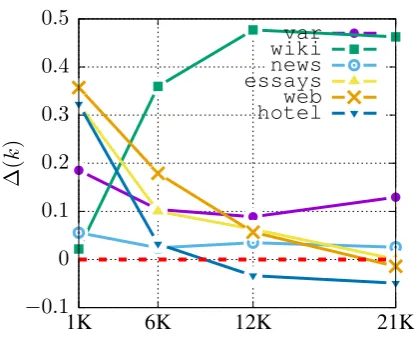
Figure 1 shows the general trends of our re-sults. For each dataset, the figure plots the dif-ference between normalized MTL and normalized STL macro-F1 scores (MTLnorm(k)−STLnorm(k))
fork=1K, 6K, 12K, 21K training data points for the main task. For each specific dataset, the nor-malized macro-F1 score is defined asσnorm(k) =
σ(k)
STL(1K), whereσ(k)is the original macro-F1 score
and STL(1K) denotes the STL score for 1K
Dataset 21K 12K 6K 1K var– STL 43.34 42.85 38.89 31.30 var– MTL 47.39 45.63 42.14 37.10
var– BL 30.45 27.35 26.75 26.62 wiki– STL 23.37 22.57 20.93 19.74 wiki– MTL 32.50 31.99 28.03 20.17*
wiki–BL 18.34 18.12 17.49 20.47 news– STL 56.49 54.61 54.21 49.67 news– MTL 57.76 56.34 55.41* 52.43
news– BL 32.63 40.63 36.54 35.51 essays– STL 60.54 56.35 49.68 24.60 essays– MTL 60.55 57.90* 52.14 32.55
essays– BL 48.38 31.58 21.13 12.39 web– STL 23.43 22.33 19.71 11.28 web– MTL 23.27 22.97 21.73 15.31
web– BL 15.21 14.94 12.09 10.80 hotel– STL 47.91 47.78 45.64 29.82 hotel– MTL 46.44 46.78 46.60 39.45
[image:4.595.307.516.63.233.2]hotel– BL 45.69 43.61 42.56 20.39 Table 2: Macro-F1 for AM component identifi-cation, comparing MTL, STL (significant differ-ences in bold withp < 0.01,p < 0.05if* using Mann-Whitney U Test) and union baseline (BL).
ing data. Using this normalization, all scores are directly comparable and have the interpretation of improvement over the STL scenario with 1K to-kens. It is noteworthy that MTL always improves over STL when the main task is very sparse (1K) and gains are sometimes substantial (between 30 and 40% forweb,essays, andhotel).
We observe three different patterns with re-spect to the main task: (i) for essays, web, andhotel, MTL is considerably better than STL when the main task is sparse, but for 21K tokens we observe either minimal gains or losses from MTL compared to STL. (ii) The var andnews datasets are stable, with consistent small gains from MTL over STL for all sizes of the main task. Finally, (iii)wiki displays an unusual pattern in that MTL gains are increasing with the amount of training data. We attribute this to the large label imbalance inwiki, where nearly 70% of the data is ‘O’. When training data is very sparse, STL pre-dicts 99% of all tokens as ‘O’, which results in a high F1 score for this component type but very low F1 scores (below 1%) for the two other component types. The macro-F1 is thus lower than that of MTL, where ‘claim’ and ‘premise’ have a higher F1 score. Even though STL improves on the iden-tification of ‘premise’ and ‘claim’ in the 21k sce-nario, the trend remains, since MTL also improves
−0.1 0 0.1 0.2 0.3 0.4 0.5
1K 6K 12K 21K
∆(
k
)
var wiki news essays web hotel
Figure 1: MTL versus STL: curves ∆(k) = MTLnorm(k)−STLnorm(k) as a function of size kof main task.
on these labels.
Detailed analysis Upon closer inspection, we find that across all datasets MTL generally im-proves performance for class labels with low fre-quency as compared to STL. The more training data becomes available, the better STL gets in predicting such class labels, thus closing the gap to MTL. However, for wiki even 21K does not seem sufficient for STL to learn the two infrequent class labels, predicting 87% as ‘O’, so MTL still yields more than 10pp higher F1 for these infre-quent classes.
Further analysis of our results reveals that the increase in the overall F1 score for MTL over STL is both due to improved component segmentation (BIO labeling) and better type prediction. For ex-ample, in the 21K and 6K data settings, the BIO la-beling improves by 1-4pp macro-F1 for nearly all datasets and even by up to 17% forwiki. Unsur-prisingly, in most cases, MTL also reduces invalid BIO sequences (‘O’ followed by ‘I’). Regarding the F1 scores of argument component types, we observe an improvement of MTL over STL for claims or major claims in all datasets containing these types and for premises in all but one dataset. It is further interesting that for thehoteldataset, MTL confuses premises mainly with the semanti-cally similar implicit premises, whereas STL con-fuses premises with claims. Moreover, in both hotelandessays, claims are rarely predicted to be major claims, but major claims are predicted to be claims (both STL and MTL).
[image:4.595.70.285.63.295.2]differ-ent domains and label spaces of the six datasets, MTL appears to learn generalized cross-domain representations of argument components, which aid argument component identification in sparse data scenarios and across domains.
5 Concluding Remarks
We showed that MTL improves performance over STL on AM tasks (particularly) when training data is sparse. More precisely, argument com-ponent identification on a small AM dataset im-proves when treating other AM datasets as auxil-iary tasks, even if these include different compo-nent types, coming from diverse domains. Over-all, our results challenge the view that MTL is only infrequently effective for semantic or higher-level tasks (Alonso and Plank, 2017). We at-tribute the success of MTL over STL to a few fac-tors in our setting: (1) Alonso and Plank (2017) used syntactic auxiliary tasks for semantic main tasks, whereas we choose only higher-level aux-iliary tasks for higher-level main tasks. (2) The label spaces of all our tasks are relatively small, so that generalized representations can be learned in the LSTMs’ hidden layers without suffering from labelsparsity. (3) The AM tasks considered here apparently do share common ground, a finding worth mentioning in itself given the contrary ev-idence in related work (Daxenberger et al.,2017). Our findings cannot be readily anticipated by previous research, which has reached mixed con-clusions regarding the effectiveness of MTL over-all and particular aspects, such as the size of main task. For example, whileLuong et al.(2016) sug-gest that success of MTL requires that the auxil-iary task does not swamp the main task data, Ben-ton et al.(2017) andYang et al.(2017) come to the opposite conclusion that MTL is particularly ef-fective when the data of the main task is small, and Bingel and Søgaard(2017) find a low correlation between size of the main task and MTL success. Our curves in Figure 1appear toprefer the view that MTL is effective when the main task training data is sparse.
The scope for future work is vast. For exam-ple, it would be interesting to investigate whether standard low-level tasks, such as POS tagging or chunking, are effective for AM. Furthermore, other architectures for multi-task learning that ap-ply soft parameter sharing, such as sluice networks (Ruder et al.,2017), will be investigated.
Acknowledgments
Calculations for this research were conducted on the Lichtenberg high performance cluster of Tech-nische Universit¨at Darmstadt. This work has been supported by the German Federal Ministry of Education and Research (BMBF) under the pro-motional references 16DHL1040 (FAMULUS), 01UG1816B (CEDIFOR), and 03VP02540 (Argu-menText).
References
Khalid Al-Khatib, Henning Wachsmuth, Matthias Ha-gen, Jonas K¨ohler, and Benno Stein. 2016. Cross-Domain Mining of Argumentative Text through Dis-tant Supervision. InProceedings of the 15th Confer-ence of the North American Chapter of the Associ-ation for ComputAssoci-ational Linguistics: Human Lan-guage Technologies. pages 1395–1404.
Khalid Al-Khatib, Henning Wachsmuth, Matthias Ha-gen, and Benno Stein. 2017. Patterns of Argumenta-tion Strategies across Topics. InProceedings of the 2017 Conference on Empirical Methods in Natural Language Processing. pages 1362–1368.
H´ector Mart´ınez Alonso and Barbara Plank. 2017. When is multitask learning effective? Semantic se-quence prediction under varying data conditions. In
Proceedings of the 15th Conference of the European Chapter of the Association for Computational Lin-guistics. volume 1, pages 44–53.
Isabelle Augenstein and Anders Søgaard. 2017. Multi-Task Learning of Keyphrase Boundary
Classifica-tion. InProceedings of the 55th Annual Meeting of
the Association for Computational Linguistics. vol-ume 2, pages 341–346.
Adrian Benton, Margaret Mitchell, and Dirk Hovy. 2017. Multi-Task Learning for Mental Health
us-ing Social Media Text. InProceedings of the 15th
Conference of the European Chapter of the Associa-tion for ComputaAssocia-tional Linguistics. volume 1, pages 152–162.
Joachim Bingel and Anders Søgaard. 2017. Identify-ing beneficial task relations for multi-task learnIdentify-ing in deep neural networks. InProceedings of the 15th Conference of the European Chapter of the Associa-tion for ComputaAssocia-tional Linguistics. volume 2, pages 164–169.
Or Biran and Owen Rambow. 2011. Identifying Justi-fications in Written Dialogs by Classifying Text as
Argumentative. International Journal of Semantic
Computing5(4):363–381.
Marcel Bollmann and Anders Søgaard. 2016. Im-proving historical spelling normalization with
bi-directional LSTMs and multi-task learning. In
Chlo´e Braud, Oph´elie Lacroix, and Anders Søgaard. 2017. Cross-lingual and cross-domain discourse
segmentation of entire documents. InProceedings
of the 55th Annual Meeting of the Association for Computational Linguistics. volume 2, pages 237– 243.
Chlo´e Braud, Barbara Plank, and Anders Søgaard. 2016. Multi-view and multi-task training of RST discourse parsers. InProceedings of the 26th Inter-national Conference on Computational Linguistics. pages 1903–1913.
Rich Caruana. 1993. Multitask Learning: A
Knowledge-Based Source of Inductive Bias. In
Pro-ceedings of the 10th International Conference on Machine Learning. volume 2, pages 41–48.
Rich Caruana. 1996. Algorithms and Applications for
Multitask Learning. InProceedings of the 13th
In-ternational Conference on Machine Learning. pages 87–95.
Ronan Collobert, Jason Weston, L´eon Bottou, Michael Karlen, Koray Kavukcuoglu, and Pavel Kuksa. 2011. Natural Language Processing (Almost) from
Scratch. Journal of Machine Learning Research
12:2493–2537.
Johannes Daxenberger, Steffen Eger, Ivan Habernal, Christian Stab, and Iryna Gurevych. 2017. What is the Essence of a Claim? Cross-Domain Claim Iden-tification. InProceedings of the 2017 Conference on Empirical Methods in Natural Language Process-ing. pages 2045–2056.
Steffen Eger, Johannes Daxenberger, and Iryna Gurevych. 2017. Neural End-to-End Learning for
Computational Argumentation Mining. In
Proceed-ings of the 55th Annual Meeting of the Association for Computational Linguistics. volume 1, pages 11– 22.
Yang Gao, Hao Wang, Chen Zhang, and Wei
Wang. 2017. Reinforcement Learning Based
Argument Component Detection. arxiv
http://arxiv.org/abs/1702.06239.
Ivan Habernal and Iryna Gurevych. 2017.
Argumenta-tion mining in user-generated web discourse.
Com-putational Linguistics43(1):125–179.
Ivan Habernal, Henning Wachsmuth, Iryna Gurevych,
and Benno Stein. 2017. The Argument
Rea-soning Comprehension Task. Technical report.
http://arxiv.org/abs/1708.01425.
Kazuma Hashimoto, Caiming Xiong, Yoshimasa Tsu-ruoka, and Richard Socher. 2017. A Joint Many-Task Model: Growing a Neural Network for
Mul-tiple NLP Tasks. InProceedings of the 30th
Con-ference on Neural Information Processing Systems. pages 1–17.
Alexandros Komninos and Suresh Manandhar. 2016. Dependency Based Embeddings for Sentence Clas-sification Tasks. InProceedings of the 15th Confer-ence of the North American Chapter of the Associ-ation for ComputAssoci-ational Linguistics: Human Lan-guage Technologies. pages 1490–1500.
Haijing Liu, Yang Gao, Pin Lv, Mengxue Li, Shiqiang Geng, Minglan Li, and Hao Wang. 2017. Using Argument-based Features to Predict and Analyse
Review Helpfulness. In Proceedings of the 2017
Conference on Empirical Methods in Natural Lan-guage Processing. pages 1358–1363.
Minh-Thang Luong, Quoc V. Le, Ilya Sutskever, Oriol Vinyals, and Lukasz Kaiser. 2016. Multi-task
Se-quence to SeSe-quence Learning. InProceedings of the
2016 International Conference on Learning Repre-sentations.
F. Pedregosa, G. Varoquaux, A. Gramfort, V. Michel, B. Thirion, O. Grisel, M. Blondel, P. Pretten-hofer, R. Weiss, V. Dubourg, J. Vanderplas, A. Pas-sos, D. Cournapeau, M. Brucher, M. Perrot, and E. Duchesnay. 2011. Scikit-learn: Machine learning
in Python. Journal of Machine Learning Research
12:2825–2830.
Andreas Peldszus and Manfred Stede. 2013. From ar-gument diagrams to arar-gumentation mining in texts: A survey. International Journal on of Cognitive In-formatics and Natural Intelligence7(1):1–31.
Nanyun Peng and Mark Dredze. 2017.
Multi-task Multi-domain Representation Learning for
Se-quence Tagging. InProceedings of the 2nd
Work-shop on Representation Learning for NLP. pages 91–100.
Jeffrey Pennington, Richard Socher, and Christopher D Manning. 2014. GloVe: Global Vectors for Word
Representation. In Proceedings of the 2014
Con-ference on Empirical Methods in Natural Language Processing. pages 1532–1543.
Isaac Persing and Vincent Ng. 2016. End-to-End
Ar-gumentation Mining in Student Essays. In
Proceed-ings of the 15th Conference of the North Ameri-can Chapter of the Association for Computational Linguistics: Human Language Technologies. pages 1384–1394.
Barbara Plank, Anders Søgaard, and Yoav Goldberg. 2016. Multilingual Part-of-Speech Tagging with Bidirectional Long Short-Term Memory Models and
Auxiliary Loss. InProceedings of the 54th Annual
Meeting of the Association for Computational Lin-guistics. volume 2, pages 412–418.
Chris Reed, Raquel Mochales Palau, Glenn Rowe, and Marie-Francine Moens. 2008. Language Resources
for Studying Argument. InProceedings of the 6th
Nils Reimers and Iryna Gurevych. 2017. Reporting Score Distributions Makes a Difference: Perfor-mance Study of LSTM-networks for Sequence
Tag-ging. In Proceedings of the 2017 Conference on
Empirical Methods in Natural Language Process-ing. pages 338–348.
Sebastian Ruder, Joachim Bingel, Isabelle Augenstein,
and Anders Søgaard. 2017.Sluice networks:
Learn-ing what to share between loosely related tasks.
http://arxiv.org/abs/1705.08142.
Anders Søgaard and Yoav Goldberg. 2016. Deep
multi-task learning with low level tasks supervised
at lower layers. InProceedings of the 54th Annual
Meeting of the Association for Computational Lin-guistics. volume 1, pages 231–235.
Christian Stab and Iryna Gurevych. 2017. Parsing
Ar-gumentation Structures in Persuasive Essays.
Com-putational Linguistics43(3):619–659.
Zhilin Yang, Ruslan Salakhutdinov, and William W. Cohen. 2017. Transfer learning for sequence
tag-ging with hierarchical recurrent networks. In