Review Article
Elevated expression of long noncoding RNA UCA1
can predict a poor prognosis: a meta-analysis
Tao Chen1*, Peng Yang1*, Zhenyu He2
1Department of General Surgery, The Second Clinical Medical College of Nanjing Medical University, Nanjing, China; 2Department of General Surgery, The Second Affiliated Hospital of Nanjing Medical University, Nanjing, China. *Equal contributors.
Received February 2, 2016; Accepted February 17, 2016; Epub June 15, 2016; Published June 30, 2016
Abstract: Background: UCA1 (Urothelial cancer associated 1), a long non-coding RNA (lncRNA), has been reported to be aberrantly regulated in a wide range of cancers. This meta-analysis was performed to explore the potential value of UCA1 as a biomarker for cancer prognosis. Methods: We searched the electronic databases PubMed and Web of Science (up to Jan 20, 2016) in attention to collect all relevant researches to identify the association of lncRNA
UCA1 with overall survival (OS) and lymph node metastasis (LNM). Results: Our findings revealed that high levels
of UCA1 expression could predict poor OS in multiple cancers (pooled HR: 1.719, 95% CI: 1.429-2.066, P<0.001). Subgroup analyses by cancer type and survival analysis indicated that UCA1 had a reliable prognostic value with
multivariate analysis. However, we could not draw a definite conclusion that there’s significant association between
UCA1 expression and lymph node metastasis (pooled OR: 1.81, 95% CI: 0.95-3.44, P=0.070) owing to the limited size of samples. Conclusions: This meta-analysis showed that overexpression of UCA1 might potentially serve as a reliable biomarker for poor prognosis in different types of cancers.
Keywords:UCA1, lncRNA, metastasis, prognosis, survival, meta-analysis
Introduction
LncRNAs (non-coding RNAs >200 nucleotides) are a class of RNAs lacking an open reading frame. They are evolutionarily conserved and aberrantly expressed under different patho-physiological conditions [1, 2]. Moreover, recent studies have confirmed that these kinds of RNAs are critical to a wide range of cellular pro-cesses, such as cell proliferation, invasion and metastasis [3]. Consequently, a large number of researches were conducted to identified the associations between lncRNAs and different types of cancers, such as lung, prostate, blad-der, kidney, gastric cancer and so on [4-6]. The distinctive expression profiles of lncRNAs in various cancers indicated this class of mole-cules can be used for tumor diagnosis and prognosis [7-9].
Urothelial carcinoma-associated 1 (UCA1) is a lncRNA isolated from transitional cell carcino-ma (TCC) cell lines, and cloned full-length cDNA of UCA1 gene is 1442 bp. Further researches
identified that UCA1 was significantly overex-pressed in transitional cell carcinoma (TCC), which promoted tumorigenic potential of TCC, and this difference could be used as a biomark-er in the diagnosis and prognosis of bladdbiomark-er cancer [10, 11]. Now elevated expression of UCA1 has been observed in various tumors [12-20]. Therefore, UCA1 might be feasible as a prognostic biomarker for multiple cancers. To explore the correlation of UCA1 with tumor prognosis and metastasis, we conducted this quantitative meta-analysis.
Materials
Search strategy and selection criteria
overall survival (OS) and lymph node metasta-sis (LNM). Nine studies were applicable for analysis, which included 852 patients. Inclusion criteria were the following: (1) articles investi-gating the relation of UCA1 and cancer patients; (2) the expression levels of UCA1 in primary tumor tissues were measured; (3) patients were divided into high and low expression groups; (4) relevant clinicopathologic character-istics were described. Exclusion criteria were the following: (1) editorials, letters, expert opin-ions, reviews and case reports. (2) studies with-out usable data; (3) duplicate publications.
Data extraction
Tao Chen and Peng Yang extracted data inde-pendently from the feasible studies, and dis-agreements were resolved by discussion with a third investigator. The following information was recorded: the first author, year of publica-tion, country, number of patients, tumor type, detection method of UCA1, cut-off values, sur-vival analysis method, the sources of HRs (95% CI), number of high UCA1 expression group and low expression group, number of patients with LNM in each group. In one study, we extracted the relevant numerical value to extrapolate HRs with their 95% CIs from the Kaplan-Meier sur-vival curve using Engauge Digitizer version 4.1 [21], and others’ HRs could be extracted direct-ly from data in the text.
Statistical analysis
The effect of UCA1 on survival outcome was evaluated by the HRs (95% CIs), and the rela-tionship between UCA1 and LNM was
present-ed as the ORs (95% CIs). The I2 statistic was used to assess statistical heterogeneity among studies. The random-effects model was used if there was significant heterogeneity between studies (I2>50% or P<0.05). Otherwise,
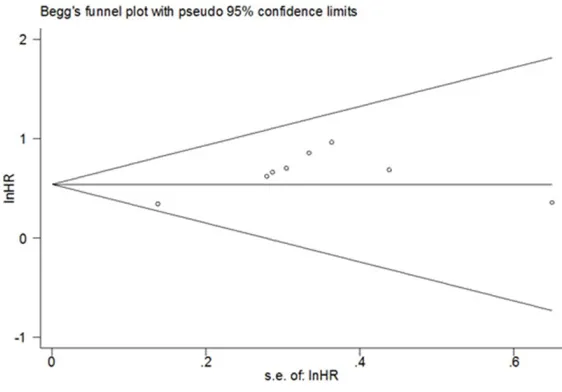
fixed-effects model was chosen [22, 23]. Subgroup analysis was conducted with stratification by cancer type and survival analysis. We also per-formed sensitivity analysis to evaluate the sta-bility of the results. The presence of publication bias was estimated by using funnel plots, Begg’s test and Egger’s test (P<0.05 repre-sents significant) [24]. Statistical analyses of HRs for OS, and the odds ratios for LNM were calculated by Stata 12.0 (Stata Corporation, College Station, Texas, USA).
Results
Characteristics of eligible studies
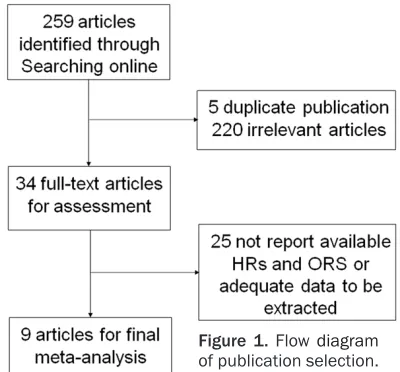
A total of 259 articles were obtained by search-ing from PubMed and Web of Science databas-es. Out of these, 225 articles were excluded due to duplicate publications and irrelevant contents. After full-text reading remaining 34 articles, another 25 articles lacking available HRs and ORs (95% CI) or adequate data were excluded. Finally, 9 articles were included in the meta-analysis [12-20]. Figure 1 showed the flow diagram of the literature research process. The main characteristics were summarized in
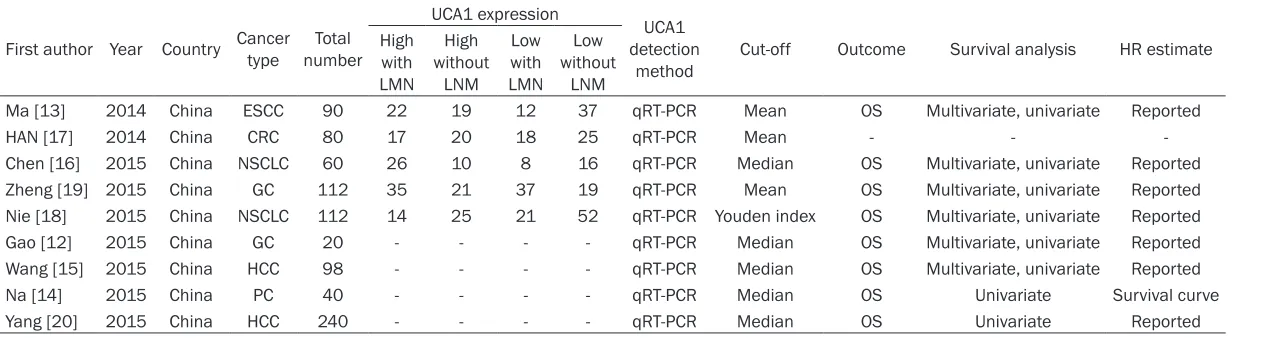
[image:2.612.88.288.72.258.2]Table 1. Among these 9 studies, all of them came from China. Six different types of cancers were evaluated, including 2 non-small cell lung cancer (NSCLC), 2 gastric cancer (GC), 2 hepa-tocellular carcinoma (HCC), 1 esophageal squa-mous cell carcinoma (ESCC), 1 colorectal can-cer (CRC) and 1 prostate cancan-cer (PC). All the diagnoses of LMN were based on pathology examination. In these studies, three methods were used to classify the low and high groups: (1) the level of UCA1 expression measured by qRT-PCR was normalized to glyceraldehyde-3-phosphate dehydrogenase (GAPDH), and the cut-off value was mean value of UCA1 levels. (2) the level of UCA1 expression measured by qRT-PCR was normalized to β-actin, and the cut-off value was in relation to the Youden in- dex. (3) the level of UCA1 expression measured by qRT-PCR was normalized to glyceraldehyde-3-phosphate dehydrogenase (GAPDH), and the cut-off value was median value of UCA1 levels. HRs (95% CIs) were directly extracted from 7 studies, while 1 study was calculated from sur-vival curves.
Table 1. Characteristics of UCA1 studies included in the meta-analysis
First author Year Country Cancer type numberTotal
UCA1 expression UCA1
detection
method Cut-off Outcome Survival analysis HR estimate
High with LMN
High without
LNM Low with LMN
Low without
LNM
Ma [13] 2014 China ESCC 90 22 19 12 37 qRT-PCR Mean OS Multivariate, univariate Reported
HAN [17] 2014 China CRC 80 17 20 18 25 qRT-PCR Mean - -
-Chen [16] 2015 China NSCLC 60 26 10 8 16 qRT-PCR Median OS Multivariate, univariate Reported
Zheng [19] 2015 China GC 112 35 21 37 19 qRT-PCR Mean OS Multivariate, univariate Reported
Nie [18] 2015 China NSCLC 112 14 25 21 52 qRT-PCR Youden index OS Multivariate, univariate Reported
Gao [12] 2015 China GC 20 - - - - qRT-PCR Median OS Multivariate, univariate Reported
Wang [15] 2015 China HCC 98 - - - - qRT-PCR Median OS Multivariate, univariate Reported
Na [14] 2015 China PC 40 - - - - qRT-PCR Median OS Univariate Survival curve
Yang [20] 2015 China HCC 240 - - - - qRT-PCR Median OS Univariate Reported
Relationship between UCA1 and OS
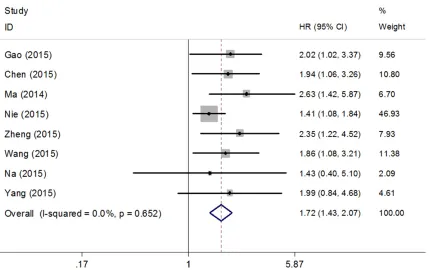
To investigate the relationship between UCA1 expression and cancer progression, 772 pa- tients from 8 studies were included in this meta-analysis of overall survival. The result revealed that high level of UCA1 expression could predict poor OS in multiple cancers (pooled HR: 1.719, 95% CI: 1.429-2.066,
P<0.001, Figure 2) by adopting a fixed-effec- ts model without significant heterogeneity (I2<0.1%, P=0.652).
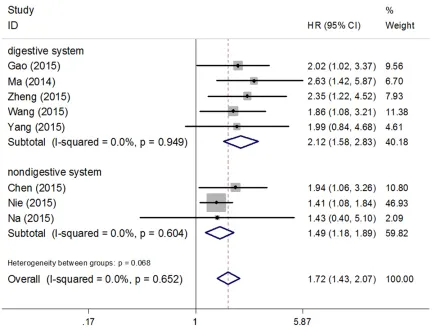
Subsequently, we performed subgroup analysis based on cancer type and survival analysis to evaluate the association between UCA1 expres-sion and OS (Figures 3 and 4). We examined the effect of the cancer type among the studies and found that UCA1 overexpression was relat-ed to the worse OS both in digestive system (HR=2.119, 95% CI: 1.585-2.834, P<0.001;
I2<0.1%, P=0.949) and nondigestive system
(HR=1.493, 95% CI: 1.177-1.894, P=0.001;
I2<0.1%, P=0.604). Next, we examined the
effect of analysis model and found that univa- riate analysis had no relevance to OS in patien- ts (HR=1.792, 95% CI: 0.880-3.651, P=0.108;
I2<0.1%, P=0.675), and significant correlation
was observed in subgroup of multivariate anal-ysis (HR=1.713, 95% CI: 1.416-2.073, P<0.001;
I2<0.1%, P=0.432). Fixed-effects model was
used for these two subgroup analyses consid-ering that no significant heterogeneity between subgroups and within subgroups was observed.
Relationship between UCA1 and lymph node metastasis
Five studies reported the number of patients with LNM based on different UCA1 expression levels in a total of 454 individuals. The random-effects model was adopted for the significant heterogeneity (I2=61.5%, P=0.035, Figure 5).
Analysis showed a pooled OR of 1.810 with 95% CI 0.954–3.436 (P=0.070). Considering the small sample size, there’s no sufficient evi-dence to prove that UCA1 expression was cor-related to LNM.
Sensitivity analysis and publication bias
[image:4.612.94.528.71.341.2]0.047, indicating there were publication biases exiting in our analysis.
Discussion
Recent studies have identified that lncRNAs were aberrantly expressed in different types of cancers. It was demonstrated by further clinical researches that lncRNAs were associated with cancer initiation and progression [25]. Several well-known lncRNAs such as HOTAIR and MALAT1 have been analyzed systematically to summarize their roles in cancer prognosis [26, 27]. Previous studies have showed UCA1 expression could regulate cancer cell physio-logical processes and was associated with poor survival outcome of cancer patients. Limited by the size of sample, there have been many controversies about the prognostic role of UCA1 in cancers. We believed that this meta-analysis was the first to investigate the relation-ship between lncRNA UCA1 and the clinical
prognosis in human cancers. A total of 9 papers comprising 852 patients were included into this meta-analysis. We found that UCA1 expres-sion was associated with a poorer prognosis (OS) in patients with different types of cancers.
[image:5.612.90.525.73.403.2]Figure 4. Forest plots for relationship between UCA1 expression and OS with subgroup analysis based on survival analysis.
[image:6.612.97.523.450.689.2]UCA1 expression might be more meaningful in predicting OS of patients with digestive system carcinoma than those with non-digestive sys-tem cancer. Since UCA1 overexpression pro-moted cancer cell invasion and migration including bladder cancer [10], melanoma can-cer [28], tongue squamous cell carcinoma [29] and ovarian cancer cell [30], we estimated ORs in 5 studies with available data regarding the independent prognostic role of UCA1 in lymph node metastasis. Considering the limited num-ber of relevant studies, we could not draw a definite conclusion that there’s no relationship between UCA1 expression and LNM, as more studies with large sample size were needed. In
In conclusion, we have demonstrated that high UCA1 expression was significant correlated with poor OS (pooled HR: 1.719, 95% CI: 1.429-2.066, P<0.001) in many cancer types. Further studies regarding the association between clin-icopathological features and UCA1 expression level are required to explore its clinical applica-tion value.
Acknowledgements
[image:7.612.94.373.74.263.2]This work was supported by the Science and Technology projects of Jiangsu Province (YB2015171), Bureau of Traditional Chinese Medicine.
Figure 6. Sensitivity analysis of the pooled HRs of UCA1 expression and OS for the included studies.
Figure 7. Begg’s funnel plot to explore publication bias of the included stud-ies between UCA1 and OS.
addition, further relevant clini-cal researches should be con-ducted to confirm the role of UCA1 expression level in lymph node metastasis, dis-tant metastasis, clinical st- age, tumor size, histological differentiation and other clini-cal characteristics.
[image:7.612.92.373.315.511.2]Disclosure of conflict of interest
None.
Address correspondence to: Zhenyu He, Depart-
ment of General Surgery, Second Affiliated Hospital
of Nanjing Medical University, 121 Jiangjiayuan Road, Nanjing 210011, Jiangsu Province, China. Tel: +86-25-58509900; Fax: +86-25-58509900; E-mail: [email protected]
References
[1] Kapusta A and Feschotte C. Volatile evolution of long noncoding RNA repertoires: mecha-nisms and biological implications. Trends Genet 2014; 30: 439-452.
[2] Di Gesualdo F, Capaccioli S and Lulli M. A pathophysiological view of the long non-coding RNA world. Oncotarget 2014; 5: 10976-10996. [3] Malek E, Jagannathan S and Driscoll JJ.
Correlation of long non-coding RNA expression with metastasis, drug resistance and clinical outcome in cancer. Oncotarget 2014; 5: 8027-8038.
[4] Sang H, Liu H, Xiong P and Zhu M. Long non-coding RNA functions in lung cancer. Tumour Biol 2015; 36: 4027-4037.
[5] Martens-Uzunova ES, Bottcher R, Croce CM, Jenster G, Visakorpi T and Calin GA. Long non-coding RNA in prostate, bladder, and kidney cancer. Eur Urol 2014; 65: 1140-1151. [6] Gan L, Xu M, Zhang Y, Zhang X and Guo W.
Focusing on long noncoding RNA dysregulation in gastric cancer. Tumour Biol 2015; 36: 129-141.
[7] Meseure D, Drak Alsibai K, Nicolas A, Bieche I and Morillon A. Long Noncoding RNAs as New Architects in Cancer Epigenetics, Prognostic Biomarkers, and Potential Therapeutic Targets. Biomed Res Int 2015; 2015: 320214.
[8] Silva A, Bullock M and Calin G. The Clinical Relevance of Long Non-Coding RNAs in Cancer. Cancers (Basel) 2015; 7: 2169-2182.
[9] Tsai MC, Spitale RC and Chang HY. Long inter-genic noncoding RNAs: new links in cancer progression. Cancer Res 2011; 71: 3-7. [10] Wang F, Li X, Xie X, Zhao L and Chen W. UCA1,
a non-protein-coding RNA up-regulated in
blad-der carcinoma and embryo, influencing cell
growth and promoting invasion. FEBS Lett 2008; 582: 1919-1927.
[11] Wang XS, Zhang Z, Wang HC, Cai JL, Xu QW, Li MQ, Chen YC, Qian XP, Lu TJ, Yu LZ, Zhang Y,
Xin DQ, Na YQ and Chen WF. Rapid identifica
-tion of UCA1 as a very sensitive and specific
unique marker for human bladder carcinoma. Clin Cancer Res 2006; 12: 4851-4858. [12] Gao J, Cao R and Mu H. Long non-coding RNA
UCA1 may be a novel diagnostic and predictive
biomarker in plasma for early gastric cancer. Int J Clin Exp Pathol 2015; 8: 12936-12942. [13] Li JY, Ma X and Zhang CB. Overexpression of
long non-coding RNA UCA1 predicts a poor prognosis in patients with esophageal squa-mous cell carcinoma. Int J Clin Exp Pathol 2014; 7: 7938-7944.
[14] Na XY, Liu ZY, Ren PP, Yu R and Shang XS. Long non-coding RNA UCA1 contributes to the gression of prostate cancer and regulates pro-liferation through KLF4-KRT6/13 signaling pathway. Int J Clin Exp Med 2015; 8: 12609-12616.
[15] Wang F, Ying HQ, He BS, Pan YQ, Deng QW, Sun HL, Chen J, Liu X and Wang SK. Upregulated lncRNA-UCA1 contributes to progression of hepatocellular carcinoma through inhibition of miR-216b and activation of FGFR1/ERK sig-naling pathway. Oncotarget 2015; 6: 7899-7917.
[16] Wang HM, Lu JH, Chen WY and Gu AQ. Upregulated lncRNA-UCA1 contributes to pro-gression of lung cancer and is closely related to clinical diagnosis as a predictive biomarker in plasma. Int J Clin Exp Med 2015; 8: 11824-11830.
[17] Han Y, Yang YN, Yuan HH, Zhang TT, Sui H, Wei XL, Liu L, Huang P, Zhang WJ and Bai YX. UCA1, a long non-coding RNA up-regulated in
colorec-tal cancer influences cell proliferation, apopto -sis and cell cycle distribution. Pathology 2014; 46: 396-401.
[18] Nie W, Ge HJ, Yang XQ, Sun X, Huang H, Tao X, Chen WS and Li B. LncRNA-UCA1 exerts onco-genic functions in non-small cell lung cancer by targeting miR-193a-3p. Cancer Lett 2016; 371: 99-106.
[19] Zheng Q, Wu F, Dai WY, Zheng DC, Zheng C, Ye H, Zhou B, Chen JJ and Chen P. Aberrant ex-pression of UCA1 in gastric cancer and its
clin-ical significance. Clin Transl Oncol 2015; 17:
640-646.
[20] Yang Z, Lu Y, Xu Q, Tang B, Park CK and Chen X. HULC and H19 Played Different Roles in Overall and Disease-Free Survival from Hepatocellu- lar Carcinoma after Curative Hepatectomy: A Preliminary Analysis from Gene Expression Omnibus. Dis Markers 2015; 2015: 191029. [21] Tierney JF, Stewart LA, Ghersi D, Burdett S and
Sydes MR. Practical methods for incorporating summary time-to-event data into meta-analy-sis. Trials 2007; 8: 16.
[22] Higgins JP and Thompson SG. Quantifying het-erogeneity in a meta-analysis. Stat Med 2002; 21: 1539-1558.
[23] DerSimonian R and Laird N. Meta-analysis in clinical trials. Control Clin Trials 1986; 7: 177-188.
simple, graphical test. BMJ 1997; 315: 629-634.
[25] Shi X, Sun M, Liu H, Yao Y and Song Y. Long non-coding RNAs: a new frontier in the study of human diseases. Cancer Lett 2013; 339: 159-166.
[26] Zhang S, Chen S, Yang G, Gu F, Li M, Zhong B, Hu J, Hoffman A, Chen M. Long Noncoding RNA HOTAIR as an Independent Prognostic Marker in Cancer: A Meta-Analysis. PLoS One 2014; 9: e105538.
[27] Zhu L, Liu J, Ma S and Zhang S. Long Noncoding RNA MALAT-1 Can Predict Metastasis and a Poor Prognosis: a Meta-Analysis. Pathol Oncol Res 2015; 21: 1259-1264.
[28] Tian Y, Zhang X, Hao Y, Fang Z and He Y. Potential roles of abnormally expressed long noncoding RNA UCA1 and Malat-1 in metasta-sis of melanoma. Melanoma Res 2014; 24: 335-341.
[29] Fang Z, Wu L, Wang L, Yang Y, Meng Y and Yang H. Increased expression of the long non-coding RNA UCA1 in tongue squamous cell carcino-mas: a possible correlation with cancer metas-tasis. Oral Surg Oral Med Oral Pathol Oral Radiol 2014; 117: 89-95.