93
Testing a Minimalist Grammar Parser
on Italian Relative Clause Asymmetries
Aniello De Santo
Department of Linguistics Stony Brook University
Abstract
Stabler’s (2013) top-down parser for Minimal-ist grammars has been used to account for off-line processing preferences across a vari-ety of seemingly unrelated phenomena cross-linguistically, via complexity metrics measur-ing “memory burden”. This paper extends the empirical coverage of the model by looking at the processing asymmetries of Italian rela-tive clauses, as I discuss the relevance of these constructions in evaluating plausible structure-driven models of processing difficulty.
1 Introduction
Recent studies have shown that a top-down parser for Minimalist grammars (MGs; Stabler, 1996,
2013)) can be combined with complexity metrics to relate parsing behavior to memory usage, and successfully used to model sentence processing preferences across a variety of phenomena cross-linguistically (Kobele et al., 2013; Gerth, 2015;
Graf et al., 2017). This kind of work follows a
line of research on syntactic processing that sees computational models provide a transparent, inter-pretable linking theory between syntactic assump-tions and processing behavior (Joshi,1990;
Ram-bow and Joshi,1994;Hale,2011). Importantly, at
the core of the particular approach adopted here is a theory of grammatical structure driving off-line processing cost, thus connecting longstand-ing ideas about memory resources with explicit syntactic analyses in rigorous ways. Extending the range of phenomena correctly modeled by the parser is then going to be crucial to confirm the empirical feasibility of the approach.
Here, I adopt Kobele et al.’s (2013) imple-mentation of Stabler’s (2013) top-down traver-sal algorithm, coupled with the set of complex-ity metrics defined byGraf et al. (2017). We test the MG parser’s performance on the processing
asymmetries reported for Italian relative clauses, which have been object of extensive study in the psycholinguistic literature. Apart from conform-ing to a well-attested cross-lconform-inguistic preference for subject over object relatives, Italian speak-ers also show increased processing difficulties when encountering relative clauses with subjects in postverbal position. This difficulty gradient has often been accounted for in the literature in terms of the cost of local ambiguity resolution. Since in the particular formulation ofKobele et al.(2013) the MG parser acts as an oracle and deliberately ignores structural ambiguity, these constructions thus make for a challenging testing ground for a model attempting to account for processing con-trastsjustin terms ofstructural complexity.
The paper is structured as follows. Section 2
presents an informal introduction to MGs and Sta-bler’s (2013) top-down parser, and an overview of previous work on combining the MG parser with complexity metrics measuring memory burden. Section 3 discusses Italian relative clause asym-metries and our modeling assumptions. Section4
looks at the modeling results, and shows how the MG parser succeeds in predicting the correct pro-cessing preferences. Section 5 concludes with a brief discussion of possible limits of the model, and promising future work.
2 Preliminaries
2.1 Minimalist Grammars
TP
Steveni T’
T vP
ti v’
v VP
likes Connie
(a)
Move
Merge
:: v+nom+T− Merge
Steven:: D−nom− Merge
:: V+D+v− Merge
likes:: D+V− Connie:: D−
(b)
TP
T’
T vP
Steven v’
v VP
likes Connie
1
2
2
3
3
6 3
4
4
5 4
7
8
9 8
10
10
11 10
12
[image:2.595.81.500.70.227.2](c)
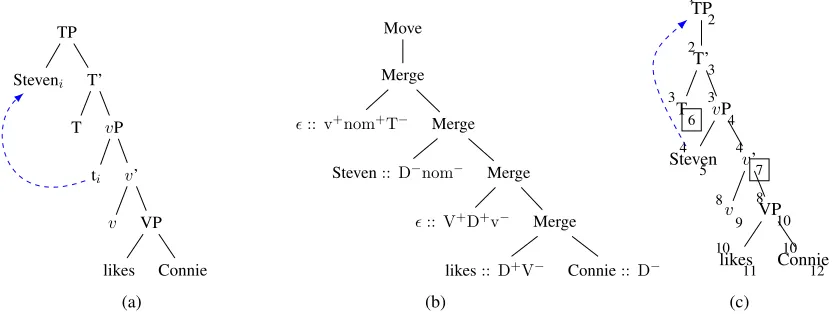
Figure 1: Phrase structure tree (a), MG derivation tree (b), and annotated derivation tree (c) forSteven likes Connie. Boxed nodes in (c) are those with tenure value greater than2, following (Graf and Marcinek,2014).
much work has been done on the formal proper-ties of MGs, the fine-grained details of the formal-ism are unnecessary given the focus of this paper. Thus, I introduce MGs in a mostly informal way, as my main goal is to provide the reader with an intuitive understanding of the core data structure the parser is going to operate on: derivation trees.
An MG grammar is a set of of lexical items (LIs) consisting of a phonetic form and a finite, non-empty string of features. They distinguish two types on features, each with either positive or
negativepolarity:Merge features (written here in upper caps, with the exception of little v), and
Move features (in lower caps). LIs are assem-bled via two feature checking operations: Merge
andMove. Informally, Merge combines two LIs if their respective first unchecked features are Merge features of opposite polarity. Move removes a phrase from an already assembled tree and dis-places it to a different position (Stabler,2011). In-tuitively, Merge encodes subcategorization, while Move long-distance movement dependencies.
MGs succinctly encode the sequence of Merge and Move operations required to build the phrase structure tree for a specific sentence into deriva-tion trees (Michaelis,1998;Harkema, 2001; Ko-bele et al.,2007). For instance, Fig.1a and Fig.1b compare these two kind of trees for a simplified analysis of the sentence Steven likes Connie. In the derivation tree (Fig.1b), all leaf nodes are la-beled by LIs, while unary and binary branching nodes are labeled as Move or Merge, respectively. Crucially, the main difference between the phrase structure tree and the derivation tree is that in the latter, moving phrases remain in their base
po-sition, and their landing site can be fully recon-structed via the feature calculus. Thus, the final word order of a sentence is not directly reflected in the order of the leaf nodes in a derivation tree.
Importantly, MG derivation trees form a regular tree language, and thus — modulo a more com-plex mapping from trees to strings — can be re-garded as a simple variant of context-free gram-mars (CFG), which have been studied extensively in the computational parsing literature. This is the crucial insight behind Stabler’s top-down parser.
2.2 MG Parsing
Stabler’s (2013) parser for MGs is a variant of a standard depth-first, top-down parser for CFGs: it takes as input a sentence represented as string of words, hypothesizes the structure top-down, veri-fies that the words in the structure match the input string, and outputs a tree encoding of the sentence structure. Basically, the parser scans the nodes from top to bottom and from left to right; but since the surface order of lexical items in the derivation tree is not the phrase structure tree’s surface or-der, simple left-to-right scanning of the leaf nodes yields the wrong word order. Thus, while scanning the nodes, the MG parser must also keep tracking the derivational operations which affect the linear word order.
been found, continue from the point where it was predicted (Kobele et al.,2013).
Essential to this procedure is the role of mem-ory: if a node is hypothesized at stepi, but can-not be worked on until step j, it must be stored for j −i steps in a priority queue. To make the traversal strategy easy to follow, I adopt Kobele
et al.’s (2013) notation, in which each node in the tree is annotated with anindex(superscript) and an
outdex(subscript). Intuitively, the annotation indi-cates for each node in the tree when it is first con-jectured by the parser (index) and placed in the memory queue, and at what point it is considered completed and flushed from memory (outdex). In the rest of the paper I adopt an annotated, simpli-fied version of derivation trees, with internal nodes explicitly labelled and dashed arrows indicating movement relations (as shown in Fig.1c).1
Finally, note that in Stabler’s original formula-tion the parser is equipped with a search beam dis-carding the most unlikely predictions. In this paper though, I followKobele et al. (2013) in ignoring the beam and assuming that the parser is equipped with a perfect oracle, which always makes the right choices when constructing a tree. This ide-alization is clearly implausible from a psycholin-guistic point of view. However, it is made with a precise purpose in mind: to ignore the cost of choosing among several possible predictions and, by assuming a deterministic parse, to focus on the specific contribution of syntactic complexity to processing difficulty. In Sec. 3 I will discuss how assuming an idealized parser is exactly what makes Italian RCs an interesting test case.
2.3 Complexity Metrics
In order to allow for psycholinguistic predictions, the behavior of the parser must be related to pro-cessing difficulty via a linking theory, which here takes the form of complexity metrics. Specifically, I employ complexity metrics that predict process-ing difficulty based on how the geometry of the trees built by the parser affects memory usage.
Extending previous work on MG parsing ( Ko-bele et al.,2013;Graf and Marcinek,2014;Gerth,
2015), Graf et al. (2017) distinguish three
cog-nitive notions of memory usage: I) how long a node is kept in memory (tenure); II) how many nodes must be kept in memory (payload); or III) 1Note that, due to the fact that intermediate landing sites
for moved phrases do not affect the traversal strategy, they not explicitly marked by movement arrows.
how many bits a node consumes in memory (size). Tenure and payload for each node n in the tree can be easily computed via the node annotation scheme of Kobeleet al.: a node’s tenure is equal to the difference between its index and its outdex; the payload of a derivation tree is computed as the number of nodes with a tenure strictly greater than2. Defining size in an informal way is slightly trickier, as its original conception was based on how information about movers is stored by Sta-bler’s top-down parser (for a technical discussion, seeGraf et al.,2015). Procedurally, the size of the parse item corresponding to each noden can be simply computed by exploiting our simplified rep-resentation of derivation trees: it corresponds to the number of nodes below nthat have a move-ment arrow pointing to somewhere aboven.2 For example, referring to the annotated tree in Fig.1c, the size of vP is 1, while the size of VP is 0. In practice, size encodes how many nodes in a derivation consume more memory because a cer-tain phrasemmoves across them.
With the exception of payload, these concepts are not exactly metrics we can use to directly com-pare derivations. What we are missing is a way for them to be applied to a given derivation as mea-sures of overall processing difficulty. In order to do so, these notions of memory have been used to define a vast set of complexity metrics measuring processing difficulty over a full derivation tree. In this paper, we look at Italian relative clause asym-metries using the full set of 1600 metrics as de-fined inGraf et al.(2017). However, in what fol-lows we only give a general intuition of how such metrics can be defined, and we refer the reader to Grafet al. for the detailed formal definitions. Im-portantly, just a few of these metrics are enough to account for the contrasts we are interested in.
Kobele et al.(2013) show that tenure can be
as-sociated to quantitative values by defining metrics ike MAXT := max({tenure-of(n)}) and SUMT
:= P
n tenure-of(n). MAXT measures the max-imum amount of time any node stays in mem-ory during processing, while SUMT measures the overall amount of memory usage for all nodes whose tenure is not trivial (i.e., > 2). It thus captures total memory usage over the course of a parse. Building on these findings, Graf and
Marcinek (2014) show that MAXT (restricted to
2Thus, as a reviewer correctly notes, size is sensitive to
pronounced nodes) makes the right difficulty pre-dictions for several phenomena, such as right em-bedding vs. center emem-bedding, nested dependen-cies vs. crossing dependendependen-cies, as well as a set of contrasts involving relative clauses.
Extending Graf & Marcinek’s (2014) analysis of relative clause constructions,Graf et al.(2015) argue for the insufficiency of MAXT as a single,
reliable metric. They then introduce several new metrics, inspired by those defined for tenure. For example, they define an the equivalent of SUMT
for size, which measures the overall cost of main-taining long-distance filler-gap dependencies over a derivation. Let M be the set of all nodes of derivation treetthat are the root of a subtree un-dergoing movement. For each m ∈ M, i(m) is the index ofmandf(m)is the index of the high-est Move node thatm’s subtree is moved to. Then SUMS is defined asP
m∈Mi(m)−f(m).
Graf et al. (2015) also introduce the idea of
ranked metrics of the type hM1, M2, . . . , Mni, similar to constraint ranking in Optimality The-ory (Prince and Smolensky,2008): a lower ranked metric matters only if all higher ranked metric have failed to pick out a unique winner (e.g., if two constructions result in atieover MAXT). This suggestion is fully explored inGraf et al.(2017), which show that when complexity metrics are al-lowed to be ranked in such a way the total num-ber of possible metrics quickly reaches an astro-nomical size. However, surveying the variety of previously modeled phenomena, the authors also suggest that the number of metrics truly needed to account for human processing contrasts can be reduced to a small number of core metrics (partic-ularly, they point toward a combination of MAXT and SUMS), an hypothesis that seems supported
by recent work on several different constructions (Liu,2018;Lee,2018).
3 Modeling Italian RCs
3.1 Processing Asymmetries
Restrictive relative clauses (RCs) in Italian have been the focus of extensive experimental stud-ies from the perspective of comprehension (
Vol-pato and Adani, 2009), production (Belletti and
Contemori,2009), and acquisition (Volpato,2010;
Friedmann et al.,2009). Italian speakers conform
to the general cross-linguistic preference for sub-ject over obsub-ject RCs (Frauenfelder et al., 1980;
King and Kutas, 1995; Schriefers et al., 1995,
a.o.), so that (1) is easier to process than (2): (1) Il cavallo che ha inseguito i leoni
The horse that has chased the lions “The horse that chased the lions” SRC
(2) Il cavallo che i leoni hanno inseguito The horse that the lions have chased “The horse that the lions chased” ORC
Interestingly, Italian also allows for sentences like (3), ambiguous between a SRC interpretation (3a) and an ORC interpretation (3a) with the em-bedded subject expressed postverbally:
(3) Il cavallo che ha inseguito il leone The horse that has chased the lion
a. “The horse that chased the lion” SRC
b. “The horse that the lion chased”ORCp
Although postverbal subject constructions are very common in Italian, in such cases native speakers show a marked preference for the SRC interpretation over the ORCp one. Sentences like (3) can be disambiguated by grammatical cues like subject-verb agreement:
(4) Il cavallo che hanno inseguito i leoniORCp
The horse that have chased the lions “The horse that the lions chased”
However, even in unambiguous cases like (4), studies report increased efforts with ORCp, lead-ing to the followlead-ing difficulty gradient: SRC < ORC<ORCp (Utzeri,2007, a.o.).
The contrast between SRCs and ORCs has been well studied in the past, and it is compatible with a variety of models, such as surprisal (Levy,
2013), cue-based memory retrieval (Lewis and Va-sishth, 2005), the active filler strategy (Frazier,
1987), the Dependency Locality Theory (Gibson,
1998, 2000), the Competition Model (Bates and
MacWhinney,1987), the Minimal Chain Principle
(De Vincenzi,1991), among many. The increased
CP
C TP
T0
vP
pro v0
v VP vedo DP il CP C0 che TP T0 PerfP
ha vP
DP D cavallo v0 v VP inseguito DP il leone 1 2 2 3 2 4 4 5 5 6 6 7 6 8 8 11 8 9 9 10 9 12 12 13 12 14 14 15 15 23 15 16 16 17 17 18 18 24 18 19 19 20 20 21 20 22 19 25 25 26 25 27 27 28 27 29 29 30 29 31 (a) CP C TP T0 vP
pro v0
v VP vedo DP il CP C0 che TP T0 PerfP
ha vP
DP il leone v0 v VP inseguito DP D cavallo 1 2 2 3 2 4 4 5 5 6 6 7 6 8 8 11 8 9 9 10 9 12 12 13 12 14 14 15 15 25 15 16 16 17 17 18 18 29 18 19 19 26 26 27 26 28 19 20 20 30 20 21 21 31 21 22 22 23 22 24 (b) CP C TP T0 vP
pro v0
v VP
vedo DP
il CP
C0
che TP
pro T0
PerfP
ha TopP
Top0
Top FocP
Foc0
Foc vP
[image:5.595.83.509.66.519.2]DP il leone v0 v VP inseguito DP D cavallo 1 2 2 3 2 4 4 5 5 6 6 7 6 8 8 11 8 9 9 10 9 12 12 13 12 14 14 15 15 29 15 16 16 30 16 17 17 18 18 31 18 19 19 20 20 34 20 21 21 22 22 38 22 23 23 35 35 36 35 37 23 24 24 32 24 25 25 33 25 26 26 27 26 28 (c)
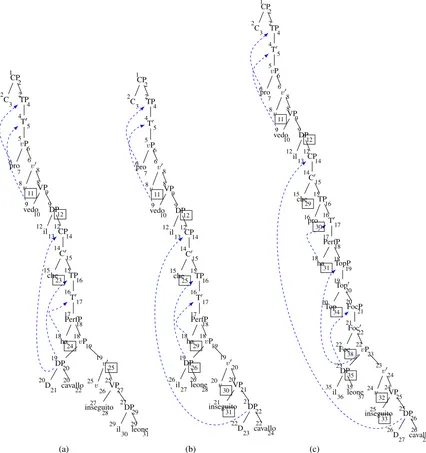
Figure 2: Annotated derivation trees for right-embedding (a) SRC, (b) ORC, and (c) ORCp.
aim of this paper is not to argue for the correctness (or lack thereof) of these accounts. Our purpose is to extend previous evaluations of memory metrics for a top-down MG parser as a reliable model of processing difficulty.
As discussed above, the MG parser has already been successful in accounting for RC asymme-tries cross-linguistically (Graf et al.,2017;Zhang,
2017). Thus, Italian RCs are the perfect next step in understanding the plausibility of the model, al-lowing us to build on the insights provided by previous work while incrementally exploring new structural configurations. In particular, the fact that by assumption the MG parser ignores structural
ambiguity (thus potential costs associated to re-analysis) and deterministically builds only the cor-rect parse, makes ORCs with postverbal subjects an intriguing test case.
3.2 Syntactic Assumptions
The central tenant of the MG model is to take syn-tactic commitments seriously, so to explore how different aspects of sentence structure drive pro-cessing cost. The choice of a syntactic analysis is then particularly important. In line with most of the psycholinguistic literature on Italian RCs, this paper’s analysis of postverbal subjects follows
[i leoni] is merged in preverbal subject position Spec,vP, and then raised to a Spec,Focus position in the clause-internalvP periphery. The whole ver-bal cluster is raised to a clause-internal Spec,Topic position; and an expletive pro is base generated in Spec,TP and co-indexed with the postverbal subject (Fig.2c).3Furthermore, again consistently
with the Italian psycholinguistic literature (Arosio
et al., 2017, a.o.), we adopt a promotion
analy-sis of relative clauses (Kayne, 1994). That is to say, the head noun starts out as an argument of the embedded verb and undergoes movement into the specifier of the RC. The RC itself is treated as an NP, and selected by the determiner that would normally select the head noun in more traditional, head-external accounts (Chomsky,1977).
4 Modeling Results
4.1 Core Results
I tested the parser performance on right-branching restrictive RCs of the form (pro) vedo il cavallo [RC che ...] (I see the horse [RC that ...]) — the RC head raising to the matrix object position, and the embedded relative clause either an SRC (1), an ORC (2), or an ORCp (4). The corresponding derivation trees, annotated by the MG parser with index and outdex values at each node, are shown in Fig. 2a, Fig. 2b, and Fig.2c respectively. Re-call that by assumption the parser is equipped with a perfect oracle, and that the complexity metrics areonlysensitive to structural differences (i.e., the MG model is blind to agreement relationships). Contrasting (1) and (4) is then equivalent to con-trasting (3a) and (3b). Thus, to reiterate the central tenants of the approach, these comparisons aim to model both the preference for SRC in ambiguous cases, and the overall increased processing diffi-culty of ORCps, just in terms of structural differ-ences.
Modeling results show that the parser correctly predicts the gradient of difficulty observed for
Ital-3
Technically, Belletti & Leonini (2004) assume that VP, notvP, raises to Spec,Topic. This follows from the authors adoptingCollins(2005)’s smuggling analysis of passives di-rectly. However, if we follow the traditional view of active verbs moving out of their base position to adjoin to littlev, this analysis cannot hold as it would derive the wrong word order. Thus, I raise the wholevP cluster to Topic. This also seems to be in the spirit of what suggested byBelletti and Contemori(2009). But note that the modeling results in the following section would remain mostly unchanged even if we were to leave thevP shell in its base position, while both verb and object raise above.
ian RCs (SRC < ORC< ORCp), across a vari-ety of complexity metrics.4 In fact, the increased difficulty of ORCps over both SRCs and ORCs is predicted byevery base (i.e., non ranked) met-rics defined in (Graf et al.,2017). However, since the relationship between complexity metrics and the structure of a specific derivation tree is sub-tle, a detailed discussion of why each metric fares the way it does is not feasible within the scope of this paper. In what follows, I focus on two metrics that have been noted in previous studies as con-sistent predictors of processing difficulty: MAXT and SUMS.
The fact that MAXT (SRC:8/che; ORC:11/ha; ORCp:16/Foc) succeeds in predicting the reported processing preferences is encouraging, given the past success of this metric on many different con-structions.5 In particular, observe how the string-driven traversal strategy of the MG parser makes tenure sensitive to minor structural differences. In the SRC,cheis introduced at step15. Since, based on information in the input string, the parser is looking for the the subject DPil cavallo,che has to be kept in memory until the latter is found. Thus, it is flushed from memory at step 23. In the ORC, che is also put in memory at step 15. However, since the head of the relative clause is the embedded object, the parser will discard the standard CFG top-down strategy, ignore the sub-ject DP, and keep expanding nodes untilil cavallo
is found. Thus,checannot be flushed from mem-ory until step25.
The difference between SRC and ORC also highlights how tenure interacts with movement. Oncechehas been found in the SRC tree, the next node in the stack isha, which can be discharged from memory immediately after. In the ORC how-ever, the parser still has to find the subject DP. Thus, ha has to be kept in memory for the three additional steps that are required to conjecture and scanil leone.
Similarly, the maximum tenure recorded on the Foc head in ORCp highlights the cost of the ad-ditional movement steps postulated for this con-struction. The Foc node needs to wait until both the RC objectand subject are built and scanned, before being itself discharged from the memory
4https://github.com/CompLab-StonyBrook/mgproc. 5These predictions hold even if we ignore tenure on
CP C TP T0 vP DP il CP C0 che TP T0 PerfP
ha vP
DP D cavallo v0 v VP inseguito DP il leone v0 v VP salta DP la siepe 1 2 2 3 2 4 4 5 5 6 6 7 7 8 7 9 9 10 10 18 10 11 11 12 12 13 13 19 13 14 14 15 15 16 15 17 14 20 20 21 20 22 22 23 22 24 24 25 24 26 6 27 27 30 27 28 28 29 28 31 31 32 31 33 (a) CP C TP T0 vP DP il CP C0 che TP T0 PerfP
ha vP
DP il leone v0 v VP inseguito DP D cavallo v0 v VP salta DP la siepe 1 2 2 3 2 4 4 5 5 6 6 7 7 8 7 9 9 10 10 20 10 11 11 12 12 13 13 24 13 14 14 21 21 22 21 23 14 15 15 25 15 16 16 26 16 17 17 18 17 19 6 27 27 30 27 28 28 29 28 31 31 32 31 33 (b) CP C TP T0 vP DP il CP C0 che TP
pro T0
PerfP
ha TopP
Top0
Top FocP
Foc0
Foc vP
[image:7.595.127.495.72.415.2]DP il leone v0 v VP inseguito DP D cavallo v0 v VP salta DP la siepe 1 2 2 3 2 4 4 5 5 6 6 7 7 8 7 9 9 10 10 24 10 11 11 25 11 12 12 13 13 26 13 14 14 15 15 29 15 16 16 17 17 33 17 18 18 30 30 31 30 32 18 19 19 27 19 20 20 28 20 21 21 22 21 23 6 34 34 37 34 35 35 36 35 38 38 39 38 40 (c)
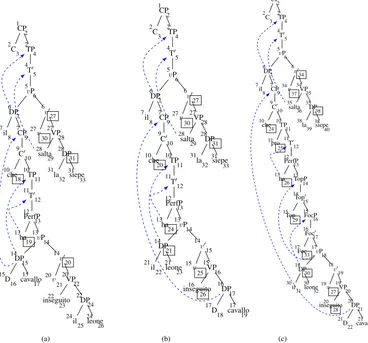
Figure 3: Annotated derivation trees for left-embedding (a) SRC (b) ORC and (c) ORCp.
queue.
4.2 Additional Simulations
From one side, the successful predictions made by MAXT are a welcome result, as they con-firm the sensitivity of tenure-based metrics to fine-grained structural details. From the other though, one might wonder exactly how much these differ-ences depend on the specific case study we are modeling. In this section, I partially address this issue by looking at variations in the construction of the RCs, and at two more processing asymme-tries involving Italian post-verbal subjects.6 I re-turn to the general issue of the sensitivity of the MG results to syntactic choices in Sec.5.
4.2.1 Left-Embedding RCs
Due to the string-driven nature of its traversal strategy, the MG parser is peculiarly sensitive to the depth of left- vs. right-embedding construc-tions. To control for this, I tested the parser pre-6Trees for these simulations can be found in AppendixA.
dictions on sentences of the form Il cavallo [RC
che ...] salta la siepe (The horse [RC that ...]
jumps the fence, Fig.3), with the head noun rais-ing to the subject position in the matrix clause. Here, MAXT predicts that SRC and ORC should
have the same processing complexity (they tie), since their memory differences are flattened by the increased tenure on the matrixv’ (the Merge node expanding the matrixvP). The tenure of this node depends on the size of the matrix subject — thus, on the size of the relative clause. Since the size of the SRC and of the ORC is the same (the only thing changing being the site of extraction), MAXT for the whole sentence will never vary be-tween the two constructions. This issue is solved by SUMS, which correctly predicts SRC<ORC, as well as the SRC/ORC<ORCp contrast.
position is identical. This is not the case for OR-Cps, due the sequence of projections and move-ment steps involved in deriving postverbal sub-jects from the base SVO order. Thus, while MAXT in these sentences in still measured on the matrix
v’(28), this value is also picking up on the addi-tional steps required to derive the internal structure of the ORCp construction.
4.2.2 Postverbal Subjects in Matrix Clauses In order to understand the complexity of the gram-matical assumptions made for the postverbal sub-jects, we can look at processing asymmetries of postverbal constructions outside of RC environ-ments. Consider Italian declarative sentences with a lexically empty subject position, like in (5).
(5) Ha chiamato Gio Has called Giovanni
a. “He/she/it called Gio” SVO
b. “Gio called” VS
Without contextual/discourse cues, sentences like (5) are structurally ambiguous between a null-subject interpretation (5a) and a postverbal subject one (5b), with a marked processing preference for (5a) as compared to (5b) (De Vincenzi,1991).
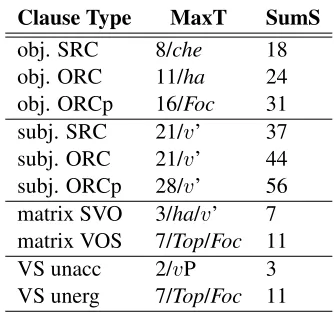
As summarized in Tbl. 1, both MAXT and
SUMS predict the correct preferences under
Bel-letti and Leonini(2004)’s analysis, as the Top and
Foc heads have to wait for the whole vP to be found, before they can be discharged from mem-ory themselves (cf. Fig.4and Fig.5).
4.2.3 Unaccusatives vs. Unergatives
Finally, it is interesting to look at declarative sen-tences containing intransitive verbs of two classes: unaccusatives (6) and unergatives (7).
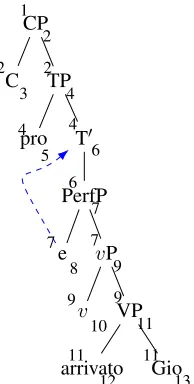
(6) E arrivato Gio` Is arrived Gio
“Gio arrived” Unaccusative
(7) Ha corso Gio Has ran Gio
“Gio ran” Unergative
While on the surface these sentences look very similar, they differ in that the subject originates in postverbal position for unaccusatives but in pre-verbal position for unergatives (Belletti, 1988). Importantly, De Vincenzi (1991) reports faster reading times and higher comprehension accuracy for (6) over (7), a preference that is again correctly captured both by MAXT and SUMS (cf. Fig. 6
Clause Type MaxT SumS
obj. SRC 8/che 18
obj. ORC 11/ha 24
obj. ORCp 16/Foc 31
subj. SRC 21/v’ 37
subj. ORC 21/v’ 44
subj. ORCp 28/v’ 56
matrix SVO 3/ha/v’ 7 matrix VOS 7/Top/Foc 11
VS unacc 2/vP 3
[image:8.595.332.499.60.216.2]VS unerg 7/Top/Foc 11
Table 1: Summary of MAXT (value/node) and SUMS by construction. Obj. and subj. indicate the landing site of the RC head in the matrix clause.
and Fig.7). In particular, due to unaccusative sub-jects being base-generated postverbally, MAXT for these constructions is the lowest it can be (2, the tenure of any right sibling which is predicted and immediately discharged).
5 Discussion
The success of a top-down parser in modeling the processing difficulties of Italian RCs adds support to the MG model as a valuable theory of how pro-cessing cost is tied to structure.
As some reviewers point out though, one poten-tial concern with the plausibility of the approach is in the degrees of freedom that are left to the model. In particular, the processing predictions depend on the interaction of three factors: the parsing strategy, the syntactic analysis, and the complex-ity metrics. Here, I put aside the choice of parsing strategy (but seeHunter,2018;Stanojevi´c and Sta-bler,2018), and briefly address concerns about the remaining two factors.
underspecification is not an issue in practice. The results in this paper are indeed consis-tent with these observations, as they show SUMS as a reliable complexity metric. Importantly, as subject-modifying SRCs and ORCs only tie on MAXT, these findings are also consistent with
Graf et al.(2017)’s hypothesis that SUMS should
be used a secondary metric to adjudicate between constructions, after they tie on MAXT.7
A second, reasonable concern is how much the correct predictions depend on the specific syntac-tic analysis of choice. Due to the richness of ex-isting analyses and to space constraints, in this pa-per I only considered an analysis of Italian RCs and postverbal constructions which had been ex-tensively referred to in the psycholinguistic liter-ature. To partially address this concern though, I showed how SUMS and MAXT not only make the right predictions for RC constructions under a few different syntactic configurations, but they also correctly account for postverbal subject asymme-tries in different kind of sentences. Nonetheless, an important future enterprise will be to look at alternative approaches to postverbal subject con-figurations, such as right dislocation (Antinucci and Cinque,1977;Cardinaletti,1998), orleftward scrambling (Ord´o˜nez, 1998). Note though that these analyses all assume additional movement de-pendencies in the structure of ORCps compared to clauses with preverbal subjects. Given what this paper taught us about SUMS and MAXT, it seems probable that such dependencies would also be picked up by these metrics.
Independently on the specific predictions of the parser for alternative analyses though, the contri-butions of this line of inquiry would be twofold. From one side, it will improve our understand-ing of the MG model, by clarifyunderstand-ing which as-pects of sentence structure drive the parser’s per-formance, and how they weight on the recruit-ment of memory resources as measured by differ-ent metrics. Secondly, grounded in the discrimina-tive power given to MAXT and SUMS by their suc-cess across empirical phenomena, comparing the predictions made by the parser for different anal-yses of the same construction might help adjudi-cate between competing theoretical assumptions, as was the original goal ofKobele et al.(2013).
Clearly, the fact that the parser relies on an ide-7S
UMS by itself does not seem to be enough, as it fails to predict the right preferences for contrasts like English right vs. center embedding (Graf et al.,2017).
alized deterministic search strategy is one of the (potentially) most contentious assumption of the MG model, and could thus be used as yet another objection to the plausibility of the linking theory. As already mentioned, the goal is not to claim this as a comprehensive model of processing difficulty, as a cognitively realistic theory would see multiple factors interact with each other to derive the cor-rect contrasts (Demberg and Keller, 2008; Bren-nan et al.,2016, a.o.). In principle though, the MG parser can be integrated with several of these addi-tional factors (e.g., uncertainty;Hunter and Dyer,
2013;Yun et al.,2015). Crucially, the main advan-tage of the MG model is its transparent specifica-tion of the parser’s behavior, which clarifies the ef-fects of structural complexity on memory burden and would allow us to separate them from other effects contributing to processing load.
Moreover, while uncertainty is clearly a funda-mental component of the human sentence process-ing system, the fact that an account deliberately abstracting away from all ambiguity can explain effects that would usually be attributed to it is an intriguing result. A fascinating open question is then whether we can characterize those phenom-ena where ambiguity really is the decisive factor, and cannot be “eliminated” from the model.
Finally, another advantage of having a compu-tational model which provides a testable link be-tween syntactic theory and behavioral data, is that it allows us to formally integrate structural hy-potheses in existing psycholinguistic theories in a way that leads to precise quantitative predictions. However, as one reviewer observes, the complex-ity metrics exploited by the MG parser rely on very weak assumptions about the nature of human memory. In a sense, this could be considered a perk, as it leaves the model open to connections with a variety of sentence processing theories. In another sense though, this lack of cognitive plau-sibility weakens the impact of the approach, as it is often difficult to connect its results to more gen-eral concerns in the sentence processing literature. An important future research direction will thus be to re-evaluate the existing complexity metrics in light of psychological insights about human mem-ory mechanisms (cf.Zhang,2017).
Acknowledgments
References
Francesco Antinucci and Guglielmo Cinque. 1977. Sull’ordine delle parole in italiano: l’emarginazione.
Studi di grammatica italiana VI, pp. 121-146.
Fabrizio Arosio, Flavia Adani, and Maria Teresa Guasti. 2009. Grammatical features in the com-prehension of Italian Relative Clauses by children.
Merging Features: Computation, Interpretation, and Acquisition, pages 138–158.
Fabrizio Arosio, Francesca Panzeri, Bruna Molteni, Santina Magaz`u, and Maria Teresa Guasti. 2017. The comprehension of Italian relative clauses in poor readers and in children with specific language impairment. Glossa: a journal of general linguis-tics, 2(1).
Elizabeth Bates and Brian MacWhinney. 1987. Com-petition, variation, and language leaning. Mecha-nisms of language acquisition.
Adriana Belletti. 1988. The case of unaccusatives. Lin-guistic inquiry, 19(1):1–34.
Adriana Belletti and Carla Contemori. 2009. Inter-vention and attraction. on the production of subject and object relatives by Italian (young) children and adults. In Language acquisition and development, 3. Proceedings of Gala, pages 39–52.
Adriana Belletti and Chiara Leonini. 2004. Subject in-version in L2 Italian. EUROSLA yearbook, 4:95– 118.
Jonathan R Brennan, Edward P Stabler, Sarah E Van Wagenen, Wen-Ming Luh, and John T Hale. 2016. Abstract linguistic structure correlates with temporal activity during naturalistic comprehension.
Brain and Language, 157:81–94.
Anna Cardinaletti. 1998. A second thought on” emarginazione”: Destressing vs.” right dislocation”.
Working Papers in Linguistics, 8.2, 1998, pp. 1-28.
Noam Chomsky. 1977. On wh-movement. Formal syntax, pages 71–132.
Chris Collins. 2005. A smuggling approach to the pas-sive in english. Syntax, 8(2):81–120.
Marica De Vincenzi. 1991. Syntactic parsing strate-gies in Italian: The minimal chain principle, vol-ume 12. Springer Science & Business Media.
Vera Demberg and Frank Keller. 2008.Data from eye-tracking corpora as evidence for theories of syntac-tic processing complexity. Cognition, 109(2):193 – 210.
Ulrich Hans Frauenfelder, Juan Segui, and Jacques Mehler. 1980. Monitoring around the relative clause. Journal of Verbal Learning and Verbal Be-havior, 19(3):328–337.
Lyn Frazier. 1987. Syntactic processing: evidence from Dutch. Natural Language & Linguistic The-ory, 5(4):519–559.
Naama Friedmann, Adriana Belletti, and Luigi Rizzi. 2009. Relativized relatives: Types of intervention in the acquisition of a-bar dependencies. Lingua, 119(1):67–88.
Sabrina Gerth. 2015. Memory Limitations in Sen-tence Comprehension: A Structural-based Complex-ity Metric of Processing Difficulty, volume 6. Uni-versit¨atsverlag Potsdam.
Edward Gibson. 1998. Linguistic complexity: Locality of syntactic dependencies. Cognition, 68(1):1–76.
Edward Gibson. 2000. The dependency locality the-ory: A distance-based theory of linguistic complex-ity.Image, language, brain, pages 95–126.
Thomas Graf, Brigitta Fodor, James Monette, Gianpaul Rachiele, Aunika Warren, and Chong Zhang. 2015. A refined notion of memory usage for minimalist parsing. InProceedings of the 14th Meeting on the Mathematics of Language (MoL 2015), pages 1–14, Chicago, USA. Association for Computational Lin-guistics.
Thomas Graf and Bradley Marcinek. 2014. Evaluating evaluation metrics for minimalist parsing. In Pro-ceedings of the 2014 ACL Workshop on Cognitive Modeling and Computational Linguistics, pages 28– 36.
Thomas Graf, James Monette, and Chong Zhang. 2017. Relative clauses as a benchmark for Minimalist pars-ing.Journal of Language Modelling, 5:57–106.
John T Hale. 2011. What a rational parser would do.
Cognitive Science, 35(3):399–443.
Henk Harkema. 2001. A characterization of minimalist languages. InInternational Conference on Logical Aspects of Computational Linguistics, pages 193– 211. Springer.
Tim Hunter. 2018. Formal methods in experimental syntax.The Oxford Handbook of Experimental Syn-tax.
Tim Hunter and Chris Dyer. 2013. Distributions on minimalist grammar derivations. InProceedings of the 13th Meeting on the Mathematics of Language (MoL 13), pages 1–11.
Aravind K Joshi. 1990. Processing crossed and nested dependencies: An automation perspective on the psycholinguistic results. Language and cognitive processes, 5(1):1–27.
Richard S Kayne. 1994. The antisymmetry of syntax. 25. MIT Press.
Gregory Kobele, Christian Retor´e, and Sylvain Salvati. 2007. An automata-theoretic approach to minimal-ism. InModel Theoretic Syntax at 10, pages 73–82. J. Rogers and S. Kepser.
Gregory M Kobele, Sabrina Gerth, and John Hale. 2013. Memory resource allocation in top-down minimalist parsing. InFormal Grammar, pages 32– 51. Springer.
So Young Lee. 2018. A minimalist parsing account of attachment ambiguity in English and Korean. Jour-nal of Cognitive Science, 19(3):291–329.
Roger Levy. 2013. Memory and surprisal in human sentence comprehension. In Sentence processing, pages 90–126. Psychology Press.
Richard L Lewis and Shravan Vasishth. 2005. An activation-based model of sentence processing as skilled memory retrieval. Cognitive science, 29(3):375–419.
Lei Liu. 2018. Minimalist Parsing of Heavy NP Shift. InProceedings of PACLIC 32 The 32nd Pacific Asia Conference on Language, Information and Com-putation, The Hong Kong Polytechnic University, Hong Kong SAR.
Jens Michaelis. 1998. Derivational minimalism is mildly context–sensitive. In International Confer-ence on Logical Aspects of Computational Linguis-tics, pages 179–198. Springer.
Francisco Ord´o˜nez. 1998. Post-verbal asymmetries in Spanish. Natural Language & Linguistic Theory, 16(2):313–345.
Alan Prince and Paul Smolensky. 2008. Optimality Theory: Constraint interaction in generative gram-mar. John Wiley & Sons.
Owen Rambow and Aravind K Joshi. 1994. A process-ing model for free word order languages. Perspec-tives on Sentence Processing.
Herbert Schriefers, Angela D Friederici, and Katja Kuhn. 1995. The processing of locally ambiguous relative clauses in german. Journal of Memory and Language, 34(4):499.
Edward P Stabler. 1996. Derivational minimalism. In International Conference on Logical Aspects of Computational Linguistics, pages 68–95. Springer.
Edward P Stabler. 2011. Computational perspectives on minimalism. In The Oxford Handbook of Lin-guistic Minimalism.
Edward P Stabler. 2013. Two models of minimalist, incremental syntactic analysis. Topics in cognitive science, 5(3):611–633.
Miloˇs Stanojevi´c and Edward Stabler. 2018. A sound and complete left-corner parsing for minimalist grammars. In Proceedings of the Eight Workshop on Cognitive Aspects of Computational Language Learning and Processing, pages 65–74.
Irene Utzeri. 2007. The production and acquisition of subject and object relative clauses in Italian: a com-parative experimental study. Nanzan Linguistics, 2.
Francesca Volpato. 2010. The acquisition of relative clauses and phi-features: evidence from hearing and hearing-impaired populations. Ph.D. thesis, Univer-sit`a Ca’Foscari di Venezia.
Francesca Volpato and Flavia Adani. 2009. The subject/object relative clause asymmetry in Italian hearing-impaired children: evidence from a compre-hension task. Studies in Linguistics, 3:269–281.
Jiwon Yun, Zhong Chen, Tim Hunter, John Whitman, and John Hale. 2015. Uncertainty in processing rel-ative clauses across East Asian languages. Journal of East Asian Linguistics, 24(2):113–148.
A Appendix
CP
C TP
T0
PerfP
ha vP
pro v0
v VP
chiamato Gio
1 2
2 3
2 4
4 5
5 6
6
9 6
7
7
8 7
10
10
11 10
12
12 13
[image:12.595.95.198.92.307.2]12 14
Figure 4: Annotated derivation tree for the SVO sen-tence in (5a)
CP
C TP
pro T0
PerfP
ha TopP
Top0
Top FocP
Foc0
Foc vP
Gio v0
v chiamato 1
2
2 3
2 4
4 5
4 6
6 7
7 8
7 9
9 10
10 17
10 11
11 12
12 19
12 13
13 18
13 14
14 15
[image:12.595.315.412.109.301.2]14 16
Figure 5: Annotated derivation trees for the VS sen-tences in (5b)
CP
C TP
pro T0
PerfP
e vP
v VP
arrivato Gio 1
2
2
3 2
4
4
5 4
6
6
7
7
8 7
9
9
10 9
11
11
12 11
13
Figure 6: Annotated derivation trees for the unac-cusative sentence in (6)
CP
C TP
pro T0
PerfP
ha TopP
Top0
Top FocP
Fop0
Foc vP
Gio v0
v corso 1
2
2 3
2 4
4 5
4 6
6 7
7 8
7 9
9 10
10 17
10 11
11 12
12 19
12 13
13 18
13 14
14 15
14 16
[image:12.595.79.189.370.617.2] [image:12.595.316.415.441.681.2]