Proceedings of the Workshop on Extracting Structured Knowledge from Scientific Publications, pages 62–71 62
Playing by the Book: An Interactive Game Approach for Action Graph
Extraction from Text
Ronen Tamari∗
The Hebrew University of Jerusalem [email protected]
Hiroyuki Shindo
NAIST / RIKEN-AIP [email protected]
Dafna Shahaf
The Hebrew University of Jerusalem [email protected]
Yuji Matsumoto
NAIST / RIKEN-AIP [email protected]
Abstract
Understanding procedural text requires track-ing entities, actions and effects as the narra-tive unfolds. We focus on the challenging real-world problem of action-graph extraction from
materials science papers, where language is highly specialized and data annotation is ex-pensive and scarce. We propose a novel ap-proach, TEXT2QUEST, where procedural text is interpreted as instructions for aninteractive game. A learning agent completes the game by executing the procedure correctly in a text-based simulated lab environment. The frame-work can complement existing approaches and enables richer forms of learning compared to static texts. We discuss potential limitations and advantages of the approach, and release a prototype proof-of-concept, hoping to encour-age research in this direction.
1 Introduction
Materials science literature includes a vast amount of synthesis procedures described in natural lan-guage. The ability to automatically parse these texts into a structured form could allow for data-driven synthesis planning, a key enabler in the de-sign and discovery of novel materials (Kim et al.,
2018;Mysore et al.,2017). A particularly useful parsing is action graph extraction, which maps a passage describing a procedure to a symbolic action-graph representation of the core entities, op-erations and their accompanying arguments, as they unfold throughout the text (Fig.1).
Procedural text understanding is a highly chal-lenging task for today’s learning algorithms (Lucy and Gauthier,2017;Levy et al.,2017). Synthesis procedures are especially challenging, as they are written in difficult and highly technical language assuming prior knowledge. Some texts are long,
∗
Work was begun while author was an intern at RIKEN and continued at the Hebrew University.
many follow a non-linear narrative, or include logi-cal quantifiers (“all synthesis steps were performed in an argon atmosphere...”). Furthermore, anno-tated data is scarce and expensive to obtain.
Two related research areas are grounded semantic parsing and state-tracking reading-comprehension. Grounded (or executable) seman-tic parsers map natural language to a symbolic representation which can also be thought of as a sequence of instructions in some pre-defined pro-gramming language. Such “neural-programing” ar-chitectures offer strong symbolic reasoning capabil-ities, compositionality modelling, and strong gen-eralization (Reed and de Freitas,2015), but are typ-ically applied to simple texts due to prohibitive an-notation costs (Liang et al.,2016).State-tracking
models (Bosselut et al., 2018; Das et al., 2018;
Bansal et al.,2017) can model complex relations between entities as they unfold, with easier training but less symbolic reasoning abilities. Their appli-cability to longer texts is hindered as well by the lack of fine-grained annotated data.
In this work we describe an approach, TEXT2QUEST, that attempts to combine the strengths of both methods. Instead of trying to learn from static text, we propose to treat proce-dural text asinstructions for an interactive game
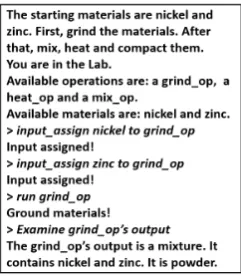
(or “quest”). The learning agent interacts with en-tities defined in the text by executing symbolic actions (Fig.2). A text-based symbolic interpreter handles execution and tracking of the agent’s state and actions. The game is completed by “simulating” the instructions correctly; i.e., mapping instructions to a sequence of actions. Correct simulation thus directly yields the desired action graph.
for-Figure 1: Sample surface text (left) and possible corresponding action-graph (right) for typical partial material synthesis procedure. Operation numbers in parentheses are added for clarity. Nodes are entities, edges are relations linking them, equivalent to actions in the text-based game.
mat allows applying powerful neural programming methods, with a significantly richer training envi-ronment, including advances such as curriculum learning, common-sense and domain-specific con-straints, and full state tracking. Such “friendly” environments that assist the learning agent have been shown to be valuable (Liang et al.,2016) and enable learning of patterns that are often hard to learn from surface annotations alone, such as im-plicit effects of operations (i.e., filtering a mixture splits it into two entities).
Interestingly, understanding by simulation aligns well with models of human cognition; mental sim-ulation, the ability to construct and manipulate an internal world model, is a cornerstone of human intelligence involved in many unique behaviors, including language comprehension (Marblestone et al.,2016;Hamrick,2019). In this work we take first steps towards this idea. Our contributions are:
• We propose anovel formulationof the prob-lem of procedural text understanding as a text-based game, enabling the use of neural pro-gramming and text-based reinforcement learn-ing (RL) methods.
• We present and release TEXTLABS1, an
in-stance of TEXT2QUESTdesigned for interac-tion with synthesis procedure texts. We fo-cus on the material-science setting, but the approach is intended to be more generally ap-plicable.
• We propose to address the problem of obtain-ing full-graph annotations at scale by cou-pling the simulator withcontrollable natural language generation(NLG) to generate syn-thetic data, also enabling curriculum learning.
1
[image:2.595.85.518.62.186.2]Code and experiments available athttps://github. com/ronentk/TextLabs
Figure 2: Excerpt from an actual “material synthe-sis quest” generated by our system with example in-put/outputs.
While this work is preliminary in nature, neural programming and text-based reinforcement learn-ing approaches are attractlearn-ing significant and grow-ing interest, and we expect advances in these areas to directly benefit future versions of the system.
2 Related Work
Procedure understanding: Many recent works have focused on tracking entities and relations in long texts, such as cooking recipes and scientific processes (Bosselut et al.,2018;Das et al.,2018). However, these methods do not directly extract a full action graph. For action graph extraction, ear-lier works use sequence tagging methods (Mysore et al.,2017).Feng et al.(2018) have applied deep-RL to the problem of extracting action sequences, but assume explicit procedural instruction texts. In
Johnson(2017), a graph is constructed from simple generated stories, using state tracking at each time step as supervision.
[image:2.595.356.477.260.400.2]and simpler texts which may require complex sym-bolic reasoning, such as mapping natural language to queries over knowledge graphs (Liang et al.,
2016). In the case of narrative parsing, the text itself may be complex while the programs are rel-atively simple (creating and linking between enti-ties present in the text). Recent work (Lu et al.,
2018) frames narrative understanding as neural-programming, the learner converts a document into a structured form, using a predefined set of data-structures. This approach is similar to ours, though with simpler texts and without a simulated environ-ment. In our approach, the learning architecture is decoupled from the symbolic interpreter environ-ment, enabling greater architectural flexibility.
Text-RL: Text-based games are used to study language grounding and understanding and RL for combinatorical action spaces (Zahavy et al.,2018;
Narasimhan,2017) but have not yet been applied to real world problems. TextWorld (Cˆot´e et al.,
2018) is a recently released reinforcement learning sandbox environment for creation of custom text-based games, upon which we base TEXTLABS.
3 Problem Formulation
Entities, Relations & Rules (E,R,Λ): Assume two vocabularies defining types of entities E = {e1, ..., eN} and relations R = {r1, ..., rK}. A
fact f is a grounded predicate of the formf =
r(h, t), h, t ∈ E, r ∈ R(single or double argu-ment predicate relations are allowed). We define the set of valid world-statesS, where a states∈S is a set of facts, and validity is decided by a world-modelΛdefined using linear logic. Λis comprised of production rules (or transition rules) over enti-ties and relations governing which new facts can be produced from a given state. Following the schema used in the Synthesis Project2(see for ex-ampleMSP), entity types include materials, opera-tions, and relevant descriptors (like operation condi-tions, etc.). Relations link between entities (like in-put(material,operation)or denote single predicate relations (entity properties such assolid(material)). We currently use a simplified version of the schema to ease the learning problem. See appendixA.1
for a mapping of relations and entities. Pro-duction rules correspond to the actions available to the learner, in our domain these include for example link-descriptor(descriptor,entity), input-assign(material, operation). While not currently
2https://www.synthesisproject.org/
included, actions such as co-reference linking and generation of entities can also be incorporated.
Action-Graph (K): An action sequence is de-fined to be a sequence of valid actions (or produc-tion rules) rooted at some initial state s0: K =
(s0, λ0, λ1, ..., λn) (applying λi to si results in
si+1, intermediate states are left out for brevity).
Note that actions may apply to implicit entities not present in the surface text (for example, the result of an operation). Construction of an action graph corresponding toK is straightforward (en-tities as nodes, actions connecting them as edges), and henceforth we useK to denote either the se-quence or the graph. Note that there can be multiple possible action sequences resulting in the same ac-tion graph, equivalent w.r.t the topological ordering of operations induced by their dependencies.
Surface (X): Asurfaceis simply a text in natu-ral language describing a process.
Learning Task: Our objective is to learn a map-pingΨ :X →K. As this mapping may be highly complex, we convert the problem to a structured prediction setting. As an intermediate stepwe map an input X to an enriched text-based-gameG
representation(details below), where the solution ofGis the required action graphK. The game is modelled as a partially observable Markov Deci-sion Process (POMDP)G= (S, A, T,Ω, O, R, γ). We refer the reader toCˆot´e et al. (2018) for a detailed exposition, and focus here on mapping the game-setting to our approach: S are states, A are actions, T are conditional state transition probabilities, where all are constant per domain and defined byE,R,Λ. Ωare observations, and O are conditional observations probabilities. R :
S×A→Ris the reward function,γ∈[0,1]is the discount factor. Asγ,Ω, Oare also preset (with actual observations dependent on agent actions), mapping a surface X to game G boils down to providing a list of entities for initializings0. For
training and evaluation, a reward function must also be provided (not necessary for applying a trained model on un-annotated text “in the wild”).
If a fully annotated action graph is available (whether synthetic or real), this mapping is simple: the initial game states0is a room where the agent
Figure 3: Proposed solution architecture of TEXT2QUEST. (i) Flow for training agent on games from real annotated data. (ii) Flow for training agent on synthetic games. (iii) Extracting action graph from un-annotated real data.
multiple possible winning action sequences. See appendicesA.2,A.3for examples.
For data “in the wild”, entities can be identi-fied using named entity recognition (NER) as pre-processing. Future directions include end-to-end learning to reduce cascading initialization errors.
By default, the TextWorld environment is par-tially observable. The agent observes the surface X at time t = 0 and other textual descriptions upon executing an “examine” action. Unlike clas-sic text-based games where partial observability is part of the challenge, in our case we can adopt the “friendly-environment” perspective and assist the learner with information such as state-tracking or action pruning (Liang et al.,2016;Johnson,2017).
4 Proposed Solution Architecture
Our system consists of 6 core modules (Fig. 3): a Knowledge Base defines entity, relation and action vocabularies. This is used by the Surface Genera-tor and Quest GeneraGenera-tor modules to generate pairs (X,˜ K˜) of synthetic surfaces and their correspond-ing action graphs for traincorrespond-ing. For un-annotated text, a pre-trained domain specific NER tagger3 is used to extract an initial game states0 by
iden-tifying the mentioned entities. A learning agent extractsKfrom a generated game.
The TEXT2QUESTarchitecture supports three central modes of operation: (i) Enrich existing real world annotated pairs (X, K) by converting them
3
For the materials synthesis domain we use the tagger available athttps://github.com/olivettigroup/ materials-synthesis-generative-models
to game instances for training the game-solving agent. (ii) Produce synthetic training pairs (X,˜ K˜). (iii) Convert un-annotated texts to game instances for action graph extraction “in the wild”.
The current version of TEXTLABS supports mode (ii). We implemented simple prototypes of the domain-specific Knowledge Base, plus Quest and Surface Generators. See Sec. A.1for details about converting the entity and relation annotation schema into TextWorld. TextWorld is easily ex-tensible and can support a variety of interaction semantics. Aside from adding a domain specific entity type-tree and actions, most of the underlying logic engine and interface is handled automatically. For the game environment, we use Inform7, a pro-gramming language and interpreter for text-based games. For quest generation, we currently use sim-ple forward chaining and heuristic search strategies to create plausible quests (for example, all start materials must be incorporated into the synthesis route). Combining these with a simple rule-based Surface Generator already allows for creating sim-ple synthetic training game instances (Fig.2).
5 Preliminary Evaluation
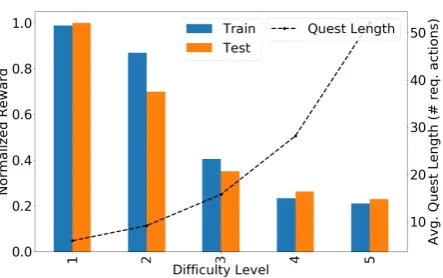
As a very preliminary sanity check for the TEXT -LABSenvironment, we train a simple text-based RL agent on synthetic games in increasingly dif-ficult environments. Difdif-ficulty is measured by maximum quest length, and the number of en-tities in the target action graph. See Sec. A.2
for representative examples. We use the basic LSTM-DQN agent ofNarasimhan(2017) adapted to the TEXTLABS setting. The action space is A = {Wv×Wo1 ×Wo2}, whereWv consists of 8 action-verbs corresponding to the entity relations tracked and additional native TextWorld actions liketake(see Sec. A.1for details). Wo1, Wo2 are (identical) sets of potential arguments correspond-ing to the active entities which can be interacted with in the game (single and double argument ac-tions allowed). As this basic agent is not condi-tioned on previous actions, we further concatenate the last four commands taken to the current obser-vation. For the same reason, we also append the full quest instructions at every timestep’s observa-tion. All illegal actions are pruned at each state to reduce search space size.
We train the agent on 100 games per level and test on 10 games. Evaluation is measured by avg. normalized reward per game: |K|1 PT
t=1ri, where
Figure 4: Preliminary evaluation results for a basic LSTM-DQN text-RL agent on synthetic quests. Dot-ted line shows average generaDot-ted quest lengths.
length (set to 50) andri = 1for each action inK and−1for otherwise (and 0 for neutral actions like
examine). A normalized score of 1 means the agent performed the required actions exactly.
As can be seen in Fig. 4, the agent learns to suc-cessfully perform the required actions only for the easiest levels. Examining longer games the agent did not complete, we note that the lack of condi-tioning on previous states is a serious limitation. Equipping agents with better sequence encoding (e.g., attention), recurrent memory, and utilizing state information is expected to significantly im-prove performance. Furthermore, due to technical limitations of the current implementation, some actions cannot be reversed. This adds to the diffi-culty of the task, and will be addressed in future versions. Finally, learning good initial policies for semantic parsers is known to be a hard problem with RL alone, and related approaches commonly use hybrid RL/supervised training methods (Liang et al.,2016;Jiang et al.,2012).
6 Discussion
Our approach faces tough challenges. However, we are encouraged by the significant recent advances towards these challenges in related areas, and plan to leverage this progress for our framework.
Programming semantics and rewards for instruction-following agents is known to be no-toriously difficult (Winograd, 1972) as language and environments grow increasingly complex. Re-search on learned instruction-conditional re-ward models(Bahdanau et al.,2018) is a promis-ing approach towards reducpromis-ing the amount of “en-vironment engineering” required.
Another critical open question in our framework is whether the surface generator will be able to generate surfaces representative enough to allow for generalization to real examples. Current NLG systems are increasingly capable of structured text generation (Marcheggiani and Perez, 2018), and though they produce relatively short surfaces, we believe that coupling them with the generated ac-tion graphs is a promising approach to scaling up to longer sequences while maintaining coher-ence. Such systems can use sentence-level se-mantic parses as training data, meaning they can leverage existing weakly-supervised shallow pars-ing techniques. Encouragpars-ing for our modellpars-ing paradigm, recent work (Peng et al.,2018) extend-ing the Dyna-Q (DQ) framework (Sutton,1990) demonstrates a real-world application of structured NLG with a simulated RL training environment.
Given sufficient text generation capabilities, one may question the added utility of the game en-vironment (as opposed to learning a direct map-ping X → K). Recent research suggests that for stronger generalization, data alone may not be enough, and symbolic reasoning capabilities are necessary (Khashabi et al., 2018; Yi et al.,
2018). Given the compositional complexity and difficulty of the language involved, we believe they will prove necessary in our setting as well.
7 Conclusions
References
The materials science procedural text corpus. https://github.com/olivettigroup/ annotated-materials-syntheses. Ac-cessed: 5/4/2019.
Dzmitry Bahdanau, Felix Hill, Jan Leike, Edward Hughes, Pushmeet Kohli, and Edward Grefenstette. 2018. Learning to Understand Goal Specifications by Modelling Reward. pages 1–19.
Trapit Bansal, Arvind Neelakantan, and Andrew Mc-Callum. 2017. RelNet: End-to-end Modeling of En-tities & Relations. pages 1–6.
Antoine Bosselut, Omer Levy, Ari Holtzman, Corin Ennis, Dieter Fox, and Yejin Choi. 2018. Simulat-ing action dynamics with neural process networks.
Proceedings of the 6th International Conference for Learning Representations.
Marc-Alexandre Cˆot´e, ´Akos K´ad´ar, Xingdi Yuan, Ben Kybartas, Tavian Barnes, Emery Fine, James Moore, Matthew Hausknecht, Layla El Asri, Mahmoud Adada, Wendy Tay, and Adam Trischler. 2018. Textworld: A learning environment for text-based games. CoRR, abs/1806.11532.
Rajarshi Das, Tsendsuren Munkhdalai, Xingdi Yuan, Adam Trischler, and Andrew McCallum. 2018. Building Dynamic Knowledge Graphs from Text us-ing Machine Readus-ing Comprehension. pages 1–12.
Wenfeng Feng, Hankz Hankui Zhuo, and Subbarao Kambhampati. 2018. Extracting Action Sequences from Texts Based on Deep Reinforcement Learning.
Jessica B Hamrick. 2019. Analogues of mental sim-ulation and imagination in deep learning. Current Opinion in Behavioral Sciences.
Jiarong Jiang, Adam R. Teichert, Hal Daum´e, and Ja-son Eisner. 2012. Learned prioritization for trading off accuracy and speed. InNIPS.
Daniel D. Johnson. 2017. Learning graphical state tran-sitions. InICLR 2017.
Daniel Khashabi, Tushar Khot, Ashutosh Sabharwal, and Dan Roth. 2018. Question answering as global reasoning over semantic abstractions. InAAAI.
Edward Kim, Zach Jensen, Alexander van Groo-tel, Kevin Huang, Matthew Staib, Sheshera Mysore, Haw-Shiuan Chang, Emma Strubell, An-drew McCallum, Stefanie Jegelka, and Elsa Olivetti. 2018. Inorganic Materials Synthesis Planning with Literature-Trained Neural Networks.
Omer Levy, Minjoon Seo, Eunsol Choi, and Luke Zettlemoyer. 2017. Zero-Shot Relation Extraction via Reading Comprehension.
Chen Liang, Jonathan Berant, Quoc Le, Kenneth D. Forbus, and Ni Lao. 2016. Neural Symbolic Ma-chines: Learning Semantic Parsers on Freebase with Weak Supervision (Short Version).
Zhengdong Lu, Haotian Cui, Xianggen Liu, Yukun Yan, and Daqi Zheng. 2018. Object-oriented neu-ral programming (oonp) for document understand-ing. InACL.
Li Lucy and Jon Gauthier. 2017. Are distributional rep-resentations ready for the real world? Evaluating word vectors for grounded perceptual meaning.
Adam H. Marblestone, Gregory Wayne, and Konrad P. K¨ording. 2016. Toward an integration of deep learn-ing and neuroscience. InFront. Comput. Neurosci.
Diego Marcheggiani and Laura Perez. 2018. Deep Graph Convolutional Encoders for Structured Data to Text Generation.
Sheshera Mysore, Edward Kim, Emma Strubell, Ao Liu, Haw-Shiuan Chang, Srikrishna Kompella, Kevin Huang, Andrew McCallum, and Elsa Olivetti. 2017. Automatically Extracting Action Graphs from Materials Science Synthesis Procedures.
Karthik Narasimhan. 2017. Grounding natural lan-guage with autonomous interaction. Ph.D. thesis, Massachusetts Institute of Technology, Cambridge, USA.
Baolin Peng, Xiujun Li, Jianfeng Gao, Jingjing Liu, Kam-Fai Wong, and Shang-Yu Su. 2018. Deep Dyna-Q: Integrating Planning for Task-Completion Dialogue Policy Learning.
Scott Reed and Nando de Freitas. 2015. Neural Programmer-Interpreters. pages 1–13.
Richard S. Sutton. 1990. Integrated Architectures for Learning, Planning, and Reacting Based on Approx-imating Dynamic Programming. InMachine Learn-ing ProceedLearn-ings 1990.
Terry Winograd. 1972. Understanding natural lan-guage. Cognitive Psychology, 3(1):1 – 191.
Kexin Yi, Jiajun Wu, Chuang Gan, Antonio Tor-ralba, Pushmeet Kohli, and Joshua B. Tenenbaum. 2018. Neural-Symbolic VQA: Disentangling Rea-soning from Vision and Language Understanding. (NeurIPS).
A Appendices
A.1 Entity & Relation Types
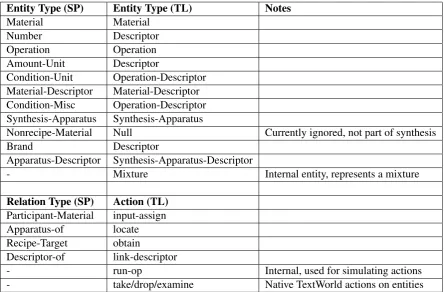
We have claimed that converting an annotation schema to a game for TEXTLABSwas relatively straightforward. In this section, we provide de-tails of the mapping between the Synthesis Project annotation schema of (denoted with “SP” in the tables) to the TEXTLABSimplementation (denoted
“TL”). A mapping between the central entity types is presented in Figure5, as well as the TEXTLABS
actions and representative corresponding relations in the schema. All current TEXTLABSentities and actions are shown here, though not all of the orig-inal entities and relations are listed. For the full mapping, refer to the project source repository.
A.2 Synthetic Action-Graphs
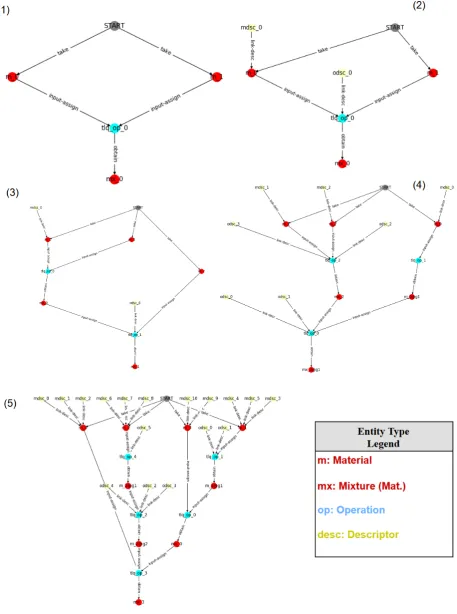
Figure6displays sample representative generated quests for the various difficulty levels evaluated in Sec.5, demonstrating the controllable complexity. As can be seen by comparison with the real text in Fig. 7(which is only one sentence), these graphs correspond to short real-world surfaces, where even the hardest could by covered by a 2-3 sentence-long procedure.
A.3 Action-Graphs from Real Annotated Graphs
We now provide further details on how the origi-nal Synthesis Project (SP) annotated graphs can be converted to a TEXTLABSaction graphK. There are some minor differences between the formats, primarily in the handling of the SP “next-operation” relation. Rather than use a “next-operation” re-lation, we currently opt to explicitly model in-puts/outputs to operations, as can be seen in Fig.
Entity Type (SP) Entity Type (TL) Notes
Material Material
Number Descriptor
Operation Operation
Amount-Unit Descriptor
Condition-Unit Operation-Descriptor Material-Descriptor Material-Descriptor Condition-Misc Operation-Descriptor Synthesis-Apparatus Synthesis-Apparatus
Nonrecipe-Material Null Currently ignored, not part of synthesis
Brand Descriptor
Apparatus-Descriptor Synthesis-Apparatus-Descriptor
- Mixture Internal entity, represents a mixture
Relation Type (SP) Action (TL)
Participant-Material input-assign
Apparatus-of locate
Recipe-Target obtain
Descriptor-of link-descriptor
- run-op Internal, used for simulating actions
[image:8.595.77.522.249.541.2]- take/drop/examine Native TextWorld actions on entities