SemEval-2015 Task 4: TimeLine: Cross-Document Event Ordering
Anne-Lyse Minard1, Manuela Speranza1, Eneko Agirre2, Itziar Aldabe2, Marieke van Erp3,Bernardo Magnini1,German Rigau2,Rub´en Urizar2
1 Fondazione Bruno Kessler, Trento, Italy
2 The University of the Basque Country (UPV/EHU), Spain 3 VU University Amsterdam, the Netherlands
{minard,manspera,magnini}@fbk.eu, [email protected] {itziar.aldabe,e.agirre,german.rigau,ruben.urizar}@ehu.eus
Abstract
This paper describes the outcomes of the TimeLine task (Cross-Document Event Order-ing), that was organised within the Time and Space track of SemEval-2015. Given a set of documents and a set of target entities, the task consisted of building a timeline for each en-tity, by detecting, anchoring in time and or-dering the events involving that entity. The TimeLine task goes a step further than previ-ous evaluation challenges by requiring partic-ipant systems to perform both event corefer-ence and temporal relation extraction across documents. Four teams submitted the output of their systems to the four proposed subtracks for a total of 13 runs, the best of which ob-tained anF1-score of 7.85 in the main track (timeline creation from raw text).
1 Introduction
In any domain, it is important that professionals have access to high quality knowledge for taking well-informed decisions. As daily tasks of information professionals revolve around reconstructing a chain of previous events, an insightful way of presenting information to them is by means of timelines. The aim of the Cross-Document Event Ordering task is to build timelines from English news articles. To provide focus to the timeline creation, the task is pre-sented as an ordering task in which events involving a particular target entity are to be ordered chrono-logically. The task focuses on cross-document event coreference resolution and cross-document temporal relation extraction.
The latter has been the topic of the three previous TempEval tasks within the SemEval challenges:
• TempEval-1 (2007): Temporal Relation Identifi-cation (Verhagen et al., 2009)
• TempEval-2 (2010): Evaluating Events, Time Ex-pressions, and Temporal Relations (Verhagen et al., 2010)
• TempEval-3 (2013): Temporal Annotation (Uz-Zaman et al., 2013)
Additionally, it has also been the focus of the 6th i2b2 NLP Challenge for clinical records (Sun et al., 2013). The cross-document aspect, however, has not often been explored. One example is the work de-scribed in (Ji et al., 2009) using the ACE 2005 train-ing corpora. Here the authors link pre-defined events involving the same centroid entities (i.e. entities fre-quently participating in events) on a timeline. Nom-inal coreference resolution has been the topic of Se-mEval 2010 Task on Coreference Resolution in Mul-tiple Languages (Recasens et al., 2010). TimeLine is a pilot task that goes beyond the above-mentioned evaluation exercises by addressing coreference reso-lution for events and temporal relation extraction at a cross document level.
This task was motivated by work done in the NewsReader project1. The goal of the NewsReader
project is to reconstruct story lines across news ar-ticles in order to provide policy and decision mak-ers with an overview of what happened, to whom, when, and where. Thus, the NewsReader project aims to present end-users with cross-document sto-rylines. Timelines are intermediate event
represen-1http://www.newsreader-project.eu
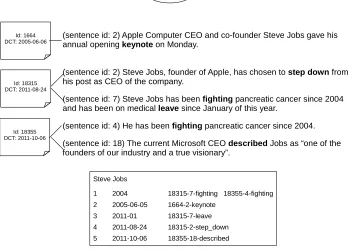
Id: 1664 DCT: 2005-06-06
Id: 18315 DCT: 2011-08-24
Id: 18355 DCT: 2011-10-06
(sentence id: 2) Apple Computer CEO and co-founder Steve Jobs gave his annual opening keynote on Monday.
(sentence id: 2) Steve Jobs, founder of Apple, has chosen to step down from his post as CEO of the company.
(sentence id: 7) Steve Jobs has been fighting pancreatic cancer since 2004 and has been on medical leave since January of this year.
(sentence id: 4) He has been fighting pancreatic cancer since 2004.
(sentence id: 18) The current Microsoft CEO described Jobs as “one of the founders of our industry and a true visionary”.
Steve Jobs
1 2004 18315-7-fighting 18355-4-fighting 2 2005-06-05 1664-2-keynote
3 2011-01 18315-7-leave 4 2011-08-24 18315-2-step_down 5 2011-10-06 18355-18-described
Target entity:
[image:2.612.125.474.87.337.2]Steve Jobs
Figure 1: Example of a timeline for the target entity “Steve Jobs” built from five sentences coming from three documents.
tations towards this goal.
The remainder of this paper is organised as fol-lows. In Section 2, we introduce the task. In Sec-tion 3, we describe the data annotaSec-tion protocol. In Section 4, we present the characteristics of our dataset and gold standard timelines. In Section 5, we describe our evaluation methodology, followed by the description of participant systems in Section 6 and the results obtained by the participants to the task in Section 7. Lessons learnt and limitations of our setup are discussed in Section 8.
2 Task Description
Given a set of documents and a set of target enti-ties, the task consists of building a timeline related to each entity, i.e. detecting, anchoring in time, and ordering the events in which the target entity is in-volved (Minard et al., 2014b). We base our no-tion of event on TimeML, according to which an event is a cover term for situations that happen or occur, including predicates describing states or cir-cumstances in which something obtains or holds true
(Pustejovsky et al., 2003).
As input data, we provide a set of documents and a set of target entities; only entities involved in more than two events across at least two different docu-ments are considered as candidates target entities. We also propose two different tracks on the basis of the data used as input: Track A, for which we provided only the raw text sources (main track), and
Track B, for which we also made gold event men-tions available.
The expected output, both for Track A and B, is one timeline for each target entity. A timeline for a specific target entity consists of the ordered list of the events in which that entity participates. Events in a timeline are anchored in time through the time anchor attribute; however, for both Track A and B, we also propose a subtrack in which the events do not need to be associated to a time anchor.
In order to perform the task, participants are required to resolve entity coreference, as time-lines should contain events involving all corefer-ring textual mentions of the target entities (including pronominal mentions). For example, in Figure 1, the eventfightinginvolving the target entitySteve Jobs mentioned asheis included in the timeline together with other events also referring toSteve Jobs.
The dataset released for this task is composed of 120 Wikinews2 articles and 44 target entities. 30
documents and 6 target entities (each associated to a timeline) are provided as trial data, while the evalu-ation dataset consist of 90 documents and 38 target entities (each associated to a timeline).
3 Data Annotation
We manually selected a set of target entities that ap-peared in at least two different documents and were involved in more than two events.
The target entities are restricted to type PERSON (single persons or sets of people), ORGANISATION (corporations, agencies, and other groups of people defined by an established organisational structure), PRODUCT (anything that might satisfy a want or need, including facilities, food, products, services, etc.), and FINANCIAL (the entities belonging to the financial domain that are not included in one of the other entity types).
Some examples of target entities are Steve Jobs (PERSON),Apple Inc. (ORGANISATION),Airbus A380(PRODUCT), andNasdaq(FINANCIAL).
The annotation procedure for the creation of gold standard timelines for the target entities required one person month. It consisted of four steps, as de-scribed below.
Entity annotation. All occurrences of the target entities in the four corpora were marked following (Tonelli et al., 2014). Cross-document co-reference was annotated according to the NewsReader cross-document annotation guidelines (Speranza and Mi-nard, 2014). For this task, we used CROMER3
(Gi-rardi et al., 2014), a tool designed specifically for cross-document annotation.
2http://en.wikinews.org.
3https://hlt.fbk.eu/technologies/cromer
Event and time anchor annotation. Using
CROMER, the corpora were annotated with events following the NewsReader cross-document annota-tion guidelines (Speranza and Minard, 2014). The annotation of events as defined in (Tonelli et al., 2014) was restricted by limiting the annotation to events that could be placed on a timeline. Thus, we did not annotate adjectival events, cognitive events, counter-factual events (which certainly did not hap-pen), uncertain events (which might or might not have happened) and grammatical events4. For
ex-ample, the eventsgave, chosenandbeen (on medi-cal leave)in Figure 1 are excluded from the timeline as they are grammatical events.
Furthermore, timelines only contain events in which target entities explicitly participate in a has participantrelation as defined in (Tonelli et al., 2014), with the semantic role ARG0 (i.e. agent) or ARG1 (i.e. patient), as defined in the PropBank Guidelines (Bonial et al., 2010). In the example in Figure 1 we have an explicithas participantrelation between the entitySteve Jobsand the eventfighting with semantic role ARG0, and one with semantic role ARG1 betweenSteve Jobsanddescribed.
Based on TimeML (Pustejovsky et al., 2003), a time anchor corresponds to a TIMEX3 of type DATE; the time anchor attribute of an event takes as value the point in time when the event occurred (in the case of punctual events) or began (in the case of durative events). Its format follows the ISO-8601 standard: YYYY-MM-DD (i.e. Year, Month, and Day).
The finest granularity for time anchor values is DAY; other granularities admitted are MONTH and YEAR (references to months are specified as YYYY-MM and references to years are expressed as YYYY). The place-holder character, X, is used for unfilled positions in the value of a component. Thus, an event happened some day (not specified in the text) in July 2010 (for example, resigned in The company’s CEO met his employees one morn-ing last July) has time anchor 2010-07-XX
(granu-4Grammatical events are verbs or nouns that are
larity DAY), while an event happened in the same month but with a granularity lower than day (for example in Apple received criticism last month for the placement of the antenna on iPhone 4), has time anchor 2010-07. Similarly, XXXX-XX-XX is used when the time anchor is completely unknown and the granularity is DAY, while XXXX-XX and XXXX are used when the time anchor is unknown and the granularity is MONTH and YEAR respec-tively (Minard et al., 2014a).
Automatic creation of timelines. We represent timelines in a simple tab format. On each line, we first have a cardinal number indicating the position of an event in the timeline, then the value of the an-chor time attribute for the same event, and finally the event itself, which is represented as follows: docu-ment identifier, sentence number and textual extent of the event. For example, the event18315-7-leave in Figure 1 (occurring in sentence 7 of document 18315) occupies position4in the timeline and is an-chored to2011-01.
In the case of event coreference, in the third col-umn, there is a list of coreferring events separated by tabs instead of a single event (see the coreferring events18315-7-fightingand18355-4-fightingat po-sition 1 in the example in Figure 1).
If two events have the same value for the anchor time attribute, they are placed in the same position (i.e. the same number in the first column), but on different lines.
The automatic created timelines are produced by a script that orders events in a timeline on the basis of the time anchors (all events with the same time an-chor are simultaneous and all events with unknown time anchor are at position 0).
Manual revision of the timelines. The manual re-vision consists of ordering events with the same time anchor or with unknown time anchor taking into consideration textual information that goes beyond the defining of time anchor (Minard et al., 2014a).
For example bothfoundedandclosedinThe firm was founded in 2010 and closed before the end of the yearhave anchor time 2010; nonetheless, based on textual information, it is possible to order them (the firm first was founded and then closed). When it is not possible to order events based either on the time anchor or on textual information, annotators leave
them at the same position on the timeline. The same holds for events with anchor time XXXX-XX-XX; if annotators have no textual information that can help ordering them, they leave them at position 0; other-wise they place them on the timeline.
Inter-annotator agreement Three annotators have annotated a corpus starting from one target entity, i.e. they have annotated entity coreferences refering to the target entity and the events in which this entity participates. The corpus used is the trial corpus aboutApple Inc.and the target entityiPhone 4. We compute the inter-annotator agreement using the Dice’s coefficient (Dice, 1945). For the annotation of entity and event mentions, the agreement is respectively 0.81 and 0.66, and for entity coreferences of 0.84.
4 Task Dataset
The dataset used for this task is composed of arti-cles from Wikinews, a collection of multilingual on-line news articles written collaboratively in a wiki-like manner. The reason for choosing Wikinews as a source is its creative commons license allowing us to freely release this dataset to the research community. For this task, we selected Wikinews articles around four topics:
• Apple Inc. (trial corpus);
• Airbus and Boeing (corpus 1);
• General Motors, Chrysler and Ford (corpus 2);
• Stock Market (corpus 3).
The trial data consists of one corpus of 30 docu-ments and gold standard timelines for six target en-tities. The other three corpora, each consisting of 30 documents (about 30,000 tokens each) were used as the evaluation dataset.
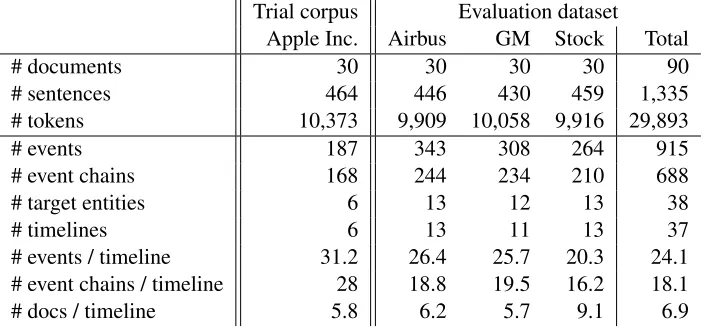
As reported in Table 1, the total number of target entities in the evaluation dataset amounts to 38, but for the evaluation we used 37 timelines instead as one of the timelines contained no events.
Trial corpus Evaluation dataset
Apple Inc. Airbus GM Stock Total
# documents 30 30 30 30 90
# sentences 464 446 430 459 1,335 # tokens 10,373 9,909 10,058 9,916 29,893
# events 187 343 308 264 915
# event chains 168 244 234 210 688 # target entities 6 13 12 13 38
# timelines 6 13 11 13 37
# events / timeline 31.2 26.4 25.7 20.3 24.1 # event chains / timeline 28 18.8 19.5 16.2 18.1 # docs / timeline 5.8 6.2 5.7 9.1 6.9
Table 1: Quantitative data about the dataset.
The three evaluation corpora are very similar in terms of size. It is interesting to notice, however, that the timelines created from the Stock Market corpus have peculiar features as they contain a lower aver-age number of events with respect to those created from the other corpora. On the other hand, on av-erage, Stock Market timelines contain events from a higher number of different documents, i.e. 9.1, ver-sus 6.2 for Airbus and 5.7 for GM.
5 Evaluation Methodology
The evaluation methodology of this task is based on the evaluation metric used for TempEval-3 (UzZa-man et al., 2013) to evaluate relations in terms of recall, precision andF1-score. The metric captures
the temporal awareness of an annotation (UzZaman and Allen, 2011).
Temporal awareness is defined as the performance of an annotation as identi-fying and categorizing temporal relations, which implies the correct recognition and classification of the temporal entities in-volved in the relations.
We calculate the Precision by check-ing the number of reduced system rela-tions that can be verified from the refer-ence annotation temporal closure graph, out of number of temporal relations in the reduced system relations. Similarly, we calculate the Recall by checking the num-ber of reduced reference annotation
rela-keynote leave step_down
fighting described
2004 2005-06-05 2011-01 2011-08-24 2011-10-06
[image:5.612.131.485.61.225.2]BEFORE SIMULTANEOUS Explicit relations Implicit relations
Figure 2: Explicit and implicit relations resulting from the timeline of Figure 1.
tions that can be verified from the sys-tem output’s sys-temporal closure graph, out of number of temporal relations in the re-duced reference annotation. (UzZaman et al., 2013)
Before evaluating temporal awareness, each time-line needs to be transformed into a set of temporal relations. Figure 2 shows the explicit relations re-sulting from the timeline of Figure 1 as well as the implicit relations captured by the temporal graph. In order to convert each timeline, we defined the fol-lowing transformation steps:
1. Each time anchor is represented as a TIMEX3. 2. Each event is related to one TIMEX3 with the
3. If one event happens before another one, a BE-FORE relation type is created between both events.
4. If one event happens at the same time as another one, a SIMULTANEOUS relation type is created between both events.
Note that the evaluation of subtracks (ordering only), requires steps 3 and 4 alone.
For this first pilot on timelines, we decided to simplify the representation of durative events in the timelines by anchoring them in time considering their starting point. For this reason we represent re-lations between each event and its time anchor with the SIMULTANEOUS relation type (instead of other possibilities like BEGUN BY or INCLUDES).
Events placed at the beginning of the timeline at position 0, i.e. events that were not ordered, are not considered in the evaluation. The official scores are based on the micro-average of the individualF1
-scores for each timeline, i.e. the -scores are averaged over the events of the timelines of each corpus. The micro-average precision and recall values are also provided.
6 Participant Systems
29 teams signed up for the evaluation task, 8 teams downloaded the evaluation dataset and only 4 teams submitted results. A total of 13 unique runs were submitted: 3 for Track A (for which the participants worked on the raw texts), 2 for SubTrack A, 4 for Track B (for which the event mentions were pro-vided) and 4 for SubTrack B.
The WHUNLPteam processed the texts with
Stan-ford CoreNLP. They applied a rule-based approach to extract target entities and their predicates, and per-form temporal reasoning.
The SPINOZAVU5system is based on the pipeline
developed in the NewsReader project and on the TIPSem tool. The tools are used for pre-processing, dependency parsing, semantic role labelling, event detection, temporal expression normalisation, coref-erence resolution and temporal relations extraction.
The GPLSIUA team also used a pipeline
ap-proach, employing the OpeNER language analysis
5The members of the SPINOZAVU team involved in the
NewsReader project were not involved in any annotation work or discussions around the organisation of the TimeLine task.
toolchain, the Semantic Role Labeller from SENNA and the TIPSem tool for temporal processing. In addition, in order to detect event coreferences, they used the topic modelling algorithm of MALLET.
The HEIDELTOULteam used the HeidelTime tool
for time expression recognition and normalisation and Stanford CoreNLP for coreference resolution. Afterwards, they used a cosine similarity matching function and a distance measure to select sentences relevant for a target entity and their events.
Three teams, SPINOZAVU, GPLSIUA and HEI -DELTOUL, participated in the subtracks. They all
submitted the same timelines both for the Tracks and the SubTracks, simply removing time anchors.
7 Evaluation Results
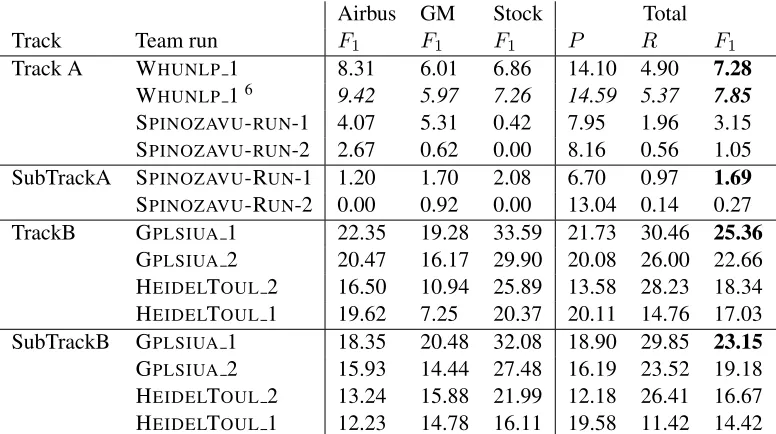
The official results are presented in Table 2. For each corpus we present the micro F1-score and in
the last three columns the micro precision, micro re-call and micro F1-score overall the three corpora.
In the main track, Track A, WHUNLP 1 was the
best run and achieved anF1 of 7.28%. In Track B,
GPLSIUA 1 obtained the best scores with an F1 of
25.36%.
The subtracks were proposed in order to evaluate systems that do not perform time normalisation or event anchoring in time but focus on temporal re-lations between events. In the end, the events or-dering of the runs submitted to the subtracks was the same as those submitted to the main tracks. In SubTrack A the best results are obtained with the run 1 of SPINOZAVU team, achieving an F1-score
of 1.69%. In SubTrack B, the best system is the same as in Track B, GPLSIUA 1, with anF1-score
of 23.15%.
We evaluate the selection of the relevant events involving a target entity using the classic evaluation metrics: recall, precision andF1-score. All events
are taken into account independently of their order-ing in timelines; events placed at position 0 are also evaluated. The number of true positives and F1
-scores obtained on each corpus as well as the micro-average F1-scores are presented in Table 3. In
Airbus GM Stock Total Track Team run F1 F1 F1 P R F1
Track A WHUNLP 1 8.31 6.01 6.86 14.10 4.90 7.28
WHUNLP 16 9.42 5.97 7.26 14.59 5.37 7.85
SPINOZAVU-RUN-1 4.07 5.31 0.42 7.95 1.96 3.15
SPINOZAVU-RUN-2 2.67 0.62 0.00 8.16 0.56 1.05
SubTrackA SPINOZAVU-RUN-1 1.20 1.70 2.08 6.70 0.97 1.69
SPINOZAVU-RUN-2 0.00 0.92 0.00 13.04 0.14 0.27
TrackB GPLSIUA 1 22.35 19.28 33.59 21.73 30.46 25.36
GPLSIUA 2 20.47 16.17 29.90 20.08 26.00 22.66
HEIDELTOUL2 16.50 10.94 25.89 13.58 28.23 18.34
HEIDELTOUL1 19.62 7.25 20.37 20.11 14.76 17.03
SubTrackB GPLSIUA 1 18.35 20.48 32.08 18.90 29.85 23.15
GPLSIUA 2 15.93 14.44 27.48 16.19 23.52 19.18
HEIDELTOUL2 13.24 15.88 21.99 12.18 26.41 16.67
HEIDELTOUL1 12.23 14.78 16.11 19.58 11.42 14.42
Table 2: Official results of the TimeLine task of the four participating teams7 presented per subcorpus
and over the whole dataset. (Track A: timelines with time anchors from raw text;SubTrack A: timelines without time anchors from raw text;Track B: timelines with time anchors from texts annotated with events;
SubTrack B: timelines without time anchors from texts annotated with events.)
Airbus GM Stock Total
Events TA Events TA Events TA Events TA
Team runs TP F1 Acc TP F1 Acc TP F1 Acc TP F1 Acc
WHUNLP 120 34.53 42.50 120 34.33 34.17 91 42.52 17.58 331 36.33 32.63
SPINOZAVU1 46 17.59 23.91 61 22.93 36.07 57 30.24 0.00 164 22.91 20.12
SPINOZAVU2 30 13.16 26.67 50 21.69 30.00 45 26.55 0.00 125 19.90 18.40
GPLSIUA 1 240 59.33 36.67 234 67.73 24.34 190 72.80 43.16 664 65.68 34.17
GPLSIUA 2 197 53.53 32.49 188 57.58 22.87 152 59.14 41.45 537 56.44 31.66
HEIDELTOUL 1 172 50.44 38.95 119 49.90 10.92 98 46.34 47.96 389 49.18 32.65
[image:7.612.112.500.60.277.2]HEIDELTOUL 2 250 45.83 37.60 182 54.98 16.48 178 55.02 48.31 610 50.83 34.43
Table 3: Evaluation of the selection of events in which a target entity is involved and of time anchors assignment; TP: number of correctly identified events; F1: micro-average F1-score for the selection of
events;Acc: accurracy in assignment of time anchors.
correctly identified events (TP in the table).
The results obtained in SubTracks, when evaluat-ing only events orderevaluat-ing, are mainly lower than in Tracks, except on the “GM” corpus. For example the HEIDELTOUL 1 system achieved anF1-score of
17.03% overall the 3 corpora in Track B and 14.42%
6We found an error in the format of some event ids and
re-processed the evaluation on a corrected version of the timelines.
7HEIDELTOUL 1 and HEIDELTOUL 2 are shorthand
for HEIDELTOUL NONTOLMATCHPRUNE and HEIDEL-TOUL TOLMATCHPRUNErespectively.
in SubTrack B. But on “GM” corpus, the HEIDEL
-TOUL 1 system obtained anF1-score twice as high
as in Track B, obtaining anF1-score of 14.78% (vs.
7.25% in Track B). In evaluating the time anchors assignment (see Table 3), we observed that HEI -DELTOUL and GPLSIUA systems performed better
[image:7.612.77.540.358.480.2](Track B). Furthermore, the task of time expression extraction and normalisation has been the topic of different shared tasks and the obtained results are high with an F1-score of 90.30 for time
expres-sion detection and of 77.61 for normalisation (re-sults obtained by HeidelTime (Str¨otgen et al., 2013) at TempEval-3). However, the performance of tem-poral relation extraction systems is quite low with an
F1-score of 36.26 obtained by ClearTK-2 (Bethard,
2013), the best system at TempEval-3 on Task C. Observing the results by corpus in Table 2, we notice that, except for Track A, the best results are obtained on the “Stock Market” corpus. One of the reasons is that in the timelines related to this corpus all events were ordered (only one event was placed at position 0), while in “Airbus” and “GM” corpora less than 70% of the events were ordered.
In the “GM” corpus, one timeline was empty (“General Motors creditors”), i.e. the corpus does not contain any event that have this target entity as Arg0 or Arg1, therefore this timeline was re-moved from the evaluation. We observed that SPINOZAVUsystems in Track A and GPLSIUA
sys-tems in Track B correctly returned an empty time-line, while WHUNLP created a timeline with 3
events in Track A and HEIDELTOUL1 and HEIDEL
-TOUL 2 produced a timeline containing respectively
32 and 78 events for this target entity in Track B. Track B was proposed as a simplified task given that annotated texts with events were distributed to participants. Unfortunately no results from the same system run on both Tracks A and B were submitted, therefore, at the moment, we cannot evaluate the im-pact of pre-annotation of events.
8 Conclusion
The TimeLine task is the first task focusing on cross-document ordering of events. For this task, we have defined guidelines for cross-document annotation and for timeline creation, as well as annotated trial and evaluation datasets. The results submitted by four teams show much room for improvement. Ob-viously, timeline creation is a very challenging task which deserves more attention in future research.
Additionally, during the organisation of this task, many issues arose that provide interesting avenues of future research into timeline creation. Our three
main issues concern durative versus punctual events, events without explicit time anchors and the relation between target entities and events. Below, we detail each of these questions.
Anchoring events in time. The ordering of an event in a timeline is based on the time when the event occurred. However, many events are durative events that have a starting point and/or an ending point. For the task, we decided to order durative events according to their starting points. We are in-vestigating whether a new timeline format can be de-fined to represent the durative aspect of these events.
Events without explicit textual time anchor. We made the choice to include them in the timelines but not to evaluate them (events at position 0). The dif-ficulty is to identify cases in which an event cannot be ordered in order to give instruction to annotators and systems. When ordering an event, should we take into consideration the information contained in-side one document or inin-side one corpus, or could (should) we consider also background knowledge?
The relation between target entities and events.
We chose to select events in which one target en-tity is explicitly involved in a participant relation. Amongst others, this rule excludes events involving a group of which a target entity is member. For example the event received in The two companies have received$13.4 billion(in which the two com-paniesrefers to General Motors and Chrysler) does not appear either in the “General Motors” timeline or in the “Chrysler” timeline. Considering also im-plicithas participantrelations would take the time-line task into the domain of complex entity relation-ships, but could possibly be interesting if considered in combination with taxonomy induction tasks.
Acknowledgments
This research was funded by the European Union’s 7th Framework Programme via the NewsReader (ICT-316404) project.
References
Steven Bethard. 2013. ClearTK-TimeML: A minimalist approach to TempEval 2013. In Proceedings of the Seventh International Workshop on Semantic Evalu-ation, SemEval ’13, pages 10–14, Atlanta, Georgia, USA, June.
Claire Bonial, Olga Babko-Malaya, Jinho D. Choi, Jena Hwang, and Martha Palmer. 2010. Propbank
anno-tation guidelines, December. http://www.ldc.
upenn.edu/Catalog/docs/LDC2011T03/
propbank/english-propbank.pdf.
Lee Raymond Dice. 1945. Measures of the amount of ecologic association between species. Ecology, 26(3):297–302, July.
Christian Girardi, Manuela Speranza, Rachele Sprugnoli, and Sara Tonelli. 2014. CROMER: a Tool for Cross-Document Event and Entity Coreference. In Proceed-ings of the Ninth International Conference on Lan-guage Resources and Evaluation (LREC’14), Reyk-javik, Iceland, may.
Heng Ji, Ralph Grishman, Zheng Chen, and Prashant Gupta. 2009. Cross-document event extraction and tracking: Task, evaluation, techniques and challenges. InRANLP, pages 166–172.
Anne-Lyse Minard, Alessandro Marchetti, Manuela Speranza, Bernardo Magnini, Marieke van Erp, Itziar Aldabe, Rub´en Urizar, Eneko Agirre, and
German Rigau. 2014a. TimeLine:
CrossDocument Event Ordering. SemEval 2015
-Task 4. Annotation Guidelines. Technical
Re-port NWR2014-11, Fondazione Bruno Kessler.
http://www.newsreader-project.eu/
files/2014/12/NWR-2014-111.pdf.
Anne-Lyse Minard, Manuela Speranza, Bernardo Magnini, Marieke van Erp, Itziar Aldabe, Rub´en
Urizar, Eneko Agirre, and German Rigau.
2014b. TimeLine: Cross-Document Event
Or-dering. SemEval 2015 - Task 4. Technical Report
NWR2014-10, Fondazione Bruno Kessler. http:
//www.newsreader-project.eu/files/
2013/01/SemEvaltaskdescription.pdf.
James Pustejovsky, Jos´e Casta˜no, Robert Ingria, Roser Saur´ı, Robert Gaizauskas, Andrea Setzer, and Graham Katz. 2003. TimeML: robust specification of event and temporal expressions in text. In Fifth Interna-tional Workshop on ComputaInterna-tional Semantics (IWCS-5), pages 1–11.
Marta Recasens, Llu´ıs M`arquez, Emili Sapena, M. Ant`onia Mart´ı, Mariona Taul´e, V´eronique Hoste, Massimo Poesio, and Yannick Versley. 2010. SemEval-2010 Task 1: Coreference Resolution in Multiple Languages. InProceedings of the 5th Inter-national Workshop on Semantic Evaluation, SemEval ’10, pages 1–8, Stroudsburg, PA, USA.
Manuela Speranza and Anne-Lyse Minard. 2014.
NewsReader Cross-Document Annotation Guidelines. Technical Report NWR2014-9, Fondazione Bruno
Kessler. http://www.newsreader-project.
eu/files/2015/01/NWR-2014-9.pdf.
Jannik Str¨otgen, Julian Zell, and Michael Gertz. 2013. Heideltime: Tuning english and developing spanish re-sources for tempeval-3. InProceedings of the Seventh International Workshop on Semantic Evaluation, Se-mEval ’13, pages 15–19, Atlanta, Georgia, USA. Weiyi Sun, Anna Rumshisky, and Ozlem Uzuner. 2013.
Evaluating temporal relations in clinical text: 2012 i2b2 Challenge. Journal of the American Medical In-formatics Association, 20(5):806–813, September. Sara Tonelli, Rachele Sprugnoli, Manuela Speranza, and
Anne-Lyse Minard. 2014. NewsReader
Guide-lines for Annotation at Document Level.
Tech-nical Report NWR2014-2-2, Fondazione Bruno
Kessler. http://www.newsreader-project.
eu/files/2014/12/NWR-2014-2-2.pdf.
Naushad UzZaman and James Allen. 2011. Temporal evaluation. InProceedings of the 49th Annual Meet-ing of the Association for Computational LMeet-inguistics: Human Language Technologies, pages 351–356, Port-land, Oregon, USA.
Naushad UzZaman, Hector Llorens, Leon Derczynski, James Allen, Marc Verhagen, and James Pustejovsky. 2013. SemEval-2013 Task 1: TempEval-3: Evaluating Time Expressions, Events, and Temporal Relations. InProceedings of the Seventh International Workshop on Semantic Evaluation, SemEval ’13, pages 1–9, At-lanta, Georgia, USA.
Marc Verhagen, Robert J. Gaizauskas, Frank Schilder, Mark Hepple, Jessica Moszkowicz, and James Puste-jovsky. 2009. The TempEval challenge: identifying temporal relations in text. Language Resources and Evaluation, 43(2):161–179.