Exactly two things to learn from modeling scope ambiguity resolution:
Developmental continuity and numeral semantics
K.J. Savinelli UCI Cognitive Sciences
Gregory Scontras UCI Linguistics [email protected]
Lisa Pearl UCI Linguistics & Cognitive Sciences
Abstract
Behavioral data suggest that both children and adults struggle to access theinverse
interpretation of scopally-ambiguous ut-terances in certain contexts. To deter-mine whether the causes of both child and adult difficulty are similar, we extend an existing computational model of chil-dren’s scope ambiguity resolution in con-text. We find that the same utterance-disambiguation mechanism is active in both children and adults, supporting the theory of developmental continuity. More-over, because adult behavior requires an
exact semantics for numerals, we also provide empirical support for this theory of linguistic representation.
Keywords: ambiguity resolution, devel-opmental continuity, language acquisition, numerals, pragmatics, processing, Ratio-nal Speech Act model, scope, semantics
1 Introduction
Consider a scenario where two out of three horses jump over a fence. Is the utterance in(1)a reason-able description?
(1) Every horse didn’t jump over the fence. a. ∀ ¬(surfacescope):
Noneof the horses jumped over the fence. b. ¬ ∀(inversescope):
Not allof the horses jumped the fence. Adults typically endorse theevery-notutterance as true, while children typically do not (Musolino,
1998; Lidz and Musolino, 2002; Musolino and Lidz, 2006; Musolino, 2006; Viau et al., 2010). This utterance is scopally ambiguous, involving multiple quantifiers (i.e., every and n’t). Chil-dren’s behavior is non-adult-like at five years old:
though theinverse interpretation in(1b)is true, five-year-olds still do not endorse the utterance.
Now, consider a scenario with only two horses, one of which successfully jumps. Is thetwo-not
utterance in(2)a reasonable description?
(2) Two horses didn’t jump. a. ∃2 ¬(surfacescope):
There are two horses that didn’t jump. b. ¬ ∃2 (inversescope):
It’s not the case that there are two horses that jumped.
Most adults wouldnot endorse the utterance, de-spite theinverseinterpretation in(2b)being true (Musolino and Lidz, 2003)—that is, it is not the case that two horses jumped (only one did).
This pair of findings underscores that not en-dorsing a scopally-ambiguous utterance when only theinverse interpretation is true occurs in both children and adults in different contexts. We might therefore wonder about continuity in the development of scope ambiguity resolution: is the cause of child utterance non-endorsement in an every-not scenario qualitatively similar to the cause of adult non-endorsement in the two-not
scenario? If so, this similarity supports develop-mental continuity: children use the same mecha-nism as adults when understanding ambiguous ut-terances in context. The only difference would be that adults are better-equipped to deploy this mechanism, owing perhaps to increased domain-general knowledge and/or cognitive capacities, or to language-specific experience. In contrast, if the underlying causes are different for child and adult utterance non-endorsement, this would sug-gest developmental discontinuity: children are en-gaging in a fundamentally different process as they understand ambiguous utterances. So, the devel-opment of adult-like behavior would involve
quiring a new mechanism for resolving ambiguity. To choose between these accounts, we must understand utterance (non-)endorsement behav-ior. To that end, Savinelli et al. (2017) articu-lated a computational model of ambiguity resolu-tion within the Raresolu-tional Speech Act (RSA) frame-work (Goodman and Frank, 2016). The model demonstrated the central role of pragmatic fac-tors over processing facfac-tors in explaining chil-dren’s non-adult-like behavior in every-not con-texts like (1). Here, we extend this same model to capturetwo-not utterance endorsement behav-ior in adults, identifying the factors that yield the experimentally-observed patterns of behavior.
We begin by reviewing the scope ambiguity res-olution findings from Savinelli et al. (2017), to-gether with the experimental results that informed the design of the computational model. Next, we consider the experimental findings fromMusolino and Lidz (2003), where adults seem to behave like children in specific contexts. We then extend the model fromSavinelli et al. (2017) to capture these new data, and demonstrate support for de-velopmental continuity, with the same utterance-disambiguation mechanism active in both chil-dren and adults. Importantly, the complete range of experimentally-observed behavior can only be captured if adults representtwowith anexact in-terpretation, an unexpected finding that informs the debate on numeral semantics.
2 Previous work: Modelingevery-not
In the basic truth-value judgment task (TVJT) meant to assess children’s scope disambiguation behavior, children first watch a scene acted out and hear a puppet produce a scopally-ambiguous utterance; then they are asked whether they would endorse the utterance as a true description of the scenario. Children typically do not endorse the ambiguousevery-notutterance in the critical con-text where thesurfaceinterpretation is false but theinverseinterpretation is true (e.g., aNOT-ALL scenario where two out of three horses jumped over a fence). This behavior has been interpreted as children failing to access theinversescope in-terpretation that would make the utterance true.
Interestingly, various alterations to the task setup have yielded more adult-like behavior in children, with higher rates of endorsement for the
every-not utterance. These experimental manip-ulations highlight at least three core factors (two
pragmatic, one processing) that underlie children’s behavior in the TVJT: (i)pragmatic: expectations about the experimental world (e.g., how likely suc-cessful outcomes are), (ii) pragmatic: expecta-tions about the Question Under Discussion (QUD; e.g., were all outcomes successful?), and (iii)
processing: the accessibility of theinversescope (i.e., the ease by which the logical form is either derived or accessed in real time).
To capture and independently manipulate the contributions of each of these factors, Savinelli et al. (2017) modeled ambiguity resolution for
every-not utterances within the Bayesian RSA framework (Goodman and Frank, 2016). They found that when it comes to understanding non-adult-like behavior in the TVJT, there is likely a stronger role for the pragmatics of context man-agement (as realized in prior beliefs about world state and QUD) than for grammatical process-ing (as realized in the prior on scope interpreta-tions), although there may be a role for both. So, children’s failure to endorse scopally-ambiguous
every-not utterances in NOT-ALL contexts likely stems from their beliefs about the experimental world (e.g., whether actors are a priori likely to succeed) and about the topic of conversation (e.g., whether the conversational goal is to determine if
all the actors succeeded), rather than an inabil-ity to grammatically derive or access the inverse scope interpretation in real time.
Perhaps most interesting was the prediction that the highest rates of utterance endorsement (i.e., adult-like behavior) occur when resolving the scope ambiguity isirrelevant for communicating successfully about the NOT-ALL world. This oc-curs when expectations about the world state favor total success, or when the QUD asks ifall?of the actors succeeded. In either case,bothscope inter-pretations serve to inform a listener, either that the
a priori likely total-success world state does not hold or that the answer to theall?QUD isno.
demon-strate children’s difficulty with inverse scope calculation in fact require no disambiguation at all if the goal is informative communication. In-stead, children simply need the ability to manage the pragmatic context so they can recognize the potential informativity of these ambiguous utter-ances. Notably, considerations of pragmatic con-text have long played a role in the design and in-terpretation of the TVJT (e.g.,Crain et al.,1996).
Savinelli et al. (2017) take the extra step of for-mally articulating specific pragmatic factors and the role they play in children’s apparent difficulty with ambiguous utterances in the TVJT.
3 Experimentaltwo-notresults
Musolino and Lidz (2003) (ML2003) demon-strated that adults are sensitive to some of the same experimentally-manipulated factors as children when it comes to endorsing scopally-ambiguous utterances. Like us, ML2003 were interested in developmental continuity: are child and adult am-biguity resolution behavior in context qualitatively similar? To investigate this, they conducted three TVJTs.
The goal of the first TVJT was to determine which interpretation adults preferred when they endorsed a scopally-ambiguous utterance in con-text. For example, adults heard“Cookie Monster didn’t eat two pizza slices” in a context where both interpretations were true, such as Cookie Monster eating one of three available pizza slices (surface: it’s not the case he ate two = true;
inverse: there are two he didn’t eat= true). Im-portantly, they were then asked to explain why
they endorsed the utterance so that their preferred scope interpretation could be inferred. For exam-ple, if their answer referred to Cookie Monster eat-ing only one slice, then it was assumed that they accessed the surface interpretation (surface:
he only ate one, so it’s not the case he ate two). However, if their answer referred to the two slices Cookie Monster did not eat, then it was assumed that they accessed theinverse in-terpretation (inverse: there are two he didn’t eat). All participants endorsed the utterance, and their explanations indicated a strong surface scope bias (75% surface, 7.5% inverse, 17.5% un-clear from explanation). ML2003 interpreted this finding as evdence that adults prefer thesurface
scope interpretation when both interpretations are true in context. It could then be that children’s
non-endorsement behavior, if due to a preference for thesurfacescope interpretation, is driven by a stronger version of this same preference.
In the second TVJT, adults heard an utterance like(2)(e.g.,Two frogs didn’t jump over the rock) in two different contexts. The first context in-cluded two actors (e.g., frogs), with one actor suc-cessfully completing the action (e.g.,frog1
jump-ing over the rock whilefrog2does not). In this
1-OF-2 context, thesurface interpretation is false (only frog2 did not jump, so it is false that two
frogs didn’t jump), but theinverseinterpretation is true (onlyfrog1did jump, so it is indeed not the
case that two frogs jumped). Yet, adults had low endorsement (endorsement rate: 27.5%).
In the second context, there were four actors. For example, four frogs attempted to jump over a rock; two jumped (frog1,frog2) and two did not
(frog3,frog4). In this 2-OF-4 context, thesurface
interpretation of the scopally-ambiguous utterance is true becausefrog3andfrog4did not jump.
How-ever, the inverse interpretation is false because
frog1andfrog2did indeed jump. Here, adults had
an endorsement rate of 100%.
ML2003 interpreted this asymmetry of en-dorsement between the two contexts as a strong
surface scope preference in adults. According to this explanation, non-endorsement occurs in the 1-OF-2 context because only theinversescope is true; in contrast, endorsement occurs in the 2-OF -4 context because only thesurfacescope is true. That is, both these patterns would result because adults favor thesurfaceinterpretation. While we find this account compelling, we note that there are other differences between the two contexts that might lead to the observed asymmetry. For exam-ple, it could be that the seemingly benign change from two to four total actors affects the pragmatic context. Another variable is the potential ambigu-ity present in the numeral semantics, which only occurs in the 2-OF-4 context.1 In either case, exploring the effects of these factors in a formal model of TVJT behavior can clarify the process underlying utterance disambiguation.
Returning to the question of continuity, while the observable behavior appears qualitatively the same in children and adults (i.e., a non-endorsement preference when only the inverse
scope is true), it remains unclear whether the un-derlying cause of this behavior is the same. To
evaluate this, ML2003 conducted a third TVJT with adults in 1-OF-2 contexts, involving an experimental manipulation from Lidz and Mu-solino (2002) that children are known to be sen-sitive to. This manipulation is implemented as an explicit linguistic contrast clause before the scopally-ambiguous utterance, such as the bolded material in(3).
(3) Two frogs jumped over the fence but
two frogs didn’t jump over the rock.
Adults responded the same way as the children fromLidz and Musolino(2002), shifting to strong endorsement in the 1-OF-2 context (endorsement rate: 92.5%; cf. 27.5% endorsement without the explicit contrast). Yet, as ML2003 note them-selves, it is not obvious why the adult endorse-ment rate increases when the linguistic contrast is present. According to ML2003, the linguistic contrast creates the positive expectation necessary to make the negation in the later clause felicitous (Wason,1965;Musolino and Lidz, 2003). How-ever, it remains unclear how exactly the context creates the positive expectation. There are multi-ple ways this information could impact the con-text. For example, the positive expectation could arise because of a changeeither in the pragmatic factor of world knowledge or in the pragmatic fac-tor of the QUD. Specifically, the affirmative state-ment could alter the listener’s beliefs about how successful frogs are known to be in the experimen-tal world. This affirmative statement also poten-tially changes the listener’s expectations about the QUD: because both frogs were successful before, the topic of conversation might now be focused on whether both frogs were successful again. Both these effects could generate a context that makes the negated clause more informative.
Without knowing the factors responsible for en-dorsement behavior, it is difficult to determine whether the same factors are operating in both children and adults, and whether the underly-ing representation oftwomatters. Computational modeling can help determine why these two be-havioral patterns occur: (i) adult sensitivity to the pragmatic contrast manipulation, and (ii) asymme-try in endorsement behavior between 1-OF-2 and 2-OF-4 contexts in the absence of that pragmatic contrast. In the next section, we extend Savinelli et al.(2017)’s model of utterance disambiguation to handle these empirical data.
4 Modelingtwo-not
Savinelli et al.(2017)’s model of ambiguity res-olution is conceived within the Bayesian Ratio-nal Speech Act (RSA) framework (Goodman and Frank, 2016), which views language understand-ing as a social reasonunderstand-ing process. A pragmatic listener L1 interprets an utterance by reasoning
about a cooperative speaker S1 who is trying to
inform aliteral listener L0 about the world. The
model is a “lifted-variable” extension in which the ambiguous utterance’s literal semantics gets parameterized by interpretation-fixing variables (e.g., the relative scope of the quantificational el-ements; Bergen et al., 2012; Lassiter and Good-man,2013;Scontras and Goodman,2017). Hear-ing an ambiguous utterance, the pragmatic listener
L1reasons jointly about the true state of the world
(e.g., how many frogs successfully jumped), the scope interpretation speakerS1 had in mind (i.e., surface, inverse), as well as the likely QUD that the utterance addresses (e.g., did all frogs succeed?). To generate testable predictions, par-ticipant TVJT behavior is modeled as apragmatic speaker S2’s (relative) endorsement of an
utter-ance about an observed situation (cf. Degen and Goodman, 2014; Tessler and Goodman, 2016). That is, this model predicts whether a speakerS2
would endorse the scopally-ambiguous utterance as a description of the observed state. S2 decides
this by reasoning about whether a pragmatic lis-tenerL1(who is reasoning about a speakerS1
rea-soning about a literal listenerL0) would arrive at
the correct world state after hearing the utterance. We take world statesw∈W to consist of a col-lection ofnindividuals (e.g., frogs), each of which either succeeds or fails at the relevant task (e.g., jumping over a rock). The world success baser-ate bsuc determines the probability that an indi-vidual will succeed. We assume a simple truth-functional semantics where an utterance u de-notes a mapping from world states to truth val-ues (Bool = {true,false}). We parameterize this truth function so that it depends on the scope interpretation i∈I ={inverse,surface}, [[u]]i:
W→Bool. We consider two alternative utterances
u∈U: thenullutterance (i.e., saying nothing at all, and so choosingnot to endorse the utterance) and the scopally-ambiguous utterance amb (e.g.,
“Two frogs didn’t jump over the rock”).
nu-meral in cases where the number of relevant in-dividualsn exceeds the numeral’s value. For ex-ample, consider the positive utterance“Two frogs jumped over the rock.” If we assign an exact
(=) semantics to two, the sentence will be true only when two frogs succeeded. If we assign an
at-least(≥) semantics, the sentence will be true when two or more frogs succeeded. In worlds with only two frogs, the=vs.≥distinction makes no difference: the sentence will be true in the world where both frogs succeed, and false in all other worlds. However, in a world with four frogs, the numeral semantics will define different truth-functional mappings. With the = semantics, the sentence is true in any world where two frogs— but not more—succeed. With the≥semantics, the sentence is true in a larger set of worlds, where two or more frogs succeed.
To evaluate the potential contribution of utter-ance semantics to the 1-OF-2 vs. 2-OF-4 asymme-try, we consider two different sets of utterance al-ternatives, one withamb= and another withamb≥. So,U=={null,amb=}andU≥={null,amb≥}.
The utterance semantics in (4) shows that scope parameterization i only impacts the truth condi-tions forambutterances.2
(4) Utterance semantics[[u]]i: a. [[null]]i=true
b. [[amb=/≥]]i= ifi=inverse
then[[inverse=/≥]] else[[surface=/≥]]
where:
[[inverse=]]=
λw.¬∃!x: |x|=2∧x⊆success(w) [[surface=]]=
λw.∃!x: |x|=2∧x6⊆success(w) [[inverse≥]]=
λw.¬∃x:|x|=2∧x⊆success(w) [[surface≥]]=
λw.∃x:|x|=2∧x6⊆success(w)
We consider five potential QUDs q ∈ Q, three from the original Savinelli et al. (2017) model: (i) “What happened with the frogs?” (what-happened?), (ii) “Did all the frogs suc-ceed?” (all?), and (iii) “Did none of the frogs succeed?” (none?). We also consider two addi-tional QUDs specific to thetwo-notutterance: (iv) “Did exactly two frogs succeed?” (two=?), and
2Thesuccess()function in(4)returns the set of
success-ful outcomes in a worldw.
(v) “Did at least two frogs succeed?” (two≥?). The QUDs serve as projections from the inferred world state to the relevant dimension of meaning, so thatq:W →X (Kao et al.,2014a,b). In prac-tice, the QUDs establish partitions on the possible world states, as shown in (5). For example, the
all?QUD partitions the world space in two: the unique world in which all frogs succeeded (true) and all other possible worlds (false).
(5) QUD semantics[[q]]:
a. [[what-happened?]]=λw. w b. [[all?]]=λw.success(w) = w c. [[none?]]=λw.success(w) = Ø d. [[two=?]]=λw.|success(w)|= 2
e. [[two≥?]]=λw.|success(w)| ≥2
Literal listenerL0 has prior uncertainty about the
true state,P(w). L0 updates beliefs aboutw
con-ditioned on the the literal semantics, and restricts prior beliefs to those worlds that [[u]]i maps to
true. The functionδ[[u]]i(w)maps the Boolean truth
value to a probability, 1 or 0.
PL0(w|u,i)∝ δ[[u]]i(w)·P(w)
To capture the notion that communication pro-ceeds relative to a specific QUDq,L0must infer
not only the true world statew, but also the value of the QUD applied to that world state,[[q]](w) =x.
PL0(x|u,i,q)∝
∑
w δx=[[q]](w)·PL0 (w|u,i)
SpeakerS1chooses an utteranceuin proportion
to its utility in communicating about the true world state w with respect to the QUD q, [[q]](w) =x. Thus, the speaker maximizes the probability that
L0arrives at the intendedxfromu. This selection
is implemented via a softmax function (exp) and free parameterα, which controls how rational the speaker is in utterance selection.
PS1(u|w,i,q)∝ exp(α·log(L0(x|u,i,q))) Utterance interpretation happens at the level of the pragmatic listenerL1, who interprets an
utter-anceuto jointly infer the world statew, the inter-pretationi, and the QUD q. We model ambiguity resolution as pragmatic inference over an under-specified utterance semantics (i.e., the interpreta-tion variablei). To do this,L1 invertsS1’s model,
and so the joint probability ofw,i, andqis propor-tional to the likelihood ofS1 producing utterance
ugiven world statew, interpretationi, and QUDq, as well as the priors onw,i, andq.
To model the utterance endorsement implicit in TVJT, we need an additional level of inference. Pragmatic speakerS2observes the true world state
w and selects u by inverting the L1 model, thus
maximizing the probability that a pragmatic lis-tener would arrive atwfromu by summing over possible interpretationsiand QUDsqfor worldw.
PS2(u|w)∝ exp(log
∑
i,qPL1(w,i,q|u))
To generate model predictions for adult sensi-tivity to the pragmatic contrast manipulation and the 1-OF-2 vs. 2-OF-4 asymmetry, we fix various model parameters. For 1-OF-2 data, we set the number of individualsnto 2; for 2-OF-4 data, we set n to 4. The S1 speaker rationality parameter
α>0 is set to 2.5 (i.e., the same value in the
every-notsimulations inSavinelli et al.,2017). The pri-orsP(w)andP(q)correspond to expectations for the discourse context (i.e., likely world states or QUDs). In the default case, we set these priors to be uniform over their possible values, with the individual success baseratebsuc set to 0.5 and the relevant QUDs having equal probability. The in-terpretation prior P(i) corresponds to how easy it is to access the inverse scope interpretation. In the default case, P(inverse) = P(surface) = 0.5. Importantly, to better understand utterance endorsement behavior with scopally-ambiguous utterances, we can independently manipulate the values of the priors onW, Q, and I, and observe their impact on utterance endorsement.
5 Results
Recall the empirical phenomena we are trying to capture: (i) the dramatic increase in endorsement rates in the 1-OF-2 context when an explicit con-trast is present, and (ii) the stark asymmetry in ut-terance endorsement rates between 1-OF-2 and 2-OF-4 contexts in the absence of that explicit con-trast. We report results for each in turn.
5.1 The explicit contrast effect for 1-OF-2
Following Savinelli et al. (2017), we attempt to capture the increase in ambiguous utterance en-dorsement rates by systematically manipulating the pragmatic and processing factors, as imple-mented in the relevant priors.
For the world state prior (Figure1,left), we ma-nipulate baseratebsuc, which determines an actor’s chance of success. Holding the QUD and scope priors at their default values, we see a marked
in-crease in endorsement of the ambiguous utterance in the 1-OF-2 context as prior beliefs about frog success increase. Utterance endorsement is at its lowest (33%) when prior knowledge suggests that frogs are particularly unlikely to succeed; endorse-ment is at its highest (86%) when frogs are very likely to succeed.
For the QUD prior (Figure 1, center), we selectively favor specific QUDs by assigning a 0.9 probability to the favored QUD and dividing
the remaining probability equally among the oth-ers. Since the two? QUDs are equivalent to the
all? QUD in the 1-OF-2 context, we omitted the two? QUDs in the 1-OF-2 context. Holding the other priors at their default values, endorse-ment rates increase from favoring thenone?QUD (35%) to favoring the what-happened? QUD (46%) to favoring theall?QUD (64%).
For the scope prior (Figure1,right), we manip-ulate the prior probability of the inverse inter-pretation while holding the other factors at their default values. We see an increase in utterance endorsement as the probability of inverse in-creases, from a low of 40% to a high of 57%.
Each manipulation qualitatively captures the re-sponse pattern from ML2003, and replicates the results of Savinelli et al. for every-not. How-ever, as observed bySavinelli et al., the pragmatic factors controlling world and QUD beliefs have a much more pronounced effect than the processing factor controlling scope access; the model’s world prior baserate manipulation comes closest to cap-turing the experimentally-observed effect of ex-plicit contrast manipulation (i.e., 27.5% base en-dorsement vs. 92.5% enen-dorsement with the ex-plicit contrast). We can amplify the effect of the world baserate manipulation by allowing it to in-teract with the other factors.
As discussed in Section3, the early success ex-plicit contrast manipulation possibly affects two aspects of the disambiguation calculus: it could increase expectations for success and shift the topic of conversation to whether total success was achieved again. Figure 2 plots the interaction of the world and QUD priors, together with the effect of scope. The low-endorsement baseline (27.5%) most likely results from low expectations for suc-cess (bsuc =0.1) and QUD uncertainty (QUD:
Figure 1: Model predictions for ambiguoustwo-notutterance endorsement (e.g.,Two frogs didn’t jump over the rock) in a 1-OF-2 context. Dotted lines represent experimentally-observed endorsement behav-ior in the absence (lower) and presence (upper) of an explicit contrast.
Figure 2: Model predictions for ambiguous two-not utterance endorsement in a 1-OF-2 context when multiple factors interact. Dotted lines repre-sent experimentally-observed endorsement behav-ior in the absence (lower) and presence (upper) of an explicit contrast.
the effect of the explicit contrast manipulation by increasing success expectations (bsuc =0.9) and shifting the topic of conversation to whether total success occurred (QUD:all?). This manipulation results in a dramatic increase in utterance endorse-ment, irrespective of scope.
To summarize, if the explicit contrast clause im-pacts a listener’s beliefs about the frogs’ chance of success (increasingbsuc) or the QUD (favoring
all?), then the model predicts the endorsement rate should increase. Notably, both of these ma-nipulations make thetwo-notscopally-ambiguous utterance more informative for a listener. In the case of the the world state manipulation, two-not—under either scope interpretation—informs the listener that her prior beliefs about total frog success do not hold. Similarly with the QUD ma-nipulation favoring all?, both scope interpreta-tions answer this question in the negative (i.e., it is not the case that all (two) frogs succeeded).
5.2 The 1-OF-2 vs. 2-OF-4 asymmetry
If the factors identified for capturing the experimentally-observed effect of the
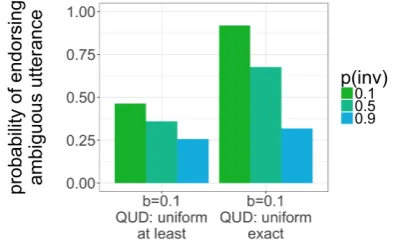
ex-Figure 3: Model predictions for ambiguous two-notendorsement in a 2-OF-4 context.
plicit contrast are indeed active in utterance disambiguation (i.e., to validate their explanatory power), we would expect the very same factors and values to additionally capture the ceiling-level endorsement rate in the 2-OF-4 context without the explicit contrast.
Recall the baseline 1-OF-2 values from Figure 2: low expectations for success (bsuc=0.1) and QUD uncertainty (QUD:uniform). To model the 2-OF-4 context, we change the number of actors
n to 4 and additionally manipulate whether the
exact(=) orat-least(≥) semantics applies, as they diverge when there are more than two actors in the context (see section 4). This decision im-pacts both the utterance semantics and the relevant set of QUDs (e.g., if≥semantics gets used, then the two≥? QUD is included in the set of poten-tial QUDs). As shown in Figure3, we do indeed predict high endorsement with the same parame-ter value baseline, but only withexactutterance semantics and a low probability of accessing the inverse scope (P(inv) =0.1). In this case, we find an endorsement rate of 92%.
6 Discussion
[image:7.595.81.278.225.346.2]also captured the same effect in children (Savinelli et al., 2017). This parallelism—sensitivity to the pragmatic context in both children and adults across different contexts—suggests that the same disambiguation mechanism is active in both chil-dren and adults. Adults seem better able to char-itably interpret less supportive pragmatic contexts (i.e., the original every-notscenarios); yet, there remain scenarios (i.e., certain two-not contexts) where even adult abilities are exceeded. We inter-pret the common underlying mechanism as sup-port for developmental continuity in scope ambi-guity resolution, with no qualitative shift required. In addition to supporting the developmental continuity hypothesis, this model also suggests
whymanipulations like the explicit contrast clause work. The pragmatic variables capture the explicit contrast manipulation because they create a situ-ation where the ambiguous two-not utterance is still informativedespitethe ambiguity. When the utterance provides the listener with information that diverges from her prior beliefs, the ambigu-oustwo-not utterance becomes more informative, more useful, and therefore more endorsable.
The model also seamlessly captures ML2003’s results from the 2-OF-4 context: with the very same parameter values that yield low endorsement rates for 1-OF-2 contexts, the model predicts the high endorsement observed for 2-OF-4 contexts. The only change is increasing the number of rele-vant individuals from two to four. This exploration of the 1-OF-2 vs. 2-OF-4 contexts allows us to re-fine our understanding of the potential sources of child and adult behavior. Savinelli et al.(2017)’s findings suggested that pragmatic factors alone are capable of capturing the non-adult-like behavior in children and the extension in the current model captures the explicit contrast effect in adults; how-ever, the processing factor of scope (in particu-lar, disfavoring the inverse scope) is needed to ac-count for ML2003’s 2-OF-4 results. This find-ing supports ML2003’s conclusion, namely that adults have a strong preference for surface inter-pretations oftwo-not utterances. Combined with the appropriate pragmatic context, that preference has the potential to drive the endorsement asym-metry between the 1-OF-2 and 2-OF-4 contexts. Whether this surface interpretation preference in
two-notcontexts is also something children share remains an open empirical question; experimen-tal results for every-notdo not answer this
ques-tion definitively (Viau et al.,2010;Savinelli et al.,
2017).
References
Leon Bergen, Noah Goodman, and Roger Levy. 2012. That’s what she (could have) said: How alternative utterances affect language use. InProceedings of the Cognitive Science Society. volume 34, pages 120– 125. http://escholarship.org/uc/item/5f03m09d.
Richard Breheny. 2008. A new look at the se-mantics and pragmatics of numerically quantified noun phrases. Journal of Semantics25(2):93–139. https://doi.org/10.1093/jos/ffm016.
Stephen Crain, Rosalind Thornton, Carole Boster, Laura Conway, Diane Lillo-Martin, and Elaine Woodams. 1996. Quantification without qual-ification. Language Acquisition 5(2):83–153. https://doi.org/10.1207/s15327817la0502 2.
Judith Degen and Noah D Goodman. 2014. Lost your marbles? the puzzle of dependent mea-sures in experimental pragmatics. In Pro-ceedings of the Annual Meeting of the Cogni-tive Science Society. volume 36, pages 397–402. http://escholarship.org/uc/item/97t2w1f3.
Bart Geurts. 2006. Take five: The meaning and use of a number word. In Svetlana Vogeleer and Liliane Tasmowski, editors, Non-Definiteness and Plurality, Benjamins, Amsterdam, pages 311–329. https://doi.org/10.1075/la.95.16geu.
Noah D Goodman and Michael C Frank. 2016. Prag-matic language interpretation as probabilistic infer-ence.Trends in Cognitive Sciences20(11):818–829. https://doi.org/10.1016/j.tics.2016.08.005.
Justine T Kao, Leon Bergen, and Noah D Goodman. 2014a. Formalizing the pragmatics of metaphor understanding. InProceedings of Annual Meeting of the Cognitive Science Society. volume 36, pages 719–724. http://escholarship.org/uc/item/09h3p4cz.
Justine T Kao, Jean Y Wu, Leon Bergen, and Noah D Goodman. 2014b. Nonliteral understand-ing of number words. Proceedings of the Na-tional Academy of Sciences 111(33):12002–12007. https://doi.org/10.1073/pnas.1407479111.
Chris Kennedy. 2015. A “de-Fregean” semantics (and neo-Gricean pragmatics) for modified and unmod-ified numerals. Semantics and Pragmatics8(1):1– 44.https://doi.org/10.3765/sp.8.10.
Daniel Lassiter and Noah D. Goodman. 2013. Con-text, scale structure, and statistics in the interpre-tation of positive-form adjectives. In Semantics and Linguistic Theory (SALT) 23. pages 587–610. https://doi.org/10.3765/salt.v23i0.2658.
Jeffrey Lidz and Julien Musolino. 2002. Chil-dren’s command of quantification. Cognition 84(2):113–154. https://doi.org/10.1016/S0010-0277(02)00013-6.
Julien Musolino. 1998. Universal Grammar and the Acquisition of Semantic Knowledge: An Experi-mental Investigation into the Acquisition of Quan-tifier Negation Interaction in English. Doctoral dissertation, University of Maryland, College Park. http://ling.umd.edu/assets/publications/Musolino 1998.pdf.
Julien Musolino. 2006. Structure and meaning in the acquisition of scope. In Semantics in Acquisition, Springer, pages 141–166. https://doi.org/10.1007/1-4020-4485-2 6.
Julien Musolino and Jeffrey Lidz. 2003. The scope of isomorphism: Turning adults into chil-dren. Language Acquisition 11(4):277–291. https://doi.org/10.1207/s15327817la1104 3.
Julien Musolino and Jeffrey Lidz. 2006. Why children aren’t universally successful with quantification. Linguistics 44(4):817–852. https://doi.org/10.1515/LING.2006.026.
K.J. Savinelli, Gregory Scontras, and Lisa Pearl. 2017. Modeling scope ambiguity resolution as pragmatic inference: Formalizing differences in child and adult behavior. In Proceed-ings of the Annual Meeting of the Cognitive Science Society. volume 39, pages 3064–3069. https://mindmodeling.org/cogsci2017/papers/0579/ paper0579.pdf.
Gregory Scontras and Noah D. Goodman. 2017. Resolving uncertainty in
plu-ral predication. Cognition 168:294–311.
https://doi.org/10.1016/j.cognition.2017.07.002.
Benjamin Spector. 2013. Bare numerals and scalar implicatures. Language and Linguistics Compass 7(5):273–294. https://doi.org/10.1111/lnc3.12018.
Michael Henry Tessler and Noah D. Goodman. 2016. A pragmatic theory of generic language. http://arxiv.org/abs/1608.02926.
Joshua Viau, Jeffrey Lidz, and Julien Musolino. 2010. Priming of abstract logical representations in 4-year-olds. Language Acquisition 17(1-2):26–50. https://doi.org/10.1080/10489221003620946.