Temnikova, I, Or˘asan, C., Corpas Pastor, G., and Mitkov, R. (eds.) (2019)Proceedings of the 2nd Workshop on Human-Informed Translation and Interpreting Technology (HiT-IT 2019), Varna, Bulgaria, September 5 - 6, pages 122–128.
https://doi.org/10.26615/issn.2683-0078.2019_015 122
Exploring Adequacy Errors in Neural Machine Translation with the
Help of Cross-Language Aligned Word Embeddings
Michael Ustaszewski
University of Innsbruck, Department of Translation Studies
[email protected]
Abstract
Neural machine translation (NMT) was shown to produce more fluent output than phrase-based statistical (PBMT) and rule-based machine translation (RBMT). How-ever, improved fluency makes it more diffi-cult for post editors to identify and correct adequacy errors, because unlike RBMT and SMT, in NMT adequacy errors are fre-quently not anticipated by fluency errors. Omissions and additions of content in oth-erwise flawlessly fluent NMT output are the most prominent types of such adequacy errors, which can only be detected with ref-erence to source texts. This contribution ex-plores the degree of semantic similarity be-tween source texts, NMT output and post edited output. In this way, computational semantic similarity scores (cosine similar-ity) are related to human quality judgments. The analyses are based on publicly availa-ble NMT post editing data annotated for er-rors in three language pairs (DE, EN-LV, EN-HR) with the Multidimensional Quality Metrics (MQM). Methodologi-cally, this contribution tests whether cross-language aligned word embeddings as the sole source of semantic information mirrors human error annotation.
1
Introduction
The most recent advances in artificial intelligence have brought substantial improvements to ma-chine translation (MT). Systems based on artificial neural networks are able to produce more fluent and readable translations than most state-of-the-art phrase-based statistical (PBMT) and rule-based (RBMT) systems. The significant and highly promising advances notwithstanding, neural ma-chine translation (NMT) still suffers from im-portant shortcomings. Several lines of research ad-dress these shortcomings, most notably research
on post-editing (PE) effort, on the evaluation and error annotation of NMT output and on (semi-)au-tomated approaches to translation quality estima-tion.
Numerous studies in various language pairs and subject domains (see Section 2) have shown that NMT outperforms other types of MT in terms of fluency, while at the same time being more prone to adequacy errors such as omissions, additions or mistranslations. Adequacy errors are problematic from the perspective of the integration of NMT into translation workflows, because the identification and correction of adequacy errors is possible only by comparing NMT output to source segments, which arguably entails a higher cognitive load for post editors. Thus, participants in PE studies re-ported that NMT errors are more difficult to iden-tify as compared other types of MT (Castilho et al. 2017). A phenomenon that is particularly difficult to handle for post editors and end users of NMT systems are invisible adequacy errors, first and foremost omissions in flawlessly fluent output that contains no traces of missing content, which means that they cannot be identified without the source text (van Brussel et al., 2018).
In view of these difficulties, the evaluation of se-mantic adequacy in NMT output and PE is indis-pensable to further advance the development of cutting-edge translation technology. Traditionally, the evaluation of MT output is performed by hu-man annotators or post editors, but automated ap-proaches have gained momentum as well (e.g.
distri-123 butional semantics, holding the potential to im-prove the performance of numerous multilingual NLP tasks.
Against this background, the present paper ex-plores to what extent cross-language aligned word embeddings can be used to inform semantic analy-sis in NMT output evaluation. More specifically, the correspondence between human adequacy judgments and automatically generated semantic similarity scores is assessed. The main goal is to in-vestigate whether publicly available, pre-trained cross-language embeddings as the sole source of semantic information (i.e. used in isolation without any other resources or features that capture the se-mantic relation between source and target seg-ments) are reliable estimators of translation ade-quacy. The analyses are performed at the sentence level for three language pairs: English-German (EN-DE), Latvian (EN-LV), and English-Croatian (EN-HR), using publicly available error-annotated NMT and PE datasets.
2
Related Work
A number of error analysis studies have shown that NMT is prone to adequacy errors, i.e. deficiencies with regard to the semantic transfer of content from the source to the target language. Castilho et al. (2017) compared NMT to statistical MT and ob-served increases in fluency but at the same time there were more errors of omission, addition and mistranslation. For instance, in NMT omission er-rors accounted for 37% of all erer-rors found in 100 Chinese-to-English translation segments from the patent domain, thus being the most frequent of seven error types, while for PBMT omission errors accounted only for 8% of all errors. Similar results were observed for four other language pairs in the domain of MOOC translations. Van Brussel et al. (2018) also observed numerous omission errors (13.1% of all adequacy errors) in a comparative evaluation of 665 English sentences translated by NMT, PBMT and RBMT into Dutch. The majority of omissions in NMT (85.5%) were due to missing content words, while for PBMT and RBMT these ratios were 70.0% and 0.1% respectively. As a con-sequence, most omission errors in NMT (69%) are invisible, i.e. not indicated by flawed fluency, whereas in the other two MT types, annotators deemed only 23% and 7% of omissions to be invis-ible without source text comparisons. The study concludes that due to their frequency and often
in-visible nature, adequacy errors are a major chal-lenge to NMT and its users. Finally, Klubička, Toral and Sánchez-Cartagena make similar obser-vations for the EN-HR pair, concluding that “NMT tends to sacrifice completeness of translation in or-der to increase overall fluency” (2018, 209). All these reviewed studies employ manual human error annotation to assess the quality of MT output. From a more technical perspective, Tu et al. (2016) argue that NMT’s tendency to produce over- or under-translation is because conventional systems do not maintain a coverage vector.
A complementary line of research is concerned with the automated estimation of MT output qual-ity at run-time without the use of reference transla-tions (Specia et al., 2018). Translation quality esti-mation usually requires (a certain amount) of su-pervision and thus human-annotated training data. Given this interdependence of human and auto-mated approaches to quality estimation, the present contribution sets out to relate automatically gener-ated semantic similarity scores at the sentence level with human error annotation.
3
Materials and Methods
3.1 Datasets
The analyses are based on three publicly available datasets that provide fine-grained error annotation of NMT output according to the Multidimensional Quality Metrics (MQM) framework (Lommel et al., 2014). For EN-DE and EN-LV, two datasets de-veloped within the QT21 project (Specia et al., 2017) were used, each containing 1800 source sen-tences paired with the corresponding error-anno-tated NMT outputs and post-edited versions, 200 of which were annotated by two annotators. For EN-HR, the dataset by Klubička, Toral and Sánchez-Cartagena (2018) was used; it contains 100 source sentences together with error annotations of NMT output performed by two evaluators. Instead of post-edited target language versions, it contains hu-man reference translations for 93 out of 100 source sentences.
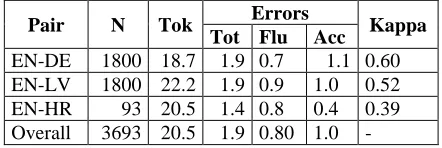
124 For each dataset, only the annotations of the first evaluator were considered; however, to assess the quality of annotation, Cohen’s kappa scores for in-ter-rater agreement on the annotation of omission errors were computed, indicating weak to moderate agreement. Summary statistics of the extracted data are shown in Table 1.
3.2 Cross-Language Aligned Word Embed-dings
All sentences under investigation were represented as 300-dimensional word embedding vectors. To enable semantic analyses across source and target languages, pre-trained cross-language aligned
fastText1 word embeddings based on Wikipedia (Joulin et al., 2018) were used. In addition, for the EN-DE pair, custom cross-language aligned
fastText embeddings we trained by aligning mono-lingual fastText Wikipedia embeddings2 with the help of the VecMap toolkit3 for cross-language word embedding mapping (Artetxe, Labaka and Agirre, 2018). For the mapping, the supervised mode of VecMap was used, based on the 5000-word EN-DE training dictionary from Artetxe, Labaka and Agirre (2018). Since both the pre-trained and custom embeddings are based on 300-dimensional fastText embeddings trained on Wik-ipedia, they are comparable irrespective of differ-ent mapping algorithms.
For each sentence in the dataset, the mean of the embeddings of each token in the sentence was cal-culated. The vector representations of the sentences in the datasets were built with the flair NLP library4 implemented in Python (Akbik, Blythe and Voll-graf, 2018).
Subsequently, cosine similarity was computed between each source sentence and the following sentences:
1https://fasttext.cc/docs/en/aligned-vectors.html 2https://fasttext.cc/docs/en/pretrained-vectors.html 3https://github.com/artetxem/vecmap
(1) the corresponding NMT output;
(2) the corresponding PE target sentence (in the case of EN-DE and EN-LV) or the human reference translation (for EN-HR);
(3) a truncated copy of the NMT output, ob-tained by randomly removing 15% of its to-kens;
(4) a truncated copy of the PE/reference transla-tion sentence, obtained by randomly remov-ing 15% of its tokens;
(5) two different sentences from the set of target sentences, randomly selected among the re-maining target sentences in the given lan-guage (post-edited sentences for DE and LV, reference translation for HR);
(6) two different target language sentences, sam-pled from completely unrelated text collec-tions: for DE and HR, sentences were sam-pled from the Universal Dependencies cor-pus (Nivre et al, 2016) included in the flair
library, whereas for Latvian the W2C corpus5 (Majliš and Žabokrtský, 2012) was taken as a source.
The inclusion of the sentences (3) to (6) was moti-vated by the need to test whether the combination of aligned word embeddings and cosine similarity adequately captures cross-linguistic similarity be-tween sentences of varying degrees of semantic re-latedness.
4
Results and Discussion
4.1 Similarity between Related vs. Unrelated Sentences
The comparison of similarity scores between source sentences and their machine-translated or post-edited equivalents on the one hand and ran-domly selected unrelated target sentences on the other provides insights into the general validity of the tested approach. The assumption is that the sim-ilarity between sentences in a translation relation – no matter whether machine-translated or post-ed-ited – is higher than between unrelated pairs of source and target language sentences. What is more, it can be expected that among non-translated cross-lingual sentence pairs the similarity is higher when data is sampled from the same text collection,
4https://github.com/zalandoresearch/flair 5https://ufal.mff.cuni.cz/w2c
Pair N Tok Errors Kappa
[image:3.595.70.291.174.248.2]Tot Flu Acc EN-DE 1800 18.7 1.9 0.7 1.1 0.60 EN-LV 1800 22.2 1.9 0.9 1.0 0.52 EN-HR 93 20.5 1.4 0.8 0.4 0.39 Overall 3693 20.5 1.9 0.80 1.0 -
125 as opposed to data taken from a completely differ-ent corpus. Indeed, the results in Table 2 confirm this assumption, showing that the mean cosine sim-ilarity scores for translated source-target pairs (NMT and PE) are higher than for randomly aligned text pairs from the same dataset (MQM1, MQM2). The latter, in turn, are more similar to the source language sentences than sentence pairs ob-tained by assigning random sentences from unre-lated corpora (X1, X2). The results are very similar for all three language pairs, suggesting the stability of cross-lingual word embeddings. It can also be seen that for EN-DE, the pre-trained and custom embeddings behave the same way, although the
VecMap-aligned custom embeddings yield higher similarity scores. Both embedding types capture the differences between the semantically diverging sentences to the same extent.
4.2 Similarity between Closely-Related Sen-tences
To test whether the method is capable of detecting minor differences in meaning, NMT and PE out-puts were juxtaposed with artificially truncated copies of these sentences by randomly removing 15% of tokens from the target sentences, not con-trolling for parts of speech, which means that punc-tuation may have been among the removed tokens. The truncation procedure is to simulate omissions in NMT output by creating semantically closely re-lated sentences.
As shown in Table 3, the similarity scores be-tween full vs. truncated sentences are almost iden-tical, indicating that the method in isolation is not capable of capturing subtle semantic differences. Unlike the pre-trained embeddings, the VecMap
-aligned embeddings do capture differences be-tween full and truncated sentences, but the scores differ only marginally.
As shown in Table 3, the similarity scores be-tween full vs. truncated sentences are almost iden-tical, indicating that the method in isolation is not capable of capturing subtle semantic differences. Unlike the pre-trained embeddings, the VecMap -aligned embeddings do capture differences be-tween full and truncated sentences, but the scores differ only marginally.
It would be insightful to test whether truncations by more than 15% yield different results, and whether the removal of content words has a differ-ent impact on similarity and adequacy than the re-moval of function words or punctuation tokens. Preliminary exploration suggested that truncations by 30% do result in lower similarity scores, albeit only to a moderate extent. This might be due to the part-of-speech-insensitive nature of the employed truncation procedure, as well as to the use of con-text-insensitive word embeddings, as opposed to contextualized embeddings, such as ELMo (Peters et al., 2018), BERT (Devlin et al., 2019) or flair
(Akbik, Blythe and Vollgraf, 2018) embeddings. Systematic analyses of the impact of truncation on similarity scores are left for future work.
The (almost) nonexistent differences between full and truncated sentences further suggest limita-tions as to the detection of omissions or addilimita-tions as one of the most relevant types of NMT adequacy errors. Table 3 also shows that no tangible differ-ences between NMT and PE were detected by ei-ther embedding type. This issue is discussed in more detail in the following subsection.
Emb NMT PE MQM1 MQM2 X1 X2 DE pre 0.22 0.22 0.16 0.16 0.07 0.07 DE cust 0.84 0.84 0.74 0.74 0.61 0.61 LV pre 0.30 0.31 0.25 0.25 0.17 0.17 HR pre 0.15 0.14 0.06 0.06 0.04 0.03
Table 3: Mean cosine similarity between source language sentences and the respective
NMT and PE output, as well as randomly chosen target language sentences from the same corpus (MQM) and from different cor-pora (X). For DE, similarity scores were ob-tained from pre-trained (pre) and custom
(cust) fastText embeddings.
[image:4.595.309.519.83.146.2]Emb NMT NMT_Short PE PE_Short DE pre 0.22 0.22 0.22 0.22 DE cust 0.84 0.82 0.84 0.82 LV pre 0.30 0.30 0.31 0.30 HR pre 0.15 0.14 0.14 0.14
Table 2: Mean cosine similarity between source language sentences and the respective NMT and PE output, as well as copies of
tar-get sentences randomly truncated by 15% of tokens (NMT_Short, PE_Short). Scores pro-vided for pre-trained (pre) and custom (cust)
126
4.3 Correspondence between Cosine Simi-larity Scores and Human Error Annota-tion
Any valid computational metric should mirror hu-man ratings, irrespective the fact that agreement between human raters is not always unanimous, es-pecially in cognitively and intellectually demand-ing tasks. In the context of MT evaluation, it can be assumed that output containing adequacy errors, as assessed by human annotators or post-editors, ex-hibits lower degrees of semantic similarity accord-ing to vector space models. However, this observa-tion was not made in this study.
Table 4 relates cosine similarity to the presence or absence of certain errors in NMT output: the first group compares machine-translated sentences that, according to human annotators, are free of ade-quacy errors (the left column of each block, desig-nated with F for ‘false’) with sentences that contain at least one adequacy error (the second column of each block, designated with T for ‘true’). The mean cosine scores for this group do not reveal any dif-ferences for NMT sentences that do and do not con-tain adequacy errors. Similar results were obcon-tained for NMT output with and without omission errors (second group), for NMT output that does and does not contain only adequacy errors (third group), as well as for output that does and does not contain only fluency errors (fourth group). This lack of ob-served differences holds for both types of cross-language aligned embeddings used in the analyses, as shown in Table 4.
It was also tested whether the absence or pres-ence of other error types and combinations thereof (e.g. output that contains mistranslations but no flu-ency errors) have an influence on cosine similarity scores, but no important differences were observed. In sum, the results clearly show that when used in isolation without any other resources or features, aligned cross-language word embeddings are hardly helpful to inform cross-linguistic similarity judgments in cases of subtle adequacy deviations typical of NMT.
5
Conclusion
The measurement of cross-linguistic similarity is a highly complex problem with relevance not only to translation, but also, among other things, to seman-tic textual similarity (Agirre et al., 2016) or compa-rable and parallel corpus building (Sharoff, Rapp
and Zweigenbaum, 2013). Recent advances in em-beddings-based vector space representations have brought significant advances to cross-linguistic se-mantic problems, which can be useful in the con-text of translation quality estimation and MT eval-uation.
The present study attempted to explore the use-fulness of cross-language aligned word embed-dings in isolation, i.e. without further resources or features. In doing so, the correspondence of cosine similarity scores has been related to human similar-ity judgments of NMT output and PE. It was ob-served that cross-language embeddings used in iso-lation are only able to differentiate between sen-tences related by translation on the one hand and unrelated in-domain and out-of-domain sentences on the other, which means that the analysis of sub-tle adequacy issues frequently observed in NMT, such as omissions or additions, requires more elab-orate approaches. The results from the EN-DE lan-guage pair suggest that it makes no difference whether pre-trained fastText or custom VecMap -aligned cross-language embeddings are used, be-cause both types do not capture subtle semantic dif-ferences. Analogous comparisons for other lan-guage pairs may yield more insights into the com-parability of different types of cross-language word embeddings.
The methodology employed in this study could be improved in several ways. On the one hand, the embeddings in this study were used without any pa-rameter tuning. On the other hand, contextualized word embeddings, such as ELMo (Peters et al., 2018), BERT (Devlin et al., 2019) or flair (Akbik, Blythe and Vollgraf, 2018), which were shown to yield state-of-the-art results in several NLP tasks, could be used as an alternative to the context-insen-sitive embeddings used in this study. However,
Adq Err OmissionOnly AdqOnly Flu
Emb F T F T F T F T
DE pre 0.22 0.22 0.22 0.22 0.22 0.22 0.22 0.22 DE cust 0.84 0.84 0.84 0.84 0.84 0.83 0.84 0.84 LV pre 0.30 0.31 0.30 0.31 0.31 0.30 0.30 0.30
HR cust 0.16 0.14 0.15 0.14 0.15 0.15 0.15 0.14
Table 4: Mean cosine similarity between source language sentences and the respective NMT out-put, grouped according to the absence and
pres-ence of four error types. Scores shown for pre-trained (pre) and custom (cust) fastText
127 since the cross-language alignment of contextual-ized embeddings is a very recent and therefore still relatively unexplored line of research (e.g. Aldar-maki and Diab, 2019; Schuster et al., 2019), the use of contextualized cross-language aligned embed-dings for the detection of subtle adequacy devia-tions is left for future work. A further potential im-provement of the present methodology relates to the fact that in this study, sentences were repre-sented as means of the embeddings of all words in the sentences. There are other approaches to com-pute sentence- or document-level embeddings from individual word embeddings (Chen, Ling and Zhu, 2018), and the flair library, for instance, imple-ments various methods, such as minimum and maximum pooling or recurrent neural networks6. Similarly, there are alternatives to the traditionally used cosine similarity, for instance the word mover’s distance (Kusner et al., 2015).
Given that monolingual embeddings are already being successfully employed in translation quality estimation (Specia et al., 2018), the unsupervised nature of cross-language embeddings may further promote this line of research. Yet, its application to translation quality estimation and error analysis re-quires more thorough benchmarking. This also means that human evaluation is still to be seen as pivotal to research into adequacy errors in NMT. Datasets that focus explicitly on omissions and ad-ditions might become an asset in this regard, since the datasets used in the present study are much wider in scope. While they do contain useful infor-mation about adequacy, complementary and more focused datasets might contribute to the develop-ment of new approaches to the automated detection of adequacy errors, including the problematic in-visible omissions and additions.
Acknowledgments
I thank the four anonymous reviewers for their helpful comments.
References
Eneko Agirre, Carmen Banea, Daniel Cer, Mona Diab, Aitor Gonzalez-Agirre, Rada Mihalcea, German Rigau, and Janyce Wiebe. 2016. SemEval-2016 Task 1: Semantic Textual Similarity, Monolingual and Cross-Lingual Evaluation. In Proceedings of
6
https://github.com/zalandoresearch/flair/blob/master/re- sources/docs/TUTORIAL_5_DOCUMENT_EMBED-DINGS.md
SemEval 2016. Association for Computational Lin-guistics, pages 497-511.
http://dx.doi.org/10.18653/v1/S16-1081.
Alan Akbik, Duncan Blythe, and Roland Vollgraf. 2018. Contextual String Embeddings for Sequence Labeling. In Proceedings of the 27th International Conference on Computational Linguistics. Associa-tion for ComputaAssocia-tional Linguistics, pages 1638-1649. https://www.aclweb.org/anthology/C18-1139.
Hanan Aldarmaki and Mona Diab. 2019. Context-Aware Cross-Lingual Mapping. In Proceedings of the 2019 Conference of the North American Chapter of the Association for Computational Linguistics: Human Language Technologies, Volume 1 (Long and Short Papers). Association for Computational Linguistics, pages 3906-3911.
http://dx.doi.org/10.18653/v1/N19-1391.
Mikel Artetxe, Gorka Labaka, and Eneko Agirre. 2018. A robust self-learning method for fully unsupervised cross-lingual mappings of word embeddings. In Proceedings of the 56th Annual Meeting of the As-sociation for Computational Linguistics (Volume 1: Long Papers). Association for Computational Lin-guistics, pages 789–798.
http://dx.doi.org/10.18653/v1/P18-1073.
Sheila Castilho, Joss Moorkens, Federico Gaspari, Iacer Calixto, John Tinsley, and Andy Way. 2017. Is Neural Machine Translation the New State of the Art? In The Prague Bulletin of Mathematical
Lin-guistics, 108, pages 109–120.
https://doi.org/10.1515/pralin-2017-0013.
Qian Chen, Zhen-Hua Ling, and Xiaodan Zhu. 2018. Enhancing Sentence Embedding with Generalized Pooling. In Proceedings of the 27th International Conference on Computational Linguistics.Associa-tion for ComputaLinguistics.Associa-tional Linguistics, pages 1815-1826. https://www.aclweb.org/anthology/C18-1154.
Jacob Devlin, Ming-Wei Chang, Kenton Lee, and Kris-tina Toutanova. 2019. BERT: Pre-training of Deep Bidirectional Transformers for Language Under-standing. In Proceedings of the 2019 Conference of the North American Chapter of the Association for Computational Linguistics: Human Language Tech-nologies, Volume 1 (Long and Short Papers). Asso-ciation for Computational Linguistics, pages 4171-4186. http://dx.doi.org/10.18653/v1/N19-1423. Armand Joulin, Piotr Bojanowski, Tomas Mikolov,
128
Conference on Empirical Methods in Natural Lan-guage Processing. Association for Computational Linguistics, pages 2979-2984.
http://dx.doi.org/10.18653/v1/D18-1330.
Filip Klubička, Antonio Toral, and Víctor M. Sánchez-Cartagena. 2018. Quantitative fine-grained human evaluation of machine translation systems: a case study on English to Croatian. In Machine
Transla-tion, 32, pages 195-2015.
https://doi.org/10.1007/s10590-018-9214-x. Matt J. Kusner, Yu Sun, Nicholas I. Kolkin, and Kilian
Q. Weinberger. 2015. From Word Embeddings To Document Distances. In Proceedings of the 32nd In-ternational Conference on Machine Learning. Lille, France, 2015. JMLR: W&CP volume 37.
Arle Lommel, Hans Uszkoreit, and Aljoscha Bur-chardt. 2014. Multidimensional Quality Metrics (MQM): A Framework for Declaring and Describ-ing Translation Quality Metrics. In Revista
Tradumàtica, 12, pages 455-463.
https://doi.org/10.5565/rev/tradumatica.77.
Martin Majliš and Zdeněk Žabokrtský. 2012. Lan-guage Richness of the Web. In Proceedings of the Eighth International Conference on Language Re-sources and Evaluation (LREC-2012). European Languages Resources Association (ELRA), pages 2927-2934. https://aclweb.org/anthology/pa-pers/L/L12/L12-1110/.
Joss Moorkens, Sheila Castilho, Federico Gaspari, and Stephen Doherty (eds.). 2019. Translation Quality Assessment. From Principles to Practice. Cham: Springer. https://doi.org/10.1007/978-3-319-91241-7.
Joakim Nivre, Marie-Catherine de Marneffe, Filip Ginter, Yoav Goldberg, Jan Hajič, Christopher D. Manning, Ryan McDonald, Slav Petrov, Sampo Pyysalo, Natalia Silveira, Reut Tsarfaty, and Daniel Zeman. 2016. Universal Dependencies v1: A Multi-lingual Treebank Collection. In Proceedings of the Tenth International Conference on Language Re-sources and Evaluation (LREC 2016). European Language Resources Association (ELRA), pages 1659-1666. https://www.aclweb.org/anthol-ogy/L16-1262.
Matthew Peters, Mark Neumann, Mohit Iyyer, Matt Gardner, Christopher Clark, Kenton Lee, and Luke Zettlemoyer. 2018. Deep contextualized word repre-sentations. In Proceedings of the 2018 Conference of the North American Chapter of the Association for Computational Linguistics: Human Language Technologies, Volume 1 (Long Papers). Association for Computational Linguistics, pages 2227-2237.
http://dx.doi.org/10.18653/v1/N18-1202.
Tal Schuster, Ori Ram, Regina Barzilay, and Amir Globerson. 2019. Cross-Lingual Alignment of Con-textual Word Embeddings, with Applications to Zero-shot Dependency Parsing. In Proceedings of the 2019 Conference of the North American Chapter of the Association for Computational Linguistics: Human Language Technologies, Volume 1 (Long and Short Papers). Association for Computational Linguistics, pages 1599-1613.
http://dx.doi.org/10.18653/v1/N19-1162.
Serge Sharoff, Reinhard Rapp, and Pierre Zweigen-baum. 2013. Overviewing Important Aspects of the Last Twenty Years of Research in Comparable Cor-pora. In S. Sharoff, R- Rapp, P. Zweigenbaum and P. Fung (eds.). Building and Using Comparable Corpora. Berlin, Heidelberg: Springer, pages 1-17.
https://doi.org/10.1007/978-3-642-20128-8_1. Lucia Specia, Kim Harris, Frédéric Blain, Aljoscha
Burchardt, Vivien Macketanz, Inguna Skadiņa, Matteo Negri, and Marcho Turchi. 2017. Translation Quality and Productivity: A Study on Rich Morphol-ogy Languages. In Proceedings of the 16th Machine Translation Summit (Volume 1: Research Track), pages 55- 71.
Lucia Specia, Frédéric Blain, Varvara Logacheva, Ram ón F. Astudillo, and André Martins. 2018. Findings of the WMT 2018 Shared Task on Quality Estima-tion. In Proceedings of the Third Conference on Ma-chine Translation (WMT), Volume 2: Shared Task Papers. Association for Computational Linguistics,
pages 689–709.
http://dx.doi.org/10.18653/v1/W18-6451.
Zhaopeng Tu, Zhengdong Lu, Yang Liu, Xiaohua Liu, and Hang Li. 2016. Modeling Coverage for Neural Machine Translation. In Proceedings of the 54th An-nual Meeting of the Association for Computational Linguistics (Volume 1: Long Papers). Association for Computational Linguistics, pages 76-85.
http://dx.doi.org/10.18653/v1/P16-1008.