54
Computational Argumentation Synthesis as a Language Modeling Task
Roxanne El Baff1 Henning Wachsmuth2 Khalid Al-Khatib1 Manfred Stede3 Benno Stein1
1Bauhaus-Universität Weimar, Weimar, Germany,<first>{.<last>}+@uni-weimar.de 2 Paderborn University, Paderborn, Germany,[email protected]
3University of Potsdam, Potsdam, Germany,[email protected]
Abstract
Synthesis approaches in computational argu-mentation so far are restricted to generating claim-like argument units or short summaries of debates. Ultimately, however, we expect computers to generate whole new arguments for a given stance towards some topic, backing up claims following argumentative and rhetor-ical considerations. In this paper, we approach such an argumentation synthesis as a language modeling task. In our language model, argu-mentative discourse units are the “words”, and arguments represent the “sentences”. Given a pool of units for any unseen topic-stance pair, the modelselectsa set of unit types ac-cording to a basic rhetorical strategy (logos vs. pathos),arrangesthe structure of the types based on the units’ argumentative roles, and fi-nally“phrases”an argument by instantiating the structure with semantically coherent units from the pool. Our evaluation suggests that the model can, to some extent, mimic the human synthesis of strategy-specific arguments.
1 Introduction
Existing research on computational argumentation largely focuses on theanalysisside. Various analy-sis tasks are widely studied including identifying the claims along with their supporting premises (Stab and Gurevych, 2014), finding the relation between argumentative units (Cocarascu and Toni,
2017), and assessing the persuasiveness of argu-ments (Habernal and Gurevych,2016).
Diverse downstream applications, however, ne-cessitate the development of argumentation synthe-sistechnologies. For example, synthesis is needed to produce a summary of arguments for a given topic (Wang and Ling,2016) or to build a debat-ing system where new arguments are exchanged between the users and the system (Le et al.,2018).
As a result, a number of recent studies addresses the argumentation synthesis task. These studies
have proposed different approaches to generating claims or reasons for a given topic, partly with a par-ticular stance towards the topic (Bilu and Slonim,
2016;Hua and Wang,2018). However, the next important synthesis step is still missing in the liter-ature, namely, to generate complete texts including both argumentative and rhetorical considerations. With the latter, we refer to Aristotle’s three means of persuasion: logos (providing logical arguments), ethos (demonstrating credibility), and pathos (evok-ing emotions). As discussed byWachsmuth et al.
(2018), following a rhetorical strategy is key to achieving persuasion with argumentative texts.
This paper proposes a new computational ap-proach that synthesizes argumentative texts follow-ing a rhetorical strategy. We do not tackle this task immediately “in the wild”, i.e., generating an en-tirely new argumentative text for a freely-chosen topic and a possibly complex strategy. Rather, we consider a “controlled” synthesis setting, with the goal of successively creating models that are able to deal with more complex settings later on.
In particular, given a pool of argumentative dis-course units (ADUs), our approach generates argu-ments for any unseen pair of topic and stance (e.g., “con abortion”) as well as a basic rhetorical strat-egy (i.e., logos-oriented vs. pathos-oriented).1 To abstract from the arguments’ topics during training, we first identify different ADU types using cluster-ing. Our approach then learns toselectunit types matching the given strategy and toarrangethem according to their argumentative roles. Both steps are realized as a language model where ADUs rep-resent words and arguments are sentences. Finally, our approach“phrases”an argument by predict-ing the best set of semantically related ADUs for the arranged structure using supervised regression. Thereby, we ensure that the synthesized texts are
1We consider a single argument to be a sequence of ADUs
composed of meaningful units, a property that neu-ral generation methods barely achieve so far.
In our evaluation, we utilize the dataset of
Wachsmuth et al.(2018). This dataset contains 260 argumentative texts on 10 topic-stance pairs, where each text composes five ADUs in a logos-oriented or pathos-oriented manner. In our experiments, we train our approach on nine topic-stance pairs and then generate an argument for the tenth. The re-sults demonstrate that our approach successfully manages to combine pairs of ADUs, but its perfor-mance on longer sequences of ADUs is limited.
Altogether, our contribution is three-fold:
1. A new view of argumentation synthesis that represents argumentative and rhetorical con-siderations with language modeling.
2. A novel approach that selects, arranges, and phrases ADUs to synthesize strategy-specific arguments for any topic and stance.
3. First experimental evidence that arguments with basic rhetorical strategies can be synthe-sized computationally.2
2 Related Work
Recently, some researchers have tackled argumen-tation synthesis statistically with neural networks. For instance, Wang and Ling (2016) employed a sequence-to-sequence model to generate sum-maries of argumentative texts, andHua and Wang
(2018) did similar to generate counterarguments. Using neural methods in text generation, it is possi-ble to achieve output that is on topic and grammat-ically (more or less) correct. However, when the desired text is to span multiple sentences, the gen-erated text regularly suffers from incoherence and repetitiveness, as for instance discussed by Holtz-man et al.(2018) who examine texts that were pro-duced by RNNs in various domains. While these problems may be tolerable to some extent in some applications, such as chatbots, bad text cannot be accepted in an argumentative or debating scenario, where the goal is to convince or persuade a reader (rather than to merely inform or entertain).
Holtzman et al.(2018) propose to alleviate in-coherence and repetitiveness by training a set of discriminators, which aim to ensure that a text spects the Gricean maxims of quantity, quality, re-lation, and manner (Grice,1975). To this end, they
2The code for running the experiments is
avail-able here: https://github.com/webis-de/ inlg19-argumentation-synthesis
employ specific datasets, such as one that opposes authentic text continuation to randomly-sampled text. The discriminators learn optimal weightings for the various models and their combination, such that overall text quality is maximized. For argu-mentation, we hypothesize that one needs to go even further and eventually account for the author, implementing her underlyingintentionin the dif-ferent parts of an argumentative text as well as in the relations between the parts.
In the past times of rule-based text generation, argumentation synthesis was a popular task ( Zuker-man et al.,2000). Approaches involved much hand-crafted (linguistic and domain) knowledge and user modeling. For example, the system of Carenini and Moore(2006) compares attributes of houses (from a database) to desired target attributes (from a user model), to then recommend a house to the reader in a convincing text following the Gricean maxims. To this end, it selected house attributes potentially interesting to the user, arranged, and finally phrased them. The resulting texts resembled the arguments we work with here, which have been manually composed by experts (Wachsmuth et al.,
2018) from the claims, evidence, and objections in the arg-microtext corpus (Peldszus and Stede,
2016). To achieve a similar level of output control, today’s text-to-text generation models need to ac-count for the various interdependencies between the text units to be combined.
Most related to our approach is the system of
Sato et al.(2015), where a user can enter a claim-like topic along with a stance. The system then generates argumentative paragraphs on specific as-pects of the topic by selecting sentences from 10 million news texts of the Gigaword corpus. Poten-tially relevant aspects are those that trigger eval-uative judgment in the reader. The sentences are arranged so that the text starts with a claim sentence and is followed by support sentences, employing the approach ofYanase et al.(2015). The support sentences are ordered by maximizing the seman-tic connectivity between sentences. Finally, some rephrasing is done in terms of certain aspects of sur-face realization. In a manual evaluation, however, no text was seen as sounding natural, underlining the difficulty of the task. In contrast toSato et al.
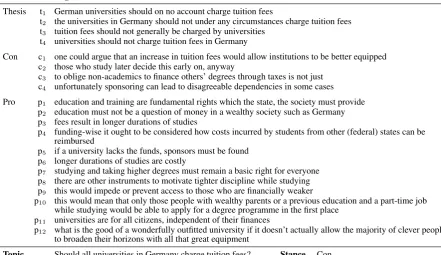
Role ID Argumentative Discourse Unit
Thesis t1 German universities should on no account charge tuition fees
t2 the universities in Germany should not under any circumstances charge tuition fees t3 tuition fees should not generally be charged by universities
t4 universities should not charge tuition fees in Germany
Con c1 one could argue that an increase in tuition fees would allow institutions to be better equipped c2 those who study later decide this early on, anyway
c3 to oblige non-academics to finance others’ degrees through taxes is not just c4 unfortunately sponsoring can lead to disagreeable dependencies in some cases
Pro p1 education and training are fundamental rights which the state, the society must provide p2 education must not be a question of money in a wealthy society such as Germany p3 fees result in longer durations of studies
p4 funding-wise it ought to be considered how costs incurred by students from other (federal) states can be reimbursed
p5 if a university lacks the funds, sponsors must be found p6 longer durations of studies are costly
p7 studying and taking higher degrees must remain a basic right for everyone p8 there are other instruments to motivate tighter discipline while studying p9 this would impede or prevent access to those who are financially weaker
p10 this would mean that only those people with wealthy parents or a previous education and a part-time job while studying would be able to apply for a degree programme in the first place
p11 universities are for all citizens, independent of their finances
p12 what is the good of a wonderfully outfitted university if it doesn’t actually allow the majority of clever people to broaden their horizons with all that great equipment
[image:3.595.74.516.75.330.2]Topic Should all universities in Germany charge tuition fees? Stance Con
Table 1: The candidate thesis, con, and pro units for one topic-stance pair in the dataset ofWachsmuth et al.(2018).
Some other approaches have been proposed that recompose existing text segments in new argu-ments. In particular,Bilu and Slonim(2016) gener-ated new claims by “recycling” topics and pred-icates that were found in a database of claims. Claim selection involves preferring predicates that are generally amenable to claim units and that are relevant for the target topic. Egan et al. (2016) created summaries of the main points in a debate, andReisert et al.(2015) synthesized complete argu-ments from a set of manually curated topic-stance relations based on the fine-grained argument model of Toulmin(1958). However, we are not aware of any approach that synthesizes arguments fully automatically, let alone that follows rhetorical con-siderations in the synthesis process.
3 Data
To develop our model for argumentation synthe-sis, we exploit the dataset recently developed by
Wachsmuth et al.(2018). The dataset comprises
260manuallygenerated argumentative texts. The
generation of each text, for one topic-stance pair, has been conducted in a systematic fashion follow-ing the three canons of rhetoric (Aristotle,2007):
1. Inventio∼Selectinga subset of argumentative
discourse units (ADUs) from a pool of given ADUs for a topic-stance pair.
2. Dispositio∼Arrangingthe selected ADUs in
a sequential order.
3. Elocutio∼Phrasingthe arranged ADUs by
adding connectives at unit-initial or unit-final positions.
Specifically,Wachsmuth et al.(2018) selected a pool of 200 ADUs for 10 pairs of controversial topic and stance from the English version of the arg-microtexts corpus (Peldszus and Stede,2016). As a preprocessing step, they “decontextualized” these ADUs manually by removing connectives, resolving pronouns, and similar. Each topic-stance pair comes with 20 such ADUs: four theses, four con units, and 12 pro units. Table1shows the ADU list for one topic-stance pair.
26 participants were asked byWachsmuth et al.
(2018) to create short argumentative texts for each topic-stance pair following one of two basic rhetor-ical strategies: (1)logos-oriented, i.e., arguing log-ically, and (2)pathos-oriented, i.e., arguing based on emotional appeals. For each topic-stance pair they created an argument by selecting one the-sis, one con and three pro units that they thought could best form a persuasive argument following the given strategies. Table2shows two samples of generated arguments in the dataset.
Strategy ID Text Manually Synthesized From Five Argumentative Discourse Units
Logos-oriented c1 one could argue that an increase in tuition fees would allow institutions to be better equipped,
t1 howeverGerman universities should on no account charge tuition fees.
p1 education and training are fundamental rights which the state, the society must provide,
p12 becausewhat is the good of a wonderfully outfitted university if it doesn’t actually allow the majority
of clever people to broaden their horizons with all that great equipment.
p4 Besides,funding-wise it ought to be considered how costs incurred by students from other (federal)
states can be reimbursed.
Pathos-oriented p1 education and training are fundamental rights which the state, the society must provide.
t2 This is whythe universities in Germany should not under any circumstances charge tuition fees.
c1 one could argue that an increase in tuition fees would allow institutions to be better equipped,
p3 howeverfees result in longer durations of studies
[image:4.595.72.528.69.206.2]p6 andlonger durations of studies are costly.
Table 2: two sample arguments manually synthesized from the ADUs in Table1, which are included in the dataset ofWachsmuth et al.(2018). The italiced connectives were added by the participants; they arenotpart of the ADUs.
pathos-oriented argumentative texts. We use these 260 texts to develop and evaluate our computational model for argumentation synthesis.
4 Approach
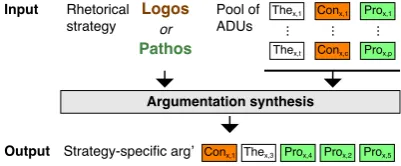
This section presents our computational approach to synthesize arguments for any pair of topic and stance, following one of two basic rhetorical strate-gies: arguing logically (logos-oriented) or arguing emotionally (pathos-oriented). A black-box view of the approach is shown in Figure1.
As input, our approach takes a strategy as well as a pool of argumentative discourse units (ADUs) for any specific topic-stance pairx. Each ADU has the role of athesis(in terms of claim with a stance on the topic), aconpoint (objecting the thesis), or apropoint (supporting the thesis). The approach then imitates the human selection, arrangement, and “phrasing” of a sequence ofnADUs, in order to synthesize an argument. Phrasing is done only in terms of picking semantically coherent ADUs for the arranged sequence; the addition of connectives between ADUs is left to future work.
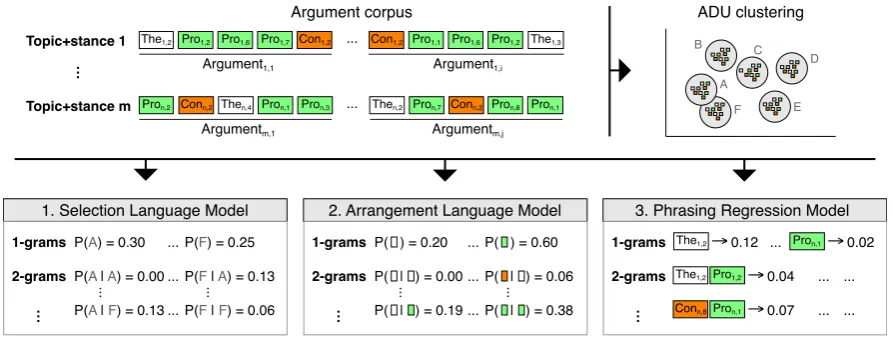
Below, we detail how we realize each step (se-lection, arrangement, and phrasing) with a topic-independent model. For each step, we explain how it is trained (illustrated in Figure2) and how it is applied to an unseen topic-stance pair (Figure3).
4.1 Selection Language Model
This model handles the selection of a set ofnADUs for a topic-stance pairxand a rhetorical strategy. We approach the selection as a language modeling task where each ADU is a “word” of our language model and each argument a “sentence”. To abstract from topic, the model actually selects ADUtypes, as explained in the following.
Argumentation synthesis
Thex,3 Prox,4 Prox,2 Prox,5
Conx,1
Input Thex,1
Thex,t
... Conx,1
Conx,c
Prox,1
Prox,p
Pool of
ADUs ... ...
Rhetorical strategy
Output Strategy-specific arg’
Logos or Pathos
Figure 1: Black-box view of our argumentation synthe-sis approach. The input is a rhetorical strategy as well as a pool of thesis, con, and pro ADUs for some topic-stance pairx. The approach outputs a strategy-specific sequence ofnADUs as an argument forx(here,n= 5).
4.1.1 Training of the Model
We start from a training set of ADUs for a set of
mtopic-stance pairs. To generalize the language model beyond the covered topics, each ADU is rep-resented using features that aim to capture general emotion-related and logic-related characteristics, accounting for the two given strategies.
In particular, we first cluster the pool of all train-ing ADUs based on their feature representation. As a result, each ADU is represented by a cluster label (A–F in Figure2), where each label represents one ADU type. Now, for each of the strategies, we map each manually-generated sequence of ADUs to a sequence of cluster labels. Using these sequences of labels, we train one separated selection language model for each strategy.
For clustering, we rely on topic-independent fea-tures that we expect to implicitly encode logical and emotional strategies: (1) psychological mean-ingfulness (Pennebaker et al.,2015), (2) eight basic emotions (Plutchik,1980;Mohammad and Turney,
[image:4.595.315.516.262.345.2]→
1. Selection Language Model 2. Arrangement Language Model→ 3. Phrasing Regression Model→
1-grams P(A) = 0.30
2-grams
P(F) = 0.25
...
P(A | A) = 0.00 P(... F | A) = 0.13
P(A | F) = 0.13 P(... F | F) = 0.06
…
... ...
1-grams
2-grams
…
P( ) = 0.20 ...P( ) = 0.60
P( | ) = 0.00...P( | ) = 0.06
P( | ) = 0.19...P( | ) = 0.38
... ...
1-grams
2-grams
…
→0.12 ... Pron,1→0.02
Pro1,2
The1,2
The1,2
→0.04 ... ...
Pron,1
Conn,8 →0.07
The1,2 Pro1,2 Pro1,6 Pro1,7 Con1,2 ... Con1,2 Pro1,1 Pro1,6 Pro1,2 The1,3
Then,4
Pron,2 Conn,2 Pron,1 Pron,3 ... Then,2 Pron,7 Conn,2 Pron,8 Pron,1
Topic+stance 1
Topic+stance m
…
Argument corpus
Argumentm,1 Argumentm,j
Argument1,1 Argument1,i
ADU clustering
B
A
C D
[image:5.595.76.523.61.230.2]E F
... ...
Figure 2: Illustration of training the three models of our argumentation synthesis approach. The input is a corpus of argumentative texts formtopic-stance pairs, each decomposed into a sequence of theses, con units, and pro units. Initially, the set of all these ADUs is clustered to obtain a set topic-independent ADU types, calledA–F here. (1)Selection language model: Each argument is converted from a sequence of ADUs to a sequence of ADU types, where a language model is trained on these type sequences. (2)Arrangement language model:Each argument is converted from a sequence of ADUs to a sequence of ADU roles (thesis, pro, and con) where a language model is trained on these ADU role sequences. (3)Phrasing regression model:A linear regression model is trained which scores each ADU sequence with respect to its semantic coherence.
Linguistic Inquiry and Word Count (LIWC) LIWC is a lexicon-based text analysis that counts words in psychologically meaningful categories (Tausczik and Pennebaker,2010). We use the ver-sion byPennebaker et al.(2015), which contains the following 15 dimensions:
1. Language metrics, e.g., words per sentence.
2. Function words, e.g., pronouns and auxiliary
verbs.
3. Other grammar, e.g., common verbs and
com-parisons.
4. Affect words, e.g., positive emotion words.
5. Social words, e.g., “family” and “friends”.
6. Cognitive processes, e.g., “discrepancies” and
“certainty”.
7. Perceptual processes, e.g., “feeling”.
8. Biological processes, e.g., “health”.
9. Core drives and needs, e.g., “power” and
“re-ward focused”.
10. Time orientation, e.g., past-focused.
11. Relativity, e.g., “time” and “space”.
12. Personal concerns, e.g., “work” and “leisure”.
13. Informal speech, e.g., fillers and nonfluencies.
14. Punctuation, e.g., periods and commas.
15. Summary variables, as detailed below.
There are four summary variables, each of which is derived from various LIWC dimensions: (1)
an-alytical thinking(Pennebaker et al.,2014), i.e., the
degree to which people use narrative language (low value), or more logical and formal language (high);
(2)clout(Kacewicz et al.,2014), i.e., the relative
social status, confidence, and leadership displayed in a text; (3)authenticity(Newman et al.,2003), i.e., the degree to which people reveal themselves in an authentic way; and (4)emotional tone(Cohn et al.,2004), i.e., negative for values lower than 50 and positive otherwise.
NRC Emotional and Sentiment Lexicons We use the NRC lexicon of Mohammad and Turney
(2013). The lexicon has been compiled manually using crowdsourcing and contains a set of English words and their associations with (1)sentiment, i.e., negative and positive polarities, and (2)emotions, i.e., the eight basic emotions defined byPlutchik
(1980): anger, anticipation, disgust, fear, joy, sur-prise, sadness, and trust. These features are repre-sented as the count of words associated with each category (e.g., the count ofsad wordsin an ADU).
MPQA Arguing Lexicon Somasundaran et al.
(2007) constructed a lexicon that includes the fol-lowing arguing patterns: assessments,doubt,
au-thority,emphasis,necessity,causation,
generaliza-tion,structure,conditionals,inconsistency,
inyour-Thex,1 Thex,2 Thex,3
Thex,t
...
predict A A C
E Conx,1 Conx,2 Conx,3
Conx,c
...
predict D B A
C Prox,1 Prox,2 Prox,3
Prox,p
...
predict B C C
D Rhetorical strategy + ADUs of topic-stance pair x Input
1. Selection Language Model
more probable
A B C D C
A B C D C
A B C D C
Thex,3 Prox,1 Prox,3 Prox,p Conx,3
Thex,1 Conx,2 Prox,2 Prox,p Prox,3
Thex,2 Conx,2 Prox,2 Prox,p Prox,3
2. Arrangement Language Model
generate Candidate arguments
more probable
generate
...
...
Thex,1 Conx,2 Prox,2 Prox,p Prox,3
Thex,2 Conx,2 Prox,2 Prox,p Prox,3
3. Phrasing Regression Model
Filtered candidates
higher score
predict
Thex,1Conx,2Prox,2 Prox,p Prox,3
Thex,2Conx,2Prox,2 Prox,p Prox,3 Thex,2 Conx,2 Prox,2 Prox,p Prox,3 Output
[image:6.595.73.291.68.431.2]Logos or Pathos
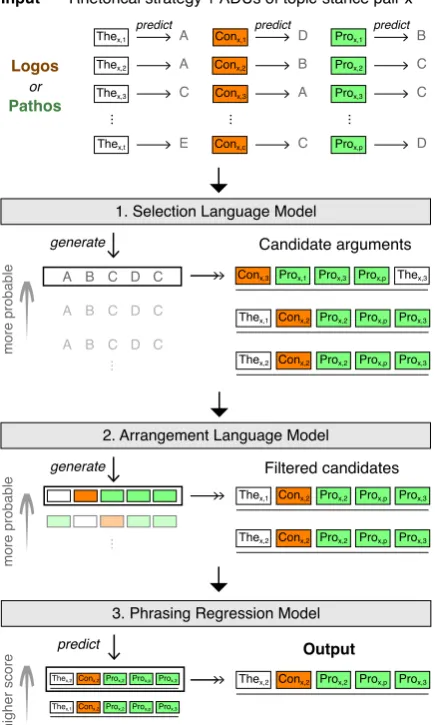
Figure 3: Illustration of applying our synthesis ap-proach. Given the predicted type of each input ADU of the given topic-stance pairx, (1) theselection gener-ates the most probable type sequence,(A, B, C, D, C). From the type sequence, a set of candidate arguments is decoded. (2) Thearrangementfilters out candidates not matching the most probable ADU role sequence,
(T hesis, Con, P ro, P ro, P ro). (3) Phrasing scores each remaining argument and outputs the top argument.
shoes, rhetorical question. We use the count of
each arguing pattern in text as one feature (e.g., number ofassessmentspatterns in an ADU).
4.1.2 Application of the Model
As shown in Figure3, the selection language model takes the ADUs of an unseen topic-stance x as input. It then outputs a set of candidate arguments, in terms of sequences of ADUs. Each ADU is encoded into a cluster label (representing an ADU type). For example, one might have the following mappings, given the six labelsA–F from Figure2:
A ← {T hex,1, T hex,2, Conx,3}
B ← {Conx,2, P rox,1}
C ← {T hex,3, Conx,c, P rox,2, P rox,3}
D ← {P rox,p, Conx,1}
E ← {T hex,t}
F ← {T hex,4, Conx,4, P rox,4}
The language model for either of the two rhetor-ical strategies generates a set of arguments where each argument is composed ofncluster labels, e.g.,
(A, B, C, D, C)forn= 5in Figure3. This set is ranked by probability of the associated sequence. For example, assume that(A, B, C, D, C)is most probable. Then we decode all possible ADU se-quences for topic-stancex from (A, B, C, D, C)
to a set of candidate arguments:
(A, B, C, D, C)→
{T hex,1, T hex,2, Conx,3}
× {Conx,2, P rox,1}
× {T hex,3, Conx,c, P rox,2, P rox,3}
× {P rox,p, Conx,1}
× {T hex,3, Conx,c, P rox,2, P rox,3}
The output of the model is a set of candidate arguments, which becomes the input of the arrange-ment language model.
4.2 Arrangement Language Model
In the arrangement process, we aim to imitate the human behavior of arranging ADUs for a specific topic-stance following a rhetorical strategy (here,
logosorpathos). Again, we approach this problem
as a language modeling task. Each ADU role (the-sis, pro, or con) is a word of the language model and each argument a sentence.
4.2.1 Training of the Model
As sketched in Figure2, we first convert the human-generated arguments from a sequence of ADUs to a sequence of ADU roles. Then, we use these se-quences to train a language model for each strategy.
4.2.2 Application of the Model
As shown in Figure3, the arrangement language model takes as input the candidate arguments that we get from the selection language model and out-puts a set of filtered candidate arguments.
The language model for a specific strategy gen-erates a set of argument structures where each such structure is a sequence ofnADU roles, e.g.,
Using the output from the selection language model, we filter out all candidate arguments that do not match(T hesis, Con, P ro, P ro, P ro), ending up with the following filtered arguments:
{T hex,1, T hex,2} × {Conx,2}
× {P rox,2, P rox,3} × {P rox,p} × {P rox,2, P rox,3}
The output of the model is a filtered set of can-didate arguments, which becomes the input of the phrasing regression model.
4.3 Phrasing Regression Model
The set of arguments resulting from the selection and arrangement language models are based on topic-independent features. The missing step is to entail the topical relationship between the ADUs in each generated argument. We approach this task with supervised regression. As indicated above, our model does not reallyphrasean argument. Rather, it aims to choose the best among the given set of candidates in terms of semantic coherence.
4.3.1 Training of the Model
For each argument, we opt for a feature represen-tation that embeds the content properties of ADUs in order to capture their content relationship. Con-cretely, we represent each argument by calculating the semantic similarities of each adjacent bigram in a human-generated argument. We train a linear regression model where each instance represents the features of one argument. To this end, we set a score to be the sum of the probabilities of ADU bigrams occurring in one argument.
The phrasing model scores each of the filtered ar-guments given as output by the arrangement model. The argument with the highest score is the final generated argument.
4.3.2 Application of the Model
At this point, the phrasing model is provided by the filtered arguments from the arrangement model. For each filtered argument, we extract the bigram features (semantic similarities). Next, using the phrasing model, we predict the score of each se-quence. The sequence with the highest score is the generated argument. In Figure3, this is:
(T hex,2, Conx,2, P rox,2, P rox,p, P rox,3)
5 Experiments
In this section, we report the results of evaluating the introduced approach to argumentation synthesis
Strategy 2-grams 3-grams
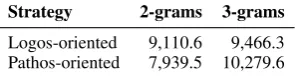
[image:7.595.343.491.65.103.2]Logos-oriented 9,110.6 9,466.3 Pathos-oriented 7,939.5 10,279.6
Table 3: Selection. Perplexity of the 2-gram and 3-gram language models for each strategy, averaged over 10 leave-one-topic-out runs using Laplace smoothing.
based on the dataset described in Section3.
5.1 Experimental Set-up
Our experiments are designed in leave-one-out cross-validation setting: From the 10 topic-stance pairs in the dataset, we use nine for training and the last as the test fold, and we repeat this once for each possible fold. This way, no topic-specific knowledge can be used in the synthesis process.
For each given basic rhetorical strategy (
logos-orientedandpathos-oriented), we train one model
each for the selection, the arrangement, and the “phrasing” of argumentative discourse units (ADUs)
on the nine training folds. The arguments syn-thesized by their combination are then evaluated against the human-generated arguments in the test folds. The evaluation covers all three models as well as the final generated argument for each strat-egy. We report the average accuracy across all ten folds for each of the models.
5.2 Training: Selection Language Model
In each training/test experiment for one of the two strategies, we first abstract all ADUs across all strategy-specific topic-stance pairs by extracting the LIWC, NRC, and MPQA features, as described in Section4.1. Then, we cluster the given training set using standardk-means (Ostrovsky et al.,2012). After some initial experiments, we decide to setk
to 6, because this best balanced the distribution of arguments over clusters, and showed clear strategy-specific differences.3 Using the resulting clustering model, we predicted the typeA–F of each ADU in the test set (the tenth topic).
Given the ADU types, we next converted the human-generated training and test arguments from a sequence of ADUs to a sequence of ADU types. After that, we trained one 2-gram and one 3-gram selection language.4 In Table3, we report the mean perplexity of the models for both strategies.
3
A more thorough evaluation ofkis left to future work. 4We did not consider 1-grams, because arguments are
Strategy 2-grams 3-grams
Logos 54.5 33.5 Pathos 45.9 23.9
Table 4:Arrangement. Perplexity of the 2-gram and 3-gram language models for each strategy, averaged over 10 leave-one-topic-out runs using Laplace smoothing.
As shown, the 2-gram perplexity is lower than the 3-gram perplexity in both cases. We assume that the reason lies in the limited size of the dataset and the narrow setting: Only 117 sentences (ADUs) are given per strategy for training, with a vocabu-lary size of 6 (number of ADU types). Based on the results, we decided to use the 2-gram selection language model to generate candidate arguments.
5.3 Training: Arrangement Language Model
To train arrangement as described in Section4.2, we took all arguments of the nine training topics in each experiment. We converted each argument from a sequence of ADUs to a sequence of ADU roles (thesis, pro, and con). After that, we trained a 2-gram and 3-gram language model for each strat-egy. Table4lists the mean perplexity values over the 10 folds.
Here, the perplexity is lower for 3-grams than for 2-grams, which can be expected to yield better per-formance. Therefore, we used the 3-gram language model to filter the set of candidate arguments.
5.4 Training: Phrasing Regression Model
For phrasing (in terms of choosing the best ADU sequence), we first extracted features from each candidate, as described in Section4.3. Then, we calculated the semantic similarities between each pair of adjacent ADUs as follows:
1. We obtained a 300-dimensional word embed-ding for each word in an ADU using the pre-trained GloVe common-crawl model ( Pen-nington et al.,2014).5
2. We averaged the embeddings of all words in an ADU, resulted in one vector representing the ADU.
3. For each adjacent pair of ADUs, we computed the cosine similarity of their vectors.
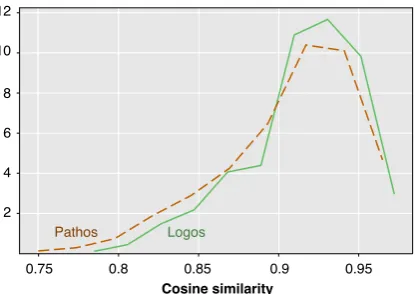
Figure4shows a histogram of the distribution of the cosine similarities of each adjacent pair of
5The used model can be found here: http://nlp.
stanford.edu/data/glove.42B.300d.zip.
Pathos Logos
0.75 0.8 0.85 0.9 0.95
2 4 6 8 10 12
[image:8.595.314.522.61.208.2]Cosine similarity
Figure 4: Histogram of the cosine similarity of the av-erage word embeddings of adjacent pairs of ADUs in logos-oriented and in pathos-oriented arguments.
ADUs (i.e., each ADU 2-gram) in logos-oriented ar-guments and in pathos-oriented arar-guments. We ob-serve a generally high similarity between neighbor-ing ADUs for both strategies, with logos-oriented 2-grams being slightly more similar on average.
Given the ADU 2-grams, we train a linear regres-sion model that predicts the sum of ADU 2-gram probabilities in each argument. In case of the logos strategy, the model has a mean squared error (MSE) of 0.05. In case of pathos the MSE is 0.03.
5.5 Results: Argumentation Synthesis
Up to this point, we trained all selection, arrange-ment, and phrasing models 10 times. Combining the three models for each strategy, we finally gener-ated one argument per strategy for the topic-stance pair left out in each experiments. Hence, we ended up with 10 computationally synthesized arguments per strategy in total.
We evaluate each of these arguments by check-ing whether it matches any of the 13 human-generated ground-truth arguments given per topic-stance pair. The matching is quantified in terms of
n-gram overlap withn={1, . . . ,5}.
For comparison, we consider a baseline that ran-domly generates arguments for each topic-stance pair as follows:
1. Select a random thesis unit from t1to t4.
2. Select a random con unit from c1to c4.
3. Select three random pro units from p1to p12.
4. Randomly arrange the selected units.
[image:8.595.119.243.65.103.2]Sequential Non-Sequential
Strategy Approach 1-gram 2-gram 3-gram 4-gram 5-gram 1-gram 2-gram 3-gram 4-gram 5-gram
Logos Our model 80.0% 15.0% 0.0% 0.0% 0.0% 80.0% 39.0% 9.0% 0.0% 0.0% Baseline 76.0% 10.0% 0.7% 0.0% 0.0% 76.0% 3.1% 8.8% 2.0% 0.0%
Pathos Our model 88.0% 20.0% 0.0% 0.0% 0.0% 88.0% 48.0% 17.0% 4.0% 0.0% Baseline 82.0% 11.5% 0.7% 0.0% 0.0% 82.0% 38.9% 10.7% 1.6% 0.0%
Table 5: Accuracy ofn-gram overlaps between the human-generated arguments for each strategy and the arguments computationally synthesized byour modeland thebaseline. In thesequentialcase, the ordering is considered, in thenon-sequentialcase, it is ignored. The better result in each experiment is marked bold, if any.
Strategy ID Argument Computationally Synthesized from Five Argumentative Discourse Units
Logos t4 universities should not charge tuition fees in Germany.
c3 to oblige non-academics to finance others’ degrees through taxes is not just. p9 this would impede or prevent access to those who are financially weaker. p5 if a university lacks the funds, sponsors must be found.
p8 there are other instruments to motivate tighter discipline while studying.
Pathos p2 education must not be a question of money in a wealthy society such as Germany.
c1 one could argue that an increase in tuition fees would allow institutions to be better equipped. p7 studying and taking higher degrees must remain a basic right for everyone.
p6 longer durations of studies are costly.
t2 the universities in Germany should not under any circumstances charge tuition fees.
Table 6: Comparison of two con arguments computationally synthesized with our model for the topicShould all universities in Germany charge tuition fees?, each being a sequence of five ADUs. A logos-oriented argument
(t4, c3, p9, p5, p8)and a pathos-oriented argument(p2, c1, p7, p6, t2). The thesis of each argument is marked bold.
and by the baseline, with and without considering the ordering of ADUs. Our models outperform the baseline for 1-grams and 2-grams in all cases. For
sequential 3-grams, however, it did not achieve any
overlap with the human-generated arguments for ei-ther strategy. This may be explained by the fact that the employed selection and phrasing models are based on 2-grams only. Forn ≥2, the synthesis generally does not work well anymore. We believe that the small data size is a main cause behind this, although it may also point to the limitation of com-posing ADUs based on surface features. In the non-sequential case, though, our model performs comparably well for 3-grams, and it even manages to correctly synthesize some ADU 4-grams.
In Table 6, we exemplify the top-scored argu-ments for one topic-stance pair, synthesized by our approach for logos and for pathos respectively. They indicate that our model was able to learn strategy-specific differences.6 In particular, the logos argument starts with the thesis (t2), as argu-mentation guidelines suggest. It then reasons based on consequences and alternatives. Matching
intu-6Notice that the coherence of the arguments may be
opti-mized by inserting discourse markers, such as a “but” before
p7in the pathos argument. As stated above, however, this is beyond the scope of the paper at hand.
ition, the pathos argument appeals more to emotion, reflected in phrases such as “wealthy society" and “under any circumstances”. Particularly the thesis (t4) has a more intense tonality thant2, and putting it at the end creates additional emphasis.
6 Conclusion
This paper has presented a topic-independent com-putational approach to imitate the process of se-lecting, arranging, and phrasing argumentative dis-course units (ADUs) — so to speak, to synthesize arguments. We have proposed to operationalize the necessary synthesis knowledge in the form of a combined language and regression model that pre-dicts ADU sequences. So far, we have evaluated our approach on a small dataset only that contains 260 argumentative texts following either of two rhetorical strategies. For a controlled experiment setting based on this data, we have reported prelim-inary results of medium effectiveness regarding the imitation of human-generated arguments.
References
Aristotle. 2007. On Rhetoric: A Theory of Civic Dis-course(George A. Kennedy, Translator). Clarendon Aristotle series. Oxford University Press.
Yonatan Bilu and Noam Slonim. 2016. Claim synthe-sis via predicate recycling. In Proceedings of the 54th Annual Meeting of the Association for Compu-tational Linguistics (Volume 2: Short Papers), pages 525–530. Association for Computational Linguis-tics.
Giuseppe Carenini and Johanna D. Moore. 2006. Gen-erating and evaluating evaluative arguments. Artifi-cial Intelligence, 170(11):925–952.
Oana Cocarascu and Francesca Toni. 2017. Identify-ing attack and support argumentative relations us-ing deep learnus-ing. InProceedings of the 2017 Con-ference on Empirical Methods in Natural Language Processing, pages 1374–1379. Association for Com-putational Linguistics.
Michael A Cohn, Matthias R Mehl, and James W Pen-nebaker. 2004. Linguistic markers of psychological change surrounding September 11, 2001. Psycho-logical science, 15(10):687–693.
Charlie Egan, Advaith Siddharthan, and Adam Wyner. 2016. Summarising the points made in online po-litical debates. In Proceedings of the Third Work-shop on Argument Mining (ArgMining2016), pages 134–143, Berlin, Germany. Association for Compu-tational Linguistics.
H. Paul Grice. 1975. Logic and conversation. In Peter Cole and Jerry L. Morgan, editors, Syntax and Se-mantics, Vol. 3, pages 41–58. Academic Press, New York.
Ivan Habernal and Iryna Gurevych. 2016. Which ar-gument is more convincing? Analyzing and predict-ing convincpredict-ingness of web arguments uspredict-ing bidirec-tional LSTM. In Proceedings of the 54th Annual Meeting of the Association for Computational Lin-guistics (Volume 1: Long Papers), pages 1589–1599. Association for Computational Linguistics.
Ari Holtzman, Jan Buys, Maxwell Forbes, Antoine Bosselut, David Golub, and Yejin Choi. 2018.
Learning to write with cooperative discriminators. Technical Report 1805.06087, arXiv.
Xinyu Hua and Lu Wang. 2018. Neural argument generation augmented with externally retrieved evi-dence. InProceedings of the 56th Annual Meeting of the Association for Computational Linguistics (Vol-ume 1: Long Papers), pages 219–230. Association for Computational Linguistics.
Ewa Kacewicz, James W Pennebaker, Matthew Davis, Moongee Jeon, and Arthur C Graesser. 2014. Pronoun use reflects standings in social hierar-chies. Journal of Language and Social Psychology, 33(2):125–143.
Dieu Thu Le, Cam-Tu Nguyen, and Kim Anh Nguyen. 2018. Dave the debater: a retrieval-based and gen-erative argumentative dialogue agent. In Proceed-ings of the 5th Workshop on Argument Mining, pages 121–130, Brussels, Belgium. Association for Com-putational Linguistics.
Saif M Mohammad and Peter D Turney. 2013. Crowd-sourcing a word–emotion association lexicon. Com-putational Intelligence, 29(3):436–465.
Matthew L Newman, James W Pennebaker, Diane S Berry, and Jane M Richards. 2003. Lying words: Predicting deception from linguistic styles. Person-ality and social psychology bulletin, 29(5):665–675.
Rafail Ostrovsky, Yuval Rabani, Leonard J Schulman, and Chaitanya Swamy. 2012. The effectiveness of lloyd-type methods for the k-means problem. Jour-nal of the ACM (JACM), 59(6):28.
Andreas Peldszus and Manfred Stede. 2016. An anno-tated corpus of argumentative microtexts. In Argu-mentation and Reasoned Action: 1st European Con-ference on Argumentation (ECA 16). College Publi-cations.
James W Pennebaker, Ryan L Boyd, Kayla Jordan, and Kate Blackburn. 2015. The Development and Psy-chometric Properties of LIWC2015.
James W Pennebaker, Cindy K Chung, Joey Frazee, Gary M Lavergne, and David I Beaver. 2014.
When small words foretell academic success: The case of college admissions essays. PloS one, 9(12):e115844.
Jeffrey Pennington, Richard Socher, and Christopher D. Manning. 2014.Glove: Global vectors for word rep-resentation. InEmpirical Methods in Natural Lan-guage Processing (EMNLP), pages 1532–1543.
Robert Plutchik. 1980. A general psychoevolutionary theory of emotion. In Theories of emotion, pages 3–33. Elsevier.
Paul Reisert, Naoya Inoue, Naoaki Okazaki, and Ken-taro Inui. 2015. A computational approach for gen-erating Toulmin model argumentation. In Proceed-ings of the 2nd Workshop on Argumentation Mining, pages 45–55. Association for Computational Lin-guistics.
Misa Sato, Kohsuke Yanai, Toshinori Miyoshi, Toshi-hiko Yanase, Makoto Iwayama, Qinghua Sun, and Yoshiki Niwa. 2015. End-to-end argument genera-tion system in debating. InProc. ACL-IJCNLP 2015 System Demonstrations.
Christian Stab and Iryna Gurevych. 2014. Identifying argumentative discourse structures in persuasive es-says. In Proceedings of the 2014 Conference on Empirical Methods in Natural Language Processing (EMNLP), pages 46–56. Association for Computa-tional Linguistics.
Yla R Tausczik and James W Pennebaker. 2010. The psychological meaning of words: LIWC and com-puterized text analysis methods. Journal of lan-guage and social psychology, 29(1):24–54.
Stephen E. Toulmin. 1958. The Uses of Argument. Cambridge University Press.
Henning Wachsmuth, Manfred Stede, Roxanne El Baff, Khalid Al Khatib, Maria Skeppstedt, and Benno Stein. 2018. Argumentation synthesis following rhetorical strategies. In Proceedings of COLING 2018, the 27th International Conference on Compu-tational Linguistics. The COLING 2018 Organizing Committee. To appear.
Lu Wang and Wang Ling. 2016.Neural network-based abstract generation for opinions and arguments. In
Proceedings of the 2016 Conference of the North American Chapter of the Association for Computa-tional Linguistics: Human Language Technologies, pages 47–57. Association for Computational Lin-guistics.
Toshihiko Yanase, Toshinori Miyoshi, Kohsuke Yanai, Misa Sato, Makoto Iwayama, Yoshiki Niwa, Paul Reisert, and Kentaro Inui. 2015. Learning sentence ordering for opinion generation of debate. In Pro-ceedings of the 2nd Workshop on Argumentation Mining, pages 94–103. Association for Computa-tional Linguistics.