Annual Report
2017
Office of the Dir
ector of C
or
por
ate Enf
or
cement
Ann
ual R
epor
t
Dublin 1 D01 W5C2
Tel: 01 858 5800 Lo-call: 1890 315 015 Fax: 01 858 5801 Email: [email protected] Web: www.odce.ie
Copyright and Disclaimer Statement
The contents of this document are the copyright of the Director of Corporate Enforcement. All or part of this publication may be reproduced without further permission, provided the source is acknowledged.
Nothing herein should be construed as a representation by, or on behalf of, the Director of Corporate Enforcement as to his understanding or interpretation of any of the provisions of the Companies Act 2014 or as to the interpretation of any law. Independent legal advice should be sought in relation to the effects of any legal provision. The Director of Corporate Enforcement accepts no responsibility or liability howsoever arising from the contents of this publication or any errors, inaccuracies or omissions in the contents of this document. The Director reserves the right to take action, which may or may not be in accordance with the provisions of this document.
Office of the Director of Corporate Enforcement Annual Report2017
1
TABLE OF CONTENTS
DIRECTOR’S INTRODUCTION
3
AT A GLANCE
10
CHAPTER 1: OVERVIEW OF THE ODCE
12
Statutory mandate 13
High level goals 13
Resources, organisational structure, governance arrangements & principal workstreams 14
CHAPTER 2: PROMOTING A GREATER UNDERSTANDING OF AFFECTED PARTIES’
RIGHTS AND DUTIES UNDER COMPANY LAW
18
Introduction 19
Publications and outreach activities 19
Managing and developing relationships with external stakeholders 19
CHAPTER 3: CONFRONTING UNLAWFUL AND IRRESPONSIBLE
BEHAVIOUR INSOFAR AS IT RELATES TO COMPANY LAW
22
Structure of this Chapter 23
PART A: INPUTS 23
EXTERNAL INPUTS 23
Liquidators’ section 682 reports 24
Sectoral distribution of other external inputs (i.e., external inputs other than liquidators’ section 682 reports) 27
Complaints 28
Auditors’ indictable offence reports 29
Examiners’ Reports 29
Referrals 30
Professional bodies’ indictable offence reports 30
Liquidators’ reports regarding possible criminality 31
Disclosures under the Protected Disclosures Act 2014 31
INTERNAL INPUTS 31
Introduction 31
Actions focussing on particular cohorts of persons, e.g., persons who are undischarged bankrupts 32
Investigations commenced on own initiative 33
Dissolved insolvent companies 33
Actions relating to liquidator performance/behaviour 34
PART B: THROUGHPUTS 35
PART C: OUTPUTS 36
Outputs from the section 682 process 36
Outputs of enforcement work 39
Securing voluntary rectification/remediation 40
Securing compliance through the exercise of the Director’s statutory powers 40
Permitting/facilitating compliance through the exercise of the Director’s statutory functions 40
Civil remedies sought 41
Summary criminal proceedings 43
Indictable criminal proceedings 43
Referrals to professional and other regulatory bodies 44
CHAPTER 4: PROVIDING QUALITY CUSTOMER SERVICE
TO INTERNAL AND EXTERNAL STAKEHOLDERS
45
Provision of a quality customer service to external stakeholders 46
Provision of a quality customer service to internal stakeholders 48
Compliance with obligations on foot of law, regulation and by virtue of the Office’s status
as a public sector entity established by statute 48
APPENDICES
51
Appendix 1: Allocated vs. actual expenditure 2015 – 2017 52
Appendix 2: Presentations delivered and exhibitions/events attended – 2017 53
Appendix 3: Report under section 22 of the Protected Disclosures Act 2014 55
Appendix 4: Cases where Restriction Declarations were made by the High Court or Restriction Consent Undertakings were given by company directors pursuant to
section 683 of the Companies Act 2014 56
Appendix 5: Cases where Disqualification Orders were made by the High Court or Disqualification Consent Undertakings were given by company directors pursuant to
section 683 of the Companies Act 2014 60
Appendix 6: Cases where no Restriction or Disqualification Orders were made by the
High Court pursuant to section 683 of the Companies Act 2014 61
3
DIRECTOR’S
INTRODUCTION
In accordance with the provisions of section 954(1) of the Companies Act 2014 (“the Act”), I am pleased to submit the 2017 Annual Report of the Office of the Director of Corporate Enforcement to the Minister for Business, Enterprise & Innovation, Ms. Heather Humphreys TD. Set out hereunder are details of some of the more significant matters relating to the year under review.
OVERVIEW OF PRINCIPAL ENFORCEMENT ACTIVITIES
Reflective of both the ODCE’s:
•
graduated approach towards enforcement; and•
strategic shift towards seeking to confront indications of wrongdoing at the more serious end of the spectrum, enforcement activities during the year under review included:Administrative measures
•
the issuing of 58 cautions and warnings on a variety of issues;•
the rectification of directors’ loans of an aggregate monetary value of approximately €15m;Insolvency-related enforcement measures
•
the making of definitive decisions on 600 liquidators’ reports, including the granting of no relief or partial relief only in respect of 51 such reports. Liquidator applications to the High Court during the year under review following the previous issuing of no relief and partial relief only decisions by the ODCE resulted in 31 company directors being restricted with a further 9 company directors being disqualified;•
entering into Restriction Undertakings with 91 company directors and 1 Disqualification Undertaking with a company director on foot of liquidators’ reports;•
entering into 4 Disqualification Undertakings with directors of insolvent companies that had been struck off the Register of Companies for having failed to file annual returns with the Registrar;Exercise of statutory investigative/enforcement powers and related measures
•
over 100 instances of the exercising of statutory powers in the furtherance of investigative activities and as enforcement measures, such as:•
the execution of search warrants;•
the use of powers of arrest;•
the issuing of Requirements for the production of books and documents to companies;•
the issuing of Requirements for the production of books and documents to third parties;•
the issuing of Requirements for the provision of explanations and assistance to relevant persons; and•
the issuing to relevant persons of directions to comply with statutory obligations;•
applications to the High Court on a variety of matters with a view to progressing investigations and other enforcement-related activities (including on matters such as legal professional privilege and issues associated with interrogating electronic evidence in the possession the ODCE);Referrals to the Director of Public Prosecutions (“DPP”) and associated prosecutions
Office of the Director of Corporate Enforcement Annual Report2017
5
•
on foot of previously referred investigation files in respect of which the DPP had directed charges, and following the entering of guilty pleas by two individuals (one in respect of an alleged breach of section 297 of the Companies Act 1990 (i.e., fraudulent trading) and the other in respect of an alleged breach of section 44 of the Companies Act 1990 (i.e., licensed bank’s register of lending to directors and connected persons) (which was in lieu of an alleged offence under section 297 of the Companies Act 1990), the first individual was sentenced to two and a half years’ imprisonment and the second individual was fined €3,000;•
the referral of 1 investigation file to the DPP for consideration as to whether charges should be directed on indictment. Based on the underlying investigation, that file included recommendations for a total of 81 charges (in respect of alleged breaches of the Companies Acts, the Criminal Justice (Theft & Fraud Offences) Act 2001, the Taxes Consolidation Act 1997 and common law respectively) against a total of 3 suspects. At year end, that file was under consideration by the DPP;•
the referral of a further 3 investigation files to the DPP. The DPP issued a direction to prosecute on 1 of those files but that was subsequently amended to no prosecution following the death of a witness. In the other two cases, having considered the available evidence, the Office of the DPP directed that no prosecution should follow.OTHER ISSUES OF NOTE ARISING DURING THE YEAR UNDER REVIEW
Correspondence with the Joint Oireachtas Committee on Transport, Tourism & Sport
By letter dated 1 September 2017, the Joint Oireachtas Committee on Transport, Tourism & Sport (“the Committee”) referred the report prepared by Mr. Justice Carroll Moran into “the receipt, distribution and sale of tickets to Olympic Games
and ancillary matters” (“the Moran Report”) to the ODCE for consideration. The Committee indicated that its decision
to refer the Moran Report to the ODCE was based on concerns “…surrounding issues of governance, possible fiduciary
negligence of directors, and accounts and audit issues pertaining to the Olympic Council of Ireland”.
By letter dated 18 September 2017, the ODCE furnished its observations on the Moran Report to the Committee. In so doing, the ODCE, inter alia, noted the limitations that had applied to the Inquiry that preceded completion of the Moran Report, which included the:
•
non-statutory nature of the Inquiry and the associated absence of powers of compulsion and adversarial proceedings;•
invocation by a number of the parties of the right against self-incrimination;•
non-co-operation on the part of a number of parties with the work of the Inquiry; and•
Inquiry’s resultant assessment that it was constrained initially to focus its attention on the Olympic Games of 2016 and to defer consideration of the two earlier Games.Whereas a number of the issues detailed in the Report were suggestive of governance weaknesses, shortcomings and departures from conventional governance practices, the Committee was advised that, based on the Report’s contents, there did not appear to be evidence suggestive of non-compliance with company law. It was suggested to the Committee, however, that in the context of its further deliberations on the Report, it might wish to have regard to the provisions of the Criminal Justice (Theft & Fraud Offences) Act 2001.
Winding up in the public interest
Section 5691 of the Act includes a provision not previously contained in the Companies Acts whereby a company may be
wound up by the Court “…if the Court is satisfied, on a petition of the Director [of Corporate Enforcement], that it is in the
public interest that the company should be wound up…”.
During the year under the review, an issue came to the ODCE’s attention that warranted consideration of this new legislative provision and as to whether a petition to wind up the company concerned might be an appropriate and proportionate remedy. That consideration was precipitated by concerns expressed by another State body regarding the relevant company’s activities.
However, having taken legal advice on the matter and having considered all of the relevant facts and circumstances prevailing, it was concluded that, in light of other enforcement options available to the other State body concerned, it was unlikely that the Court would make such an order.
CAPABILITY ENHANCEMENT
During the year under review, and with the ongoing support of successive Ministers and their Department, the ODCE continued the process of enhancing its human resource and operational capabilities through:
•
the recruitment of two Enforcement Portfolio Managers (one an accountant and the other a barrister-at-law);•
the recruitment of a Digital Forensics Specialist (with both relevant qualifications and a background in law enforcement);•
the recruitment of a further Investigative Accountant. At year end, a recruitment exercise for the purpose of appointing a further two Investigative Accountants was at an advanced stage; and•
at year end, a further recruitment exercise for the purpose of appointing two Enforcement Lawyers had also commenced.In addition, and with the assistance of the Garda authorities, the Detective Inspector position, which had been vacant for some time, was filled during the year. A vacant Garda position was also filled during the year, thereby bringing the ODCE’s Garda complement back to its approved number of 7 members.
The appointment of a Digital Forensics Specialist during the year was followed shortly thereafter by the establishment and fitting out of a state of the art digital forensics laboratory. In addition to significantly enhancing the ODCE’s in-house digital forensics capabilities, these developments have:
•
equipped ODCE investigators to conduct on-site digital forensics investigative work, thereby enhancing the ODCE’s overall investigative wherewithal; and•
substantially reduced the ODCE’s previous heavy reliance on third parties (including An Garda Síochána) to assist it with digital forensics work.In addition to the foregoing, the ODCE continued to invest in specialist training, education and development during the year under review.
TRANSITION TO AGENCY STATUS
As the Government prepares to publish its proposals for the transitioning of the ODCE from an Office to a stand-alone Agency, the ODCE stands ready to provide the Minister and her Department with whatever assistance is required in that regard and looks forward to the enhancements in operational effectiveness that are expected to flow from that initiative.
REPORT TO THE MINISTER UNDER SECTION 955(1)(A) OF THE ACT
Request for a report
Following the decision by Judge John Alymer on 23 May 2017 to direct the jury to acquit Mr. Seán FitzPatrick on all counts on the indictment, by letter dated 24 May 2017, I was requested by the then Minister, Ms. Mary Mitchell O’Connor, TD, to furnish her with a report into the matter under section 955(1)(a) of the Act. Specifically, in her letter, the then Minister stated as follows:
“I would be grateful if you would prepare a report, on the issues arising from the investigations by the ODCE into Anglo Irish Bank since 2008. These include:
•
the coaching of witness statements;•
late disclosure of documents;•
a perceived bias by ODCE investigators;•
the shredding of documents; and•
any other relevant matters.I expect receipt of your report as a matter of priority, but no later than 23rd of June 2017”.
Section 955(1)(a) of the Act
The relevant provisions of section 955 are:
“955 (1) Subject to subsection (2), the Director shall:
Office of the Director of Corporate Enforcement Annual Report2017
7
Submission of a report to the Minister
On 23 June 2017, I submitted my report (“the Report”) to the then Tánaiste and Minister, Ms. Frances Fitzgerald, TD. In so doing, I drew attention to the following relevant matters:
•
the Report is not, and does not purport to be, the result of an investigation or enquiry. Neither is it, nor does it purport to be, a detailed analysis of every aspect of the investigation referred to therein. Rather, to the extent practicable within the timeframe laid down for delivery (i.e., one month), the Report is a summary of the principal facts, the purpose of which was (and remains) to assist the Minister in her broader consideration of the relevant issues;•
that being the case, the Report is, to the maximum extent practicable, grounded in relevant documents within the ODCE’s possession and in transcripts of Court proceedings; and•
not being an investigation or enquiry but, rather, a presentation of the principal facts through a statutoryaccountability mechanism, those identified in the Report (several of whom are no longer employed within the ODCE and many of whom are, or were, employed by third parties), have not had an opportunity to comment, or furnish observations, on its content as such an exercise would not have been feasible within the timeframe set for the preparation and delivery of the Report and, in any event, such an exercise is not contemplated by section 955.
Notwithstanding that section 955(2) provides that the Director is not required to provide the Minister with any information under section 955(1) if the provision of such information would, in the Director’s opinion, be likely to prejudice the performance of any of his functions, nothing was omitted from the Report on that basis. Rather, having regard to the purpose of the Report, the approach adopted towards its preparation was to include as much relevant information therein as possible.
Submission of relevant extracts of the Report to the Comptroller & Auditor General (“C&AG”)
Given that certain issues had been raised in that regard by the defence during the trial, amongst the matters dealt with in the Report was the subject of professional fees paid to experts engaged by the ODCE and the associated tender process. That being the case, on the same date that I submitted the Report to the Minister, given their relevance to his remit, I submitted relevant extracts from the Report (i.e., the relevant Chapter and Appendices) to the C&AG for information purposes. The ODCE has received no enquiries or queries from the Office of the C&AG since the date of submission of those extracts, i.e., 23 June 2017.Ministerial consideration of the Report
Following receipt of the Report, the then Tánaiste and Minister advised Dáil Éireann that, originally, it was the intention that the Report would be published2. However, based on legal advice received from the Attorney General, the then Tánaiste
subsequently advised Dáil Éireann that she did not have the statutory power to publish the Report and that, instead, she intended to publish “…an account of the investigative failures identified by Judge Aylmer and the steps being taken to address
them”3.
ENGAGEMENT WITH THE JOINT OIREACHTAS COMMITTEE ON
BUSINESS, ENTERPRISE & INNOVATION
Initial invitation to appear
On 25 May 2017, the Joint Oireachtas Committee on Enterprise, Trade & Innovation (as it then was and as has subsequently been renamed as the Joint Oireachtas Committee on Business, Enterprise & Innovation) (“the Committee”) wrote to me and requested that I attend before it on 31 May 2017. In that letter, the Committee indicated that it wished to discuss:
“…the very serious failures of the ODCE investigative processes highlighted by Judge John Aylmer; the processes, or lack thereof, which led to those failures and the steps, if any, that have been taken to correct those failures and errors to ensure they do not occur again”.
By letter of the same date, I responded to the Committee advising that I was available to assist it in any way possible. I drew attention to the fact that, on the previous day, I had been requested by the then Minister to prepare a report for delivery by 23 June 2017 and, in the context of that timeframe, requested the Committee to consider deferring the meeting until I had prepared and submitted the Report to the Minister, at which time I expected to be in a better position to assist the Committee.
By letter dated 26 May 2017, the Committee responded, advising that it was willing to defer the proposed meeting until after the completion and submission of the Report. In that letter, I was requested to advise the Committee when my Report had been submitted to the Minister. I duly advised the Committee of that fact by letter dated 23 June 2017, i.e., on the date that the Report was submitted to the then Tánaiste and Minister.
By letter dated 5 July 2017, the Committee noted that the Report had been submitted and advised that it had requested the Office of the then Tánaiste and Minister to notify it when the Report became available.
Subsequent invitation to appear before the Committee
The next correspondence received from the Committee was a letter dated 14 December 2017, in which the Committee renewed its invitation to appear before it. On this occasion the Committee invited me to appear before it on 16 January 2018 and indicated that it was:
“particularly interested in discussing what measures have been taken to address the concerns with the investigative process undertaken by the ODCE cited by Judge John Aylmer in the recent case concerning alleged breaches of the Companies Acts”; and
“also concerned about the number of prosecutions which have been brought by the ODCE in the past decade and notes that
€6m in funding allocated to the ODCE has been returned to the state in the last three years”.
By letter dated 16 December 2017, I responded to the Committee confirming that I would attend the meeting and indicating that I would revert in advance of the meeting with any submissions that I considered necessary or relevant to furthering the Committee’s understanding of the issues of interest to it.
I wrote again to the Committee on 22 December 2017. The purpose of this letter was to:
•
record the fact that the then Tánaiste had, by that time, advised Dáil Éireann that, based on the advice received by her from the Attorney General, she did not have the legal power to publish the Report;•
record that, in consequence of the foregoing, the then Tánaiste had further advised Dáil Éireann of her intention to publish “…an account of the investigative failures identified by Judge Aylmer and the steps that are being taken to addressthem”;
•
indicate that, whereas the then Tánaiste clearly had to have regard to the legal advice received by her, any “accountof…investigative failures” could not, by definition, address the much broader range of issues that had been dealt with
in the Report.
In that context, I advised the Committee that:
•
I was at an advanced stage of preparing a document that I wished to submit to the Committee in advance of the meeting (“the Submission”); and•
the purpose of the Submission was to provide the Committee with information necessary to enable it to discharge its functions, including holding the ODCE to account, on a properly informed basis.Specifically, I advised the Committee that the Submission addresses:
•
the nature of the issues that contributed to the trial judge’s decision to direct the jury to acquit the accused on all counts on the indictment;•
the extent to which those issues arose as a result of the discharge by the ODCE of its functions and the extent to which those issues arose for other reasons;•
the factors that contributed to those issues arising; and•
the context within which those issues arose.I further advised that a secondary purpose of the Submission is to ensure that, in circumstances where the Committee will have a role in scrutinising legislation giving effect to the transitioning of the ODCE to a standalone Agency (i.e., a new Companies Act), the Committee has the information necessary to enable it to discharge that function on a properly informed basis.
Office of the Director of Corporate Enforcement Annual Report2017
9 An exchange of correspondence then ensued, with the Committee seeking certain additional information and clarifications,
all of which were provided. That correspondence resulted in the Committee issuing a letter to me on 31 January 2018. In that letter the Committee advised that:
i. the matters to be discussed at the forthcoming meeting would be:
•
the role and functioning of the ODCE as set out in section 949 of the Act;•
governance issues in the ODCE;•
the number of prosecutions which have been brought by the ODCE in the past decade (without addressing the substantive issues arising);•
the return to the State of €6m in funding allocated to the ODCE in the last 3 years;ii. the meeting would be scheduled for after the conclusion of the ongoing trial of DPP v Drumm4; and
iii. the invitation was being extended on the clear understanding that, unless and until requested by the Committee:
•
the trial of Mr. Seán FitzPatrick or related matters would not be discussed at the meeting; and•
no submission or report in relation to the investigation that led to Mr. Seán FitzPatrick being charged with, tried for and acquitted in respect of suspected offences would be received by the Committee.By letter dated 7 February 2018, I responded to the Committee expressing the view that, having regard, inter alia, to the fact that, during the period 2009 to 2012, virtually the entirety of the ODCE’s investigative capacity had been consumed by its involvement in Anglo-related matters, any assessment of its performance over the past decade cannot meaningfully be performed without considering the totality of its activities over that period.
At the time of writing, that is where the matter rests as the aforementioned trial of DPP v Drumm is ongoing. In the interim, the Committee has been advised that the Submission remains available to it.
CONCLUDING REMARKS
The first half of 2017 was both difficult and challenging for the ODCE and for its staff. There are lessons to be learned by all those who played a part in the underlying events. For its part, and notwithstanding that, for the most part, the issues that gave rise to judicial criticism of the ODCE date back the best part of a decade, the ODCE has sought to learn from those experiences. In addition to lessons learned regarding investigative practice and procedure, valuable lessons have also been learned regarding the very real risks associated with seeking to do too much with too little. If and when the time comes for those events to be subjected to Parliamentary scrutiny, the ODCE will provide a full and forthright account of the events, and of the full range of contributory factors, that led to the trial judge’s decision to direct the jury to acquit the accused on all counts on the indictment.
In the context of the foregoing, I would like to express my gratitude to current and former Ministers Ms. Heather Humphreys, TD, Ms. Mary Mitchell O’Connor, TD and Ms. Frances Fitzgerald, TD for their support, particularly during what was a difficult time for the Office and its staff. I would also like to record my appreciation for the support received from the Department of Business, Enterprise & Innovation during that period. In particular, I would like to thank Ms. Breda Power and Dr Orlaigh Quinn.
Finally, I would like to express my sincere gratitude to my colleagues, including those who departed from the ODCE during the year under review and subsequently, whose fortitude, resilience and willingness to go above and beyond has, in my experience, been unfaltering.
Ian Drennan
Director
30 April 2018
Office of the Director of Corporate Enforcement Annual Report2017
11
ENFORCEMENT
Sources of our work
•
In excess of 1,100 statutory reports and referrals received from liquidators, auditors, examiners, professional bodies and other regulatory and enforcement authorities•
Reviewed 234 (2016: 248) complaints received from members of the public•
Generated 97 (2016: 128) internal inputsOutputs from our work
•
As a proportionate and cost-effective alternative to formal enforcement actions, cautions issued to a total of 58 (2016: 59) companies•
Directors’ loan infringements in 39 (2016:60) cases, and to an approximate aggregate value of €15.5m (2016: €17m), were rectified on foot of ODCE actions•
Following the examination of reports submitted by liquidators of insolvent companies:-
91 company directors restricted under the Restriction Undertakings regime;-
31 company directors restricted by the High Court on foot of liquidator applications;-
1 company director disqualified under the Disqualification Undertakings regime; and-
9 company directors disqualified by the High Court on foot of liquidator applications;•
A further 4 Disqualification Undertakings entered into by company directors who had allowed companies of which they were directors to be struck off the Companies Register while having significant outstanding liabilities;•
47 (2016: 108) directions issued to relevant parties requiring them to comply with their statutory obligations under company law•
58 (2016: 7) Requirements issued for the production of companies’ books and documents, third parties’ books and documents and for the provision of explanations and assistance;•
The execution of 4 search warrants and the exercise of power of arrest on 3 occasions;•
Various applications to the High Court with a view to progressing investigations and other enforcement-related activities;•
In keeping with the ongoing strategic shift towards the investigation of more serious indications of wrongdoing:-
the submission of 4 (2016:5) investigation files to the DPP for consideration, with recommendations including charges under company law, the Criminal Justice (Theft & Fraud Offences) Act 2001, the Taxes Consolidation Act 1997 and common law;-
guilty pleas from 3 separate individuals on foot of directions issued by the DPP following consideration of ODCE investigation files, which in turn gave rise to the imposition of 2 custodial sentences and a monetary fine; and-
an ongoing caseload of large scale investigations which, if considered appropriate by reference to the available evidence, may upon completion be referred to the DPP for consideration as to whether to charges should be directed on indictment.ADVOCACY
•
26 information presentations delivered (to a combined audience of approximately 1,350)•
16 events attended by staff with exhibition information standsFINANCIAL
•
The cost of running the Office during 2017 was €3m, some 61% of its allocation for the year and an increase of 10% on the previous year.CAPABILITY ENHANCEMENT
•
Recruitment of a Digital Forensic Specialist•
Establishment of a state of the art Digital Forensics Laboratory•
Recruitment of a further Investigative Accountant•
Recruitment of 2 Enforcement Portfolio Managers•
Detective Inspector and Detective Garda posts filled, thereby bringing Garda complement to approved levelOffice of the Director of Corporate Enforcement Annual Report2017
13
STATUTORY MANDATE
Companies Act 2014 (as amended)
The Companies Act 2014 (“the Act”) came into effect in 2015. Except where the circumstances otherwise require therefore, all statutory references in this Report are to the Act as opposed to the various Companies Acts that it replaced. The full text of the Act can be accessed on the Irish Statute Book website5.
Office of the Director of Corporate Enforcement
The position of Director of Corporate Enforcement (“Director”) is provided for in Part 15, Chapter 3 of the Act. The Director, who is appointed by the Minister for Business, Enterprise and Innovation (“the Minister”), is assisted in the furtherance of his or her statutory mandate by:
•
staff assigned by the Minister; and•
members of An Garda Síochána seconded from the Garda National Economic Crime Bureau for that purpose.Collectively, the foregoing make up the Office of the Director of Corporate Enforcement (“ODCE”/”the Office”).
Principal functions of the Director
The Director’s principal functions are set out in the Act6. They include to:
i. encourage compliance with the Act;
ii. investigate instances of suspected offences under the Act;
iii. enforce the Act, including by the prosecution of offences by way of summary proceedings7;
iv. refer cases, at his discretion, to the Director of Public Prosecutions (“DPP”) where the Director has reasonable grounds for believing that an indictable offence8 under the Act has been committed; and
v. exercise, insofar as he feels it necessary or appropriate, a supervisory role over the activity of liquidators and receivers in the discharge of their functions under the Act.
In addition, section 192 of the Irish Collective Asset-management Vehicles Act 2015 (“ICAV Act”) provides that, in addition to the functions conferred upon him by company law, the Director may perform the functions conferred upon him by the ICAV Act and do such acts or things as are necessary or expedient in the performance of those functions.
Independence of the Director
The Act9 provides that the Director shall be independent in the performance of his or her functions.
HIGH LEVEL GOALS
Based on the principal statutory functions as set out above, the ODCE’s high level goals during the year under review were to: i. Promote a greater understanding of affected parties’ rights and duties under company law;
ii. Confront unlawful and irresponsible behaviour insofar as it relates to company law; and iii. Provide a quality customer service to internal and external stakeholders.
The strategies and activities pursued and undertaken respectively during the year under review to achieve these goals are elaborated upon in the remainder of this Report as follows:
•
Chapter 2 – Promoting a greater understanding of affected parties’ rights and duties under company law•
Chapter 3 – Confronting unlawful and irresponsible behaviour insofar as it relates to company law•
Chapter 4 – Providing quality customer service to internal and external stakeholders5 http://www.irishstatutebook.ie/eli/2014/act/38/enacted/en/pdf 6 Section 949 Companies Act, 2014
7 i.e. before the District Court
RESOURCES, ORGANISATIONAL STRUCTURE, GOVERNANCE
ARRANGEMENTS & PRINCIPAL WORKSTREAMS
Human resources
The ODCE’s actual staff complements at the beginning and end of the year respectively are detailed in Table 1 below.
Table 1 ODCE staff complement
Staff Numbers (WTE10) 31 December, 2017 31 December, 2016
Actual complement in place 39 37.5
Following the recruitment process, both positions of Enforcement Portfolio Manager were filled in 2017, along with one further Investigative Accountant post and the post of Digital Forensics Specialist. Vacancies at Inspector and Detective Garda level were also filled. However, further vacancies arose during the year for various reasons.
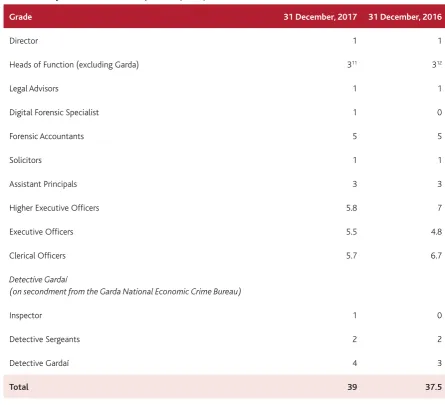
The composition of the Office’s staff complement as at 31 December, 2017, together with comparative data, is set out in Table 2 below.
Table 2 Analysis of actual staff complement (WTEs)
Grade 31 December, 2017 31 December, 2016
Director 1 1
Heads of Function (excluding Garda) 311 312
Legal Advisors 1 1
Digital Forensic Specialist 1 0
Forensic Accountants 5 5
Solicitors 1 1
Assistant Principals 3 3
Higher Executive Officers 5.8 7
Executive Officers 5.5 4.8
Clerical Officers 5.7 6.7
Detective Gardaí
(on secondment from the Garda National Economic Crime Bureau)
Inspector 1 0
Detective Sergeants 2 2
Detective Gardaí 4 3
[image:16.595.73.519.328.733.2]Office of the Director of Corporate Enforcement Annual Report2017
15
Digital Forensics
The office now has a dedicated digital forensics laboratory, which is equipped to carry out digital forensics examinations. The facility includes its own separate communications room for facilitating dedicated networking and on-site file storage solutions and also includes secure evidence storage solutions to ensure chain of evidence procedures. Previously the Office relied largely on third-party contractors and An Garda Síochána to perform this function.
The Portable digital forensics capability has assisted in operations with the interrogation of devices and corporate networks in-situ when executing search warrants. This has allowed investigators to identify relevant information and remove same while not having to dismantle corporate networks and disrupt a company’s operations. These additional resources provided the ability to setup a digital forensics solution at Garda stations to provide investigative support while suspects in custody are being questioned by ODCE staff.
Financial resources
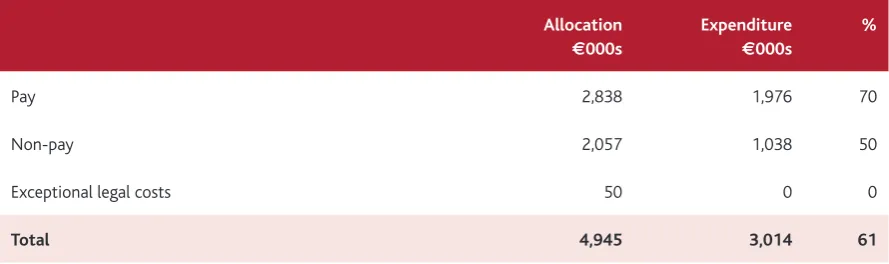
The Office is funded via the Department of Business, Enterprise & Innovation’s (“the Department”) Vote (Vote 32). Table 3 below sets out details of the Office’s 2017 allocation and expenditure respectively.
Table 3 Financial allocation and expenditure – 2017
Allocation €000s
Expenditure €000s
%
Pay 2,838 1,976 70
Non-pay 2,057 1,038 50
Exceptional legal costs 50 0 0
Total 4,945 3,014 61
The principal reasons as to why actual expenditure differed from the allocation were as follows:
•
savings on pay resulting from vacancies arising during the year (principally retirements and transfers out) that remained unfilled at year-end and the delay in recruitment of new staff for which sanction was granted; and•
the non-pay allocation for the year included provision for potential costs associated with litigation to which the Office was a party. The costs incurred during the year on these cases were less than might have been anticipated.A more detailed analysis of expenditure incurred during the year is set out at Appendix 1 to this Report.
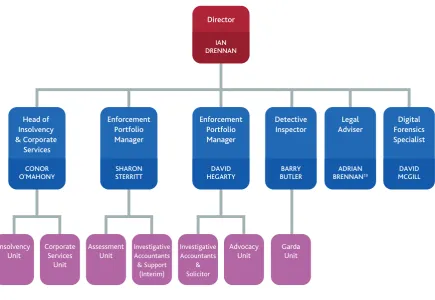
Organisational structure
[image:17.595.74.519.290.422.2]CONOR O'MAHONY IAN DRENNAN Head of Insolvency & Corporate Services Insolvency Unit Corporate Services Unit Assessment Unit Investigative Accountants & Support (Interim) Investigative Accountants & Solicitor Advocacy Unit Garda Unit SHARON STERRITT Enforcement Portfolio Manager Enforcement Portfolio Manager BARRY BUTLER Detective Inspector ADRIAN BRENNAN13 Legal Adviser DAVID MCGILL Digital Forensics Specialist Director DAVID HEGARTY
Principal workstreams
The nature of the Office’s principal workstreams is such that most of them require a multi-disciplinary approach involving ongoing interaction between Units and/or the active collaboration of Units with a view to achieving corporate objectives.
Accordingly, effective communication between Units, and that each Unit take an organisation-wide perspective when performing its functions, is a critical success factor. Accordingly, this is an approach that is both encouraged and facilitated by the Office’s leadership team.
The Office’s principal workstreams are set out in the Table below, together with details of where in this Report each workstream is primarily dealt with.
Table 4 Principal workstreams
Workstream Unit(s) principally involved Chapter
Encouraging compliance with the Companies Act
Responsibility for encouraging compliance with the Act resides in the first instance with the Advocacy Unit. However, the Advocacy Unit liaises with other relevant Units with a view to monitoring trends and identifying areas meriting focussed advocacy initiatives.
2
Advocating
legislative and policy enhancements
Depending upon the nature of the subject matter, the development of ODCE submissions is assigned to one or more Units. Generally speaking, however, the development of submissions will be co-ordinated through the Advocacy Unit.
2
Reviewing, and adjudicating upon, liquidators’ reports
Liquidators’ reports are processed by the Insolvency Unit. Decisions on individual reports are made by Case Officers. This workstream also encompasses the recently implemented Undertakings regime, which is further elaborated upon later in this Report.
[image:18.595.84.520.75.375.2]Office of the Director of Corporate Enforcement Annual Report2017
17
Workstream Unit(s) principally involved Chapter
Examination of complaints and statutory reports
The examination of complaints and statutory reports (such as, for example, auditors’ indictable offence reports) is the responsibility of the Enforcement function. Dependent upon the nature of the issues arising, the Enforcement function may:
•
address the issues itself, e.g., by way of voluntary rectification/remediation or through the use of certain of the Director’s statutory powers;•
designate the matter as being one for further investigation;•
refer the matter to the Insolvency Unit, e.g., where the issues in question relate to an insolvent company in liquidation;•
refer the matter to a third party, for example, another regulatory or enforcement body.3
Civil enforcement litigation
For the most part, civil enforcement litigation is managed by the Enforcement function.
Civil litigation, such as seeking the disqualification of directors of companies that have been struck off the Register of Companies14 whilst having undischarged debts, is
managed jointly by the Insolvency and Enforcement functions.
3
Criminal investigation and prosecution
The investigation of possible criminal breaches of the Act is undertaken by the Enforcement function in conjunction with the Garda Unit.
Once a decision has been taken to initiate summary criminal proceedings, the prosecution becomes a collaborative exercise between the Enforcement function and Garda Unit. Investigations in which a prosecution on indictment is envisaged involve collaboration on the part of the Enforcement function and Garda Unit.
In circumstances where, having reviewed an investigation file as submitted by the Office, a decision is taken by the DPP to initiate a prosecution on indictment, the provision of subsequent support to the Office of the DPP (for example, regarding disclosure to the defence), is primarily the responsibility of the Enforcement function and Garda Unit.
3
Supervision of liquidators’ behaviour
Actions taken to supervise liquidators’ behaviour (such as, for example, reviewing liquidators’ books and records) is a collaborative effort between the Insolvency and Enforcement function.
3
Provision of support services
The provision of support services to other areas of the Office is the primary responsibility of the Corporate Services Unit.
All Units have a responsibility to assist the Corporate Services Unit in ensuring that the ODCE’s obligations as a publicly funded Office (e.g. in the areas of procurement, tax clearance procedures etc.) are fully complied with.
4
Relationship management and development
Whilst certain Units, by virtue of the nature of their principal operations, have a greater degree of interface with certain external stakeholders than others, the interlinked nature of the organisation is such that all Units have a role in ongoing relationship management and development.
2
Office of the Director of Corporate Enforcement Annual Report2017
19
PROMOTING A GREATER UNDERSTANDING OF AFFECTED PARTIES’
RIGHTS AND DUTIES UNDER COMPANY LAW – INTRODUCTION
This Chapter provides details of the principal strategies pursued, and activities undertaken, by the Office during the year under review in the furtherance of the above stated goal. In summary, those strategies and activities included:
•
the development and promulgation of publications and other guidance material;•
engaging in a range of outreach activities, including the delivery of presentations, attendance at seminars and exhibitions and dealing with company law enquiries on a range of issues from members of the public;•
advocating legislative and policy enhancements; and•
managing and developing relationships with external stakeholders.PUBLICATIONS AND OUTREACH ACTIVITIES
Publications
Following on from the signing into law in May 2017 of the Companies (Accounting) Act 2017 and the impending Companies (Statutory Audits) Act 2018 which is scheduled to commence in 2018, the Office is currently updating its suite of information guidance to reflect changes to the law. The revised documents are expected to be published in the second half of 2018.
During the year under review, approximately 9,500 physical copies of the various ODCE publications, principally, Information Books and Quick Guides, were issued to interested parties. These publications were issued in response to public demand, either at, or as a consequence of attendance at, events, exhibitions and presentations or as a result of persons contacting the Office directly. In addition, and in agreement with ODCE, the Companies Registration Office (“CRO”) issue a Quick Guide on the roles and duties of directors to persons registering new companies. In the past, a physical guide issued, however, reflecting the CRO’s move to electronic means the guide is now issued electronically, consequentially reducing the number of physical copies issued by the Office by about 6,000.
Seminars and exhibitions
A key element of the Office’s advocacy strategy is its outreach programme. This consists of, amongst other things, the delivery of presentations and speeches to stakeholder groups, as well as attendance at exhibitions and events where the audience is likely to include one or more subsets of the Office’s target audience. The Office has identified certain constituencies as being its target audience, including:
•
persons considering incorporation or persons that have recently incorporated companies;•
professionals engaged in the provision of advice to companies and company directors, who are, by virtue of those activities, well placed to relay the ODCE’s compliance message to clients and so considerably expand the Office’s reach;•
students currently enrolled in business programmes at undergraduate and postgraduate level, many of whom, it is anticipated, will ultimately become directors of companies or professional advisors themselves; and•
the community and voluntary sectors, who by their nature tend, as a general proposition, to have a less well developed knowledge of company law and, as a result, tend to need guidance on company law and associated corporate governance matters.During the year, Office staff delivered 26 presentations (2016: 43) to a combined audience of approximately 1,350 people. Many of these presentations dealt specifically with the Companies Act 2014 and the ODCE’s enhanced remit and enforcement policies in that context. During the year, the Office was also represented at a total of 16 exhibitions (2016: 14). Details of the presentations delivered and exhibitions attended respectively during the year are set out at Appendix 2 to this Report.
MANAGING AND DEVELOPING RELATIONSHIPS WITH
EXTERNAL STAKEHOLDERS
In furtherance of its statutory objectives and associated goals, the Office seeks to develop and maintain strong and effective relationships with a range of key stakeholders. In addition to the general public, the Office’s key stakeholders include the Oireachtas15, the Minister, the Department, other statutory/regulatory bodies and those providing professional services to
companies and company directors and officers. The Office’s interactions during the year with certain of its key stakeholders are summarised below.
Members of the Oireachtas
The Office, from time to time, receives communications from members of the Oireachtas. Typically, these communications constitute expressions of concern as to whether company law is being breached by particular parties or relate to cases under review. Whilst the Office is constrained in the extent to which it can respond to such communications by virtue of its statutory confidentiality obligations, it endeavours to provide whatever assistance it can to Deputies16 and Senators17.
Department of Business, Enterprise & Innovation
Office staff continued to liaise with colleagues in the Department throughout the year on matters of mutual interest.
CRO
As the public repository of information on companies and company officers, the CRO plays a critically important role in supporting the Office in its work. In addition to meeting regularly on matters of mutual interest, CRO staff regularly supply evidence in ODCE proceedings and, where identified, of prima facie breaches of company law.
Garda National Economic Crime Bureau (“GNECB”)
As referred to in Chapter 1 of this Report, the Office’s staff complement includes a number of Gardaí. These Gardaí are on secondment from the GNECB. The Office’s close working relationship with An Garda Síochána, and GNECB in particular, is critical to its criminal enforcement work. In that context, the Office meets with GNECB senior management on a regular basis on matters of mutual interest.
Irish Auditing and Accounting Supervisory Authority (“IAASA”)
In accordance with the provisions of the Act, the Director is a member of IAASA and has the consequential right to nominate a member to its Board of Directors. Mr. Conor O’Mahony, the Office’s Head of Insolvency & Corporate Services, is, in that context, a member of IAASA’s Board of Directors. Mr. O’Mahony attended all relevant meetings of IAASA’s Board held during 2017. IAASA’s 2017 Annual Report will be available on its website18 once it has been laid before the Oireachtas by the Minister.
In addition to this statutory relationship as outlined above, the Office engaged regularly with IAASA during the year on matters of mutual interest, and one formal meeting was held with senior staff of IAASA on matters of mutual interest during the year under review.
Company Law Review Group (“CLRG”)
The CLRG19 is a statutorily established advisory body to the Minister on matters relating to company law. The Director is a
member of the CLRG and the ODCE is represented at both plenary meetings and at meetings of Committees whose work is pertinent to its remit.
CORPORATE INSOLVENCY
The Office’s Head of Insolvency & Corporate Services, Mr. Conor O’Mahony, is a member of the Corporate Insolvency sub-committee which has been examining, inter alia, the UNCITRAL Model Law on Cross-Border Insolvency, the European Proposal for a Directive on Insolvency, Restructuring and Second Chance, and has been tasked with reviewing the legislation on the winding up of companies.
COMPLIANCE & ENFORCEMENT
Office of the Director of Corporate Enforcement Annual Report2017
21
CORPORATE GOVERNANCE
The Office’s Head of Insolvency & Corporate Services, Mr. Conor O’Mahony, is a member of the Corporate Governance sub-committee, which has been charged with examining certain submissions referred to the CLRG by the Department of Business, Enterprise and Innovation relating to measures (dealing with the governance of companies) contained in Part 4 of the Act and the appropriate chapters of Parts 16, 17, 18 and 19. The subcommittee will also consider other codes of best practice in corporate governance, as recommended and/or required by relevant regulators.
Central Bank
The ODCE and the Central Bank have in place a Memorandum of Understanding (“MoU”) which, based on their respective grounding legislation, allows each body to refer information to the other where they are satisfied that such information is relevant to the other’s remit.
Office of the Revenue Commissioners
The Revenue Commissioners are an important partner of the Office in the furtherance of its work, particularly in respect of insolvency related matters. The ODCE and the Revenue Commissioners have in place an MoU which, based on their respective grounding legislation, allows each body to refer information to the other where they are satisfied that such information is relevant to the other’s remit.
In that context, the two bodies met on a number of occasions during the year. Moreover, the two bodies shared information in respect of five separate matters (2016: 5). This represents a reduced level of exchange compared with previous years and is explained by the decision to defer taking any new disqualification applications against the directors of struck-off companies pending the conclusion of an appeal taken by the Office to the Court of Appeal. This matter is elaborated upon further in Chapter 3 of this Report.
Accountancy profession
The accountancy profession plays an important role in assisting the work of the Office, through both auditors’ reporting obligations (which are elaborated upon in the next Chapter) and the profession’s wider support for, and communication of, the Office’s compliance message. As such, the Office seeks to work closely with the professional accountancy bodies to support them in ensuring that their members are fully informed of their statutory reporting obligations and to apprise them of the assistance that the Office can be to those of their members’ clients that occupy positions as company directors and officers.
Irish Stock Exchange
The Stock Exchange is another body with which the ODCE has an MoU in place and, in that context, one formal meeting was held with senior staff of the Irish Stock Exchange on matters of mutual interest during the year under review.
International Association of Insolvency Regulators (“IAIR”)
The IAIR is an international body that brings together the collective experiences and expertise of national insolvency regulators from 26 jurisdictions around the world. The IAIR, of which the Office has been a member since 2003, is a valuable forum for the promotion of liaison and co-operation between its members and for sharing information on areas of common interest and best practice.