118
Deconstructing multimodality: visual properties and visual context in
human semantic processing
Christopher Davis†, Luana Bulat†, Anita Vero†, Ekaterina Shutova‡ †Department of Computer Science & Technology, University of Cambridge, U.K.
{ccd38,luana.bulat,alv34}@cam.ac.uk
‡Institute for Logic, Language and Computation, University of Amsterdam, Netherlands
Abstract
Multimodal semantic models that extend lin-guistic representations with additional percep-tual input have proved successful in a range of natural language processing (NLP) tasks. Recent research has successfully used neural methods to automatically create visual repre-sentations for words. However, these works have extracted visual features from complete images, and have not examined how differ-ent kinds of visual information impact perfor-mance. In contrast, we construct multimodal models that differentiate between internal vi-sual properties of the objects and their exter-nal visual context. We evaluate the models on the task of decoding brain activity associ-ated with the meanings of nouns, demonstrat-ing their advantage over those based on com-plete images.
1 Introduction
Multimodal models combining linguistic and vi-sual information have enjoyed a growing interest in the field of semantics. Recent research has shown that such models outperform purely lin-guistic models on a range of NLP tasks, including modelling semantic similarity (Silberer and Lap-ata,2014), lexical entailment (Kiela et al.,2015), and metaphor identification (Shutova et al.,2016). Despite this success, little is known about the na-ture of semantic information learned from images and why it is useful. For instance, some concepts may be better characterised by their own (inter-nal) visual properties and others by the (exter(inter-nal) visual context, in which they appear. However, existing neural multimodal semantic approaches use entire images to learn visual word represen-tations, without differentiating between these two kinds of visual information. In contrast, we inves-tigate whether differentiating between internal vi-sual properties and external vivi-sual context is ben-eficial compared to learning visual representations
from complete images. We construct three multi-modal models combining linguistic and visual in-formation: using (1) internal visual features ex-tracted from an object’s bounding box, (2) exter-nalvisual features outside the bounding box, i.e. the visual context, and (3) visual features extracted fromcompleteimages. Figure1visualises the dif-ferent visual information extracted from an image. We use skip-gram (Mikolov et al., 2013) as our linguistic model and extract visual representations from a convolutional neural network (CNN) pre-trained on the ImageNet classification task ( Fei-Fei,2010).
We evaluate the models in their ability to decode patterns of brain activity associated with the mean-ings of nouns, obtained via brain imaging. This choice of task allows us to assess the importance of each type of visual information in human se-mantic processing. Specifically, we perform two experiments: (1) using the Visual Genome ( Kr-ishna et al., 2016) dataset of images where ob-jects are manually annotated with bounding boxes, and (2) using images retrieved from Google Image Search and automatically segmenting them using a Faster R-CNN (FRCNN) model (Ren et al.,2015). We find that all of our multimodal models are able to decode brain activity patterns and that the mod-els relying on internal visual properties are supe-rior to all others.
2 Related Work
con-(a)VIS-WHOLE (b)VIS-INTERNAL (c)VIS-EXTERNAL
Figure 1: An example of images processed to ex-tract the internal and external visual features using the bounding box around the concept.
catenate them with linguistic representations ob-tained from a skip-gram model. Their results pre-sented empirical improvements over the previous bag-of-visual-words method (Bruni et al., 2012). Other approaches use restricted Boltzmann ma-chines (Srivastava and Salakhutdinov, 2012), re-cursive neural networks (Socher et al., 2014) and autoencoders (Silberer and Lapata,2014).
Decoding Brain Activity Research in neuro-science supports the view that concepts are rep-resented as patterns of neural activation and, sim-ilarly to distributed semantic representations, are naturally encoded in neural semantic vector space (Haxby et al.,2001;Huth et al., 2012;Anderson et al.,2013).Mitchell et al.(2008) were the first to employ distributional semantic models to predict neural activation in the human brain using data ob-tained via functional Magentic Resonance Imag-ing (fMRI).Murphy et al.(2012);Devereux et al.
(2010); Pereira et al. (2013) have since success-fully tested a wider range of distributional models in this task.
Recent research shows that multimodal models grounded in the visual modality strongly corre-late with neural activation patterns associated with word meaning. Anderson et al.(2013) construct semantic models using visual data and show a high correlation to brain activation patterns from fMRI. WhileAnderson et al.(2015) find that linguistic-only semantic models better predict brain activity associated with linguistic processing, and image-based semantic models better predict similarity within the visual processing portions of the brain.
Bulat et al.(2017) compare and evaluate a range of distributional semantic models in their ability to predict brain activity associated with concepts. Two key differences between our work and both
[image:2.595.73.293.61.147.2]Anderson et al.(2013) andAnderson et al.(2015) are 1) we make use of neural-network-based vi-sual features as opposed to SIFT features (Lowe,
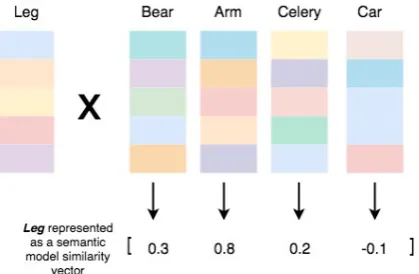
Figure 2: Semantic model similarity encoding. Where the coloured columns represent semantic vectors from the same model (i.e.VIS-INTERNAL). The bottom row represents the similarity codes for the concept “Leg”, calculated by computing the Pearson correlation be-tween “Leg” and the other semantic vectors from the dataset.
2004), and 2) we perform a word-level decoding analysis as opposed to representational similarity analysis (Kriegeskorte et al.,2008).
We aim to further our understanding of the role of vision in semantic processing by evaluating our models on the task of decoding brain activity as-sociated with the meanings of nouns.
3 Data
Visual Data In the first experiment, we used the Visual Genome (Krishna et al., 2016) dataset of images manually-annotated for objects and their bounding boxes. In the second experiment, we trained Faster-RCNN networks on manually anno-tated images from ImageNet (Deng et al., 2009;
Fei-Fei, 2010), and then processed images re-trieved from Google Images to construct a dataset of automatically-annotated images. Both Visual Genome and ImageNet were selected as they con-tain bounding box annotations around objects.
Brain Imaging Data We used a dataset of brain activity patterns associated with the mean-ings of nouns created by Mitchell et al. (2008) (MITCHELL). The dataset includes 60 concrete nouns from 12 semantic categories, such as vehi-cles or vegetables. fMRI images were recorded when participants were presented with line draw-ings of the objects and the corresponding nouns. We use 50 nouns from the dataset in our experi-ments, since 10 of the nouns were not covered by the Visual Genome and ImageNet datasets.
[image:2.595.309.519.62.199.2]pro-Model P1 P2 P3 P4 P5 P6 P7 P8 P9 Mean LINGUISTIC 0.90 0.77 0.85 0.86 0.83 0.70 0.84 0.62 0.78 0.79 VIS-INTERNAL 0.90 0.81 0.85 0.82 0.75 0.66 0.79 0.63 0.73 0.77
[image:3.595.118.478.61.165.2]VIS-EXTERNAL 0.82 0.72 0.76 0.81 0.62 0.62 0.73 0.59 0.73 0.71 VIS-WHOLE 0.84 0.69 0.77 0.80 0.63 0.61 0.75 0.60 0.75 0.71 MM-INTERNAL 0.92 0.81 0.86 0.88 0.82 0.69 0.84 0.62 0.79 0.80 MM-EXTERNAL 0.90 0.78 0.85 0.88 0.79 0.70 0.85 0.63 0.82 0.80 MM-WHOLE 0.90 0.76 0.83 0.87 0.79 0.67 0.84 0.63 0.82 0.79 VIS-COMBINED 0.89 0.80 0.82 0.84 0.70 0.66 0.78 0.61 0.77 0.76 MM-COMBINED 0.91 0.80 0.87 0.88 0.80 0.78 0.85 0.63 0.81 0.81
Table 1: Average decoding accuracies for the models trained on Visual Genome per participant and the mean over participants.Vis=visual,MM=multimodal,COMBINED=explicitly differentiates internal and external features.
file across concepts. We perform leave-two-out cross validation and select voxels independently for each of the cross validation folds during train-ing. The stability score for a voxel is measured across six presentations of a word and is approxi-mated as the average pairwise Pearson correlation among activation profiles over the training words in a cross-validation fold. The 500 voxels with the highest stability score are chosen and combined into a vector, used to evaluate how well the multi-modal models can decode brain activity patterns.
4 Methods
We construct three visual models using three types of visual information: the internal features of the object, the external context surrounding it, and the whole image. These representations are then com-bined with linguistic representations to create the multimodal models.
4.1 Learning linguistic representations
We use the skip-gram model with negative sampling (Mikolov et al., 2013) to learn 100-dimensional word embeddings from a lemmatized 2015 copy of Wikipedia (Rimell et al.,2016).
4.2 Learning visual representations
Object detection and segmentation We use the FRCNN unified object detection model (Ren et al.,
2015) to automatically detect objects and their bounding boxes in images associated with our nouns. FRCNN combines a region proposal net-work (RPN) with Fast R-CNN, an object detection network, and minimizes computational cost dur-ing traindur-ing and testdur-ing by shardur-ing convolutional layers between the networks. To maximize accu-racy, we train an FRCNN network for each seman-tic class in the MITCHELLdataset, starting from a VGG16 network (Simonyan and Zisserman,2014) pre-trained on the PASCAL VOC 2007 data set.
The pre-trained model contains many useful lower level features and therefore we expect
fine-tuning a pre-trained model to yield optimal results. We train the networks using ImageNet images an-notated with bounding boxes. We collected an av-erage of 303 images per concept, with the follow-ing nouns lackfollow-ing annotated images: foot, arm, eye, igloo, pliers and carrot. Images were split into 10% test, 40% train, and 50% train-validation sets. We trained the networks using approximate joint training. We tuned the step-size to 3000 and used the following default hyperparameter values: learning rate policy: “step”; base learning rate: 0.001; average loss: 100; momentum: 0.9; weight decay: 0.0005; gamma: 0.1. After training, the mean average precision (mAP) score across all se-mantic classes was 0.73.
Extracting visual features We retrieve 60 im-ages per word using Google Image Search. We then create three sets of images for every word: the INTERNAL image (containing the object de-noted by the word), an EXTERNAL image (con-taining its visual context), and the originalWHOLE image. To generate the internal images, we crop and extract each object from within the annotated bounding boxes. To generate external images, we fill in the annotated bounding box area with black pixels, leaving only the visual context (black pix-els are used as a simple way to represent no infor-mation). All images are re-scaled to 256x256 and the original aspect ratios are maintained, padding any remaining area with black pixels.
We use a Caffe (Jia et al.,2014) implementation of a pre-trained AlexNet model (Krizhevsky et al.,
Model Mean LINGUISTIC 0.79 VIS-INTERNAL 0.80
[image:4.595.127.234.60.163.2]VIS-EXTERNAL 0.74 VIS-WHOLE 0.80 MM-INTERNAL 0.81 MM-EXTERNAL 0.81 MM-WHOLE 0.82 VIS-COMBINED 0.79 MM-COMBINED 0.82
Table 2: Average decoding accuracies over the nine participants for the semantic models trained on the au-tomatically annotated images. Naming convention fol-lows Table1
. to the nouns in our data set.
4.3 Multimodal Models
We construct multimodal models by concatenat-ing L2-normalised lconcatenat-inguistic and visual represen-tations. This strategy, known as middle fusion, has been shown successful in previous multimodal se-mantics research (Kiela and Bottou, 2014). We combine the linguistic model with each of our visual models, resulting in the three kinds of multimodal models: INTERNAL, EXTERNAL and WHOLE. Furthermore, we construct twocombined
models: aCOMBINEDvisual-only model concate-nating the internal and external models, and a COMBINED multimodal model concatenating the internal, external, and linguistic models.
4.4 Decoding Brain Activity
We evaluate our models in their ability to decode brain activity associated with unseen words, i.e. to predict the correct label associated with their fMRI patterns. We follow the same procedure as Ander-son et al.(2016), computing asemantic model sim-ilarity matrix consisting of semantic model sim-ilarity codes for each of the 50 nouns from the
Mitchell et al.(2008) dataset. Similarly, we con-struct abrain activity similarity matrixconsisting of brain activity similarity codes of the 50 nouns. This process is visualised in Figure 2, where the coloured columns represent semantic model vec-tors for each word in the dataset, and the bottom row represents the resulting similarity codes for the concept “Leg”.
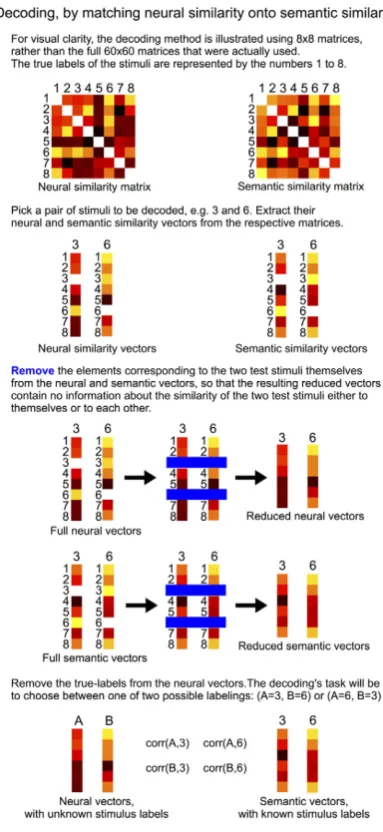
We perform leave-two-out cross validation, selecting the semantic model similarity codes (−→si,−→sj) and brain activity similarity codes
(−→ai,−→aj)for two nouns. We remove thei-th and j-th elements from each of the similarity codes as these entries correspond to the nouns being tested. Figure3visualises an example of the de-coding procedure. Dede-coding is successful if the
Figure 3: Visualisation of leave-two-out cross valida-tion for semantic model similarity decoding. Visuali-sation from (Anderson et al.,2016).
sum of Pearson correlations for the correct pair-ings is greater than the sum of Pearson correlations for the incorrect pairings, resulting in decoding ac-curacy of 1 for this pair and 0 otherwise. The ex-pected chance-level decoding accuracy is50%if a model were to match word labels with similarity vectors at random.
5 Experiments
[image:4.595.318.510.61.478.2]5.1 Manually annotated images
Experimental Setup We use 50 nouns from the MITCHELLdataset and assess each model’s ability to decode brain activity vectors using leave-two-out cross validation, resulting in 1225 (50 choose 2) cross-validation folds per model.
Results The results, presented in Table 1, demonstrate that all semantic models decode brain activity patterns significantly above chance lev-els1. The INTERNALvisual-only model achieves a mean accuracy of 0.77, significantly2 outper-forming (V={36, 43}, all p<0.015) the EXTER -NAL and WHOLE visual-only models, using the paired Wilcoxon signed rank test. TheINTERNAL andEXTERNALmultimodal models both achieve a mean accuracy of 0.80, outperforming theWHOLE multimodal model with a mean of 0.79. Finally, the COMBINED multimodal model outperforms the INTERNALand EXTERNAL multimodal mod-els, and significantly outperforms (V=35, p<0.02) theWHOLE multimodal model with a mean accu-racy of 0.81. These results demonstrate that it is beneficial to differentiate between internal and ex-ternal visual information, but that both are useful for semantic processing, with the internal visual features having the most prominent influence.
We investigated the errors produced during the cross-validation folds, and found the INTERNAL visual-only model outperforms itsEXTERNALand WHOLEcounterparts systematically for all but one semantic class: kitchen utensils, where the EX -TERNAL visual-only model obtains the fewest er-rors. Overall, these results suggest that internal visual features are superior in this task and corre-late strongly with the patterns of human semantic representation.
5.2 Automatically annotated images
Experimental Setup For each of our 50 nouns from the MITCHELL dataset, we retrieve 60 im-ages using Google Image Search. The imim-ages are annotated using FRCNNs and then processed to
1Using permutation testing with 1000 repeats, we found
all models perform significantly above chance level. We fol-low the same shuffling procedure detailed inAnderson et al.
(2017) to obtain a null distribution of chance-level decoding accuracies. The p-value of decoding accuracy is the propor-tion of chance-level accuracies greater than or equal to the observed cross-validated decoding accuracy.
2When comparing two models, we used paired Wilcoxon
signed rank tests (two-tailed) to tell us whether their mean accuracy scores significantly differ from each other.
create INTERNAL, EXTERNAL andWHOLE mod-els. We follow the same evaluation procedure as in the previous experiment, performing 1225 (50 choose 2) cross-validation folds.
Results The results, presented in Table 2, demonstrate that all models decode brain activity vectors significantly above chance level. They also show multimodal models constructed with auto-matic object detection perform on par with rep-resentations learned from manually annotated im-ages. Overall, we observe a similar trend, i.e. the INTERNALvisual-only model significantly outper-forms (V=43, p<0.015) the EXTERNAL visual-only model (mean accuracies of 0.80 and 0.74).
Our qualitative analysis has shown that the IN-TERNAL visual model outperforms the others for the following semantic classes, in both experi-ments: building,furnitureandinsect. We find the WHOLE visual-only model has fewer class-level errors in this experiment. We believe this is due to the quality of the images; the Visual Genome im-ages contain more objects per image on average, making the external visual context more variable compared to images from Google Images.
Besides corroborating the findings of the previ-ous experiment on the importance of the internal visual features, these results show that high qual-ity visual representations capturing the objects’ in-ternal properties and their visual context can be learned through automatic object detection tech-niques, decreasing the reliance on human anno-tated datasets (albeit some annoanno-tated data is re-quired to train the object detection system) and al-lowing for a greater scalability of the models.
6 Conclusion
Our results show that multimodal semantic mod-els correlate with human neural semantic repre-sentations associated with concrete concepts, and the visual-only model using internal visual fea-tures outperforms the other visual-only models in most cases. Similar performance across models using manual and automatically annotated images demonstrates progress in object detection systems, presenting opportunities to expand to other tasks where evaluation datasets may not be covered by manually annotated image datasets.
References
words, eyes and brains: Correlating image-based distributional semantic models with neural represen-tations of concepts. InEMNLP, pages 1960–1970.
Andrew J Anderson, Elia Bruni, Alessandro Lopopolo, Massimo Poesio, and Marco Baroni. 2015. Reading visually embodied meaning from the brain: Visu-ally grounded computational models decode visual-object mental imagery induced by written text. Neu-roImage, 120:309–322.
Andrew J Anderson, Douwe Kiela, Stephen Clark, and Massimo Poesio. 2017. Visually grounded and tex-tual semantic models differentially decode brain ac-tivity associated with concrete and abstract nouns. Transactions of the Association for Computational Linguistics, 5:17–30.
Andrew J Anderson, Benjamin D Zinszer, and Ra-jeev DS Raizada. 2016. Representational similarity encoding for fmri: Pattern-based synthesis to pre-dict brain activity using stimulus-model-similarities. NeuroImage, 128:44–53.
Elia Bruni, Jasper Uijlings, Marco Baroni, and Nicu Sebe. 2012. Distributional semantics with eyes: Us-ing image analysis to improve computational repre-sentations of word meaning. InProceedings of the 20th ACM international conference on Multimedia, pages 1219–1228. ACM.
Luana Bulat, Stephen Clark, and Ekaterina Shutova. 2017. Speaking, seeing, understanding: Correlating semantic models with conceptual representation in the brain. InProceedings of the 2017 Conference on Empirical Methods in Natural Language Process-ing, pages 1092–1102.
Jia Deng, Wei Dong, Richard Socher, Li-Jia Li, Kai Li, and Li Fei-Fei. 2009. Imagenet: A large-scale hi-erarchical image database. InComputer Vision and Pattern Recognition, 2009. CVPR 2009. IEEE Con-ference on, pages 248–255. IEEE.
Barry Devereux, Colin Kelly, and Anna Korhonen. 2010. Using fmri activation to conceptual stim-uli to evaluate methods for extracting conceptual representations from corpora. In Proceedings of the NAACL HLT 2010 First Workshop on Compu-tational Neurolinguistics, pages 70–78. Association for Computational Linguistics.
Li Fei-Fei. 2010. Imagenet: crowdsourcing, bench-marking & other cool things. InCMU VASC Semi-nar.
James V Haxby, M Ida Gobbini, Maura L Furey, Alu-mit Ishai, Jennifer L Schouten, and Pietro Pietrini. 2001. Distributed and overlapping representations of faces and objects in ventral temporal cortex. Sci-ence, 293(5539):2425–2430.
Alexander G Huth, Shinji Nishimoto, An T Vu, and Jack L Gallant. 2012. A continuous semantic space describes the representation of thousands of object and action categories across the human brain. Neu-ron, 76(6):1210–1224.
Yangqing Jia, Evan Shelhamer, Jeff Donahue, Sergey Karayev, Jonathan Long, Ross Girshick, Sergio Guadarrama, and Trevor Darrell. 2014. Caffe: Con-volutional architecture for fast feature embedding. InProceedings of the 22Nd ACM International Con-ference on Multimedia, MM ’14, pages 675–678, New York, NY, USA. ACM.
Douwe Kiela. 2016. Mmfeat: A toolkit for extracting multi-modal features. InProceedings of ACL.
Douwe Kiela and Leon Bottou. 2014. Learning image embeddings using convolutional neural networks for improved multi-modal semantics. InEMNLP, pages 36–45. Citeseer.
Douwe Kiela, Laura Rimell, Ivan Vulic, and Stephen Clark. 2015. Exploiting image generality for lexical entailment detection. InProceedings of the 53rd An-nual Meeting of the Association for Computational Linguistics (ACL 2015), pages 119–124. ACL.
Nikolaus Kriegeskorte, Marieke Mur, and Peter A Ban-dettini. 2008. Representational similarity analysis-connecting the branches of systems neuroscience. Frontiers in systems neuroscience, 2:4.
Ranjay Krishna, Yuke Zhu, Oliver Groth, Justin John-son, Kenji Hata, Joshua Kravitz, Stephanie Chen, Yannis Kalantidis, Li-Jia Li, David A Shamma, Michael Bernstein, and Li Fei-Fei. 2016. Visual genome: Connecting language and vision using crowdsourced dense image annotations.
Alex Krizhevsky, Ilya Sutskever, and Geoffrey E Hin-ton. 2012. Imagenet classification with deep con-volutional neural networks. In Advances in neural information processing systems, pages 1097–1105.
Max M Louwerse. 2011. Symbol interdependency in symbolic and embodied cognition.Topics in Cogni-tive Science, 3(2):273–302.
David G Lowe. 2004. Distinctive image features from scale-invariant keypoints. International journal of computer vision, 60(2):91–110.
Tomas Mikolov, Kai Chen, Greg Corrado, and Jef-frey Dean. 2013. Efficient estimation of word representations in vector space. arXiv preprint arXiv:1301.3781.
Tom M. Mitchell, Svetlana V. Shinkareva, Andrew Carlson, Kai-Min Chang, Vicente L. Malave, Robert A. Mason, and Marcel Adam Just. 2008. Predicting human brain activity associated with the meanings of nouns.science, 320(5880):1191–1195.
Francisco Pereira, Matthew Botvinick, and Greg Detre. 2013. Using wikipedia to learn semantic feature rep-resentations of concrete concepts in neuroimaging experiments.Artificial intelligence, 194:240–252.
Shaoqing Ren, Kaiming He, Ross Girshick, and Jian Sun. 2015. Faster r-cnn: Towards real-time ob-ject detection with region proposal networks. In Advances in neural information processing systems, pages 91–99.
Laura Rimell, Jean Maillard, Tamara Polajnar, and Stephen Clark. 2016. Relpron: A relative clause evaluation data set for compositional distributional semantics. Computational Linguistics, 42(4):661– 701.
Ekaterina Shutova, Douwe Kiela, and Jean Maillard. 2016. Black holes and white rabbits: Metaphor identification with visual features. In Proc. of the 2016 Conference of the North American Chapter of the Association for Computational Linguistics: Hu-man Language Technologies, pages 160–170.
Carina Silberer and Mirella Lapata. 2014. Learn-ing grounded meanLearn-ing representations with autoen-coders. InACL (1), pages 721–732.
Karen Simonyan and Andrew Zisserman. 2014. Very deep convolutional networks for large-scale image recognition. arXiv preprint arXiv:1409.1556.
Richard Socher, Andrej Karpathy, Quoc V Le, Christo-pher D Manning, and Andrew Y Ng. 2014. Grounded compositional semantics for finding and describing images with sentences. Transactions of the Association for Computational Linguistics, 2:207–218.