727
Pardeep at SemEval-2019 Task 6: Identifying and Categorizing Offensive
Language in Social Media Using Deep Learning
Pardeep Singh
School of Computer & Systems Sciences Jawaharlal Nehru University
New Delhi-110067
Satish Chand
School of Computer & Systems Sciences Jawaharlal Nehru University
New Delhi-110067 [email protected]
Abstract
The rise of social media has made informa-tion exchange faster and easier among the peo-ple. However, in recent times, the use of of-fensive language has seen an upsurge in so-cial media. The main challenge for a service provider is to correctly identify such offensive posts and take necessary action to monitor and control their spread. In this work, we try to ad-dress this problem by using sophisticated deep learning techniques like LSTM, Bidirectional LSTM and Bidirectional GRU. Our proposed approach solves 3 different Sub-tasks provided in the SemEval-2019 task 6 which incorpo-rates identification of offensive tweets as well as their categorization. We obtain significantly better results in the leader-board for Sub-task B and decent results for task A and Sub-task C validating the fact that the proposed models can be used for automating the offen-sive post-detection task in social media.
1 Introduction
Social media has revolutionized the way of com-munication among the people. It is an instant communication medium which connects people all over the world and shares their views. But, some people misuse this freedom by using the of-fensive language through posts or comments to de-fame, insult or target an individual or a group of individuals. The mainstream media have reported various cases of suicide and depression due to trolling and cyberbullying in social media. Hence it becomes worrisome for the corporates, govern-ment organizations and security agencies to ei-ther stop or mitigate this type of behavior of the users. Manually it is impossible to check the neg-ative behavior of users due to the volume, veloc-ity and variety of data coming from the social net-works. Hence there is an utmost need to develop a system which automatically identifies and catego-rizes the offensive language in social networks. To
tackle these issues SemEval-2019 (Zampieri et al.,
2019b) aimed exactly at that need and organized a task in identifying and categorizing offensive lan-guage in social media. This task is divided into three Sub-tasks.
Sub-task A - Offensive language identification. Sub-task B - Categorization of offense types. Sub-task C - Offense target identification.
All the three Sub-tasks are related to each other. In Sub-task A, we have to identify whether a given set of tweets is offensive or not. It is a binary clas-sification task based on tweet text. In Sub-task B, the main challenge is to categorize the tweets which are offensive in Sub-task A into targeted or untargeted. Sub-task C is comparatively challeng-ing than other two Sub-tasks due to the multi-class nature. Its goal is to identify the tweets which are targeted in Sub-task B and categorized those tweets into individual, group or others.
2 Related Work
This section discusses some existing work related to identifying and categorizing offensive language in social media. Researchers have applied various computational methods to deal with hate speech, aggression, offensive language, racist and sexist language, and cyberbullying.
Hate Speech: Detection of hate speech is mod-eled in (Zhang et al.,2018). The authors applied CNN and GRU deep neural networks along with pre-trained Google Word2vec word embedding to detect the hate speech on Twitter. (Zhang and Luo,2018) proposed Skip Gram Extraction CNN (SKIP-CNN) deep neural network model to iden-tify hate speech present in social media text. It is discussed in this paper that hate speech lacks dis-tinctive and unique features in a dataset which is hard to discover. The proposed model serves as a feature extractor for capturing the semantics of hate speech in social media.
Aggression:A method to detect aggression in so-cial media is proposed in (Madisetty and Desarkar,
2018). The authors applied CNN, LSTM and Bidi-rectional LSTM on Facebook comment dataset. The output of these three deep learning models are used as an input to the majority based ensemble method for detection of aggression in social me-dia. Another paper (Kumar et al.,2018) presents the system description report of shared task on identification of aggression in social media as a part of the 1st workshop on trolling, aggression and cyberbullying (TRAC1). The aggression an-notated dataset of Facebook posts and comments in English and Hindi language were provided to the participants for training and validation. Six models out of the top ten best performing models were trained using LSTM, Bidirectional LSTM, CNN, and RNN deep neural networks.
Racist and Sexist Language: (Davidson et al.,
2017) focused on classifying homophobic and racist tweets as hate speech and sexist remarks tweets as offensive. They use Logistic Regression with L2 regularization to predict the class mem-bership. (Pitsilis et al., 2018) proposed an en-semble LSTM deep learning classifier that utilizes the user behavior metric to show each user view-point towards racism and sexism captured by their tweeting history.
Cyberbullying: (Dadvar et al., 2013) studied about the Cyberbullying detection. They combine individual comments, user characteristics and user
profile information for training the Support Vector Machine classifier. It is also reported that the ad-dition of user history with text features improves cyberbullying detection accuracy. (Rafiq et al.,
2018) proposed a multi-stage cyberbullying detec-tion mechanism by two novel components. First is dynamic priority scheduler which drastically re-duces the classification time, and second is incmental classification method which is highly re-sponsive regarding time to raise alerts.
Until now there have been many publications and studies on offensive language, aggression and hate speech in social media. Examples include ( Wie-gand et al., 2018), (ElSherief et al., 2018) and (Fortuna and Nunes, 2018). All these methods have some pros and cons associated with them. Therefore this paper proposed the idea of using deep learning sequence models for better accuracy in results for SemEval-2019 task 6.
3 Methodology and Data
In this section, we first describe the dataset used in the competition and then we explain the descrip-tion of approaches used for solving the problem.
3.1 Dataset Used
The dataset provided by the task organizers is OLID (Offensive Language Identification). The details of data and annotation are available in (Zampieri et al., 2019a). For Sub-task A, this dataset contains tweets labeled into the following two categories: offensive (OFF) and not offensive (NOT). For Sub-task B, tweets are labeled into the following two categories: targeted input (TIN) and untargeted (UNT). For Sub-task C, the given tweets are classified into the following three cate-gories: group (GP), individual (IND) and others (OTH). Out of 13,240 training samples of task A, 4404 samples have been allocated to Sub-task B and 3,877 samples have been allocated to Sub-task C. All the tweets are in English language. The statistics of the dataset and some instances of tweets with their labels are shown in Table 1 and Table 2.
Training Set samples
Testing Set samples
Sub-task A 13240 860
Sub-task B 4404 240
Sub-task C 3877 213
Tweet Sub-task A Sub-task B Sub-task C
Its not my fault you support gun control. NOT -
-Someone should’veTaken” this piece of shit to a vol-cano.
OFF UNT
-you are a lying corrupt traitor!!! Nobody wants to hear anymore of your lies!!! #DeepStateCorruption.
OFF TIN IND
Kind of like when conservatives wanna associate ev-eryone to their left as communist antifa members?
OFF TIN GRP
[image:3.595.75.519.62.187.2]why report this garbage. We don’t give a crap. OFF TIN OTH
Table 2:Some tweets from the training dataset with their labels.
3.2 Methodology
Here we discuss our proposed approach in details. Our initial approach was to check with standard machine learning algorithms like Logistic Regres-sion (Hosmer Jr et al.,2013), Random Forest (Xu et al.,2012), Support Vector Machines (Chang and Lin,2011), XGBoost (Chen and Guestrin, 2016) and Gradient Boosting (Natekin and Knoll,2013). We use TF-IDF vectorization for vectorizing our text and then apply the above-mentioned algo-rithms for the model development. Performance of these algorithms were not quite acceptable as it gave low Accuracy in results. To overcome above mentioned issues, we use deep learning algorithms for classifying the text. First we convert the text into vector representations with the help of GloVe (Pennington et al., 2014) word level embeddings and then use these representations as an input to the deep learning models described in the subse-quent sections for classification tasks.
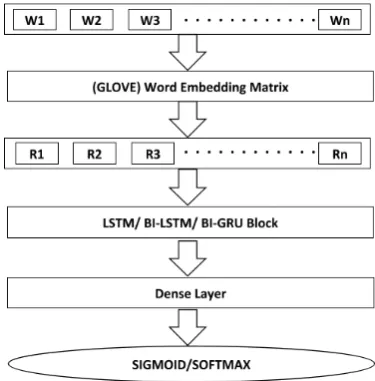
Figure 1:Architecture of the proposed deep learning models.
The multi-layered architecture of our approach presented in Figure 1. It comprised of various components in the form of layers. Since the data is in the form of text and the first step is to vec-torize the text. To achieve this, we first make the tokens of the text W1, W2, W3,..., Wn and apply pre-trained GloVe word embeddings to get vector representations R1, R2, R3,..., Rn from it. Next layer can be LSTM, Bidirectional LSTM or Bidi-rectional GRU Block described in the next subsec-tions. To overcome the problem of overfitting, we add a small amount of dropout. Finally, we use a Dense layer and Softmax/Sigmoid layer to get the output of the models.
3.2.1 Long Short Term Memory (LSTM)
We first try LSTM (Hochreiter and Schmidhuber,
1997) which have been used successfully in many text classification tasks (Madisetty and Desarkar,
2018). LSTM is special kind of RNN which cap-tures the long contexts and long-range dependen-cies very efficiently in the sentences and takes care of the vanishing gradient problem of RNN (Lipton et al., 2015) with the help of carefully regulated structures named gates. The main components of the LSTM model are input gate, forget gate, output gate and candidate memory state. All these gates are single layered neural networks with the Sig-moid activation function except candidate memory state which uses tanh as the activation function.
3.2.2 Gated Recurrent Unit (GRU)
[image:3.595.86.274.532.723.2]The main components of GRU are reset gate, up-date gate and current memory content. Similar to LSTM, both reset gate and update gate are sin-gle layered neural networks with the Sigmoid ac-tivation function except current memory content which use tanh as the activation function. The ba-sic function of the reset gate is to determine how much of the past information to be lost whereas the update gate decides how much of the information the model should pass to the next states.
3.2.3 Bidirectional LSTM and GRU
Both LSTM and GRU uses sequential information of the textual data for the processing and capture much longer range dependencies. But, the catch is that they use the sequence of only one direction while the Bidirectional version of the same consid-ers a revconsid-erse copy of the provided input. In certain problems, this reversal helps to a better feature un-derstanding and improved model performance. In our work, we mainly use standard LSTM and Bidirectional version of both LSTM and GRU for the model developments. The detailed experimen-tal setup is described in the next section.
4 Experimental Setting
For implementing the models, we use Keras (Ketkar,2017) and Scikit-learn (Pedregosa et al.,
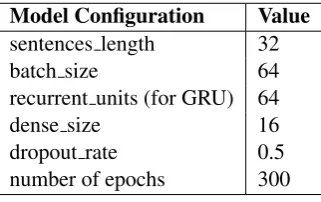
2011) python framework libraries. The experi-mental details and model configuration are shown in Table 3. For the effectiveness of models, we add a small proportion of dropout. For GRU model, we specify the number of Recurrent Units. In terms of training, we use categorical cross Entropy as a loss function with ADAM as the optimization function. All the models are tested using 10 fold cross-validation.
Model Configuration Value
sentences length 32
batch size 64
recurrent units (for GRU) 64
dense size 16
dropout rate 0.5
[image:4.595.309.510.122.275.2]number of epochs 300
Table 3:Configuration of the proposed models.
4.1 Impact of Batch Size on Model Performance
We checked our proposed approach with three dif-ferent batch sizes 64, 128 and 256 to check its
im-pact on model performance. It is found experi-mentally that batch size 64 provides optimal re-sults.
0.773
0.606
0.723
0.524 0.817
0.769
0.583
0.733
0.487 0.815
0.766
0.567 0.74
0.464 0.81
Metric Value
0 0.1 0.2 0.3 0.4 0.5 0.6 0.7 0.8 0.9 1
Accuracy F1(Macro) Precision Recall AUC
64 128 256
[image:4.595.101.262.569.670.2]Batch Size
Figure 2:Performance comparisons with different batch Sizes.
Performance metrics: The official evaluation metric for all the three Sub-tasks are the macro-averaged F1 score. For additional analysis, we use the Accuracy, Precision, Recall and ROC-AUC.
5 Results and Discussions
Classifier Accuracy F1(Macro) Precision Recall ROC-AUC Logistic Regression + TF-IDF 0.7610 0.5563 0.5070 0.4463 0.6832
Random Forest + TF-IDF 0.7567 0.5189 0.7718 0.3908 0.6662
SVM with linear Kernel + TF-IDF 0.7658 0.5579 0.7613 0.4403 0.6853
Xgboost + TF-IDF 0.7323 0.5248 0.6493 0.4403 0.6601
Gradient Boosting + TF-IDF 0.7525 0.5750 0.6785 0.4988 0.6897
BI-LSTM + GloVe 0.7686 0.6089 0.7026 0.5459 0.8100
BI-GRU + GloVe 0.7524 0.6021 0.6501 0.5672 0.7963
[image:5.595.73.504.62.189.2]LSTM + GloVe 0.7695 0.5942 0.7191 0.5081 0.8100
Table 4:Results of the proposed deep learning approaches including baselines on the Sub-task A training data using 10-fold cross validation
5.1 Results for Sub-task A
The official results of our proposed models on the test set for Sub-task A is shown in Table 5. As it is evident from these results that Bidirectional GRU performed better than other two deep learn-ing models with F1 Score of 0.69. To analyze the correct label of a tweet, we also show the confu-sion matrix which shows correct class predictions along diagonal lines. Our team ranked 74 out of 104 participating teams.
System F1
(macro)
Accuracy
All NOT baseline 0.4189 0.7209 All OFF baseline 0.2182 0.2790
BI-LSTM 0.6617 0.7535
BI-GRU 0.6992 0.7744
[image:5.595.305.528.381.479.2]LSTM 0.6785 0.7477
Table 5:Results for Sub-task A (Binary Classification)
NOT OFF
Predicted label NOT
OFF
True label
548 72
122 118
Confusion Matrix
0.0 0.1 0.2 0.3 0.4 0.5 0.6 0.7 0.8
Figure 3:Confusion Matrix shows results for Sub-task A using Bidirectional GRU
5.2 Results for Sub-task B
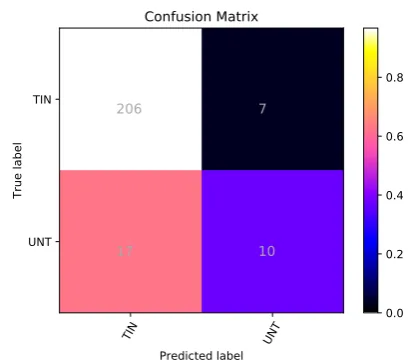
As comparison to Sub-task A, the official results for Sub-task B shown in Table 6 are significantly better. Our team ranked 7 out of 76 participating teams with F1 Score of 0.69. Again the tional GRU outperforms both LSTM and Bidirec-tional LSTM deep learning models in terms of F1 and Accuracy.
System F1
(macro)
Accuracy
All TIN baseline 0.4702 0.8875 All UNT baseline 0.1011 0.1125
BI-LSTM 0.6511 0.8958
BI-GRU 0.6997 0.9
[image:5.595.71.298.394.494.2]LSTM 0.6455 0.8917
Table 6:Results for Sub-task B (Binary classification)
TIN UNT
Predicted label TIN
UNT
True label
206 7
17 10
Confusion Matrix
0.0 0.2 0.4 0.6 0.8
[image:5.595.305.510.544.724.2] [image:5.595.74.277.547.724.2]5.3 Results for Sub-task C
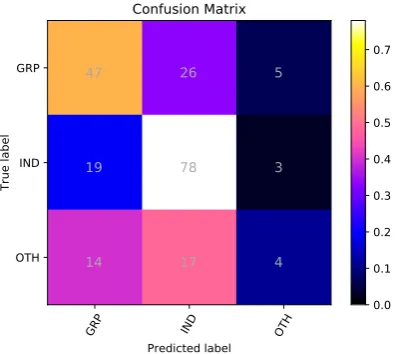
Table 7 presents our results on the test set for Sub-task C. For this multi-class classification chal-lenge, the results are lower as compared to other two Sub-tasks. All the participating teams had a lower performance with highest F1 score of 0.66, demonstrating the difficulty of the Sub-task. Our team ranked 41 out of 65 participating teams and Bidirectional LSTM give better results with F1 score of 0.49.
System F1
(macro)
Accuracy
All GRP baseline 0.1787 0.3662 All IND baseline 0.2130 0.4695 All OTH baseline 0.0941 0.1643
BI-LSTM 0.4903 0.6056
BI-GRU 0.4635 0.5775
[image:6.595.75.293.214.325.2]LSTM 0.4810 0.6197
Table 7:Results for Sub-task C (Multi-Class Classification)
GRP IND OTH
Predicted label GRP
IND
OTH
True label
47 26 5
19 78 3
14 17 4
Confusion Matrix
0.0 0.1 0.2 0.3 0.4 0.5 0.6 0.7
Figure 5:Confusion Matrix shows results for Sub-task C using Bidirectional LSTM
5.4 Class Label results
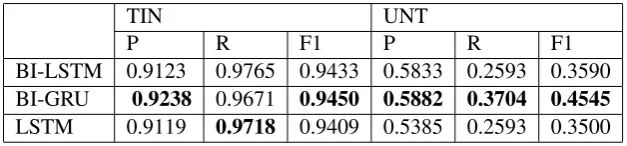
Besides the combined results of our proposed models on the test set for three Sub-tasks, we also present per class results in Tables 8, 9 and 10. The results in these tables show how well our models performed on each class label.
Table 8 shows each class label results for Sub-task A which comprises of two classes offensive (OFF)
and not offensive (NOT). Bidirectional GRU per-formed better on both classes with F1 score of 0.54 and 0.84 respectively validating the fact that offen-sive class are relatively difficult to classify. Table 9 shows each class label results for Sub-task B which comprises of two classes targeted input (TIN) and untargeted (UNT). Bidirectional GRU performed better on both classes with F1 score of 0.94 and 0.45 respectively which shows that untar-geted class are much harder to classify.
Table 10 shows each class label results for Sub-task C which is a multi-class classification chal-lenge having three classes individual (IND), group (GRP) and others (OTH). LSTM provides bet-ter results with F1 score of 0.72 and 0.63 for both (IND) and (GRP) classes while Bidirectional LSTM performed better on (OTH) class with F1 score of 0.17, justifies that (OTH) class is rela-tively harder to classify.
6 Conclusion
In this paper, we address the challenge of identi-fication of offensive tweets as well as their cate-gorization. Our proposed approach comprises of three deep learning based techniques for efficient classification of offensive posts in social media. In this work, we show that applying word embedding over social media text followed by the application of a sequence to sequence models like LSTM, Bidirectional LSTM and Bidirectional GRU leads to a better classification of the text. This proposed approach can also be incorporated in an end-to-end framework. Overall, our approach provides an efficient way of text classification in social media. For future work, we want to include character-based embeddings along with pre-trained word level embeddings for better representation of text. Also, the addition of attention layer to the deep networks sometimes increases performance even further.
Acknowledgements
[image:6.595.76.276.387.564.2]OFF NOT
P R F1 P R F1
BI-LSTM 0.5814 0.4167 0.4854 0.7965 0.8839 0.8379 BI-GRU 0.6211 0.4917 0.5488 0.8179 0.8839 0.8496 LSTM 0.5520 0.5083 0.5293 0.8153 0.8403 0.8276
Table 8:Shows per-class performance of our proposed models for Sub-task A.
TIN UNT
P R F1 P R F1
[image:7.595.144.455.62.131.2]BI-LSTM 0.9123 0.9765 0.9433 0.5833 0.2593 0.3590 BI-GRU 0.9238 0.9671 0.9450 0.5882 0.3704 0.4545 LSTM 0.9119 0.9718 0.9409 0.5385 0.2593 0.3500
Table 9:Shows per-class performance of our proposed models for Sub-task B.
IND GRP OTH
P R F1 P R F1 P R F1
BI-LSTM 0.6446 0.7800 0.7059 0.5875 0.6026 0.5949 0.3333 0.1143 0.1702 BI-GRU 0.6389 0.6900 0.6635 0.5667 0.6538 0.6071 0.2000 0.0857 0.1200
LSTM 0.6508 0.8200 0.7257 0.6575 0.6154 0.6358 0.1429 0.0571 0.0816
Table 10:Shows per-class performance of our proposed models for Sub-task C.
References
Chih-Chung Chang and Chih-Jen Lin. 2011. Libsvm: a library for support vector machines. ACM
transac-tions on intelligent systems and technology (TIST),
2(3):27.
Tianqi Chen and Carlos Guestrin. 2016. Xgboost: A scalable tree boosting system. InProceedings of the 22nd acm sigkdd international conference on
knowl-edge discovery and data mining, pages 785–794.
ACM.
Maral Dadvar, Dolf Trieschnigg, Roeland Ordelman, and Franciska de Jong. 2013. Improving cyberbul-lying detection with user context. In Advances in
Information Retrieval, pages 693–696. Springer.
Thomas Davidson, Dana Warmsley, Michael Macy, and Ingmar Weber. 2017. Automated Hate Speech Detection and the Problem of Offensive Language.
InProceedings of ICWSM.
Mai ElSherief, Vivek Kulkarni, Dana Nguyen,
William Yang Wang, and Elizabeth Belding. 2018. Hate Lingo: A Target-based Linguistic Analysis of Hate Speech in Social Media. arXiv preprint
arXiv:1804.04257.
Paula Fortuna and S´ergio Nunes. 2018. A Survey on Automatic Detection of Hate Speech in Text. ACM
Computing Surveys (CSUR), 51(4):85.
Sepp Hochreiter and J¨urgen Schmidhuber. 1997. Lstm can solve hard long time lag problems. In
Ad-vances in neural information processing systems,
pages 473–479.
David W Hosmer Jr, Stanley Lemeshow, and Rodney X Sturdivant. 2013. Applied logistic regression, vol-ume 398. John Wiley & Sons.
Nikhil Ketkar. 2017. Introduction to keras. InDeep
Learning with Python, pages 97–111. Springer.
Ritesh Kumar, Atul Kr. Ojha, Shervin Malmasi, and Marcos Zampieri. 2018. Benchmarking Aggression Identification in Social Media. InProceedings of the First Workshop on Trolling, Aggression and
Cyber-bulling (TRAC), Santa Fe, USA.
Zachary C Lipton, John Berkowitz, and Charles Elkan. 2015. A critical review of recurrent neu-ral networks for sequence learning. arXiv preprint
arXiv:1506.00019.
Sreekanth Madisetty and Maunendra Sankar Desarkar. 2018. Aggression detection in social media using deep neural networks. InProceedings of the First Workshop on Trolling, Aggression and
Cyberbully-ing (TRAC-2018), pages 120–127.
Alexey Natekin and Alois Knoll. 2013. Gradient boost-ing machines, a tutorial. Frontiers in neurorobotics, 7:21.
[image:7.595.142.456.177.250.2]Grisel, Mathieu Blondel, Peter Prettenhofer, Ron Weiss, Vincent Dubourg, et al. 2011. Scikit-learn: Machine learning in python. Journal of machine
learning research, 12(Oct):2825–2830.
Jeffrey Pennington, Richard Socher, and Christopher Manning. 2014. Glove: Global vectors for word representation. InProceedings of the 2014 confer-ence on empirical methods in natural language
pro-cessing (EMNLP), pages 1532–1543.
Georgios K Pitsilis, Heri Ramampiaro, and Helge
Langseth. 2018. Detecting offensive language
in tweets using deep learning. arXiv preprint
arXiv:1801.04433.
Rahat Ibn Rafiq, Homa Hosseinmardi, Richard Han, Qin Lv, and Shivakant Mishra. 2018. Scalable and timely detection of cyberbullying in online social networks. InProceedings of the 33rd Annual ACM
Symposium on Applied Computing, pages 1738–
1747. ACM.
Andros Tjandra, Sakriani Sakti, Ruli Manurung, Mirna Adriani, and Satoshi Nakamura. 2016. Gated recur-rent neural tensor network. In 2016 International
Joint Conference on Neural Networks (IJCNN),
pages 448–455. IEEE.
Michael Wiegand, Melanie Siegel, and Josef Rup-penhofer. 2018. Overview of the GermEval 2018 Shared Task on the Identification of Offensive Lan-guage. InProceedings of GermEval.
Baoxun Xu, Joshua Zhexue Huang, Graham Williams,
Qiang Wang, and Yunming Ye. 2012.
Classify-ing very high-dimensional data with random forests built from small subspaces. International Journal of
Data Warehousing and Mining (IJDWM), 8(2):44–
63.
Marcos Zampieri, Shervin Malmasi, Preslav Nakov, Sara Rosenthal, Noura Farra, and Ritesh Kumar. 2019a. Predicting the Type and Target of Offensive Posts in Social Media. InProceedings of NAACL.
Marcos Zampieri, Shervin Malmasi, Preslav Nakov, Sara Rosenthal, Noura Farra, and Ritesh Kumar. 2019b. SemEval-2019 Task 6: Identifying and Cat-egorizing Offensive Language in Social Media (Of-fensEval). InProceedings of The 13th International
Workshop on Semantic Evaluation (SemEval).
Ziqi Zhang and Lei Luo. 2018. Hate speech detection: A solved problem? the challenging case of long tail on twitter.Semantic Web, (Preprint):1–21.
Ziqi Zhang, David Robinson, and Jonathan Tepper. 2018. Detecting Hate Speech on Twitter Using a Convolution-GRU Based Deep Neural Network. In
Lecture Notes in Computer Science. Springer