535
YNU DYX at SemEval-2019 Task 5: A Stacked BiGRU Model Based on
Capsule Network in Detection of Hate
Yunxia Ding, Xiaobing Zhou∗, Xuejie Zhang
School of Information Science and Engineering Yunnan University, Yunnan, P.R. China
[email protected],[email protected],[email protected]
Abstract
This paper describes our system designed for SemEval 2019 Task 5 “Shared Task on Mul-tilingual Detection of Hate”. We only par-ticipate in subtask-A in English. To address this task, we present a stacked BiGRU mod-el based on a capsule network system. In or-der to convert the tweets into corresponding vector representations and input them into the neural network, we use the fastText tools to get word representations. Then, the sentence representation is enriched by stacked Bidirec-tional Gated Recurrent Units (BiGRUs) and used as the input of capsule network. Our sys-tem achieves an average F1-score of 0.546 and
ranks 3rd in the subtask-A in English.
1 Introduction
Hate speech is an offensive language, a statemen-t statemen-thastatemen-t a person or group astatemen-tstatemen-tacks anostatemen-ther person or group based on characteristics such as gen-der, race, religion, disability, or sexual orientation. Nockleby (Nockleby,2000) defines hate speech as “any communication that disparages a person or a group on the basis of some characteristic such as race, color, ethnicity, gender, sexual orientation, nationality, religion, or other characteristic.” Giv-en the huge amount of user-gGiv-enerated contGiv-ent on the Web, and in particular on social media, the problem of detecting, and therefore possibly limit the Hate Speech diffusion, is becoming fundamen-tal, for instance for fighting against misogyny and xenophobia (Basile et al.,2019).
Microblog today has become a very popular communication tool among Internet users. Mil-lions of users share opinions on different aspects of life everyday. And Twitter1is a social platform that is very popular all over the word and million-s of people million-share their experiencemillion-s, moodmillion-s,
atti-∗
Corresponding author 1http://twitter.com
tudes toward life and discuss current issues (Pak and Paroubek,2010). Many of the content is re-lated to people’s feelings, so many people begin to conduct emotional analysis and research on tweet-s. SemEval 2019 Task 5 is to detect hate speech on tweets. Task A is a binary classification task that predicts whether English or Spanish tweets for specific goals (women or immigrants) are hateful or not hateful (Basile et al.,2019). There are many studies that currently use tweets as a corpus for natural language processing (NLP). Text classifi-cation using traditional machine learning methods mainly includes Support Vector Machines (SVM-s) (Gunn et al., 1998), Naive Bayes (McCallum et al., 1998) and Random Forests (Cutler et al.,
2007), etc. In recent years, the use of deep neu-ral networks for NLP has become mainstream, such as Convolutional Neural Networks (CNNs) for sentence classification (Kim, 2014) and Re-current Neural Networks (RNNs) (Graves et al.,
2013).
This task aims to predict whether the tweet for each ID is a hate speech about women or immi-grants. Our system implements a stacked Bidi-rectional Gated Recurrent Units (BiGRUs) (Cho et al.,2014) based on a capsule network. The vec-tor representations of words are obtained with fast-Tex. The result of the classification is through the output of a fully connected layer. The rest of this paper is organized as follows: Data Processing and analysis are discussed in section 2. Section 3 pro-vides the details of the proposed model. Experi-ments and results are described in Section 4. Fi-nally, we draw conclusions in Section 5.
2 Data Processing
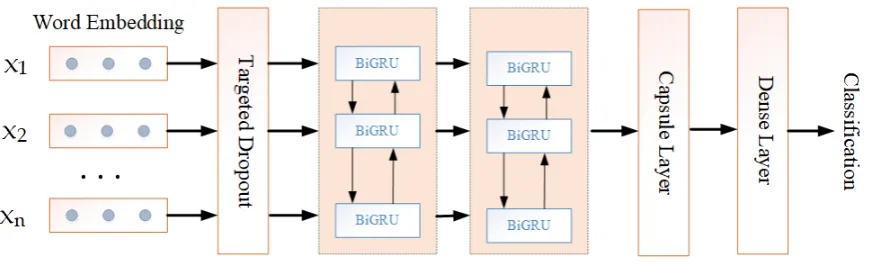
Figure 1: Neural architecture of stacked BiGRU with capsule network.
2.1 Experimental Data
This is a binary classification task of hate speech about immigrants or women. The task organizer-s provide training organizer-setorganizer-s, development organizer-setorganizer-s and teorganizer-st sets, respectively. Table 1 shows the data distri-bution of hate speech and non-hate speech in each data set. From Table 1, we can find that there are 9,000 tweets in training set, 1,000 tweets in devel-opment set and 2,971 tweets in test set.
data hate speech non-hate speech
training set 3,783 5,217
dev set 427 573
[image:2.595.85.520.61.193.2]test set 1,252 1,719
Table 1: Distribution of labels in each datasets.
2.2 Processing Data
We perform a series of standard processing on datasets.
• All punctuation marks are removed.
• All characters are converted to lowercase.
• All hyperlinks are replaced by “url”.
• All sentences are tokenized by Natural Lan-guage Toolkit (NLTK) (Bird et al.,2009).
• All numbers are replaced by “number”
• All contractions are normalized, like place “shouldn’t” with “should not” and “dosen’t” with “does not” and so on.
• All @specific user names are replaced with usernames, for example “@PdxPatriot1” is replaced with “username”.
We consider the specific length of the sentence in the input model. If it is too long, the calculation time of the training model will increase. If it is too short, it will lose extra information. So we choose twice the average value, which is 45, as the final length of the sentence in the input model, so that the lost information will not be too much, and the calculation time will not be too long. In the training set, the development set and the test set have 473, 122, and 102 sentences respectively longer than 45, and the maximum sentence length is 65.
3 System Description
Our system can be roughly divided into two part-s: the space vector representation of the words and the learning of the tweet content by the cap-sule network. We first map the words into a low-dimensional space vector, then feed the sentence vectors composed of these word vectors into a cap-sule network to learn the sentence features, and fi-nally classify the text of the test set by a softmax function.
3.1 Word Representation
in our system2.
3.2 Model Description
In order to enrich the word vector representation in the text, we use a stacked Bidirectional Gated Recurrent Units (BiGRUs) (Cho et al.,2014). The output of BiGRU is then used as the input to the capsule network (Sabour et al., 2017). The final result is obtained by thesof tmaxactivation func-tion in the fully connected layer. The model archi-tecture is show in Figure 1.
Targeted Dropout Layer: Dropout regulariza-tion only activates some local neurons in each for-ward propagation, so it adds sparsity properties during training. This encourages the neural net-work to learn a representation that is robust to s-parsification, that is, to randomly delete a set of neurons. Targeted Dropout (Gomez et al.,2018) sorts weights or neurons based on some measure of fast approximation weight importance and ap-plies Dropout to those elements of lower impor-tance. This approach encourages neural networks to learn more important weights or neurons. In other words, the network learns to be robust to our choice of post hoc pruning strategy. At the same time it is easy to implement withKeras3.
Stacked BiGRU:To get more fine-grained sen-tence information, we use stacked Bidirectional Gated Recurrent Units (BiGRUs) to encode sen-tence information. The “stack” here refers to 2, which is 2 layers BiGRU. The information of the sentence is directional. The forward GRU can on-ly get the information from the front to the back of the sentence, and can’t encode the information from the back to the front. BiGRU better captures semantic dependencies in both directions.
Capsule Layer: The capsule network (Sabour et al.,2017) replaces a single neuron node of a tra-ditional neural network with a neuron vector, and trains a completely new neural network in the way of Dynamic Routing, which effectively improves the low efficiency and space insensitivity of the CNN model. The capsule network is connected the same way as a fully connected network. Each capsule neuron in the previous layer is connect-ed to each capsule neuron in the next layer. Each connection of the capsule network is also weight-ed. The difference is that there is a coupling coef-ficient on the connection of the capsule network.
2
https://fasttext.cc/docs/en/english-vectors.html 3https://pypi.org/project/keras-targeted-dropout/
The coupling coefficient is determined by the iter-ative dynamic routing process.
4 Experiments and Results
4.1 Evaluation
To evaluate the performance of the classification system, the system uses a standard evaluation met-rics that includesaccuracy,precision, recall, and
F1-score. In this task we useF1-scoreto measure the performance of the proposed method. Accura-cyis the most intuitive performance measure and it is simply a ratio of correctly predicted observa-tion to the total observaobserva-tions.Precisionis the ratio of correctly predicted positive observations to the total predicted positive observations. Recallis the ratio of correctly predicted positive observation-s to the all obobservation-servationobservation-s in actual claobservation-sobservation-s. F1-score is the weighted average of Precision and
Recal-l. Precisionandrecallhave equal contributions to
F1-score. The formula forF1-scoreis defined as:
F1−score=
(2∗P recision∗Recall) (P recision+Recall) (1)
4.2 Hyperparameter
The Targeted Dropout layer has two parameters,
drop rateandtarget rate. In this system, these
t-wo parameters are both set to 0.55.
For the stacked BiGRU, the first layer BiGRU
units = 64, and the second layer BiGRUunits =
64.
The parameters of the capsule layer are set as follows:routings= 5, the number of caspule is 10 and the dimension is 32.
Finally, at the full connection layer output, we added two parameters, kernel regularizer
and activity regularizer, respectively.
Kernel regularizer uses l2 regularization with
a parameter of 0.001, activity regularizer is l1 regularization, and the parameter is also set to 0.001.
Usually the multi-classification problem uses
categorical crossentropyas the loss function. But
our system usesbinary crossentropyin this binary classification.
We setepochs= 6 andbatch size= 64.
4.3 Experiments and Result Analysis
we compare the normal Dropout and Targeted
Dropoutperformance.
It can be seen from Table 2 that the performance
of Targeted Dropout is significantly better than
that ofDropout. Model performance increases by
5%on averageF1-score.
Sets Acc P R F1
Dropout 0.53 0.58 0.61 0.52
Targeted Dropout 0.56 0.64 0.60 0.55
Table 2: Experimental results on test set. The values in the table are macro averages.
To determine the specific parameters of the
Tar-geted Dropout, we do a lot of comparison
exper-iments. As can be seen from Table 3, the best parameter is 0.55. This is also the parameter we submitted to the system in the competition.
Targeted Dropout Acc P R F1
0.40 0.53 0.58 0.63 0.50
0.45 0.56 0.60 0.63 0.54
0.50 0.53 0.59 0.64 0.49
0.55 0.56 0.64 0.60 0.55
0.60 0.55 0.60 0.63 0.54
Table 3: Experimental results of different Targeted Dropouts on the test set.
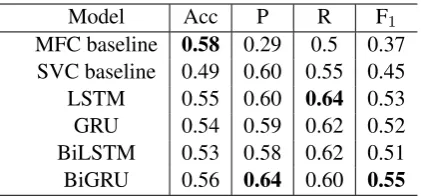
We compare the four network architectures based on a capsule network, LSTM, GRU, BiLST-M and BiGRU. We observe that the performance of BiGRU is better than the other three in this task. Compared to MFC baseline and SVC baseline, our method increases the averageF1-scoreby 0.18 and 0.10, respectively, as is shown in Table 4.
The values of MFC baseline and SVC base-line come from the data published by the orga-nizer4. To ensure the fairness of the experiment, the parameters of the capsule network remain un-changed, using the parameters mentioned in sec-tion 4.2.
5 Conclusion and Future Work
In this paper, we present a stacked BiGRU mod-el based on a capsule network system in the task “Shared Task on Multilingual Detection of Hate”. We replace Dropout with Targeted Dropout, the effect is more obvious, indicating that Targeted
4https://docs.google.com/spreadsheets/d/
1wSFKh1hvwwQIoY8 XBVkhjxacDmwXFpkshYzLx4bw-0/edit#gid=0
Model Acc P R F1
MFC baseline 0.58 0.29 0.5 0.37
SVC baseline 0.49 0.60 0.55 0.45
LSTM 0.55 0.60 0.64 0.53
GRU 0.54 0.59 0.62 0.52
BiLSTM 0.53 0.58 0.62 0.51
[image:4.595.312.523.61.159.2]BiGRU 0.56 0.64 0.60 0.55
Table 4: Each model is a stacked or two-layer model, and the units in the model are all 64.
Dropout is effective in this system. At the same
time, we have conducted several experiments to find the optimal parameters of Targeted Dropout. Through comparative experiments, BiGRU is the best model based on capsule networks.
Due to time limit, we don’t tune the parameters of the capsule network. In the future, we will ad-just the parameters of the capsule network to opti-mize the performance of the model. Secondly, we are going to try ensemble methods such as hard voting, soft voting and stacking to find the one that works best for our task. Finally, we would like to explore transfer learning technology.
Acknowledgments
This work was supported by the Natural Sci-ence Foundations of China under Grant Nos. 61463050, 61702443 and 61762091, and the Project of Innovative Research Team of Yunnan Province under Grant No. 2018HC019.
References
Valerio Basile, Cristina Bosco, Elisabetta Fersini, Deb-ora Nozza, Viviana Patti, Francisco Rangel, Paolo Rosso, and Manuela Sanguinetti. 2019. SemEval-2019 Task 5: Multilingual Detection of Hate Speech Against Immigrants and Women in Twitter. In Pro-ceedings of the 13th International Workshop on Se-mantic Evaluation (SemEval-2019). Association for Computational Linguistics.
Steven Bird, Ewan Klein, and Edward Loper. 2009. Natural language processing with Python: analyz-ing text with the natural language toolkit. ” O’Reilly Media, Inc.”.
pages 1724–1734. Association for Computational Linguistics.
D Richard Cutler, Thomas C Edwards Jr, Karen H Beard, Adele Cutler, Kyle T Hess, Jacob Gibson, and Joshua J Lawler. 2007. Random Forests for Classification in Ecology. Ecology, pages 2783– 2792.
Aidan N Gomez, Ivan Zhang, Kevin Swersky, Yarin Gal, and Geoffrey E Hinton. 2018. Targeted Dropout. InInternational Conference on Neural In-formation Processing Systems.
Alex Graves, Abdel-rahman Mohamed, and Geoffrey Hinton. 2013. Speech Recognition with Deep Re-current Neural Networks. In 2013 IEEE interna-tional conference on acoustics, speech and signal processing, pages 6645–6649. IEEE.
Steve R Gunn et al. 1998. Support Vector Machines for Classification and Regression. ISIS technical report, 14(1):5–16.
Armand Joulin, Edouard Grave, Piotr Bojanowski, and Tomas Mikolov. 2017. Bag of Tricks for Efficient Text Classification. InProceedings of the 15th Con-ference of the European Chapter of the Association for Computational Linguistics: Volume 2, Short Pa-pers, pages 427–431.
Yoon Kim. 2014. Convolutional Neural Networks for Sentence Classification. InProceedings of the 2014 Conference on Empirical Methods in Natural Lan-guage Processing (EMNLP), pages 1746–1751, Do-ha, Qatar. Association for Computational Linguistic-s.
Andrew McCallum, Kamal Nigam, et al. 1998. A Comparison of Event Models for Naive Bayes Text Classification. InAAAI-98 workshop on learning for text categorization, volume 752, pages 41–48. Cite-seer.
John T Nockleby. 2000. Hate Speech.Encyclopedia of the American constitution, 3(2):1277–1279.
Alexander Pak and Patrick Paroubek. 2010. Twitter as a Corpus for Sentiment Analysis and Opinion Min-ing. In Proceedings of the Seventh conference on International Language Resources and Evaluation (LREC’10), volume 10, pages 1320–1326.