Proceedings of the 12th International Workshop on Semantic Evaluation (SemEval-2018), pages 146–150
INGEOTEC at SemEval-2018 Task 1:
EvoMSA and
µ
TC for Sentiment Analysis
Mario Graff and Sabino Miranda-Jim´enez∗and Eric S. Tellez
CONACyT - INFOTEC, Aguascalientes, M´exico
{mario.graff,sabino.miranda,eric.tellez}@infotec.mx
Daniela Moctezuma
CONACyT - CentroGEO, Aguascalientes, M´exico [email protected]
Abstract
This paper describes our participation in Affective Tweets task for emotional intensity and sentiment intensity subtasks for English, Spanish, and Ara-bic languages. We used two approaches,µTC and EvoMSA. The first one is a generic text catego-rization and regression system; and the second one is a two-stage architecture for Sentiment Analysis. Both approaches are multilingual and domain in-dependent.
1 Introduction
Sentiment Analysis is a research area where does a computational analysis of people’s feelings or be-liefs expressed in texts such as emotions, opinions, attitudes, appraisals, etc. (Liu and Zhang,2012). People communicate not only the emotion or sen-timent they are feeling, but also the intensity, that is, the degree of emotion or sentiment. In this con-text, SemEval is one of the forums that conducts evaluations on semantics at different levels, for in-stance, it proposes tasks such as sentiment analy-sis, the intensity of emotion or sentiment (affective tweets) (Mohammad et al.,2018), irony detection, among others (SemEval,2017).
In this work, we present the results of our par-ticipation in Affective Tweets task for four of the five subtasks in English, Spanish, and Arabic lan-guages and for all emotions available: anger, fear, joy, and sadness.
The subtasks are A) emotion intensity regres-sion (EI-REG): given a tweet and an emotion, de-termine the intensity of the emotion that best rep-resents the mental state of the tweeter, a real-value score between 0 and 1.
B) Emotion intensity ordinal classification
∗
corresponding author: [email protected]
(EI-OC): given a tweet and an emotion E, classify the tweet into one of four ordinal classes of inten-sity of emotion: anger, fear, joy, and sadness, that best represents the mental state of the tweeter.
C) A sentiment intensity regression task (V-REG): given a tweet, determine the intensity of sentiment, a real-valued score between 0 (most negative) and 1 (most positive).
D) A sentiment analysis, ordinal classification (V-OC): given a tweet, classify it into one of seven ordinal classes, corresponding to several levels of positive and negative sentiment intensity.
In this context, one crucial step is the procedure used to transform the data (i.e., tweets) into the inputs (vectors) of the supervised learning tech-niques used. Typically, Natural Language Pro-cessing (NLP) approaches for data representation use n-grams of words, linguistic information such as dependency relations, syntactic information, lexical units (e.g., lemmas, stems), affective lexi-cons, error correction, etc. However, selecting the best configuration of those characteristics could be a cumbersome task, many times disregarded in favor of some well-known competitive setups. (Tellez et al., 2017b) studies the dependency be-tween the performance and the proper selection of the text model. This selection can be seen as a combinatorial optimization problem where the objective is to maximize the performance metric of the classifier being used; this approach is im-plemented by µTC, (Tellez et al., 2018). Due to
its combinatorial nature, and the kind of parame-ters that compose the configuration space, the re-sulting classifiers are multilingual and domain in-dependent. Therefore, with a tight dependency on the training set, it is mandatory to provide ad-ditional information about the particular task to avoid overfitting. In this sense, the use of multi-ple knowledge sources is essential, and combin-ing them simply and effectively is the idea
hind EvoMSA. EvoMSA (§2.2) is a stacking sys-tem based on genetic programming, and partic-ularly on the use of semantic genetic operators, that focus on sentiment analysis. The core of our contribution is to use both µTC and EvoMSA to
learn from different annotated collections and then use that diverse knowledge to tackle the SemEval 2018 Task 1 challenge.
Looking at systems that obtained the best re-sults in previous SemEval editions, it can be con-cluded that it is necessary to include more datasets, see for instance BB twtr system (Cliche,2017) for Sentiment Analysis in the Twitter task, which uses more datasets besides the one given in the com-petition. Here, it was decided to follow a sim-ilar approach by including an additional human-annotated dataset publicly available for English, Spanish, and Arabic to build robust models.
2 System Description
As commented, we use two systems to evaluate the Affective Tweets task:µTC and EvoMSA. On
the one hand,µTC is used mainly to evaluate two
tasks for the Arabic language because in our ex-periments it obtained the best performance in al-most all subtask in this language both for regres-sion and classification tasks. On the other hand, EvoMSA is used to evaluate English and Span-ish languages, and ordinal sentiment classification (valence) task for Arabic. In the following para-graphs, we describe these approaches.
2.1 µTC
µTC1 is a minimalistic and wide system able to
tackle text classification and regression tasks in-dependent of domain and language a detail. For complete details of the model see (Tellez et al., 2018). Essentially,µTC creates text classifiers (or a text regressors) searching for the best models in a given configuration space. A configuration con-sists of instructions to enable several preprocess-ing functions, a combination of tokenizers among the power set of several possible ones (character q-grams, n-word grams, skip-grams, etc.), and a weighting scheme (application of frequency filters and the use of TF, TFIDF, or several distributional schemes).µTC seeks the best configurations
opti-mizing a score which is evaluated through a clas-sifier or a regressor; currently, it uses SVM for both tasks. In Table1, we can see details of text
1https://github.com/INGEOTEC/microTC
transformations used in our solution for detecting
Angeremotion for Arabic. This set of text trans-formations was selected among millions of possi-ble configurations through the combinatorial opti-mization process implemented inµTC. In ordinal
classification tasks the model is found out based on the training dataset provided for each emotion, if this is the case.
2.2 EvoMSA
EvoMSA2 is a Sentiment Analysis System based
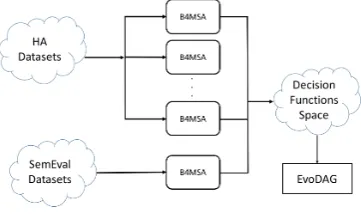
[image:2.595.326.507.602.709.2]on B4MSA and EvoDAG. It is an architecture of two phases to solve classification or regression tasks, see Figure 1. EvoMSA improves the per-formance of a global classifier combining the pre-dictions of a set of classifiers with different mod-els on the same text to be classified. Roughly speaking, in the first stage, a set of B4MSA classi-fiers (see Sec. 2.2.1) are trained with two kind of datasets; datasets provided by SemEval, and large datasets annotated by humans for sentiment anal-ysis for English and Spanish languages (Mozetiˇc et al., 2016), called HA datasets. In the case of HA datasets, it is split into balanced small datasets that feed each B4MSA classifier which produces three real output values, one for each sentiment (negative, neutral and positive). In the case of Se-mEval datasets, for instance, for EI-OC, the clas-sifier produces one of four ordinal classes of in-tensity of emotion (0, 1, 2, 3). It creates a deci-sion functions space with mixtures of values com-ing from different views of knowledge. Finally, EvoDAG’s inputs are the concatenation of all the decision functions predicted by each B4MSA sys-tem, and EvoDAG produces a final value or pre-diction. The following subsections describe the in-ternal parts of EvoMSA. The precise configuration of our benchmarked system is described in Sec.4.
Figure 1: EvoMSA Architecture
2.2.1 B4MSA
B4MSA3is related toµTC, but this framework is
mainly focused for multilingual sentiment analy-sis. For complete details of the model see (Tellez et al.,2017a,b).
The core idea behind B4MSA is similar to that ofµTC, i.e., it tackles the sentiment analysis
prob-lem as a model selection probprob-lem, yet using a dif-ferent view of the underlying combinatorial prob-lem. Also, contrarily to µTC, B4MSA takes
ad-vantage of several domain-specific particularities like emojis and emoticons and makes explicit han-dling of negation statements expressed in texts. Nonetheless, EvoMSA avoids the sophisticated use of B4MSA fixing the model for each language in favor of performing an optimization process at the level of the decision functions of several mod-els. Table1shows text transformation parameters used in our system for English and Spanish lan-guages.
2.2.2 EvoDAG
EvoDAG4 (Graff et al.,2016, 2017) is a Genetic
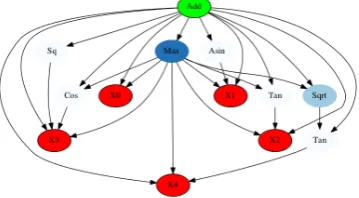
Programming system specifically tailored to tackle classification and regression problems on very high dimensional vector spaces and large datasets. In particular, EvoDAG uses the principles of Dar-winian evolution to create models represented as a directed acyclic graph (DAG). An EvoDAG model has three distinct node’s types; the inputs nodes, that as expected received the independent vari-ables, the output node that corresponds to the la-bel, and the inner nodes are the different numerical functions such as: sum, product, sin, cos, max, and min, among others. Due to lack of space, we refer the reader to (Graff et al.,2016) where EvoDAG is broadly described. In fact, in this research, we followed the steps explained there. In order to give an idea of the type of models being evolved, Fig-ure2depicts a model evolved for the Arabic polar-ity classification at global message task. As can be seen, the model is represented using a DAG where direction of the edges indicates the dependency, e.g.,cosdepends onX3, i.e., cosine function is
ap-plied toX3. As commented above, there are three
types of nodes; the inputs nodes are colored in red, the inner nodes are blue (the intensity is related to the distance to the height, the darker the closer), and the green node is the output node. As
men-3https://github.com/INGEOTEC/b4msa 4https://github.com/mgraffg/EvoDAG
tioned previously, EvoDAG uses as inputs the de-cision functions of B4MSA, then the first three in-puts (i.e.,X0,X1, andX2) correspond to the
deci-sion functions values of the negative, neutral, and positive polarity of B4MSA model trained with SemEval Arabic dataset, and the later two (i.e.,X3
andX4) correspond to the decision function
val-ues of two B4MSA systems each one trained with other dataset for two classes. It is important to mention that EvoDAG does not have information regarding whether inputXi comes from a
[image:3.595.327.507.256.355.2]partic-ular polarity decision function, consequently from EvoDAG point of view all inputs are equivalent.
Figure 2: An evolved model for the Arabic task.
3 Experimental Settings
As we mentioned, to determine the best configu-ration of parameters for text modeling, µTC and
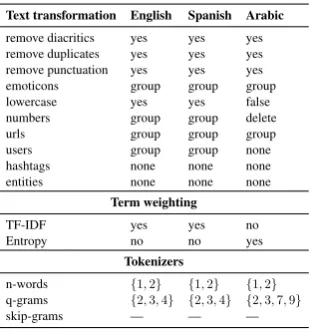
B4MSA integrate a hyper-parameter optimization phase that ensures the performance of the classi-fier based on the training data. The text modeling parameters for B4MSA were set for all process as we show in Table1for English and Spanish lan-guage for classification and regression tasks. In the case of the Arabic language, the parameters were calculated by the optimization phase; an ex-ample is showed in Table 1. A text transforma-tion feature could be binary (yes/no) or ternary (group/delete/none) option. Tokenizers denote how texts must be split after applying the process of each text transformation to texts. Tokenizers generate text chunks in a range of lengths, all to-kens generated are part of the text representation. Both, B4MSA andµTC, allow selecting
tokeniz-ers based onn-words, q−grams, and skip-grams,
in any combination. We calln-words to the
well-known wordn-grams; in particular, we allow to
use any combination of unigrams, bigrams, and trigrams. Also, the configuration space allows se-lecting any combination of character q-grams (or
use(2,1)and(3,1)skip-grams (two words sepa-rated by one word, and three words sepasepa-rated by a gap).
Table 1 shows the final configurations for En-glish and Spanish and an example for one emotion for Arabic. For example, numbers are deleted in Arabic, but it is grouped in English and Spanish. In the case of English, it is split in unigrams, bi-grams, characterq-grams of sizes 2, 3, and 4.
Text transformation English Spanish Arabic
remove diacritics yes yes yes
remove duplicates yes yes yes
remove punctuation yes yes yes
emoticons group group group
lowercase yes yes false
numbers group group delete
urls group group group
users group group none
hashtags none none none
entities none none none
Term weighting
TF-IDF yes yes no
Entropy no no yes
Tokenizers
n-words {1,2} {1,2} {1,2} q-grams {2,3,4} {2,3,4} {2,3,7,9}
[image:4.595.104.260.209.376.2]skip-grams — — —
Table 1: Example of set of configurations for text modeling
3.1 Datasets
SemEval provides datasets to train systems for each subtask. For instance, for emotion Anger in English, subtask emotion intensity ordinal clas-sification, OC, the training data is distributed for four classes (class 0 = 445, class 1 = 322, class 2 = 507, class 3 = 427). The Arabic datasets for each emotion have around 800 samples each one, for English the sizes are between 1500 and 2200 samples, and for Spanish are between 1000 and 1150 samples, for more details of the data distri-bution and how the datasets were built we refer the reader to (Mohammad et al.,2018; Moham-mad and Kiritchenko, 2018). In addition of Se-mEval data, we use extra datasets annotated by humans around 73 thousand tweets for English, 223 thousand for Spanish (Mozetiˇc et al., 2016), and two thousand for Arabic (NRC, 2017). Ta-ble2shows the distribution of classes for datasets. Those datasets are mainly used for sentiment anal-ysis; however, we use this extra information to im-prove the final decision in the approach we imple-mented (EvoMSA).
HA-DataSet Positive Neutral Negative Total
English 21,166 33,620 18,454 73,240 Spanish 107,252 89,782 26,272 223,306 Arabic 448 202 1,350 2,000
Table 2: Statistics of Human-Annotated training data. We used the labeled English and Spanish data from (Mozetiˇc et al.,2016), and the Arabic data from (NRC,2017).
4 Results
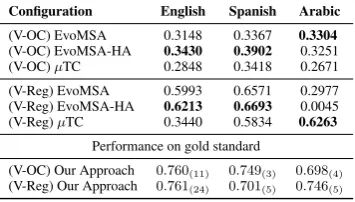
We present the results of our approaches in Table 3and Table4. All experiments were tested on the development dataset provided by SemEval. In the case of OC tasks, we use the macro-F1 score to measure the performance, and in the case of Reg tasks, we use the Pearson correlation coefficient. Table 3 shows the results of emotional intensity for ordinal classification (OC) and regression tasks (Reg) grouped by each emotion and language. Ta-ble4shows the results of sentiment analysis, ordi-nal classification task (V-OC) and sentiment inten-sity regression task (V-Reg) group by each emo-tion and language. We present three system con-figurations in Table3and Table4. EvoMSA con-figuration uses only the training datasets provided by SemEval, and it is used as regressor or clas-sification system. In addition of SemEval data, EvoMSA-HA uses extra information comes from sentiment analysis domain, and this information improves the performance as we can see. And
µTC uses only the training data provided by the
contest as the knowledge base to calculate the fi-nal class or real value. As we can see in Table 3, the best performance obtained are grouped by EvoMSA-HA configuration for both OC and Reg tasks for English and Spanish languages. For the Arabic language,µTC is quite good with OC and
Reg task. According to the results we obtained, we decided to use for the evaluation phase the follow-ing configuration: EvoMSA-HA is used for OC, Reg, V-OC, and V-Reg tasks for English and Span-ish; also for OC (Fear and Joy) and V-OC tasks for Arabic; andµTC is used for Arabic in OC (Anger
Configuration Anger Fear Joy Sadness English
(OC) EvoMSA 0.3938 0.3820 0.3983 0.4249
(OC) EvoMSA-HA 0.4188 0.4187 0.3977 0.4389
(OC)µTC 0.3300 0.4120 0.3167 0.3908
(Reg) EvoMSA 0.4948 0.4758 0.5371 0.5714
(Reg) EvoMSA-HA 0.5756 0.5380 0.6249 0.6105
(Reg)µTC 0.3301 0.5158 0.5042 0.5087
Performance on gold standard
(OC) Our Approach 0.560(14) 0.489(15) 0.643(9) 0.584(13) (Reg) Our Approach 0.643(26) 0.621(29) 0.684(20) 0.626(28)
Spanish
(OC) EvoMSA 0.4210 0.5013 0.4811 0.4419
(OC) EvoMSA-HA 0.4405 0.5006 0.5275 0.4835
(OC)µTC 0.3741 0.4070 0.4353 0.3757
(Reg) EvoMSA 0.5487 0.7338 0.7051 0.5965
(Reg) EvoMSA-HA 0.4990 0.7265 0.7129 0.5941
(Reg)µTC 0.5241 0.6568 0.4897 0.5693
Performance on gold standard
(OC) Our Approach 0.468(4) 0.634(2) 0.655(3) 0.628(2) (Reg) Our Approach 0.543(4) 0.675(4) 0.682(3) 0.633(5)
Arabic
(OC) EvoMSA 0.4062 0.3721 0.3688 0.4039
(OC) EvoMSA-HA 0.3805 0.3620 0.3768 0.3637
(OC)µTC 0.4182 0.3092 0.3347 0.4689
(Reg) EvoMSA 0.3661 0.2770 0.3782 0.5142
(Reg) EvoMSA-HA 0.2118 0.1117 0.4279 0.5952
(Reg)µTC 0.4700 0.5011 0.4090 0.6191
Performance on gold standard
[image:5.595.73.263.60.338.2](OC) Our Approach 0.387(4) 0.440(4) 0.498(4) 0.425(6) (Reg) Our Approach 0.501(5) 0.501(6) 0.628(5) 0.537(6)
Table 3: Results for Emotion Intensity: Ordinal Classifica-tion (OC) and Regression (Reg), in terms of macro-F1 (OC) and Pearson correlation coefficient (Reg).
Configuration English Spanish Arabic
(V-OC) EvoMSA 0.3148 0.3367 0.3304
(V-OC) EvoMSA-HA 0.3430 0.3902 0.3251 (V-OC)µTC 0.2848 0.3418 0.2671 (V-Reg) EvoMSA 0.5993 0.6571 0.2977 (V-Reg) EvoMSA-HA 0.6213 0.6693 0.0045 (V-Reg)µTC 0.3440 0.5834 0.6263
Performance on gold standard
(V-OC) Our Approach 0.760(11) 0.749(3) 0.698(4) (V-Reg) Our Approach 0.761(24) 0.701(5) 0.746(5)
Table 4: Results for Valence: Ordinal Classification (OC) and Regression (Reg), in terms of macro-F1 (OC) and Pear-son correlation coefficient (Reg).
5 Conclusions
In this paper was presented our solution for Af-fective Tweets task combining two approaches EvoMSA andµTC. Both systems are designed to
be multilingual and language and domain indepen-dent as much as possible. For the training step, we use extra human annotated datasets out of any spe-cific emotion, but related to sentiment-analysis in-formation; our solution performs well in Spanish and Arabic languages; however, there is room for further improvements in performance for tasks in English language using another sort of knowledge such as semantic information (word embeddings) into EvoMSA architecture.
References
Mathieu Cliche. 2017. Bb twtr at semeval-2017 task 4: Twit-ter sentiment analysis with cnns and lstms. InProceedings of the 11th International Workshop on Semantic Evalua-tion (SemEval-2017), pages 573–580.
M. Graff, E. S. Tellez, S. Miranda-Jim´enez, and H. J. Es-calante. 2016. Evodag: A semantic genetic programming python library. In2016 IEEE International Autumn Meet-ing on Power, Electronics and ComputMeet-ing (ROPEC), pages 1–6.
Mario Graff, Eric S. Tellez, Hugo Jair Escalante, and Sabino Miranda-Jim´enez. 2017. Semantic Genetic Programming for Sentiment Analysis. In Oliver Schtze, Leonardo Tru-jillo, Pierrick Legrand, and Yazmin Maldonado, editors,
NEO 2015, number 663 in Studies in Computational Intel-ligence, pages 43–65. Springer International Publishing. DOI: 10.1007/978-3-319-44003-3 2.
Bing Liu and Lei Zhang. 2012. A Survey of Opinion Mining and Sentiment Analysis. Springer US, Boston, MA. Saif M. Mohammad, Felipe Bravo-Marquez, Mohammad
Salameh, and Svetlana Kiritchenko. 2018. Semeval-2018 Task 1: Affect in tweets. InProceedings of International Workshop on Semantic Evaluation (SemEval-2018), New Orleans, LA, USA.
Saif M. Mohammad and Svetlana Kiritchenko. 2018. Un-derstanding emotions: A dataset of tweets to study inter-actions between affect categories. InProceedings of the 11th Edition of the Language Resources and Evaluation Conference, Miyazaki, Japan.
Igor Mozetiˇc, Miha Grˇcar, and Jasmina Smailovi´c. 2016. Multilingual twitter sentiment classification: The role of human annotators.PloS one, 11(5):e0155036.
NRC. 2017. Syrian tweets arabic sentiment analysis dataset. http://saifmohammad.com/WebPages/
ArabicSA.html. Accessed 17-Feb-2017.
SemEval. 2017. Semeval-2017: Sentiment analysis task 4. http://alt.qcri.org/semeval2017/ task4/. Accessed 17-Feb-2017.
Eric S. Tellez, Sabino Miranda-Jim´enez, Mario Graff, Daniela Moctezuma, Ranyart R. Su´arez, and Oscar S. Siordia. 2017a. A simple approach to multilingual polar-ity classification in Twitter. Pattern Recognition Letters, 94:68–74.
Eric S. Tellez, Sabino Miranda-Jimnez, Mario Graff, Daniela Moctezuma, Oscar S. Siordia, and Elio A. Villaseor. 2017b. A case study of spanish text transformations for twitter sentiment analysis. Expert Systems with Applica-tions, 81:457 – 471.
[image:5.595.93.271.392.493.2]