Assessing the Annotation Consistency
of the Universal Dependencies Corpora
Marie-Catherine de Marneffe Linguistics Department The Ohio State University
Columbus, OH, USA [email protected]
Matias Grioni
Computer Science Department The Ohio State University
Columbus, OH, USA [email protected]
Jenna Kanerva and Filip Ginter Turku NLP group
University of Turku Finland
{jmnybl,figint}@utu.fi
Abstract
A fundamental issue in annotation efforts is to ensure that the same phenomena within and across corpora are annotated consistently. To date, there has not been a clear and obvious way to ensure anno-tation consistency of dependency corpora. Here, we revisit the method of Boyd et al. (2008) to flag inconsistencies in depen-dency corpora, and evaluate it on three lan-guages with varying degrees of morphol-ogy (English, French, and Finnish UD v2). We show that the method is very efficient in finding errors in the annotations. We also build an annotation tool, which we will make available, that helps to stream-line the manual annotation required by the method.
1 Introduction
In every annotation effort, it is necessary to make sure that the annotation guidelines are followed, and crucially that similar phenomena do receive a consistent analysis within and across corpora. Given the recent success of the Universal De-pendencies (UD) project1 which aims at build-ing cross-lbuild-inguistically consistent treebanks for many languages and the rapid creation of 74 cor-pora for 51 languages supposedly following the UD scheme, investigating the quality of the de-pendency annotations and improving their consis-tency is, more than ever, of crucial importance.
While there has been a fair amount of work to automatically detect part-of-speech inconsis-tent annotations (i.a., Eskin (2000), van Halteren (2000), Dickinson & Meurers (2003a)), most ap-proaches to assess the consistency of dependency annotations are based on heuristic patterns (i.a., De Smedt et al. (2016) who focus on multi-word
1http://universaldependencies.org
expressions in the UD v1 corpora (Nivre et al., 2016)). There exists a variety of querying tools allowing to search dependency treebanks, given such heuristic patterns (i.a., SETS (Luotolahti et al., 2015); Grew (Bonfante et al., 2011); PML TreeQuery ( ˇStˇep´anek and Pajas, 2010); ICARUS (G¨artner et al., 2013)). Statistical methods, such as the one of Ambati et al. (2011), are supplemented with hand-written rules. While approaches based on heuristic patterns work extremely well to look for given constructions (e.g., clefts) or check that specific guidelines are taken into account (e.g., auxiliary dependencies should not form a chain in UD), such approaches are limited to finding what has been defined a priori.
In this paper, we adapt the method proposed by Boyd et al. (2008) to flag potential depen-dency annotation inconsistencies, and evaluate it on three of the UD v2 corpora (English, French and Finnish). The original Boyd et al. method finds pairs of words in identical context that vary in their dependency relation. We show that this method works fairly well in finding annotation er-rors, within a given corpus. We further hypoth-esize that using lemmas instead of word forms would improve recall in finding annotation errors, without a detrimental effect on precision. We show that our intuition is valid for languages that are not too morphologically-rich, like English and French, but not for Finnish.
We also examine whether we can extend the method by leveraging the availability of large corpora which are automatically dependency-annotated to identify more inconsistencies than when restricting ourselves only to the given manu-ally annotated corpus. We find that when based on automatic rather than manual annotation, the pre-cision drops but not excessively so, but the gain in recall is rather moderate.
Finally, the Boyd et al. approach is semi-automatic, flagging potential inconsistencies
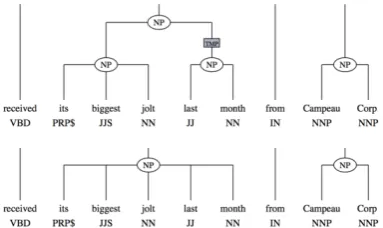
Figure 1: Example of variation nuclei for phrase-structure tree from (Boyd et al., 2008).
which require manual validation. To help stream-line this manual validation process, we develop a visualization and annotation tool for the task, available to the UD community, with data for all UD treebanks.2 Rather than a standalone tool such as ICARUS (Thiele et al., 2014), we provide an accessible browser-based interface.
2 Boyd et al. 2008: Variation nuclei
Boyd et al. (2008) extend, to dependency repre-sentation, the concept of variation nuclei devel-oped by Dickinson and Meurers (2003b; 2005) for identifying inconsistent annotations in phrase-structure trees. Variation nuclei are elements which occur multiple times in a corpus with vary-ing annotation. For phrase-structure trees, a vari-ation nucleus is any n-gram for which bracketing or labeling varies, with one shared word of context on each side of the n-gram. Figure 1, from Boyd et al. (2008), shows an example of a 5-gram, its biggest jolt last month, which receives two differ-ent analyses in the Penn TreeBank.
For dependency representation, the basic ele-ments are dependencies, i.e. pairs of words linked by a labeled dependency. Here variation nuclei are then pairs of words which are linked by dif-ferent relations. However flagging any pairs of words linked by different relations would gener-ate too many potential inconsistencies, most of which might be genuine ambiguities and not an-notation errors. To restrict the number of poten-tial inconsistencies, Boyd et al. add context re-strictions. Their “non-fringe heuristic” requires the words in the nucleus to share the same con-text (one word to the left and one word to the right of the nucleus). Example (1) shows a variation 2http://www.universaldependencies.org/
fixud
nucleus in a dependency representation, extracted from the UD English corpus, where the pairs of words Here and examples are linked differently. Boyd et al. also experimented with a “dependency context heuristic” requiring the governors of the dependency pairs to have the same incoming de-pendency relation. They also considered the case of pairs of words which are linked by a depen-dency relation in some instances and not linked by any relation in other instances, but required for those cases that the internal context between the two words be exactly the same.
(1) a. Here ’s two examples :
advmod cop
nummod punct
b. Here are two examples : . . .
cop
nsubj nummod
appos punct
3 Extending to lemmas
Our goal in this paper is two-fold: evaluate the Boyd et al. method on the UD data, and increase recall of finding annotation errors without sacrific-ing precision. So far we have restricted our evalu-ation to words that are linked by different existing dependency relations, evaluating the “non-fringe” and “dependency context” heuristics. Boyd et al. applied their method to words (tokens). We hy-pothesized that to reduce data sparsity and thus find more errors, we could use lemmas instead of words, and contrary to Boyd et al., we do not re-quire that the part-of-speech of the lemmas match. Note that the Boyd et al. method is independent of the dependency representation chosen.
4 Data
2 3 4 5 6 7 8 9 10 11 12 15 18 21 36 80 0
50 100 150 200
(a) English (266 lemma pairs)
2 3 4 56 7 8 9 1011 14 15 18 1921 22 23 24 31 3451 53 59 60 0
50 100 150 200 250 300
(b) French (474 lemma pairs)
2 3 4 5 7 8 9 13 18 26 55
0 20 40 60 80 100
[image:3.595.122.487.59.179.2](c) Finnish (117 lemma pairs)
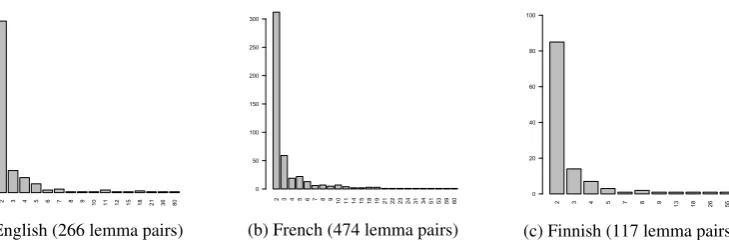
Figure 2: Number of lemma pairs (y-axis) displaying different numbers of potentially erroneous trees (x-axis).
UD v2 # sentences # tokens
English 14,545 229,753
French 16,031 392,230
[image:3.595.104.261.238.303.2]Finnish 13,581 181,138
Table 1: Size of the UD v2 English, French and Finnish corpora.
5 Evaluation
The method retrieves 266 pairs of lemmas display-ing inconsistencies for English, 474 for French and 117 for Finnish, using the “non-fringe” heuris-tic (i.e., the pairs need to share context: same lemma to the left and same lemma to the right of the lemmas in the dependency pair). Each pair varies in the number of inconsistent trees they are associated with. But most pairs contain two trees, as can be seen in Figure 2 which shows the counts of pairs (y-axis) for the different numbers of trees they contain (x-axis).
For each language, to evaluate how many of the inconsistencies flagged are indeed annotation er-rors, we randomly sampled 100 of the pairs re-trieved and annotated all the trees associated with these pairs, nevertheless limiting to 10 trees per dependency type.
5.1 Lemma-based approach
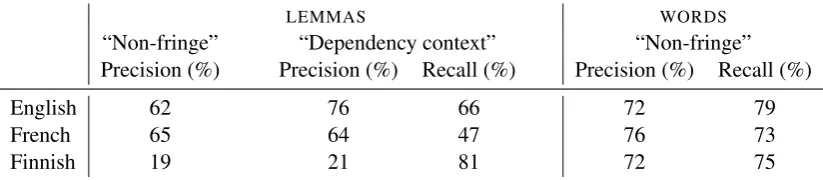
Table 2 gives the results. In the “non-fringe” col-umn, we computed how many of the 100 pairs do contain erroneous trees. Thus these results in-dicate how precise the method is. Boyd et al. propose an additional, more stringent heuristic of “dependency context”. This heuristic requires the word/lemma pairs to not only share the left/right context, but also the incoming relation type. As we did not implement this heuristic when
select-ing the trees for annotation, we are able to evalu-ate its precision as well as its recall relative to the pairs retrieved when using only the “non-fringe” heuristic. Using the 100 pairs annotated in each language as a gold-standard, we calculated the precision and recall of the “dependency context” heuristic by examining which pairs are left when adding the further requirement of shared incoming relation to the governor.
For the method used on lemmas, the results are satisfying for both English and French, with a pre-cision of 62% and 65%, respectively. However the method is not precise enough for Finnish, with only 19% of the pairs containing annotation errors. The use of lemmas for Finnish loses too much information: different inflections in Finnish can have completely different roles in many cases, and this leads to many false positives being retrieved. A good example of this is relative clauses, where the Finnish relativizer lemmasjoka andmik¨aget different syntactic functions depending on the case inflection. For example, in the relative clauses “joka (Case=Nom) tarvitsee” who needs, “jota (Case=Par) tarvitsee” what is needed and “jossa (Case=Ine) tarvitsee”where something is needed, three different syntactic functions, “nsubj”, “obj” and “obl” respectively, are correctly assigned for the same lemma pair.
LEMMAS WORDS
“Non-fringe” “Dependency context” “Non-fringe”
Precision (%) Precision (%) Recall (%) Precision (%) Recall (%)
English 62 76 66 72 79
French 65 64 47 76 73
[image:4.595.93.505.65.155.2]Finnish 19 21 81 72 75
Table 2: Results of the Boyd et al. method on 100 pairs in each corpus for the “non-fringe” and “de-pendency context” heuristics when using lemmas as well as for the “non-fringe” heuristic when using wordforms. Recall is always reported relative to the “non-fringe” lemma-based method.
Boyd et al. obtained 58% precision on 354 pairs retrieved, increasing precision slightly to 61% when adding the more stringent heuristic, but with a recall of 66%. For the Swedish data (11,431 sen-tences – 197,123 tokens), 210 pairs were retrieved, with a high precision of 92%. The more strin-gent heuristic yielded a slight increase in precision (95%) but an important drop in recall (48%). For German (1,567 sentences – 29,373 tokens) how-ever, due to the small corpus size, only 3 pairs were retrieved, all containing annotation errors.
5.2 Wordform-based approach
Capitalizing on the fact that every identified pair of words is also among the pairs of lemmas, we can subset the manually annotated lemma pairs and compute the precision of the method using word-forms as well as its recall relative to the lemma-based method. The results of the method lemma-based on words (instead of lemmas) are shown in the last columns of Table 2. For English and French, we see a moderate gain in precision whereas for Finnish we see a dramatic gain in precision, from 19% to 72%. The recall of the wordform-based method is in the 70–80% range for all languages, meaning that the gain in precision is offset by a loss of 20–30% of identified annotation errors. As the task is to find as many annotation errors as pos-sible, the loss of 20–30% of identified annotation errors might not be justified, especially for English and French where it is not accompanied by a major gain in precision.
5.3 Delexicalized approach
Seeing that for Finnish, new strategies need to be explored, we also test a delexicalized version of the method, whereby only pairs of morphologi-cal features are considered, rather than wordforms or lemmas, but constrained on the context
lem-mas. For instance, in Figure 3, instead of using the wordform or lemma, we work at the level of the morphological features: the elements in the pairs share the same features, and the left and right contexts have identical lemmas. For English and French, initial inspection of the results revealed a hopeless over-generation, but for Finnish this method outperforms the lemma-based approach both in precision and recall. While the lemma-based method identifies 117 pairs with precision of 19%, the delexicalized version identifies 353 pairs with precision of 25%. This shows that when ap-plying the method to Finnish, the morphology is of primary consideration, even above the lemmas themselves. Nevertheless for Finnish, the more useful method is the original Boyd et al., which considers wordforms, given that it reaches a high enough precision.
5.4 Analysis of the errors retrieved
suuria kaloja pieness¨a lammessa ja . . .
ADJ+Par+Pos+Plur NOUN+Par+Plur ADJ+Ine+Pos+Sing NOUN+Ine+Sing CCONJ
big fish in small in pond and . . .
amod
obl
amod cc
suurempia ongelmia p¨a¨aoman hankinnassa ja . . .
ADJ+Par+Cmp+Plur NOUN+Par+Plur NOUN+Gen+Sing NOUN+Ine+Sing CCONJ
bigger problems of capital in gathering and . . .
amod
nmod
[image:5.595.80.518.63.173.2]nmod:gobj cc
Figure 3: An example of an annotation error identified by the delexicalized method in the Finnish corpus. Here a pair of words is identified sharing a lemma-based context (big, and) such that the first word is a noun in plural partitive and the second word is a noun in singular inessive.
dependency type in identical phrase constructions. As the “obl” relation type has only been intro-duced in the recent version of the UD guidelines, it may be more error prone at this point.
(2) a. this is what the thing is about nsubj
cop
acl:relcl
cop nsubj
b. This store is what Colorado is all about nsubj
ccomp nsubj cop advmod
case
(3) a. . . . meilleurbetter thanque thele pr´ec´edentformer .
case det
obl
b. . . . meilleur que la pr´ec´edente .
better than the former mark
det advcl
(4) a. . . . that which NEG isce qui n’ est gu`erenot ´elev´ehigh .
acl:relcl nsubj
b. . . . ce qui est peu ´elev´e .
that which is little high conj nsubj
fixed
(5) a. . . . thousands of euros of subscriptionstuhansia euroja j¨asenmaksuja
nummod nmod obj
b. . . . thousands of euros of subscriptionstuhansia euroja j¨asenmaksuja
nummod nmod obj
(6) a. on yksi katsotuimpia tv-sarjoja
is one of the most watched tv series
cop amod
nmod root
b. . . . on yksi pahimpia ongelmia
is one of the worst problems
cop amod
obl root
Some errors are due to wrong attachments, such as (7) in which able is wrongly attached to had
with a “ccomp” relation instead of being attached toidea.
(7) We hada pretty good idea when we signed the contract that ECS would not beable to complete that by the contract start date, . . .
The total number of annotation errors identified during the annotation of the 100 lemma pairs for each of the three corpora is summarized in Table 3. The annotation took a maximum of two hours per language and was carried out by annotators well versed in the task.
6 Extending with parsebank data
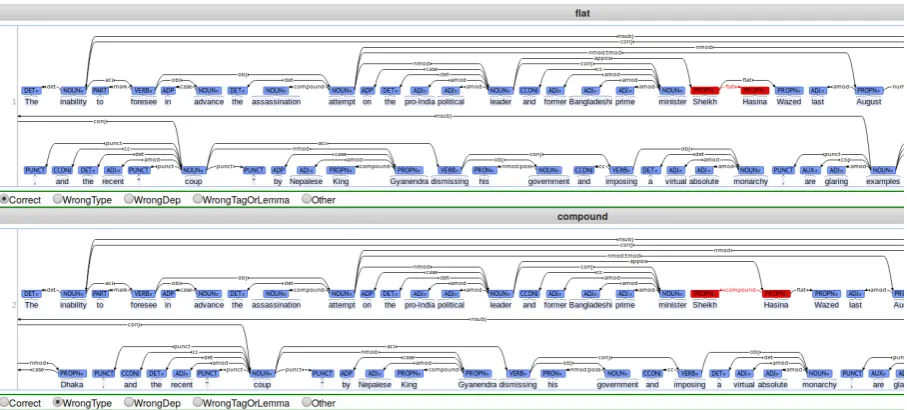
Figure 4: Example of the annotation tool.
Erroneous Correct
Type Structure
English 63 13 223
French 56 45 241
[image:6.595.92.270.315.395.2]Finnish 7 12 259
Table 3: The number of trees assessed as erro-neous (incorrect relation type or incorrect struc-ture), and the number of trees verified to be cor-rect.
per UD language, parsed with the UDPipe 1.1 de-pendency parser (Straka et al., 2016). For each of the three UD corpora we analyze, we flag pairs if they appear in the corresponding parsebank data in the same context at least 5 times, but are a vari-ation nucleus. Table 4 gives the number of trees which were manually assessed as annotation er-rors, as well as the percentage of trees which con-tain annotation errors (out of 100 pairs randomly sampled for French, all of them for English and Finnish). It also indicates how many of the erro-neous trees are already found based on the tree-bank itself. The proportion of such erroneous trees ranges from 30% to 40% depending on the lan-guage, but this means that 60–70% of annotation errors found based on the parsebank data are not flagged by the Boyd et al. method, when operat-ing only within the same corpus.
7 Annotation tool
The method retrieves pairs that display different analyses. However the pairs retrieved need to be checked manually: are they annotation errors or genuine ambiguities? To facilitate the annotation, we implemented a web-based tool which allows the annotation of the flagged inconsistencies to be carried out entirely in the browser in an intu-itive manner. The tool is illustrated in Figure 4. First, the annotators are presented with a list of lemma pairs, sortable by various criteria. For each pair, a link is provided leading to visualizations of the trees involving the pair, which is highlighted in every tree. The trees are grouped by depen-dency relation, which very often results in con-sistent groups where every tree is correct or ev-ery tree is incorrect, thus streamlining the anno-tation. For each tree, the annotator can mark the
# tree “Non-fringe” % in Boyd errors Precision
English 54 41% 38%
French 74 57% 36%
Finnish 10 16% 30%
[image:6.595.307.523.593.670.2]tree ascorrectorincorrectfor three separate rea-sons (relation type, governor/dependent, or part-of-speech), or the catch-all category other. The choice is saved automatically, and retrieved in case the page with the trees is reloaded or reopened. A visual cue in the form of a green border is given to assure the annotator that the choice was success-fully saved.
8 Conclusion
We evaluated the Boyd et al. (2008) method for finding annotation errors in dependency corpora on three of the UD v2 datasets (English, French and Finnish), and showed that this method per-forms fairly well.
We tried to adapt the Boyd et al. method to retrieve more errors, by working at the level of lemmas instead of wordforms. While results seem to indicate that this can work for languages with no case marking, it is clearly failing for a morphologically-rich language such as Finnish.
The parsebank-based method did not at present result in a large increase in recall, likely in part due to a too strict cut-off on the minimal num-ber of parsebank instances needed in order to flag a treebank relation as inconsistent, and in part due to the noise in the automated parses of the web data. The winning system of the CoNLL’17 Shared Task3gains 8 percents in Labeled
Attach-ment Score (LAS) over the baseline system which produced the parsebank analyses that we used, giving hope that this winning parser will lead to better results for the parsebank-based method.
We developed an easy and intuitive web inter-face for manual verification of the identified in-consistencies. Given our encouraging results on the three UD treebanks, we make both the inter-face and the automatically identified inconsisten-cies available to the UD community for all of the 70+ UD treebanks. This will allow us to expand the effort to the larger UD community and cover a number of languages and treebanks. For this, we will implement a light-weight user management so that multiple annotations for a single tree can be aggregated if necessary.
Our work is restricted to assessing the annota-tion consistency within a given corpus. However, moving forward, ensuring that similar construc-tions across corpora and languages are given the
3http://universaldependencies.org/
conll17/results.html
same analysis will also need to be addressed.
Acknowledgments
We are grateful to Alane Suhr for her help on this project early on. We thank our anonymous review-ers for their useful feedback. The work was sup-ported by a Google Faculty Award to the first au-thor and by the KONE Foundation and the Finnish Academy.
References
Bharat Ram Ambati, Rahul Agarwal, Mridul Gupta, Samar Husain, and Dipti Misra Sharma. 2011.
Er-ror detection for treebank validation. Proceedings
of the 9th Workshop on Asian Language Resources, pages 23–30.
Alena B¨ohmov´a, Jan Hajiˇc, Eva Hajiˇcov´a, and Barbora Hladk´a. 2003. The Prague dependency treebank. In Treebanks, pages 103–127. Springer.
Guillaume Bonfante, Bruno Guillaume, Mathieu
Morey, and Guy Perrier. 2011. Modular graph
rewriting to compute semantics. In Proceedings
of the Ninth International Conference on Computa-tional Semantics, pages 65–74.
Adriane Boyd, Markus Dickinson, and W Detmar Meurers. 2008. On detecting errors in dependency
treebanks. Research on Language & Computation,
6(2):113–137.
Koenraad De Smedt, Victoria Ros´en, and Paul Meurer. 2016. Studying consistency in UD treebanks with
INESS-Search. In Fourteenth Workshop on
Tree-banks and Linguistic Theories (TLT14).
Markus Dickinson and W. Detmar Meurers. 2003a.
Detecting errors in part-of-speech annotation. In
Proceedings of the Tenth Conference on European Chapter of the Association for Computational Lin-guistics, pages 107–114.
Markus Dickinson and W. Detmar Meurers. 2003b.
Detecting inconsistencies in treebanks. In
Proceed-ings of the Second Workshop on Treebanks and Lin-guistic Theories (TLT-03).
Markus Dickinson and W. Detmar Meurers. 2005.
Detecting errors in discontinuous structural
anno-tation. In Proceedings of the 43rd Annual
Meet-ing of the Association for Computational LMeet-inguis- Linguis-tics, pages 322–329.
Eleazar Eskin. 2000. Detecting errors within a
cor-pus using anomaly detection. InProceedings of the
Martin Forst, N´uria Bertomeu, Berthold Crysmann, Frederik Fouvry, Silvia Hansen-Schirra, and Valia
Kordoni. 2004. Towards a dependency-based
gold standard for German parsers – the TiGer
De-pendency Bank. In Proceedings of the
COL-ING Workshop on Linguistically Interpreted Cor-pora (LINC04), Geneva, Switzerland.
Markus G¨artner, Gregor Thiele, Wolfgang Seeker, An-ders Bj¨orkelund, and Jonas Kuhn. 2013. ICARUS – An extensible graphical search tool for dependency
treebanks. InProceedings of the 51st Annual
Meet-ing of the Association for Computational LMeet-inguis- Linguis-tics: System Demonstrations, pages 55–60.
Filip Ginter, Jan Hajiˇc, Juhani Luotolahti, Milan
Straka, and Daniel Zeman. 2017. CoNLL 2017
shared task - automatically annotated raw texts and
word embeddings. LINDAT/CLARIN digital
li-brary at the Institute of Formal and Applied Linguis-tics, Charles University.
Juhani Luotolahti, Jenna Kanerva, Sampo Pyysalo, and Filip Ginter. 2015. SETS: Scalable and efficient
tree search in dependency graphs. InNAACL Demo,
pages 51–55.
Joakim Nivre, Jens Nilsson, and Johan Hall. 2006. Tal-banken05: A Swedish treebank with phrase
struc-ture and dependency annotation. InProceedings of
the fifth international conference on Language Re-sources and Evaluation (LREC-06).
Joakim Nivre, Marie-Catherine de Marneffe, Filip Gin-ter, Yoav Goldberg, Jan Hajic, Christopher D Man-ning, Ryan McDonald, Slav Petrov, Sampo Pyysalo, Natalia Silveira, et al. 2016. Universal
dependen-cies v1: A multilingual treebank collection. In
Pro-ceedings of the 10th International Conference on Language Resources and Evaluation (LREC 2016), pages 1659–1666.
Jan ˇStˇep´anek and Petr Pajas. 2010. Querying
di-verse treebanks in a uniform way. InProceedings of
the 7th International Conference on Language Re-sources and Evaluation (LREC 2010).
Milan Straka, Jan Hajiˇc, and Jana Strakov´a. 2016. UD-Pipe: Trainable pipeline for processing CoNLL-U files performing tokenization, morphological
anal-ysis, pos tagging and parsing. In Proceedings of
the Tenth International Conference on Language Re-sources and Evaluation (LREC’16), Paris, France, May. European Language Resources Association (ELRA).
Gregor Thiele, Wolfgang Seeker, Markus G¨artner, An-ders Bj¨orkelund, and Jonas Kuhn. 2014. A graph-ical interface for automatic error mining in corpora.
In Proceedings of the Demonstrations at the 14th
Conference of the European Chapter of the Associ-ation for ComputAssoci-ational Linguistics, pages 57–60. Association for Computational Linguistics.
Hans van Halteren. 2000. The detection of
inconsis-tency in manually tagged text. In Proceedings of