Evaluating LSTM models for grammatical function labelling
Bich-Ngoc Do♦ and Ines Rehbein♣ Leibniz ScienceCampus
Universit¨at Heidelberg♦/ Institut f¨ur Deutsche Sprache Mannheim♣ {do|rehbein}@cl.uni-heidelberg.de
Abstract
To improve grammatical function belling for German, we augment the la-belling component of a neural dependency parser with a decision history. We present different ways to encode the history, using different LSTM architectures, and show that our models yield significant improve-ments, resulting in a LAS for German that is close to the best result from the SPMRL 2014 shared task (without the reranker). 1 Introduction
For languages with a non-configurational word order and rich(er) morphology, such as German, grammatical function (GF) labels are essential for interpreting the meaning of a sentence. Case syn-cretism in the German case paradigm makes GF labelling a challenging task. See (1) for an exam-ple where the nouns in the sentence are ambiguous between different cases, which makes it hard for a statistical parser to recover the correct reading.
We approach the problem of GF labelling as a subtask of dependency parsing, where we first generate unlabelled trees and, in the second step, try to find the correct labels. This pipeline ar-chitechture gives us more flexibility, allowing us to use the labeller in combination with our parser, but also to apply it to the unlabelled output of other parsing systems without the need to change or re-training the parsers.
The approach also makes it straightforward to test different architectures for GF labelling. We are especially interested in the influence of differ-ent input structures represdiffer-enting differdiffer-ent (surface
versus structural) orders of the input. In particular, we compare models where we present the unla-belled tree in linear order with a model where we encode the parser output as a tree. We show that all models are able to learn GFs with a similar overall LAS, but the model where the tree is encoded in a breadth-first order outperforms all other models on labelling core argument GFs.
2 Related Work
Grammatical function labelling is commonly in-tegrated into syntactic parsing. Few studies have adressed the issue as a separate classification task. While most of them assign grammatical functions on top of constituency trees (Blaheta and Char-niak,2000;Jijkoun and de Rijke,2004;Chrupała and van Genabith, 2006; Klenner, 2007; Seeker et al.,2010), less work has tried to predict GF la-bels for unlabelled dependency trees. One of them is McDonald et al. (2006) who first generate the unlabelled trees using a graph-based parser, and then model the assignment of dependency labels as a sequence labelling task.
Another approach has been proposed by Zhang et al. (2017) who present a simple, yet efficient and accurate parsing model that generates unlabelled trees by identifying the most probable head for each token in the input. Then, in a post-processing step, they assign labels to each head-dependent pair, using a two-layer rectifier network.
Dependency Parsing as Head Selection Our labelling model is an extension of the parsing model of Zhang et al. (2017). We use our own implementation of the head-selection parser and focus on the grammatical function labelling part. The parser uses a bidirectional LSTM to extract a dense, positional representationaiof the wordwi
at positioniin a sentence:
hFi =LSTMF(xi, hFi−1) (1)
hBi =LSTMB(xi, hBi+1) (2)
ai = [hFi ;hBi ] (3)
xi is the input at positioni, which is the
concate-nation of the word embeddings and the tag em-beddings of wordwi. An artificial root token w0
is added at the beginning of each sentence. The unlabelled tree is then built by selecting the most probable head for each word. The score of word wj being the head of wordwi is computed
by a single hidden layer neural network on their representationsajandai.
An additional classifier with two rectified hid-den layers is used to predict depenhid-dency labels, and is trained separately from the unlabeled pars-ing component, in a pipeline architecture. The classifier predictions are based on the represen-tations of the head and the dependent, bj andbi,
which are the concatenation of the input and the bidirectional LSTM-based representations:
bi= [xi;ai] (4)
Despite its simplicity and the lack of global op-timisation, Zhang et al. (2017) report competitive results for English, Czech, and German.
3 Labeling Dependencies with History Although the labelling approach in Zhang et al. (2017) is simple and efficient, looking at head and dependent only when assigning the labels comes with some disadvantages. First, some la-bels are easier to predict when we also take con-text into account, e.g. the parent and grandparent nodes or the siblings of the head or dependent.
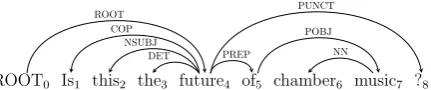
Consider, for example, the following sentence: Is this the future of chamber music? and its syn-tactic structure (figure1). If we only consider the nodes this and future, there is a chance that the edge between them is labelled asdet(determiner). However, if we also look at the local context, we know that node the to the left of future is more likely to be the determiner, and thusthisshould be assigned a different label.
Second, when looking at the parser output, we notice some errors that are well-known from other local parsing models, such as the assignment of duplicate subjects for the same predicate. To ad-dress this issue, we propose an extended labelling
ROOT0 Is1 this2 the3 future4 of5 chamber6 music7 ?8 ROOT
COP NSUBJ
DET PREP
[image:2.595.315.531.67.112.2]PUNCT POBJ NN
Figure 1: The dependency tree of the sentenceIs this the future of chamber music?
model that incorporates a decision history. To that end, we design different LSTM architectures for the labelling task and compare their performance on German, Czech and English.
Label prediction as a sequence labelling task Presenting the input to the labeller in sequential surface order does not seem very intuitive when we want to assign labels to a tree. This ap-proach, however, was adapted by McDonald et al. (2006). In their work, they consider all de-pendentsxj1, ..., xjM of a headxiand label those
edges(i, j1), ...,(i, jM)in a sequence.
We argue, however, that it is not enough to know the labels of the siblings, but that we also need to consider nodes at different levels in the tree. Therefore, when predicting the label for the cur-rent node, we consider all label decisions in the history, and feed them to a bidirectional LSTM. Given a sequence of nodesS = (w1, ..., wN)and
their corresponding head(h1, ..., hN), at each
re-current step, we input the learned representation of the head and the dependent:
hFi (lbl)=LSTMFlbl(bi, bhi, hFi−(lbl)1 ) (5)
hBi (lbl)=LSTMBlbl(bi, bhi, hBi+1(lbl)) (6)
After that, the concatenated hidden states
[hFi (lbl);hBi (lbl)] are projected to a softmax layer to predict the label.
When presenting a tree as a sequence, we ex-periment with two different input orders:
• BILSTM(L): Tree nodes are ordered
ac-cording to their surface order in the sentence (linear order; figure2).
• BILSTM(B): Tree nodes are ordered
Is, future this, future the, future future, ROOT of, future chamber, music music, of ?, future
COP NSUBJ DET ROOT PREP NN POBJ PUNCT
biLSTM(l) biLSTM(l) biLSTM(l) biLSTM(l) biLSTM(l) biLSTM(l) biLSTM(l) biLSTM(l)
future, ROOT is, future this, future the, future of, future ?, future music, of chamber, music
ROOT COP NSUBJ DET PREP PUNCT POBJ NN
[image:3.595.100.501.63.221.2]biLSTM(b) biLSTM(b) biLSTM(b) biLSTM(b) biLSTM(b) biLSTM(b) biLSTM(b) biLSTM(b)
Figure 2: The processing order of the sentence in figure1a) in the BILSTM(L) model (top) and b) in theBILSTM(B) model (bottom).
Top-down tree LSTM Intuitively, it seems more natural to present the input as a tree struc-ture when trying to predict the dependency labels. We do that by adopting the top-down tree LSTM model (Zhang et al., 2016) that processes nodes linked through dependency paths in a top-down manner. To make it comparable to the previous LSTM models, we only useone LSTM instead of four, and do not stack LSTMs. The hidden state is computed as follow:
h(ilbl) =treeLSTM(bi, hi−1) (7)
After that, we proceed as we did for the BI
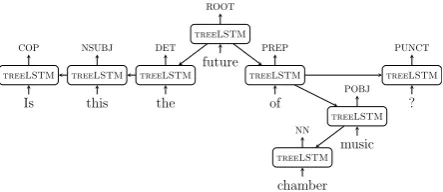
-LSTM models (see above). Note that the pro-cessing orderiis also the BFS order. We call this modelTREELSTM(figure3).
4 Experiments
Our interest is focussed on German, but to put our work in context, we follow Zhang et al. (2017) and report results also for English, which has a config-urational word order, and for Czech, which has a free word order, rich morphology, and less ambi-guity in the case paradigm than German.
For English, we use the Penn Treebank (PTB) (Marcus et al., 1993) with standard train-ing/dev/test splits. The POS tags are assigned using the Stanford POS tagger (Toutanova et al.,
2003) with ten-way jackknifing, and constituency trees are converted to Stanford basic dependen-cies (De Marneffe et al.,2006). The German and Czech data come from the CoNLL-X shared task (Buchholz and Marsi,2006) and our data split fol-lows Zhang et al. (2017). As the CoNLL-X test-sets are rather small (∼ 360 sentences), we also
treeLSTM
future
ROOT
treeLSTM
the
DET
treeLSTM
of
PREP
treeLSTM
this
NSUBJ
treeLSTM
Is
COP
treeLSTM
?
PUNCT
treeLSTM
music
POBJ
treeLSTM
chamber
NN
Figure 3: The processing order of the sentence in figure1in theTREELSTM model.
train and test on the much larger German SPMRL 2014 shared task data (Seddah et al.,2014) (5,000 test sentences). For the SPMRL data we use the predicted POS tags provided by the shared task or-ganisers.
4.1 Setup
We test different labelling models on top of the un-labelled trees produced by our re-implementation of theparsing as head selectionmodel (§2).
We first train the unlabelled parsing models for the three languages. Unless stated other-wise, all parameters are set according to Zhang et al. (2017), and tag embedding size was set to 40 for all languages. Please note that we donot use pre-trained embeddings in our experiments.
In the next step, we train four different labelling models: the labeller of Zhang et al. (2017) that uses a rectifier neural network with two hidden layers (baseline), two bidirectional LSTM mod-els (BILSTM(L)andBILSTM(B)), and one tree
LSTM model (TREELSTM) (§3).
[image:3.595.307.529.281.377.2]Model en cs deCoNLL deSP MRL
UAS 93.35 89.70 93.09 91.29
Baseline 91.58 83.42 90.22 88.15
BILSTM(L) 91.92* 84.08* 90.87* 88.73*
BILSTM(B) 91.91* 83.80 90.97* 88.74* TREELSTM 91.92* 83.82 90.89* 88.74*
DENSE 91.90 81.72 89.60 -Table 1: Results for different labellers applied to the unlabelled parser output. The first row re-ports UAS for the input to the labellers. The last row (DENSE) shows the results from Zhang et al. (2017). (*) indicates that the difference between the model and the baseline is statistically signifi-cant (p < .001).
(Kingma and Ba, 2015) with default parameters (initial learning rate 0.001, first momentum coef-ficient 0.9, second momentum coefcoef-ficient 0.999). We used L2 regularization with a coefficient of
10−3 and max-norm regularization with an upper
bound of 5.0. The dropout (Srivastava et al.,2014) rate was set to 0.05 for the input connections, and 0.5 for the rest.
4.2 Results
Table 1 shows the unlabelled attachment score (UAS) for the unlabelled trees and the labelled at-tachment scores (LAS) for the different labellers (excluding punctuation). All history-based la-belling models perform significantly better than the local baseline model,1but for English the
im-provements are smaller (0.3%) than for the non-configurational languages (∼0.7%).
While we tried to reimplement the model of Zhang et al. (2017) following the details in the pa-per, our reimplemented model yields higher scores for German, compared to the results in the paper. The scores for English are slightly lower since, in contrast to Zhang et al. (2017), we do not use pre-trained embeddings. When using our history-based labellers, we get similar results for English (91.9%) and higher results for both Czech (84.1% vs. 81.7%) and German (91.0% vs. 89.6%) on the same data without using pre-trained embeddings or post-processing.
On the SPMRL 2014 shared task data, our re-sults are only 0.3% lower than the ones of the winning system (Bj¨orkelund et al.,2014)without reranker (blended).2 To further illustrate the
ef-1For significance testing, we use Bikel’s
Random-ized Parsing Evaluation Comparator (http://www.cis. upenn.edu/˜dbikel/software.html).
2The shared task winner is a complex ensemble system
that generates a tree byblendingthe output of three parsers
deSP MRL SB OA DA PD
# 6,638 # 3,184 # 568 # 1,045
baseline 90.3 83.6 64.7 77.1
BILSTM(L) 91.4 85.3 67.7 80.0
BILSTM(B) 91.9 85.4 69.3 80.5
treeLSTM 91.2 85.1 68.6 79.8
deSP MRL AG PG OC OG
# 2,241 # 388 # 3,652 # 21
baseline 91.3 80.0 90.1 0
BILSTM(L) 91.3 81.6 90.5 16.0 BILSTM(B) 91.5 82.4 90.7 37.0
treeLSTM 91.4 81.4 90.2 27.6
Table 2: LAS for core argument functions (Ger-man SPMRL data), and frequency (#) of GF in the testset (SB: subj, OA: acc.obj, DA: dat.obj, PD: pred, AG: gen.attribute, PG: phrasal genitive, OC: clausal obj, OG: gen.obj).
fectiveness of our models, we also ran our labeller on theunlabelled outputof the SPMRL 2014 win-ning system and onunlabelled goldtrees. On the output of the blended system LAS slightly im-proves from 88.62% to 88.76% (TREELSTM).3 When applied to unlabelled gold trees, the dis-tance between our models and the baseline be-comes larger and the best of our history-based models (BILSTM(B), 97.38%) outperforms the original labeller of Zhang et al. (2017) (96.15%) by more than 1%.
We would like to emphasize that our history-based LSTM labeller is practically simple and computationally inexpensive (as compared to global training or inference), so our model man-ages to preserve simplicity while significantly im-proving labelling performance.
4.3 Discussion
Most strikingly, all three models seem to perform roughly the same, and theTREELSTM model fails to outperform the other two models. However, in comparison to the BILSTM models, the TREE -LSTM model has a smaller number of parameters, and the history only flows in one direction. The tree model also has a shorter history chain since nodes are linked by paths from the root (figure3), which might explain why it does not yield better results than the linear LSTM models.
The overall results suggest that the order in which the nodes are presented in the history does not have any impact on the labelling results. How-ever, when looking at results for individual core argument functions (subject, direct object, etc.), a (Mate, Turbo, BestFirst; see (Bj¨orkelund et al.,2014)).
3Following Bj¨orkelund et al. (2014), here we include
[image:4.595.307.523.61.186.2] [image:4.595.72.297.62.135.2]GF en cs deSP MRL
sb 3.1 3.4 3.9
dep-length dobj 2.5 *2.4 4.2
iobj 1.7 - 4.7
sb 4.6 32.5 34.2
left-head ratio dobj 97.4 *77.5 37.2
[image:5.595.78.285.62.135.2]iobj 100.0 - 27.5
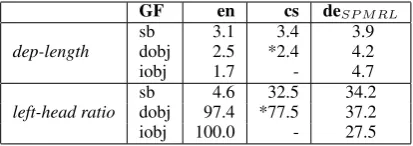
Table 3: Avg. dependency length and ratio of left arcs vs. all (left + right) arc dependencies for args. (* in the Czech data, Obj subsumes all types of objects, not only direct objects)
more pronounced pattern emerges (table2).4 Here
we see the benefit of encoding the siblings close to each other in the history: For all core argument functions, theBILSTM(B) model outperforms the other models.
To find out why the history-based models work better for Czech and German than for English, we compared the average dependency length as well as the variability in head direction (how often e.g. the head of a subject is positioned to the left, in relation to the total number of subjects). Table3
suggests that the success of the history-based mod-els is not due to a better handling of long depen-dencies but that they are better in dealing with the uncertainty in head direction (also see Gulordava and Merlo (2016)).
5 Conclusions
We have shown that GF labelling, which is of cru-cial importance for languages like German, can be improved by combining LSTM models with a de-cision history. All our models outperform the orig-inal labeller of Zhang et al. (2017) and give re-sults in the same range as the best system from the SPMRL-2014 shared task (without the reranker), but with a much simpler model. Our results show that the history is especially important for lan-guages that show more word order variation. Here, presenting the input in a structured BFS order not only significantly outperforms the baseline, but also yields improvements over the other LSTM models on core grammatical functions.
Acknowledgments
We would like to thank Minh Le for his help with data pre-processing. This research has been con-ducted within the Leibniz Science Campus “Em-4We evaluate GFs on the German SPMRL data which
are sufficiently large with 5,000 test sentences. The CoNLL datasets, in comparison, only include∼360 test sentences.
pirical Linguistics and Computational Modeling”, funded by the Leibniz Association under grant no. SAS-2015-IDS-LWC and by the Ministry of Sci-ence, Research, and Art (MWK) of the state of Baden-W¨urttemberg.
References
Anders Bj¨orkelund, ¨Ozlem C¸etino˘glu, Agnieszka Fale´nska, Rich´ard Farkas, Thomas M¨uller,
Wolf-gang Seeker, and Zsolt Sz´ant´o. 2014.
Intro-ducing the IMS-Wroclaw-Szeged-CIS entry at the SPMRL 2014 Shared Task: Reranking and Morpho-syntax meet Unlabeled Data. In Proceedings of the First Joint Workshop on Statistical Parsing of Morphologically Rich Languages and Syntac-tic Analysis of Non-Canonical Languages. Dublin City University, Dublin, Ireland, pages 97–102.
http://www.aclweb.org/anthology/W14-6110. Don Blaheta and Eugene Charniak. 2000.
Assign-ing function tags to parsed text. InProceedings of the 1st North American Chapter of the Association for Computational Linguistics Conference. NAACL ’00, pages 234–240.
Sabine Buchholz and Erwin Marsi. 2006. CoNLL-X shared task on multilingual dependency parsing. In
Proceedings of the Tenth Conference on Computa-tional Natural Language Learning. Association for Computational Linguistics, Stroudsburg, PA, USA, CoNLL-X ’06, pages 149–164.
Grzegorz Chrupała and Josef van Genabith. 2006. Us-ing machine-learnUs-ing to assign function labels to
parser output for Spanish. In Proceedings of the
COLING/ACL on Main Conference Poster Sessions. COLING-ACL ’06, pages 136–143.
Marie-Catherine De Marneffe, Bill MacCartney, and Christopher D. Manning. 2006. Generating typed dependency parses from phrase structure parses. In
The fifth international conference on Language Re-sources and Evaluation. LREC’06, pages 449–454. Kristina Gulordava and Paola Merlo. 2016.
Multi-lingual dependency parsing evaluation: a large-scale analysis of word order properties using artificial
data.TACL4:343–356.
Valentin Jijkoun and Maarten de Rijke. 2004. En-riching the output of a parser using memory-based
learning. InProceedings of the 42nd Annual
Meet-ing of the Association for Computational LMeet-inguis- Linguis-tics. pages 311–318.
Diederik Kingma and Jimmy Ba. 2015. Adam: A method for stochastic optimization. InThe Interna-tional Conference on Learning Representations. San Diego.
ACL on Interactive Poster and Demonstration Ses-sions. ACL ’07, pages 201–204.
Mitchell P. Marcus, Mary Ann Marcinkiewicz, and Beatrice Santorini. 1993. Building a large annotated
corpus of English: the Penn treebank.
Computa-tional Linguistics19(2):313–330.
Ryan McDonald, Kevin Lerman, and Fernando Pereira. 2006. Multilingual dependency analysis with a
two-stage discriminative parser. In Proceedings of the
10th Conference on Computational Natural Lan-guage Learning. CoNLL-X ’06, pages 206–210. Djam´e Seddah, Sandra K¨ubler, and Reut Tsarfaty.
2014. Introducing the SPMRL 2014 shared task
on parsing morphologically-rich languages. In Pro-ceedings of the First Joint Workshop on Statisti-cal Parsing of MorphologiStatisti-cally Rich Languages and Syntactic Analysis of Non-Canonical Languages. Dublin City University, Dublin, Ireland, pages 103– 109. http://www.aclweb.org/anthology/W14-6111. Wolfgang Seeker, Ines Rehbein, Jonas Kuhn, and Josef
van Genabith. 2010. Hard constraints for grammat-ical function labelling. In Proceedings of the 48th Annual Meeting of the Association for Computa-tional Linguistics. ACL ’10, pages 1087–1097. Nitish Srivastava, Geoffrey Hinton, Alex Krizhevsky,
Ilya Sutskever, and Ruslan Salakhutdinov.
2014. Dropout: A simple way to prevent
neural networks from overfitting. Journal of Machine Learning Research 15:1929–1958.
http://jmlr.org/papers/v15/srivastava14a.html. Kristina Toutanova, Dan Klein, Christopher D.
Man-ning, and Yoram Singer. 2003. Feature-rich part-of-speech tagging with a cyclic dependency network. InProceedings of the 2003 Conference of the North American Chapter of the Association for Computa-tional Linguistics on Human Language Technology. NAACL ’03, pages 173–180.
Xingxing Zhang, Jianpeng Cheng, and Mirella Lapata. 2017. Dependency parsing as head selection. In
Proceedings of the 15th Conference of the European Chapter of the Association for Computational Lin-guistics. EACL’17, pages 665–676.
Xingxing Zhang, Liang Lu, and Mirella Lapata.
2016. Top-down tree long short-term memory
net-works. In Proceedings of the 2016 Conference of the North American Chapter of the Associa-tion for ComputaAssocia-tional Linguistics: Human Lan-guage Technologies. Association for Computational Linguistics, San Diego, California, pages 310–320.