
Neural-based Context Representation Learning
for Dialog Act Classification
Daniel Ortega Ngoc Thang Vu Institute for Natural Language Processing (IMS)
University of Stuttgart
Pfaffenwaldring 5b, 70569 Stuttgart, Germany
{daniel.ortega, thang.vu}@ims.uni-stuttgart.de
Abstract
We explore context representation learn-ing methods in neural-based models for dialog act classification. We propose and compare extensively different meth-ods which combine recurrent neural net-work architectures and attention mecha-nisms (AMs) at different context levels. Our experimental results on two bench-mark datasets show consistent improve-ments compared to the models without contextual information and reveal that the most suitable AM in the architecture de-pends on the nature of the dataset.
1 Introduction
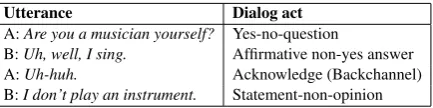
The study of spoken dialogs between two or more speakers can be approached by analyzing the di-alog acts (DAs), which is the intention of the speaker at every utterance during a conversation. Table1shows a fragment of a conversation from the Switchboard (SwDA) dataset with DA anno-tation. Automatic DA classification is an impor-tant pre-processing step in natural language under-standing tasks and spoken dialog systems. This classification task has been approached using tra-ditional statistical methods such as hidden Markov models (HMMs) (Stolcke et al., 2000), condi-tional random fields (CRF) (Zimmermann,2009) and support vector machines (SVMs) (Henderson et al., 2012). However, recent works with deep learning (DL) techniques have brought state-of-the-art models in DA classification, such as con-volutional neural networks (CNNs) (Kalchbrenner and Blunsom,2013;Lee and Dernoncourt,2016), recurrent neural networks (RNNs) (Lee and Der-noncourt,2016;Ji et al.,2016) and long short-term memory (LSTM) models (Shen and Lee,2016).
Utterance Dialog act
A:Are you a musician yourself? Yes-no-question
B:Uh, well, I sing. Affirmative non-yes answer
A:Uh-huh. Acknowledge (Backchannel)
[image:1.595.310.527.221.275.2]B:I don’t play an instrument. Statement-non-opinion
Table 1: Examples from the SwDA dataset.
Given an utterance in a dialog without any pre-vious context, it is not always obpre-vious even for human beings to find the corresponding dialog act. In many cases, the utterances are too short so that is hard to classify them, for example the utterance’Right’can be either anAgreement or a
Backchannel indicating the interlocutor to go on talking, in this case the context plays a key role at disambiguating. Therefore, using context in-formation from the previous utterances in a dialog flow is a crucial step for improving DA classifica-tion. Few papers in the literature have suggested to utilize context as a potential knowledge source for DA classification (Lee and Dernoncourt,2016; Shen and Lee, 2016). Recently, Ribeiro et al. (2015) presented an extensive analysis of the in-fluence of context on DA recognition concluding that contextual information from preceding utter-ances helps to improve the classification perfor-mance. Nonetheless, such information should be differentiable from the current utterance informa-tion, otherwise, the contextual information could have a negative impact.
Attention mechanisms (AMs) introduced by Bahdanau et al. (2014) have contributed to sig-nificant improvements in many natural language processing tasks, for instance machine translation (Bahdanau et al., 2014), sentence classification (Shen and Lee, 2016) and summarization (Rush et al., 2015), uncertainty detection (Adel and Sch¨utze, 2017), speech recognition (Chorowski et al., 2015), sentence pair modeling (Yin et al., 2015), question-answering (Golub and He,2016),
document classification (Yang et al.,2016) and en-tailment (Rockt¨aschel et al.,2015) . AMs let the model decide what parts of the input to pay atten-tion to according to the relevance for the task.
In this paper, we explore the use of AMs to learn the context representation, as a manner to differ-entiate the current utterance from its context as well as a mechanism to highlight the most relevant information, while ignoring unimportant parts for DA classification. We propose and compare exten-sively different neural-based methods for context representation learning by leveraging a recurrent neural network architecture with LSTM (Hochre-iter and Schmidhuber, 1997) or gated recurrent units (GRUs) (Cho et al.,2014;Chung et al.,2014) in combination with AMs.
2 Model
The model architecture, shown on the left side of Figure1, contains two main parts: the CNN-based utterance representation and the attention mecha-nism for context representation learning. Finally, the context representation is fed into a softmax layer which outputs the posterior of each prede-fined DA given the current dialog utterance.
2.1 CNN-based Dialog Utterance Representation
We used CNNs for the representation of each ut-terance. CNNs perform a discrete convolution on an input matrix with a set of different filters. For the DA classification task, the input matrix rep-resents a dialog utterance and its context, this is n previous utterances: each column of the ma-trix stores the word embedding of the correspond-ing word. We use 2D filters f (with width |f|) spanning all embedding dimensionsd. This is de-scribed by the following equation:
(w∗f)(x, y) = d X
i=1 |Xf|/2
j=−|f|/2
w(i, j)·f(x−i, y−j)
(1) After convolution, a max pooling operation is ap-plied that stores only the highest activation of each filter. Furthermore, we apply filters with different window sizes 3-5 (multi-windows), i.e. spanning a different number of input words. Then, all feature maps are concatenated to one vector which repre-sents the current utterance and its context.
2.2 Internal Attention Mechanism
Attention mechanisms can be applied in different sequences of input vectors, e.g. representations of consecutive dialog utterances. For each of the in-put vectorsu(t−i)at time stept−iin a dialog andtis the current time step, the attention weights αi are computed as follows
αi= P exp(f(u(t−i)))
0<j<mexp(f(u(t−j)) (2) wheref is the scoring function. In this work,f is the linear function of the inputu(t−i)
f(u(t−i)) =WTu(t−i) (3) where W is a trainable parameter. The out-put attentive u after the attention layer is the weighted sum of the input sequence.
attentive u=X i
αiu(t−i) (4)
Another option (order-preserved attentionas pro-posed in Adel and Sch¨utze (2017)) is to store the weighted inputs into a vector sequence attentive v which preserves the order informa-tion.
attentive v= [α0u(t), α1u(t−1), ...] (5)
2.3 Neural-based Context Modeling
In this subsection, we present different methods, depicted on the right side of Figure1, to learn the context representation.
a Max We apply max-pooling on top of the di-alog utterance representations which spans all the contexts and the vector dimension.
b Attention We apply directly attention mech-anism on the dialog utterance representations. The weighted sum of all the dialog utterances repre-sents the context information.
c RNN We introduce a recurrent architecture with LSTM or GRU cells on top of the dialog ut-terance representations to model the relation be-tween the context and the current utterance over time. The output of the hidden layer of the last state is the context representation.
Figure 1: Model architecture for DA classification. On the left side is the overview of the model. The right site contains six neural-based methods for context representation learning.
e RNN-Input-Attention We first apply the order-preserved attention mechanism on the dia-log utterance representations to obtain a sequence of weighted inputs. Afterwards, an RNN with LSTM or GRU cells is introduced to model the relation of the weighted context.
3 Experimental Setup 3.1 Data
We test our model on two DA datasets:
• MRDA: ICSI Meeting Recorder Dialog Act Corpus (Janin et al., 2003; Shriberg et al., 2004; Dhillon et al., 2004), a dialog corpus of multiparty meetings. The 5-tag-set used in this work was introduced by Ang et al. (2005).
• SwDA: Switchboard Dialog Act Corpus (Godfrey et al.,1992;Jurafsky et al.,1997), a dialog corpus of2-speaker conversations.
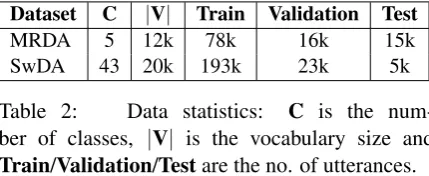
Train, validation and test splits on both datasets were taken as defined in Lee and Dernoncourt (2016)1, summary statistics are shown in Table2.
In both datasets the classes are highly unbalanced, the majority class is59.1% on MRDA and33.7% on SwDA.
3.2 Hyperparameters and Training
The hyperparameters for both datasets are sum-marized in Table 3, they were selected by vary-1Concerning SwDA, the data setup inLee and
Dernon-court(2016) was preferred overStolcke et al.(2000)’s, be-cause it was not clearly found in the latter which conversa-tions belong to each split.
Dataset C |V| Train Validation Test
MRDA 5 12k 78k 16k 15k SwDA 43 20k 193k 23k 5k
Table 2: Data statistics: C is the num-ber of classes, |V| is the vocabulary size and Train/Validation/Testare the no. of utterances.
ing one hyperparameter at a time while keeping the others fixed. The filter widths and feature maps were taken from the CNN architecture for sentence classification in Kim (2014). Dropout rate of 0.5 was found to be the most effective in the range of [0-0.9]. The rectified linear unit (ReLU) was used as non-linear activation func-tion, 1-max as pooling operation at utterance level as suggested inZhang and Wallace (2015). The only dataset specific hyperparameter is the mini-batch size: 150 and 50 for SwDA and MRDA, re-spectively. Word2vec (Mikolov et al., 2013) was used for word vector representation. Training was done for 30 epochs with averaged stochastic gradi-ent descgradi-ent (Polyak and Juditsky,1992) over mini-batches. The learning rate was initialized at 0.1 and reduced 10% every 2000 parameter updates. We kept the word vector unchanged during train-ing. The context length was optimized on the de-velopment set, ranging from 1-5. Our best re-sults were obtained with three context utterances for MRDA and two for SwDA.
4 Experimental Results 4.1 Baseline Models
[image:3.595.308.523.286.374.2]Hyperparameter Value Filter width 3, 4, 5 Feature maps per filter 100
Dropout rate 0.5
Activation function ReLU
[image:4.595.74.293.61.161.2]Pooling 1-max pooling per utterance Mini-batch size 50 (MRDA) – 150 (SwDA) Word embeddings word2vec (dim. 300)
Table 3: Hyperparameters.
Kim(2014) but with an input variation: a) Base-line I: The input is a single utterance a time with-out any contextual information and b) Baseline II: The input is the concatenation of the current utter-ance and previous utterutter-ances.
4.2 Results
Table4summarizes the results of all the models. Results on the Baseline I and the Baseline II on both datasets show that a simple context concate-nation is not enough to model the context informa-tion for this task. While on SwDA the accuracy improves by 1.3%, it slightly drops on MRDA. Other simple methods such asMaxandAttention
do not improve the results over the baseline either. Our results are consistently improved on both datasets after introducing RNN architecture to model the relation between the contexts. It in-dicates that hierarchical structure is crucial to learn the context representation. Attention mecha-nisms contribute to the overall improvements. On MRDA, the AM was more useful when it was ap-plied to the inputs of the RNN, whereas on SwDA when it was applied to the outputs. Our intuition is that in multiparty dialogs the dependency be-tween the utterances should be weighted before being processed by the RNN.
Model MRDA SwDA
Baseline I 83.6 71.3
Baseline II 83.5 72.6
Max 58.5 48.0
Attention 83.5 72.4
RNN (LSTM) 83.8 73.1
RNN (GRU) 83.8 72.8
RNN-Output-Attention (LSTM) 84.1 73.8 RNN-Output-Attention (GRU) 84.0 73.1 RNN-Input-Attention (LSTM) 84.3 73.3 RNN-Input-Attention (GRU) 83.6 73.1
Table 4: Accuracy (%) of baselines and models with different context processing methods.
4.3 Impact of Context Length
Our experiments revealed that context length plays an important role for DA classification and the best length is corpus dependent. By experimenting in the context range of 0-5 utterances, we found that the best context length for MRDA is three utter-ances and two for SwDA. Table5shows the results at different context lengths.
n-context MRDA SwDA
1 83.8 73.1
2 83.9 73.8
3 84.3 73.5
4 84.0 73.1
[image:4.595.353.480.195.257.2]5 84.0 72.9
Table 5: Comparison of accuracy (%) on different context lengths (n-context, wherenis the number of sentences as context).
5 Comparison with Other Works
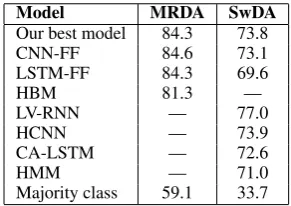
Table 6 compares our results with other works. To the best of our knowledge, Lee and Dernon-court (2016) is the newest research in DA clas-sification, which published train/validation splits and claimed to be the state-of-the-art on that setup. Therefore, an accurate comparison of our results can be only done with this work. Our model yields comparable results to the state-of-the-art on both datasets, 84.3% against 84.6% on MRDA and 73.8% against 73.1% on SwDA. Ji et al. (2016) and Kalchbrenner and Blunsom (2013) obtained higher accuracy on SwDA but with different setup.
Model MRDA SwDA
Our best model 84.3 73.8
CNN-FF 84.6 73.1
LSTM-FF 84.3 69.6
HBM 81.3 —
LV-RNN — 77.0
HCNN — 73.9
CA-LSTM — 72.6
HMM — 71.0
Majority class 59.1 33.7
Table 6: Comparison of accuracy (%). CNN-FF andLSTM-FF: proposed inLee and Dernon-court(2016),HBM: hidden backoff model (Ji and Bilmes,2006).LV-RNN: latent variable RNN with conditional training (Ji et al.,2016).HCNN: hier-archical CNN (Kalchbrenner and Blunsom,2013).
[image:4.595.343.489.536.639.2] [image:4.595.76.291.583.721.2]6 Conclusions
We explored different neural-based context repre-sentation learning methods for dialog act classi-fication which combine RNN architectures with attention mechanisms at different context levels. Our results on two benchmark datasets reveal that using RNN architecture is important to learn the context representation. Moreover, attention mech-anisms contribute to the overall improvements, however, the place where AM should be applied depends on the nature of the dataset.
References
Heike Adel and Hinrich Sch¨utze. 2017. Explor-ing different dimensions of attention for uncer-tainty detection. In Proceedings of the 15th Conference of the European Chapter of the As-sociation for Computational Linguistics: Vol-ume 1, Long Papers. Association for Computa-tional Linguistics, Valencia, Spain, pages 22–34.
http://www.aclweb.org/anthology/E17-1003. Jeremy Ang, Yang Liu, and Elizabeth Shriberg. 2005.
Automatic dialog act segmentation and classifica-tion in multiparty meetings. In in Proc. IEEE Int. Conf. on Acoustics, Speech and Signal Processing (ICASSP. pages 1061–1064.
Dzmitry Bahdanau, Kyunghyun Cho, and Yoshua Bengio. 2014. Neural machine translation by jointly learning to align and translate. CoRR
abs/1409.0473. http://arxiv.org/abs/1409.0473. KyungHyun Cho, Bart van Merrienboer, Dzmitry
Bahdanau, and Yoshua Bengio. 2014. On the properties of neural machine translation: Encoder-decoder approaches.CoRRabs/1409.1259.
http://arxiv.org/abs/1409.1259.
Jan Chorowski, Dzmitry Bahdanau, Dmitriy Serdyuk, KyungHyun Cho, and Yoshua Bengio. 2015. Attention-based models for speech recognition. CoRR abs/1506.07503.
http://arxiv.org/abs/1506.07503.
Junyoung Chung, C¸aglar G¨ulc¸ehre, KyungHyun Cho, and Yoshua Bengio. 2014. Empirical evaluation of gated recurrent neural networks on sequence modeling. CoRR abs/1412.3555.
http://arxiv.org/abs/1412.3555.
Rajdip Dhillon, Sonali Bhagat, Hannah Carvey, and Elizabeth Shriberg. 2004. Meeting Recorder Project: Dialog Act Labeling Guide. Technical re-port, ICSI Tech. Report. https://goo.gl/TtLJlE. John J. Godfrey, Edward C. Holliman, and Jane
McDaniel. 1992. Switchboard: Telephone speech corpus for research and development. In Proceed-ings of the 1992 IEEE International Conference
on Acoustics, Speech and Signal Processing - Volume 1. IEEE Computer Society, Wash-ington, DC, USA, ICASSP’92, pages 517–520.
http://dl.acm.org/citation.cfm?id=1895550.1895693. David Golub and Xiaodong He. 2016.
Character-level question answering with attention. CoRR
abs/1604.00727.http://arxiv.org/abs/1604.00727. M. Henderson, M. Gai, B. Thomson, P. Tsiakoulis,
K. Yu, and S. Young. 2012. Discriminative spoken language understanding using word con-fusion networks. In 2012 IEEE Spoken Lan-guage Technology Workshop (SLT). pages 176–181.
https://doi.org/10.1109/SLT.2012.6424218.
Sepp Hochreiter and J¨urgen Schmidhuber. 1997. Long short-term memory. Neural Comput. 9(8):1735– 1780.https://doi.org/10.1162/neco.1997.9.8.1735. Adam Janin, Don Baron, Jane Edwards, Dan Ellis,
David Gelbart, Nelson Morgan, Barbara Peskin, Thilo Pfau, Elizabeth Shriberg, Andreas Stolcke, and Chuck Wooters. 2003. The icsi meeting corpus. pages 364–367.
Gang Ji and Jeff Bilmes. 2006. Backoff model training using partially observed data: Applica-tion to dialog act tagging. In Proceedings of the Main Conference on Human Language Technol-ogy Conference of the North American Chapter of the Association of Computational Linguistics. As-sociation for Computational Linguistics, Strouds-burg, PA, USA, HLT-NAACL ’06, pages 280–287.
https://doi.org/10.3115/1220835.1220871.
Yangfeng Ji, Gholamreza Haffari, and Jacob Eisen-stein. 2016. A latent variable recurrent neural net-work for discourse relation language models. CoRR
abs/1603.01913.http://arxiv.org/abs/1603.01913. D. Jurafsky, E. Shriberg, and D. Biasca. 1997.
Switch-board SWBD-DAMSL shallow-discourse-function annotation coders manual. Technical Report Draft 13, University of Colorado, Institute of Cognitive Science.
Nal Kalchbrenner and Phil Blunsom. 2013. Re-current convolutional neural networks for dis-course compositionality. CoRR abs/1306.3584.
http://arxiv.org/abs/1306.3584.
Yoon Kim. 2014. Convolutional neural networks for sentence classification. CoRR abs/1408.5882.
http://arxiv.org/abs/1408.5882.
Ji Young Lee and Franck Dernoncourt. 2016. Sequen-tial short-text classification with recurrent and con-volutional neural networks. CoRRabs/1603.03827.
http://arxiv.org/abs/1603.03827.
Tomas Mikolov, Ilya Sutskever, Kai Chen, Greg Corrado, and Jeffrey Dean. 2013. Distributed representations of words and phrases and their compositionality. CoRR abs/1310.4546.
B. T. Polyak and A. B. Juditsky. 1992. Accel-eration of stochastic approximation by averag-ing. SIAM J. Control Optim. 30(4):838–855.
https://doi.org/10.1137/0330046.
Eug´enio Ribeiro, Ricardo Ribeiro, and David Mar-tins de Matos. 2015. The influence of context on dialogue act recognition. CoRR abs/1506.00839.
http://arxiv.org/abs/1506.00839.
Tim Rockt¨aschel, Edward Grefenstette, Karl Moritz Hermann, Tom´as Kocisk´y, and Phil Blun-som. 2015. Reasoning about entailment with neural attention. CoRR abs/1509.06664.
http://arxiv.org/abs/1509.06664.
Alexander M. Rush, Sumit Chopra, and Jason We-ston. 2015. A neural attention model for abstrac-tive sentence summarization. In Llu´ıs M`arquez, Chris Callison-Burch, Jian Su, Daniele Pighin, and Yuval Marton, editors, Proceedings of the 2015 Conference on Empirical Methods in Natu-ral Language Processing, EMNLP 2015, Lisbon, Portugal, September 17-21, 2015. The Associa-tion for ComputaAssocia-tional Linguistics, pages 379–389.
http://aclweb.org/anthology/D/D15/D15-1044.pdf. Sheng-syun Shen and Hung-yi Lee. 2016. Neural
at-tention models for sequence classification: Anal-ysis and application to key term extraction and dialogue act detection. CoRR abs/1604.00077.
http://arxiv.org/abs/1604.00077.
Elizabeth Shriberg, Raj Dhillon, Sonali Bhagat, Jeremy Ang, and Hannah Carvey. 2004. The icsi meet-ing recorder dialog act (mrda) corpus. In Michael Strube and Candy Sidner, editors, Proceedings of the 5th SIGdial Workshop on Discourse and Dia-logue. Association for Computational Linguistics, Cambridge, Massachusetts, USA, pages 97–100.
http://www.aclweb.org/anthology/W04-2319. Andreas Stolcke, Noah Coccaro, Rebecca Bates, Paul
Taylor, Carol Van Ess-Dykema, Klaus Ries, Eliz-abeth Shriberg, Daniel Jurafsky, Rachel Martin, and Marie Meteer. 2000. Dialogue act modeling for automatic tagging and recognition of conversa-tional speech. Comput. Linguist. 26(3):339–373.
https://doi.org/10.1162/089120100561737.
Zichao Yang, Diyi Yang, Chris Dyer, Xiaodong He, Alexander J. Smola, and Eduard H. Hovy. 2016. Hi-erarchical attention networks for document classifi-cation. InHLT-NAACL.
Wenpeng Yin, Hinrich Sch¨utze, Bing Xiang, and Bowen Zhou. 2015. ABCNN: attention-based convolutional neural network for mod-eling sentence pairs. CoRR abs/1512.05193.
http://arxiv.org/abs/1512.05193.
Ye Zhang and Byron C. Wallace. 2015. A sen-sitivity analysis of (and practitioners’ guide to) convolutional neural networks for sen-tence classification. CoRR abs/1510.03820.
http://arxiv.org/abs/1510.03820.
![Statement [on coal sales agreements] by Herr Franz Etzel, Vice-President of the High Authority. Strasburg, 23 November 1955. Includes French version](data:image/gif;base64,R0lGODlhAQABAIAAAP///wAAACH5BAEAAAAALAAAAAABAAEAAAICRAEAOw==)