Splitting Complex English Sentences
John Lee
Department of Linguistics and Translation City University of Hong Kong
J. Buddhika K. Pathirage Don∗ Hong Kong Applied Science and Technology Research Institute [email protected]
Abstract
This paper applies parsing technology to the task of syntactic simplification of En-glish sentences, focusing on the identifi-cation of text spans that can be removed from a complex sentence. We report the most comprehensive evaluation to-date on this task, using a dataset of sentences that exhibit simplification based on coordina-tion, subordinacoordina-tion, punctuation/parataxis, adjectival clauses, participial phrases, and appositive phrases. We train a decision tree with features derived from text span length, POS tags and dependency rela-tions, and show that it significantly outper-forms a parser-only baseline.
1 Introduction
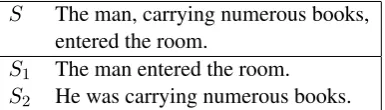
The task of text simplification aims to rewrite a sentence so as to reduce its complexity, while preserving its meaning and grammaticality. The rewriting may involve various aspects, includ-ing lexical simplification, syntactic simplification, content deletion, and content insertion for clarifi-cation. This paper focuses on syntactic simplifica-tion and, specifically, on splitting a complex sen-tence into two simpler sensen-tences.1 Consider the input sentenceS in Table 1, a complex sentence containing a participial phrase, “carrying numer-ous books”. After removing this phrase fromS, the system generatesS2from the phrase by turning
the participle “carrying” into the finite form “was carrying”, and by generating the pronoun “he” as the subject.
A number of systems can already perform this task (Chandrasekar et al.,1996;Siddharthan, ∗The second author completed this work as a Postdoctoral
Fellow at City University of Hong Kong.
1The simplified sentences can in turn be split iteratively.
S The man, carrying numerous books, entered the room.
S1 The man entered the room.
[image:1.595.309.502.222.277.2]S2 He was carrying numerous books.
Table 1: Example input (S) and output sentences (S1,S2) for the task of syntactic simplification.
2002a;Inui et al.,2003;Belder and Moens,2010;
Bott et al.,2012;Siddharthan and Angrosh,2014;
Saggion et al., 2015). While some systems have undergone task-based evaluations, such as reading comprehension (Angrosh et al.,2014), most have adopted holistic assessment, which commonly in-cludes human ratings on the grammaticality, flu-ency, meaning preservation, and simplicity of the system output (ˇStajner et al.,2016). These ratings are indeed helpful in indicating the overall quality of a system; however, the need for human inter-vention restricts the scale of the evaluations, and makes direct comparisons difficult. Other systems have been evaluated with automatic metrics, such as BLEU and readability metrics (Aluisio et al.,
2010;Narayan and Gardent, 2014), which over-come the limitations of human ratings, but do not reveal what aspects of the simplification process caused the most difficulties.
The contribution of this paper is two-fold. First, it presents the first publicly available dataset that facilitates detailed, automatic evaluation on syn-tactic simplification. Second, we report the results of a decision tree approach that incorporates parse features, giving a detailed analysis on its perfor-mance for various constructs.
2 Previous Work
The phrase-based and syntax-based machine translation approaches have been used in many text simplification systems (Vickrey and Koller,
Construct Complex sentence example Freq. Coordination I ate fishand he drank wine. 463
Peter cameand saw.
Adjectival clause Peter ate an apple,which was green. 119 Participial phrase Peter,running fast, arrived. 90 Appositive phrase Peter,my friend, ate the apple. 69 Subordination After Peter came, I left. 158
After calling Peter, I left.
Punctuation/Parataxis I ate fish;he drank wine. 155 Peter (twenty years old) is a linguistics major.
Prepositional phrase The final was played at Manchesteron 14 May 2008. 16
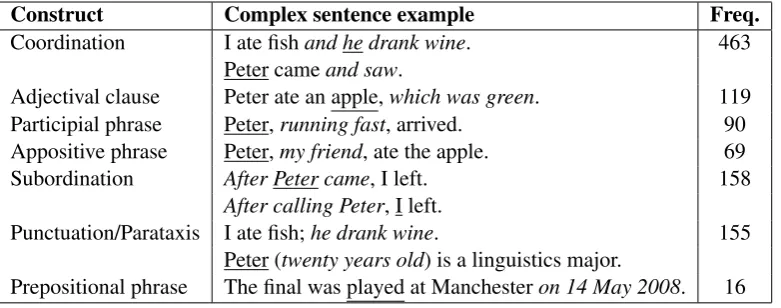
Table 2: Distribution of syntactic constructs in the test set (Section3). The complex sentence can be split into two simpler sentences by (i) removing the text span (italicized); and (ii) transforming the text span into a new sentence with the referent (underlined). This paper focuses on step (i).
2008;Zhu et al.,2010;Coster and Kauchak,2011;
Wubben et al., 2012). While these approaches are effective for lexical substitution and deletion, they are less so for sentence splitting, sentence re-ordering, and morphological changes (Bott et al.,
2012;Siddharthan,2014).
Most syntactic simplification systems start by analyzing the input sentence via a parse tree, or a deep semantic representation (Narayan and Gardent, 2014). For identifying the referent NP (clause attachment), accuracy can reach 95%; for identifying clause boundary, accuracy is at 97% when there is punctuation, and 80% in gen-eral (Siddharthan, 2002b). Noun post-modifiers can be extracted at an F-measure of 92% ( Dor-nescu et al.,2014;Stanovsky and Dagan,2016).
Given a syntactic analysis of the input sentence, the system then applies manually written trans-formation rules (Siddharthan, 2002a; Belder and Moens, 2010; Bott et al., 2012; Siddharthan and Angrosh,2014;Saggion et al.,2015). These rules identify specific constructs in a parse tree, such as the participial phrase in S in Table 1; they then determine whether the construct should be split, and if so, generate an independent sentence from it. For example, Alu´ısio et al. (2008) used a set of transformation rules to treat 22 syntac-tic constructs. Siddharthan (2011) used 63 rules, which handle coordination of both verb phrases and full clauses, subordination, apposition and relative clauses, as well as conversion of pas-sive voice to active voice. Siddharthan and An-gorsh (2014) used 26 hand-crafted rules for ap-position, relative clauses and combinations of the two; as well as 85 rules handle subordination and
coordination.
3 Data
Many evaluation datasets are available for lexi-cal simplification (Paetzold and Specia,2016), but there is not yet any that enables automatic evalu-ation on syntactic simplificevalu-ation systems. We cre-ated an annotcre-ated dataset for this purpose, based on the 167,689 pairs of “normal” and simplified sentences from Wikipedia and Simple Wikipedia aligned by Kauchak (2013). While a majority of these pairs are one-to-one alignments, 23,715 of them are one-to-two alignments.2 These aligned sentences, in their raw form, can serve as triplets ofS,S1andS2(Table1).
However, as pointed out by Xu et al. (2015), Wikipedia and Simple Wikipedia contain rather noisy data; indeed, upon manual inspection, not all triplets are good examples for syntactic sim-plification. These fall into two cases. In the first case, significant content fromSis deleted and ap-pear neither in S1 nor S2; these triplets provide
examples of content deletion rather than splitting. In the second case,S2 (orS1) consists mostly of
new content. In some instances, S1 (or S2) is so
similar toSthat no real splitting occurs. In others, the new content put into doubt whether the split-ting ofS was motivated by syntactic complexity alone, or were influenced by the new content. To reduce the noise, we employed human annotation to create the test set, and an automatic procedure to clean up the training set.
[image:2.595.106.497.62.216.2]<S><ref>The man</ref> <split type="participial">, carrying numerous books,</split>entered the room.</S>
<S1><ref1>The man</ref1>entered the room.</S1> <S2><ref2>He</ref2>was carrying numerous books.</S2>
Table 3: Each triplet in our corpus contains a complex sentence (S) and the two shorter sentences (S1,
S2) into which it was re-written.
3.1 Test set
An annotator marked up 1,070 triplets of (S, S1, S2) in the format shown in Table 3, with
the following items:3
Removed text span The<split>element en-closes the text span that is removed fromS. This text span usually, though not necessar-ily, appears inS1orS2.
Construct Type The type attribute inside the
<split> element indicates the construct
type of the removed text span. Table2gives a list of the construct types and their distribu-tion.
Re-ordering If the removed text span forms the basis ofS1(S2), thedestattribute inside the
<split>element takes the valueS1(S2). This attribute indicates whether sentence re-ordering has occurred.
Referent There are often referring expressions in S1 andS2 for an entity inS. For example,
in Table1, the words “the man” and “he” in S1andS2 refer to “the man” inS. These
re-ferring expressions are marked as<ref1> and<ref2>, and the entity inS is marked as<ref>.
3.2 Training set
The rest of the triplets form our training instances. To filter out instances that are not genuine splits (see above) and to determine the value ofdest, we require at least 75% of the words in either S1 orS2 to appear in S. To determine the value
oftype, we ran the baseline system (Section4), which is unsupervised and has relatively high re-call, onS. Thus, the training set has all the anno-tations in Table3, except for<ref>, <ref1> and<ref2>.
3The annotations on re-ordering and referent were not
used in this study, but will be useful for evaluation on sen-tence re-generation.
4 Approach
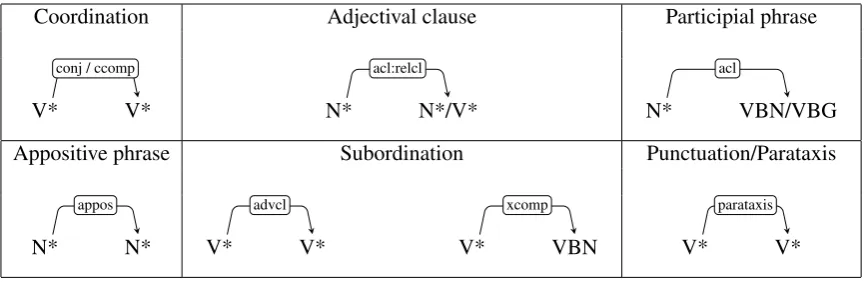
Baseline system. We manually developed tree pat-terns, in the form of dependency relations and POS tags, to identify text spans that should be removed from a complex sentence (Table 4). These pat-terns are designed to yield high recall but lower precision. The system parses the input sentence with the Stanford parser (Manning et al., 2014), and then performs breadth-first search on the de-pendency tree for these patterns, returning the first match it finds. This algorithm removes at most one text span from each complex sentence; this assumption is consistent with the material in our dataset, which was derived from one-to-two sen-tence alignments.
Proposed system. Even if one of the constructs in Table2is present in a complex sentence, it may not be appropriate or worthwhile to remove it. To refine the tree patterns developed for the baseline system, we trained a decision tree with the scikit-learn package. For each word in the sentence, the decision tree considers the features listed in Ta-ble5. If the decision tree predicts a split, the text span headed by the word is removed from the sen-tence.
5 Evaluation
We evaluate our system’s performance at identify-ing a text span, if any, in a complex sentence that should be removed to form an independent sen-tence.
As expected, the baseline system achieved rela-tively high recall (0.88) but low precision (0.34), since it always tries to split a text span that matches any of the tree patterns in Table4. The decision tree was able to substantially increase the precision (0.63) by learning some useful rules, at the expense of lower recall (0.72).
tak-Coordination Adjectival clause Participial phrase
V* V*
conj / ccomp
N* N*/V*
acl:relcl
N* VBN/VBG
acl
Appositive phrase Subordination Punctuation/Parataxis
N* N*
appos
V* V* V* VBN
advcl xcomp
V* V*
parataxis
Table 4: Manually crafted tree patterns, written in Stanford dependencies (Manning et al.,2014), that are used in the baseline system. If the pattern exists inS, the text span headed by the child word (e.g., VBN/VBG for participial phrases) is to be removed fromS.
Feature Description
POS Tag is JJ, N*, VBN, VBG, or V*?
Parent POS Tag of parent word is JJ, N*, VBN, VBG, or V*?
Root Parent word is root?
Sibling POS Tag of a sibling word is IN, TO, WP, WRB, WP$, or WDT? Child POS Tag of child word is IN, TO,
WP, WRB, WP$, or WDT? Comma There is a comma between the
[image:4.595.83.517.61.202.2]word and its parent word? Det Subject ofSis tagged DT? Length Number of words in text span
Table 5: Features used by the decision tree.
System→ Baseline Proposed
↓Construct P/R/F P/R/F
Coordination 0.31/0.84/0.45 0.61/0.80/0.69 Adjectival 0.29/0.97/0.45 0.59/0.79/0.68 clause
Participial 0.33/0.90/0.48 0.56/0.58/0.57 phrase
Appositive 0.21/0.91/0.34 0.36/0.56/0.44 phrase
Subordination 0.39/0.84/0.53 0.70/0.74/0.72 Punctuation/ 0.78/0.99/0.87 0.92/0.95/0.93 Parataxis
Overall 0.34/0.88/0.49 0.63/0.72/0.67
Table 6: Precision, recall and F-measure for iden-tifying the text span to be removed fromS.
ing the phrase “conducting at Montreux ...” out of the sentence “He began conducting at Mon-treux ...”. Another useful rule was that the par-ent word in theconjrelation must be root; other-wise, the structure is likely coordinated NPs rather than coordinated clauses. Further, when the mod-ifier is tagged as TO (i.e., an infinitive), or when the subject of the sentence is a determiner (e.g., “this”, “that”), no splitting should be done. Fi-nally, shorter text spans are less likely to be split up.
Among the different constructs, the proposed system performed best for punctuation/parataxis, with precision at 0.92 and recall at 0.95. This con-struct is not only clearly marked, but also more consistently split up. The most challenging con-struct turned out to be appositive phrases, with precision at 0.36 and recall at 0.56. Many of the errors trickled down from inaccurate analysis by the automatic parser, especially mistakes in rela-tive clause attachment and clause boundary iden-tification (Siddharthan and Angrosh,2014).
The precision figures can be viewed as lower bounds. In post-hoc analysis, we found that many of the proposed text spans by our system can be acceptable, but they were not deemed necessary to be split up by the editors of Simple Wikipedia. Ul-timately, the decision to split a complex sentence should be made in consideration of the reader’s proficiency, but our current dataset does not sup-port the modelling of this factor.
6 Conclusions and Future Work
[image:4.595.72.291.284.479.2]We trained a decision tree to learn to recognize these text spans, using dependencies, POS tags and text span length as features. Experimental results showed that it outperformed a parser-only baseline.
We have reported the most detailed evalua-tion to-date on this task. This evaluaevalua-tion was made possible with a new dataset, derived from Wikipedia and Simple Wikipedia, that covers co-ordinated clauses, subco-ordinated clauses, punc-tuation/parataxis, adjectival clauses, participial clauses, appositive phrases, and prepositional phrases.
In future work, we plan to investigate the next steps in syntactic simplification, i.e., sentence re-ordering and the generation of referring expres-sions. Our dataset, which traces sentence order and annotates referring expressions, is well suited for automatic evaluation for these tasks.
Acknowledgments
This work was partially supported by the Innova-tion and Technology Fund (Ref: ITS/132/15) of the Innovation and Technology Commission, the Government of the Hong Kong Special Adminis-trative Region.
References
Sandra Aluisio, Lucia Specia, Caroline Gasperin, and Carolina Scarton. 2010. Readability Assessment for Text Simplification. InProc. 5th Workshop on Inno-vative Use of NLP for Building Educational Appli-cations. pages 1–9.
Sandra Alu´ısio, Lucia Specia, T. A. Pardo, E. G. Maziero, and R. P. Fortes. 2008. Towards Brazilian Portuguese Automatic Text Simplification Systems. In Proc. 8th ACM Symposium on Document Engi-neering.
M. A. Angrosh, Tadashi Nomoto, and Advaith Sid-dharthan. 2014. Lexico-syntactic text simplification and compression with typed dependencies. InProc. COLING.
J. De Belder and M. F. Moens. 2010. Text Simplifi-cation for Children. In Proc. SIGIR Workshop on Accessible Search Systems.
Stefan Bott, Horacio Saggion, and David Figueroa. 2012. A Hybrid System for Spanish Text Simplifi-cation. InProc.Workshop on Speech and Language Processing for Assistive Technologies.
R. Chandrasekar, Christine Doran, and B. Srinivas. 1996. Motivations and Methods for Text Simplifi-cation. InProc. COLING.
William Coster and David Kauchak. 2011. Learning to Simplify Sentences using Wikipedia. InProc. Work-shop on Monolingual Text-to-Text Generation. Iustin Dornescu, Richard Evans, and Constantin
Orˇasan. 2014. Relative Clause Extraction for Syn-tactic Simplification. In Proc. Workshop on Auto-matic Text Simplification: Methods and Applications in the Multilingual Society. Dublin, Ireland. Kentaro Inui, Atsushi Fujita, Tetsuro Takahashi, Ryu
Iida, and Tomoya Iwakura. 2003. Text Simplifica-tion for Reading Assistance: A Project Note. In
Proc. 2nd International Workshop on Paraphrasing. David Kauchak. 2013. Improving Text Simplification Language Modeling using Unsimplified Text Data. InProc. ACL.
Christopher D. Manning, Mihai Surdeanu, John Bauer, Jenny Finkel, Steven J. Bethard, and David Mc-Closky. 2014. The Stanford CoreNLP Natural Lan-guage Processing Toolkit. In Proc. ACL System Demonstrations. pages 55–60.
Shashi Narayan and Claire Gardent. 2014. Hybrid Simplification using Deep Semantics and Machine Translation. InProc. ACL.
Gustavo H. Paetzold and Lucia Specia. 2016. Bench-marking Lexical Simplification Systems. In Proc. LREC.
Horacio Saggion, Sanja ˇStajner, Stefan Bott, Simon Mille, Luz Rello, and Biljana Drndarevic. 2015. Making It Simplext: Implementation and Evaluation of a Text Simplification System for Spanish. ACM Transactions on Accessible Computing (TACCESS)
6(4).
Advaith Siddharthan. 2002a. An Architecture for a Text Simplification System. InProc. Language En-gineering Conference (LEC).
Advaith Siddharthan. 2002b. Resolving attachment and clause boundary ambiguities for simplifying rel-ative clause constructs. In Proc.Student Workshop, ACL.
Advaith Siddharthan. 2011. Text Simplification us-ing Typed Dependencies: A Comparison of the Robustness of Different Generation Strategies. In
Proc. 13th European Workshop on Natural Lan-guage Generation.
Advaith Siddharthan. 2014. A Survey of Research on Text Simplification. International Journal of Ap-plied Linguistics165(2):259–298.
Advaith Siddharthan and M. A. Angrosh. 2014. Hy-brid Text Simplification using Synchronous Depen-dency Grammars with Hand-written and Automati-cally Harvested Rules. InProc. EACL.
David Vickrey and Daphne Koller. 2008. Sentence Simplification for Semantic Role Labeling. InProc. ACL.
Sanja ˇStajner, Maja Popovi´c, Horacio Saggion, Lu-cia SpeLu-cia, and Mark Fishel. 2016. Shared task on quality assessment for text simplification. InProc. LREC.
Sander Wubben, Antal van den Bosch, and Emiel Krahmer. 2012. Sentence Simplification by Mono-lingual Machine Translation. InProc. ACL. Wei Xu, Chris Callison-Burch, and Courtney Napoles.