Modelling User Satisfaction and Student Learning in a Spoken Dialogue
Tutoring System with Generic, Tutoring, and User Affect Parameters
Kate Forbes-Riley
Learning Research & Development Ctr University of Pittsburgh
Pittsburgh, PA 15260
Diane J. Litman
Learning Research & Development Ctr Dept. of Computer Science
University of Pittsburgh Pittsburgh, PA 15260
Abstract
We investigate using the PARADISE framework to develop predictive models of system performance in our spoken di-alogue tutoring system. We represent per-formance with two metrics: user satis-faction and student learning. We train and test predictive models of these met-rics in our tutoring system corpora. We predict user satisfaction with 2 parameter types: 1) system-generic, and 2) tutoring-specific. To predict student learning, we also use a third type: 3) user affect. Al-hough generic parameters are useful pre-dictors of user satisfaction in other PAR-ADISE applications, overall our parame-ters produce less useful user satisfaction models in our system. However, generic and tutoring-specific parameters do pro-duce useful models of student learning in our system. User affect parameters can in-crease the usefulness of these models.
1 Introduction
In recent years the development ofspoken dialogue tutoring systems has become more prevalent, in an attempt to close the performance gap between hu-man and computer tutors (Mostow and Aist, 2001; Pon-Barry et al., 2004; Litman et al., 2006).Student learningis a primary metric for evaluating the per-formance of these systems; it can be measured, e.g., by comparing student pretests taken prior to system use with posttests taken after system use.
In other types of spoken dialogue systems, the user’s subjective judgments about using the system are often considered a primary system performance metric; e.g., user satisfaction has been measured via surveys which ask users to rate systems during use along dimensions such as task ease, speech in-put/output quality, user expectations and expertise, and user future use (M¨oller, 2005b; Walker et al., 2002; Bonneau-Maynard et al., 2000; Walker et al., 2000; Shriberg et al., 1992). However, it is expen-sive to run experiments over large numbers of users to obtain reliable system performance measures.
The PARADISE model (Walker et al., 1997) pro-poses instead topredict system performance, using parameters representing interaction costs and bene-fits between system and user, including task success, dialogue efficiency, and dialogue quality. More for-mally, a set of interaction parameters are measured in a spoken dialogue system corpus, then used in a multivariate linear regression to predict the target performance variable. The resulting model is de-scribed by the formula below, where there aren in-teraction parameters,pi, each weighted by the
anal-ysis with a coefficient, wi, which will be negative
or positive, depending on whether the model treats pi as a cost or benefit, respectively. The model can
then be used to estimate performance during system design, with the design goals of minimizing costs and maximizing benefits.
System Performance=Pni=1wi* pi
We investigate using PARADISE to develop pre-dictive models of performance in our spoken dia-logue tutoring system. Although to our knowledge,
Corpus Date Voice #Dialogues #Students #with Survey #with Tests #with Affect
SYN03 2003 synthesized 100 20 0 20 20
PR05 2005 pre-recorded 140 28 28 28 17
[image:2.612.110.507.62.104.2]SYN05 2005 synthesized 145 29 29 29 0
Table 1: Summary of our 3 ITSPOKE Corpora
prior PARADISE applications have only used user satisfaction to represent performance, we hypothe-size that other metrics may be more relevant when PARADISE is applied to tasks that are not optimized for user satisfaction, such as our spoken dialogue tu-toring system. We thus use 2 metrics to represent performance: 1) a generic metric of user satisfaction computed via user survey, 2) a tutoring-specific met-ric of student learning computed via student pretest and posttest scores. We train and test predictive models of these metrics on multiple system corpora. To predict user satisfaction, we use 2 types of in-teraction parameters: 1) system-generic parameters such as used in other PARADISE applications, e.g. speech recognition performance, and 2) tutoring-specific parameters, e.g. student correctness. To predict student learning, we also use a third type of parameter: 3) manually annotated user affect. Al-though prior PARADISE applications have tended to use system-generic parameters, we hypothesize that task-specific and user affect parameters may also prove useful. We emphasize that user affect parame-ters are still system-generic; user affect has been an-notated and/or automatically predicted in other types of spoken dialogue systems, e.g. as in (Lee et al., 2002; Ang et al., 2002; Batliner et al., 2003).
Our results show that, although generic param-eters were useful predictors of user satisfaction in other PARADISE applications, overall our parame-ters produce less useful user satisfaction models in our tutoring system. However, generic and tutoring-specific parameters do produce useful models of stu-dent learning in our system. Generic user affect pa-rameters increase the usefulness of these models.
2 Spoken Dialogue Tutoring Corpora
ITSPOKE (Intelligent TutoringSPOKEn dialogue
system) (Litman et al., 2006) is aspeech-enabled tu-tor built on top of the text-based Why2-Atlas con-ceptual physics tutor (VanLehn et al., 2002). In ITSPOKE, a student first types an essay into a
web-based interface answering a qualitative physics problem. ITSPOKE then analyzes the essay and en-gages the student in spoken dialogue to correct mis-conceptions and elicit more complete explanations. Student speech is digitized from the microphone in-put and sent to the Sphinx2 recognizer. Sphinx2’s most probable “transcription” is then sent to Why2-Atlas for syntactic, semantic and dialogue analy-sis. Finally, the text response produced by Why2-Atlas is converted to speech as described below, then played in the student’s headphones and displayed on the interface. After the dialogue, the student revises the essay, thereby ending the tutoring or causing an-other round of tutoring/essay revision.
For this study, we used 3 ITSPOKE corpora, shown in Table 1.1 The SYN03 corpus was
col-lected in 2003 for an evaluation comparing
learn-ing in typed and spoken human and computer tu-toring (Litman et al., 2006). ITSPOKE’s voice was
synthesized with the Cepstral text-to-speech system,
and its speech recognizer was trained from pilot IT-SPOKE studies and Why2-Atlas evaluations. The
PR05and SYN05corpora were collected in 2005,
to evaluate the impact of tutor voice quality (Forbes-Riley et al., 2006). For these 2 corpora, ITSPOKE used an updated speech recognizer further trained on theSYN03 corpus. For theSYN05 corpus,
IT-SPOKE used the synthesized tutor voice from the SYN03 corpus; for the PR05 corpus, ITSPOKE
used a pre-recorded tutor voice from a paid voice
talent. Figure 1 gives an annotated (Section 3)PR05
excerpt (ASRshows what ITSPOKE heard).
The same experimental procedure was used to collect all 3 ITSPOKE corpora: college students who had taken no college physics: 1) read a small document of background material, 2) took a pretest measuring initial physics knowledge, 3) work through a set of 5 problems (dialogues) with ITSPOKE, 4) took a posttest similar to the pretest.
Subjects in the PR05 and SYN05 corpora also
completed a survey probing user satisfaction after taking the posttest (SYN03corpus subjects did not).
Our survey, shown in Figure 2, is essentially the same as the one used in the DARPA Communicator multi-site evaluation (Walker et al., 2002). Although tailored lexically for a tutoring system, these state-ments are generally applicable to spoken dialogue systems. Students rated their degree of agreement with each statement on a scale of 1 to 5.
PHYSICS PROBLEM: Suppose a lightweight car and a
mas-sive truck hit a patch of frictionless ice and have a head-on col-lision. Upon which vehicle is the impact force greater? Which vehicle undergoes the greater change in its motion? Defend your answers.
ESSAY UNDER DISCUSSION:The truck exerts an equal and
opposite reaction force on the car. The car has a greater accel-eration. The car will have a greater change in its motion. . . .excerpt at 28.8 minutes into dialogue. . .
TUTOR60: So, when you add forces together, besides the
mag-nitudes of the forces, what must you also consider?
STUDENT57: direct- direction (ASR:the truck in direction)
[correct, uncertain, non-frustrated/angry]
TUTOR61: Yes. [...] The vector sum of the forces acting on
the body is also equal to the mass of the body multiplied by its acceleration. What is another term for the vector sum of forces acting on a body?
STUDENT58: net force (ASR: net force) [correct, neutral,
non-frustrated/angry]
TUTOR62: That’s super. Another term for the resultant force
is the net force. In this relationship, what is the direction of the net force applied to a body and the direction of the body’s acceleration?
STUDENT59: same same same (ASR: seems same type
seems)[correct, certain, frustrated/angry]
Figure 1: AnnotatedPR05Corpus Excerpt
Task Ease:It was easy to learn from the tutor. TTS Performance:It was easy to understand the tutor. User Expertise:I knew what I could say or do at each point in
the conversations with the tutor.
Expected Behavior:The tutor worked the way I expected it to. Future Use: Based on my experience using the tutor to learn
physics, I would like to use such a tutor regularly.
ALMOST ALWAYS (5), OFTEN (4), SOMETIMES (3), RARELY (2), ALMOST NEVER (1)
Figure 2: ITSPOKE Survey Questionnaire
3 Interaction Parameters
3.1 Dialogue System-Generic Parameters
Prior PARADISE applications predicted user satis-faction using a wide range of system-generic
param-eters, which include measures of speech recognition quality (e.g. word error rate), measures of dialogue communication and efficiency (e.g. total turns and elapsed time), and measures of task completion (e.g. a binary representation of whether the task was com-pleted) (M¨oller, 2005a; M¨oller, 2005b; Walker et al., 2002; Bonneau-Maynard et al., 2000; Walker et al., 2000; Walker et al., 1997). In this prior work, each dialogue between user and system represents a sin-gle “task” (e.g., booking airline travel), thus these measures are calculated on a per-dialogue basis.
In our work, the entire tutoring session represents a single “task”, and every student in our corpora completed this task. Thus we extract 13 system-generic parameters on a per-student basis, i.e. over the 5 dialogues for each user, yielding a single pa-rameter value for each student in our 3 corpora.
First, we extracted 9 parameters representing dia-logue communication and efficiency. Of these pa-rameters, 7 were used in prior PARADISE appli-cations: Time on Task, Total ITSPOKE Turns and Words, Total User Turns and Words, Average IT-SPOKE Words/Turn, and Average User Words/Turn. Our 2 additional “communication-related” (M¨oller, 2005a) parameters measure system-user interactiv-ity, but were not used in prior work (to our knowl-edge): Ratio of User Words to ITSPOKE Words, Ra-tio of User Turns to ITSPOKE Turns.
Second, we extracted 4 parameters representing speech recognition quality, which have also been used in prior work: Word Error Rate, Concept Ac-curacy, Total Timeouts, Total Rejections2.
3.2 Tutoring-Specific Parameters
Although prior PARADISE applications tend to use system-generic parameters, we hypothesize that task-specific parameters may also prove useful for predicting performance. We extract 12 tutoring-specificparameters over the 5 dialogues for each stu-dent, yielding a single parameter value per stustu-dent, for each student in our 3 corpora. Although these pa-rameters are specific to our tutoring system, similar parameters are available in other tutoring systems.
First, we hypothesize that the correctness of the students’ turns with respect to the tutoring topic
(physics, in our case) may play a role in predicting system performance. Each of our student turns is automatically labeled with 1 of 3 “Correctness” la-bels by the ITSPOKE semantic understanding com-ponent: Correct, Incorrect, Partially Correct. La-beled examples are shown in Figure 1. From these 3 Correctness labels, we derive 9 parameters: a To-tal and a Percent for each label, and a Ratio of each label to every other label (e.g. Correct/Incorrect).
Second, students write and then may modify their physics essay at least once during each dialogue with ITSPOKE. We thus hypothesize that like “Correct-ness”, the total number of essays per student may play a role in predicting system performance.
Finally, although student test scores before/after using ITSPOKE will be used as our student learning metric, we hypothesize that these scores may also play a role in predicting user satisfaction.
3.3 User Affect Parameters
We hypothesize that user affect plays a role in pre-dicting user satisfaction and student learning. Al-though affect parameters have not been used in other PARADISE studies (to our knowledge), they are generic; for example, in various spoken dialogue systems, user affect has been annotated and automat-ically predicted from e.g., acoustic-prosodic and lex-ical features (Litman and Forbes-Riley, 2004b; Lee et al., 2002; Ang et al., 2002; Batliner et al., 2003).
As part of a larger investigation into emotion adaptation, we are manually annotating the stu-dent turns in our corpora for affective state. Cur-rently, we are labeling 1 of 4 states of “Certain-ness”: certain, uncertain, neutral, mixed (certain and uncertain), and we are separately labeling 1 of 2 states of “Frustration/Anger”: frustrated/angry, non-frustrated/angry. These affective states3 were
found in pilot studies to be most prevalent in our tu-toring dialogues4, and are also of interest in other
dialogue research, e.g. tutoring (Bhatt et al., 2004; Moore et al., 2004; Pon-Barry et al., 2004) and spo-ken dialogue (Ang et al., 2002). Labeled examples are shown in Figure 1.5 To date, one paid annotator
3We use “affect” and “affective state” loosely to cover stu-dent emotions and attitudes believed to be relevant for tutoring. 4For a full list of affective states identified in these pilot stud-ies, see (Litman and Forbes-Riley, 2004a).
5Annotations were performed from both audio and
tran-has labeled all student turns in ourSYN03 corpus,
and all the turns of 17 students in ourPR05corpus.6
From these labels, we derived 25User Affect
pa-rameters per student, over the 5 dialogues for that student. First, for each Certainness label, we com-puted a Total, a Percent, and a Ratio to each other la-bel. We also computed a Total for eachsequenceof identical Certainness labels (e.g. Certain:Certain), hypothesizing that states maintained over multiple turns may have more impact on performance than single occurrences. Second, we computed the same parameters for each Frustration/Anger label.
4 Prediction Models
In this section, we first investigate the usefulness of our system-generic and tutoring-specific parameters for training models of user satisfaction and student learning in our tutoring corpora with the PARADISE framework. We use the SPSS statistical package with a stepwise multivariate linear regression pro-cedure7to automatically determine parameter
inclu-sion in the model. We then investigate how well these models generalize across different user-system configurations, by testing the models in different corpora and corpus subsets. Finally, we investigate whether generic user affect parameters increase the usefulness of our student learning models.
4.1 Prediction Models of User Satisfaction
Only subjects in thePR05andSYN05corpora
com-pleted a user survey (Table 1). Each student’s re-sponses were summed to yield a single user satis-faction total per student, ranging from 9 to 24 across corpora (the possible range is 5 to 25), with no dif-ference between corpora (p = .46). This total was used as our user satisfaction metric, as in (M¨oller, 2005b; Walker et al., 2002; Walker et al., 2000).8
scription within a speech processing tool.
6In a preliminary agreement study, a second annotator la-beled the entireSYN03corpus foruncertainversusother,
yield-ing 90% inter-annotator agreement (0.68 Kappa).
7At each step, the parameter with the highest partial correla-tion with the target predicted variable, controlled for all previ-ously entered parameters, is entered in the equation, until the re-maining parameters do not increase R2
by a significant amount or do not yield a significant model.
8Researchers have also used average score (M¨oller, 2005b; Walker et al., 1997); single survey statements can also be used (Walker et al., 1997). We tried these variations, and our R2
Training Data R2
Predictors Testing Data R2
PR05 .274 INCORRECTS, ESSAYS SYN05 .001
SYN05 .068 TUT WDS/TRN PR05 .018
PR05:half1 .335 PARTCORS/INCORS PR05:half2 .137
PR05:half2 .443 STU TRNS PR05:half1 .079
SYN05:half1 .455 STU TRNS/TUT TRNS SYN05:half2 .051
[image:5.612.121.493.58.140.2]SYN05:half2 .685 TUT WDS/TRN, STU WDS/TRN, CORRECTS SYN05:half1 .227
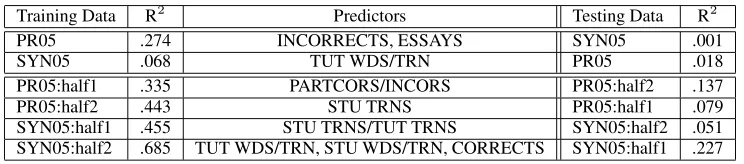
Table 2: Testing the Predictive Power of User Satisfaction Models
We trained a user satisfaction model on each cor-pus, then tested it on the other corpus. In addition, we split each corpus in half randomly, then trained a user satisfaction model on each half, and tested it on the other half. We hypothesized that despite the decrease in the dataset size, models trained and tested in the same corpus would have higher gen-eralizability than models trained on one corpus and tested on the other, due to the increased data homo-geneity within each corpus, since each corpus used a different ITSPOKE version. As predictors, we used only the 13 system-generic and 12 tutoring-specific parameters that were available for all subjects.
Results are shown in Table 2. The first and fourth columns show the training and test data, respec-tively. The second and fifth columns show the user satisfaction variance accounted for by the trained model in the training and test data, respectively. The third column shows the parameters that were se-lected as predictors of user satisfaction in the trained model, ordered by degree of contribution9.
For example, as shown in the first row, the model trained on thePR05corpus uses Total Incorrect
stu-dent turns as the strongest predictor of user satis-faction, followed by Total Essays; these parameters are not highly correlated10. This model accounts for
27.4% of the user satisfaction variance in thePR05
corpus. When tested on the SYN05corpus, it
ac-counts for 0.1% of the user satisfaction variance. The low R2 values for both training and testing in the first two rows show that neither corpus yields
9The ordering reflects the standardized coefficients (beta weights), which are computed in SPSS based on scaling of the input parameters, to enable an assessment of the predictive power of each parameter relative to the others in a model.
10Hereafter, predictors in a model are not highly correlated (R≥.70) unless noted. Linear regression does not assume that
predictors are independent, only that they are not highly corre-lated. Because correlations above R =.70 can affect the coeffi-cients, deletion of redundant predictors may be advisable.
a very powerful model of user satisfaction even in the training corpus, and this model does not gener-alize very well to the test corpus. As hypothesized, training and testing in a single corpus yields higher R2values for testing, as shown in the last four rows, although these models still account for less than a quarter of the variance in the test data. The increased R2values for training here may indicate over-fitting. Across all 6 experiments, there is almost no overlap of parameters used to predict user satisfaction.
Overall, these results show that this method of developing an ITSPOKE user satisfaction model is very sensitive to changes in training data; this was also found in other PARADISE applica-tions (M¨oller, 2005b; Walker et al., 2000). Some applications have also reported similarly low R2 val-ues fortestingboth within a corpus (M¨oller, 2005b) and also when a model trained on one system cor-pus is tested on another system corcor-pus (Walker et al., 2000). However, most PARADISE applications have yielded higher R2 values than ours for train-ing(M¨oller, 2005b; Walker et al., 2002; Bonneau-Maynard et al., 2000; Walker et al., 2000).
Training Data R2
Predictors Testing Data R2
PR05 .556 PRE, %CORRECT SYN05 .636
SYN05 .736 PRE, INCORS/CORS, STU WDS/TRN PR05 .472
PR05:half1 .840 PRE, PARTCORRECTS PR05:half2 .128
PR05:half2 .575 PARTCORS/INCORS, PRE PR05:half1 .485
SYN05:half1 .580 PRE, STU WDS/TRN SYN05:half2 .556
SYN05:half2 .855 PRE, TIMEOUTS SYN05:half1 .384
PR05+SYN03 .413 PRE, TIME SYN05 .586
PR05+SYN05 .621 PRE, INCORS/CORS SYN03 .237
SYN05+SYN03 .590 INCORS/CORS, PR05 .244
[image:6.612.133.481.58.183.2]%INCORRECT, PRE, TIME
Table 3: Testing the Predictive Power of Student Learning Models with the Same Datasets
or have an opposite relationship) (Pon-Barry et al., 2004). In fact, it may be that user satisfaction is not a metric of primary relevance in our application.
4.2 Prediction Models of Student Learning
As in other tutoring research, e.g. (Chi et al., 2001; Litman et al., 2006), we use posttest score (POST) controlled for pretest score (PRE) as our target stu-dent learning prediction metric, such that POST is our target variable and PRE is always a parameter in the final model, although it is not necessarily the strongest predictor.11 In this way, we measure
stu-dent learninggains, not just final test score.
As shown in Table 1, all subjects in our 3 corpora took the pretest and posttest. However, in order to compare our student learning models with our user satisfaction models, our first experiments predicting student learning used the same training and testing datasets that were used to predict user satisfaction in Section 4.1 (i.e. we ran the same experiments except we predicted POST controlled for PRE instead of user satisfaction). Results are shown in the first 6 rows of Table 3.
As shown, these 6 models all account for more than 50% of the POST variance in the training data. Furthermore, most of them account for close to, or more than, 50% of the POST variance in the test data. Although again we hypothesized that training and testing in one corpus would yield higher R2 val-ues for testing, this is not consistently the case; two of these models had the highest R2values for
train-11In SPSS, we regress two independent variable blocks. The first block contains PRE, which is regressed with POST using the “enter” method, forcing inclusion of PRE in the final model. The second block contains all remaining independent variables, which are regressed using the stepwise method.
ing and the lowest R2values for testing (PR05:half1 andSYN05:half2), suggesting over-fitting.
Overall, these results show that this is an effec-tive method of developing a prediction model of stu-dent learning for ITSPOKE, and is less sensitive to changes in training data than it was for user satis-faction. Moreover, there is more overlap in these 6 models of parameters that are useful for predict-ing student learnpredict-ing (besides PRE); “Correctness” parameters and dialogue communication and effi-ciency parameters appear to be most useful overall.
Our next 3 experiments investigated how our stu-dent learning models are impacted by including our third SYN03 corpus. Using the same 25
parame-ters, we trained a learning model on each set of two combined corpora, then tested it on the other corpus. Results are shown in the last 3 rows of Table 3.
As shown, these models still account for close to, or more than, 50% of the student learning vari-ance in the training data.12 The model trained
on PR05+SYN03 accounts for the most student
learning variance in the test data, showing that the training data that is most similar to the test data will yield the highest generalizability. That is, the combined PR05+SYN03corpora contains
sub-jects drawn from the same subject pool (2005) as the SYN05 test data, and also contains subjects
who interacted with the same tutor voice (synthe-sized) as this test data. In contrast, the combined
PR05+SYN05corpora did not overlap in user
pop-ulation with theSYN03test data, and the combined SYN05+SYN03corpora did not share a tutor voice
with thePR05 test data. “Correctness” parameters
Training Data R2
Predictors Testing Data R2
SYN03 (affect) .644 TIME, PRE, NEUTRAL PR05:17 .411
PR05:17 (affect) .835 PRE, NFA:NFA, STU WDS/TRN SYN03 .127
SYN03 .478 PRE, TIME PR05:17 .340
[image:7.612.145.472.58.118.2]PR05:17 .609 PRE, STU TRNS/TUT TRNS SYN03 .164
Table 4: Testing the Predictive Power of Student Learning Models with User Affect Parameters
and dialogue communication and efficiency param-eters are consistently used as predictors in all 9 of these student learning models.
4.3 Adding User Affect Parameters
Our final experiments investigated whether our 25 user affect parameters impacted the usefulness of the student learning models. As shown in Table 1, all 20 subjects in ourSYN03corpus were annotated
for user affect, and 17 subjects in ourPR05corpus
were annotated for user affect. We trained a model of student learning on each of these datasets, then tested it on the other dataset.13 As predictors, we
included our 25 user affect parameters along with the 13 system-generic and 12 tutoring-specific inter-action parameters. These results are shown in the first two rows of Table 4. We also reran these ex-periments without user affect parameters, to gauge the impact of the user affect parameters. These re-sults are shown in the last two rows of Table 4. We hypothesized that user affect parameters would pro-duce more useful models, because prior tutoring re-search has shown correlations between user affect and student learning (e.g. (Craig et al., 2004)).
As shown in the first two rows, user affect predic-tors appear in both models where these parameters were included. The models trained onSYN03 use
pretest score and Total Time on Task as predictors; when affect parameters are included, “Neutral Cer-tainness” is added as a predictor, which increases the R2 values for both training and testing. However, the two models trained onPR05:17show no
predic-tor overlap (besides PRE). Moreover, the PR05:17
model that includes an affect predictor (Total Se-quence of 2 Non-Frustrated/Angry turns) has the highest training R2, but the lowest testing R2 value.
13As only 17 subjects have both user affect annotation and user surveys, there is not enough data currently to train and test a user satisfaction model including user affect parameters.
5 Conclusions and Current Directions
Prior work in the tutoring community has focused on correlations of single features with learning; our re-sults suggest that PARADISE is an effective method of extending these analyses. For the dialogue com-munity, our results suggest that as spoken dialogue systems move into new applications not optimized for user satisfaction, such as tutoring systems, other measures of performance may be more relevant, and generic user affect parameters may be useful.
Our experiments used many of the same system-generic parameters as prior studies, and some of these parameters predicted user satisfaction both in our models and in prior studies’ models (e.g., sys-tem words/turn (Walker et al., 2002)). Nonetheless, overall our user satisfaction models were not very powerful even for training, were sensitive to training data changes, showed little predictor overlap, and did not generalize well to test data. Our user sat-isfaction metric may not be fine-grained enough; in other PARADISE studies, users took a survey after everydialogue with the system. In addition, tutoring systems are not designed to maximize user satisfac-tion; their goal is to maximize student learning.
Our student learning models were much more powerful and less sensitive to changes in training data. Our best models explained over 50% of the stu-dent learning variance for training and testing, and both student “Correctness” parameters and dialogue communication and efficiency parameters were of-ten useful predictors. User affect parameters further improved the predictive power of one student learn-ing model for both trainlearn-ing and testlearn-ing.
sys-tem. However, as in (Batliner et al., 2003), our prior work suggests that linguistic features reflective of af-fective states can replace affect annotation (Forbes-Riley and Litman, 2005). In future work we will use such features in our prediction models. Finally, we are also annotating tutor and student dialogue acts and automating the tutor act annotations; when com-plete we can investigate their usefulness in our pre-diction models; dialogue acts have also been used in prior PARADISE applications (M¨oller, 2005a).
Acknowledgements
NSF (0325034 & 0328431) supports this research. We thank Pam Jordan and the NLP Group.
References
J. Ang, R. Dhillon, A. Krupski, E.Shriberg, and A. Stol-cke. 2002. Prosody-based automatic detection of an-noyance and frustration in human-computer dialog. In
Proc. Int. Conf. Spoken Language Processing (ICSLP).
A. Batliner, K. Fischer, R. Huber, J. Spilker, and E. Noth. 2003. How to find trouble in communication. Speech Communication, 40:117–143.
K. Bhatt, M. Evens, and S. Argamon. 2004. Hedged re-sponses and expressions of affect in human/human and human/computer tutorial interactions. InProc. 26th Annual Meeting of the Cognitive Science Society.
H. Bonneau-Maynard, L. Devillers, and S. Rosset. 2000. Predictive performance of dialog systems. In Proc. Language Resources and Evaluation Conf. (LREC)).
M. T. H. Chi, S. A. Siler, H. Jeong, T. Yamauchi, and R. G. Hausmann. 2001. Learning from human tutor-ing. Cognitive Science, 25:471–533.
S. Craig, A. Graesser, J. Sullins, and B. Gholson. 2004. Affect and learning: An exploratory look into the role of affect in learning. Journal of Educational Media,
29:241–250.
K. Forbes-Riley and D. Litman. 2005. Correlating stu-dent acoustic-prosodic profiles with stustu-dent learning in spoken tutoring dialogues. InProc. INTERSPEECH.
K. Forbes-Riley, D. Litman, S. Silliman, and J. Tetreault. 2006. Comparing synthesized versus pre-recorded tu-tor speech in an intelligent tutu-toring spoken dialogue system. InProc. FLAIRS.
C.M. Lee, S. Narayanan, and R. Pieraccini. 2002. Com-bining acoustic and language information for emotion recognition. InProc. ICSLP.
D. Litman and K. Forbes-Riley. 2004a. Annotating stu-dent emotional states in spoken tutoring dialogues. In
Proc. SIGdial, pages 144–153.
D. Litman and K. Forbes-Riley. 2004b. Predicting stu-dent emotions in computer-human tutoring dialogues. InProc. ACL, pages 352–359.
D. Litman, C. Ros´e, K. Forbes-Riley, K. VanLehn, D. Bhembe, and S. Silliman. 2006. Spoken versus typed human and computer dialogue tutoring. Intnl Jnl of Artificial Intelligence in Education, To Appear.
S. M¨oller. 2005a. Parameters for quantifying the inter-actioin with spoken dialogue telephone services. In
Proc. SIGdial.
S. M¨oller. 2005b. Towards generic quality prediction models for spoken dialogue systems - a case study. In
Proc. INTERSPEECH.
J. D. Moore, K. Porayska-Pomsta, S. Varges, and C. Zinn. 2004. Generating tutorial feedback with affect. In
Proc. FLAIRS.
J. Mostow and G. Aist. 2001. Evaluating tutors that lis-ten: An overview of Project LISTEN. In K. Forbus and P. Feltovich, editors, Smart Machines in Educa-tion.
H. Pon-Barry, B. Clark, E. Owen Bratt, K. Schultz, and S. Peters. 2004. Evaluating the effectiveness of SCoT: a Spoken Conversational Tutor. InProc. of ITS 2004 Workshop on Dialogue-based Intelligent Tutoring Sys-tems: State of the Art and New Research Directions.
E. Shriberg, E. Wade, and P. Price. 1992. Human-machine problem solving using spoken language sys-tems (SLS): Factors affecting performance and user satisfaction. InProc. DARPA Speech and NL Work-shop, pages 49–54.
K. VanLehn, P. W. Jordan, C. P. Ros´e, D. Bhembe, M. B¨ottner, A. Gaydos, M. Makatchev, U. Pap-puswamy, M. Ringenberg, A. Roque, S. Siler, R. Sri-vastava, and R. Wilson. 2002. The architecture of Why2-Atlas: A coach for qualitative physics essay writing. InProc. Intelligent Tutoring Systems.
M. Walker, , D. Litman, C. Kamm, and A. Abella. 1997. PARADISE: A framework for evaluating spoken dia-logue agents. InProc. ACL/EACL, pages 271–280.
M. Walker, C. Kamm, and D. Litman. 2000. Towards de-veloping general models of usability with PARADISE.
Natural Language Engineering, 6:363–377.