COGEX: A Logic Prover for Question Answering
Dan Moldovan, Christine Clark, Sanda Harabagiu
Language Computer Corporation
Richardson, Texas 75080
[email protected]
Steve Maiorano
ATP
Washington, DC 20505
Abstract
Recent TREC results have demonstrated the need for deeper text understanding methods. This paper introduces the idea of automated reasoning applied to question answering and shows the feasibility of integrating a logic prover into a Question Answering system. The approach is to transform questions and answer passages into logic representations. World knowledge axioms as well as linguistic ax-ioms are supplied to the prover which renders a deep understanding of the relationship be-tween question text and answer text. Moreover, the trace of the proofs provide answer justifica-tions. The results show that the prover boosts the performance of the QA system on TREC questions by 30%.
1
Introduction
Motivation
In spite of significant advances made recently in the Question Answering technology, there still remain many problems to be solved. Some of these are: bridging the gap between question and answer words, pinpointing ex-act answers, taking into consideration syntex-actic and se-mantic roles of words, better answer ranking, answer jus-tification, and others. The recent TREC results (Voorhees 2002) have demonstrated that many performing systems reached a plateau; the systems ranked from 4th to 14th answered correctly between 38.4% to 24.8% of the total number of questions. It is clear that new ideas based on a deeper language understanding are necessary to push further the QA technology.
In this paper we introduce one such novel idea, the use of automated reasoning in QA, and show that it is fea-sible, effective, and scalable. We have implemented a Logic Prover, called COGEX (from the permutation of
the first two syllables of the verb excogitate) which uni-formly codifies the question and answer text, as well as world knowledge resources, in order to use its inference engine to verify and extract any lexical relationships be-tween the question and its candidate answers.
Usefulness of a Logic Prover in QA
COGEX captures the syntax-based relationships such as the syntactic objects, syntactic subjects, prepositional at-tachments, complex nominals, and adverbial/adjectival adjuncts provided by the logic representation of text. In addition to the logic representations of questions and can-didate answers, the QA Logic Prover needs world knowl-edge axioms to link question concepts to answer con-cepts. These axioms are provided by the WordNet glosses represented in logic forms. Additionally, the prover needs rewriting procedures for semantically equivalent lexical patterns. With this deep and intelligent representation, COGEX effectively and efficiently re-ranks candidate an-swers by their correctness, extracts the exact answer, and ultimately eliminates incorrect answers. In this way, the Logic Prover is a powerful tool in boosting the accuracy of the QA system. Moreover, the trace of a proof consti-tutes a justification for that answer.
Technical challenges
The challenges one faces when using automated reason-ing in the context of NLP include: logic representation of open text, need of world knowledge axioms, logic rep-resentation of semantically equivalent linguistic patterns, and others. Logic proofs are accurate but costly, both in terms of high failure rate due to insufficient input axioms, as well as long processing time. Our solution is to inte-grate the prover into the QA system and rely on reasoning methods only to augment other previously implemented answer extraction techniques.
2
Integration of Logic Prover into a QA
System
The QA system includes traditional modules such as question processing, document retrieval, answer extrac-tion, built in ontologies, as well as many tools such as syntactic parser, name entity recognizer, word sense dis-ambiguation (Moldovan and Noviscki 2002), logic rep-resentation of text (Moldovan and Rus 2001) and others. The Logic Prover is integrated in this rich NLP environ-ment and augenviron-ments the QA system operation.
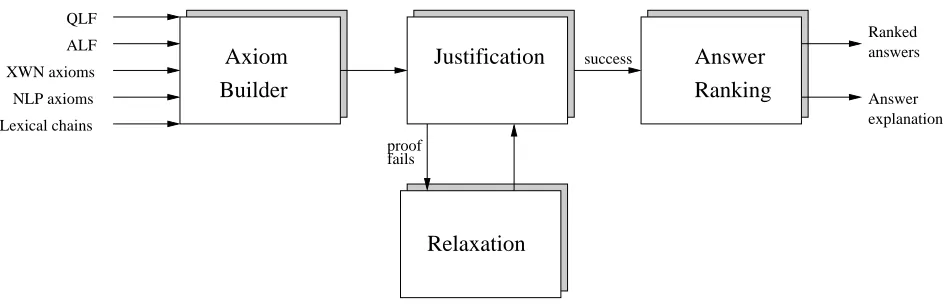
As shown in Figure 1, the inputs to COGEX consist of logic representations of questions, potential answer para-graphs, world knowledge and lexical information. The term Answer Logic Form (ALF) refers to the candidate answers in logic form. Candidate answers returned by the Answer Extraction module are classified as open text due to the unpredictable nature of their grammatical struc-ture. The term Question Logic Form (QLF) refers to the questions posed to the Question Answering system rep-resented in logic form.
The prover also needs world knowledge axioms sup-plied by the WordNet glosses transformed into logic rep-resentations. Additionally there are many other axioms representing equivalence classes of linguistic patterns, called NLP axioms. All these are described below.
The Axiom Builder converts the Logic Forms for the question, the glosses, and its candidate answers into ax-ioms. Based on the parse tree patterns in the question and answers, other NLP axioms are built to supplement the existing general NLP axioms. Once the axioms are complete and loaded, justification of the answer begins. If a proof fails, the relaxation module is invoked. The purpose of this module is twofold: (1) to compensate for errors in the text parsing and Logic Form transfor-mation phase, such as prepositional attachments and sub-ject/object detection in verbs, (2) to detect correct an-swers when the NLP and XWN (Extended WordNet) ax-ioms fail to provide all the necessary inferences. During the relaxation, arguments to predicates in the question are incrementally uncoupled, the proof score is reduced, and the justification is re-attempted. The loop between the Justification and the Relaxation modules continues until the proof succeeds, or the proof score is below a prede-fined threshold. When all the candidate answers are pro-cessed, the candidate answers are ranked based on their proof scores, with the output from COGEX being the ranked answers and the answer justifications.
3
Logic Representation of Text
A text logic form (LF) is an intermediary step between syntactic parse and the deep semantic form. The LF cod-ification acknowledges syntax-based relationships such as: (1) syntactic subjects, (2) syntactic objects, (3)
prepo-sitional attachments, (4) complex nominals, and (5) ad-jectival/adverbial adjuncts. Our approach is to derive the LF directly from the output of the syntactic parser which already resolves structural and syntactic ambiguities.
Essentially there is a one to one mapping of the words of the text into the predicates in the logic form. The pred-icate names consist of the base form of the word concate-nated with the part of speech of the word. Each noun has an argument that is used to represent it in other predi-cates. One of the most important features of the Logic Form representation is the fixed-slot allocation mecha-nism of the verb predicates (Hobbs 1993). This allows for the Logic Prover to see the difference between the role of the subjects and objects in a sentence that is not answerable in a keyword based situation.
Logic Forms are derived from the grammar rules found in the parse tree of a sentence. There are far too many grammar rules in the English language to efficiently and realistically implement them all. We have observed that the top ten most frequently used grammar rules cover 90% of the cases for WordNet glosses. This is referred to as the 10-90 rule (Moldovan and Rus 2001). Below we provide a sample sentence and its corresponding LF representation.
Example:
Heavy selling of Standard & Poor’s 500-stock index fu-tures in Chicago relentlessly beat stocks downward.
LF:
heavy JJ(x1) & selling NN(x1) & of IN(x1,x6) & Standard NN(x2) & & CC(x13,x2,x3) & Poor NN(x3) &’s POS(x6,x13) & 500-stock JJ(x6) & index NN(x4) & future NN(x5) & nn NNC(x6,x4,x5) & in IN(x1,x8) & Chicago NN(x8) & relentlessly RB(e12) &
beat VB(e12,x1,x9) & stocks NN(x9) & down-ward RB(e12)
4
World Knowledge Axioms
Logic representation of WordNet glosses
A major problem in QA is that often an answer is expressed in words different from the question keywords. World knowledge is necessary to conceptually link ques-tions and answers. WordNet glosses contain a source of world knowledge. To be useful in automated reasoning, the glosses need to be transformed into logic forms. Taking the same approach as for open text, we have parsed and represented in logic forms more than 50,000 WordNet glosses. For example, the gloss definition of concept sport NN#1 is an active diversion requiring
physical exertion and competition, which yields the logic
representation:
Ranking
Answer
answersAnswer explanation QLF
ALF
XWN axioms
Lexical chains
NLP axioms
Builder
Axiom
Ranked
Justification
Relaxation
success
[image:3.612.69.543.68.220.2]proof fails
Figure 1: COGEX Architecture
Lexical Chains
A much improved source of world knowledge is obtained when the gloss words are semantically disambiguated (Moldovan and Noviscki 2002). By doing this, the con-nectivity between synsets is dramatically increased. Lex-ical chains can be established between synsets in different hierarchies. These are sequences of semantically related words that link two concepts.
Lexical chains improve the performance of question answering systems in two ways: (1) increase the docu-ment retrieval recall and (2) improve the answer extrac-tion by providing the much needed world knowledge ax-ioms that link question keywords with answers concepts. We developed software that automatically provides connecting paths between any two WordNet synsets
and
up to a certain distance (Moldovan and Noviscki 2002). The meaning of these paths is that the concepts along a path are topically related. The path may contain any of the WordNet relations augmented with a GLOSS relation which indicates that a certain concept is present in a synset gloss.
Examples
Below we provide some relevant lexical chains that link a few selected TREC 2002 questions with their answers.
Q1394: What country did the game of croquet originate in ?
Answer: Croquet is a 15th-century French sport that has
largely been dominated by older, wealthier people who play at exclusive clubs.
Lexical chains:
(1) game:n#3 HYPERNYM recreation:n#1 HYPONYM sport:n#1
(2) originate in:v#1 HYPONYM stem:v#1 GLOSS origin:n#1 GLOSS be:v#1
Q1403: When was the internal combustion engine invented ?
Answer: The first internal - combustion engine was built
in 1867.
Lexical chains:
(1) invent:v#1 HYPERNYM cre-ate by mental act:v#1 HYPERNYM create:v#1
HYPONYM build:v#1
Q: 1518 What year did Marco Polo travel to Asia ? Answer: Marco Polo divulged the truth after returning in
1292 from his travels, which included several months on Sumatra.
Lexical chains:
(1) travel to:v#1 GLOSS travel:v#1 RGLOSS
travel:n#1
(2) travel to#1 GLOSS travel:v#1 HYPONYM
return:v#1
(3) Sumatra:n#1 ISPART Indonesia:n#1 IS-PART Southeast Asia:n#1 ISPART Asia:n#1
Q: 1540 What is the deepest lake in America ?
Answer: Rangers at Crater Lake National Park in Oregon
have closed the hiking trail to the shore of the nation ’s deepest lake
Lexical chains:
(1) America:n#1 HYPERNYM North American country:n#1 HYPERNYM country:n#1 GLOSS nation:n#1
Q: 1570 What is the legal age to vote in Argentina ? Answer: Voting is mandatory for all Argentines aged over
18
Lexical chains:
(1) legal:a#1 GLOSS rule:n#1 RGLOSS mandatory:a#1
(2) age:n#1 RGLOSS aged:a#3
(3) Argentine:a#1 GLOSS Argentina:n#1
5
NLP Axioms
prover. General axioms that reflect equivalence classes of linguistic patterns need to be created and instantiated when invoked. We call these NLP axioms and present below some examples together with questions that call them.
Complex nominals and coordinated conjunctions A question may refer to a subject/object by its full proper name, and the answer will refer to the subject/object in an abbreviated form. For example in the correct candi-date answer for the question, “Which company created
the Internet browser Mosaic?”, Internet browser Mosaic
is referred to as Mosaic.
Using abduction, an axiom is built such that the head noun of the complex nominal in the question implies the remaining nouns in the complex nominal:
all x1 (mosaic nn(x1) internet nn(x1) & browser nn(x1))
An additional axiom is built such that all the nouns in the complex nominal imply a complex nominal:
all x1 (internet nn(x1) & browser nn(x1) & mo-saic nn(x1) nn nnc(x1,x1,x1,x1))
So as not to restrict the ordering of the nouns in the noun phrase from which the complex nominal is built, the same argument is used for each of the noun predicates in the complex nominal. Similar to the above issue, a question may refer to the subject/object in an abbreviated form, while the answer will refer to the subject/object in its full, proper form. For example in the correct candidate answer for the question, “When was Microsoft
established?”, Microsoft is referred to as Microsoft
Corp.
An axiom is built such that each noun of the complex nominal takes on the identifying argument of the complex nominal:
all x1 x2 x3 ( microsoft nn(x1) & corp nn(x2) & nn nnc(x3,x1,x2) microsoft nn(x3) & corp nn(x3)) Similar axioms are used for coordinated conjunctions de-tected in the answer and the question. These are consid-ered weak axioms, and any proof that uses them will be penalized by being given a lower score than those that do not.
Appositions
A candidate answer for a question may use an apposition to describe the subject/object of the answer. The ques-tion may refer to the subject/object by this apposiques-tion. For example in the question, “Name the designer of the
shoe that spawned millions of plastic imitations , known as jellies”, the candidate answer, “..Italian Andrea Pfis-ter , designer of the 1979 ” bird cage ” shoe that spawned millions of plastic imitations, known as ” jellies ...” uses
an apposition to describe the designer.
An axiom is built to link the head of the noun phrases in the apposition such that they share the same argument:
all x12 x13 x14 x15 x17 x18 x19 (ital-ian nn(x12) & andrea nn(x13) & pfister NN(x14) & nn nnc(x15,x12,x13,x14) designer nn(x15) & of in(x15,x17) & 1979 nn(x17) & bird nn(x18) & cage nn(x19))
Possesives
A question/answer substitutes the use of a possesive by using an of or by preposition. For example, in the ques-tion, “What was the length of the Wright brothers’ first
flight?”, the candidate answer, “Flying machines , which got off the ground with a 120 - foot flight by the Wright brothers in 1903...” implies ownership using the
preposi-tion by to connect the Wright brothers to flight. An axiom is built to connect by to the possessive: all x1 x2 (by in(x1,x2) pos(x1,x2))
Equivalence classes for prepositions
Prepositions can be grouped into equivalence classes de-pending on the context of the question, which is deter-mined by the expected answer type. In location seeking questions the prepositions at and in are often interchange-able. Similarly for in and into, and from and of. In date seeking questions in and of have interchangeable mean-ings as do at and in. For example, in the question, “What
body of water does the Colorado River flow into?”, the
candidate answer, “...the Colorado River flowed in the
Salton trough about 130 miles east of San Diego”, the
preposition in and into in the answer take in the same meaning.
An axiom is built to link in to into: all x1 x2 (in in(x1,x2) into in(x1,x2))
Part of relations in location questions
A location seeking question may have a candidate answer that identifies a location by referring to a part of the location. For example, in the question, “Where is
Devil ’s Tower?”, the answer, “American Indians won another court battle over their right to worship without interference at Devils Tower National Monument in the northeast corner of Wyoming”, identifies Wyoming as
the location of Devil ’s Tower by referring to the part of Wyoming in which it lies. An axiom is built to connect Wyoming to its part:
all x1 x2 x3 (corner nn(x1) & of in(x1,x2) & wyoming nn(x2) wyoming nn(x1) )
Attribute of relations in quantity seeking questions A question seeking a quantity may have a candidate an-swer that implies quantity of subject by prefixing the quantity to the subject. For example in the question
“What is the height of the tallest redwood?” the answer is “329 feet Mother of Forest’s Big Basin tallest redwood..”
An axiom is built to connect the quantity to its subject, redwood:
This is a weak axiom since the proximity of redwood to quantity in the answer text is not guaranteed. As men-tioned for the complex nominal and coordinated conjunc-tion axioms, any proof that uses these axioms should be penalized and ranked lower than those that do not. Note that for this axiom to be effective, an axiom linking the heads of the apposition is built:
all x8 x9 x10 x11 x12 (mother nn(x8) & of in(x8,x9) & forest nn(x9) big nn(x10) & basin nn(x11) & nn nnc(x12,x10,x11) & s pos(x8,x12) & tall jj(x8) & redwood nn(x8))
6
Control Strategy
Axiom partitioning mechanism
The search strategy used is the Set of Support Strategy, which partitions the axioms used during the course of a proof into those that have support and those that are considered auxiliary (Wos 1988). The axioms with sup-port are placed in the Set of Supsup-port (SOS) list and are intended to guide the proof. The auxiliary axioms are placed in the Usable list and are used to help the SOS infer new clauses. This strategy restricts the search such that a new clause is inferred if and only if one of its par-ent clauses come from the Set of Support. The axioms that are placed in the SOS are the candidate answers, the question negated (to invoke the proof by contradiction), and axioms related to linking named entities to answer types.
Axioms placed in the Usable list are: (1) Extended WordNet axioms, (2) NLP axioms, and (3) axioms based on outside world knowledge, such as people and organi-zations.
Inference rules
The inference rule sets are based on hyperresolution and paramodulation. Hyperresolution is an inference rule that does multiple binary resolution steps in one, where bi-nary resolution is an inference mechanism that looks for a positive literal in one clause and negative form of that same literal in another clause such that the two literals can be canceled, resulting in a newly inferred clause. Paramodulation introduces the notion of equality substi-tution so that axioms representing equality in the proof do not need to be explicitly included in the axiom lists. Additionally, similar to hyperresolution, paramodulation combines multiple substitution steps into one.
All modern theorem provers use hyperresolution and paramodulation inference rules since they allow for a more compact and efficient proof by condensing multi-ple steps into one.
COGEX will continue trying to find a proof until the Set of Support becomes empty, a refutation is found, or the proof score drops below a predefined threshold.
Two techniques have been implemented in COGEX to
deal with incomplete proofs:
1. Count the number of unifications/resolutions with terms in the question along the longest search path in the proof attempts, and
2. Relax the question logic form by incrementally un-coupling arguments in the predicates, and/or removing prepositions or modifiers that are not crucial to the mean-ing of the text.
For example in question, “How far is Yaroslavl from
Moscow?” a candidate answer is “.. Yaroslavl, a city 250 miles north of Moscow.” By dropping the from predicate
in the question makes the proof succeed for the candidate answer.
7
An example
The following example illustrates how all these pieces are put together to generate answer proofs.
Question 108?:
Which company created the Internet Browser Mosaic ?
QLF:
organization AT(x2) ) & company NN(x2) & cre-ate VB(e1,x2,x6) & Internet NN(x3) & browser NN(x4) & Mosaic NN(x5) & nn NNC(x6,x3,x4,x5)
Question Axiom:
-(exists e1 x2 x3 x5 x6 ( organization at(x2) & company nn(x2) & create vb(e1,x2,x6) & inter-net nn(x3) & browser nn(x4) & mosaic nn(x5) & nn nnc(x6,x3,x4,x5))).
Answer:
In particular, a program called Mosaic , developed by the National Center for Supercomputing Applications ( NCSA ) at the University of Illinois at Urbana - Cham-paign , is gaining popularity as an easy to use point and click interface for searching portions of the Internet.
ALF:
Answer Axiom:
exists e1 e2 e3 e4 e5 x1 x10 x11 x12 x13 x14 x15 x16 x17 x18 x19 x2 x20 x21 x22 x23 x26 x27 x28 x3 x32 x33 x4 x5 x6 x7 x8 x9 (in in(e2,x28) & particular jj(x28) & pro-gram nn(x1) & call vb(e1,x27,x1) & mosaic nn(x2) & develop vb(e2,x8,x2) & by in(e2,x8) & national nn(x3) & center nn(x4) & for nn(x5) & supercomputing nn(x6) & application nn(x7) & nn nnc(x8,x3,x4,x5,x6,x7) & ncsa nn(x9) & at in(x8,x15) & university nn(x10) & of nn(x11) & illinois nn(x12) & at nn(x13) & ur-bana nn(x14) & nn nnc(x15,x10,x11,x12,x13,x14) & champaign nn(x16) & gain vb(e3,x2,x17) & popularity nn(x17) & as in(e3,x32) & easy jj(x33) & use vb(e4,x9,x2) & point nn(x18) & and cc(x26,x18,x21) & click nn(x19) & inter-face nn(x20) & nn nnc(x21,x19,x20) & for in(x26,e5) & search vb(e5,x2,x22) & portion nn(x22) & of in(x22,x23) & internet nn(x23)).
Named entity axioms:
(1) all x3 x4 x5 x6 x7 x8 (national nn(x3) & center nn(x4) & for nn(x5) & supercomputing nn(x6) & application nn(x7) & nn nnc(x8,x3,x4,x5,x6,x7)
organization at(x8)).
(2) all x10 x11 x12 x13 x14 x15 (university nn(x10) & of nn(x11) & illinois nn(x12) & at nn(x13) & ur-bana nn(x14) & nn nnc(x15,x10,x11,x12,x13,x14)
university at(x15)).
(3) all x16 (champaign nn(x16) town at(x16)).
Wordnet Gloss axioms:
The question contained the verb create while the answer contains the verb develop. In order to prove that this answer is in fact correct, we need to detect and use a lexical chain between develop and create. WordNet supplies us with that chain such that
develop make and make create
Using WordNet glosses, this chain is transformed into two axioms:
(4) exists x2 x3 x4 all e2 x1 x7 (develop vb(e2,x7,x1) make vb(e2,x7,x1) & something nn(x1) & new jj(x1) & such jj(x1) & product nn(x2) & or cc(x4,x1,x3) & mental jj(x3) & artistic jj(x3) & creation nn(x3)). (5) all e1 x1 x2 (make vb(e1,x1,x2) cre-ate vb(e1,x1,x2) & manufacture vb(e1,x1,x2) & man-made jj(x2) & product nn(x2)).
Furthermore, the question asks about the Internet
browser Mosiac, while the candidate answer refers to Mosaic. To provide the knowledge that the Internet
browser Mosaic refers to the same thing as Mosaic, the
head of the complex nominal, Internet browser Mosaic, implies its remaining components.
(6) all x1 (mosaic nn(x1) internet nn(x1) & browser nn(x1)).
(7) all x1 x2 x3 x4 (mosaic nn(x1) & internet nn(x1) & browser nn(x1) nn nnc(x1,x1,x1,x1)).
The next step is to build the Set of Support Axiom(s) for the Question. The question is negated to invoke the proof by contradiction
-(exists e1 x2 x3 x5 x6 ( organization at(x2) & com-pany nn(x2) & create vb(e1,x2,x6) & internet nn(x3) & browser(x4) & mosaic nn(x5) & nn nnc(x6,x3,x4,x5))). Next, link the answer type term, its modifiers, and any prepositional attachments to the answer type as a substi-tute for more refined named entity recognition.
all x1 ( organization at(x1) company nn(x1)).
It remains to create axioms for the ALF of the candidate answer and to start the proof.
The Proof
34 [] -develop vb(x22,x7,x1)make vb(x22,x7,x1). 44 [] -make vb(x23,x1,x2)create vb(x23,x1,x2). 74 [] - organization at(x1)company nn(x1). 121 [] -mosaic nn(x1)internet nn(x1). 122 [] -mosaic nn(x1)browser nn(x1).
123 [] -mosaic nn(x1) -internet nn(x1) -browser nn(x1) nn nnc(x1,x1,x1,x1).
294 [] - organization at(x2) -company nn(x2) -create vb(x34,x2,x6) -internet nn(x3) -browser nn(x4)
-mosaic nn(x5) -nn nnc(x6,x3,x4,x5). 299 [] mosaic nn($c111).
300 [] develop vb($c126,$c96,$c111). 302 [] national nn($c103).
303 [] center nn($c100). 304 [] for nn($c99).
305 [] supercomputing nn($c98). 306 [] application nn($c97).
307 [] nn nnc($c96,$c103,$c100,$c99,$c98,$c97). 332 [] -national nn(x3) -center nn(x4) -for nn(x5)
-supercomputing nn(x6) -application nn(x7) -nn -nnc(x8,x3,x4,x5,x6,x7) organization at(x8). 335 [hyper,299,122] browser nn($c111). 336 [hyper,299,121] internet nn($c111).
337 [hyper,336,123,299,335] nn nnc($c111,$c111,$c111,$c111).
347 [hyper,300,34] make vb($c126,$c96,$c111). 356 [hyper,347,44] create vb($c126,$c96,$c111). 372 [hyper,332,302,303,304,305,306,307]
organization at($c96).
373 [hyper,372,74] company nn($c96).
question being derived in their positive form so the proof by contradiction succeeds, which is indicated by the $F in the final step and the hyperresolution of all the derived terms with the negated question from step 1 of the proof. The success of this proof boosts the candidate answer to the first position.
When the proof fails, we devised a way to incremen-tally relax some of the conditions that hinder the comple-tion of the proof. This relaxacomple-tion process puts weights on the proof such that proofs weaker than a predefined threshold are not accepted.
8
Results
COGEX was implemented and integrated into a state-of-the-art Question Answering system that participated in TREC 2002. All questions are attempted by the prover, but if the proof fails the QA system resorts to other an-swer extraction methods that were part of the system be-fore the prover. Thus, some questions are answered by the QA system without the prover, some only by the prover and some by both the non-prover system and the prover. The complete system answered 415 questions out of 500 TREC 2002 questions. Of these, 206 were an-swered by COGEX but some of these answers were also provided by QA system without COGEX. A careful anal-ysis indicates that the QA system without logic prover an-swered 317 questions and the prover can answer only 98 additional questions for which the system without prover failed. Table 1 summarizes these results.
Questions answered by the complete system 415 Questions answered by COGEX 206 Questions answered only by COGEX 98 Questions answered without COGEX 317
Table 1: Performance over 500 TREC 2002 questions
The added value of automated reasoning to the QA sys-tem is 30.9% (98/317). This represents a significant im-provement in the performance of the logic prover for QA over the one reported in (Moldovan 2002). The failures of the prover are due primarily to the lack of linguistic axioms.
9
Discussion
A logic prover brings several advantages to question an-swering, but at a high cost. Some advantages are: the ca-pability of pinpointing exact answers that otherwise will be missed, answer justification, and a quantifiable mea-sure of how close a system is to providing an answer. However, the implementation of a QA logic prover is ex-pensive as it requires logic representation of text, world knowledge axioms and a large number of linguistic ax-ioms, that all take time to develop.
Acknowledgment
This work was supported in part by the ARDA AQUAINT program.
We wish to thank Mihai Surdeanu and Marius Pasca from LCC for their contribution to this work.
References
J. Hobbs, M. Stickel, and P. Martin. Interpretation as ab-duction. Artificial Intelligence, 63 (1993), pp 69-142.
D. Moldovan, M. Pasca, S. Harabagiu and M. Surdeanu. Performance issues and error analysis in an open-domain question answering system. In Proceedings of
ACL 2002.
Dan Moldovan and Adrian Noviscki. Lexical Chains for Questions. In Proceedings of Coling 2002.
Dan Moldovan and Vasile Rus. Logic Form Transfor-mation of WordNet and its Applicability to Question Answering. In Proceedings of ACL 2001.
Ellen Voorhees. Overview of the TREC 2002 Question Answering Track. In TREC 2002 http://trec.nist.gov