Morphological Analysis for Statistical Machine Translation
Young-Suk Lee
IBM T. J. Watson Research Center, Yorktown Heights, NY 10598 Email: [email protected]
Abstract
We present a novel morphological analysis technique which induces a morphological and syntactic symmetry between two languages with highly asymmetrical morphological structures to improve statistical machine translation qualities. The technique pre-supposes fine-grained segmentation of a word in the morphologically rich language into the sequence of prefix(es)-stem-suffix(es)
and part-of-speech tagging of the parallel corpus. The algorithm identifies morphemes to be merged or deleted in the morphologically rich language to induce the desired morphological and syntactic symmetry. The technique improves Arabic-to-English translation qualities significantly when applied to IBM Model 1 and Phrase Translation Models trained on the training corpus size ranging from 3,500 to 3.3 million sentence pairs.
1.
Introduction
Translation of two languages with highly different morphological structures as exemplified by Arabic and English poses a challenge to successful implementation of statistical machine translation models (Brown et al. 1993). Rarely occurring inflected forms of a stem in Arabic often do not accurately translate due to the frequency imbalance with the corresponding translation word in English. So called a word (separated by a white space) in Arabic often corresponds to more than one independent word in English, posing a technical problem to the source channel models. In the English-Arabic sentence alignment shown in Figure 1, Arabic word AlAHmr (written in Buckwalter transliteration) is aligned to two English words ‘the red’, and llmEArDp to three English words ‘of the opposition.’ In this paper, we present a technique to induce a morphological and syntactic symmetry between two languages with different morphological structures for statistical translation quality improvement.
The technique is implemented as a two-step morphological processing for word-based translation models. We first apply word segmentation to Arabic, segmenting a word into
prefix(es)-stem-suffix(es). Arabic-English
sentence alignment after Arabic word segmentation is illustrated in Figure 2, where one Arabic morpheme is aligned to one or zero English word. We then apply the proposed technique to the word segmented Arabic corpus to identify prefixes/suffixes to be merged into their stems or deleted to induce a symmetrical morphological structure. Arabic-English sentence alignment after Arabic morphological analysis is shown in Figure 3, where the suffix p
is merged into their stems mwAjh and mEArd. For phrase translation models, we apply additional morphological analysis induced from noun phrase parsing of Arabic to accomplish a syntactic as well as morphological symmetry between the two languages.
2.
Word Segmentation
We pre-suppose segmentation of a word into
prefix(es)-stem-suffix(es), as described in (Lee et al. 2003) The category prefix and suffix encompasses function words such as conjunction markers, prepositions, pronouns, determiners and all inflectional morphemes of the language. If a word token contains more than one prefix and/or suffix, we posit multiple prefixes/suffixes per stem. A sample word segmented Arabic text is given below, where prefixes are marked with #, and suffixes with +.
w# s# y# Hl sA}q Al# tjArb fy jAgwAr Al# brAzyly lwsyAnw bwrty mkAn AyrfAyn fy Al# sbAq gdA Al# AHd Al*y s# y# kwn Awly xTw
+At +h fy EAlm sbAq +At AlfwrmwlA
3. Morphological Analysis
Sudan : alert in the red sea to face build-up of the oppositions in Eritrea
AlswdAn : AstnfAr fy AlbHr AlAHmr lmwAjhp H$wd llmEArDp dAxl ArytryA
Figure 1. Word alignment between Arabic and English without Arabic morphological processing Sudan : alert in the red sea to face build-up of the opposition in Eritrea
Al swdAn : AstnfAr fy Al bHr Al AHmr l mwAjh p H$wd l Al mEArd p dAxl ArytryA
Figure 2. Alignment between word-segmented Arabic and English
Sudan : alert in the red sea to face build-up of the opposition in Eritrea
swdAn : AstnfAr fy Al bHr AHmr l mwAjhp H$wd l Al mEArdp dAxl ArytryA
Figure 3. Alignment between morphologically analyzed Arabic and English
Sample Arabic texts before and after morphological analysis is shown below.
Mwskw 51-7 ( Af b ) - Elm An Al# qSf Al# mdfEy Al*y Ady Aly ASAb +p jndy +yn
rwsy +yn Avn +yn b# jrwH Tfyf +p q*A}f Al# jmE +p fy mTAr xAn qlE +p …
Mwskw 51-7 ( Af b ) - Elm An Al# qSf Al# mdfEy Al*y Ady Aly ASAbp jndyyn rwsyyn
Avnyn b# jrwH Tfyfp msA' Al# jmEp fy mTAr xAn qlEp …
In the morphologically analyzed Arabic (bottom), the feminine singular suffix +p and the masculine plural suffix +yn are merged into the preceding stems analogous to singular/plural noun distinction in English, e.g. girl vs. girls.
3.1 Method
We apply part-speech tagging to a symbol tokenized and word segmented Arabic and symbol-tokenized English parallel corpus. We then viterbi-align the part-of-speech tagged parallel corpus, using translation parameters obtained via Model 1 training of word segmented Arabic and symbol-tokenized English, to derive the conditional probability of an English part-of-speech tag given the combination of an Arabic prefix and its part-of-speech or an Arabic suffix and its part-of-speech.1
1We have used an Arabic part-of-speech tagger with
around 120 tags, and an English part-of-speech tagger with around 55 tags.
3.2 Algorithm
The algorithm utilizes two sets of translation probabilities to determine merge/deletion analysis of a morpheme. We obtain tag-to-tag translation probabilities according to (1), which identifies the most probable part-of-speech correspondences between Arabic (tagA) and
English (tagE).
(1) Pr(tagE | tagA)
We also obtain translation probabilities of an English part-of-speech tag given each Arabic prefix/suffix and its part-of-speech according to (2) and (3):
(2) Pr(tagE | stemtagA, suffixj_tagjk)
(2) computes the translation probability of an Arabic suffix and its part-of-speech into an English part-of-speech in the Arabic stem tag context, stemtagA. StemtagA is one of the major stem parts-of-speech with which the specified prefix or suffix co-occurs, i.e. ADV, ADJ, NOUN, NOUN_PROP, VERB_IMPERFECT, VERB_PERFECT.2
J in suffixj ranges from 1 to M, M = number of
distinct suffixes co-occurring with stemtagA.
tagjk in suffixj_tagjk is the part-of-speech of suffixj, where k ranges from 1 to L, L = number of
2 All Arabic part-of-speech tags are adopted from
distinct tags assigned to the suffixj in the training corpus.
(3) Pr(tagE | prefixi_tagik, stemtagA)
(3) computes the translation probability of an Arabic prefix and its part-of-speech into an English part-of-speech in the Arabic stem tag context, stemtagA. Prefixi and tagik in
prefixi_tagik may be interpreted in a manner analogous to suffixj and tagjk of suffixj_tagjk in (2).
3.2.1 IBM Model 1
The algorithm for word-based translation model, e.g. IBM Model 1, implements the idea that if a morpheme in one language is robustly translated into a distinct part-of-speech in the other language, the morpheme is very likely to have its independent counterpart in the other language. Therefore, a robust overlap of tagE given tagA
between Pr(tagE|tagA) and Pr(tagE|stemtagA,
suffixj_tagjk) for a suffix and Pr(tagE|tagA) and Pr(tagE|prefixi_tagik, stemtagA) for a prefix is a positive indicator that the Arabic prefix/suffix has an independent counterpart in English. If the overlap is weak or doesn’t exist, the prefix/suffix is unlikely to have an independent counterpart and is subject to merge/deletion analysis.3
Step 1: For each tagA, select the top 3 most probable tagE from Pr(tagE|tagA).
Step 2: Partition all prefixi_tagik and suffixj_tagjk
into two groups in each stemtagA context.
Group I: At least one of ‘tagE|tagik’ or ‘tagE|tagjk’ occurs as one of the top 3 most probable translation pairs in Pr(tagE|tagA). Prefixes and suffixes in this group are likely to have their independent counterparts in English.
Group II: None of ‘tagE|tagik’ or ‘tagE|tagjk’ occurs as one of the top 3 most probable translation pairs in Pr(tagE|tagA). Prefixes and suffixes in this group are unlikely to have their independent counterparts in English.
Step 3: Determine the merge/deletion analysis of the prefixes/suffixes in Group II as follows: If prefixi_tagik/suffixj_tagjk occurs in more than one
stemtagA context, and its translation probability
into NULL tag is the highest, delete the prefixi_tagik/suffixj_tagjk in the stemtagA context.
If prefixi_tagik/suffixj_tagjk occurs in more than
one stemtagA context, and its translation
3We assume that only one tag is assigned to one
morpheme or word, i.e. no combination tag of the form DET+NOUN, etc.
probability into NULL tag is not the highest, merge the prefixi_tagik/suffixj_tagjk into its stem
in the stemtagA context.
Merge/deletion analysis is applied to all prefixi_tagik/suffixj_tagjk occurring in the
appropriate stem tag contexts in the training corpus (for translation model training) and a new input text (for decoding).
3.2.2 Phrase Translation Model
For phrase translation models (Och and Ney 2002), we induce additional merge/deletion analysis on the basis of base noun phrase parsing of Arabic. One major asymmetry between Arabic and English is caused by more frequent use of the determiner Al# in Arabic compared with its counterpart the in English. We apply
Al#-deletion to Arabic noun phrases so that only the first occurrence of Al# in a noun phrase is retained. All instances of Al# occurring before a proper noun – as in Al# qds, whose literal translation is the Jerusalem – are also deleted. Unlike the automatic induction of morphological analysis described in 3.2.1, Al#-deletion analysis is manually induced.
4.
Performance Evaluations
System performances are evaluated on LDC-distributed Multiple Translation Arabic Part I consisting of 1,043 segments derived from AFP and Xinhua newswires. Translation qualities are measured by uncased BLEU (Papineni et al. 2002) with 4 reference translations, sysids: ahb, ahc, ahd, ahe.
Systems are developed from 4 different sizes of training corpora, 3.5K, 35K, 350K and 3.3M sentence pairs, as in Table 1. The number in each cell indicates the number of sentence pairs in each genre (newswires, ummah, UN corpus).4
Genre 3.5K 35K 350K 3.3M News 1,000 1,000 9,238 12,002 Ummah 500 1,000 13,027 13,027 UN 2,000 33,000 327,735 3,270,200 Table 1. Training Corpora Specifications
4.1 IBM Model 1
Impact of morphological analysis on IBM Model 1 is shown in Table 2.
4
corpus size baseline morph analysis 3.5K 0.10 0.25 35K 0.14 0.29 350K 0.18 0.31 3.3M 0.18 0.32
Table 2. Impact of morphological analysis on IBM Model 1
Baseline performances are obtained by Model 1 training and decoding without any segmentation or morphological analysis on Arabic. BLEU scores under ‘morph analysis’ is obtained by Model 1 training on Arabic morphologically analyzed and English symbol-tokenized parallel corpus and Model 1 decoding on the Arabic morphologically analyzed input text.5
4.2 Phrase Translation Model
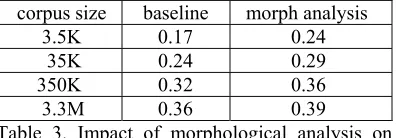
Impact of Arabic morphological analysis on a phrase translation model with monotone decoding (Tillmann 2003), is shown in Table 3.
corpus size baseline morph analysis 3.5K 0.17 0.24 35K 0.24 0.29 350K 0.32 0.36 3.3M 0.36 0.39
Table 3. Impact of morphological analysis on Phrase Translation Model
BLEU scores under baseline and morph analysis are obtained in a manner analogous to Model 1 except that the morphological analysis for the phrase translation model is a combination of the automatically induced analysis for Model 1 plus the manually induced Al#-deletion in 3.2.2. The scores with only automatically induced morphological analysis are 0.21, 0.25, 0.33 and 0.36 for 3.5K, 35K, 350K and 3.3M sentence pair training corpora, respectively.
5. Related Work
Automatic induction of the desired linguistic knowledge from a word/morpheme-aligned parallel corpus is analogous to (Yarowsky et al. 2001). Word segmentation and merge/deletion analysis in morphology is similar to parsing and insertion operation in syntax by (Yamada and Knight 2001). Symmetrization of linguistic structures can also be found in (Niessen and Ney 2000).
5 Our experiments indicate that addition of Al#
-deletion, cf. Phrase Translation Model, does not affect the performance of IBM Model 1.
Acknowledgements
This work was partially supported by the Defense Advanced Research Projects Agency and monitored by SPAWAR under contract No. N66001-99-2-8916. The views and findings contained in this material are those of the authors and do not necessarily reflect the position of policy of the Government and no official endorsement should be inferred. We would like to acknowledge Salim Roukos and Kishore Papineni for technical discussions.
6.
References
Brown, P., Della Pietra, S., Della Pietra, V., and Mercer, R. 1993. The mathematics of statistical machine translation: Parameter Estimation. Computational Linguistics, 19(2): 263—311.
Lee, Y-S., Papineni, K., Roukos, S., Emam, O., Hassan, H. 2003. Language Model Based Arabic Word Segmentation. In Proceedings of the 41st Annual Meeting of the ACL. Pages 399—
406. Sapporo, Japan.
Niessen, S., Ney, H. 2000. Improving SMT quality with morpho-syntactic analysis. In
Proceedings of 20th International Conference on
Computational Linguistics. Saarbrucken,
Germany.
Och, F. J., Ney. H. 2002. Discriminative training and maximum entropy models for statistical machine translation. In Proceedings of the 40th Annual Meeting of the ACL. Pages
295—302. Philadelphia. PA.
Papineni, K., Roukos, S., Ward, R., Zhu W. 2002. Bleu: a Method for Automatic Evaluation of Machine Translation. Proceedings of the 40th Annual Meeting of the ACL. Pages 311—318. Philadelphia, PA.
Tillmann, Christoph 2003. A Projection Extension Algorithm for Statistical Machine Translation. In Proceedings of the 2003 Conference on Empirical Methods in Natural
Language Processing. Pages 1—8. Sapporo,
Japan.
Yamada, K. and Knight, K. 2001. A Syntax-Based Statistical Translation Model. In
Proceedings of the 39th Conference of the ACL.
Pages 523—530. Toulouse, France.
[image:4.612.92.290.328.397.2]