An Error-Oriented Approach to Word Embedding Pre-Training
Youmna Farag1 Marek Rei1,2 Ted Briscoe1,2
1Computer Laboratory, University of Cambridge, United Kingdom 2The ALTA Institute, Cambridge, United Kingdom
{youmna.farag,marek.rei,ted.briscoe}@cl.cam.ac.uk
Abstract
We propose a novel word embedding pre-training approach that exploits writing er-rors in learners’ scripts. We compare our method to previous models that tune the embeddings based on script scores and the discrimination between correct and corrupt word contexts in addition to the generic commonly-used embeddings pre-trained on large corpora. The com-parison is achieved by using the afore-mentioned models to bootstrap a neural network that learns to predict a holistic score for scripts. Furthermore, we in-vestigate augmenting our model with er-ror corrections and monitor the impact on performance. Our results show that our error-oriented approach outperforms other comparable ones which is further demon-strated when training on more data. Addi-tionally, extending the model with correc-tions provides further performance gains when data sparsity is an issue.
1 Introduction
Assessing students’ writing plays an inherent ped-agogical role in the overall evaluation of learning outcomes. Traditionally, human graders are re-quired to mark essays, which is cost- and time-inefficient, especially with the growing numbers of students. Moreover, the evaluation process is subjective, which leads to possible variations in the awarded scores when more than one human assessor is employed. To remedy this, the auto-mated assessment (AA) of writing has been mo-tivated in order to automatically evaluate writ-ing competence and hence not only reduce grader workload, but also bypass grader inconsistencies as only one system would be responsible for the
assessment. Numerous AA systems have been developed for research purposes or deployed for commercial use, including Project Essay Grade (PEG) (Page,2003), e-Rater (Attali and Burstein,
2006), Intelligent Essay Assessor (IEA) (Landauer et al.,2003) and Bayesian Essay Test Scoring sYs-tem (BETSY) (Rudner and Liang,2002) among others. They employ statistical approaches that ex-ploit a wide range of textual features.
A recent direction of research has focused on applying deep learning to the AA task in order to circumvent the heavy feature engineering in-volved in traditional systems. Several neural ar-chitectures have been employed including variants of Long Short-Term Memory (LSTM) ( Alikani-otis et al., 2016; Taghipour and Ng, 2016) and Convolutional Neural Networks (CNN) (Dong and Zhang,2016). They were all applied to the Auto-mated Student Assessment Prize (ASAP) dataset, released in a Kaggle contest1, which contains es-says written by middle-school English speaking students. On this dataset, neural models that only operate on word embeddings outperformed state-of-the-art statistical methods that rely on rich linguistic features (Yannakoudakis et al., 2011;
Phandi et al.,2015).
The results obtained by neural networks on the ASAP dataset demonstrate their ability to capture properties of writing quality without recourse to handcrafted features. However, other AA datasets pose a challenge to neural models and they still fail to beat state-of-the-art methods when evalu-ated on these sets. An example of such datasets is the First Certificate in English (FCE) set where ap-plying a rank preference Support Vector Machine (SVM) trained on various lexical and grammatical features achieved the best results (Yannakoudakis et al.,2011). This motivates further investigation
1https://www.kaggle.com/c/asap-aes/
into neural networks to determine what minimum useful information they can utilize to enhance their predictive power.
Initializing neural models with contextually rich word embeddings pre-trained on large corpora (Mikolov et al., 2013; Pennington et al., 2014;
Turian et al.,2010) has been used to feed the net-works with meaningful embeddings rather than random initialization. Those embeddings are generic and widely employed in Natural Language Processing (NLP) tasks, yet few attempts have been made to learn more task-specific embed-dings. For instance,Alikaniotis et al. (2016) de-velopedscore-specific word embeddings(SSWE) to address the AA task on the ASAP dataset. Their embeddings are constructed by ranking correct ngrams against their “noisy” counterparts, in addi-tion to capturing words’ informativeness measured by their contribution to the overall score of the es-say.
We propose a task-specific approach to pre-train word embeddings, utilized by neural AA models, in an error-oriented fashion. Writing errors are strong indicators of the quality of writing com-petence and good predictors for the overall script score, especially in scripts written by language learners, which is the case for the FCE dataset. For example, the Spearman’s rank correlation coeffi-cient between the FCE script scores and the ratio of errors is −0.63 which is indicative of the im-portance of errors in writing evaluation:
ratio of errors= number of erroneous script wordsscript length
This correlation could even be higher if error severity is accounted for as some errors could be more serious than others. Therefore, it seems plausible to exploit writing errors and integrate them into AA systems, as was successfully done byYannakoudakis et al.(2011) andRei and Yan-nakoudakis (2016), but not by capturing this in-formation directly in word embeddings in a neural AA model.
Our pre-training model learns to predict a score for each ngram based on the errors it contains and modifies the word vectors accordingly. The idea is to arrange the embedding space in a way that discriminates between “good” and “bad” ngrams based on their contribution to writing errors. Boot-strapping the assessment neural model with those learned embeddings could help detect wrong
pat-terns in writing which should improve its accuracy of predicting the script’s holistic score.
We implement a CNN as the AA model and compare its performance when initialized with our embeddings, tuned based on natural writing errors, to the one obtained when bootstrapped with the SSWE, proposed byAlikaniotis et al.(2016), that relies on random noisy contexts and script scores. Furthermore, we implement another version of our model that augments ngram errors with their corrections and investigate the effect on perfor-mance. Additionally, we compare the aforemen-tioned pre-training approaches to the commonly used embeddings trained on large corpora (Google or Wikipedea). The results show that our approach outperforms other initialization methods and aug-menting the model with error corrections helps al-leviate the effects of data sparsity. Finally, we further analyse the pre-trained representations and demonstrate that our embeddings are better at de-tecting errors which is inherent for AA.
2 Related Work
There have been various attempts to employ neu-ral networks to assess the essays in the ASAP dataset. Taghipour and Ng (2016) compared the performance of a few neural network variants and obtained the best results with an LSTM fol-lowed by a mean over time layer that averages the output of the LSTM layer. Alikaniotis et al.
(2016) assessed the same dataset by building a bidirectional double-layer LSTM which outper-formed Distributed Memory Model of Paragraph Vectors (PV-DM) (Le and Mikolov, 2014) and Support Vector Machines (SVM) baselines.Dong and Zhang(2016) implemented a CNN where the first layer convolves a filter of weights over the words in each sentence followed by an aggrega-tive pooling function to construct sentence repre-sentations. Subsequently, a second filter is applied over sentence representations followed by a pool-ing operation then a fully-connected layer to pre-dict the final score. Their CNN was applied to the ASAP dataset and its efficacy in in-domain and domain-adaptation essay evaluation was demon-strated in comparison to traditional state-of-the-art baselines.
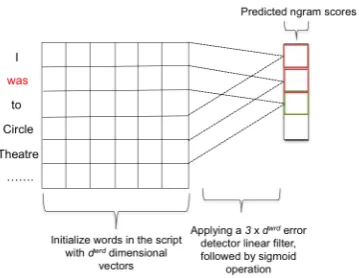
Figure 1: Error-specific Word Embeddings (ESWE).
as the ones with grades above or equal to the av-erage score and the rest as poor ones. They cal-culated the Fisher scores (Fisher,1922) of ngrams and selected201with the highest scores as“useful ngrams”. Similarly, they generated correct POS ngrams from grammatically correct texts, classi-fied the rest as “bad POS ngrams” and used them along with the useful ngrams and other shallow lexical features as bag-of-words features. They applied Bayesian linear ridge regression (BLRR) and SVM regression for domain-adaptation es-say scoring using the ASAP dataset. Alikaniotis et al.(2016) applied a similar idea; in their SSWE model, they trained word embeddings to distin-guish between correct and noisy contexts in addi-tion to focusing more on each word’s contribuaddi-tion to the overall text score. Bootsrapping their LSTM model with those embeddings offered further per-formance gains.
Other models have directly leveraged error in-formation exhibited in text. For example, Yan-nakoudakis et al.(2011) demonstrated that adding an “error-rate” feature to their SVM ranking model that uses a wide range of lexical and gram-matical writing competence features further im-proves the AA performance. They calculated the error-rate using the error annotations in the Cam-bridge Learner Corpus (CLC) in addition to clas-sifying a trigram as erroneous if it does not oc-cur in the large ukWaC corpus (Ferraresi et al.,
2008) or highly scoring CLC scripts.Rei and Yan-nakoudakis(2016) proposed a bidirectional LSTM for error detection in learner data, where the model predicts the probability of a word being correct for each word in text. As an extension to their ex-periment, they incorporated the average predicted probability of word correctness as an additional feature to the self-assessment and tutoring system
(SAT) (Andersen et al., 2013) that applied a su-pervised ranking perceptron to rich linguistic fea-tures. Adding their correctness probability feature successfully enhanced the predictive power of the SAT.
3 Approach
3.1 Word Embedding Pre-training
In this section, we describe three different neu-ral networks to pre-train word representations: the model implemented by Alikaniotis et al. (2016) and the two error-oriented models we propose in this work. The models’ output embeddings – re-ferred to as AA-specific embeddings – are used later to bootstrap the AA system.
Score-specific Word Embeddings (SSWE). We compare our pre-training models to the SSWE de-veloped byAlikaniotis et al.(2016). Their method is inspired by the work of Collobert and Weston
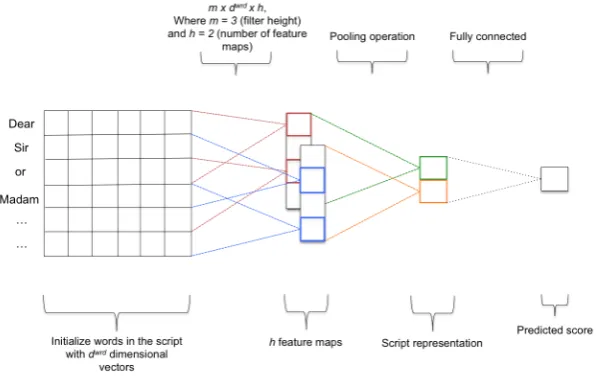
Figure 2: A CNN for AA where the final score is predicted by applying a convolutional operation fol-lowed by a pooling function.
Loss(SSW E)=α·loss(ranking)
+ (1−α)·loss(score) (1)
whereαis a hyperparameter. In their experiment, they set α to 0.1 giving most of the weight to score-related information.
Error-specific Word Embeddings (ESWE).We propose a model that fine-tunes the embedding space using a supervised method that leverages the errors appearing in the training data. It modifies the embedding space to discriminate between er-roneous ngrams and correct ones. The core differ-ence between this approach and SSWE is that it relies on the writing errors occurring naturally in the training data instead of randomly generating incorrect ngrams or capturing words’ informative-ness. The motivation for adopting this approach is twofold. First, we believe that the model could learn more useful AA features from actual errors rather than introducing random contexts that are unlikely to happen. Second, SSWE ignores the frequent words as they have less predictive power (they are used equally in highly and lowly scored texts). However, despite the fact that frequent words (e.g. function words) carry less topical in-formation than content ones, the errors associated with them constitute a substantial portion of the errors committed by non-native English speakers. For instance, determiner errorsaccount for more than 9% of the total errors in public FCE train-ing data. Therefore, learntrain-ing representations from
both function and content word errors in their con-texts could be advantageous.
The ESWE model predicts error scores for word ngrams. First, we demonstrate how the true er-ror scores for ngrams are calculated and second, we describe the approach applied to estimate these scores. Each word wi in a training document is
given an error indicating scoreei ∈ {1,0}based
on whether it is part of an error or not, respectively. Subsequently, an ngram gold score (n score) is calculated based on the sum of the errors it con-tains as follows:
n score= 1 +P1 n
i ei (2)
wherenis the ngram length. For the model to es-timate the ngram scores, a convolutional operation is applied as depicted in Figure1. First, each word is mapped to a unique vector vwrd
i ∈ Rdwrd
re-trieved from an embedding spaceE ∈R|V|×dwrd
, where |V| is the vocabulary size. Consequently, an ngram is represented as a concatenation of its word vectors vng = [vwrd
i ;...;vwrdi+n−1]. Scoring
the ngrams is accomplished by sliding a convolu-tional linear filterWe ∈Rn×dwrd
– hereaftererror filter2– over all the ngrams in the script, followed by a sigmoid non-linearity to map the predicted score to a[0,1]probability space:
ˆ
n score=σ(We·vng) (3)
2We also refer to the window size used in SSWE as error
whereσis the sigmoid function.3 The error filter should work as an error detector that evaluates the correctness of words given their contexts and ar-ranges them in the embedding space accordingly. For optimization, the sum of squared errors loss is minimized between the gold ngram scores and the estimated ones and the error gradients are back-propagated to the embedding matrix E building the ESWE space:
Loss=X
k
(n scorek−n scoreˆ k)2 (4)
wherekis the ngram index.
Error-correction-specific Word Embeddings (ECSWE).As an extension to ESWE, we propose augmenting it with the errors’ corrections as fol-lows. We build a corrected version of each script by replacing all its errors with their suggested rections and train the ESWE model using the cor-rected scripts together with the original ones. In the corrected version, all the ngrams are given ei = 0and consequently,n score = 1according
to Equation2. All the above ESWE equations are applied and the loss for each script is calculated as the sum of both the loss of the original script and its corrected version (Equation4applied to obtain both). The motivation for this model is twofold. First, it could enrich the embedding space by al-lowing the model to learn from faulty ngrams and their correct counterparts (both occur naturally in text) and construct ECSWE which is a modified version of ESWE that is more capable of distin-guishing between good and bad contexts. Second, it could alleviate the effects of data sparsity, when training on small datasets, by learning from more representations.4
3.2 AA Model
The previous section discusses pre-training ap-proaches for word embeddings that are later used to initialize the AA model. For this model, we use a second CNN to predict a holistic score for the script (Figure2) as follows. Each word in an input script is initialized with its vector vwrd0
i ∈
Rdwrd
from a ptrained embedding matrix, re-sulting in a script embedding [vwrd0
1 ;....;vlwrd0],
where l is the length of the script. A convolu-tional filterWs ∈ Rm×dwrd×h
is slid over all the
3Biases are removed from equations for simplicity. 4We refer to ESWE and ECSWE aserror-oriented
mod-els.
Model Dataset Error Script Google Word2Vec
& GloVe FCEextFCE - 3 SSWE, ESWE &
[image:5.595.312.523.61.134.2]ECSWE FCEFCEext 39 39 Table 1: Error and script refer to their filter sizes. For each of the5 pre-training models on the two datasets, the error filter size is displayed (if ap-plicable) along with the script filter size used in the AA network initialized with the embeddings on the left. FCE refers to the public FCE.
script’s subsequences to generate the feature maps M ∈ Rh×(l−m+1), where m is the filter height
(window size) and h is the number of the out-put feature maps. We refer to this filter as the
script filter. Previously, for the error filter used in the ESWE and ECSWE approaches,h was set to 1 which represents the predicted ngram score (n score), whereas here, the system extracts vari-ˆ
ous contextual features from each ngram as a pre-step towards predicting the script’s score, hence settinghto a large value. The convolutional oper-ation is followed by aReLUnon-linearity to cap-ture more complex linguistic phenomena:5
Mi =ReLU(Ws·viwrd:i+m0 −1) (5)
M = [M1, M2, ...Ml−m+1] (6)
Subsequently, an average pooling function is ap-plied to the output feature maps in order to select the useful features and unify the scripts’ represen-tations to a vectorS ∈Rhof fixed length. Finally,
the last layer of the network is a fully connected one by applying linear regression to the script rep-resentation in order to predict the final score:
ˆ
s score=Wreg·S (7)
whereWreg ∈ Rh is a learned parameter matrix.
The network optimizes the sum of squared errors loss between the scripts’ predicted scores and the gold ones.
4 Experimental Setup
Baselines. We compare our error-oriented ap-proaches to the SSWE model as well as generic pre-trained models commonly used to initialize
5Initial experimentation showed thatReLUperforms
Bootstrapping Model Pearson (r) Spearman (ρ) RMSE Google Word2Vec 300d 0.488 0.446 5.339
GloVe 50d 0.475 0.427 5.308
SSWE 0.494 0.445 5.182
ESWE 0.521 0.481 5.194
[image:6.595.154.445.61.148.2]ECSWE 0.538 0.499 5.033
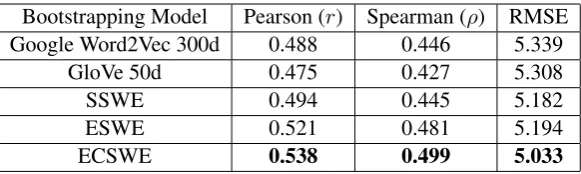
Table 2: AA results when bootstrapped from different word embeddings and trained on public FCE. The bold values indicate the best results.
neural networks for different NLP tasks. The generic models are trained on large corpora to cap-ture general semantic and syntactic regularities, hence creating richer, more meaningful word vec-tors, as opposed to random vectors. In particular, Google News Word2Vec (dwrd = 300) (Mikolov
et al.,2013) and GloVe (dwrd = 50) (Pennington
et al.,2014) pre-trained models are used. Google Word2Vec6 is a Skip-gram model that learns to predict the context of a given word. It is trained on Google News articles which contain around 100
billion words with3million unique words. On the other hand, GloVe7vectors are learned by leverag-ing word-word cooccurrence statistics in a corpus. We use the GloVe embeddings trained on a 2014 Wikipedia dump in addition to Gigaword 5 with a total of6billion words.
Evaluation. We replicate the SSWE model, im-plement our ESWE and ECSWE models, use Google and GloVe embeddings and conduct a comparison between the5initilization approaches by feeding their output embeddings to the AA sys-tem from Section 3.2. All the models are im-plemented using the open-source Python library Theano (Al-Rfou et al.,2016). For evaluation, we calculate Spearman’s rank correlation coefficient (ρ), Pearson’s product-moment correlation coef-ficient (r) and root mean square error (RMSE) between the final predicted script scores and the ground-truth values (Yannakoudakis and Cum-mins,2015).
Dataset. For our experiments, we use the FCE dataset (Yannakoudakis et al., 2011) which con-sists of exam scripts written by English learners of upper-intermediate proficiency and graded with scores ranging from 1 to 40.8 Each script con-tains two answers corresponding to two different
6https://code.google.com/archive/p/word2vec/ 7https://nlp.stanford.edu/projects/glove/
8We only evaluate on FCE and not the ASAP dataset
be-cause the latter does not contain error annotations.
prompts asking the learner to write either an arti-cle, a letter, a report, a composition or a short story. We apply script-level evaluation by concatenating the two answers and using a specialanswer end token to separate the answers in the same script.
The writing errors committed in the scripts are manually annotated using a taxonomy of 80 er-ror types (Nicholls,2003) together with suggested corrections. An example of error annotations is:
The problems started<e type=“RT”> <i>in</i><c>at</c></e> the box office.
where<i></i>is the error,<c></c>is the sug-gested correction and the error type“RT”refers to
“replace preposition”. For error-oriented models, a word is considered an error if it occurs inside an error tag and the correction is retrieved according to the correction tag.
We train the models on the released public FCE dataset which contains1,141scripts for training and97scripts for testing. In order to examine the effects of training with extra data, we conduct ex-periments where we augment the public set with additional FCE scripts and refer to this extended version as FCEext, which contains 9,822 scripts. We report the results of both datasets on the re-leased test set. The public FCE dataset is divided into 1,061 scripts for training and 80 for devel-opment while for FCEext, 8,842scripts are used for training and980are held out for development. The only data preprocessing employed is word to-kenization which is achieved using the Robust Ac-curate Statistical Parsing (RASP) system (Briscoe et al.,2006).
Training.Hyperparameter tuning is done for each model separately. The SSWE, ESWE and ECSWE models are initialized with GloVe (dwrd = 50)
gen-Bootstrapping Model Pearson (r) Spearman (ρ) RMSE Google Word2Vec 300d 0.626 0.567 4.930
GloVe 50d 0.568 0.518 5.200
SSWE 0.624 0.583 4.872
ESWE 0.667 0.637 4.536
[image:7.595.153.446.61.148.2]ECSWE 0.674 0.642 4.692
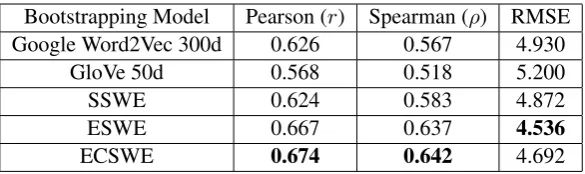
Table 3: AA results when bootstrapped from different word embeddings and trained on the extended FCE version (FCEext). The bold values indicate the best results.
erated counterparts per ngram to 20 and the size of hidden layer to100.9 For the AA network, ini-tialized with any of the5models,his set to100, and learning rate to0.001when training on pub-lic FCE and0.0001on FCEext. The sizes used for error and script filters are shown in Table1.10 All the networks are optimized using Stochastic Gra-dient Descent (SGD). The AA system is regular-ized withL2regularization with rate =0.0001and trained for50epochs during which performance is monitored on the dev sets. Finally, the AA model with the best mean square error over the dev sets is selected.
5 Results and Discussion
The public FCE results shown in Table 2 reveal that AA-specific embedding pre-training offers further gains in performance over the traditional embeddings trained on large corpora (Google and GloVe embeddings), which suggests that they are more suited for the AA task. The table also demonstrates that the ESWE model outperforms the SSWE one on correlation metrics, with a slight difference in the RMSE value. While the vari-ance in the correlations between the two models is noticeable and suggests that the ESWE model is a more powerful one, the RMSE values weaken this assumption. This result could be attributed to the fact that public FCE is a small dataset with sparse error representations and SSWE is trained on 20 times more data as each ngram is paired with20randomly generated counterparts. There-fore, a more relevant comparison is needed and could be achieved by either training on more data, as will be discussed later, or further enriching the embedding space with corrections (ECSWE). Table 2 demonstrates that learning from the
er-9Using the same parameters asAlikaniotis et al.(2016). 10Tuning the filter sizes was done for each model
sepa-rately; for the Glove and Word2Vec models, a filter of size3 performed better than9, on both datasets.
rors and their corrections enhances the error pre-training performance on public FCE which indi-cates the usefulness of the approach and its ability to mitigate the effects of data sparsity. Accord-ing to the results, trainAccord-ing the model based on nat-urally occurring errors and their correct counter-parts is better suited to the AA task rather than in-troducing artificial noisy contexts and tuning the embeddings according to scripts’ scores or relying on word distributions learned from large corpora.
For a more robust analysis, we examine the performance when training on additional data (FCEext) as shown in Table3. Comparing the re-sults in Tables 2and 3proves that training with more data boosts the predictive power of all the models. It is also clear from Table 3 that with more data, the discrepancy in the performance be-tween SSWE and ESWE models becomes more prominent and ESWE provides a superior perfor-mance on all evaluation metrics which suggests that, qualitatively, learning from learners’ errors is a more efficient bootstrapping method. How-ever, with FCEext, the ECSWE approach outper-forms ESWE on correlation metrics while giving a worse RMSE value. This change in the results when training on a bigger dataset indicates that the effect of incorporating the corrections in training becomes less obvious with enough data as the dis-tribution of correct and incorrect ngrams is enough to learn from.
6 Analysis
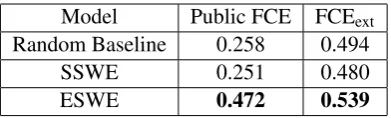
We conduct further analysis to the scores predicted by AA-specific embeddings by investigating the ability of the ESWE and SSWE models to de-tect errors in text. We run each model for 20
Model Public FCE FCEext Random Baseline 0.258 0.494
SSWE 0.251 0.480
[image:8.595.84.280.61.120.2]ESWE 0.472 0.539
Table 4: AP results of the random baseline and SSWE and EWE models when trained on public and extended FCE sets and tested on the respective dev sets. The AP is calculated with respect to the error class.
zero value if it contains any errors and one oth-erwise. ESWE predicts a score∈ [0,1]for each ngram indicating its correctness and hence could be used directly in the evaluation. On the other hand, SSWE predicts two scores for each ngram:
correct score that it maximizes in comparison to the noisy ngrams andscript score that should be high for good ngrams that occur in highly-graded scripts. The two scores are hence expected to be high for high-quality ngrams and low otherwise, which suggests that they can be used as proxies for error detection. We calculate the ngram pre-dicted score of the SSWE model as a weighted sum of the correct and script scores, similar to its loss function (Equation1withα = 0.1), and map the output to a[0,1]probability based on the min-imum and maxmin-imum generated scores.11 We cal-culate the average precision (AP) between the true scores and predicted ones with respect to the error representing class (true score = 0) and compare it to a random baseline, where random probability scores are generated. The results are displayed in Table4which shows that ESWE achieves a higher AP score on all evaluation sets, particularly with public FCE, and SSWE’s performance is similar to the random baseline. This result is expected since the ESWE model is trained to predict ac-tual errors, yet an empirical verification was re-quired. We conclude from this analysis that tuning the embeddings based on training writing errors increases their sensitivity to unseen errors which is key for learners’ data assessment and yields bet-ter performance than comparable pre-training ap-proaches.
7 Conclusion and Future Work
In this work, we have presented two error-oriented approaches to train the word embeddings used by
11Different score combinations were implemented
includ-ing usinclud-ing only one score, but they all led to similar results.
writing assessment neural networks. The first ap-proach learns to discriminate between good and bad ngrams by leveraging writing errors occur-ring in learner data. The second extends the first by combining the error representations with their suggested corrections and tuning the embedding space accordingly. Our motivation for applying these models is to provide neural assessment sys-tems with the minimum features useful for the task in an attempt to boost their performance on chal-lenging datasets while still avoiding heavy fea-ture engineering. The presented results demon-strate that our error-oriented embeddings are better suited for learners’ script assessment than generic embeddings trained on large corpora when both are used to bootstrap a neural assessment model. Additionally, our embeddings have yielded supe-rior performance to those that rely on ranking cor-rect and noisy contexts as well as words’ contri-butions to the script’s overall score. Furthermore, extending our error embeddings with error correc-tions has enhanced the performance when trained on small data, while having a less obvious effect when trained on greater amounts of data which shows their efficacy to enrich the embedding space and mitigate data sparsity issues. We further anal-ysed our embeddings and the score-specific ones and showed empirically that error-oriented repre-sentations are better at error detection which expli-cates their superior performance in learners’ data evaluation.
Our best performing model still underperforms the state-of-the-art system byYannakoudakis et al.
(2011) that utilises a wide variety of features, even when they exclude error related features. How-ever, the improvement obtained by error-oriented models over employing generic embeddings or score-specifc ones suggests that our pre-training approach is a promising avenue of research as it provides neural network assessment with useful information and motivates learning relevant prop-erties associated with language proficiency.
fea-tures that could be useful for assessment models and incorporating them in the pre-training stage. This way the performance could be further en-hanced with less information than what heavily engineered systems require.
References
Rami Al-Rfou, Guillaume Alain, Amjad Almahairi, et al. 2016. Theano: A Python framework for fast computation of mathematical expressions .
Dimitrios Alikaniotis, Helen Yannakoudakis, and Marek Rei. 2016. Automatic text scoring using neu-ral networks. In Proceedings of the 54th Annual Meeting of the Association for Computational Lin-guistics (Volume 1: Long Papers). Association for Computational Linguistics, pages 715–725.
Øistein E Andersen, Helen Yannakoudakis, Fiona Barker, and Tim Parish. 2013. Developing and test-ing a self-assessment and tutortest-ing system. In Pro-ceedings of the Eighth Workshop on Innovative Use of NLP for Building Educational Applications, BEA. pages 32–41.
Yigal Attali and Jill Burstein. 2006. Automated essay scoring with e-raterR v. 2. The Journal of
Technol-ogy, Learning and Assessment4(3).
Ted Briscoe, John Carroll, and Rebecca Watson. 2006. The second release of the rasp system. In Proceed-ings of the COLING/ACL on Interactive presenta-tion sessions. Association for Computational Lin-guistics, pages 77–80.
Ronan Collobert and Jason Weston. 2008. A unified architecture for natural language processing: Deep neural networks with multitask learning. In Pro-ceedings of the 25th international conference on Machine learning. ACM, pages 160–167.
Fei Dong and Yue Zhang. 2016. Automatic features for essay scoring – an empirical study. In Proceed-ings of the 2016 Conference on Empirical Methods in Natural Language Processing. pages 1072–1077.
Adriano Ferraresi, Eros Zanchetta, Marco Baroni, and Silvia Bernardini. 2008. Introducing and evaluating ukwac, a very large web-derived corpus of english. InProceedings of the 4th Web as Corpus Workshop (WAC-4) Can we beat Google. sn, pages 47–54.
Ronald A Fisher. 1922. On the interpretation ofχ 2 from contingency tables, and the calculation of p.
Journal of the Royal Statistical Society85(1):87–94.
Thomas K Landauer, Darrell Laham, and Peter W Foltz. 2003. Automated scoring and annotation of essays with the intelligent essay assessor. Auto-mated essay scoring: A cross-disciplinary perspec-tivepages 87–112.
Quoc Le and Tomas Mikolov. 2014. Distributed repre-sentations of sentences and documents. In Proceed-ings of the 31st International Conference on Ma-chine Learning (ICML-14). pages 1188–1196. Tomas Mikolov, Ilya Sutskever, Kai Chen, Greg S
Cor-rado, and Jeff Dean. 2013. Distributed representa-tions of words and phrases and their compositional-ity. InAdvances in neural information processing systems. pages 3111–3119.
Diane Nicholls. 2003. The cambridge learner corpus: Error coding and analysis for lexicography and elt. InProceedings of the Corpus Linguistics 2003 con-ference. volume 16, pages 572–581.
Ellis Batten Page. 2003. Project essay grade: Peg.
Automated essay scoring: A cross-disciplinary per-spectivepages 43–54.
Jeffrey Pennington, Richard Socher, and Christo-pher D. Manning. 2014. Glove: Global vectors for word representation. InEmpirical Methods in Nat-ural Language Processing (EMNLP). pages 1532– 1543.
Peter Phandi, Kian Ming Adam Chai, and Hwee Tou Ng. 2015. Flexible domain adaptation for automated essay scoring using correlated linear regression. In
EMNLP. pages 431–439.
Marek Rei and Helen Yannakoudakis. 2016. Composi-tional sequence labeling models for error detection in learner writing. InProceedings of the 54th An-nual Meeting of the Association for Computational Linguistics (Volume 1: Long Papers). Association for Computational Linguistics, pages 1181–1191. Lawrence M Rudner and Tahung Liang. 2002.
Au-tomated essay scoring using bayes’ theorem. The Journal of Technology, Learning and Assessment
1(2).
Kaveh Taghipour and Hwee Tou Ng. 2016. A neural approach to automated essay scoring. In Proceed-ings of the 2016 Conference on Empirical Meth-ods in Natural Language Processing. Association for Computational Linguistics, pages 1882–1891. Joseph Turian, Lev Ratinov, and Yoshua Bengio. 2010.
Word representations: a simple and general method for semi-supervised learning. InProceedings of the 48th annual meeting of the association for computa-tional linguistics. pages 384–394.
Helen Yannakoudakis, Ted Briscoe, and Ben Medlock. 2011. A new dataset and method for automatically grading esol texts. InProceedings of the 49th An-nual Meeting of the Association for Computational Linguistics: Human Language Technologies-Volume 1. Association for Computational Linguistics, pages 180–189.