DCU System Report on the WMT 2017
Multi-modal Machine Translation Task
Iacer Calixto and Koel Dutta Chowdhury and Qun Liu
{iacer.calixto,koel.chowdhury,qun.liu}@adaptcentre.ie
Abstract
We report experiments with multi-modal neural machine translation models that in-corporate global visual features in differ-ent parts of the encoder and decoder, and use the VGG19 network to extract fea-tures for all images. In our experiments, we explore both different strategies to in-clude global image features and also how ensembling different models at inference time impact translations. Our submissions ranked 3rd best for translating from
En-glish into French, always improving con-siderably over an neural machine transla-tion baseline across all language pair eval-uated, e.g. an increase of 7.0–9.2
ME-TEOR points.
1 Introduction
In this paper we report on our application of three different multi-modal neural machine translation (NMT) systems to translate image descriptions. We use encoder–decoder attentive multi-modal NMT models where each training example con-sists of one source variable-length sequence, one image, and one target variable-length sequence, and a model is trained to translate sequences in the source language into corresponding sequences in the target language while taking the image into consideration. We use the three models introduced in Calixto et al. (2017b), which integrate global image features extracted using a pre-trained con-volutional neural network into NMT(i) as words in the source sentence,(ii)to initialise the encoder hidden state, and(iii)as additional data to initialise the decoder hidden state.
We are inspired by the recent success of multi-modal NMT models applied to the translation of image descriptions (Huang et al., 2016; Calixto
et al., 2017a). Huang et al. (2016) incorporate global visual features into NMT with some suc-cess, andCalixto et al.(2017a) propose to use lo-cal visual features instead, achieving better results. We follow Calixto et al. (2017b) and investigate whether we can achieve better results while still using global visual features, which are consider-ably smaller and simpler to integrate when com-pared to local features.
We expect that, by integrating visual informa-tion when translating image descripinforma-tions, we are able to exploit valuable information from both modalities when generating the target description, effectively grounding machine translation ( Glen-berg and Robertson,2000).
2 Model Description
The models used in our experiments can be viewed as expansions of the attentive NMT framework in-troduced byBahdanau et al.(2015) with the addi-tion of a visual component that incorporates visual features from images. A bi-directional recurrent neural network (RNN) with gated recurrent unit (GRU) (Cho et al., 2014) is used as the encoder. The final annotation vector for a given source po-sitioniis the concatenation of forward and back-ward RNN hidden states,hi =−→hi;←h−i.
We use the publicly available pre-trained con-volution neural network VGG191 of Simonyan and Zisserman(2014) to extract global image fea-ture vectors for all images. These feafea-tures are the 4096D activations of the penultimate
fully-connected layer FC7, henceforth referred to asq.
We now describe the three multi-modal NMT models used in our experiments. For a detailed explanation about these models, seeCalixto et al. (2017b).
1http://www.robots.ox.ac.uk/˜vgg/
research/very_deep/
2.1 IMG2W: Image as source words
In model IMG2W, the image features are used
as the first and last words of the source sen-tence, and the source-language attention model learns when to attend to the image representations. Specifically, given the global image feature vector
q∈R4096:
d=WI2·(WI1·q+b1I) +b2I, (1)
whereW1
I ∈R4096×4096andWI2 ∈R4096×dxare image transformation matrices, b1I ∈ R4096 and
b2I ∈ Rdx are bias vectors, and d
x is the source words vector space dimensionality, all trained with the model.
We directly use d as the first and last
words of the source sentence. In other words, given the word embeddings for a source sen-tence X = (x1,x2,· · · ,xN), we concate-nate the transformed image vector d to it, i.e.
X= (d,x1,x2,· · ·,xN,d), and apply the for-ward and backfor-ward encoder RNN. By including images into the encoder in model IMG2W, our
in-tuition is that(i)by including the image as thefirst word, we propagate image features into the source sentence vector representations when applying the forward RNN to produce vectors−→hi, and(ii)by in-cluding the image as thelast word, we propagate image features into the source sentence vector rep-resentations when applying the backward RNN to produce vectors←h−i.
2.2 IMGE: Image for encoder initialisation In the original attention-based NMT model of Bahdanau et al.(2015), the hidden state of the en-coder is initialised with the zero vector #»0.
In-stead, we propose to use two new single-layer feed-forward neural networks to compute the ini-tial states of the forward and the backward RNN, respectively.
Similarly to what we do for model IMG2W
de-scribed in Section 2.1, given a global image fea-ture vector q ∈ R4096, we compute a vector d
using Equation (1), only this time the parameters
W2
I and b2I project the image features into the same dimensionality as the hidden states of the source language encoder.
The feed-forward networks used to initialise the encoder hidden state are computed as in (2):
←−
hinit= tanh Wfd+bf
,
− →
hinit= tanh Wbd+bb
, (2)
where Wf and Wb are multi-modal projection matrices that project the image featuresdinto the
encoder forward and backward hidden states di-mensionality, respectively, andbf andbb are bias vectors. −→hinit and ←h−init are directly used as the
forward and backward RNN initial hidden states, respectively.
2.3 IMGD: Image for decoder initialisation To incorporate an image into the decoder, we in-troduce a new single-layer feed-forward neural network. Originally, the decoder initial hidden state is computed using a summary of the encoder hidden states. This is often the concatenation of the last hidden states of the encoder forward RNN and backward RNN, respectively−→hN and←h−1, or
the mean of the source-language annotation vec-torshi.
We propose to include the image features as additional input to initialise the decoder’s hidden state, as described in (3):
s0 = tanh Wdi[←h−1;−→hN] +Wmd+bdi
, (3)
wheres0 is the decoder initial hidden state,Wm is a multi-modal projection matrix that projects the image featuresdinto the decoder hidden state
di-mensionality and Wdiandbdi are learned model parameters.
Once again we computedby applying Equation
(1) onto a global image feature vectorq∈R4096,
only this time the parametersW2
I andb2I project the image features into the same dimensionality as the decoder hidden states.
3 Experiments
We report results for Task 1, specifically when translating from English into German (en–de) and French (en–fr). We conducted experiments on the constrained version of the shared task, which means that the only training data we used is the data released by the shared task organisers, i.e. thetranslated Multi30k(M30kT) data set (Elliott
et al.,2016) with the additional French image de-scriptions, included for the 2017 run of the shared task.
jointly with our model. All non-recurrent matri-ces are initialised by sampling from a Gaussian distribution (µ = 0, σ = 0.01), recurrent
matri-ces are random orthogonal and bias vectors are all initialised to #»0. We apply dropout (Srivastava
et al., 2014) with a probability of 0.3 in source
and target word embeddings, in the image fea-tures, in the encoder and decoder RNNs inputs and recurrent connections, and before the readout op-eration in the decoder RNN. We follow Gal and Ghahramani(2016) and apply dropout to the en-coder bidirectional RNN and deen-coder RNN using the same mask in all time steps.
The translated Multi30k training and validation sets contain 29k and 1014 images respectively, each accompanied by a sentence triple, the orig-inal English sentence and its gold-standard trans-lations into German and into French.
We use the scripts in the Moses SMT Toolkit (Koehn et al., 2007) to normalise, lowercase and tokenize English, German and French descriptions and we also convert space-separated tokens into subwords (Sennrich et al., 2016). The subword models are trained jointly for English–German scriptions and separately for English–French de-scriptions using the German and English-French WMT 2015 data (Bojar et al., 2015). English–German models have a final vocabulary of74K English and81K German subword tokens,
and English–French models82K English and82K
French subword tokens. If sentences in English, German or French are longer than 80 tokens, they are discarded.
Finally, we use the 29K entries in the M30kT
training set for training our models, and the
1,014 entries in the M30kT development set for
model selection, early stopping the training pro-cedure in case the model stops improving BLEU scores on this development set. We evaluate our English–German models on three held-out test sets, the Multi30k 2016/2017 and the MSCOCO 2017 test sets, and our English–French models on the Multi30k 2017 and the MSCOCO 2017 test sets.
We evaluate translation quality quantitatively in terms of BLEU4(Papineni et al.,2002), METEOR
(Denkowski and Lavie,2014), and TER (Snover et al.,2006).
Multi30k 2017
Lang. Model BLEU4↑ METEOR↑ TER↓ en–de NMT baseline 19.3 41.9 72.2 en–de Ensemble 29.8(↑10.3) 50.5(↑8.6) 52.3(↓19.9)
en–fr NMT baseline 44.3 63.1 39.6 en–fr Ensemble 54.1(↑9.8) 70.1(↑7.0) 30.0(↓9.6)
Table 1: Results for the M30kT 2017 English–
German and English–French test sets. All models are trained on the original M30kT training data.
Our ensemble uses four multi-modal models, all independently trained: two models IMGD, one
model IMGE, and one model IMG2W.
MSCOCO 2017
Lang. Model BLEU4↑ METEOR↑ TER↓ en–de NMT baseline 18.7 37.6 66.1 en–de Ensemble 26.4(↑7.7) 46.8(↑9.2) 54.5(↓11.6)
en–fr NMT baseline 35.1 55.8 45.8 en–fr Ensemble 44.5(↑9.4) 64.1(↑8.3) 35.2(↓10.6)
Table 2: Results for the MSCOCO 2017 English– German and English–French test sets. All mod-els are trained on the original M30kT training
data. Ensemble uses four multi-modal models, all trained independently: two models IMGD, one
model IMGE, and one model IMG2W.
3.1 Results
In Table 1, we show results when translating the Multi30k 2017 test sets. Models are trained on the original M30kT training data only. The NMT
baseline is the attention-based NMT model of Bahdanau et al.(2015) and its results are the ones reported by the shared task organisers. When com-pared to other submissions of the multi-modal MT task under the constrained data regime, our mod-els ranked sixth best when translating the English– German Multi30k 2017, and fourth best when translating the English–German MSCOCO 2017 test sets. When translating both the Multi30k 2017 and the MSCOCO 2017 English–French test sets, our models are ranked third best, scoring only 1–2 points (BLEU, METEOR) less than the best sys-tem.
In Table2, we show results when translating the MSCOCO 2017 English–German and English– French test sets. Again, all models are trained on the original M30kT training data only. When
lan-Multi30k 2016 (English→German)
Ensemble? BLEU4↑ METEOR↑ TER↓
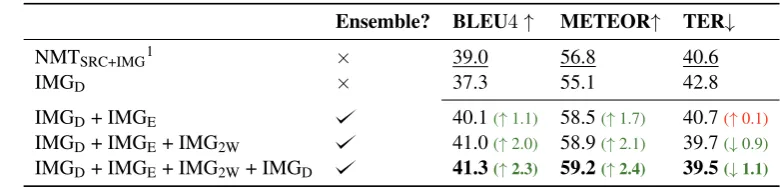
NMTSRC+IMG1 × 39.0 56.8 40.6
IMGD × 37.3 55.1 42.8
IMGD+ IMGE 40.1(↑1.1) 58.5(↑1.7) 40.7(↑0.1)
IMGD+ IMGE+ IMG2W 41.0(↑2.0) 58.9(↑2.1) 39.7(↓0.9) IMGD+ IMGE+ IMG2W+ IMGD 41.3(↑2.3) 59.2(↑2.4) 39.5(↓1.1) 1 This model is pre-trained on the English–German WMT 2015 (Bojar et al.,2015), consisting of∼4.3M
[image:4.595.99.491.74.168.2]sentence pairs.
Table 3: Results for the best model ofCalixto et al.(2017a), which is pre-trained on the English–German WMT 2015 (Bojar et al., 2015), and different combinations of multi-modal models, all trained on the original M30kTtraining data only, evaluated on the M30kT 2016 test set.
guage pair, scoring only 1 to 1.5 points less than the best system. These are promising results, spe-cially taking into consideration that we are us-ing global image features, which are smaller and simpler than local features (used inCalixto et al. (2017a)).
Ensemble decoding We now report on how can ensemble decoding be used to improve multi-modal MT. In Table3, we show results when trans-lating the Multi30k 2016’s test set. We ensem-bled different models by starting with one of Cal-ixto et al.(2017b)’s best performing multi-modal models on this data set, IMGD, and by adding new
models to the ensemble one by one, until we reach a maximum of four independent models, all of which are trained separately and on the original M30kT training data only. We also report results
for the best model ofCalixto et al.(2017a), which is pre-trained on the English–German WMT 2015 (Bojar et al.,2015) and uses local visual features extracted with the ResNet-50 network (He et al., 2015).
We first note that adding more models to the ensemble seems to always improve translations by a large margin (∼3BLEU/METEOR points).
Adding model IMG2W to the ensemble already
consisting of models IMGE and IMGD still
im-proves translations, according to all metrics evalu-ated. This is an interesting result, since compared to these other two multi-modal models, model IMG2W performs the worst according to BLEU,
METEOR and chrF3 (seeCalixto et al.(2017b)). Our best results are obtained with an ensemble of four different multi-modal models.
By using an ensemble of four different multi-modal NMT models trained on the translated
Multi30k training data, we were able to obtain translations comparable to or even better than those obtained with the strong multi-modal NMT model of Calixto et al. (2017a), which is pre-trained on large amounts of WMT data and uses local image features.
4 Conclusions and Future work
In this work, we evaluated multi-modal NMT models which integrateglobal image featuresinto both the encoder and the decoder. We exper-imented with ensembling different multi-modal NMT models introduced inCalixto et al.(2017b), and results show that these models can gener-ate translations that compare favourably to multi-modal models that use local image features. We observe consistent improvements over a text-only NMT baseline trained on the same data, and these are typically very large (e.g., 7.0–9.2 METEOR points across language pairs and test sets). In fu-ture work we plan to study how to generalise these models to other multi-modal natural language pro-cessing tasks, e.g. visual question answering.
Acknowledgments
References
Dzmitry Bahdanau, Kyunghyun Cho, and Yoshua Bengio. 2015. Neural Machine Translation by Jointly Learning to Align and Translate. In Inter-national Conference on Learning Representations, ICLR 2015. San Diego, California.
Ondˇrej Bojar, Rajen Chatterjee, Christian Federmann, Barry Haddow, Matthias Huck, Chris Hokamp, Philipp Koehn, Varvara Logacheva, Christof Monz, Matteo Negri, Matt Post, Carolina Scarton, Lucia Specia, and Marco Turchi. 2015. Findings of the 2015 Workshop on Statistical Machine Translation.
In Proceedings of the Tenth Workshop on
Statisti-cal Machine Translation. Association for
Compu-tational Linguistics, Lisbon, Portugal, pages 1–46.
http://aclweb.org/anthology/W15-3001.
Iacer Calixto, Qun Liu, and Nick Campbell. 2017a. Doubly-Attentive Decoder for Multi-modal Neural Machine Translation. In Proceedings of the 55th Conference of the Association for Computational
Linguistics: Volume 1, Long Papers. Vancouver,
Canada (Paper Accepted).
Iacer Calixto, Qun Liu, and Nick Campbell. 2017b. In-corporating Global Visual Features into Attention-Based Neural Machine Translation. InProceedings of the 2017 Conference on Empirical Methods in
Natural Language Processing. Copenhagen,
Den-mark (Paper Accepted).
Kyunghyun Cho, Bart van Merrienboer, Caglar Gul-cehre, Dzmitry Bahdanau, Fethi Bougares, Hol-ger Schwenk, and Yoshua Bengio. 2014. Learn-ing Phrase Representations usLearn-ing RNN Encoder– Decoder for Statistical Machine Translation. In
Proceedings of the 2014 Conference on Em-pirical Methods in Natural Language
Process-ing (EMNLP). Doha, Qatar, pages 1724–1734.
http://www.aclweb.org/anthology/D14-1179.
Michael Denkowski and Alon Lavie. 2014. Meteor Universal: Language Specific Translation Evalua-tion for Any Target Language. InProceedings of the EACL 2014 Workshop on Statistical Machine
Trans-lation. The Association for Computer Linguistics,
Gothenburg, Sweden.
Desmond Elliott, Stella Frank, Khalil Sima’an, and Lucia Specia. 2016. Multi30K: Multilin-gual English-German Image Descriptions. In
Proceedings of the 5th Workshop on Vision
and Language, VL@ACL 2016. Berlin,
Ger-many. http://aclweb.org/anthology/W/W16/W16-3210.pdf.
Yarin Gal and Zoubin Ghahramani. 2016. A Theoreti-cally Grounded Application of Dropout in Recurrent Neural Networks. InAdvances in Neural
Informa-tion Processing Systems, NIPS. Barcelona, Spain,
pages 1019–1027. http://papers.nips.cc/paper/6241- a-theoretically-grounded-application-of-dropout-in-recurrent-neural-networks.pdf.
A. Glenberg and D. Robertson. 2000.
Sym-bol grounding and meaning: A comparison
of high-dimensional and embodied theories of
meaning. Journal of Memory and Language
http://psych.wisc.edu/glenberg/.
Kaiming He, Xiangyu Zhang, Shaoqing Ren, and Jian Sun. 2015. Deep Residual Learning for Image Recognition.arXiv preprint arXiv:1512.03385.
Po-Yao Huang, Frederick Liu, Sz-Rung Shiang, Jean Oh, and Chris Dyer. 2016. Attention-based Multimodal Neural Machine Translation. In
Proceedings of the First Conference on Machine
Translation. Berlin, Germany, pages 639–645.
http://www.aclweb.org/anthology/W/W16/W16-2360.
Philipp Koehn, Hieu Hoang, Alexandra Birch, Chris Callison-Burch, Marcello Federico, Nicola Bertoldi, Brooke Cowan, Wade Shen, Christine Moran, Richard Zens, Chris Dyer, Ondˇrej Bojar, Alexandra Constantin, and Evan Herbst. 2007. Moses: Open Source Toolkit for Statistical Machine Translation.
In Proceedings of the 45th Annual Meeting of the
ACL on Interactive Poster and Demonstration
Ses-sions. Association for Computational Linguistics,
Prague, Czech Republic, ACL ’07, pages 177–180.
http://dl.acm.org/citation.cfm?id=1557769.1557821.
Kishore Papineni, Salim Roukos, Todd Ward, and Wei-Jing Zhu. 2002. BLEU: A Method for Au-tomatic Evaluation of Machine Translation. In
Proceedings of the 40th Annual Meeting on As-sociation for Computational Linguistics. Philadel-phia, Pennsylvania, ACL ’02, pages 311–318.
https://doi.org/10.3115/1073083.1073135.
Rico Sennrich, Barry Haddow, and Alexandra Birch. 2016. Neural Machine Translation of Rare Words with Subword Units. In Proceedings of the 54th Annual Meeting of the Associa-tion for ComputaAssocia-tional Linguistics (Volume 1:
Long Papers). Berlin, Germany, pages 1715–1725.
http://www.aclweb.org/anthology/P16-1162.
K. Simonyan and A. Zisserman. 2014. Very Deep Con-volutional Networks for Large-Scale Image Recog-nition.CoRRabs/1409.1556.
Matthew Snover, Bonnie Dorr, Richard Schwartz, Lin-nea Micciulla, and John Makhoul. 2006. A study of translation edit rate with targeted human annotation.
InProceedings of Association for Machine
Transla-tion in the Americas, AMTA. Cambridge, MA, USA,
pages 223–231.
Nitish Srivastava, Geoffrey Hinton, Alex Krizhevsky, Ilya Sutskever, and Ruslan Salakhutdinov. 2014. Dropout: A simple way to prevent neural networks from overfitting. Journal of
Machine Learning Research 15:1929–1958.