SemEval-2013 Task 1: T
EMP
E
VAL
-3: Evaluating Time Expressions,
Events, and Temporal Relations
Naushad UzZaman
♣1, Hector Llorens
♦1, Leon Derczynski
♥,
Marc Verhagen
♠, James Allen
♣and
James Pustejovsky
♠♣: University of Rochester, USA;♦: University of Alicante, Spain
♥: Department of Computer Science, University of Sheffield, UK
♠: Computer Science Department, Brandeis University, USA
1: Nuance Communications
[email protected], [email protected], [email protected]
Abstract
Within the SemEval-2013 evaluation exercise, the TempEval-3 shared task aims to advance research on temporal information processing. It follows on from TempEval-1 and -2, with: a three-part struc-ture covering temporal expression, event, and tem-poral relation extraction; a larger dataset; and new single measures to rank systems – in each task and in general. In this paper, we describe the participants’ approaches, results, and the observations from the results, which may guide future research in this area.
1
Introduction
The TempEval task (Verhagen et al., 2009) was added as a new task in SemEval-2007. The ultimate aim of research in this area is the automatic identification of temporal ex-pressions (timexes), events, and temporal relations within a text as specified in TimeML annotation (Pustejovsky et al., 2005). However, since addressing this aim in a first evaluation challenge was deemed too difficult a staged approach was suggested.
TempEval (henceforth TempEval-1) was an initial evaluation exercise focusing only on the categorization of temporal relations and only in English. It included three relation types: event-timex, event-dct,1 and relations be-tween main events in consecutive sentences.
TempEval-2 (Verhagen et al., 2010) extended TempEval-1, growing into a multilingual task, and con-sisting of six subtasks rather than three. This included event and timex extraction, as well as the three relation tasks from TempEval-1, with the addition of a relation task where one event subordinates another.
TempEval-3 (UzZaman et al., 2012b) is a follow-up to TempEval 1 and 2, covering English and Spanish. TempEval-3 is different from its predecessors in a few respects:
1DCT stands for document creation time
Size of the corpus: the dataset used has about 600K word silver standard data and about 100K word gold stan-dard data for training, compared to around 50K word cor-pus used in TempEval 1 and 2. Temporal annotation is a time-consuming task for humans, which has limited the size of annotated data in previous TempEval exer-cises. Current systems, however, are performing close to the inter-annotator reliability, which suggests that larger corpora could be built from automatically annotated data with minor human reviews. We want to explore whether there is value in adding a large automatically created sil-ver standard to a hand-crafted gold standard.
End-to-end temporal relation processing task: the temporal relation classification tasks are performed from raw text, i.e. participants need to extract their own events and temporal expressions first, determine which ones to link and then obtain the relation types. In previous Tem-pEvals, gold timexes, events, and relations (without cate-gory) were given to participants.
Temporal relation types: the full set of temporal re-lations in TimeML are used, rather than the reduced set used in earlier TempEvals.
Platinum test set: A new test dataset has been devel-oped for this edition. It is based on manual annotations by experts over new text (unseen in previous editions).
Evaluation:we report a temporal awareness score for evaluating temporal relations, which helps to rank sys-tems with a single score.
2
Data
In TempEval-3, we reviewed and corrected existing cor-pora, and also released new corpora.
2.1 Reviewing Existing Corpora
We considered the existing TimeBank (Pustejovsky et al., 2003) and AQUAINT2data for 3.
TempEval-2See http://timeml.org/site/timebank/timebank.html
Entity Agreement
Event 0.87
Event class 0.92
Timex 0.87
[image:2.612.138.236.64.116.2]Timex value 0.88
Table 1: Platinum corpus entity inter-annotator agreement.
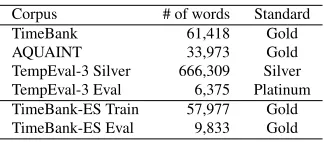
Corpus # of words Standard
TimeBank 61,418 Gold
AQUAINT 33,973 Gold
TempEval-3 Silver 666,309 Silver TempEval-3 Eval 6,375 Platinum TimeBank-ES Train 57,977 Gold TimeBank-ES Eval 9,833 Gold
Table 2: Corpora used in TempEval-3.
1 and TempEval-2 had the same documents as TimeBank but different relation types and events.
For both TimeBank and AQUAINT, we, (i) cleaned up the formatting for all files making it easy to review and read, (ii) made all files XML and TimeML schema com-patible, (iii) added some missing events and temporal ex-pressions. In TimeBank, we, (i) borrowed the events from the TempEval-2 corpus and (ii) borrowed the temporal re-lations from TimeBank corpus, which contains a full set of temporal relations. In AQUAINT, we added the tem-poral relations between event and DCT (document cre-ation time), which was missing for many documents in that corpus. These existing corpora comprised the high-quality component of our training set.
2.2 New Corpora
We created two new datasets: a small, manually-annotated set over new text (platinum); and a machine-annotated, automatically-merged dataset based on out-puts of multiple systems (silver).
The TempEval-3platinumevaluation corpus was anno-tated/reviewed by the organizers, who are experts in the area. This process used the TimeML Annotation Guide-lines v1.2.1 (Saur´ı et al., 2006). Every file was anno-tated independently by at least two expert annotators, and a third was dedicated to adjudicating between annotations and merging the final result. Some annotators based their work on TIPSem annotation suggestions (Llorens et al., 2012b). The GATE Annotation Diff tool was used for merging (Cunningham et al., 2013), a custom TimeML validator ensured integrity,3and CAVaT (Derczynski and Gaizauskas, 2010) was used to determine various modes of TimeML mis-annotation and inconsistency that are in-expressable via XML schema. Post-exercise, that corpus (TempEval-3 Platinum with around 6K tokens, on com-pletely new text) is released for the community to review
3See https://github.com/hllorens/TimeML-validator
and improve.4 Inter-annotator agreement (measured with F1, as per Hripcsak and Rothschild (2005)) and the num-ber of annotation passes per document were higher than in existing TimeML corpora, hence the name. Details are given in Table 1. Attribute value scores are given based on the agreed entity set. These are for exact matches.
The TempEval-3 silver evaluation corpus is a 600K word corpus collected from Gigaword (Parker et al., 2011). We automatically annotated this corpus by TIPSem, TIPSem-B (Llorens et al., 2013) and TRIOS (UzZaman and Allen, 2010). These systems were retrained on the corrected TimeBank and AQUAINT cor-pus to generate the original TimeML temporal relation set. We then merged these three state-of-the-art sys-tem outputs using our merging algorithm (Llorens et al., 2012a). In our selected merged configuration all entities and relations suggested by the best system (TIPSem) are added in the merged output. Suggestions from other sys-tems (TRIOS and TIPSem-B) are added in the merged output, only if they are also supported by another system. The weights considered in our configuration are: TIPSem 0.36, TIPSemB 0.32, TRIOS 0.32.
For Spanish, Spanish TimeBank 1.0 corpus (Saur´ı and Badia, 2012) wads used. It is the same corpus that was used in TempEval-2, with a major review of entity anno-tation and an important improvement regarding temporal relation annotation. For TempEval-3, we converted ES-TimeBank link types to the TimeML standard types based on Allen’s temporal relations (Allen, 1983).
Table 2 summarizes our released corpora, measured with PTB-scheme tokens as words. All data produced was annotated using a well-defined subset of TimeML, designed for easy processing, and for reduced ambigu-ity compared to standard TimeML. Participants were en-couraged to validate their submissions using a purpose-built tool to ensure that submitted runs were legible. We called this standard TimeML-strict, and release it sepa-rately (Derczynski et al., 2013).
3
Tasks
The three main tasks proposed for TempEval-3 focus on TimeML entities and relations:
3.1 Task A (Timex extraction and normalization)
Determine the extent of the timexes in a text as defined by the TimeML TIMEX3 tag. In addition, determine the value of the features TYPE and VALUE. The possible values of TYPE are time, date, duration, and set; VALUE is a normalized value as defined by the TIMEX3 standard.
4In the ACL data and code repository, referenceADCR2013T001.
[image:2.612.106.268.145.216.2]3.2 Task B (Event extraction and classification)
Determine the extent of the events in a text as defined by the TimeML EVENT tag and the appropriate CLASS.
3.3 Task ABC (Annotating temporal relations)
This is the ultimate task for evaluating an end-to-end sys-tem that goes from raw text to TimeML annotation of entities and links. It entails performing tasks A and B. From raw text extract the temporal entities (events and timexes), identify the pairs of temporal entities that have a temporal link (TLINK) and classify the temporal re-lation between them. Possible pair of entities that can have a temporal link are: (i) main events of consecu-tive sentences, (ii) pairs of events in the same sentence, (iii) event and timex in the same sentence and (iv) event and document creation time. In TempEval-3, TimeML relation are used, i.e.: BEFORE,AFTER,INCLUDES, IS-INCLUDED, DURING, SIMULTANEOUS, IMMEDIATELY AFTER, IMMEDIATELY BEFORE, IDENTITY, BEGINS, ENDS,BEGUN-BYandENDED-BY.
In addition to this main tasks, we also include two extra temporal relation tasks:
Task C (Annotating relations given gold entities) Given the gold entities, identify the pairs of entities that have a temporal link (TLINK) and classify the temporal relations between them.
Task C relation only (Annotating relations given gold entities and related pairs) Given the temporal entities and the pair of entities that have a temporal link, classify the temporal relation between them.
4
Evaluation Metrics
The metrics used to evaluate the participants are:
4.1 Temporal Entity Extraction
To evaluate temporal entities (events and temporal ex-pressions), we need to evaluate, (i) How many entities are correctly identified, (ii) If the extents for the entities are correctly identified, and (iii) How many entity attributes are correctly identified. We use classical precision and recall for recognition.
How many entities are correctly identified: We evalu-ate our entities using the entity-based evaluation with the equations below.
P recision=|Sysentity∩Refentity|
|Sysentity|
Recall= |Sysentity∩Refentity|
|Refentity|
where,Sysentitycontains the entities extracted by the
system that we want to evaluate, andRefentitycontains
the entities from the reference annotation that are being compared.
If the extents for the entities are correctly identified: We compare our entities with both strict match and re-laxed match. When there is a exact match between the system entity and gold entity then we call it strict match, e.g. “sunday morning” vs “sunday morning”. When there is a overlap between the system entity and gold entity then we call it relaxed match, e.g. “sunday” vs “sunday morning”. When there is a relaxed match, we compare the attribute values.
How many entity attributes are correctly identified: We evaluate our entity attributes using the attribute F1-score, which captures how well the system identified both the entity and attribute (attr) together.
Attribute Recall=
|{∀x|x∈(Sysentity∩Refentity)∧Sysattr(x)==Refattr(x)}|
|Refentity|
Attribute Precision=
|{∀x|x∈(Sysentity∩Refentity)∧Sysattr(x)==Refattr(x)}|
|Sysentity|
Attribute F1-score= 2p∗+p∗rr
Attribute (Attr) accuracy, precision and recall can be calculated as well from the above information.
Attr Accuracy = Attr F1 / Entity Extraction F1 Attr R = Attr Accuracy * Entity R
Attr P = Attr Accuracy * Entity P
4.2 Temporal Relation Processing
To evaluate relations, we use the evaluation metric pre-sented by UzZaman and Allen (2011).5 This metric cap-tures the temporal awareness of an annotation in terms of precision, recall and F1 score. Temporal awareness is defined as the performance of an annotation as identi-fying and categorizing temporal relations, which implies the correct recognition and classification of the tempo-ral entities involved in the relations. Unlike TempEval-2 relation score, where only categorization is evaluated for relations, this metric evaluates how well pairs of enti-ties are identified, how well the relations are categorized, and how well the events and temporal expressions are ex-tracted.
P recision=|Sys −
relation∩Ref
+
relation|
|Sys−relation|
Recall= |Ref −
relation∩Sys
+
relation|
|Refrelation− |
where, G+ is the closure of graph Gand G− is the reduced of graphG, where redundant relations are re-moved.6
We calculate the P recisionby checking the number of reduced system relations (Sys−relation) that can be veri-fied from the reference annotation temporal closure graph (Refrelation+ ), out of number of temporal relations in the
5We used a minor variation of the formula, where we consider the
reduced graph instead of all system or reference relations. Details can be found in Chapter 6 of UzZaman (2012).
strict value
F1 P R F1 F1
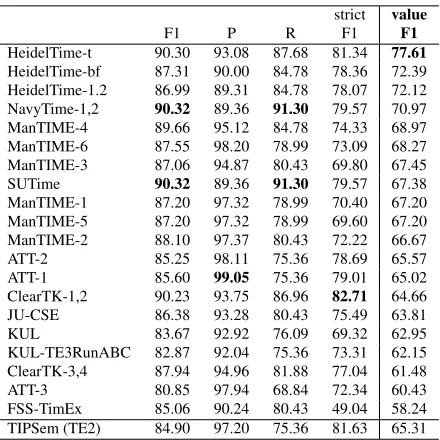
HeidelTime-t 90.30 93.08 87.68 81.34 77.61 HeidelTime-bf 87.31 90.00 84.78 78.36 72.39 HeidelTime-1.2 86.99 89.31 84.78 78.07 72.12 NavyTime-1,2 90.32 89.36 91.30 79.57 70.97 ManTIME-4 89.66 95.12 84.78 74.33 68.97 ManTIME-6 87.55 98.20 78.99 73.09 68.27 ManTIME-3 87.06 94.87 80.43 69.80 67.45 SUTime 90.32 89.36 91.30 79.57 67.38 ManTIME-1 87.20 97.32 78.99 70.40 67.20 ManTIME-5 87.20 97.32 78.99 69.60 67.20 ManTIME-2 88.10 97.37 80.43 72.22 66.67 ATT-2 85.25 98.11 75.36 78.69 65.57 ATT-1 85.60 99.05 75.36 79.01 65.02 ClearTK-1,2 90.23 93.75 86.96 82.71 64.66 JU-CSE 86.38 93.28 80.43 75.49 63.81
KUL 83.67 92.92 76.09 69.32 62.95
[image:4.612.78.298.64.284.2]KUL-TE3RunABC 82.87 92.04 75.36 73.31 62.15 ClearTK-3,4 87.94 94.96 81.88 77.04 61.48 ATT-3 80.85 97.94 68.84 72.34 60.43 FSS-TimEx 85.06 90.24 80.43 49.04 58.24 TIPSem (TE2) 84.90 97.20 75.36 81.63 65.31
Table 3: Task A - Temporal Expression Performance.
reduced system relations (Sys−relation). Similarly, we calculate theRecallby checking the number of reduced reference annotation relations (Refrelation− ) that can be verified from the system output’s temporal closure graph (Sys+relation), out of number of temporal relations in the reduced reference annotation (Refrelation− ).
This metric evaluates Task ABC together. For Task C and Task C - relation only, all the gold annotation entities were provided and then evaluated using the above metric. Our evaluation toolkit that evaluated TempEval-3 par-ticipants is available online.7
5
Evaluation Results
The aim of this evaluation is to provide a meaningful re-port of the performance obtained by the participants in the tasks defined in Section 3.
Furthermore, the results include TIPSem as reference for comparison. This was used as a pre-annotation system in some cases. TIPSem obtained the best results in event processing task in TempEval-2 and offered very compet-itive results in timex and relation processing. The best timex processing system in TempEval-2 (HeidelTime) is participating in this edition as well, therefore we included TIPSem as a reference in all tasks.
We only report results in main measures. Results are divided by language and shown per task. Detailed scores can be found on the task website.8
7See http://www.cs.rochester.edu/u/naushad/temporal 8See http://www.cs.york.ac.uk/semeval-2013/task1/
5.1 Results for English
5.1.1 Task A: Timexes
We had nine participants and 21 unique runs for tem-poral expression extraction task, Task A. Table 3 shows the results. Details about participants’ approaches can be found in Table 4.
We rank the participants for Task A on the F1 score of most important timex attribute – Value. To get the attributeValuecorrect, a system needs to correctly nor-malise the temporal expression. This score (Value F1) captures the performance of extracting the timex and identifying the attributeValuetogether (Value F1 = Timex F1 * Value Accuracy).
Participants approached the temporal expression ex-traction task with rule-engineered methods, machine learning methods and also hybrid methods. For temporal expression normalization (identifying the timex attribute value), all participants used rule-engineered approaches.
Observations: We collected the following observa-tions from the results and from participants’ experiments. Strategy: Competition was close for timex recogni-tion and the best systems all performed within 1% of each other. On our newswire corpus, statistical systems (ClearTK) performed best at strict matching, and rule-engineered system best at relaxed matching (NavyTime, SUTime, HeidelTime).
Strategy: post-processing, on top of machine learning-base temporal expression extraction, provided a statisti-cally significant improvement in both precision and recall (ManTIME).
Data: using the large silver dataset, alone or together with human annotated data, did not give improvements in performance for Task A. Human-annotated gold standard data alone provided the best performance (ManTIME).
Data: TimeBank alone was better than TimeBank and AQUAINT together for Task A (ClearTK).
Features: syntactic and gazetteers did not provide any statistically significant increment of performance with re-spect to the morphological features alone (ManTIME).
Regarding the two sub-tasks of timex annotation, recognition and interpretation/normalisation, we noticed a shift in the state of the art. While normalisation is currently (and perhaps inherently) done best by rule-engineered systems, recognition is now done well by a variety of methods. Where formerly, rule-engineered timex recognition always outperformed other classes of approach, now it is clear that rule-engineering and ma-chine learning are equally good at timex recognition.
5.1.2 Task B: Events
Strategy System Training data Classifier used Data-driven ATT-1, 2, 3 TBAQ + TE3Silver MaxEnt
ClearTK-1, 2 TimeBank SVM, Logit
ClearTK-3, 4 TBAQ SVM, Logit
JU-CSE TBAQ CRF
ManTIME-1 TBAQ + TE3Silver CRF
ManTIME-3 TBAQ CRF
ManTIME-5 TE3Silver CRF
Temp : ESAfeature TBAQ MaxEnt
Temp : WordNetfeature TBAQ MaxEnt
TIPSem (TE2) TBAQ CRF
Rule-based FSS-TimEx (EN) None None
FSS-TimEx (ES) None None
HeidelTime-1.2, bf (EN) None None
HeidelTime-t (EN) TBAQ None
HeidelTime (ES) Gold None
NavyTime-1, 2 None None
SUTime None None
Hybrid KUL TBAQ + TE3Silver Logit + post-processing
KUL-TE3RunABC TBAQ +TE3Silver Logit + post-processing ManTIME-2 TBAQ + TE3Silver CRF + post-processing
ManTIME-4 TBAQ CRF + post-processing
[image:5.612.125.488.104.382.2]ManTIME-6 TE3Silver CRF + post-processing
Table 4: Automated approaches for TE3 Timex Extraction
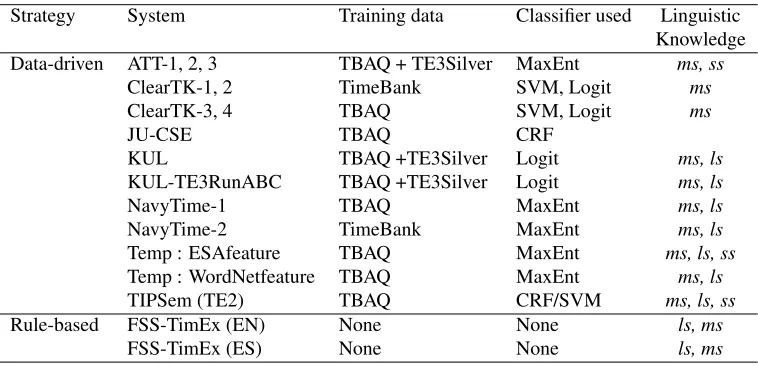
Strategy System Training data Classifier used Linguistic
Knowledge
Data-driven ATT-1, 2, 3 TBAQ + TE3Silver MaxEnt ms, ss
ClearTK-1, 2 TimeBank SVM, Logit ms
ClearTK-3, 4 TBAQ SVM, Logit ms
JU-CSE TBAQ CRF
KUL TBAQ +TE3Silver Logit ms, ls
KUL-TE3RunABC TBAQ +TE3Silver Logit ms, ls
NavyTime-1 TBAQ MaxEnt ms, ls
NavyTime-2 TimeBank MaxEnt ms, ls
Temp : ESAfeature TBAQ MaxEnt ms, ls, ss
Temp : WordNetfeature TBAQ MaxEnt ms, ls
TIPSem (TE2) TBAQ CRF/SVM ms, ls, ss
Rule-based FSS-TimEx (EN) None None ls, ms
[image:5.612.117.496.469.652.2]FSS-TimEx (ES) None None ls, ms
F1 P R class F1
ATT-1 81.05 81.44 80.67 71.88
ATT-2 80.91 81.02 80.81 71.10
KUL 79.32 80.69 77.99 70.17
ATT-3 78.63 81.95 75.57 69.55
KUL-TE3RunABC 77.11 77.58 76.64 68.74 ClearTK-3,4 78.81 81.40 76.38 67.87 NavyTime-1 80.30 80.73 79.87 67.48 ClearTK-1,2 77.34 81.86 73.29 65.44 NavyTime-2 79.37 80.52 78.26 64.81 Temp:ESAfeature 68.97 78.33 61.61 54.55
JU-CSE 78.62 80.85 76.51 52.69
[image:6.612.342.509.62.208.2]Temp:WordNetfeature 63.90 78.90 53.69 50.00 FSS-TimEx 65.06 63.13 67.11 42.94 TIPSem (TE2) 82.89 83.51 82.28 75.59
Table 6: Task B - Event Extraction Performance.
F1 P R
ClearTK-2 30.98 34.08 28.40 ClearTK-1 29.77 34.49 26.19 ClearTK-3 28.62 30.94 26.63 ClearTK-4 28.46 29.73 27.29 NavyTime-1 27.28 31.25 24.20
JU-CSE 24.61 19.17 34.36
NavyTime-2 21.99 26.52 18.78 KUL-TE3RunABC 19.01 17.94 20.22 TIPSem (TE2) 42.39 38.79 46.74
Table 7: Task ABC - Temporal Awareness Evaluation (Task C evaluation from raw text).
F1 captures the performance of extracting the event and identifying the attributeClasstogether (Class F1 = Event F1 * Class Accuracy).
All the participants except one used machine learning approaches. Details about the participants’ approaches and the linguistic knowledge9used to solve this problem, and training data, are in Table 5.
Observations: We collected the following observa-tions from the results and from participants’ experiments. Strategy: All the high performing systems for event extraction (Task B) are machine learning-based.
Data: Systems using silver data, along with the hu-man annotated gold standard data, performed very well (top three participants in the task – ATT, KUL, KUL-TE3RunABC). Additionally, TimeBank and AQUAINT together performed better than just TimeBank alone (NavyTime-1, ClearTK-3,4).
Linguistic Features: Semantic features (lsandss) have played an important role, since the best systems (TIPSem, ATT1 and KUL) include them. However, these three are not the only systems using semantic features.
9Abbreviations used in the table: TBAQ –TimeBank + AQUAINT corpusms –morphosyntactic information, e.g. POS, lexical informa-tion, morphological information and syntactic parsing related features; ls –lexical semantic information, e.g. WordNet synsets; ss – sentence-level semantic information, e.g. Semantic Role labels.
F1 P R
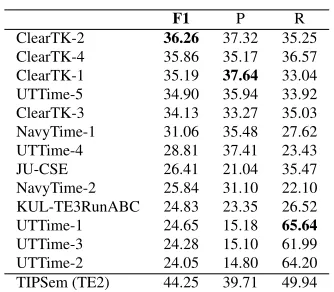
ClearTK-2 36.26 37.32 35.25 ClearTK-4 35.86 35.17 36.57 ClearTK-1 35.19 37.64 33.04 UTTime-5 34.90 35.94 33.92 ClearTK-3 34.13 33.27 35.03 NavyTime-1 31.06 35.48 27.62 UTTime-4 28.81 37.41 23.43
JU-CSE 26.41 21.04 35.47
NavyTime-2 25.84 31.10 22.10 KUL-TE3RunABC 24.83 23.35 26.52 UTTime-1 24.65 15.18 65.64 UTTime-3 24.28 15.10 61.99 UTTime-2 24.05 14.80 64.20 TIPSem (TE2) 44.25 39.71 49.94
Table 8: Task C - TLINK Identification and Classification.
F1 P R
[image:6.612.83.292.63.210.2]UTTime-1, 4 56.45 55.58 57.35 UTTime-3, 5 54.70 53.85 55.58 UTTime-2 54.26 53.20 55.36 NavyTime-1 46.83 46.59 47.07 NavyTime-2 43.92 43.65 44.20 JU-CSE 34.77 35.07 34.48
Table 9: Task C - relation only: Relation Classification.
5.1.3 Task C: Relation Evaluation
For complete temporal annotation from raw text (Task ABC - Task C from raw text) and for temporal relation only tasks (Task C, Task C relation only), we had five participants in total.
For relation evaluation, we primarily evaluate on Task ABC (Task C from raw text), which requires joint entity extraction, link identification and relation classification. The results for this task can be found in Table 7.
While TIPSem obtained the best results in task ABC, especially in recall, it was used by some annotators to pre-label data. In the interest of rigour and fairness, we separate out this system.
For task C, for provided participants with entities and participants identified: between which entity pairs a tion exists (link identification); and the class of that rela-tion. Results are given in Table 8. We also evaluate the participants on the relation by providing the entities and the links (performance in Table 9) – TIPSem could not be evaluated in this setting since the system is not prepared to do categorization only unless the relations are divided as in TempEval-2. For these Task C related tasks, we had only one new participant, who didn’t participate in Task A and B: UTTime.
Identifying which pair of entities to consider for tem-poral relations is a new task in this TempEval challenge. The participants approached the problems in data-driven, rule-based and also in hybrid ways (Table 1010). On
[image:6.612.104.270.240.337.2]Strategy System Training data Classifier used Linguistic Knowledge
Data-driven ClearTK-1 TimeBank SVM, Logit e-attr, ms
ClearTK-2 TimeBank + Bethard et al. (2007) SVM, Logit e-attr, ms
ClearTK-3 TBAQ SVM, Logit e-attr, ms
ClearTK-4 TBAQ + Muller’s inferences SVM, Logit e-attr, ms
KULRunABC TBAQ SVM, Logit ms
Rule-based JU-CSE None None
UTTime-1, 2 ,3 None None
TIPSem (TE2) None None e-attr, ms, ls, ss
Hybrid NavyTime-1 TBAQ MaxEnt ms
NavyTime-2 TimeBank MaxEnt ms
UTTime-4 TBAQ Logit ms, ls, ss
[image:7.612.139.475.229.355.2]UTTime-5 TBAQ + inverse relations Logit ms, ls, ss
Table 10: Automated approaches for TE3 TLINK Identification
Strategy System Training data Classifier used Linguistic Knowledge
Data-driven ClearTK-1 TimeBank SVM, Logit ms, ls
ClearTK-2 TimeBank + Bethard et al. (2007) SVM, Logit ms, ls
ClearTK-3 TBAQ SVM, Logit ms, ls
ClearTK-4 TBAQ + Muller’s inferences SVM, Logit ms, ls
JU-CSE TBAQ CRF
KULRunABC TBAQ SVM, Logit ms
NavyTime-1 TBAQ MaxEnt ms, ls
NavyTime-2 TimeBank MaxEnt ms, ls
UTTime-1,4, 2 TBAQ Logit ms, ls, ss
UTTime-3,5 TBAQ + inverse relations Logit ms, ls, ss
TIPSem (TE-2) TBAQ CRF/SVM ms, ls, ss
Table 11: Automated approaches for Relation Classification
the other hand, all the participants used data-driven ap-proaches for temporal relations (Table 11).
Observations: We collected the following observa-tions from the results and from participants’ experiments. Strategy: For relation classification, all participants used partially or fully machine learning-based systems.
Data: None of the participants implemented their sys-tems training on the silver data. Most of the syssys-tems use the combined TimeBank and AQUAINT (TBAQ) corpus. Data: Adding additional high-quality relations, either Philippe Muller’s closure-based inferences or the verb clause relations from Bethard et al. (2007), typically in-creased recall and the overall performance (ClearTK runs two and four).
Features: Participants mostly used the morphosyntac-tic and lexical semanmorphosyntac-tic information. The best perform-ing systems from TempEval-2 (TIPSem and TRIOS) ad-ditionally used sentence level semantic information. One participant in TempEval-3 (UTTime) also did deep pars-ing for the sentence level semantic features.
Features: Using more Linguistic knowledge is impor-tant for the task, but it is more imporimpor-tant to execute it properly. Many systems performed better using less lin-guistic knowledge. Hence a system (e.g. ClearTK) with basic morphosyntactic features is hard to beat with more semantic features, if not used properly.
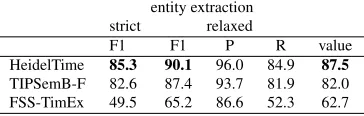
entity extraction strict relaxed
F1 F1 P R value
[image:7.612.335.517.393.451.2]HeidelTime 85.3 90.1 96.0 84.9 87.5 TIPSemB-F 82.6 87.4 93.7 81.9 82.0 FSS-TimEx 49.5 65.2 86.6 52.3 62.7
Table 12: Task A: Temporal Expression (Spanish).
class tense aspect
F1 P R F1 F1 F1
FSS-TimEx 57.6 89.8 42.4 24.9 - -TIPSemB-F 88.8 91.7 86.0 57.6 41.0 36.3
Table 13: Task B: Event Extraction (Spanish).
Classifier: Across the various tasks, ClearTK tried Mallet CRF, Mallet MaxEnt, OpenNLP MaxEnt, and LI-BLINEAR (SVMs and logistic regression). They picked the final classifiers by running a grid search over models and parameters on the training data, and for all tasks, a LIBLINEAR model was at least as good as all the other models. As an added bonus, it was way faster to train than most of the other models.
6
Evaluation Results (Spanish)
F1 P R TIPSemB-F 41.6 37.8 46.2
Table 14: Task ABC: Temporal Awareness (Spanish).
entity extraction attributes
strict relaxed val type
F1 F1 P R F1 F1
HeidelTime 86.4 89.8 94.0 85.9 87.5 89.8 FSS-TimEx 42.1 68.4 86.7 56.5 48.7 65.8 TIPSem 86.9 93.7 98.8 89.1 75.4 88.0 TIPSemB-F 84.3 89.9 93.0 87.0 82.0 86.5
Table 15: Task A: TempEval-2 test set (Spanish).
case, TIPSemB-Freeling is provided as a state-of-the-art reference covering all the tasks. TIPSemB-Freeling is the Spanish version of TIPSem with the main difference that it does not include semantic roles. Furthermore, it uses Freeling (Padr´o and Stanilovsky, 2012) to obtain the lin-guistic features automatically.
Table 12 shows the results obtained for task A. As it can be observed HeidelTime obtains the best results. It improves the previous state-of-the-art results (TIPSemB-F), especially in normalization (value F1).
Table 13 shows the results from event extraction. In this case, the previous state-of-the-art is not improved.
Table 14 only shows the results obtained in temporal awareness by the state-of-the-art system since there were not participants on this task. We observe that TIPSemB-F approach offers competitive results, which is comparable to results obtained in TE3 English test set.
6.1 Comparison with TempEval-2
TempEval-2 Spanish test set is included as a subset of this TempEval-3 test set. We can therefore compare the per-formance across editions. Furthermore, we can include the full-featured TIPSem (Llorens et al., 2010), which unlike TIPSemB-F used the AnCora (Taul´e et al., 2008) corpus annotations as features including semantic roles.
For timexes, as can be seen in Table 15, the origi-nal TIPSem obtains better results for timex extraction, which favours the hypothesis that machine learning sys-tems are very well suited for this task (if the training data is sufficiently representative). However, for normaliza-tion (value F1), HeidelTime – a rule-engineered system – obtains better results. This indicates that rule-based ap-proaches have the upper hand in this task. TIPSem uses
class tense aspect
F1 P R F1 F1 F1
FSS-TimEx 59.0 90.3 43.9 24.6 - -TIPSemB-F 90.2 92.5 88.0 58.6 39.7 38.1 TIPSem 88.2 90.6 85.8 58.7 84.9 78.7
Table 16: Task B: TempEval-2 test set (Spanish).
a partly data-driven normalization approach which, given the small amount of training data available, seemed less suited to the task.
Table 16 shows event extraction performance in TE2 test set. TIPSemB-F and TIPSem obtained a similar per-formance. TIPSemB-F performed better in extraction and TIPSem better in attribute classification.
7
Conclusion
In this paper, we described the TempEval-3 task within the SemEval 2013 exercise. This task involves identify-ing temporal expressions (timexes), events and their tem-poral relations in text. In particular participating systems were required to automatically annotate raw text using TimeML annotation scheme
This is the first time end-to-end systems are evalu-ated with a new single score (temporal awareness). In TempEval-3 participants had to obtain temporal relations from their own extracted timexes and events which is a very challenging task and was the ultimate evaluation aim of TempEval. It was proposed at TempEval-1 but has not been carried out until this edition.
The newly-introduced silver data proved not so useful for timex extraction or relation classification, but did help with event extraction. The new single-measure helped to rank systems easily.
Future work could investigate temporal annotation in specific applications. Current annotations metrics evalu-ate relations for entities in the same consecutive sentence. For document-level understanding we need to understand discourse and pragmatic information. Temporal question answering-based evaluation (UzZaman et al., 2012a) can help us to evaluate participants on document level tempo-ral information understanding without creating any addi-tional training data. Also, summarisation, machine trans-lation, and information retrieval need temporal annota-tion. Application-oriented challenges could further re-search in these areas.
From a TimeML point of view, we still haven’t tack-led subordinate relations (TimeML SLINKs), aspectual relations (TimeML ALINKs), or temporal signal anno-tation (Derczynski and Gaizauskas, 2011). The critical questions of which links to annotate, and whether the cur-rent set of temporal relation types are appropriate for lin-guistic annotation, are still unanswered.
Acknowledgments
References
J. F. Allen. 1983. Maintaining knowledge about temporal in-tervals. Communications of the ACM, 26(11):832–843. S. Bethard, J. H. Martin, and S. Klingenstein. 2007. Timelines
from text: Identication of syntactic temporal relations. In Proceedings of IEEE International Conference on Semantic Computing.
H. Cunningham, V. Tablan, A. Roberts, and K. Bontcheva. 2013. Getting More Out of Biomedical Documents with GATE’s Full Lifecycle Open Source Text Analytics. PLoS computational biology, 9(2):e1002854.
L. Derczynski and R. Gaizauskas. 2010. Analysing Temporally Annotated Corpora with CAVaT. InProceedings of the 7th International Conference on Language Resources and Eval-uation, pages 398–404.
L. Derczynski and R. Gaizauskas. 2011. A Corpus-based Study of Temporal Signals. InProceedings of the 6th Corpus Lin-guistics Conference.
L. Derczynski, H. Llorens, and N. UzZaman. 2013. TimeML-strict: clarifying temporal annotation.CoRR, abs/1304. G. Hripcsak and A. S. Rothschild. 2005. Agreement, the
f-measure, and reliability in information retrieval. Journal of the American Medical Informatics Association, 12(3):296– 298.
H. Llorens, E. Saquete, and B. Navarro. 2010. TIPSem (En-glish and Spanish): Evaluating CRFs and Semantic Roles in TempEval-2. InProceedings of the 5th International Work-shop on Semantic Evaluation, pages 284–291. Association for Computational Linguistics.
H. Llorens, N. UzZaman, and J. Allen. 2012a. Merging Tem-poral Annotations. InProceedings of the TIME Conference. H. Llorens, E. Saquete, and B. Navarro-Colorado. 2012b.
Au-tomatic system for identifying and categorizing temporal re-lations in natural language. International Journal of Intelli-gent Systems, 27(7):680–703.
H. Llorens, E. Saquete, and B. Navarro-Colorado. 2013. Ap-plying Semantic Knowledge to the Automatic Processing of Temporal Expressions and Events in Natural Language. In-formation Processing & Management, 49(1):179–197. L. Padr´o and E. Stanilovsky. 2012. Freeling 3.0: Towards wider
multilinguality. InProceedings of the Language Resources and Evaluation Conference (LREC 2012), Istanbul, Turkey, May. ELRA.
R. Parker, D. Graff, J. Kong, K. Chen, and K. Maeda. 2011. English Gigaword Fifth Edition. LDC catalog ref. LDC2011T07.
J. Pustejovsky, P. Hanks, R. Saur´ı, A. See, R. Gaizauskas, A. Setzer, D. Radev, B. Sundheim, D. Day, L. Ferro, et al. 2003. The TimeBank corpus. InCorpus Linguistics. J. Pustejovsky, B. Ingria, R. Saur´ı, J. Castano, J. Littman,
R. Gaizauskas, A. Setzer, G. Katz, and I. Mani. 2005. The specification language TimeML. The Language of Time: A reader, pages 545–557.
R. Saur´ı and T. Badia. 2012. Spanish TimeBank 1.0. LDC catalog ref. LDC2012T12.
R. Saur´ı, J. Littman, B. Knippen, R. Gaizauskas, A. Setzer, and J. Pustejovsky. 2006. TimeML Annotation Guidelines Ver-sion 1.2.1.
M. Taul´e, M. A. Martı, and M. Recasens. 2008. Ancora: Mul-tilevel annotated corpora for catalan and spanish. In Pro-ceedings of the 6th International Conference on Language Resources and Evaluation (LREC-2008).
N. UzZaman and J. Allen. 2010. TRIPS and TRIOS system for TempEval-2: Extracting temporal information from text. In Proceedings of the 5th International Workshop on Semantic Evaluation, pages 276–283. Association for Computational Linguistics.
N. UzZaman and J. Allen. 2011. Temporal Evaluation. In Pro-ceedings of The 49th Annual Meeting of the Association for Computational Linguistics: Human Language Technologies. N. UzZaman, H. Llorens, and J. Allen. 2012a. Evaluating tem-poral information understanding with temtem-poral question an-swering. InProceedings of IEEE International Conference on Semantic Computing.
N. UzZaman, H. Llorens, J. F. Allen, L. Derczynski, M. Ver-hagen, and J. Pustejovsky. 2012b. TempEval-3: Evaluating Events, Time Expressions, and Temporal Relations. CoRR, abs/1206.5333.
N. UzZaman. 2012.Interpreting the Temporal Aspects of Lan-guage. Ph.D. thesis, University of Rochester, Rochester, NY. M. Verhagen, R. Gaizauskas, F. Schilder, M. Hepple, J. Moszkowicz, and J. Pustejovsky. 2009. The TempEval challenge: identifying temporal relations in text. Language Resources and Evaluation, 43(2):161–179.