A Fully Unsupervised Word Sense Disambiguation Method Using
Dependency Knowledge
Ping Chen
Dept. of Computer and Math. Sciences University of Houston-Downtown
Chris Bowes
Dept. of Computer and Math. Sciences University of Houston-Downtown
Wei Ding
Department of Computer Science University of Massachusetts-Boston
David Brown
Dept. of Computer and Math. Sciences University of Houston-Downtown
Abstract
Word sense disambiguation is the process of determining which sense of a word is used in a given context. Due to its importance in understanding semantics of natural languages, word sense disambiguation has been exten-sively studied in Computational Linguistics. However, existing methods either are brit-tle and narrowly focus on specific topics or words, or provide only mediocre performance in real-world settings. Broad coverage and disambiguation quality are critical for a word sense disambiguation system. In this paper we present a fully unsupervised word sense dis-ambiguation method that requires only a dic-tionary and unannotated text as input. Such an automatic approach overcomes the problem of brittleness suffered in many existing methods and makes broad-coverage word sense dis-ambiguation feasible in practice. We evalu-ated our approach using SemEval 2007 Task 7 (Coarse-grained English All-words Task), and our system significantly outperformed the best unsupervised system participating in Se-mEval 2007 and achieved the performance ap-proaching top-performing supervised systems. Although our method was only tested with coarse-grained sense disambiguation, it can be directly applied to fine-grained sense disam-biguation.
1 Introduction
In many natural languages, a word can represent multiple meanings/senses, and such a word is called a homograph. Word sense disambiguation(WSD)
is the process of determining which sense of a ho-mograph is used in a given context. WSD is a long-standing problem in Computational Linguis-tics, and has significant impact in many real-world applications including machine translation, informa-tion extracinforma-tion, and informainforma-tion retrieval. Gener-ally, WSD methods use the context of a word for its sense disambiguation, and the context informa-tion can come from either annotated/unannotated text or other knowledge resources, such as Word-Net (Fellbaum, 1998), SemCor (SemCor, 2008), Open Mind Word Expert (Chklovski and Mihal-cea, 2002), eXtended WordNet (Moldovan and Rus, 2001), Wikipedia (Mihalcea, 2007), parallel corpora (Ng, Wang, and Chan, 2003). In (Ide and V´eronis, 1998) many different WSD approaches were de-scribed. Usually, WSD techniques can be divided into four categories (Agirre and Edmonds, 2006),
• Dictionary and knowledge based methods. These methods use lexical knowledge bases such as dictionaries and thesauri, and hypoth-esize that context knowledge can be extracted from definitions of words. For example, Lesk disambiguated two words by finding the pair of senses with the greatest word overlap in their dictionary definitions (Lesk, 1986).
• Supervised methods. Supervised methods
mainly adopt context to disambiguate words. A supervised method includes a training phase and a testing phase. In the training phase, a sense-annotated training corpus is required, from which syntactic and semantic features are extracted to create a classifier using machine
learning techniques, such as Support Vector Machine (Novischi et al., 2007). In the fol-lowing testing phase, a word is classified into senses (Mihalcea, 2002) (Ng and Lee, 1996). Currently supervised methods achieve the best disambiguation quality (about 80% precision and recall for coarse-grained WSD in the most recent WSD evaluation conference SemEval 2007 (Navigli et al., 2007)). Nevertheless, since training corpora are manually annotated and expensive, supervised methods are often brittle due to data scarcity, and it is hard to an-notate and acquire sufficient contextual infor-mation for every sense of a large number of words existing in natural languages.
• Semi-supervised methods. To overcome the knowledge acquisition bottleneck problem suf-fered by supervised methods, these methods make use of a small annotated corpus as seed data in a bootstrapping process (Hearst, 1991) (Yarowsky, 1995). A word-aligned bilingual corpus can also serve as seed data (Ng, Wang, and Chan, 2003).
• Unsupervised methods. These methods acquire contextual information directly from unanno-tated raw text, and senses can be induced from text using some similarity measure (Lin, 1997). However, automatically acquired information is often noisy or even erroneous. In the most recent SemEval 2007 (Navigli et al., 2007), the best unsupervised systems only achieved about 70% precision and 50% recall.
Disambiguation of a limited number of words is not hard, and necessary context information can be carefully collected and hand-crafted to achieve high disambiguation accuracy as shown in (Yarowsky, 1995). However, such approaches suffer a signifi-cant performance drop in practice when domain or vocabulary is not limited. Such a “cliff-style” per-formance collapse is called brittleness, which is due to insufficient knowledge and shared by many tech-niques in Artificial Intelligence. The main challenge of a WSD system is how to overcome the knowl-edge acquisition bottleneck and efficiently collect the huge amount of context knowledge. More pre-cisely, a practical WSD need figure out how to create
and maintain a comprehensive, dynamic, and up-to-date context knowledge base in a highly automatic manner. The context knowledge required in WSD has the following properties:
1. The context knowledge need cover a large number of words and their usage. Such a requirement of broad coverage is not trivial because a natural language usually contains thousands of words, and some popular words can have dozens of senses. For example, the Oxford English Dictionary has approximately 301,100 main entries (Oxford, 2003), and the average polysemy of the WordNet inventory is 6.18 (Fellbaum, 1998). Clearly acquisition of such a huge amount of knowledge can only be achieved with automatic techniques.
2. Natural language is not a static phenomenon. New usage of existing words emerges, which creates new senses. New words are created, and some words may “die” over time. It is esti-mated that every year around 2,500 new words appear in English (Kister, 1992). Such dynam-ics requires a timely maintenance and updating of context knowledge base, which makes man-ual collection even more impractical.
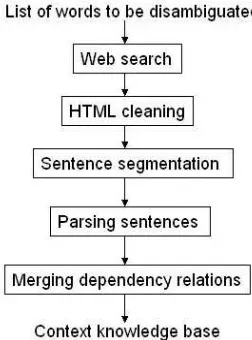
Figure 1: Context Knowledge Acquisition and Represen-tation Process
All-words Task) data set, and the experiment results are discussed in section 4. We conclude in section 5.
2 Context Knowledge Acquisition and Representation
Figure 1 shows an overview of our context knowl-edge acquisition process, and collected knowlknowl-edge is saved in a local knowledge base. Here are some details about each step.
2.1 Corpus building through Web search
The goal of this step is to collect as many as possi-ble valid sample sentences containing the instances of to-be-disambiguated words. Preferably these in-stances are also diverse and cover many senses of a word. We have considered two possible text sources,
1. Electronic text collection, e.g., Gutenberg project (Gutenberg, 1971). Such collections of-ten include thousands of books, which are ofof-ten written by professionals and can provide many valid and accurate usage of a large number of words. Nevertheless, books in these collections are usually copyright-free and old, hence are lack of new words or new senses of words used in modern English.
2. Web documents. Billions of documents exist in the World Wide Web, and millions of Web pages are created and updated everyday. Such a huge dynamic text collection is an ideal source
to provide broad and up-to-date context knowl-edge for WSD. The major concern about Web documents is inconsistency of their quality, and many Web pages are spam or contain erroneous information. However, factual errors in Web pages will not hurt the performance of WSD. Nevertheless, the quality of context knowledge is affected by broken sentences of poor linguis-tic quality and invalid word usage, e.g., sen-tences like “Colorless green ideas sleep furi-ously” that violate commonsense knowledge. Based on our experience these kind of errors are negligible when using popular Web search engines to retrieve relevant Web pages.
To start the acquisition process, words that need to be disambiguated are compiled and saved in a text file. Each single word is submitted to a Web search engine as a query. Several search engines provide API’s for research communities to auto-matically retrieve large number of Web pages. In our experiments we used both Google and Yahoo! API’s to retrieve up to 1,000 Web pages for each to-be-disambiguated word. Collected Web pages are cleaned first, e.g., control characters and HTML tags are removed. Then sentences are segmented simply based on punctuation (e.g., ?, !, .). Sentences that contain the instances of a specific word are extracted and saved into a local repository.
2.2 Parsing
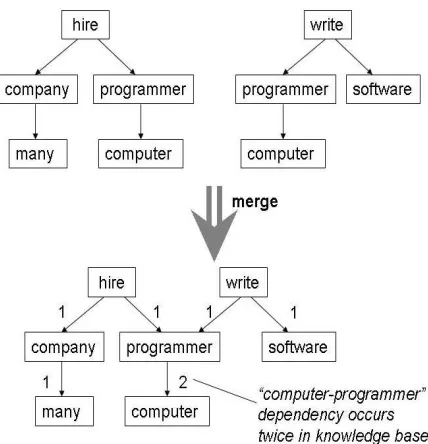
Figure 2: Merging two parsing trees. The number beside each edge is the number of occurrences of this depen-dency relation existing in the context knowledge base.
are parsed only once to extract dependency relations, then these relations are merged and saved in a local knowledge base for the following disambiguation. Hence, parsing will not affect the speed of disam-biguation at all.
2.3 Merging dependency relations
After parsing, dependency relations from different sentences are merged and saved in a context knowl-edge base. The merging process is straightforward. A dependency relation includes one head word/node and one dependent word/node. Nodes from different dependency relations are merged into one as long as they represent the same word. An example is shown in Figure 2, which merges the following two sen-tences:
“Computer programmers write software.” “Many companies hire computer programmers.”
In a dependency relation “word1 → word2”,
word1 is the head word, and word2 is the depen-dent word. After merging dependency relations, we will obtain a weighted directed graph with a word as a node, a dependency relation as an edge, and the number of occurrences of dependency relation as weight of an edge. This weight indicates the strength of semantic relevancy of head word and dependent word. This graph will be used in the following WSD
Figure 3: WSD Procedure
process as our context knowledge base. As a fully automatic knowledge acquisition process, it is in-evitable to include erroneous dependency relations in the knowledge base. However, since in a large text collection valid dependency relations tend to repeat far more times than invalid ones, these erroneous edges only have minimal impact on the disambigua-tion quality as shown in our evaluadisambigua-tion results.
3 WSD Algorithm
Our WSD approach is based on the following in-sight:
If a word is semantically coherent with its context, then at least one sense of this word is semantically coherent with its context.
Assume that the text to be disambiguated is se-mantically valid, if we replace a word with its glosses one by one, the correct sense should be the one that will maximize the semantic coherence within this word’s context. Based on this idea we set up our WSD procedure as shown in Figure 3. First both the original sentence that contains the disambiguated word and the glosses of to-be-disambiguated word are parsed. Then the parsing tree generated from each gloss is matched with the parsing tree of original sentence one by one. The gloss most semantically coherent with the original sentence will be chosen as the correct sense. How to measure the semantic coherence is critical. Our idea is based on the following hypotheses (assume
word1is the to-be-disambiguated word):
• In a sentence ifword1 is dependent onword2, and we denote the gloss of the correct sense of
[image:4.612.322.522.64.198.2]onword2;
• In a sentence if a set of words DEP1 are de-pendent onword1, and we denote the gloss of
the correct sense ofword1asg1i, theng1i con-tains the most semantically coherent words that
DEP1are dependent on.
For example, we try to disambiguate “company” in “A large company hires many computer program-mers”, after parsing we obtain the dependency rela-tions “hire → company” and “company → large”.
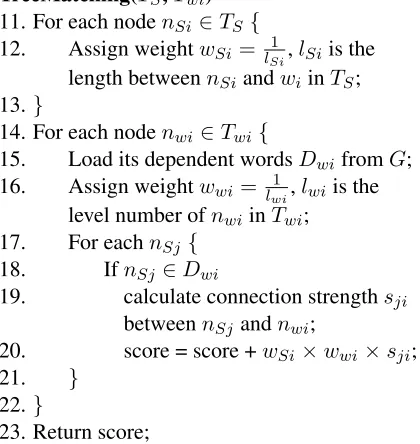
The correct sense for the word “company” should be “an institution created to conduct business”. If in the context knowledge base there exist the depen-dency relations “hire→ institution” or “institution →large”, then we believe that the gloss “an institu-tion created to conduct business” is semantically co-herent with its context - the original sentence. The gloss with the highest semantic coherence will be chosen as the correct sense. Obviously, the size of context knowledge base has a positive impact on the disambiguation quality, which is also verified in our experiments (see Section 4.2). Figure 4 shows our detailed WSD algorithm. Semantic coherence score is generated by the function T reeM atching, and we adopt a sentence as the context of a word.
We illustrate our WSD algorithm through an ex-ample. Assume we try to disambiguate “company” in the sentence “A large software company hires many computer programmers”. “company” has 9 senses as a noun in WordNet 2.1. Let’s pick the fol-lowing two glosses to go through our WSD process.
• an institution created to conduct business
• small military unit
First we parse the original sentence and two glosses, and get three weighted parsing trees as shown in Figure 5. All weights are assigned to nodes/words in these parsing trees. In the parsing tree of the original sentence the weight of a node is reciprocal of the distance between this node and to-be-disambiguated node “company” (line 12 in Fig-ure 4). In the parsing tree of a gloss the weight of a node is reciprocal of the level of this node in the parsing tree (line 16 in Figure 4). Assume that our context knowledge base contains relevant depen-dency relations shown in Figure 6.
Input:Glosses from WordNet;
S: the sentence to be disambiguated;
G: the knowledge base generated in Section 2;
1. Input a sentenceS,W ={w|w’s part of speech
is noun, verb, adjective, or adverb,w∈S}; 2. ParseSwith a dependency parser, generate
parsing treeTS; 3. For eachw∈W {
4. Input allw’s glosses from WordNet;
5. For each glosswi{
6. Parsewi, get a parsing treeTwi;
7. score = TreeMatching(TS, Twi);
}
8. If the highest score is larger than a preset threshold, choose the sense with the highest score as the correct sense; 9. Otherwise, choose the first sense. 10.}
TreeMatching(TS,Twi) 11. For each nodenSi∈TS {
12. Assign weightwSi= lSi1 ,lSiis the length betweennSiandwiinTS; 13.}
14. For each nodenwi∈Twi{
15. Load its dependent wordsDwifromG; 16. Assign weightwwi= lwi1 ,lwiis the
level number ofnwiinTwi; 17. For eachnSj{
18. IfnSj∈Dwi
19. calculate connection strengthsji betweennSjandnwi;
20. score = score +wSi×wwi×sji; 21. }
22.}
[image:5.612.311.521.349.571.2]23. Return score;
Figure 4: WSD Algorithm
nor-Figure 5: Weighted parsing trees of the original sentence and two glosses of “company”
Figure 6: A fragment of context knowledge base
malized to a low value (close to 0).
Now we load the dependent words of each word in gloss 1 from the knowledge base (line 14, 15 in Figure 4), and we get {small, large} for
“institu-tion” and {large, software} for “business”. In the dependent words of “company”, “large” belongs to the dependent word sets of “institution” and “busi-ness”, and “software” belongs to the dependent word set of “business”, so the coherence score of gloss 1 is calculated as (line 19, 20 in Figure 4):
1.0×1.0×0.7+1.0×0.25×0.8+1.0×0.25×0.9
= 1.125
We go through the same process with the second gloss “small military unit”. “Large” is the only de-pendent word of “company” appearing in the depen-dent word set of “unit” in gloss 2, so the coherence score of gloss 2 in the current context is:
1.0×1.0×0.8= 0.8
After comparing the coherence scores of two glosses, we choose sense 1 of “company” as the cor-rect sense (line 9 in Figure 4). This example illus-trates that a strong dependency relation between a head word and a dependent word has a powerful dis-ambiguation capability, and disdis-ambiguation quality is also significantly affected by the quality of dictio-nary definitions.
In Figure 4 theT reeM atchingfunction matches
the dependent words of to-be-disambiguated word (line 15 in Figure 4), and we call this matching strat-egy as dependency matching. This stratstrat-egy will not work if a to-be-disambiguated word has no depen-dent words at all, for example, when the word “com-pany” in “Companies hire computer programmers” has no dependent words. In this case, we developed the second matching strategy, which is to match the head words that the to-be-disambiguated word is de-pendent on, such as matching “hire” (the head word of “company”) in Figure 5(a). Using the dependency relation “hire→company”, we can correctly choose sense 1 since there is no such relation as “hire→
[image:6.612.81.278.373.535.2]4 Experiments
We have evaluated our method using SemEval-2007 Task 07 (Coarse-grained English All-words Task) test set (Navigli et al., 2007). The task organiz-ers provide a coarse-grained sense inventory cre-ated with SSI algorithm (Navigli and Velardi, 2005), training data, and test data. Since our method does not need any training or special tuning, neither coarse-grained sense inventory nor training data was used. The test data includes: a news article about “homeless” (including totally 951 words, 368 words are annotated and need to be disambiguated), a re-view of the book “Feeding Frenzy” (including to-tally 987 words, 379 words are annotated and need to be disambiguated), an article about some trav-eling experience in France (including totally 1311 words, 500 words are annotated and need to be dis-ambiguated), computer programming(including to-tally 1326 words, 677 words are annotated and need to be disambiguated), and a biography of the painter Masaccio (including totally 802 words, 345 words are annotated and need to be disambiguated). Two authors of (Navigli et al., 2007) independently and manually annotated part of the test set (710 word instances), and the pairwise agreement was 93.80%. This inter-annotator agreement is usually considered an upper-bound for WSD systems.
We followed the WSD process described in Sec-tion 2 and 3 using the WordNet 2.1 sense repository that is adopted by SemEval-2007 Task 07. All exper-iments were performed on a Pentium 2.33GHz dual core PC with 3GB memory. Among the 2269 to-be-disambiguated words in the five test documents, 1112 words are unique and submitted to Google API as queries. The retrieved Web pages were cleaned, and 1945189 relevant sentences were ex-tracted. On average 1749 sentences were obtained for each word. The Web page retrieval step took 3 days, and the cleaning step took 2 days. Parsing was very time-consuming and took 11 days. The merg-ing step took 3 days. Disambiguation of 2269 words in the 5 test articles took 4 hours. All these steps can be parallelized and run on multiple computers, and the whole process will be shortened accordingly.
The overall disambiguation results are shown in Table 1. For comparison we also listed the re-sults of the top three systems and three
unsuper-vised systems participating in SemEval-2007 Task 07. All of the top three systems (UoR-SSI, NUS-PT, NUS-ML) are supervised systems, which used annotated resources (e.g., SemCor, Defense Science Organization Corpus) during the training phase. Our fully unsupervised WSD system significantly out-performs the three unsupervised systems (SUSSZ-FR, SUSSX-C-WD, SUSSX-CR) and achieves per-formance approaching the top-performing super-vised WSD systems.
4.1 Impact of different matching strategies to disambiguation quality
To test the effectiveness of different matching strate-gies discussed in Section 3, we performed some ad-ditional experiments. Table 2 shows the disambigua-tion results by each individual document with the following 5 matching strategies:
1. Dependency matching only.
2. Dependency and backward matching.
3. Dependency and synonym backward matching.
4. Dependency and synonym dependency match-ing.
5. Dependency, backward, synonym backward, and synonym dependency matching.
As expected combination of more matching strategies results in higher disambiguation quality. By analyzing the scoring details, we verified that backward matching is especially useful to disam-biguate adjectives and adverbs. Adjectives and ad-verbs are often dependent words, so dependency matching itself rarely finds any matched words. Since synonyms are semantically equivalent, it is reasonable that synonym matching can also improve disambiguation performance.
4.2 Impact of knowledge base size to disambiguation quality
System Attempted Precision Recall F1 UoR-SSI 100.0 83.21 83.21 83.21 NUS-PT 100.0 82.50 82.50 82.50 NUS-ML 100.0 81.58 81.58 81.58
TreeMatch 100.0 73.65 73.65 73.65
[image:8.612.170.438.65.175.2]SUSSZ-FR 72.8 71.73 52.23 60.44 SUSSX-C-WD 72.8 54.54 39.71 45.96 SUSSX-CR 72.8 54.30 39.53 45.75
Table 1: Overall disambiguation scores (Our system “TreeMatch” is marked in bold)
Matching d001 d002 d003 d004 d005 Overall
strategy P R P R P R P R P R P R
[image:8.612.68.543.208.308.2]1 72.28 72.28 66.23 66.23 63.20 63.20 66.47 66.47 56.52 56.52 65.14 65.14 2 70.65 70.65 70.98 70.98 65.20 65.20 72.23 72.23 58.84 58.84 68.18 68.18 3 79.89 79.89 75.20 75.20 69.00 69.00 71.94 71.94 64.64 64.64 72.01 72.01 4 80.71 80.71 78.10 78.10 72.80 72.80 71.05 71.05 67.54 67.54 73.65 73.65 5 80.16 80.16 78.10 78.10 69.40 69.40 72.82 72.82 66.09 66.09 73.12 73.12
Table 2: Disambiguation scores by article with 5 matching strategies
shows a positive correlation between the amount of context knowledge and disambiguation quality. It is reasonable to assume that our disambiguation per-formance can be improved further by collecting and incorporating more context knowledge.
Matching Overall strategy P R
1 65.36 65.36 2 67.78 67.78 3 68.09 68.09 4 70.69 70.69 5 67.78 67.78
Table 3: Disambiguation scores by article with a smaller knowledge base
5 Conclusion and Future Work
Broad coverage and disambiguation quality are crit-ical for WSD techniques to be adopted in prac-tice. This paper proposed a fully unsupervised WSD method. We have evaluated our approach with SemEval-2007 Task 7 (Coarse-grained English All-words Task) data set, and we achieved F-scores ap-proaching the top performing supervised WSD sys-tems. By using widely available unannotated text and a fully unsupervised disambiguation approach,
our method may provide a viable solution to the problem of WSD. The future work includes:
1. Continue to build the knowledge base, enlarge the coverage and improve the system perfor-mance. The experiment results in Section 4.2 clearly show that more word instances can im-prove the disambiguation accuracy and recall scores;
2. WSD is often an unconscious process for hu-man beings. It is unlikely that a reader exam-ines all surrounding words when determining the sense of a word, which calls for a smarter and more selective matching strategy than what we have tried in Section 4.1;
3. Test our WSD system on fine-grained SemEval 2007 WSD task 17. Although we only evalu-ated our approach with coarse-grained senses, our method can be directly applied to fine-grained WSD without any modifications. Acknowledgments
[image:8.612.121.245.421.520.2]References
Agirre, Eneko, Philip Edmonds (eds.). 2006. Word Sense Disambiguation: Algorithms and Applications, Springer.
Chklovski, T. and Mihalcea, R. 2002. Building a sense tagged corpus with open mind word expert. In Pro-ceedings of the Acl-02 Workshop on Word Sense Dis-ambiguation: Recent Successes and Future Directions, Morristown, NJ, 116-122.
C. Fellbaum, WordNet: An Electronic Lexical Database, MIT press, 1998
Project Gutenberg, available at www.gutenberg.org Hearst, M. (1991) Noun Homograph Disambiguation
Us-ing Local Context in Large Text Corpora, Proc. 7th Annual Conference of the University of Waterloo Cen-ter for the New OED and Text Research, Oxford. Nancy Ide and Jean V´eronis. 1998. Introduction to the
special issue on word sense disambiguation: the state of the art.Comput. Linguist., 24(1):2–40.
Kister, Ken. “Dictionaries defined”, Library Journal, Vol. 117 Issue 11, p43, 4p, 2bw
Lesk, M. 1986. Automatic sense disambiguation using machine readable dictionaries: how to tell a pine cone from an ice cream cone. In Proceedings of the 5th An-nual international Conference on Systems Documenta-tion (Toronto, Ontario, Canada). V. DeBuys, Ed. SIG-DOC ’86.
Dekang Lin. 1998. Dependency-based evaluation of minipar. In Proceedings of the LREC Workshop on the Evaluation of Parsing Systems, pages 234–241, Granada, Spain.
Lin, D. 1997. Using syntactic dependency as local con-text to resolve word sense ambiguity. In Proceedings of the 35th Annual Meeting of the Association For Com-putational Linguistics and Eighth Conference of the European Chapter of the Association For Computa-tional Linguistics (Madrid, Spain, July 07 - 12, 1997). Rada Mihalcea, Using Wikipedia for Automatic Word Sense Disambiguation, in Proceedings of the North American Chapter of the Association for Computa-tional Linguistics (NAACL 2007), Rochester, April 2007.
Rada Mihalcea. 2002. Instance based learning with au-tomatic feature selection applied to word sense disam-biguation. In Proceedings of the 19th international conference on Computational linguistics, pages 1–7, Morristown, NJ.
Dan Moldovan and Vasile Rus, Explaining Answers with Extended WordNet, ACL 2001.
Roberto Navigli, Kenneth C. Litkowski, and Orin Har-graves. 2007. Semeval-2007 task 07: Coarse-grained english all-words task. InProceedings of the
Fourth International Workshop on Semantic Evalua-tions (SemEval-2007), pages 30–35, Prague, Czech Republic.
Roberto Navigli and Paola Velardi. 2005. Structural se-mantic interconnections: a knowledge-based approach to word sense disambiguation. IEEE Transactions on Pattern Analysis and Machine Intelligence (PAMI), 27(7):10631074.
Hwee Tou Ng, Bin Wang, and Yee Seng Chan. Exploit-ing Parallel Texts for Word Sense Disambiguation: An Empirical Study. ACL, 2003.
Hwee Tou Ng and Hian Beng Lee. 1996. Integrat-ing multiple knowledge sources to disambiguate word sense: an exemplar-based approach. InProceedings of the 34th annual meeting on Association for Computa-tional Linguistics, pages 40–47, Morristown, NJ. Adrian Novischi, Muirathnam Srikanth, and Andrew
Bennett. 2007. Lcc-wsd: System description for En-glish coarse grained all words task at semeval 2007. InProceedings of the Fourth International Workshop on Semantic Evaluations (SemEval-2007), pages 223– 226, Prague, Czech Republic.
Catherine Soanes and Angus Stevenson, editors. 2003. Oxford Dictionary of English. Oxford University Press.
Rada Mihalcea, available at http://www.cs.unt.edu/ rada/downloads.html