Improving nonparameteric Bayesian inference: experiments on
unsupervised word segmentation with adaptor grammars
Mark Johnson Brown University
Providence, RI
Mark [email protected]
Sharon Goldwater University of Edinburgh
Edinburgh EH8 9AB
Abstract
One of the reasons nonparametric Bayesian inference is attracting attention in computa-tional linguistics is because it provides a prin-cipled way of learning the units of generaliza-tion together with their probabilities. Adaptor grammars are a framework for defining a va-riety of hierarchical nonparametric Bayesian models. This paper investigates some of the choices that arise in formulating adap-tor grammars and associated inference proce-dures, and shows that they can have a dra-matic impact on performance in an unsuper-vised word segmentation task. With appro-priate adaptor grammars and inference proce-dures we achieve an 87% word token f-score on the standard Brent version of the Bernstein-Ratner corpus, which is an error reduction of over 35% over the best previously reported re-sults for this corpus.
1 Introduction
Most machine learning algorithms used in computa-tional linguistics are parametric, i.e., they learn a nu-merical weight (e.g., a probability) associated with each feature, where the set of features is fixed be-fore learning begins. Such procedures can be used to learn features or structural units by embedding them in a “propose-and-prune” algorithm: a feature proposal component proposes potentially useful fea-tures (e.g., combinations of the currently most useful features), which are then fed to a parametric learner that estimates their weights. After estimating ture weights and pruning “useless” low-weight fea-tures, the cycle repeats. While such algorithms can achieve impressive results (Stolcke and Omohundro,
1994), their effectiveness depends on how well the feature proposal step relates to the overall learning objective, and it can take considerable insight and experimentation to devise good feature proposals.
One of the main reasons for the recent interest in nonparametric Bayesian inference is that it offers a systematic framework for structural inference, i.e., inferring the features relevant to a particular prob-lem as well as their weights. (Here “nonparamet-ric” means that the models do not have a fixed set of parameters; our nonparametric models do have pa-rameters, but the particular parameters in a model are learned along with their values). Dirichlet Pro-cesses and their associated predictive distributions, Chinese Restaurant Processes, are one kind of non-parametric Bayesian model that has received consid-erable attention recently, in part because they can be composed in hierarchical fashion to form Hierarchi-cal Dirichlet Processes (HDP) (Teh et al., 2006).
Lexical acquisition is an ideal test-bed for explor-ing methods for inferrexplor-ing structure, where the fea-tures learned are the words of the language. (Even the most hard-core nativists agree that the words of a language must be learned). We use the unsupervised word segmentation problem as a test case for eval-uating structural inference in this paper. Nonpara-metric Bayesian methods produce state-of-the-art performance on this task (Goldwater et al., 2006a; Goldwater et al., 2007; Johnson, 2008).
In a computational linguistics setting it is natu-ral to try to align the HDP hierarchy with the hi-erarchy defined by a grammar. Adaptor grammars, which are one way of doing this, make it easy to ex-plore a wide variety of HDP grammar-based mod-els. Given an appropriate adaptor grammar, the
tures learned by adaptor grammars can correspond to linguistic units such as words, syllables and col-locations. Different adaptor grammars encode dif-ferent assumptions about the structure of these units and how they relate to each other. A generic adaptor grammar inference program infers these units from training data, making it easy to investigate how these assumptions affect learning (Johnson, 2008).1
However, there are a number of choices in the de-sign of adaptor grammars and the associated infer-ence procedure. While this paper studies the im-pact of these on the word segmentation task, these choices arise in other nonparametric Bayesian infer-ence problems as well, so our results should be use-ful more generally. The rest of this paper is orga-nized as follows. The next section reviews adaptor grammars and presents three different adaptor gram-mars for word segmentation that serve as running examples in this paper. Adaptor grammars contain a large number of adjustable parameters, and Sec-tion 3 discusses how these can be estimated using Bayesian techniques. Section 4 examines several implementation options within the adaptor grammar inference algorithm and shows that they can make a significant impact on performance. Cumulatively these changes make a significant difference in word segmentation accuracy: our final adaptor grammar performs unsupervised word segmentation with an 87% token f-score on the standard Brent version of the Bernstein-Ratner corpus (Bernstein-Ratner, 1987; Brent and Cartwright, 1996), which is an er-ror reduction of over 35% compared to the best pre-viously reported results on this corpus.
2 Adaptor grammars
This section informally introduces adaptor gram-mars using unsupervised word segmentation as a motivating application; see Johnson et al. (2007b) for a formal definition of adaptor grammars.
Consider the problem of learning language from continuous speech: segmenting each utterance into words is a nontrivial problem that language learn-ers must solve. Elman (1990) introduced an ideal-ized version of this task, and Brent and Cartwright (1996) presented a version of it where the data consists of unsegmented phonemic representations of the sentences in the Bernstein-Ratner corpus of
1
The adaptor grammar inference program is available for download at http://www.cog.brown.edu/˜mj/Software.htm.
child-directed speech (Bernstein-Ratner, 1987). Be-cause these phonemic representations are obtained by looking up orthographic forms in a pronounc-ing dictionary and appendpronounc-ing the results, identifypronounc-ing the word tokens is equivalent to finding the locations of the word boundaries. For example, the phoneme string corresponding to “you want to see the book” (with its correct segmentation indicated) is as fol-lows:
y△uNw△a△n△tNt△uNs△iND△6Nb△U△k
We can represent any possible segmentation of any possible sentence as a tree generated by the follow-ing unigram grammar.
Sentence→Word+ Word→Phoneme+
The nonterminal Phoneme expands to each pos-sible phoneme; the underlining, which identifies “adapted nonterminals”, will be explained below. In this paper “+” abbreviates right-recursion through a dummy nonterminal, i.e., the unigram grammar ac-tually is:
Sentence→Word
Sentence→WordSentence Word→Phonemes
Phonemes→Phoneme
Phonemes→Phoneme Phonemes
A PCFG with these productions can represent all possible segmentations of any Sentence into a se-quence of Words. But because it assumes that the probability of a word is determined purely by mul-tiplying together the probability of its individual phonemes, it has no way to encode the fact that cer-tain strings of phonemes (the words of the language) have much higher probabilities than other strings containing the same phonemes. In order to do this, a PCFG would need productions like the following one, which encodes the fact that “want” is aWord.
Word→w a n t
1998). (For computational efficiency reasons adap-tor grammars require these subtrees to expand to ter-minals). The set of possible adapted tree fragments is the set of all subtrees generated by the CFG whose root label is a member of the set of adapted non-terminalsA(adapted nonterminals are indicated by underlining in this paper). For example, in the uni-gram adaptor uni-grammarA={Word}, which means that the adaptor grammar inference procedure learns the probability of each possibleWordsubtree. Thus adaptor grammars are simple models of structure learning in which adapted subtrees are the units of generalization.
One might try to reduce adaptor grammar infer-ence to PCFG parameter estimation by introducing a context-free rule for each possible adapted subtree, but such an attempt would fail because the number of such adapted subtrees, and hence the number of corresponding rules, is unbounded. However non-parametric Bayesian inference techniques permit us to sample from this infinite set of adapted subtrees, and only require us to instantiate the finite number of them needed to analyse the finite training data.
An adaptor grammar is a 7-tuple
(N, W, R, S,θ, A,C) where (N, W, R, S,θ) is a PCFG with nonterminals N, terminals W, rules
R, start symbol S ∈ N and rule probabilities θ, whereθris the probability of ruler ∈R,A ⊆N is
the set of adapted nonterminals andC is a vector of adaptors indexed by elements ofA, soCX is the adaptor for adapted nonterminalX ∈A.
Informally, an adaptor CX nondeterministically
maps a stream of trees from a base distributionHX
whose support isTX (the set of subtrees whose root
node isX ∈ N generated by the grammar’s rules) into another stream of trees whose support is also TX. In adaptor grammars the base distributionsHX
are determined by the PCFG rules expandingXand the other adapted distributions, as explained in John-son et al. (2007b). When called upon to generate an-other sample tree, the adaptor either generates and returns a fresh tree from HX or regenerates a tree
it has previously emitted, so in general the adapted distribution differs from the base distribution.
This paper uses adaptors based on Chinese Restaurant Processes (CRPs) or Pitman-Yor Pro-cesses (PYPs) (Pitman, 1995; Pitman and Yor, 1997; Ishwaran and James, 2003). CRPs and PYPs non-deterministically generate infinite sequences of
nat-ural numbers z1, z2, . . ., where z1 = 1 and each
zn+1 ≤m+ 1wherem= max(z1, . . . , zn). In the
“Chinese Restaurant” metaphor samples produced by the adaptor are viewed as “customers” and zn
is the index of the “table” that thenth customer is seated at. In adaptor grammars each table in the adaptorCX is labeled with a tree sampled from the
base distributionHX that is shared by all customers
at that table; thus thenth sample tree from the adap-torCX is theznth sample fromHX.
CRPs and PYPs differ in exactly how the sequence {zk} is generated. Suppose z = (z1, . . . , zn) have already been generated and m =
max(z). Then a CRP generates the next table index
zn+1according to the following distribution:
P(Zn+1 =k|z) ∝
nk(z) ifk≤m α ifk=m+ 1
wherenk(z)is the number of times tablekappears
inzandα >0is an adjustable parameter that deter-mines how often a new table is chosen. This means that ifCX is a CRP adaptor then the next treetn+1 it generates is the same as a previously generated tree t′ with probability proportional to the number of timesCX has generatedt′before, and is a “fresh”
tree t sampled from HX with probability
propor-tional toαXHX(t). This leads to a powerful
“rich-get-richer” effect in which popular trees are gener-ated with increasingly high probabilities.
Pitman-Yor Processes can control the strength of this effect somewhat by moving mass from existing tables to the base distribution. The PYP predictive distribution is:
P(Zn+1 =k|z) ∝
nk(z)−a ifk≤m m a+b ifk=m+ 1
wherea ∈ [0,1]andb > 0are adjustable parame-ters. It’s easy to see that the CRP is a special case of the PRP wherea= 0andb=α.
Each adaptor in an adaptor grammar can be viewed as estimating the probability of each adapted subtree t; this probability can differ substantially fromt’s probability HX(t)under the base
distribu-tion. Because Words are adapted in the unigram adaptor grammar it effectively estimates the proba-bility of eachWordtree separately; the sampling es-timators described in section 4 only instantiate those
prefer to reuseWords that have been used elsewhere in the corpus, it is always possible to generate a fresh
Wordusing the CFG rules expanding Wordinto a string ofPhonemes.
We assume for now that all CFG rules RX
ex-panding the nonterminal X ∈ N have the same probability (although we will explore estimating θ below), so the base distribution HWord is a “mon-keys banging on typewriters” model. That means the unigram adaptor grammar implements the Goldwa-ter et al. (2006a) unigram word segmentation model, and in fact it produces segmentations of similar ac-curacies, and exhibits the same characteristic under-segmentation errors. As Goldwater et al. point out, becauseWords are the only units of generalization available to a unigram model it tends to misanal-yse collocations as words, resulting in a marked ten-dancy to undersegment.
Goldwater et al. demonstrate that modelling bi-gram dependencies mitigates this undersegmenta-tion. While adaptor grammars cannot express the Goldwater et al. bigram model, they can get much the same effect by directly modelling collocations (Johnson, 2008). A collocation adaptor grammar generates aSentenceas a sequence ofCollocations, each of which expands to a sequence ofWords.
Sentence→Colloc+ Colloc→Word+ Word→Phoneme+
Because Colloc is adapted, the collocation adap-tor grammar learnsCollocations as well as Words. (Presumably these approximate syntactic, semantic and pragmatic interword dependencies). Johnson reported that the collocation adaptor grammar seg-ments as well as the Goldwater et al. bigram model, which we confirm here.
Recently other researchers have emphasised the utility of phonotactic constraints (i.e., modeling the allowable phoneme sequences at word onsets and endings) for word segmentation (Blanchard and Heinz, 2008; Fleck, 2008). Johnson (2008) points out that adaptor grammars that model words as se-quences of syllables can learn and exploit these con-straints, significantly improving segmentation accu-racy. Here we present an adaptor grammar that mod-els collocations together with these phonotactic con-straints. This grammar is quite complex, permitting us to study the effects of the various model and
im-plementation choices described below on a complex hierarchical nonparametric Bayesian model.
The collocation-syllable adaptor grammar gen-erates a Sentence in terms of three levels of
Collocations (enabling it to capture a wider range of interword dependencies), and generatesWords as sequences of 1 to 4Syllables. Syllables are subcat-egorized as to whether they are initial (I), final (F) or both (IF).
Sentence→Colloc3+ Colloc3→Colloc2+ Colloc2→Colloc1+ Colloc1→Word+ Word→SyllableIF
Word→SyllableI (Syllable) (Syllable) SyllableF
Syllable→OnsetRhyme
Onset→Consonant+
Rhyme→Nucleus Coda Nucleus→Vowel+ Coda→Consonant+
SyllableIF→OnsetIRhymeF OnsetI→Consonant+
RhymeF→Nucleus CodaF CodaF→Consonant+
SyllableI→OnsetIRhyme
SyllableF→OnsetRhymeF
HereConsonantandVowelexpand to all possible consonants and vowels respectively, and the paren-theses in the expansion ofWord indicate optional-ity. Because Onsets and Codas are adapted, the collocation-syllable adaptor grammar learns the pos-sible consonant sequences that begin and end syl-lables. Moreover, because Onsets and Codas are subcategorized based on whether they are word-peripheral, the adaptor grammar learns which con-sonant clusters typically appear at word boundaries, even though the input contains no explicit word boundary information (apart from what it can glean from the sentence boundaries).
3 Bayesian estimation of adaptor grammar parameters
Adaptor grammars as defined in section 2 have a large number of free parameters that have to be chosen by the grammar designer; a rule probabil-ityθr for each PCFG ruler ∈ R and either one or
two hyperparameters for each adapted nonterminal
or Pitman-Yor Processes are used as adaptors. It’s difficult to have intuitions about the appropriate set-tings for the latter parameters, and finding the opti-mal values for these parameters by some kind of ex-haustive search is usually computationally impracti-cal. Previous work has adopted an expedient such as parameter tying. For example, Johnson (2008) set θ by requiring all productions expanding the same nonterminal to have the same probability, and used Chinese Restaurant Process adaptors with tied pa-rametersαX, which was set using a grid search.
We now describe two methods of dealing with the large number of parameters in these models that are both more principled and more practical than the ap-proaches described above. First, we can integrate outθ, and second, we can infer values for the adap-tor hyperparameters using sampling. These meth-ods (the latter in particular) make it practical to use Pitman-Yor Process adaptors in complex grammars such as the collocation-syllable adaptor grammar, where it is impractical to try to find optimal parame-ter values by grid search. As we will show, they also improve segmentation accuracy, sometimes dramat-ically.
3.1 Integrating outθ
Johnson et al. (2007a) describe Gibbs samplers for Bayesian inference of PCFG rule probabilities θ, and these techniques can be used directly with adap-tor grammars as well. Just as in that paper, we place Dirichlet priors onθ: hereθX is the subvector
ofθ corresponding to rules expanding nonterminal
X ∈N, andβX is a corresponding vector of posi-tive real numbers specifying the hyperparameters of the corresponding Dirichlet distributions:
P(θ |β) = Y
X∈N
Dir(θX |βX)
Because the Dirichlet distribution is conjugate to the multinomial distribution, it is possible to integrate out the rule probabilitiesθ, producing the “collapsed sampler” described in Johnson et al. (2007a).
In our experiments we chose an uniform prior
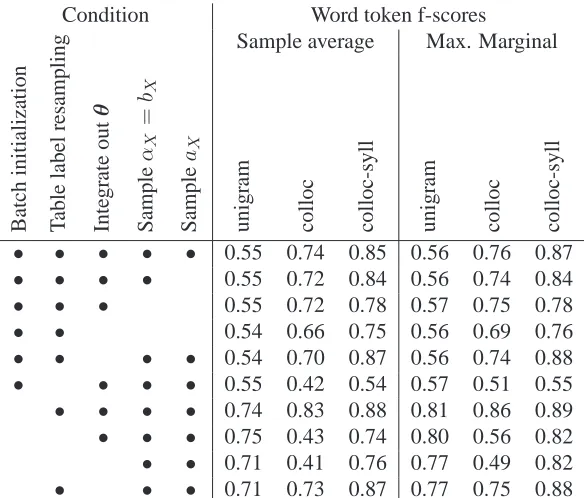
βr = 1 for all rules r ∈ R. As Table 1 shows,
integrating out θ only has a major effect on re-sults when the adaptor hyperparameters themselves are not sampled, and even then it did not have a large effect on the collocation-syllable adaptor grammar. This is not too surprising: because the
Onset, Nucleus and Coda adaptors in this gram-mar learn the probabilities of these building blocks of words, the phoneme probabilities (which is most of whatθencodes) play less important a role.
3.2 Slice sampling adaptor hyperparameters
As far as we know, there are no conjugate priors for the adaptor hyperparameters aX orbX (which
cor-responds to αX in a Chinese Restaurant Process),
so it is not possible to integrate them out as we did with the rule probabilitiesθ. However, it is possible to perform Bayesian inference by putting a prior on them and sampling their values.
Because we have no strong intuitions about the values of these parameters we chose uninformative priors. We chose a uniformBeta(1,1)prior onaX,
and a “vague”Gamma(10,0.1)prior onbX =αX
(MacKay, 2003). (We experimented with other pa-rameters in the Gamma prior, but found no signifi-cant difference in performance).
After each Gibbs sweep through the parse treest we resampled each of the adaptor parameters from the posterior distribution of the parameter using a slice sampler 10 times. For example, we resample eachbX from:
P(bX |t) ∝ P(t|bX) Gamma(bX |10,0.1)
HereP(t | bX) is the likelihood of the current
se-quence of sample parse trees (we only need the fac-tors that depend onbX) andGamma(bX | 10,0.1)
is the prior. The same formula is used for sampling
aX, except that the prior is now a flatBeta(1,1)
dis-tribution.
In general we cannot even compute the normaliz-ing constants for these posterior distributions, so we chose a sampler that does not require this. We use a slice sampler here because it does not require a pro-posal distribution (Neal, 2003). (We initially tried a Metropolis-Hastings sampler but were unable to find a proposal distribution that had reasonable ac-ceptance ratios for all of our adaptor grammars).
Condition Word token f-scores
Sample average Max. Marginal
B
atc
h
in
itia
liz
atio
n
T
ab
le
la
b
el
re
sa
mp
lin
g
In
te
g
ra
te
o
u
t
θ
S
amp
le
αX
=
bX
S
amp
le
aX
u
n
ig
ra
m
co
llo
c
co
llo
c-sy
ll
u
n
ig
ra
m
co
llo
c
co
llo
c-sy
ll
• • • • • 0.55 0.74 0.85 0.56 0.76 0.87 • • • • 0.55 0.72 0.84 0.56 0.74 0.84 • • • 0.55 0.72 0.78 0.57 0.75 0.78
• • 0.54 0.66 0.75 0.56 0.69 0.76
• • • • 0.54 0.70 0.87 0.56 0.74 0.88 • • • • 0.55 0.42 0.54 0.57 0.51 0.55 • • • • 0.74 0.83 0.88 0.81 0.86 0.89 • • • 0.75 0.43 0.74 0.80 0.56 0.82 • • 0.71 0.41 0.76 0.77 0.49 0.82 • • • 0.71 0.73 0.87 0.77 0.75 0.88
Table 1: Word segmentation accuracy measured by word token f-scores on Brent’s version of the Bernstein-Ratner corpus as a function of adaptor grammar, adaptor and estimation procedure. Pitman-Yor Process adaptors were used whenaXwas sampled, otherwise Chinese Restaurant Process adaptors were used. In runs whereθwas not integrated
out it was set uniformly, and allαX=bXwere set to 100 they were not sampled.
4 Inference for adaptor grammars
Johnson et al. (2007b) describe the basic adaptor grammar inference procedure that we use here. That paper leaves unspecified a number of implemen-tation details, which we show can make a crucial difference to segmentation accuracy. The adaptor grammar algorithm is basically a Gibbs sampler of the kind widely used for nonparametric Bayesian in-ference (Blei et al., 2004; Goldwater et al., 2006b; Goldwater et al., 2006a), so it seems reasonable to expect that at least some of the details discussed be-low will be relevant to other applications as well.
The inference algorithm maintains a vector t =
(t1, . . . , tn) of sample parses, where ti ∈ TS is a
parse for theith sentencewi. It repeatedly chooses a
sentencewiat random and resamples the parse tree tiforwifromP(ti |t−i, wi), i.e., conditioned onwi
and the parsest−i of all sentences exceptwi.
4.1 Maximum marginal decoding
Sampling algorithms like ours produce a stream of samples from the posterior distribution over parses of the training data. It is standard to take the out-put of the algorithm to be the last sample produced,
and evaluate those parses. In some other applica-tions of nonparametric Bayesian inference involv-ing latent structure (e.g., clusterinvolv-ing) it is difficult to usefully exploit multiple samples, but that is not the case here.
In maximum marginal decoding we map each sample parse treetonto its corresponding word seg-mentation s, marginalizing out irrelevant detail in
t. (For example, the collocation-syllable adaptor grammar contains a syllabification and collocational structure that is irrelevant for word segmentation). Given a set of sample parse trees for a sentence we compute the set of corresponding word segmenta-tions, and return the one that occurs most frequently (this is a sampling approximation to the maximum probability marginal structure).
[image:6.612.160.452.59.308.2]batch initialization, table label resampling incremental initialization, table label resampling batch initialization, no table label resampling
2000 1500
1000 500
0 220000
215000
210000
205000
200000
195000
190000
185000
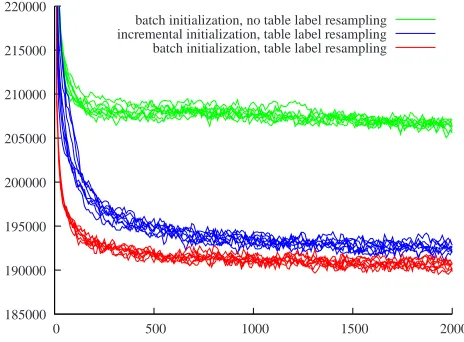
Figure 1: Negative log posterior probability (lower is bet-ter) as a function of iteration for 24 runs of the collo-cation adaptor grammar samplers with Pitman-Yor adap-tors. The upper 8 runs use batch initialization but no ta-ble label resampling, the middle 8 runs use incremental initialization and table label resampling, while the lower 8 runs use batch initialization and table label resampling.
in” by iteration 1000). We evaluated the word to-ken f-score of the most frequent marginal word seg-mentation, and compared that to average of the word token f-score for the 800 samples, which is also re-ported in Table 1. For each grammar and setting we tried, the maximum marginal segmentation was bet-ter than the sample average, sometimes by a large margin. Given its simplicity, this suggests that max-imum marginal decoding is probably worth trying when applicable.
4.2 Batch initialization
The Gibbs sampling algorithm is initialized with a set of sample parsestfor each sentence in the train-ing data. While the fundamental theorem of Markov Chain Monte Carlo guarantees that eventually sam-ples will converge to the posterior distribution, it says nothing about how long the “burn in” phase might last (Robert and Casella, 2004). In practice initialization can make a huge difference to the per-formance of Gibbs samplers (just as it can with other unsupervised estimation procedures such as Expec-tation Maximization).
There are many different ways in which we could generate the initial treest; we only study two of the obvious methods here. Batch initialization assigns every sentence a random parse tree in parallel. In more detail, the initial parse tree ti for sentencewi
is sampled fromP(t|wi, G′), whereG′is the PCFG
[image:7.612.68.300.66.237.2]obtained from the adaptor grammar by ignoring its last two componentsAandC(i.e., the adapted non-terminals and their adaptors), and seated at a new table. This means that in batch initialization each initial parse tree is randomly generated without any adaptation at all.
Incremental initialization assigns the initial parse treestito sentenceswiin order, updating the adaptor grammar as it goes. That is,tiis sampled fromP(t| wi, t1, . . . , ti−1). This is easy to do in the context of Gibbs sampling, since this distribution is a minor variant of the distributionP(ti |t−i, wi)used during Gibbs sampling itself.
Incremental initialization is greedier than batch initialization, and produces initial sample trees with much higher probability. As Table 1 shows, across all grammars and conditions after 2,000 iterations incremental initialization produces samples with much better word segmentation token f-score than does batch initialization, with the largest improve-ment on the unigram adaptor grammar.
However, incremental initialization results in sample parses with lower posterior probability for the unigram and collocation adaptor grammars (but not for the collocation-syllable adaptor grammar). Figure 1 plots the posterior probabilities of the sam-ple treestat each iteration for the collocation adap-tor grammar, showing that even after 2,000 itera-tions incremental initialization results in trees that are much less likely than those produced by batch initialization. It seems that with incremental initial-ization the Gibbs sampler gets stuck in a local op-timum which it is extremely unlikely to move away from.
It is interesting that incremental initialization re-sults in more accurate word segmentation, even though the trees it produces have lower posterior probability. This seems to be because the most prob-able analyses produced by the unigram and, to a lesser extent, the collocation adaptor grammars tend to undersegment. Incremental initialization greed-ily searches for common substrings, and because such substrings are more likely to be short rather than long, it tends to produce analyses with shorter words than batch initialization does. Goldwater et al. (2006a) show that Brent’s incremental segmenta-tion algorithm (Brent, 1999) has a similar property.
in-terested in understanding the properties of our mod-els (expressed here as adaptor grammars), and batch initialization does a better job of finding the most probable analyses under these models. However, it might be possible to justify incremental initializa-tion as (say) cognitively more plausible.
4.3 Table label resampling
Unlike the previous two implementation choices which apply to a broad range of algorithms, table label resampling is a specialized kind of Gibbs step for adaptor grammars and similar hierarchical mod-els that is designed to improve mobility. The adap-tor grammar algorithm described in Johnson et al. (2007b) repeatedly resamples parses for the sen-tences of the training data. However, the adaptor grammar sampler itself maintains of a hierarchy of Chinese Restaurant Processes or Pitman-Yor Pro-cesses, one per adapted nonterminal X ∈ A, that cache subtrees from TX. In general each of these
subtrees will occur many times in the parses for the training data sentences. Table label resampling re-samples the trees in these adaptors (i.e., the table labels, to use the restaurant metaphor), potentially changing the analysis of many sentences at once. For example, each Collocation in the collocation adaptor grammar can occur in manySentences, and eachWordcan occur in manyCollocations. Resam-pling a singleCollocation can change the way it is analysed intoWords, thus changing the analysis of all of theSentences containing thatCollocation.
Table label resampling is an additional resam-pling step performed after each Gibbs sweep through the training data in which we resample the parse trees labeling the tables in the adaptor for each
X ∈ A. Specifically, if the adaptorCX forX ∈ A
currently contains m tables labeled with the trees t = (t1, . . . , tm) then table label resampling re-places eachtj, j ∈1, . . . , min turn with a tree
sam-pled fromP(t | t−j, wj), where wj is the terminal
yield oftj. (Within each adaptor we actually resam-ple all of the treestin a randomly chosen order).
Table label resampling is a kind of Gibbs sweep, but at a higher level in the Bayesian hierarchy than the standard Gibbs sweep. It’s easy to show that ta-ble label resampling preserves detailed balance for the adaptor grammars presented in this paper, so in-terposing table label resampling steps with the stan-dard Gibbs steps also preserves detailed balance.
We expect table label resampling to have the greatest impact on models with a rich hierarchi-cal structure, and the experimental results in Ta-ble 1 confirm this. The unigram adaptor grammar does not involve nested adapted nonterminals, so we would not expect table label resampling to have any effect on its analyses. On the other hand, the collocation-syllable adaptor grammar involves a rich hierarchical structure, and in fact without table la-bel resampling our sampler did not burn in or mix within 2,000 iterations. As Figure 1 shows, table label resampling produces parses with higher pos-terior probability, and Table 1 shows that table la-bel resampling makes a significant difference in the word segmentation f-score of the collocation and collocation-syllable adaptor grammars.
5 Conclusion
This paper has examined adaptor grammar infer-ence procedures and their effect on the word seg-mentation problem. Some of the techniques inves-tigated here, such as batch versus incremental ini-tialization, are quite general and may be applica-ble to a wide range of other algorithms, but some of the other techniques, such as table label resam-pling, are specialized to nonparametric hierarchi-cal Bayesian inference. We’ve shown that sampling adaptor hyperparameters is feasible, and demon-strated that this improves word segmentation accu-racy of the collocation-syllable adaptor grammar by almost 10%, corresponding to an error reduction of over 35% compared to the best results presented in Johnson (2008). We also described and investigated table label resampling, which dramatically improves the effectiveness of Gibbs sampling estimators for complex adaptor grammars, and makes it possible to work with adaptor grammars with complex hier-archical structure.
Acknowledgments
References
N. Bernstein-Ratner. 1987. The phonology of parent-child speech. In K. Nelson and A. van Kleeck, editors,
Children’s Language, volume 6. Erlbaum, Hillsdale,
NJ.
Daniel Blanchard and Jeffrey Heinz. 2008. Improv-ing word segmentation by simultaneously learnImprov-ing phonotactics. In CoNLL 2008: Proceedings of the
Twelfth Conference on Computational Natural Lan-guage Learning, pages 65–72, Manchester, England,
August.
David Blei, Thomas L. Griffiths, Michael I. Jordan, and Joshua B. Tenenbaum. 2004. Hierarchical topic models and the nested chinese restaurant process. In Sebastian Thrun, Lawrence Saul, and Bernhard Sch¨olkopf, editors, Advances in Neural Information
Processing Systems 16. MIT Press, Cambridge, MA.
Rens Bod. 1998. Beyond grammar: an experience-based
theory of language. CSLI Publications, Stanford,
Cal-ifornia.
M. Brent and T. Cartwright. 1996. Distributional reg-ularity and phonotactic constraints are useful for seg-mentation. Cognition, 61:93–125.
M. Brent. 1999. An efficient, probabilistically sound algorithm for segmentation and word discovery.
Ma-chine Learning, 34:71–105.
Jeffrey Elman. 1990. Finding structure in time.
Cogni-tive Science, 14:197–211.
Margaret M. Fleck. 2008. Lexicalized phonotactic word segmentation. In Proceedings of ACL-08: HLT, pages 130–138, Columbus, Ohio, June. Association for Computational Linguistics.
Sharon Goldwater, Thomas L. Griffiths, and Mark John-son. 2006a. Contextual dependencies in unsupervised word segmentation. In Proceedings of the 21st
In-ternational Conference on Computational Linguistics and 44th Annual Meeting of the Association for Com-putational Linguistics, pages 673–680, Sydney,
Aus-tralia. Association for Computational Linguistics. Sharon Goldwater, Tom Griffiths, and Mark Johnson.
2006b. Interpolating between types and tokens by estimating power-law generators. In Y. Weiss, B. Sch¨olkopf, and J. Platt, editors, Advances in Neural
Information Processing Systems 18, pages 459–466,
Cambridge, MA. MIT Press.
Sharon Goldwater, Thomas L. Griffiths, and Mark John-son. 2007. Distributional cues to word boundaries: Context is important. In David Bamman, Tatiana Magnitskaia, and Colleen Zaller, editors, Proceedings
of the 31st Annual Boston University Conference on Language Development, pages 239–250, Somerville,
MA. Cascadilla Press.
H. Ishwaran and L. F. James. 2003. Generalized weighted Chinese restaurant processes for species sampling mixture models. Statistica Sinica, 13:1211– 1235.
Mark Johnson, Thomas Griffiths, and Sharon Goldwa-ter. 2007a. Bayesian inference for PCFGs via Markov chain Monte Carlo. In Human Language Technologies
2007: The Conference of the North American Chap-ter of the Association for Computational Linguistics; Proceedings of the Main Conference, pages 139–146,
Rochester, New York, April. Association for Compu-tational Linguistics.
Mark Johnson, Thomas L. Griffiths, and Sharon Gold-water. 2007b. Adaptor Grammars: A framework for specifying compositional nonparametric Bayesian models. In B. Sch¨olkopf, J. Platt, and T. Hoffman, ed-itors, Advances in Neural Information Processing
Sys-tems 19, pages 641–648. MIT Press, Cambridge, MA.
Mark Johnson. 2008. Using adaptor grammars to identi-fying synergies in the unsupervised acquisition of lin-guistic structure. In Proceedings of the 46th Annual
Meeting of the Association of Computational Linguis-tics, Columbus, Ohio. Association for Computational
Linguistics.
Aravind Joshi. 2003. Tree adjoining grammars. In Rus-lan Mikkov, editor, The Oxford Handbook of
Compu-tational Linguistics, pages 483–501. Oxford
Univer-sity Press, Oxford, England.
David J.C. MacKay. 2003. Information Theory,
Infer-ence, and Learning Algorithms. Cambridge
Univer-sity Press.
Radford M. Neal. 2003. Slice sampling. Annals of Statistics, 31:705–767.
J. Pitman and M. Yor. 1997. The two-parameter Poisson-Dirichlet distribution derived from a stable subordina-tor. Annals of Probability, 25:855–900.
J. Pitman. 1995. Exchangeable and partially exchange-able random partitions. Probability Theory and
Re-lated Fields, 102:145–158.
Christian P. Robert and George Casella. 2004. Monte
Carlo Statistical Methods. Springer.
Andreas Stolcke and Stephen Omohundro. 1994. Induc-ing probabilistic grammars by Bayesian model merg-ing. In Rafael C. Carrasco and Jose Oncina, editors,
Grammatical Inference and Applications, pages 106–
118. Springer, New York.
Y. W. Teh, M. Jordan, M. Beal, and D. Blei. 2006. Hier-archical Dirichlet processes. Journal of the American