Unsupervised Resolution of Objects and Relations on the Web
Alexander Yates Turing Center
Computer Science and Engineering University of Washington
Box 352350 Seattle, WA 98195, USA [email protected]
Oren Etzioni Turing Center
Computer Science and Engineering University of Washington
Box 352350 Seattle, WA 98195, USA [email protected]
Abstract
The task of identifying synonymous re-lations and objects, or Synonym Resolu-tion (SR), is critical for high-quality infor-mation extraction. The bulk of previous SR work assumed strong domain knowl-edge or hand-tagged training examples. This paper investigates SR in the con-text of unsupervised information extrac-tion, where neither is available. The pa-per presents a scalable, fully-implemented system for SR that runs inO(KN log N) time in the number of extractions N and the maximum number of synonyms per word,K. The system, called RESOLVER, introduces a probabilistic relational model for predicting whether two strings are co-referential based on the similarity of the assertions containing them. Given two million assertions extracted from the Web, RESOLVER resolves objects with 78% precision and an estimated 68% re-call and resolves relations with 90% pre-cision and 35% recall.
1 Introduction
Web Information Extraction (WIE)
sys-tems extract assertions that describe a rela-tion and its arguments from Web text (e.g., (is capital of,D.C.,United States)). WIE systems can extract hundreds of millions of assertions containing millions of different strings from the
Web (e.g., the TEXTRUNNERsystem (Banko et al., 2007)).1 WIE systems often extract assertions that
describe the same real-world object or relation using different names. For example, a WIE system might extract (is capital city of,Washington,U.S.), which describes the same relationship as above but contains a different name for the relation and each argument.
Synonyms are prevalent in text, and the Web cor-pus is no exception. Our data set of two million as-sertions extracted from a Web crawl contained over a half-dozen different names each for the United States and Washington, D.C., and three for the “is capital of” relation. The top 80 most commonly extracted objects had an average of 2.9 extracted names per entity, and several had as many as 10 names. The top 100 most commonly extracted re-lations had an average of 4.9 synonyms per relation. We refer to the problem of identifying synony-mous object and relation names as Synonym Res-olution (SR).2An SR system for WIE takes a set of assertions as input and returns a set of clusters, with each cluster containing coreferential object strings or relation strings. Previous techniques for SR have focused on one particular aspect of the problem, ei-ther objects or relations. In addition, the techniques either depend on a large set of training examples, or are tailored to a specific domain by assuming knowl-edge of the domain’s schema. Due to the number and diversity of the relations extracted, these
tech-1For a demo see www.cs.washington.edu/research/textrunner. 2Ironically, SR has a number of synonyms in the literature,
including Entity Resolution, Record Linkage, and Deduplica-tion.
niques are not feasible for WIE systems. Schemata are not available for the Web, and hand-labeling training examples for each relation would require a prohibitive manual effort.
In response, we present RESOLVER, a novel, domain-independent, unsupervised synonym resolu-tion system that applies to both objects and relaresolu-tions. RESOLVERclusters coreferential names together us-ing a probabilistic model informed by strus-ing similar-ity and the similarsimilar-ity of the assertions containing the names. Our contributions are:
1. A scalable clustering algorithm that runs in time O(KN log N) in the number of extrac-tions N and maximum number of synonyms per word, K, without discarding any poten-tially matching pair, under exceptionally weak assumptions about the data.
2. An unsupervised probabilistic model for pre-dicting whether two object or relation names co-refer.
3. An empirical demonstration that RESOLVER can resolve objects with 78% precision and 68% recall, and relations with 90% precision and 35% recall.
The next section discusses previous work. Section 3 introduces our probabilistic model for SR. Section 4 describes our clustering algorithm. Section 5 de-scribes extensions to our basic SR system. Section 6 presents our experiments, and section 7 discusses our conclusions and areas for future work.
2 Previous Work
The DIRT algorithm (Lin and Pantel, 2001) ad-dresses a piece of the unsupervised SR problem. DIRT is a heuristic method for finding synonymous relations, or “inference rules.” DIRT uses a depen-dency parser and mutual information statistics over a corpus to identify relations that have similar sets of arguments. In contrast, our algorithm provides a for-mal probabilistic model that applies equally well to relations and objects, and we provide an evaluation of the algorithm in terms of precision and recall.
There are many unsupervised approaches for ob-ject resolution in databases, but unlike our algo-rithm these approaches depend on a known, fixed schema. Ravikumar and Cohen (Ravikumar and Co-hen, 2004) present an unsupervised approach to
ob-ject resolution using Expectation-Maximization on a hierarchical graphical model. Several other re-cent approaches leverage domain-specific informa-tion and heuristics for object resoluinforma-tion. For ex-ample, many (Dong et al., 2005; Bhattacharya and Getoor, 2005; Bhattacharya and Getoor, 2006) rely on evidence from observing which strings appear as arguments to the same relation simultaneously (e.g., co-authors of the same publication). While this is useful information when resolving authors in the ci-tation domain, it is extremely rare to find relations with similar properties in extracted assertions. None of these approaches applies to the problem of resolv-ing relations. See (Winkler, 1999) for a survey of this area.
Several supervised learning techniques make en-tity resolution decisions (Kehler, 1997; McCallum and Wellner, 2004; Singla and Domingos, 2006), but of course these systems depend on the availability of training data, and often on a significant number of labeled examples per relation of interest. These approaches also depend on complex probabilistic models and learning algorithms, and they have order O(n3)time complexity, or worse. They currently do not scale to the amounts of data extracted from the Web. Previous systems were tested on at most a few thousand examples, compared with millions or hun-dreds of millions of extractions from WIE systems such as TEXTRUNNER.
Coreference resolution systems (e.g., (Lappin and Leass, 1994; Ng and Cardie, 2002)), like SR sys-tems, try to merge references to the same object (typ-ically pronouns, but potentially other types of noun phrases). This problem differs from the SR problem in several ways: first, it deals with unstructered text input, possibly with syntactic annotation, rather than relational input. Second, it deals only with resolv-ing objects. Finally, it requires local decisions about strings; that is, the same word may appear twice in a text and refer to two different things, so each occur-rence of a word must be treated separately.
data, and its input is in the form of relational extrac-tions rather than raw text.
Two probabilistic models for information extrac-tion have a connecextrac-tion with ours. Our probabilistic model is partly inspired by the ball-and-urns abstrac-tion of informaabstrac-tion extracabstrac-tion presented by Downey et al. (2005) Our task and probability model are dif-ferent from theirs, but we make many of the same modeling assumptions. Second, we follow Snow et al.’s work (2006) on taxonomy induction in incorpo-rating transitive closure constraints in our probabil-ity calculations, as explained below.
3 Probabilistic Model
Our probabilistic model provides a formal, rigorous method for resolving synonyms in the absence of training data. It has two sources of evidence: the similarity of the strings themselves (i.e., edit dis-tance) and the similarity of the assertions they ap-pear in. This second source of evidence is some-times referred to as “distributional similarity” (Hin-dle, 1990).
Section 3.2 presents a simple model for predict-ing whether a pair of strpredict-ings co-refer based on strpredict-ing similarity. Section 3.3 then presents a model called the Extracted Shared Property (ESP) Model for pre-dicting whether a pair of strings co-refer based on their distributional similarity. Finally, a method is presented for combining these models to come up with an overall prediction for coreference decisions between two clusters of strings.
3.1 Terminology and Notation
We use the following notation to describe the proba-bilistic models. The input is a data setDcontaining extractedassertionsof the forma= (r, o1, . . . , on),
whereris a relation string and eachoi is an object
string representing the arguments to the relation. In our data, all of the extracted assertions are binary, so n= 2. The subset of all assertions inDcontaining a stringsis calledDs.
For stringssiandsj, letRi,j be the random vari-able for the event that si andsj refer to the same
entity. LetRt
i,j denote the event that Ri,j is true,
andRfi,jdenote the event that it is false.
A pair of strings (r, s2) is called a property of a strings1 if there is an assertion (r, s1, s2) ∈ D
or (r, s2, s1) ∈ D. A pair of strings (s1, s2) is an instance of a string r if there is an assertion (r, s1, s2) ∈ D. Equivalently, the property p =
(r, s2) applies to s1, and the relation r applies to the instancei= (s1, s2). Finally, two stringsxand ysharea property (or instance) if bothx andy are extracted with the same property (or instance).
3.2 String Similarity Model
Many objects appear with multiple names that are substrings, acronyms, abbreviations, or other sim-ple variations of one another. Thus string similarity can be an important source of evidence for whether two strings co-refer. Our probabilistic String Sim-ilarity Model (SSM) assumes a simSim-ilarity function sim(s1, s2):ST RIN G×ST RIN G→[0,1]. The model sets the probability ofs1 co-referring withs2 to a smoothed version of the similarity:
P(Rti,j|sim(s1, s2)) = α∗sim(αs+1, sβ2) + 1
The particular choice ofα andβ make little differ-ence to our results, so long as they are chosen such that the resulting probability can never be one or zero. In our experimentsα= 20andβ= 5, and we use the well-known Monge-Elkan string similarity function for objects and the Levenshtein string edit-distance function for relations (Cohen et al., 2003).
3.3 The Extracted Shared Property Model
The Extracted Shared Property (ESP) Model out-puts the probability that s1 and s2 co-refer based on how many properties (or instances) they share. As an example, consider the strings “Mars” and “Red Planet”, which appear in our data 659 and 26 times respectively. Out of these extracted assertions, they share four proper-ties. For example,(lacks, M ars, ozone layer)and (lacks, Red P lanet, ozone layer) both appear as assertions in our data. The ESP model determines the probability that “Mars” and “Red Planet” refer to the same entity after observingk, the number of properties that apply to both, n1, the total number of extracted properties for “Mars”, andn2, the total number of extracted properties for “Red Planet.”
number,Pi, of properties of the string are written on balls and placed in an urn. Extractingni assertions
that containsi amounts to selecting a subset of size
nifrom these labeled balls.3Properties in the urn are
calledpotential propertiesto distinguish them from extracted properties.
To model coreference decisions, ESP uses a pair of urns, containingPi andPj balls respectively, for
the two strings si and sj. Some subset of the Pi balls have the exact same labels as an equal-sized subset of the Pj balls. Let the size of this
sub-set beSi,j. The ESP model assumes that corefer-ential strings share as many potcorefer-ential properties as possible, though only a few of the potential proper-ties will be extracted for both. For non-coreferential strings, the number of shared potential properties is a strict subset of the potential properties of each string. Thus ifRi,j is true thenSi,j = min(Pi, Pj), and if
Ri,j is false thenSi,j <min(Pi, Pj).
The ESP model makes several simplifying as-sumptions in order to make probability predictions. As is suggested by the ball-and-urn abstraction, it assumes that each ball for a string is equally likely to be selected from its urn. Because of data sparsity, almost all properties are very rare, so it would be dif-ficult to get a better estimate for the prior probability of selecting a particular potential property. Second, it assumes that without knowing the value ofk, ev-ery value ofSi,j is equally likely, since we have no
better information. Finally, it assumes that all sub-sets of potential properties are equally likely to be shared by two non-coreferential objects, regardless of the particular labels on the balls, given the size of the shared subset.
Given these assumptions, we can derive an ex-pression for P(Rt
i,j). First, note that there are
¡Pi
ni
¢¡Pj
nj
¢
total ways of extracting ni and nj
asser-tions forsiandsj. Given a particular value ofSi,j,
the number of ways in which ni andnj assertions
can be extracted such that they share exactly k is given by
Count(k, ni, nj|Pi, Pj, Si,j) =
¡Si,j
k
¢ P
r,s≥0
¡Si,j−k
r+s
¢¡r+s
r
¢¡ Pi−Si,j
ni−(k+r)
¢¡Pj−Si,j
nj−(k+s)
¢
By our assumptions,
3Unlike the URNS model, balls are drawn without
replace-ment because each extracted property is distinct in our data.
P(k|ni, nj, Pi, Pj, Si,j) =
Count(k, ni, nj|Pi, Pj, Si,j)
¡Pi
ni
¢¡Pj
nj
¢ (1)
LetPmin = min(Pi, Pj). The result below
fol-lows from Bayes’ Rule and our assumptions above:
Proposition 1 If two stringssi andsj havePi and
Pj potential properties (or instances), and they ap-pear in extracted assertions Di and Dj such that
|Di|=niand|Dj|=nj, and they sharekextracted
properties (or instances), the probability thatsiand
sj co-refer is:
P(Rti,j|Di, Dj, Pi, Pj) =
P(k|ni, nj, Pi, Pj, Si,j =Pmin)
P
k≤Si,j≤PminP(k|ni, nj, Pi, Pj, Si,j) (2)
Substituting equation 1 into equation 2 gives us a complete expression for the probability we are look-ing for.
Note that the probability forRi,j depends on just
two hidden parameters, Pi andPj. Since we have no labeled data to estimate these parameters from, we tie these parameters to the number of times the respective stringssi andsj are extracted. Thus we
setPi=N ×ni, and we setN = 50in our
experi-ments.
3.4 Combining the Evidence
For each potential coreference relationship Ri,j,
there are now two pieces of probabilistic evidence. LetEe
i,jbe the evidence for ESP, and letEi,js be the
evidence for SSM. Our method for combining the two uses the Na¨ıve Bayes assumption that each piece of evidence is conditionally independent, given the coreference relation:
P(Ei,js , Ei,je |Ri,j) =P(Ei,js |Ri,j)P(Ei,je |Ri,j)
Given this simplifying assumption, we can com-bine the evidence to find the probability of a cofer-ence relationship by applying Bayes’ Rule to both sides (we omit thei, jindices for brevity):
P(Rt|Es, Ee) =
P(Rt|Es)P(Rt|Ee)(1−P(Rt))
P
3.5 Comparing Clusters of Strings
Our algorithm merges clusters of strings with one another, using one of the above models. However, these models give probabilities for coreference deci-sions between two individual strings, not two clus-ters of strings.
We follow the work of Snow et al. (2006) in in-corporating transitive closure constraints in proba-bilistic modeling, and make the same independence assumptions. The benefit of this approach is that the calculation for merging two clusters depends only on coreference decisions between individual strings, which can be calculated independently.
Let a clustering be a set of coreference relation-ships between pairs of strings such that the corefer-ence relationships obey the transitive closure prop-erty. We let the probability of a set of assertionsD given a clusteringCbe:
P(D|C) = Y
Rt i,j∈C
P(Di∪Dj|Rti,j)×
Y
Rfi,j∈C
P(Di∪Dj|Rfi,j)
The metric used to determine if two clusters should be merged is the likelihood ratio, or the prob-ability for the set of assertions given the merged clusters over the probability given the original clus-tering. Let C0 be a clustering that differs from C only in that two clusters inC have been merged in C0, and let ∆C be the set of coreference relation-ships inC0that are true, but the corresponding ones inCare false. This metric is given by:
P(D|C0)/P(D|C) =
Q
Rt
i,j∈∆CP(R
t
i,j|Di∪Dj)(1−P(Rti,j))
Q
Rt
i,j∈∆C(1−P(R
t
i,j|Di∪Dj))P(Rti,j)
The probabilityP(Rti,j|Di∪Dj)may be supplied
by the SSM, ESP, or combination model. In our ex-periments, we let the prior for the SSM model be 0.5. For the ESP and combined models, we set the prior toP(Rt
i,j) = min(P11,P2).
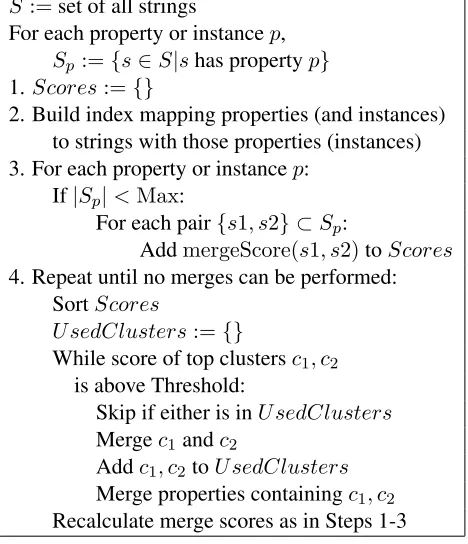
4 RESOLVER’s Clustering Algorithm Our clustering algorithm iteratively merges clusters of co-referential names, making each iteration in
S:=set of all strings
For each property or instancep, Sp :={s∈S|shas propertyp}
1.Scores:={}
2. Build index mapping properties (and instances) to strings with those properties (instances) 3. For each property or instancep:
If|Sp|<Max:
For each pair{s1, s2} ⊂Sp:
AddmergeScore(s1, s2)toScores 4. Repeat until no merges can be performed:
SortScores
U sedClusters:={}
While score of top clustersc1, c2 is above Threshold:
Skip if either is inU sedClusters Mergec1andc2
[image:5.612.312.546.63.335.2]Addc1, c2toU sedClusters Merge properties containingc1, c2 Recalculate merge scores as in Steps 1-3
Figure 1: RESOLVER’s Clustering Algorithm
time O(N log N) in the number of extracted as-sertions. The algorithm requires only basic assump-tions about which strings to compare. Previous work on speeding up clustering algorithms for SR has ei-ther required far stronger assumptions, or else it has focused on heuristic methods that remain, in the worst case,O(N2)in the number of distinct objects. Our algorithm, a greedy agglomerative clustering method, is outlined in Figure 1. The first novel part of the algorithm, step 3, compares pairs of strings that share the same property or instance, so long as no more thanM axstrings share that same property or instance. After the scores for all comparisons are made, each string is assigned its own cluster. Then the scores are sorted and the best cluster pairs are merged until no pair of clusters has a score above threshold. The second novel aspect of this algorithm is that as it merges clusters in Step 4, it merges prop-erties containing those clusters in a process we call
mutual recursion, which is discussed below.
comparing. Since the number of shared properties is a key source of evidence for our approach, these clusters almost certainly will not be merged, even if they are compared, so the assumption is quite rea-sonable. Second, the approach assumes that clus-ters sharing only properties that apply to very many strings (more than M ax) need not be compared. Since properties shared by many strings provide lit-tle evidence that the strings are coreferential, this as-sumption is reasonable for SR. We useM ax = 50 in our experiments. Less than 0.1% of the properties are thrown out using this cutoff.
4.1 Algorithm Analysis
LetDbe the set of extracted assertions. The follow-ing analysis shows that one iteration of merges takes time O(N log N), where N = |D|. Let N C be the number of comparisons between strings in step 3. To simplify the analysis, we consider only those properties that contain a relation string and an argu-ment 1 string. LetAbe the set of all such properties. N Cis linear inN:4
N C = X
p∈A
|Sp| ×(|Sp| −1)
2
≤ (M ax−1)
2 ×
X
p∈A
|Sp|
= (M ax−1)
2 ×N
Note that this bound is quite loose because most properties apply to only a few strings. Step 4 re-quires time O(N log N) to sort the comparison scores and perform one iteration of merges. If the largest cluster has sizeK, in the worst case the al-gorithm will takeK iterations. In our experiments, the algorithm never took more than 9 iterations.
4.2 Relation to other speed-up techniques
The merge/purge algorithm (Hernandez and Stolfo, 1995) assumes the existence of a particular attribute such that when the data set is sorted on this attribute, matching pairs will all appear within a narrow win-dow of one another. This algorithm isO(M log M) whereMis the number of distinct strings. However, there is no attribute or set of attributes that comes
4If the M ax parameter is allowed to vary with log|D|,
rather than remaining constant, the same analysis leads to a slightly looser bound that is still better thanO(N2).
close to satisfying this assumption in the context of domain-independent information extraction.
There are several techniques that often provide speed-ups in practice, but in the worst case they makeO(M2) comparisons at each merge iteration, whereM is the number of distinct strings. This can cause problems on very large data sets. Notably, McCallum et al. (2000) use a cheap comparison metric to place objects into overlapping “canopies,” and then use a more expensive metric to cluster ob-jects appearing in the same canopy. The RESOLVER clustering algorithm is in fact an adaptation of the canopy method; it adds the restriction that strings are not compared when they share only high-frequency properties. The canopy method works well on high-dimensional data with many clusters, which is the case with our problem, but its time complexity is worse than ours.
For information extraction data, a complexity of O(M2) in the number of distinct strings turns out to be considerably worse than our algorithm’s com-plexity ofO(N log N)in the number of extracted assertions. This is because the data obeys a Zipf law relationship between the frequency of a string and its rank, so the number of distinct strings grows linearly or almost linearly with the number of assertions.5
4.3 Mutual Recursion
Mutual recursion refers to the novel property of our algorithm that as it clusters relation strings to-gether into sets of synonyms, it collapses proper-ties together for object strings and potentially finds more shared properties between coreferential object strings. Likewise, as it clusters objects together into sets of coreferential names, it collapses instances of relations together and potentially finds more shared instances between coreferential relations. Thus the clustering decisions for relations and objects mutu-ally depend on one another.
For example, the strings “Kennedy” and “Pres-ident Kennedy” appear in 430 and 97 assertions in our data, respectively, but none of their ex-tracted properties match exactly. Many properties,
5The exact relationship depends on the shape parameterz
of the Zipf curve. Ifz <1, as it is for our data set, the num-ber of total extractions grows linearly with the numnum-ber of dis-tinct strings extracted. Ifz= 1, thennextractions will contain
Ω( n
however, almost match. For example, the asser-tions (challenged,Kennedy,Premier Krushchev) and (stood up to,President Kennedy,Kruschev) both appear in our data. Because “challenged” and “stood up to” are similar, and “Krushchev” and “Pre-mier Krushchev” are similar, our algorithm is able to merge these pairs into two clusters, thereby creat-ing a new shared property between “Kennedy” and “President Kennedy.” Eventually it can merge these two strings as well.
5 Extensions toRESOLVER
While the basic RESOLVERsystem can cluster syn-onyms accurately and quickly, there is one type of error that it frequently makes. In some cases, it has difficulty distinguishing between similar pairs of ob-jects and identical pairs. For example, “Virginia” and “West Virginia” share several extractions be-cause they have the same type, and they have high string similarity. As a result, RESOLVER clusters these two together. The next two sections describe two extensions to RESOLVERthat address the prob-lem of similarity vs. identity.
5.1 Function Filtering
RESOLVER can use functions and one-to-one rela-tions to help distinguish between similar and identi-cal pairs. For example, West Virginia and Virginia have different capitals: Richmond and Charleston, respectively. If both of these facts are extracted, and if RESOLVERknows that the “capital of” relation is functional, it should prevent Virginia and West Vir-ginia from merging.
The Function Filter prevents merges between strings that have different values for the same func-tion. More precisely, it decides that two stringsy1 andy2matchif their string similarity is above a high threshold. It prevents a merge between stringsx1 and x2 if there exist a function f and extractions f(x1, y1) andf(x2, y2), and there are no such ex-tractions such thaty1 andy2 match (andvice versa for one-to-one relations). Experiments described in section 6 show that the Function Filter can improve the precision of RESOLVERwithout significantly af-fecting its recall.
While the Function Filter currently uses func-tions and one-to-one relafunc-tions as negative evidence,
it is also possible to use them as positive evidence. For example, the relation “married” is not strictly one-to-one, but for most people the set of spouses is very small. If a pair of strings are extracted with the same spouse—e.g., “FDR” and “President Roosevelt” share the property (“married”, “Eleanor Roosevelt”)—this is far stronger evidence that the two strings are identical than if they shared some random property.
Unfortunately, various techniques that attempted to model this insight, including a TF-IDF weighting of properties, yielded essentially no improvement of RESOLVER. One major reason is that there are rel-atively few examples of shared functional or one-to-one properties because of sparsity. This idea de-serves more investigation, however, and is an area for future work.
5.2 Using Web Hitcounts
While names for two similar objects may often ap-pear together in the same sentence, it is relatively rare for two different names of the same object to appear in the same sentence. RESOLVER exploits this fact by querying the Web to determine how often a pair of strings appears together in a large corpus. When the hitcount is high, RESOLVER can prevent the merge.
Specifically, the Coordination-Phrase Filter searches for hitcounts of the phrase “s1 and s2”, where s1 and s2 are a candidate pair for merging. It then computes a variant of pointwise mutual information, given by
coordination score(s1, s2) = hits(s1ands2) 2
hits(s1)×hits(s2)
The filter prevents any merge for which the coor-dination score is above a threshold, which is de-termined on a development set. The results of Coordination-Phrase filtering are discussed in the next section.
6 Experiments
resolving synonyms than either of its components, SSM or ESP.
We test these models on a data set of 2.1 million assertions extracted from a Web crawl.6 All models
ran over all assertions, but compared only those ob-jects or relations that appeared at least 25 times in the data, to give the ESP and CSM models sufficient data for estimating similarity. However, the mod-els do use strings that appear less than 25 times as features. In all, the data contains 9,797 distinct ob-ject strings and 10,151 distinct relation strings that appear at least 25 times.
We judged the precision of each model by manu-ally labeling all of the clusters that each model out-puts. Judging recall would require inspecting not just the clusters that the system outputs, but the en-tire data set, to find all of the true clusters. Be-cause of the size of the data set, we instead esti-mated recall over a smaller subset of the data. We took the top 200 most frequent object strings and top 200 most frequent relation strings in the data. For each one of these high-frequency strings, we man-ually searched through all strings with frequency over 25 that shared at least one property, as well as all strings that contained one of the keywords in the high-frequency strings or obvious variations of them. We manually clustered the resulting matches. The top 200 object strings formed 51 clusters of size greater than one, with an average cluster size of 2.9. For relations, the top 200 strings and their matches formed 110 clusters with size greater than one, with an average cluster size of 4.9. We measured the re-call of our models by comparing the set of all clus-ters containing at least one of the high-frequency words against these gold standard clusters.
For our precision and recall measures, we only compare clusters of size two or more, in order to focus on the interesting cases. Using the term hy-pothesis cluster for clusters created by one of the models, we define the precision of a model to be the number of elements in all hypothesis clusters which are correct divided by the total number of elements in hypothesis clusters. An elementsis marked cor-rect if a plurality of the elements ins’s cluster refer to the same entity ass; we break ties arbitrarily, as
6The data is made available at
http://www.cs.washington.edu/homes/ayates/.
they do not affect results. We define recall as the sum over gold standard clusters of the most num-ber of elements found in a single hypothesis cluster, divided by the total number of elements in gold stan-dard clusters.
For the ESP and SSM models in our experiment, we prevented mutual recursion by clustering rela-tions and objects separately. Only the full RE -SOLVERsystem uses mutual recursion. For the CSM model, we create for each distinct string a row vec-tor, with each column representing a property. If that property applies to the string, we set the value of that column to the inverse frequency of the property and zero otherwise. CSM finds the cosine of the an-gle between the vectors for each pair of strings, and merges the best pairs that score above threshold.
Each model requires a threshold parameter to de-termine which scores are suitable for merging. For these experiments we arbitrarily chose a threshold of 3 for the ESP model (that is, the data needs to be 3 times more likely given the merged cluster than the unmerged clusters in order to perform the merge) and chose thresholds for the other models by hand so that the difference between them and ESP would be roughly even between precision and recall, although for relations it was harder to improve the recall. It is an important item for future work to be able to esti-mate these thresholds and perhaps other parameters of our models from unlabeled data, but the chosen parameters worked well enough for the experiments. Table 1 shows the precision and recall of our models.
6.1 Discussion
ESP significantly outperforms CSM on both object and relation clustering. CSM had particular trouble with lower-frequency strings, judging far too many of them to be co-referential on too little evidence. If the threshold for clustering using CSM is increased, however, the recall begins to approach zero.
ESP and CSM make predictions based on a very noisy signal. “Canada,” for example, shares more properties with “United States” in our data than “U.S.” does, even though “Canada” appears less of-ten than “U.S.” The results show that both models perform below the SSM model on its own for object merging, and both perform slightly better than SSM on relations because of SSM’s poor recall.
pre-Objects Relations
Model Prec. Rec. F1 Prec. Rec. F1
CSM 0.51 0.36 0.42 0.62 0.29 0.40
ESP 0.56 0.41 0.47 0.79 0.33 0.47
SSM 0.62 0.53 0.57 0.85 0.25 0.39
[image:9.612.173.434.57.144.2]RESOLVER 0.71 0.66 0.68 0.90 0.35 0.50
Table 1: Comparison of the cosine similarity metric (CSM),RESOLVERcomponents (SSM and ESP), and theRESOLVER
system. Bold indicates the score is significantly different from the score in the row above atp <0.05using the chi-squared test with one degree of freedom. Using the same test, RESOLVERis also significantly different from ESP and CSM in recall on objects, and from CSM and SSM in recall on relations. RESOLVER’s F1 on objects is a 19% increase over SSM’s F1. RESOLVER’s F1 on relations is a 28% increase over SSM’s F1.
cision and recall when using a combined model over using SSM alone. RESOLVER’s F1 is 19% higher than SSM’s on objects, and 28% higher on relations. In a separate experiment we found that mutual re-cursion provides mixed results. A combination of SSM and ESP without mutual recursion had a preci-sion of 0.76 and recall of 0.59 on objects, and a pre-cision of 0.91 and recall of 0.35 on relations. Mutual recursion increased recall and decreased precision for both objects and relations. None of the differ-ences were statistically significant, however.
There is clearly room for improvement on the SR task. Except for the problem of confusing similar and identical pairs (see section 5), error analysis shows that most of RESOLVER’s mistakes are be-cause of two kinds of errors:
1. Extraction errors. For example, “US News” gets extracted separately from “World Report”, and then RESOLVERclusters them together because they share almost all of the same properties.
2.Multiple word senses. For example, there are two President Bushes; also, there are many terms like “President” and “Army” that can refer to many dif-ferent entities.
6.2 Experiments with Extensions
The extensions to RESOLVER attempt to address the confusion between similar and identical pairs. Experiments with the extensions, using the same datasets and metrics as above, demonstrate that the Function Filter (FF) and the Coordination-Phrase Filter (CPF) boost RESOLVER’s performance.
FF requires as input the set of functional and one-to-one relations in the data. Table 2 contains a
sam-is capital of is capital city of named after was named after headquartered in is headquartered in
Table 2:A sample of the set of functions used by the Func-tion Filter.
Model Prec. Rec. F1
RESOLVER 0.71 0.66 0.68
RESOLVER+FF 0.74 0.66 0.70
RESOLVER+CPF 0.78 0.68 0.73
[image:9.612.332.515.240.281.2]RESOLVER+FF+CPF 0.78 0.68 0.73
Table 3: Comparison of object merging results for the
RESOLVERsystem,RESOLVERplus Function Filtering (RE -SOLVER+FF), RESOLVER plus Coordination-Phrase Filter-ing (RESOLVER+CPF), andRESOLVERplus both types of fil-tering (RESOLVER+FF+CPF).Bold indicates the score is sig-nificantly different from RESOLVER’s score at p < 0.05 us-ing the chi-squared test with one degree of freedom. RE -SOLVER+CPF’s F1 on objects is a 28% increase over SSM’s F1, and a 7% increase over RESOLVER’s F1.
pling of the manually-selected functions used in our experiment. Automatically discovering such func-tions from extracfunc-tions has been addressed in Ana-Maria Popescu’s dissertation (Popescu, 2007), and we did not attempt to duplicate this effort in RE -SOLVER.
merges that it prevents are, with a few exceptions, a subset of the merges prevented by CPF. This is in part due to the limited number of functions available in the data. In addition to outperforming FF on this dataset, CPF has the added advantage that it does not require additional input, like a set of functions.
7 Conclusion and Future Work
We have shown that the unsupervised and scalable RESOLVER system is able to find clusters of co-referential object names in extracted relations with a precision of 78% and a recall of 68% with the aid of coordination-phrase filtering, and can find clus-ters of co-referential relation names with precision of 90% and recall of 35%. We have demonstrated significant improvements over using simple similar-ity metrics for this task by employing a novel prob-abilistic model of coreference.
In future work, we plan to use RESOLVER on a much larger data set of over a hundred million as-sertions, further testing its scalability and its abil-ity to improve in accuracy given additional data. We also plan to add techniques for handling mul-tiple word senses. Finally, to make the probabilistic model more accurate and easier to use, we plan to investigate methods for automatically estimating its parameters from unlabeled data.
Acknowledgements
This research was supported in part by NSF grants IIS-0535284 and IIS-0312988, DARPA contract NBCHD030010, ONR grant N00014-05-1-0185 as well as gifts from Google, and carried out at the Uni-versity of Washington’s Turing Center. We thank Doug Downey, Michele Banko, Stef Schoenmack-ers, Dan Weld, Fei Wu, and the anonymous review-ers for their helpful comments on previous drafts.
References
M. Banko, M. J. Cafarella, S. Soderland, M. Broadhead, and O. Etzioni. 2007. Open information extraction from the web. InIJCAI.
I. Bhattacharya and L. Getoor. 2005. Relational Clus-tering for Multi-type Entity Resolution. In11th ACM SIGKDD Workshop on Multi Relational Data Mining.
I. Bhattacharya and L. Getoor. 2006. Query-time entity resolution. InKDD.
W.W. Cohen, P. Ravikumar, and S.E. Fienberg. 2003. A comparison of string distance metrics for name-matching tasks. InIIWeb.
I. Dagan, O. Glickman, and B. Magnini. 2006. The PAS-CAL Recognising Textual Entailment Challenge. Lec-ture Notes in Computer Science, 3944:177–190.
X. Dong, A.Y. Halevy, and J. Madhavan. 2005. Refer-ence reconciliation in complex information spaces. In SIGMOD.
D. Downey, O. Etzioni, and S. Soderland. 2005. A Prob-abilistic Model of Redundancy in Information Extrac-tion. InIJCAI.
M. A. Hernandez and S. J. Stolfo. 1995. The merge/purge problem for large databases. In SIG-MOD.
D. Hindle. 1990. Noun classification from predicage-argument structures. InACL.
A. Kehler. 1997. Probabilistic coreference in informa-tion extracinforma-tion. InEMNLP.
S. Lappin and H. J. Leass. 1994. An algorithm for pronominal anaphora resolution. Computational Lin-guistics, 20(4):535–561.
D. Lin and P. Pantel. 2001. DIRT – Discovery of Infer-ence Rules from Text. InKDD.
A. McCallum and B. Wellner. 2004. Conditional models of identity uncertainty with application to noun coref-erence. InNIPS.
A. McCallum, K. Nigam, and L. Ungar. 2000. Efficient clustering of high-dimensional data sets with applica-tion to reference matching. InKDD.
V. Ng and C. Cardie. 2002. Improving machine learning approaches to coreference resolution. InACL.
Ana-Maria Popescu. 2007. Information Extraction from Unstructured Web Text. University of Washington.
P. Ravikumar and W. W. Cohen. 2004. A hierarchical graphical model for record linkage. InUAI.
G. Salton and M.J. McGill. 1983. Introduction to Mod-ern Information Retrieval. McGraw-Hill.
P. Singla and P. Domingos. 2006. Entity Resolution with Markov Logic. InICDM.
R. Snow, D. Jurafsky, and A. Y. Ng. 2006. Semantic taxonomy induction from heterogenous evidence. In COLING/ACL.