Simple and Accurate Dependency Parsing
Using Bidirectional LSTM Feature Representations
Eliyahu Kiperwasser Computer Science Department
Bar-Ilan University Ramat-Gan, Israel [email protected]
Yoav Goldberg
Computer Science Department Bar-Ilan University
Ramat-Gan, Israel
Abstract
We present a simple and effective scheme for dependency parsing which is based on bidirectional-LSTMs (BiLSTMs). Each sen-tence token is associated with a BiLSTM vec-tor representing the token in its sentential con-text, and feature vectors are constructed by concatenating a few BiLSTM vectors. The BiLSTM is trained jointly with the parser ob-jective, resulting in very effective feature ex-tractors for parsing. We demonstrate the ef-fectiveness of the approach by applying it to a greedy transition-based parser as well as to a globally optimized graph-based parser. The resulting parsers have very simple architec-tures, and match or surpass the state-of-the-art accuracies on English and Chinese.
1 Introduction
The focus of this paper is on feature represen-tation for dependency parsing, using recent tech-niques from the neural-networks (“deep learning”) literature. Modern approaches to dependency pars-ing can be broadly categorized into graph-based and transition-based parsers (Kübler et al., 2009). Graph-based parsers (McDonald, 2006) treat pars-ing as a search-based structured prediction prob-lem in which the goal is learning a scoring func-tion over dependency trees such that the correct tree is scored above all other trees. Transition-based parsers (Nivre, 2004; Nivre, 2008) treat parsing as a sequence of actions that produce a parse tree, and a classifier is trained to score the possible actions at each stage of the process and guide the parsing pro-cess. Perhaps the simplest graph-based parsers are
arc-factored (first order) models (McDonald, 2006), in which the scoring function for a tree decomposes over the individual arcs of the tree. More elaborate models look at larger (overlapping) parts, requiring more sophisticated inference and training algorithms (Martins et al., 2009; Koo and Collins, 2010). The basic transition-based parsers work in a greedy man-ner, performing a series of locally-optimal decisions, and boast very fast parsing speeds. More advanced transition-based parsers introduce some search into the process using a beam (Zhang and Clark, 2008) or dynamic programming (Huang and Sagae, 2010). Regardless of the details of the parsing frame-work being used, a crucial step in parser design is choosing the rightfeature functionfor the underly-ing statistical model. Recent work (see Section 2.2 for an overview) attempt to alleviate parts of the fea-ture function design problem by moving from lin-ear to non-linlin-ear models, enabling the modeler to focus on a small set of “core” features and leav-ing it up to the machine-learnleav-ing machinery to come up with good feature combinations (Chen and Man-ning, 2014; Pei et al., 2015; Lei et al., 2014; Taub-Tabib et al., 2015). However, the need to carefully define a set of core features remains. For exam-ple, the work of Chen and Manning (2014) uses 18 different elements in its feature function, while the work of Pei et al. (2015) uses 21 different elements. Other works, notably Dyer et al. (2015) and Le and Zuidema (2014), propose more sophisticated feature representations, in which the feature engineering is replaced with architecture engineering.
In this work, we suggest an approach which is much simpler in terms of both feature engineering
313
and architecture engineering. Our proposal (Section 3) is centered around BiRNNs (Irsoy and Cardie, 2014; Schuster and Paliwal, 1997), and more specif-ically BiLSTMs (Graves, 2008), which are strong and trainable sequence models (see Section 2.3). The BiLSTM excels at representing elements in a sequence (i.e., words) together with their contexts, capturing the element and an “infinite” window around it. We represent each word by its BiLSTM encoding, and use a concatenation of a minimal set of such BiLSTM encodings as our feature function, which is then passed to a non-linear scoring function (multi-layer perceptron). Crucially, the BiLSTM is trained with the rest of the parser in order to learn a good feature representation for the parsing prob-lem. If we set aside the inherent complexity of the BiLSTM itself and treat it as a black box, our pro-posal results in a pleasingly simple feature extractor. We demonstrate the effectiveness of the approach by using the BiLSTM feature extractor in two pars-ing architectures, transition-based (Section 4) as well as a based (Section 5). In the graph-based parser, we jointly train a structured-prediction model on top of a BiLSTM, propagating errors from the structured objective all the way back to the BiLSTM feature-encoder. To the best of our knowl-edge, we are the first to perform such end-to-end training of a structured prediction model and a recur-rent feature extractor for non-sequential outputs.1
Aside from the novelty of the BiLSTM feature extractor and the end-to-end structured training, we rely on existing models and techniques from the parsing and structured prediction literature. We stick to the simplest parsers in each category – greedy inference for the transition-based architec-ture, and a first-order, arc-factored model for the graph-based architecture. Despite the simplicity of the parsing architectures and the feature func-tions, we achieve near state-of-the-art parsing ac-curacies in both English (93.1 UAS) and Chinese (86.6 UAS), using a first-order parser with two fea-tures and while training solely on Treebank data, without relying on semi-supervised signals such as pre-trained word embeddings (Chen and Manning, 2014), word-clusters (Koo et al., 2008), or
tech-1Structured training of sequence tagging models over
RNN-based representations was explored by Chiu and Nichols (2016) and Lample et al. (2016).
niques such as tri-training (Weiss et al., 2015). When also including pre-trained word embeddings, we obtain further improvements, with accuracies of 93.9 UAS (English) and 87.6 UAS (Chinese) for a greedy transition-based parser with 11 features, and 93.6 UAS (En) / 87.4 (Ch) for a greedy transition-based parser with 4 features.
2 Background and Notation
Notation We use x1:n to denote a sequence ofn
vectorsx1,· · · , xn. Fθ(·) is a function
parameter-ized with parametersθ. We writeFL(·)as shorthand
forFθL– an instantiation ofF with a specific set of
parameters θL. We use ◦ to denote a vector
con-catenation operation, andv[i]to denote an indexing
operation taking theith element of a vectorv.
2.1 Feature Functions in Dependency Parsing Traditionally, state-of-the-art parsers rely on linear models over hand-crafted feature functions. The fea-ture functions look at core components (e.g. “word on top of stack”, “leftmost child of the second-to-top word on the stack”, “distance between the head and the modifier words”), and are comprised of sev-eral templates, where each template instantiates a bi-nary indicator function over a conjunction of core elements (resulting in features of the form “word on top of stack is X and leftmost child is Y and . . . ”). The design of the feature function – which compo-nents to consider and which combinations of com-ponents to include – is a major challenge in parser design. Once a good feature function is proposed in a paper it is usually adopted in later works, and sometimes tweaked to improve performance. Ex-amples of good feature functions are the feature-set proposed by Zhang and Nivre (2011) for transition-based parsing (including roughly 20 core compo-nents and 72 feature templates), and the feature-set proposed by McDonald et al. (2005) for graph-based parsing, with the paper listing 18 templates for a first-order parser, while the first order feature-extractor in the actual implementation’s code (MST-Parser2) includes roughly a hundred feature tem-plates.
2http://www.seas.upenn.edu/~strctlrn/
The core features in a transition-based parser usu-ally look at information such as the word-identity and part-of-speech (POS) tags of a fixed number of words on top of the stack, a fixed number of words on the top of the buffer, the modifiers (usually left-most and right-left-most) of items on the stack and on the buffer, the number of modifiers of these elements, parents of words on the stack, and the length of the spans spanned by the words on the stack. The core features of a first-order graph-based parser usually take into account the word and POS of the head and modifier items, as well as POS-tags of the items around the head and modifier, POS tags of items be-tween the head and modifier, and the distance and direction between the head and modifier.
2.2 Related Research Efforts
Coming up with a good feature-set for a parser is a hard and time consuming task, and many researchers attempt to reduce the required manual effort. The work of Lei et al. (2014) suggests a low-rank ten-sor representation to automatically find good feature combinations. Taub-Tabib et al. (2015) suggest a kernel-based approach to implicitly consider all pos-sible feature combinations over sets of core-features. The recent popularity of neural networks prompted a move from templates of sparse, binary indicator features to dense core feature encodings fed into non-linear classifiers. Chen and Manning (2014) en-code each core feature of a greedy transition-based parser as a dense low-dimensional vector, and the vectors are then concatenated and fed into a non-linear classifier (multi-layer perceptron) which can potentially capture arbitrary feature combinations. Weiss et al. (2015) showed further gains using the same approach coupled with a somewhat improved set of core features, a more involved network archi-tecture with skip-layers, beam search-decoding, and careful hyper-parameter tuning. Pei et al. (2015) apply a similar methodology to graph-based pars-ing. While the move to neural-network classi-fiers alleviates the need for hand-crafting feature-combinations, the need to carefully define a set of core features remain. For example, the feature rep-resentation in Chen and Manning (2014) is a con-catenation of 18 word vectors, 18 POS vectors and
12 dependency-label vectors.3
The above works tackle the effort in hand-crafting effective feature combinations. A different line of work attacks the feature-engineering problem by suggesting novel neural-network architectures for encoding the parser state, including intermediately-built subtrees, as vectors which are then fed to non-linear classifiers. Titov and Henderson encode the parser state using incremental sigmoid-belief net-works (2007). In the work of Dyer et al. (2015), the entire stack and buffer of a transition-based parser are encoded as a stack-LSTMs, where each stack el-ement is itself based on a compositional represtation of parse trees. Le and Zuidema (2014) en-code each tree node as two compositional represen-tations capturing the inside and outside structures around the node, and feed the representations into a reranker. A similar reranking approach, this time based on convolutional neural networks, is taken by Zhu et al. (2015). Finally, in Kiperwasser and Gold-berg (2016) we present an Easy-First parser based on a novel hierarchical-LSTM tree encoding.
In contrast to these, the approach we present in this work results in much simpler feature functions, without resorting to elaborate network architectures or compositional tree representations.
Work by Vinyals et al. (2015) employs a sequence-to-sequence with attention architecture for constituency parsing. Each token in the input sen-tence is encoded in a deep-BiLSTM representation, and then the tokens are fed as input to a deep-LSTM that predicts a sequence of bracketing ac-tions based on the already predicted bracketing as well as the encoded BiLSTM vectors. A trainable attention mechanism is used to guide the parser to relevant BiLSTM vectors at each stage. This ar-chitecture shares with ours the use of BiLSTM en-coding and end-to-end training. The sequence of bracketing actions can be interpreted as a sequence of Shift and Reduce operations of a transition-based parser. However, while the parser of Vinyals et al.
3In all of these neural-network based approaches, the
relies on a trainable attention mechanism for fo-cusing on specific BiLSTM vectors, parsers in the transition-based family we use in Section 4 use a hu-man designed stack and buffer mechanism to hu- manu-ally direct the parser’s attention. While the effec-tiveness of the trainable attention approach is im-pressive, the stack-and-buffer guidance of transition-based parsers results in more robust learning. In-deed, work by Cross and Huang (2016), published while working on the camera-ready version of this paper, show that the same methodology as ours is highly effective also for greedy, transition-based constituency parsing, surpassing the beam-based ar-chitecture of Vinyals et al. (88.3F vs. 89.8F points) when trained on the Penn Treebank dataset and with-out using orthogonal methods such as ensembling and up-training.
2.3 Bidirectional Recurrent Neural Networks Recurrent neural networks (RNNs) are statistical learners for modeling sequential data. An RNN al-lows one to model theith element in the sequence
based on the past – the elements x1:i up to and
in-cluding it. The RNN model provides a framework for conditioning on the entire history x1:i without
resorting to the Markov assumption which is tradi-tionally used for modeling sequences. RNNs were shown to be capable of learning to count, as well as to model line lengths and complex phenomena such as bracketing and code indentation (Karpathy et al., 2015). Our proposed feature extractors are based on a bidirectional recurrent neural network (BiRNN), an extension of RNNs that take into account both the pastx1:iand the futurexi:n. We use a specific flavor
of RNN called a long short-term memory network (LSTM). For brevity, we treat RNN as an abstrac-tion, without getting into the mathematical details of the implementation of the RNNs and LSTMs. For further details on RNNs and LSTMs, the reader is referred to Goldberg (2015) and Cho (2015).
The recurrent neural network (RNN) abstraction is a parameterized function RNNθ(x1:n) mapping a
sequence ofninput vectorsx1:n,xi ∈Rdinto a
se-quence ofnoutput vectors h1:n, hi ∈ Rdout. Each
output vectorhiis conditioned on all the input
vec-torsx1:i, and can be thought of as asummaryof the
prefix x1:i of x1:n. In our notation, we ignore the
intermediate vectorsh1:n−1 and take the output of
RNNθ(x1:n)to be the vectorhn.
Abidirectional RNN is composed of two RNNs, RNNF and RNNR, one reading the sequence in its
regular order, and the other reading it in reverse. Concretely, given a sequence of vectorsx1:n and a
desired indexi, the function BIRNNθ(x1:n, i)is
de-fined as:
BIRNNθ(x1:n, i) =RNNF(x1:i)◦RNNR(xn:i)
The vectorvi =BIRNN(x1:n, i)is then a
represen-tation of the ith item in x1:n, taking into account
both the entire historyx1:iand the entire futurexi:n
by concatenating the matching RNNs. We can view the BiRNN encoding of an itemias representing the
itemitogether with a context of an infinite window
around it.
Computational Complexity Computing the BiRNN vectors encoding of the ith element of a
sequence x1:n requires O(n) time for computing
the two RNNs and concatenating their outputs. A naive approach of computing the bidirectional representation of all n elements result in O(n2)
computation. However, it is trivial to compute the BiRNN encoding of all sequence items in linear time by pre-computing RNNF(x1:n) and
RNNR(xn:1), keeping the intermediate representa-tions, and concatenating the required elements as needed.
BiRNN Training Initially, the BiRNN encodings
vido not capture any particular information. During
training, the encoded vectorsvi are fed into further
network layers, until at some point a prediction is made, and a loss is incurred. The back-propagation algorithm is used to compute the gradients of all the parameters in the network (including the BiRNN pa-rameters) with respect to the loss, and an optimizer is used to update the parameters according to the gradients. The training procedure causes the BiRNN function to extract from the input sequencex1:nthe
relevant information for the task task at hand. Going deeper We use a variant of deep bidirectional RNN (or k-layer BiRNN)
which is composed of k BiRNN functions BIRNN1,· · · ,BIRNNkthat feed into each other: the
output BIRNN`(x1:n,1), . . . ,BIRNN`(x1:n, n) of
BiRNNs in this way has been empirically shown to be effective (Irsoy and Cardie, 2014). In this work, we use BiRNNs and deep-BiRNNs interchangeably, specifying the number of layers when needed. Historical Notes RNNs were introduced by El-man (1990), and extended to BiRNNs by Schus-ter and Paliwal (1997). The LSTM variant of RNNs is due to Hochreiter and Schmidhuber (1997). BiLSTMs were recently popularized by Graves (2008), and deep BiRNNs were introduced to NLP by Irsoy and Cardie (2014), who used them for se-quence tagging. In the context of parsing, Lewis et al. (2016) and Vaswani et al. (2016) use a BiLSTM sequence tagging model to assign a CCG supertag for each token in the sentence. Lewis et al. (2016) feeds the resulting supertags sequence into an A* CCG parser. Vaswani et al. (2016) adds an addi-tional layer of LSTM which receives the BiLSTM representation together with the k-best supertags for each word and outputs the most likely supertag given previous tags, and then feeds the predicted su-pertags to a discriminitively trained parser. In both works, the BiLSTM is trained to produce accurate CCG supertags, and is not aware of the global pars-ing objective.
3 Our Approach
We propose to replace the hand-crafted feature func-tions in favor of minimally-defined feature funcfunc-tions which make use of automatically learned Bidirec-tional LSTM representations.
Given n-words input sentence s with words w1, . . . , wn together with the corresponding POS
tagst1, . . . , tn,4we associate each wordwiand POS tiwith embedding vectorse(wi)ande(ti), and
cre-ate a sequence of input vectorsx1:n in which each xiis a concatenation of the corresponding word and
POS vectors:
xi =e(wi)◦e(pi)
The embeddings are trained together with the model. This encodes each word in isolation, disregarding its context. We introduce context by representing each
4In this work the tag sequence is assumed to be given, and
in practice is predicted by an external model. Future work will address relaxing this assumption.
input element as its (deep) BiLSTM vector,vi:
vi =BILSTM(x1:n, i)
Our feature functionφis then a concatenation of a
small number of BiLSTM vectors. The exact fea-ture function is parser dependent and will be dis-cussed when discussing the corresponding parsers. The resulting feature vectors are then scored using a non-linear function, namely a multi-layer perceptron with one hidden layer (MLP):
M LPθ(x) =W2·tanh(W1·x+b1) +b2
whereθ={W1, W2, b1, b2}are the model
parame-ters.
Beside using the BiLSTM-based feature func-tions, we make use of standard parsing techniques. Crucially, the BiLSTM is trained jointly with the rest of the parsing objective. This allows it to learn rep-resentations which are suitable for the parsing task.
Consider a concatenation of two BiLSTM vectors (vi◦vj) scored using an MLP. The scoring function
has access to the words and POS-tags ofviandvj, as
well as the words and POS-tags of the words in an infinite window surrounding them. As LSTMs are known to capture length and sequence position in-formation, it is very plausible that the scoring func-tion can be sensitive also to the distance between i
andj, their ordering, and the sequential material
be-tween them.
Parsing-time Complexity Once the BiLSTM is trained, parsing is performed by first computing the BiLSTM encodingvi for each word in the sentence
(a linear time operation).5 Then, parsing proceeds as usual, where the feature extraction involves a con-catenation of a small number of the pre-computedvi
vectors.
4 Transition-based Parser
We begin by integrating the feature extractor in a transition-based parser (Nivre, 2008). We follow the notation in Goldberg and Nivre (2013). The
5While the BiLSTM computation is quite efficient as it is,
the
s2
jumped
s1
over s0
the b0
lazy
b1
dog
b2
ROOT
b3
fox
brown
Configuration:
Scoring:
LST Mf
xthe
concat
LST Mf
xbrown
concat
LST Mf
xfox
concat
LST Mf
xjumped
concat
LST Mf
xover
concat
LST Mf
xthe
concat
LST Mf
xlazy
concat
LST Mf
xdog
concat
LST Mf
xROOT
concat
LST Mb s0 LST Mb s1
LST Mb s2 LST Mb s3
LST Mb s4 LST Mb s5
LST Mb s6 LST Mb s7
LST Mb s8
Vthe Vbrown Vfox Vjumped Vover Vthe Vlazy Vdog VROOT
MLP
[image:6.612.82.552.66.304.2](ScoreLef tArc, ScoreRightArc, ScoreShif t)
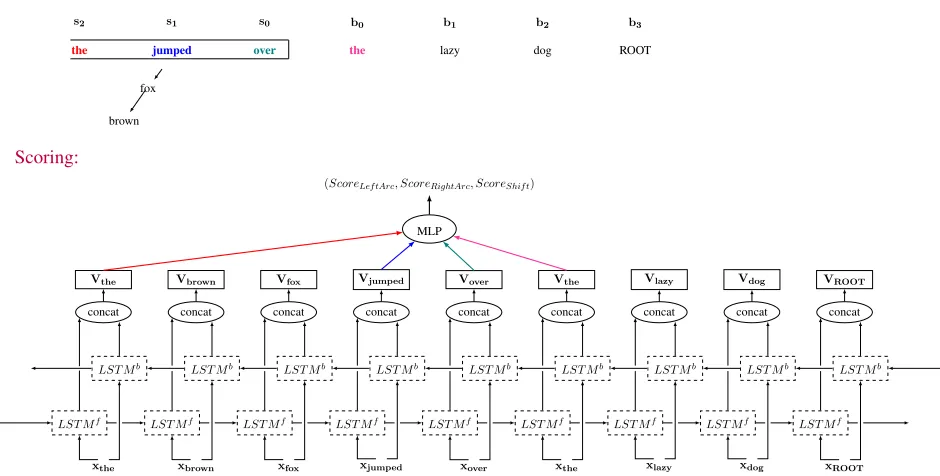
Figure 1: Illustration of the neural model scheme of the transition-based parser when calculating the scores of the possible transitions in a given configuration. The configuration (stack and buffer) is depicted on the top. Each transition is scored using an MLP that is fed the BiLSTM encodings of the first word in the buffer and the three words at the top of the stack (the colors of the words correspond to colors of the MLP inputs above), and a transition is picked greedily. Eachxiis a concatenation of a word and a POS vector, and possibly an additional external embedding vector for the
word. The figure depicts a single-layer BiLSTM, while in practice we use two layers. When parsing a sentence, we iteratively compute scores for all possible transitions and apply the best scoring action until the final configuration is reached.
transition-based parsing framework assumes a tran-sition system, an abstract machine that processes sentences and produces parse trees. The transition system has a set of configurations and a set of tran-sitions which are applied to configurations. When parsing a sentence, the system is initialized to an ini-tial configuration based on the input sentence, and transitions are repeatedly applied to this configura-tion. After a finite number of transitions, the system arrives at a terminal configuration, and a parse tree is read off the terminal configuration. In a greedy parser, a classifier is used to choose the transition to take in each configuration, based on features ex-tracted from the configuration itself. The parsing al-gorithm is presented in Alal-gorithm 1 below.
Given a sentences, the parser is initialized with
the configuration c (line 2). Then, a feature func-tionφ(c) represents the configurationcas a vector,
which is fed to a scoring function SCORE assign-ing scores to (configuration,transition) pairs. SCORE
Algorithm 1Greedy transition-based parsing 1: Input: sentence s = w1, . . . , xw, t1, . . . , tn,
parameterized function SCOREθ(·)with
param-etersθ.
2: c← INITIAL(s)
3: while notTERMINAL(c)do
4: ˆt←arg maxt∈LEGAL(c)SCOREθ φ(c), t
5: c←ˆt(c)
6: returntree(c)
scores the possible transitions t, and the highest
scoring transitionˆtis chosen (line 4). The transition ˆ
tis applied to the configuration, resulting in a new
parser configuration. The process ends when reach-ing a final configuration, from which the resultreach-ing parse tree is read and returned (line 6).
the choice of a transition system, a feature function
φand a scoring function SCORE. Our choices are detailed below.
The Arc-Hybrid System Many transition systems exist in the literature. In this work, we use the arc-hybrid transition system (Kuhlmann et al., 2011), which is similar to the more popular arc-standard system (Nivre, 2004), but for which an efficient dy-namic oracle is available (Goldberg and Nivre, 2012; Goldberg and Nivre, 2013). In the arc-hybrid sys-tem, a configuration c = (σ, β, T) consists of a stackσ, a bufferβ, and a setT of dependency arcs.
Both the stack and the buffer hold integer indices pointing to sentence elements. Given a sentence
s = w1, . . . , wn, t1, . . . , tn, the system is
initial-ized with an empty stack, an empty arc set, and
β = 1, . . . , n,ROOT, whereROOTis the special root index. Any configurationcwith an empty stack and
a buffer containing onlyROOT is terminal, and the parse tree is given by the arc setTc ofc. The
arc-hybrid system allows 3 possible transitions, SHIFT, LEFT`and RIGHT`, defined as:
SHIFT[(σ, b0|β, T)] = (σ|b0, β, T)
LEFT`[(σ|s1|s0, b0|β, T)] = (σ|s1, b0|β, T∪ {(b0, s0, `)})
RIGHT`[(σ|s1|s0, β, T)] = (σ|s1, β, T∪ {(s1, s0, `)})
The SHIFT transition moves the first item of the buffer (b0) to the stack. The LEFT` transition
re-moves the first item on top of the stack (s0) and attaches it as a modifier to b0 with label`, adding the arc(b0, s0, `). The RIGHT` transition removes s0from the stack and attaches it as a modifier to the next item on the stack (s1), adding the arc(s1, s0, `). Scoring Function Traditionally, the scoring func-tion SCOREθ(x, t) is a discriminative linear model
of the form SCOREW(x, t) = (W ·x)[t]. The
lin-earity of SCORE required the feature functionφ(·)
to encode non-linearities in the form of combination features. We follow Chen and Manning (2014) and replace the linear scoring model with an MLP.
SCOREθ(x, t) =M LPθ(x)[t]
Simple Feature Function The feature function
φ(c) is typically complex (see Section 2.1). Our feature function is the concatenated BiLSTM vec-tors of the top 3 items on the stack and the first item on the buffer. I.e., for a configuration c =
(. . .|s2|s1|s0, b0|. . . , T) the feature extractor is defined as:
φ(c) =vs2◦vs1 ◦vs0 ◦vb0 vi =BILSTM(x1:n, i)
This feature function is rather minimal: it takes into account the BiLSTM representations ofs1, s0 andb0, which are the items affected by the possible transitions being scored, as well as one extra stack contexts2.6 Figure 1 depicts transition scoring with our architecture and this feature function. Note that, unlike previous work, this feature functiondoes not take into accountT, the already built structure. The
high parsing accuracies in the experimental sections suggest that the BiLSTM encoding is capable of es-timating a lot of the missing information based on the provided stack and buffer elements and the se-quential content between them.
While not explored in this work, relying on only four word indices for scoring an action re-sults in very compact state signatures, making our proposed feature representation very appeal-ing for use in transition-based parsers that employ dynamic-programming search (Huang and Sagae, 2010; Kuhlmann et al., 2011).
Extended Feature Function One of the benefits of the greedy transition-based parsing framework is precisely its ability to look at arbitrary features from the already built tree. If we allow somewhat less minimal feature function, we could add the BiLSTM vectors corresponding to the right-most and left-most modifiers ofs0,s1 ands2, as well as the left-most modifier ofb0, reaching a total of 11 BiLSTM vectors. We refer to this as theextended feature set. As we’ll see in Section 6, using the extended set does indeed improve parsing accuracies when using pre-trained word embeddings, but has a minimal ef-fect in the fully-supervised case.7
6An additional buffer context is not needed, asb
1is by
def-inition adjacent tob0, a fact that we expect the BiLSTM
en-coding ofb0 to capture. In contrast,b0,s0,s1ands2are not
necessarily adjacent to each other in the original sentence.
7We did not experiment with other feature configurations. It
4.1 Details of the Training Algorithm
The training objective is to set the score of correct transitions above the scores of incorrect transitions. We use a margin-based objective, aiming to maxi-mize the margin between the highest scoring correct action and the highest scoring incorrect action. The hinge lossat each parsing configurationcis defined
as:
max0,1−max
to∈GM LP φ(c)
[to]
+ max
tp∈A\GM LP φ(c)
[tp]
where A is the set of possible transitions and G
is the set of correct (gold) transitions at the cur-rent stage. At each stage of the training process the parser scores the possible transitions A, incurs
a loss, selects a transition to follow, and moves to the next configuration based on it. The local losses are summed throughout the parsing process of a sen-tence, and the parameters are updated with respect to the sum of the losses at sentence boundaries.8 The gradients of the entire network (including the MLP and the BiLSTM) with respect to the sum of the losses are calculated using the backpropagation algorithm. As usual, we perform several training it-erations over the training corpus, shuffling the order of sentences in each iteration.
Error-Exploration and Dynamic Oracle Training We follow Goldberg and Nivre (2013);Goldberg and Nivre (2012) in using error exploration training with a dynamic-oracle, which we briefly describe below.
At each stage in the training process, the parser assigns scores to all the possible transitionst∈A. It
then selects a transition, applies it, and moves to the next step. Which transition should be followed? A common approach follows the highest scoring tran-sition that can lead to the gold tree. However, when training in this way the parser sees only configura-tions that result from following correct acconfigura-tions, and as a result tends to suffer from error propagation at
8To increase gradient stability and training speed, we
simu-late mini-batch updates by only updating the parameters when the sum of local losses contains at least 50 non-zero elements. Sums of fewer elements are carried across sentences. This as-sures us a sufficient number of gradient samples for every up-date thus minimizing the effect of gradient instability.
test time. Instead, in error-exploration training the parser follows the highest scoring action inA
dur-ing traindur-ing even if this action is incorrect, exposdur-ing it to configurations that result from erroneous deci-sions. This strategy requires defining the setGsuch
that the correct actions to take are well-defined also for states that cannot lead to the gold tree. Such a set G is called a dynamic oracle. We perform
error-exploration training using the dynamic-oracle defined by Goldberg and Nivre (2013).
Aggressive Exploration We found that even when using error-exploration, after one iteration the model remembers the training set quite well, and does not make enough errors to make error-exploration effec-tive. In order to expose the parser to more errors, we follow an aggressive-exploration scheme: we sometimes follow incorrect transitions also if they score below correct transitions. Specifically, when the score of the correct transition is greater than that of the wrong transition but the difference is smaller than a margin constant, we chose to follow the incor-rect action with probabilitypagg(we usepagg = 0.1
in our experiments).
Summary The greedy transition-based parser follows standard techniques from the literature (margin-based objective, dynamic oracle training, error exploration, MLP-based non-linear scoring function). We depart from the literature by re-placing the hand-crafted feature function over care-fully selected components of the configuration with a concatenation of BiLSTM representations of a few prominent items on the stack and the buffer, and training the BiLSTM encoder jointly with the rest of the network.
5 Graph-based Parser
Graph-based parsing follows the common structured prediction paradigm (Taskar et al., 2005; McDonald et al., 2005):
predict(s) = arg max
y∈Y(s)
scoreglobal(s, y)
scoreglobal(s, y) = X
part∈y
scorelocal(s, part)
Given an input sentence s (and the corresponding
highest-LST Mf
xthe
concat
LST Mf
xbrown
concat
LST Mf
xfox
concat
LST Mf
xjumped
concat
LST Mf
x∗
concat
LST Mb
s0
LST Mb
s1
LST Mb
s2
LST Mb
s3
LST Mb
s4
Vthe Vbrown Vfox Vjumped V∗
M LP M LP M LP M LP
[image:9.612.121.492.54.262.2]+
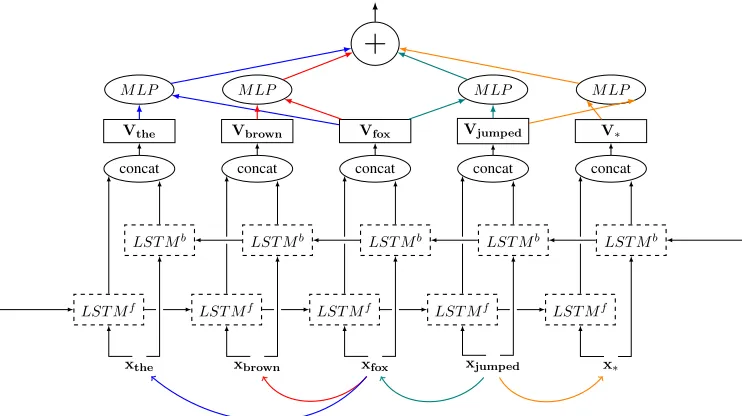
Figure 2: Illustration of the neural model scheme of the graph-based parser when calculating the score of a given parse tree. The parse tree is depicted below the sentence. Each dependency arc in the sentence is scored using an MLP that is fed the BiLSTM encoding of the words at the arc’s end points (the colors of the arcs correspond to colors of the MLP inputs above), and the individual arc scores are summed to produce the final score. All the MLPs share the same parameters. The figure depicts a single-layer BiLSTM, while in practice we use two layers. When parsing a sentence, we compute scores for all possiblen2arcs, and find the best scoring tree using a dynamic-programming algorithm.
scoring parse tree y in the space Y(s) of valid
de-pendency trees overs. In order to make the search
tractable, the scoring function is decomposed to the sum of local scores for each part independently.
In this work, we focus on arc-factored graph based approach presented in McDonald et al. (2005). Arc-factored parsing decomposes the score of a tree to the sum of the score of its head-modifier arcs
(h, m):
parse(s) = arg max
y∈Y(s)
X
(h,m)∈y
score φ(s, h, m)
Given the scores of the arcs the highest scoring pro-jective tree can be efficiently found using Eisner’s decoding algorithm (1996). McDonald et al. and most subsequent work estimate the local score of an arc by a linear model parameterized by a weight vec-torw, and a feature functionφ(s, h, m)assigning a
sparse feature vector for an arc linking modifierm
to headh. We follow Pei et al. (2015) and replace
the linear scoring function with an MLP.
The feature extractor φ(s, h, m) is usually com-plex, involving many elements (see Section 2.1). In contrast, our feature extractor uses merely the BiLSTM encoding of the head word and the
mod-ifier word:
φ(s, h, m) =BIRNN(x1:n, h)◦BIRNN(x1:n, m)
The final model is:
parse(s) = arg max
y∈Y(s)
scoreglobal(s, y)
= arg max
y∈Y(s)
X
(h,m)∈y
score φ(s, h, m)
= arg max
y∈Y(s)
X
(h,m)∈y
M LP(vh◦vm)
vi =BIRNN(x1:n, i)
The architecture is illustrated in Figure 2.
Training The training objective is to set the score function such that correct treey is scored above
in-correct ones. We use a margin-based objective (Mc-Donald et al., 2005; LeCun et al., 2006), aiming to maximize the margin between the score of the gold treey and the highest scoring incorrect treey0. We
max0,1−max
y06=y X
(h,m)∈y0
M LP(vh◦vm)
+ X
(h,m)∈y
M LP(vh◦vm)
Each of the tree scores is then calculated by acti-vating the MLP on the arc representations. The en-tire loss can viewed as the sum of multiple neural networks, which is sub-differentiable. We calculate the gradients of the entire network (including to the BiLSTM encoder and word embeddings).
Labeled Parsing Up to now, we described unbeled parsing. A possible approach for adding la-bels is to score the combination of an unlabeled arc
(h, m)and its label`by considering the label as part
of the arc(h, m, `). This results in|Labels|×|Arcs|
parts that need to be scored, leading to slow parsing speeds and arguably a harder learning problem.
Instead, we chose to first predict the unlabeled structure using the model given above, and then pre-dict the label of each resulting arc. Using this ap-proach, the number of parts stays small, enabling fast parsing.
The labeling of an arc(h, m)is performed using
the same feature representationφ(s, h, m)fed into a
different MLP predictor:
label(h, m) = arg max
`∈labels
M LPLBL(vh◦vm)[`]
As before we use a margin based hinge loss. The la-beler is trained on the gold trees.9 The BiLSTM en-coder responsible for producingvhandvmis shared
with the arc-factored parser: the same BiLSTM en-coder is used in the parer and the labeler. This sharing of parameters can be seen as an instance of multi-task learning (Caruana, 1997). As we show in Section 6, the sharing is effective: training the BiLSTM feature encoder to be good at predicting arc-labels significantly improves the parser’s unla-beled accuracy.
Loss augmented inference In initial experiments, the network learned quickly and overfit the data. In
9When training the labeled parser, we calculate the structure
loss and the labeling loss for each training sentence, and sum the losses prior to computing the gradients.
order to remedy this, we found it useful to useloss augmented inference(Taskar et al., 2005). The in-tuition behind loss augmented inference is to update against trees which have high model scores and are also very wrong. This is done by augmenting the score of each part not belonging to the gold tree by adding a constant to its score. Formally, the loss transforms as follows:
max(0,1 +score(x, y)−
max
y06=y X
part∈y0
(scorelocal(x, part) +1part6∈y))
Speed improvements The arc-factored model re-quires the scoring ofn2 arcs. Scoring is performed
using an MLP with one hidden layer, resulting inn2 matrix-vector multiplications from the input to the hidden layer, and n2 multiplications from the
hid-den to the output layer. The firstn2 multiplications involve larger dimensional input and output vectors, and are the most time consuming. Fortunately, these can be reduced to 2n multiplications and n2 vec-tor additions, by observing that the multiplication
W ·(vh◦vm)can be written asW1·vh+W2·vm
whereW1 andW1 are are the first and second half of the matrixW and reusing the products across
dif-ferent pairs.
Summary The graph-based parser is straight-forward first-order parser, trained with a margin-based hinge-loss and loss-augmented inference. We depart from the literature by replacing the hand-crafted feature function with a concatenation of BiLSTM representations of the head and modifier words, and training the BiLSTM encoder jointly with the structured objective. We also introduce a novel multi-task learning approach for labeled pars-ing by trainpars-ing a second-stage arc-labeler sharpars-ing the same BiLSTM encoder with the unlabeled parser.
6 Experiments and Results
We evaluated our parsing model on English and Chi-nese data. For comparison purposes we follow the setup of Dyer et al. (2015).
System Method Representation Emb PTB-YM PTB-SD CTB UAS UAS LAS UAS LAS This work graph, 1st order 2 BiLSTM vectors – – 93.1 91.0 86.6 85.1 This work transition (greedy, dyn-oracle) 4 BiLSTM vectors – – 93.1 91.0 86.2 85.0 This work transition (greedy, dyn-oracle) 11 BiLSTM vectors – – 93.2 91.2 86.5 84.9 ZhangNivre11 transition (beam) large feature set (sparse) – 92.9 – – 86.0 84.4 Martins13 (TurboParser) graph, 3rd order+ large feature set (sparse) – 92.8 93.1 – – – Pei15 graph, 2nd order large feature set (dense) – 93.0 – – – – Dyer15 transition (greedy) Stack-LSTM + composition – – 92.4 90.0 85.7 84.1 Ballesteros16 transition (greedy, dyn-oracle) Stack-LSTM + composition – – 92.7 90.6 86.1 84.5 This work graph, 1st order 2 BiLSTM vectors YES – 93.0 90.9 86.5 84.9 This work transition (greedy, dyn-oracle) 4 BiLSTM vectors YES – 93.6 91.5 87.4 85.9 This work transition (greedy, dyn-oracle) 11 BiLSTM vectors YES – 93.9 91.9 87.6 86.1 Weiss15 transition (greedy) large feature set (dense) YES – 93.2 91.2 – – Weiss15 transition (beam) large feature set (dense) YES – 94.0 92.0 – – Pei15 graph, 2nd order large feature set (dense) YES 93.3 – – – – Dyer15 transition (greedy) Stack-LSTM + composition YES – 93.1 90.9 87.1 85.5 Ballesteros16 transition (greedy, dyn-oracle) Stack-LSTM + composition YES – 93.6 91.4 87.6 86.2 LeZuidema14 reranking /blend inside-outside recursive net YES 93.1 93.8 91.5 – – Zhu15 reranking /blend recursive conv-net YES 93.8 – – 85.7 –
Table 1:Test-set parsing results of various state-of-the-art parsing systems on the English (PTB) and Chinese (CTB) datasets. The systems that use embeddings may use different pre-trained embeddings. English results use predicted POS tags (different systems use different taggers), while Chinese results use gold POS tags. PTB-YM: English PTB, Yamada and Matsumoto head rules.
PTB-SD: English PTB, Stanford Dependencies (different systems may use different versions of the Stanford converter). CTB: Chinese Treebank.reranking /blendin Method column indicates a reranking system where the reranker score is interpolated with the base-parser’s score. The different systems and the numbers reported from them are taken from: ZhangNivre11: (Zhang and Nivre, 2011); Martins13: (Martins et al., 2013); Weiss15 (Weiss et al., 2015); Pei15: (Pei et al., 2015); Dyer15 (Dyer et al., 2015); Ballesteros16 (Ballesteros et al., 2016); LeZuidema14 (Le and Zuidema, 2014); Zhu15: (Zhu et al., 2015).
same predicted POS-tags as used in Dyer et al. (2015);Chen and Manning (2014). This dataset con-tains a few non-projective trees. Punctuation sym-bols are excluded from the evaluation.
For Chinese, we use the Penn Chinese Treebank 5.1 (CTB5), using the train/test/dev splits of (Zhang and Clark, 2008; Dyer et al., 2015) with gold part-of-speech tags, also following (Dyer et al., 2015; Chen and Manning, 2014).
When using external word embeddings, we also use the same data as Dyer et al. (2015).10
Implementation Details The parsers are imple-mented in python, using the PyCNN toolkit11 for neural network training. The code is available at the github repository https://github.com/ elikip/bist-parser. We use the LSTM vari-ant implemented in PyCNN, and optimize using the Adam optimizer (Kingma and Ba, 2015). Unless otherwise noted, we use the default values provided by PyCNN (e.g. for random initialization, learning rates etc).
10We thank Dyer et al. for sharing their data with us.
11https://github.com/clab/cnn/tree/
master/pycnn
The word and POS embeddings e(wi)ande(pi)
are initialized to random values and trained together with the rest of the parsers’ networks. In some ex-periments, we introduce also pre-trained word em-beddings. In those cases, the vector representa-tion of a word is a concatenarepresenta-tion of its randomly-initialized vector embedding with its pre-trained word vector. Both are tuned during training. We use the same word vectors as in Dyer et al. (2015)
During training, we employ a variant of word dropout(Iyyer et al., 2015), and replace a word with the unknown-word symbol with probability that is inversely proportional to the frequency of the word. A wordwappearing#(w)times in the training cor-pus is replaced with the unknown symbol with prob-abilitypunk(w) = #(wα)+α. If a word was dropped
the external embedding of the word is also dropped with probability0.5.
We train the parsers for up to 30 iterations, and choose the best model according to the UAS accu-racy on the development set.
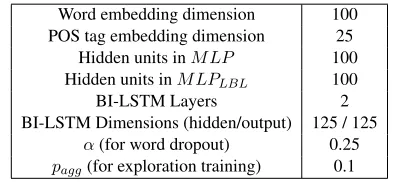
graph-based parser, and use the same hyper-parameters for both parsers. The hyper-parameters of the final net-works used for all the reported experiments are de-tailed in Table 2.
Word embedding dimension 100 POS tag embedding dimension 25
Hidden units inM LP 100 Hidden units inM LPLBL 100
BI-LSTM Layers 2 BI-LSTM Dimensions (hidden/output) 125 / 125
[image:12.612.84.281.118.209.2]α(for word dropout) 0.25 pagg(for exploration training) 0.1
Table 2: Hyper-parameter values used in experiments
Main ResultsTable 1 lists the test-set accuracies of our best parsing models, compared to other state-of-the-art parsers from the literature.12
It is clear that our parsers are very competitive, despite using very simple parsing architectures and minimal feature extractors. When not using external embeddings, the first-order graph-based parser with 2 features outperforms all other systems that are not using external resources, including the third-order TurboParser. The greedy transition based parser with 4 features also matches or outperforms most other parsers, including the beam-based transition parser with heavily engineered features of Zhang and Nivre (2011) and the Stack-LSTM parser of Dyer et al. (2015), as well as the same parser when trained using a dynamic oracle (Ballesteros et al., 2016). Moving from the simple (4 features) to the extended (11 features) feature set leads to some gains in accuracy for both English and Chinese.
Interestingly, when adding external word embed-dings the accuracy of the graph-based parser de-grades. We are not sure why this happens, and leave the exploration of effective semi-supervised parsing with the graph-based model for future work. The greedy parser does manage to benefit from the ex-ternal embeddings, and using them we also see gains from moving from the simple to the extended feature set. Both feature sets result in very competitive
re-12Unfortunately, many papers still report English parsing
results on the deficient Yamada and Matsumoto head rules (PTB-YM) rather than the more modern Stanford-dependencies (PTB-SD). We note that the PTB-YM and PTB-SD results are not strictly comparable, and in our experience the PTB-YM re-sults are usually about half a UAS point higher.
sults, with the extended feature set yielding the best reported results for Chinese, and ranked second for English, after the heavily-tuned beam-based parser of Weiss et al. (2015).
Additional Results We perform some ablation ex-periments in order to quantify the effect of the dif-ferent components on our best models (Table 3).
[image:12.612.338.516.168.263.2]PTB CTB UAS LAS UAS LAS Graph (no ext. emb) 93.3 91.0 87.0 85.4 –POS 92.9 89.8 80.6 76.8 –ArcLabeler 92.7 – 86.2 – –Loss Aug. 81.3 79.4 52.6 51.7 Greedy (ext. emb) 93.8 91.5 87.8 86.0 –POS 93.4 91.2 83.4 81.6 –DynOracle 93.5 91.4 87.5 85.9
Table 3: Ablation experiments results (dev set) for the graph-based parser without external embeddings and the greedy parser with external embeddings and extended feature set.
Loss augmented inference is crucial for the success of the graph-based parser, and the multi-task learn-ing scheme for the arc-labeler contributes nicely to the unlabeled scores. Dynamic oracle training yields nice gains for both English and Chinese.
7 Conclusion
We presented a pleasingly effective approach for feature extraction for dependency parsing based on a BiLSTM encoder that is trained jointly with the parser, and demonstrated its effectiveness by inte-grating it into two simple parsing models: a greedy transition-based parser and a globally optimized first-order graph-based parser, yielding very com-petitive parsing accuracies in both cases.
Acknowledgements This research is supported by the Intel Collaborative Research Institute for Com-putational Intelligence (ICRI-CI) and the Israeli Sci-ence Foundation (grant number 1555/15). We thank Lillian Lee for her important feedback and efforts invested in editing this paper. We also thank the re-viewers for their valuable comments.
References
explo-ration improves a greedy stack-LSTM parser. CoRR, abs/1603.03793.
Rich Caruana. 1997. Multitask learning. Machine Learning, 28:41–75, July.
Danqi Chen and Christopher Manning. 2014. A fast and accurate dependency parser using neural networks. In Proceedings of the 2014 Conference on Empirical Methods in Natural Language Processing (EMNLP), pages 740–750, Doha, Qatar, October. Association for Computational Linguistics.
Jason P.C. Chiu and Eric Nichols. 2016. Named entity recognition with bidirectional LSTM-CNNs. Transac-tions of the Association for Computational Linguistics, 4. To appear.
Kyunghyun Cho. 2015. Natural language under-standing with distributed representation. CoRR, abs/1511.07916.
James Cross and Liang Huang. 2016. Incremental pars-ing with minimal features uspars-ing bi-directional LSTM. InProceedings of the 54th Annual Meeting of the As-sociation for Computational Linguistics, Berlin, Ger-many, August. Association for Computational Lin-guistics.
Marie-Catherine de Marneffe and Christopher D. Man-ning. 2008. Stanford dependencies manual. Techni-cal report, Stanford University.
Chris Dyer, Miguel Ballesteros, Wang Ling, Austin Matthews, and Noah A. Smith. 2015. Transition-based dependency parsing with stack long short-term memory. In Proceedings of the 53rd Annual Meet-ing of the Association for Computational LMeet-inguistics and the 7th International Joint Conference on Natural Language Processing (Volume 1: Long Papers), pages 334–343, Beijing, China, July. Association for Com-putational Linguistics.
Jason Eisner. 1996. Three new probabilistic models for dependency parsing: An exploration. In16th Interna-tional Conference on ComputaInterna-tional Linguistics, Pro-ceedings of the Conference, COLING 1996, Center for Sprogteknologi, Copenhagen, Denmark, August 5-9, 1996, pages 340–345.
Jeffrey L. Elman. 1990. Finding structure in time. Cog-nitive Science, 14(2):179–211.
Yoav Goldberg and Joakim Nivre. 2012. A dynamic ora-cle for arc-eager dependency parsing. InProceedings of COLING 2012, pages 959–976, Mumbai, India, De-cember. The COLING 2012 Organizing Committee. Yoav Goldberg and Joakim Nivre. 2013. Training
deterministic parsers with non-deterministic oracles.
Transactions of the Association for Computational Linguistics, 1:403–414.
Yoav Goldberg. 2015. A primer on neural net-work models for natural language processing. CoRR, abs/1510.00726.
Alex Graves. 2008. Supervised sequence labelling with recurrent neural networks. Ph.D. thesis, Technical University Munich.
Sepp Hochreiter and Jürgen Schmidhuber. 1997. Long short-term memory. Neural Computation, 9(8):1735– 1780.
Liang Huang and Kenji Sagae. 2010. Dynamic pro-gramming for linear-time incremental parsing. In Pro-ceedings of the 48th Annual Meeting of the Associa-tion for ComputaAssocia-tional Linguistics, pages 1077–1086, Uppsala, Sweden, July. Association for Computational Linguistics.
Ozan Irsoy and Claire Cardie. 2014. Opinion mining with deep recurrent neural networks. InProceedings of the 2014 Conference on Empirical Methods in Nat-ural Language Processing (EMNLP), pages 720–728, Doha, Qatar, October. Association for Computational Linguistics.
Mohit Iyyer, Varun Manjunatha, Jordan Boyd-Graber, and Hal Daumé III. 2015. Deep unordered composi-tion rivals syntactic methods for text classificacomposi-tion. In
Proceedings of the 53rd Annual Meeting of the Associ-ation for ComputAssoci-ational Linguistics and the 7th Inter-national Joint Conference on Natural Language Pro-cessing (Volume 1: Long Papers), pages 1681–1691, Beijing, China, July. Association for Computational Linguistics.
Andrej Karpathy, Justin Johnson, and Fei-Fei Li. 2015. Visualizing and understanding recurrent networks.
CoRR, abs/1506.02078.
Diederik P. Kingma and Jimmy Ba. 2015. Adam: A method for stochastic optimization. InProceedings of the 3rd International Conference for Learning Repre-sentations, San Diego, California.
Eliyahu Kiperwasser and Yoav Goldberg. 2016. Easy-first dependency parsing with hierarchical tree LSTMs. Transactions of the Association for Compu-tational Linguistics, 4. To appear.
Terry Koo and Michael Collins. 2010. Efficient third-order dependency parsers. InProceedings of the 48th Annual Meeting of the Association for Computational Linguistics, pages 1–11, Uppsala, Sweden, July. Asso-ciation for Computational Linguistics.
Terry Koo, Xavier Carreras, and Michael Collins. 2008. Simple semi-supervised dependency parsing. In Pro-ceedings of the 46th Annual Meeting of the Associ-ation for ComputAssoci-ational Linguistics, pages 595–603, Columbus, Ohio, June. Association for Computational Linguistics.
Marco Kuhlmann, Carlos Gómez-Rodríguez, and Gior-gio Satta. 2011. Dynamic programming algorithms for transition-based dependency parsers. In Proceed-ings of the 49th Annual Meeting of the Association for Computational Linguistics: Human Language Tech-nologies, pages 673–682, Portland, Oregon, USA, June. Association for Computational Linguistics. Guillaume Lample, Miguel Ballesteros, Sandeep
Subra-manian, Kazuya Kawakami, and Chris Dyer. 2016. Neural architectures for named entity recognition. In
Proceedings of the 2016 Conference of the North American Chapter of the Association for Computa-tional Linguistics: Human Language Technologies, pages 260–270, San Diego, California, June. Associ-ation for ComputAssoci-ational Linguistics.
Phong Le and Willem Zuidema. 2014. The inside-outside recursive neural network model for depen-dency parsing. InProceedings of the 2014 Conference on Empirical Methods in Natural Language Process-ing (EMNLP), pages 729–739, Doha, Qatar, October. Association for Computational Linguistics.
Yann LeCun, Sumit Chopra, Raia Hadsell, Marc’Aurelio Ranzato, and Fu Jie Huang. 2006. A tutorial on energy-based learning.Predicting structured data, 1. Tao Lei, Yu Xin, Yuan Zhang, Regina Barzilay, and
Tommi Jaakkola. 2014. Low-rank tensors for scor-ing dependency structures. In Proceedings of the 52nd Annual Meeting of the Association for Compu-tational Linguistics (Volume 1: Long Papers), pages 1381–1391, Baltimore, Maryland, June. Association for Computational Linguistics.
Mike Lewis, Kenton Lee, and Luke Zettlemoyer. 2016. LSTM CCG parsing. InProceedings of the 2016 Con-ference of the North American Chapter of the Associa-tion for ComputaAssocia-tional Linguistics: Human Language Technologies, pages 221–231, San Diego, California, June. Association for Computational Linguistics. Mitchell P. Marcus, Beatrice Santorini, and Mary Ann
Marcinkiewicz. 1993. Building a large annotated cor-pus of English: The Penn Treebank. Computational Linguistics, 19(2):313–330.
Andre Martins, Noah A. Smith, and Eric Xing. 2009. Concise integer linear programming formulations for dependency parsing. InProceedings of the Joint Con-ference of the 47th Annual Meeting of the ACL and the 4th International Joint Conference on Natural Lan-guage Processing of the AFNLP, pages 342–350, Sun-tec, Singapore, August. Association for Computational Linguistics.
Andre Martins, Miguel Almeida, and Noah A. Smith. 2013. Turning on the turbo: Fast third-order non-projective turbo parsers. In Proceedings of the 51st Annual Meeting of the Association for Computational Linguistics (Volume 2: Short Papers), pages 617–622,
Sofia, Bulgaria, August. Association for Computa-tional Linguistics.
Ryan McDonald, Koby Crammer, and Fernando Pereira. 2005. Online large-margin training of dependency parsers. In Proceedings of the 43rd Annual Meet-ing of the Association for Computational LMeet-inguistics (ACL’05), pages 91–98, Ann Arbor, Michigan, June. Association for Computational Linguistics.
Ryan McDonald. 2006. Discriminative Training and Spanning Tree Algorithms for Dependency Parsing. Ph.D. thesis, University of Pennsylvania.
Joakim Nivre. 2004. Incrementality in deterministic de-pendency parsing. In Frank Keller, Stephen Clark, Matthew Crocker, and Mark Steedman, editors, Pro-ceedings of the ACL Workshop Incremental Parsing: Bringing Engineering and Cognition Together, pages 50–57, Barcelona, Spain, July. Association for Com-putational Linguistics.
Joakim Nivre. 2008. Algorithms for deterministic incre-mental dependency parsing. Computational Linguis-tics, 34(4):513–553.
Wenzhe Pei, Tao Ge, and Baobao Chang. 2015. An ef-fective neural network model for graph-based depen-dency parsing. In Proceedings of the 53rd Annual Meeting of the Association for Computational Linguis-tics and the 7th International Joint Conference on Nat-ural Language Processing (Volume 1: Long Papers), pages 313–322, Beijing, China, July. Association for Computational Linguistics.
Mike Schuster and Kuldip K. Paliwal. 1997. Bidirec-tional recurrent neural networks. IEEE Trans. Signal Processing, 45(11):2673–2681.
Benjamin Taskar, Vassil Chatalbashev, Daphne Koller, and Carlos Guestrin. 2005. Learning structured pre-diction models: A large margin approach. InMachine Learning, Proceedings of the Twenty-Second Interna-tional Conference (ICML 2005), Bonn, Germany, Au-gust 7-11, 2005, pages 896–903.
Hillel Taub-Tabib, Yoav Goldberg, and Amir Glober-son. 2015. Template kernels for dependency pars-ing. In Proceedings of the 2015 Conference of the North American Chapter of the Association for Com-putational Linguistics: Human Language Technolo-gies, pages 1422–1427, Denver, Colorado, May–June. Association for Computational Linguistics.
Ivan Titov and James Henderson. 2007. A latent variable model for generative dependency parsing. In Proceed-ings of the Tenth International Conference on Parsing Technologies, pages 144–155, Prague, Czech Repub-lic, June. Association for Computational Linguistics. Ashish Vaswani, Yonatan Bisk, Kenji Sagae, and Ryan
American Chapter of the Association for Computa-tional Linguistics (Short Papers), San Diego, Califor-nia, June.
Oriol Vinyals, Lukasz Kaiser, Terry Koo, Slav Petrov, Ilya Sutskever, and Geoffrey E. Hinton. 2015. Gram-mar as a foreign language. InAdvances in Neural In-formation Processing Systems 28: Annual Conference on Neural Information Processing Systems 2015, De-cember 7-12, 2015, Montreal, Quebec, Canada, pages 2773–2781.
David Weiss, Chris Alberti, Michael Collins, and Slav Petrov. 2015. Structured training for neural network transition-based parsing. In Proceedings of the 53rd Annual Meeting of the Association for Computational Linguistics and the 7th International Joint Conference on Natural Language Processing (Volume 1: Long Pa-pers), pages 323–333, Beijing, China, July. Associa-tion for ComputaAssocia-tional Linguistics.
Yue Zhang and Stephen Clark. 2008. A tale of two parsers: Investigating and combining graph-based and transition-based dependency parsing. InProceedings of the 2008 Conference on Empirical Methods in Nat-ural Language Processing, pages 562–571, Honolulu, Hawaii, October. Association for Computational Lin-guistics.
Yue Zhang and Joakim Nivre. 2011. Transition-based dependency parsing with rich non-local features. In
Proceedings of the 49th Annual Meeting of the Asso-ciation for Computational Linguistics: Human Lan-guage Technologies, pages 188–193, Portland, Ore-gon, USA, June. Association for Computational Lin-guistics.
Chenxi Zhu, Xipeng Qiu, Xinchi Chen, and Xuanjing Huang. 2015. A re-ranking model for dependency parser with recursive convolutional neural network. In