A case study on using speech-to-translation alignments for language
documentation
Antonios Anastasopoulos
University of Notre Dame
David Chiang
University of Notre Dame
Abstract
For many low-resource or endangered lan-guages, spoken language resources are more likely to be annotated with trans-lations than with transcriptions. Recent work exploits such annotations to produce speech-to-translation alignments, without access to any text transcriptions. We inves-tigate whether providing such information can aid in producing better (mismatched) crowdsourced transcriptions, which in turn could be valuable for training speech recognition systems, and show that they can indeed be beneficial through a small-scale case study as a proof-of-concept. We also present a simple phonetically aware string averaging technique that produces transcriptions of higher quality.
1 Introduction
For many low-resource and endangered lan-guages, speech data is easier to obtain than tex-tual data. The traditional method for documenting a language involves a trained linguist collecting speech and then transcribing it, often at a phonetic level, as most of these languages do not have a writing system. This, however, is a costly and slow process, as it could take up to 1 hour for a trained linguist to transcribe the phonemes of 1 minute of speech (Thi-Ngoc-Diep Do and Castelli, 2014).
Therefore, speech is more likely to be annotated with translations than with transcriptions. This translated speech is a potentially valuable source of information as it will make the collected cor-pus interpretable for future studies. New technolo-gies are being developed to facilitate collection of translations (Bird et al., 2014), and there already exist recent examples of parallel speech collection efforts focused on endangered languages (Blachon et al., 2016; Adda et al., 2016).
Recent work relies on parallel speech in order to create speech-to-translation alignments (Anas-tasopoulos et al., 2016), discover spoken terms (Bansal et al., 2017; Godard et al., 2016), learn a lexicon and translation model (Adams et al., 2016), or directly translate speech (Duong et al., 2016; B´erard et al., 2016). Another line of work (Das et al., 2016; Jyothi and Hasegawa-Johnson, 2015; Liu et al., 2016) focuses on train-ing speech recognition systems for low-resource settings using mismatched crowdsoursed tran-scriptions. These are transcriptions that include some level of noise, as they are crowdsourced from workers unfamiliar with the language being spoken.
We aim to explore whether the quality of crowd-sourced transcriptions could benefit from provid-ing transcribers with speech-to-translation word-level alignments. That way, speech recognition systems trained on the higher-quality probabilistic transcriptions (of at least a sample of the collected data) could be used as part of the pipeline to doc-ument an endangered language.
2 Methodology
As a proof-of-concept, we work on the lan-guage pair Griko-Italian, for which there exists a sentence-aligned parallel corpus of source-language speech and target-language text (Lekakou et al., 2013). Griko is an endangered minority language spoken in the south of Italy. Using the method of Anastasopoulos et al. (2016), we also obtain speech-to-translation word-level alignments.
The corpus that we work on already pro-vides gold-standard transcriptions and speech-to-translation alignments, so it is suitable for con-ducting a case study that will examine the potential effect of providing the alignments on the crowd-sourced transcriptions, as we will be able to com-pare directly against the gold standard.
We randomly sampled 30 utterances from the corpus and collected transcriptions through a sim-ple online interface (described at§3) from 12 dif-ferent participants. None of the participants spoke or had any familiarity with Griko or its directly re-lated language, Greek. Six of the participants were native speakers of Italian, the language in which the translations are provided. Three of them did not speak Italian, but were native Spanish speak-ers, and the last 3 were native English speakers who also did not speak Italian but had some level of familiarity with Spanish.
The 30 utterances amount to 1.5 minutes of
speech, which would potentially require1.5hours
of a trained linguist’s work to phonetically tran-scribe. The gold Griko transcriptions include 191 Griko tokens, with 108 types. Their average length is6.5words, with the shortest being 2 words and
the longest being 14 words.
The utterances were presented to the partici-pants in three different modes:
1. nomode: Only providing the translation text.
2. auto mode: Providing the translation text and the potentially noisy speech-to-translation alignments produced by the method of Anastasopoulos et al. (2016).
3. gold mode: Providing the translation text and the gold-standard speech-to-translation alignments.
The utterances were presented to the partici-pants in the exact same order, but in different modes following a scheme according to the utter-ance id (1 to 30) and the participant id (1 to 12). The first utterance was transcribed by the first par-ticipant under no mode, by the second partici-pant under automode, the third participant un-der goldmode, the fourth participant under no mode, etc. The second utterance was presented to the first participant under auto mode, to the second participant undergoldmode, to the third participant undernomode, etc.
This rotation scheme ensured that the utter-ances were effectively split into 3 subsets, each of which was transcribed exactly 4 times in each mode, with 2 of them by an Italian speaker, 1 time by a Spanish speaker, and 1 time by an English speaker. This enables a direct comparison of the three modes, and, hopefully, an explanation of the
effect of providing the alignments. The modes un-der which each participant had to transcribe the ut-terances changed from one utterance to another, in order to minimize the potential effect of the partic-ipants’ learning of the task and the language better. The participants were asked to produce a tran-scription of the given speech segment, using the Latin alphabet and any pronunciation conventions they wanted. The result in almost all cases is en-tirely comprised of nonsense syllables. It is safe to assume, though, that the participants would use the pronunciation conventions of their native lan-guage; for example, an Italian or Spanish speaker would transcribe the sounds[mu]asmu, whereas an English native speaker would probably tran-scribe it asmoo.
3 Interface
A simple tool for collecting transcriptions first needs to provide the user with the audio to be tran-scribed. The translation of the spoken utterance is provided, as in Figure 1, where in our case the speech to be transcribed was in Griko, and a trans-lation of this segment was provided in Italian. In a real scenario, this translation would correspond to the output of a Speech Recognition system for the parallel speech, so it could potentially be some-what noisy. Though, for the purposes of our case study, we used the gold standard translations of the utterances.
Our interface also provides speech-to-translation alignment information as shown in Figure 2. Each word in the translation has been aligned to some part of the spoken utterance. Apart from listening to the whole utterance at once, the user can also click on the individual translation words and listen to the corresponding speech segment.
For the purposes of our case study, our tool col-lected additional information about its usage. It logged the amount of time each participant spent transcribing each utterance, as well as the amount of times that they clicked the respective buttons in order to listen to either the whole utterance or word-aligned speech segments.
4 Results
Figure 1: Interface that only provides the translation non deve mangiare la sera [he/she shouldn’t eat at night], with no alignment information.
Figure 2: Interface that provides the translationnon deve mangiare la sera[he/she shouldn’t eat at night], along with speech-to-translation alignment information. Clicking on a translation word would play the corresponding aligned part of the speech segment.
Spanish (LDC96S35) and Italian,1 depending on
the native language of the participants, in order to produce phonetic sequences of the crowdsourced transcriptions in IPA.
For simplicity reasons, we merge the vowel op-positions /e∼E/ and /o∼O/ into just /e/ and /o/ for both the Italian and Griko phonetic transcriptions, as neither of the two languages makes an ortho-graphic distinction between the two.
For the transcriptions created by the English-speaking participants, and since most of the word-like units of the transcriptions do not exist in any English pronunciations lexicon, we use the LO-GIOS Lexicon Tool (SpeechLab, 2007) that uses some simple letter-to-sound rules to produce a phonetic transcription in the ARPAbet symbol set. We map several of the English vowel oppositions to a single IPA vowel; for example, IH and IY both become /i/, whileUH andUW become/u/. PhonemesAY,EY, andOYbecome/ai/,/ei/, and /oi/ respectively. This enables a direct compari-son of all the transcriptions, although it might add extra noise, especially in the case of transcriptions produced by English-speaking participants.
1Creating the rules based on (Comrie, 2009)
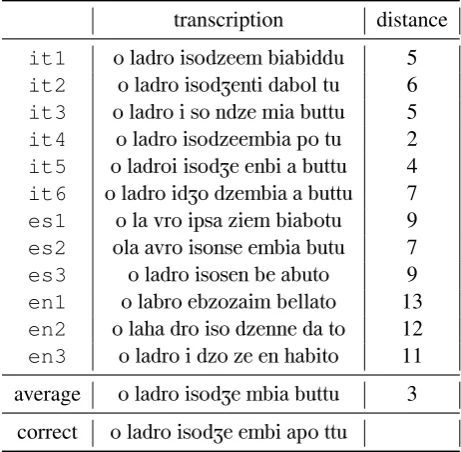
Two examples of the resulting phonetic scriptions as produced by the participants’ tran-scriptions can be found in Tables 1 and 2.
On our analysis of the results, we first focus on the results obtained by the 6 Italian-speaking par-ticipants of our study, which represent the more realistic crowdsourcing scenario where the work-ers speak the language of the translations. We then present the results of the non-Italian speaking par-ticipants. In order to evaluate the transcriptions, we report the Levenshtein distance as well as the average Phone Error Rate (PER)2against the
cor-rect transcriptions.
4.1 Italian-speaking participants
Transcription quality As a first test, we com-pare the Levenshtein distances of the produced transcriptions to the gold ones. For fairness, we remove the accents from the gold Griko transcrip-tions, as well as any accents added by the Italian speaking participants.
The results averaged per utterance set and per mode are shown in Table 3. We first note that
[image:3.595.149.445.201.341.2]participant acoustic transcription distance it1 bau tSerkianta ena furno e tranni e rustiku 9 it2 pau tSerkianta ena furna kanni e rustiku 7 it3 pau tSerkianta na furno kakanni rustiko 5 it4 po Serkieunta na furna ka kanni rustiku 6 it5 pau tSerkeunta en furno ganni rustiku 6 it6 pa u tSerkionta en na furno kahanni rustiko 5 es1 pogurSe kiunta en a furna e kakani e rustiku 12 es2 pao Serkeonta ena furna ka kani rustigo 5 es3 bao tSerke on ta e na furno e kagani e rustiko 6 en1 paoje kallonta e un forno e grane e rustiko 15 en2 pao tSerkeota eno furno e kakarni e rustiko 5 en3 pouSa kianta e a forno e tagani e rustiko 14 average pao tSerkionta ena furno kaanni e rustiku 3
[image:4.595.141.456.63.288.2]correct pao tSerkeonta ena furno ka kanni rustiku
Table 2: Transcriptions for the utterance p`ao cerk`eonta `ena f`urno ka k`anni r`ustiku [I’m looking for a bakery that makes rustic (bread)]and their Levenshtein distance to the gold tran-scription.
the three utterance sets are not equally hard: the first one is the hardest, with the second one being the easiest one to transcribe, as it included slightly shorter sentences. However, in most cases, as well as in the average case (last row of Table 3) pro-viding the alignments improves the transcription quality. In addition, the gold standard alignments provide more accurate information that is also re-flected in higher quality transcriptions.
We also evaluate the precision and recall of the word boundaries (spaces) that the transcriptions denote. We count a discovered word boundary as a correct one only if the word boundary in the tran-scription is matched with a boundary marker in the gold transcription, when we compute the Leven-shtein distance.
Undernomode (without alignments), the tran-scribers achieve 58% recall and 70% precision on correct word boundaries. However, when pro-vided with alignments, they achieve 66% recall and 77% precision; in fact, when provided with gold alignments (under gold mode) recall in-creases to 70% and precision to 81%. Therefore, the speech-to-translation alignments seem to pro-vide information that helped the transcribers to better identify word boundaries, which is arguably hard to achieve from just continuous speech.
Phonetic transcription quality We observe the same pattern when evaluating using the average
PER of these phonetic sequences, as reported in Table 4: the acoustic transcriptions are gener-ally better when alignments are provided. Also, the gold alignments provide more accurate infor-mation, resulting in higher quality transcriptions. However, even using the noisy alignments leads to better transcriptions in most cases.
It is worth noting that out of the 30 utterances, only 4 included words that are shared between Italian and Griko (ancora[yet],ladro[thief], giornale [newspaper], and subito [imme-diately] ) and only 2 of them included common proper names (ValeriaandAnna). The effect of having those common words, therefore, is min-imal.
4.2 Non-Italian speaking participants
The scenario where the crowdsourcers do not even speak the language of the translations is possibly too extreme. It still could be applicable, though, in the case where the language of the translations is not endangered by still low-resource (Tok Pisin, for example) and it’s hard to find annotators that speak the language. In any case, we show that if the participants speak a language related to the translations (and with a similar phonetic inventory, like Spanish in our case) they can still produce de-cent transcriptions.
ex-transcription distance it1 o ladro isodzeem biabiddu 5 it2 o ladro isodZenti dabol tu 6 it3 o ladro i so ndze mia buttu 5 it4 o ladro isodzeembia po tu 2 it5 o ladroi isodZe enbi a buttu 4 it6 o ladro idZo dzembia a buttu 7 es1 o la vro ipsa ziem biabotu 9 es2 ola avro isonse embia butu 7 es3 o ladro isosen be abuto 9 en1 o labro ebzozaim bellato 13 en2 o laha dro iso dzenne da to 12 en3 o ladro i dzo ze en habito 11 average o ladro isodZe mbia buttu 3
correct o ladro isodZe embi apo ttu
Table 1: Transcriptions for the utterance o l`adro `ısoze `embi apo-tt`u [the thief must have entered from here] and their Leven-shtein distance to the gold transcription. The wordladro[thief]is the same in both Griko and Italian.
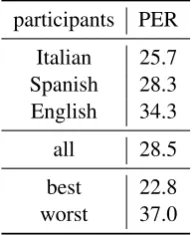
pected, the Italian-speaking participants produced higher quality transcriptions, but the Spanish-speaking participants did not perform much worse. Also in the case of non-Italian speaking par-ticipants, we found that providing speech-to-translation alignments (under auto and gold modes) improves the quality of the transcriptions, as we observed a similar trend as the ones shown in Tables 3 and 4.
The noise in the non-Italian speaker annota-tions, and especially the ones produced by English speakers, can be explained in two ways. One, it could be caused by annotation scheme employed by the English speakers, which must be more com-plicated and noisy, as English does not have a con-crete letter-to-sound system. Or two, it could be explained by the fact that English is much more typologically distant from Griko, meaning, possi-bly, that some of the sounds in Griko just weren’t accessible to English speakers. The latter effect could indeed be real, as it has been shown that a language’s phonotactics can affect what sounds a speaker is actually able to perceive (Peperkamp et al., 1999; Dupoux et al., 2008). The perceptual “illusions” created by one’s language can be quite difficult to overcome.
utterance Levenshtein distance set no auto gold all modes set 1 14.1 13.5 13.9 13.8
set 2 10.0 10.6 8.7 9.8
[image:5.595.71.302.63.289.2]set 3 11.8 10.1 10.5 10.8 average 12.0 11.4 11.0 11.5
Table 3: Breakdown of the quality of the tran-scriptions per utterance set. The value in each cell corresponds to the average Levenshtein distance to the gold transcriptions. Despite the differences in how “hard” each set is, the transcription quality generally improves when alignments are provided, as shown by the average in the last row.
utterance PER
set no auto gold all modes set 1 23.0 25.1 23.8 24.0 set 2 25.8 26.0 23.3 25.0 set 3 32.1 26.0 24.5 28.1
avg 27.0 25.7 24.5 25.7
[image:5.595.309.525.510.610.2]participants PER Italian 25.7 Spanish 28.3 English 34.3 all 28.5 best 22.8 worst 37.0
Table 5: Breakdown of the quality of the transcrip-tions per participant group. As expected, the group of participants that speak the language closest to the target language (Italian) produces better tran-scriptions.
4.3 Overall discussion
From the results, it is clear that the acoustic tran-scriptions are generally better when collected with the alignments provided. Also, the gold align-ments provide more accurate information, result-ing in higher quality transcriptions. However, even using the noisy alignments leads to better tran-scriptions in most cases.
One simple explanation for this finding is that our interface changes when we provide align-ments, giving the participants an easier way to listen to much shorter segments of the speech ut-terance. Therefore, our observations of improved transcriptions might not be caused because of the alignments, but because of the change in the in-terface. This can be tested by comparing results obtained by two interfaces, one that is similar to ours, providing the alignments, and one that also provides the option to play shorter segments of the speech utterance, randomly selected. We leave however this test to be performed in a future study. The results in Tables 3 and 4 are indicative of how, on average, we can collect better transcrip-tions by providing speech-to-translation align-ments. However, we could obtain a better under-standing by comparing the transcription modes on each individual utterance level.
For each utterance we have in total 12 transcrip-tions, 4 for each mode. We therefore have 48 possible combinations of pairs of transcriptions of the same utterance that were performed under a different mode. This means that we can have
48 ×30 = 1440 pairwise comparisons in total
(so that the pairs include only transcriptions of the same utterance). In the overwhelming majority
of these comparisons (73%) the transcriptions ob-tained with alignments provided, were better than the ones obtained without them.
In addition, for the about 380 pairs where the transcription obtained without alignments is better than the one obtained with alignments, the major-ity corresponds to pairs that include a combination of an Italian speaking participant (without align-ments) and a Spanish or English speaking partic-ipant (with alignments). For example, the very meticulous participantit4(who in fact achieves the shortest distance to the gold transcriptions) provides in several cases better transcriptions than almost all English and Spanish speaking partici-pants, even without access to speech-to-translation alignments.
Time It took about 36 minutes on average for the 12 participants to complete the study (shortest was 20 minutes, longest was 64 minutes). This is less time than what trained linguists typically require (Thi-Ngoc-Diep Do and Castelli, 2014), at the expense, naturally, of much higher error rates. At an utterance level, we find that providing the participants with the alignment information does not impact the time required to create the tran-scription. When provided with alignments, the participants listened to the whole utterance about 30% fewer times; instead, they chose to click on and play alignment segments almost as many times as opting to listen to the whole utterance. There was only one participant who rarely chose to play the alignment segment, and in fact the av-erage quality of their transcriptions does not differ across the different modes.
5 Averaging the acoustic transcriptions A fairly simple way to merge several transcrip-tions into one, is to obtain first alignments between the set of strings to be averaged by treating each substitution, insertion, deletion, or match, as an alignment. Then, we can leverage the alignments in order to create an “average” string, through an averaging scheme.
utterances, however, we apply these methods on sequences of phone embeddings.
We map each IPA phone into a feature embed-ding, with boolean features corresponding to lin-guistic features.3 Then, each acoustic
transcrip-tion can be represented as a sequence of vectors, and we can use DBA in order to obtain an “av-erage” sequence, out of a set of sequences. This “average” sequence can be then mapped back to phones, by mapping each vector to the phone that has the closest phone embedding in our space.
The standard method, ROVER (Fiscus, 1997), uses an alignment module and then majority vot-ing to produce a probabilistic final transcription. The string averaging method that we propose here is quite similar, with the exception that our align-ment method and the averaging method are tied together through the iterative procedure of DBA. Another difference is that our method operates on phone embeddings, instead of directly on phones. That way, it is more phonologically informed, so that the distance between two phones that are of-ten confused because they have similar character-istics, such as/p/and/b/, is smaller than the dis-tance between a pair of more distant phones such as eg. /p/ and /a/. In addition, the averaging scheme that we employ actually produces an av-erage of the aligned phone embeddings, which in theory could result in a different output compared to simple majority voting. A more thorough com-parison of ROVER and our averaging method is beyond the scope of this paper and is left as future work.
Using this simple string averaging method we combine the mismatched transcriptions into an “average” one. We can then compute the Leven-shtein distance and PER between the “average” and the gold transcription in order to evaluate them. Examples of “average” transcriptions are also shown in Tables 1 and 2. In almost all cases the “average” transcription is closer to the gold one than each of the individual transcriptions. Ta-ble 6 provides a more detailed analysis of the qual-ity of the “average” transcriptions per mode and per group of participants.
We first use the transcriptions as produced by all participants, and report the errors of the aver-aged outputs under all modes. Again, the tran-scriptions that were produced with alignments
3The features were taken from the inventories ofhttp:
//phoible.org/
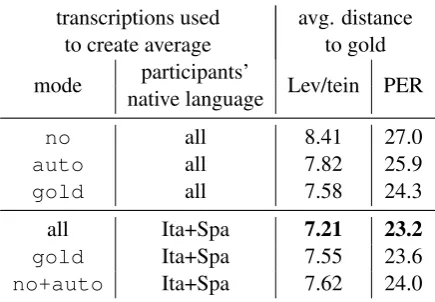
provided, when averaged, have lower error rates. However, thegoldmode corresponds to an ideal scenario, which will hardly ever occur. Thus, we focus more on the combination of the no and automodes, which will very likely occur in our collection efforts, as the alignments we will pro-duce will be noisy, or we might only have transla-tions without alignments. We also limit the input to only include the transcriptions produced by the Italian and Spanish speaking participants, as we found that the transcriptions produced by English speaking participants added more noise instead of helping. As the results in Table 6 show, using our averaging method we obtain better transcriptions on average, even if we limit ourselves to the more realistic scenario of not havinggoldalignments. The best result with an average PER of 23.2 is
achieved using all the transcriptions produced by Italian and Spanish speaking participants. Even without using gold alignments, however, the aver-aging method produces transcriptions that achieve an average PER of 24.0, which is a clear improve-ment over the average PER of the individual tran-scriptions (25.7).
The reason that the “average” transcription is better than the transcriptions used to create it is intuitive. Although all the transcriptions include some level of noise, not all of the transcribers make the same errors. Averaging the produced transcriptions together helps overcome most of the errors, simply because the majority of the partici-pants does not make each individual error. This is, besides, the intuition behind the previous work on using mismatched crowdsourced transcriptions. In addition, one of the bases of the Aikuma ap-proach (Bird, 2010) to language documentation is re-speaking of the original text. Our averag-ing method could potentially also be applied to transcriptions obtained from these re-spoken utter-ances, further improving the quality of the tran-scriptions.
6 Conclusion
transcriptions used avg. distance to create average to gold mode native languageparticipants’ Lev/tein PER
no all 8.41 27.0
auto all 7.82 25.9
gold all 7.58 24.3
all Ita+Spa 7.21 23.2
gold Ita+Spa 7.55 23.6
[image:8.595.72.290.64.215.2]no+auto Ita+Spa 7.62 24.0
Table 6: Average Levenshtein distance and PER of the “average” transcriptions obtained with our string averaging method for different subsets of the crowdsourced transcriptions. The “average” transcriptions have higher quality than the origi-nal ones, especially when obtained from transcrip-tions of participants familiar with languages close to the target language. Providing alignments also improves the resulting “average” transcription.
The combination of the mismatched transcrip-tions into one, using a simple string averaging method, yields even higher quality transcriptions, which could be used as training data for a speech recognition system for the endangered language. In the future, we plan to investigate the use of ROVER for obtaining a probabilistic transcription for the utterance, as well as explore ways to ex-pand our phonologically aware string averaging method so as to produce probabilistic transcrip-tions, and compare the outputs of the two meth-ods.
We plan to consolidate our findings by conduct-ing case studies at a larger scale (collectconduct-ing tran-scriptions through Amazon Turk) and for other language pairs. A larger collection of mismatched transcriptions would also enable us to build speech recognition systems and study how beneficial the improved transcriptions are for the speech recog-nition task.
This work falls within an envisioned pipeline where we first align speech to translations, then crowdsource transcriptions, and last we train an ASR system for the endangered language. How-ever, this is not the only approach we are consider-ing. Another approach could replace crowdsourc-ing with multiple automatic phone recognizers (or even a “universal” one) that would output candi-date phonetic sequences, which we would then
use to train an ASR system. Our main aim is to start a discussion about whether any additional information like the translations or the speech-to-translation alignments contain information that would help a human to interpret an endangered language, and how they could be used alongside the collected parallel speech for documentation ef-forts.
We are also interested on how the annotation in-terfaces could be better designed, in order to fa-cilitate faster and more accurate documentation of endangered languages. For example, our proposed interface, instead of just providing the alignments for each translation word, could also supply the transcriber with additional information, such as other utterance examples that this word has been aligned to. Or we could even attempt to suggest a candidate transcription, based on previous tran-scriptions that the transcriber (or others) have pro-duced. This could potentially further improve the quality of the transcriptions, as providing several examples should improve consistency. Expand-ing our interface, so as to provide such additional information to the transcriber, is also part of our plans for future larger scale case studies.
References
Oliver Adams, Graham Neubig, Trevor Cohn, Steven Bird, Quoc Truong Do, and Satoshi Nakamura. 2016. Learning a lexicon and translation model
from phoneme lattices. In Proc. EMNLP, pages
2377–2382.
Gilles Adda, Sebastian St¨uker, Martine Adda-Decker, Odette Ambouroue, Laurent Besacier, David Bla-chon, H´el`ene Bonneau-Maynard, Pierre Godard, Fa-tima Hamlaoui, Dmitry Idiatov, et al. 2016. Break-ing the unwritten language barrier: The BULB project. Procedia Computer Science, 81:8–14.
Antonios Anastasopoulos, David Chiang, and Long Duong. 2016. An unsupervised probability model for speech-to-translation alignment of low-resource
languages. InProc. EMNLP, pages 1255–1263.
Sameer Bansal, Herman Kamper, Sharon Goldwater, and Adam Lopez. 2017. Weakly supervised spoken term discovery using cross-lingual side information. InProc. ICASSP.
Donald J. Berndt and James Clifford. 1994. Using dynamic time warping to find patterns in time series. InProc. KDD, pages 359–370.
Steven Bird, Lauren Gawne, Katie Gelbart, and Isaac McAlister. 2014. Collecting bilingual audio in
re-mote indigenous communities. InProc. COLING,
pages 1015–1024.
Steven Bird. 2010. A scalable method for
preserv-ing oral literature from small languages. In Proc.
ICADL’10, pages 5–14.
David Blachon, Elodie Gauthier, Laurent Besacier, Guy-No¨el Kouarata, Martine Adda-Decker, and
An-nie Rialland. 2016. Parallel speech collection
for under-resourced language studies using the
Lig-Aikuma mobile device app. Procedia Computer
Sci-ence, 81:61–66.
Bernard Comrie. 2009. The world’s major languages.
Routledge.
Amit Das, Preethi Jyothi, and Mark Hasegawa-Johnson. 2016. Automatic speech recognition using probabilistic transcriptions in swahili, amharic, and dinka. Proc. Interspeech, pages 3524–3528.
Long Duong, Antonios Anastasopoulos, David Chiang, Steven Bird, and Trevor Cohn. 2016. An attentional model for speech translation without transcription. InProc. NAACL-HLT, pages 949–959.
Emmanuel Dupoux, N´uria Sebasti´an-Gall´es, Eduardo Navarrete, and Sharon Peperkamp. 2008. Persistent stress deafness: The case of french learners of span-ish. Cognition, 106(2):682–706.
Jonathan G Fiscus. 1997. A post-processing system to yield reduced word error rates: Recognizer output voting error reduction (rover). InProcc. IEEE Work-shop on Automatic Speech Recognition and Under-standing, pages 347–354.
Pierre Godard, Gilles Adda, Martine Adda-Decker, Alexandre Allauzen, Laurent Besacier, Helene Bonneau-Maynard, Guy-No¨el Kouarata, Kevin L¨oser, Annie Rialland, and Franc¸ois Yvon. 2016. Preliminary experiments on unsupervised word dis-covery in mboshi. InProc. Interspeech.
Preethi Jyothi and Mark Hasegawa-Johnson. 2015. Transcribing continuous speech using mismatched crowdsourcing. InProc. Interspeech.
Marika Lekakou, Valeria Baldiserra, and Antonis Anastasopoulos. 2013. Documentation and analysis of an endangered language: aspects of the grammar of Griko.
Chunxi Liu, Preethi Jyothi, Hao Tang, Vimal Manohar, Rose Sloan, Tyler Kekona, Mark Hasegawa-Johnson, and Sanjeev Khudanpur. 2016. Adapting asr for under-resourced languages using mismatched transcriptions. InProc. ICASSP, pages 5840–5844.
Sharon Peperkamp, Emmanuel Dupoux, and N´uria Sebasti´an-Gall´es. 1999. Perception of stress by
french, spanish, and bilingual subjects. In
Eu-rospeech. Citeseer.
Franc¸ois Petitjean, Alain Ketterlin, and Pierre
Ganc¸arski. 2011. A global averaging method
for dynamic time warping, with applications to clustering.Pattern Recognition, 44(3):678–693.
SpeechLab. 2007. Speech at cmu, logios lexicon tool.
http://www.speech.cs.cmu.edu/tools/lextool.html, Accesed Oct 2016.
Alexis Michaud Thi-Ngoc-Diep Do and Eric Castelli. 2014. Towards the automatic processing of yongn-ing na (sino-tibetan): developyongn-ing a ’light’ acoustic model of the target language and testing ’heavy-weight’ models from five national languages. In
![Figure 1: Interface that only provides the translation non deve mangiare la sera [he/sheshouldn’t eat at night], with no alignment information.](https://thumb-us.123doks.com/thumbv2/123dok_us/1459913.684353/3.595.149.445.201.341/figure-interface-provides-translation-mangiare-sheshouldn-alignment-information.webp)
![Table 2: Transcriptions for the utterance p`ao cerk`eonta `ena f`urno ka k`anni r`ustiku[I’m looking for a bakery that makes rustic (bread)] and their Levenshtein distance to the gold tran-scription.](https://thumb-us.123doks.com/thumbv2/123dok_us/1459913.684353/4.595.141.456.63.288/table-transcriptions-utterance-looking-rustic-levenshtein-distance-scription.webp)